Common Modal Verb Mistakes English Learners Make

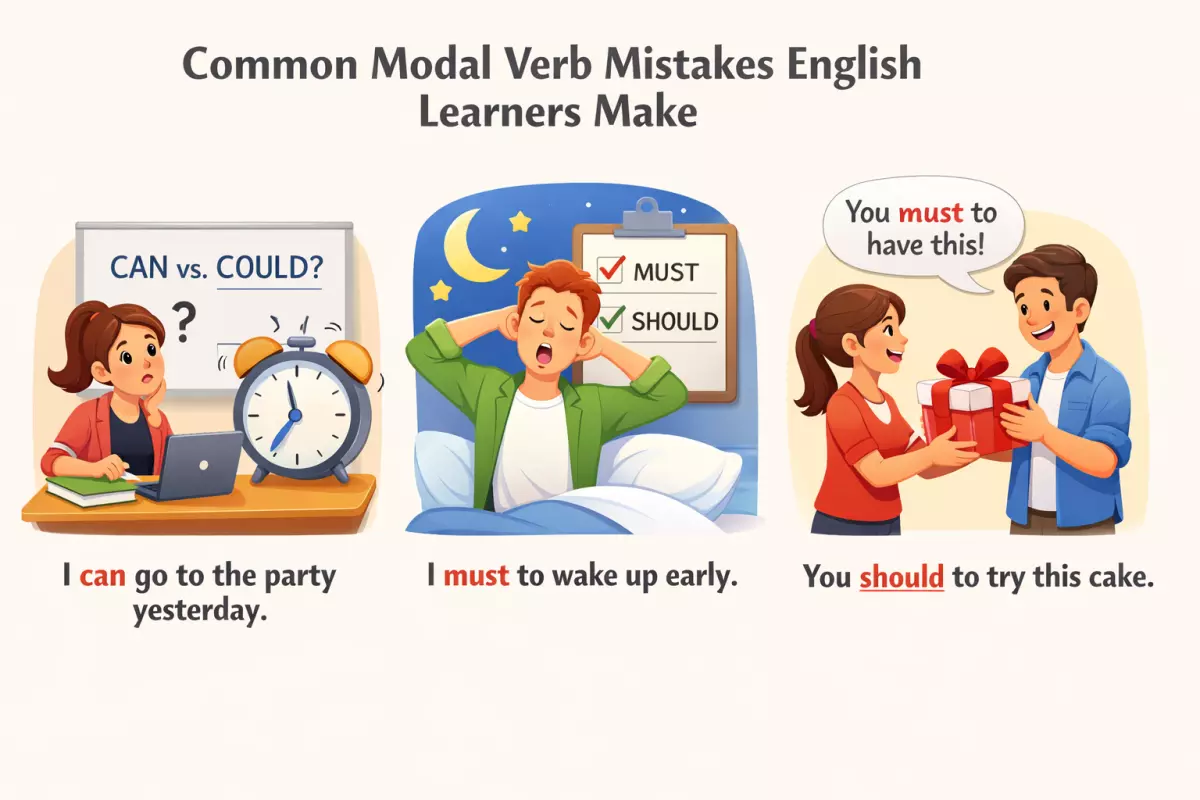 The article explains why modal verbs confuse learners and the typical mistakes from picking the wrong modal or using the wrong verb form after it. It also covers mix-ups like may vs might vs could, errors in negatives and questions, and includes exercises to fix these issues.
- Why modal verbs often cause confusion for English learners
- Typical problems when selecting the wrong modal verb
- Mistakes related to verb forms that follow modal verbs
- Confusion between similar modals such as may, might, and could
- Errors learners make when forming negative modal sentences
- Difficulties using modal verbs correctly in questions
- Exercises and practice activities correcting modal verb mistakes
Small errors with helping verbs like can, must, and should are among the most common slip-ups I hear from learners, even at advanced levels. In real conversations, these small choices affect how polite, confident, or realistic you sound, and they can cause awkward misunderstandings. This article explains the typical problems and shows simple fixes so your meaning comes across clearly and naturally.
Why modal verbs often cause confusion for English learners
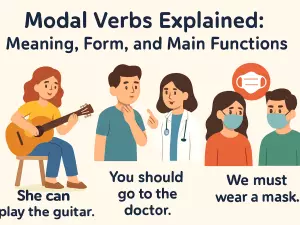
Modal verbs are tricky because they do not behave like most other verbs in English. They change meaning based on context, they follow special grammar rules, and several different modals can express similar ideas (but with different levels of certainty, politeness, or obligation). Learners often know the basic translation, but the usage patterns are what cause mistakes.
What makes modals different from “normal” verbs
- No -s in the third person singular: ❌ He cans swim. → ✅ He can swim.
- No “to” after a modal: ❌ She must to leave. → ✅ She must leave.
- Base verb form after the modal: ❌ They might goes. → ✅ They might go.
- Questions use inversion (no auxiliary “do”): ❌ Do you can drive? → ✅ Can you drive?
- Negatives attach to the modal: ❌ I don’t must go. → ✅ I mustn’t go / I don’t have to go (different meaning).
- Many modals have no infinitive form: you cannot say “to can” or “to must,” so learners must switch to alternatives like “be able to” or “have to.”
- Short answers can be modal-only: “Yes, I can.” / “No, she shouldn’t.” This feels incomplete to many learners.
Meaning overlaps that hide important differences
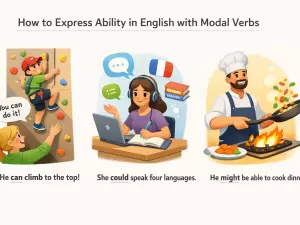
- Ability vs. possibility: “can” can mean skill (I can swim) or general possibility (It can get cold here).
- Permission vs. possibility: “may” can mean permission (May I leave?) or uncertainty (It may rain).
- Advice strength: “should” is softer than “must,” but in some contexts it still sounds quite strong.
- Obligation vs. lack of obligation: “mustn’t” (prohibition) is not the opposite of “must.” The opposite of obligation is usually “don’t have to.”
- Certainty levels: might < may < could (context-dependent) < should (expectation) < must (strong conclusion).
- Politeness levels: “Could you…?” is often more polite than “Can you…?”, even though both ask about ability on the surface.
Time reference is often indirect
- Many modals do not show tense clearly: “must” can refer to present or future depending on context.
- Past meaning often needs a different structure: “could” sometimes means past ability, but “was able to” is often needed for a single completed action.
- Perfect modal forms add another layer: modal + have + past participle changes meaning (deduction, regret, criticism), not just time.
- Reported speech shifts modals: “can” often becomes “could,” “will” becomes “would,” which can look like a meaning change even when it is mainly a reporting pattern.
Common pattern traps learners fall into
- Double modals: ❌ You might can do it. → ✅ You might be able to do it.
- Mixing modal meanings: using “must” when the intended meaning is “probably” (deduction) vs. “have to” (external obligation).
- Overusing one familiar modal: relying on “can” for permission in formal contexts where “may” or “could” is expected.
- Confusing “should” and “have to”: advice (should) vs. requirement (have to).
- Confusing “could” for polite requests vs. past ability: “Could you help?” is not about the past.
- Negative contractions with different meanings: “can’t” (impossible) vs. “mustn’t” (not allowed) vs. “don’t have to” (not necessary).
- Assuming one-to-one translation: many languages use one form where English splits meaning across several modals and semi-modals.
Typical problems when selecting the wrong modal verb

Choosing an unsuitable modal often changes the meaning more than learners expect. The most common issues come from mixing up ability, permission, obligation, advice, probability, and politeness. Paying attention to the speaker’s goal (rule, request, suggestion, guess) helps you select the right verb.
Frequent mix-ups and what they communicate instead
- Ability vs. permission: ❌ “Can I leave early?” (can = ability) → ✅ “May I leave early?” (formal permission) or “Can I leave early?” (common spoken permission).
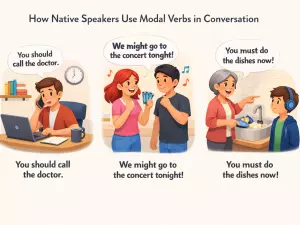
- Strong obligation vs. mild advice: ❌ “You must see a doctor.” (sounds like a rule/command) → ✅ “You should see a doctor.” (recommendation).
- No obligation vs. prohibition: ❌ “You don’t have to park here.” (means it’s optional) → ✅ “You mustn’t park here.” (not allowed).
- Logical conclusion vs. possibility: ❌ “She might be at home; I just saw her car.” (too weak if evidence is strong) → ✅ “She must be at home.” (strong inference).
- Possibility vs. certainty: ❌ “It will rain tomorrow.” (sounds definite) → ✅ “It might/may rain tomorrow.” (uncertain forecast).
- Past ability (general) vs. one successful event: ❌ “I could fix it yesterday.” (often reads as “it was possible”) → ✅ “I was able to fix it yesterday.” (successful result).
- Offers/requests: can vs. would: ❌ “Can you pass the salt?” (fine, but more direct) → ✅ “Could/Would you pass the salt?” (more polite).
- Advice strength: should vs. ought to: ❌ “You ought to be quiet.” (can sound judgmental) → ✅ “You should keep your voice down.” (usually softer).
- Expectation vs. obligation: ❌ “You have to be tired.” (sounds like a rule) → ✅ “You must be tired.” (speaker’s conclusion) or “You’re probably tired.”
- Permission in the past: ❌ “I could go out last night.” (ambiguous: permission or ability) → ✅ “I was allowed to go out last night.” (clear permission).
- Plans/intentions vs. predictions: ❌ “I will meet you at 6” (can sound like a decision made now) → ✅ “I’m meeting you at 6.” (arrangement) or “I’ll meet you at 6.” (decision/promise).
- Polite refusal vs. inability: ❌ “I can’t come” (sounds like it’s impossible) → ✅ “I’m afraid I can’t” or “I won’t be able to” (often softer).
- Rules vs. personal choice: ❌ “You must wear a tie” (sounds like company policy) → ✅ “You should wear a tie” (suggestion) or “You have to wear a tie” (external rule, common in speech).
- Possibility in formal writing: ❌ “This can cause errors.” (can = general ability; sometimes too broad) → ✅ “This may cause errors.” (possibility, more precise).
- Conditional politeness: ❌ “If you will send the file…” (can sound like willingness, not a condition) → ✅ “If you could send the file…” or “If you would send the file…” (polite request/condition).
Quick pattern checks before you choose
- Is it a rule? Use “must” (speaker imposes) or “have to” (external requirement).
- Is it advice? Use “should” (most common) or “could” (gentler suggestion).
- Is it permission? Use “can” (everyday) or “may” (more formal).
- Is it a guess from evidence? Use “must” (strong), “might/may/could” (weaker).
- Is it about the past? For a completed success, prefer “was/were able to”; for permission, prefer “was/were allowed to.”
Mistakes related to verb forms that follow modal verbs
After a modal verb, English normally uses the base form of the main verb (also called the bare infinitive). Many learner errors happen when extra endings (-s, -ed, -ing) or “to” are added where they don’t belong, or when the wrong perfect/continuous form is chosen.
1) Using the wrong verb form after a modal
- ❌ She can goes to the gym. → ✅ She can go to the gym.
- ❌ He must studies more. → ✅ He must study more.
- ❌ They should to call you. → ✅ They should call you.
- ❌ I will to send it tomorrow. → ✅ I will send it tomorrow.
- ❌ We could went earlier. → ✅ We could go earlier.
- ❌ You may taking my seat. → ✅ You may take my seat.
- ❌ She might to be late. → ✅ She might be late.
- ❌ He shall goes now. → ✅ He shall go now.
2) Confusing “modal + be + -ing” with other patterns
To talk about an action in progress (now, around now, or at a specific time), use modal + be + verb-ing. A common mistake is dropping be or using the -ing form directly after the modal.
- ❌ I must working now. → ✅ I must be working now.
- ❌ She may studying at the library. → ✅ She may be studying at the library.
- ❌ They could waiting outside. → ✅ They could be waiting outside.
- ❌ He should be going soon. → ✅ He should be going soon.
3) Mixing up perfect forms: “modal + have + past participle”
When you refer to the past with a modal (possibility, regret, criticism, deduction), the usual structure is modal + have + past participle. Learners often use the simple past after the modal instead.
- ❌ You should went earlier. → ✅ You should have gone earlier.
- ❌ He might forgot the meeting. → ✅ He might have forgotten the meeting.
- ❌ They could arrived by now. → ✅ They could have arrived by now.
- ❌ She must left already. → ✅ She must have left already.
- ❌ I would bought it, but it was expensive. → ✅ I would have bought it, but it was expensive.
4) Double modals and other “extra verb” errors
Standard English uses only one modal in a verb phrase. Another frequent issue is adding an unnecessary auxiliary or repeating the modal idea twice.
- ❌ I will can help you. → ✅ I can help you. / ✅ I will be able to help you.
- ❌ She must to finish today. → ✅ She must finish today.
- ❌ We should must leave now. → ✅ We must leave now. / ✅ We should leave now.
- ❌ He can will do it later. → ✅ He can do it later. / ✅ He will do it later.
5) Quick pattern check
- General rule: modal + base verb (can go, should study, might see).
- In progress: modal + be + -ing (must be working, may be waiting).
- Past reference: modal + have + past participle (should have gone, might have forgotten).
- Passive: modal + be + past participle (must be done, can be seen).
- No “to” after core modals: can, could, may, might, must, shall, should, will, would (but “have to / be able to / ought to” are different patterns).
Confusion between similar modals such as may, might, and could
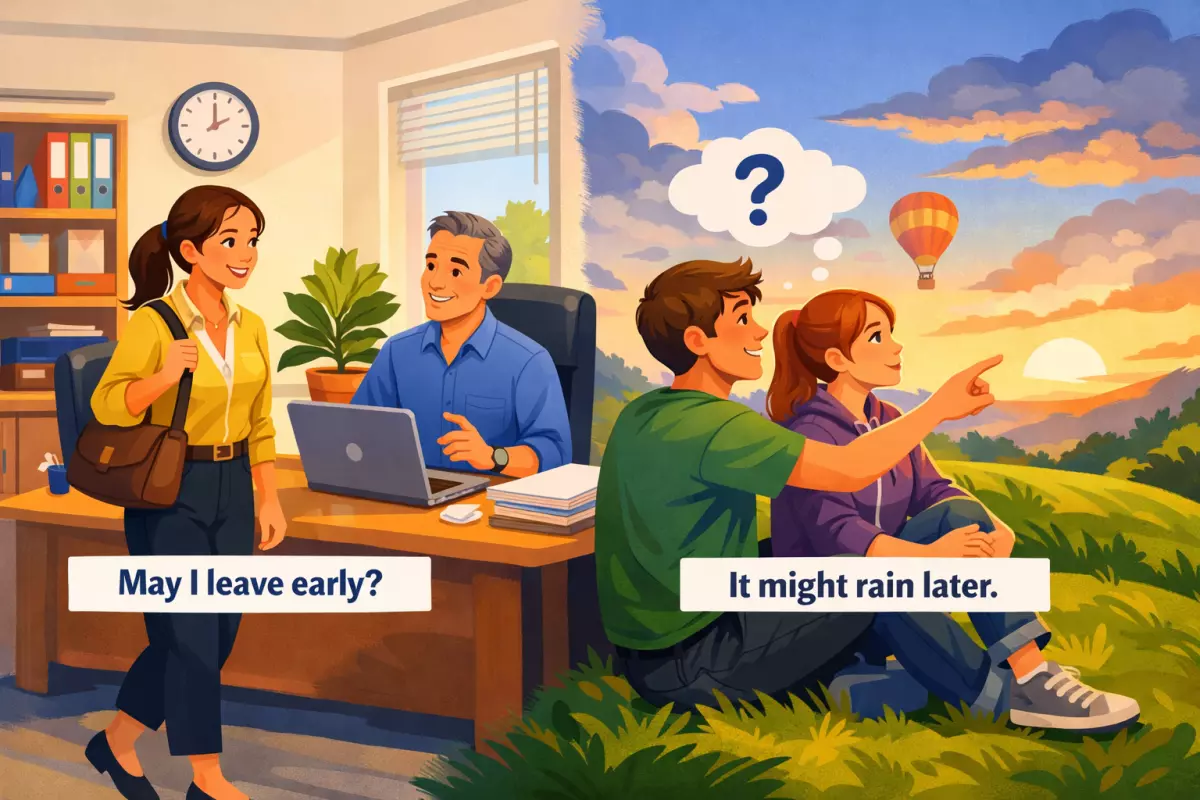
Learners often mix these modals because all three can express possibility. The key is to choose based on (1) how certain the speaker is, (2) whether you mean “permission” or “possibility,” and (3) whether you are talking about a real ability/option rather than a guess.
| Modal | Main meaning(s) | Typical use | Example |
|---|---|---|---|
| may | Possibility; permission (more formal) | Polite/formal permission; neutral possibility in careful writing | May I leave early? |
| might | Possibility (often weaker/more uncertain) | Hedging, cautious guesses, “not sure” predictions | It might rain later. |
| could | Possibility; ability (past/general); options/suggestions | Possible outcomes; available choices; polite requests | We could take the train. |
| may not / might not / couldn’t | Negative possibility vs. “not possible” | Distinguish “maybe not” from “impossible” | She may not agree. / She couldn’t agree (it’s impossible). |
Common mix-ups and the patterns that fix them
- ❌ “Could I go to the bathroom?” (not wrong, but sometimes the speaker intends formal permission) → ✅ “May I go to the bathroom?” (more formal/teacher-style permission)
- ❌ “I may come to the party, but I’m not sure.” (possible, but can sound more formal than intended) → ✅ “I might come to the party.” (clear uncertainty)
- ❌ “It could be true” when you mean a cautious guess → ✅ “It might be true.” (more hedged)
- ❌ “He might speak French” when you mean ability → ✅ “He can speak French.” / “He could speak French when he was a child.”
- ❌ “You may try restarting your phone.” (sounds like permission) → ✅ “You could try restarting your phone.” (suggestion/option)
- ❌ “I might help you tomorrow” when you mean willingness/plan → ✅ “I can help you tomorrow.” (availability) or “I will help you tomorrow.” (decision)
- ❌ “It may not be possible” when you mean “impossible” → ✅ “It can’t be done.” / “It couldn’t be done.”
- ❌ “She couldn’t be at home” when you mean “maybe she isn’t” → ✅ “She may not be at home.” / “She might not be at home.”
- ❌ “Could you open the window?” interpreted as ability by some learners → ✅ Understand it as a polite request (not a real question about ability).
- ❌ “May you help me?” (uncommon in modern requests) → ✅ “Could you help me?” / “Can you help me?”
- ❌ “It might be 30 degrees tomorrow” in a confident forecast → ✅ “It may be 30 degrees tomorrow.” (more neutral) or “It will be…” (confident)
- ❌ “We may go by taxi” when you’re presenting a choice → ✅ “We could go by taxi.” (one option among others)
Quick decision guide
- Use may for permission in formal situations: “May I…?” “You may…”
- Use might for a weaker possibility or when you want to sound cautious: “I might…” “It might…”
- Use could for options and suggestions, or general possibility among several outcomes: “We could…” “It could…”
- In negatives, separate “maybe not” from “not possible”:
- “may not / might not” = possibly not true
- “can’t / couldn’t” = not possible / logically impossible
Useful sentence frames to practice
- Possibility (neutral): “It may + base verb…”
- Possibility (hedged): “It might + base verb…”
- Possible explanation: “It could be + noun/adjective…”
- Permission request (formal): “May I + base verb…?”
- Polite request: “Could you + base verb…?”
- Suggestion: “We could + base verb…”
Errors learners make when forming negative modal sentences
Negative modal sentences follow a small set of fixed patterns, so most problems come from adding extra auxiliaries, putting not in the wrong place, or mixing rules from other verb types. The key is to remember that modals (can, could, may, might, must, should, would, etc.) behave differently from main verbs and from “be.”
Common pattern problems (with fixes)
- Adding “do/does/did” with a modal
❌ I don’t can swim. → ✅ I can’t swim.
❌ She didn’t should go. → ✅ She shouldn’t go. - Using two modals together (standard English normally allows only one modal)
❌ You must can finish today. → ✅ You must be able to finish today.
❌ He will can come later. → ✅ He will be able to come later. - Putting “not” after the main verb
❌ You can go not. → ✅ You can’t go.
❌ She should tell not him. → ✅ She shouldn’t tell him. - Forgetting the base verb after the modal (no -s, no -ed, no -ing after the modal)
❌ He can’t goes. → ✅ He can’t go.
❌ They shouldn’t went. → ✅ They shouldn’t go. - Using “to” after a modal (most modals are followed by the bare infinitive)
❌ I can’t to attend. → ✅ I can’t attend.
❌ You shouldn’t to worry. → ✅ You shouldn’t worry. - Mixing up modal negatives with “be” negatives
❌ He isn’t can drive. → ✅ He can’t drive.
❌ They aren’t should stay. → ✅ They shouldn’t stay. - Wrong contraction form or spacing
❌ can not (when you mean the usual negative) → ✅ cannot / can’t (cannot is standard; “can not” is usually for emphasis or contrast)
❌ wont / wouldnt → ✅ won’t / wouldn’t - Confusing “mustn’t” and “don’t have to” (different meanings)
❌ You mustn’t pay. (if you mean it’s optional) → ✅ You don’t have to pay.
✅ You mustn’t park here. (prohibited) is correct when something is not allowed. - Using “mayn’t” in contexts where it sounds unnatural (rare in modern usage)
❌ You mayn’t enter. → ✅ You may not enter. / You can’t enter. / You’re not allowed to enter. - Using “must not” when you mean “probably not”
❌ He must not be home. (often sounds like prohibition) → ✅ He can’t be home. / He must not be home (only if context clearly means “I conclude he isn’t”). - Negating the wrong part with “not” (scope mistakes)
- ❌ You don’t must tell anyone. → ✅ You mustn’t tell anyone. (prohibition)
❌ I can’t hardly hear you. → ✅ I can hardly hear you. / I can’t hear you well. (avoid double negatives unless dialect/style requires them) - Using “not” with semi-modals without the right auxiliary
With have to, use do-support: ✅ I don’t have to go. (not “I haven’t to go” in most modern American English)
With be able to, negate “be”: ✅ I’m not able to go. / I won’t be able to go. - Making questions from negative modals incorrectly (word order stays modal + subject)
❌ Do you can’t come? → ✅ Can’t you come?
❌ Did she shouldn’t call? → ✅ Shouldn’t she call?
Reliable formation rule to memorize
- Modal + not + base verb: cannot/can’t go, should not/shouldn’t worry, might not work, mustn’t touch.
- No “do” with true modals: say “He can’t…” not “He doesn’t can…”.
- After the modal, keep the verb in base form: can’t go, shouldn’t say, might not arrive.
Difficulties using modal verbs correctly in questions
Questions with modal verbs follow a tight word order. Most errors come from adding extra auxiliaries, putting the subject in the wrong place, or mixing up modal meanings (ability, permission, obligation, possibility). The good news is that the patterns are consistent once you know what to look for.
Core word order patterns
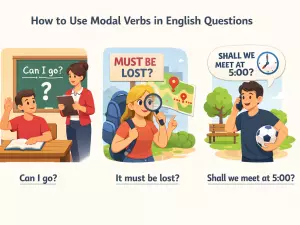
- Yes/No questions: Modal + subject + base verb (+ rest). Example: “Can you swim?” “Should we leave now?”
- Wh- questions: Wh-word + modal + subject + base verb (+ rest). Example: “Where should I park?” “Why might they be late?”
- Tag questions: Statement + comma + modal + subject pronoun. Example: “You can drive, can’t you?”
- Short answers: Yes/No + subject + modal. Example: “Yes, I can.” “No, she shouldn’t.”
Common mistakes and how to fix them
- ❌ “Do you can help?” → ✅ “Can you help?” (Don’t add do/does/did before a modal.)
- ❌ “Did he should call?” → ✅ “Should he call?” / “Did he call?” (Use either a modal or did, not both.)
- ❌ “Can he to come?” → ✅ “Can he come?” (After a modal, use the base verb without to.)
- ❌ “May you to open the window?” → ✅ “May you open the window?”
- ❌ “Must we to pay now?” → ✅ “Must we pay now?”
- ❌ “Where you can buy it?” → ✅ “Where can you buy it?” (In questions, the modal comes before the subject.)
- ❌ “Why she should apologize?” → ✅ “Why should she apologize?”
- ❌ “What can means this?” → ✅ “What can this mean?” (Keep the main verb in base form; don’t add -s.)
- ❌ “Can you helping me?” → ✅ “Can you help me?” (Modal + base verb; use -ing only in special structures like “What should I be doing?”)
- ❌ “Could you to send it?” → ✅ “Could you send it?”
- ❌ “Shouldn’t to we wait?” → ✅ “Shouldn’t we wait?” (Negative modal stays together: shouldn’t, can’t, won’t.)
- ❌ “Can not you come?” → ✅ “Can’t you come?” / “Can you not come?” (Contraction is most common; “Can you not…?” is more formal or emphatic.)
- ❌ “Mustn’t we leave now?” (when you mean obligation) → ✅ “Must we leave now?” (In many varieties, mustn’t suggests prohibition, not necessity.)
- ❌ “May I can go?” → ✅ “May I go?” / “Can I go?” (Use one modal; don’t stack modals.)
- ❌ “Will you could help?” → ✅ “Will you help?” / “Could you help?”
- ❌ “Can you please to check?” → ✅ “Can you please check?”
Meaning traps that affect question choice
- Permission: “Can I…?” is common and informal; “May I…?” is more formal. Avoid “Must I…?” unless you mean “Is it necessary?”
- Obligation vs. advice: “Must I…?” asks about necessity; “Should I…?” asks for advice.
- Politeness: “Could you…?” and “Would you…?” are often softer than “Can you…?” in requests.
- Possibility: “Could it be…?” suggests uncertainty; “Can it be…?” can sound more like disbelief in some contexts.
When you build a question, check two things: the modal is placed before the subject, and the verb after it stays in the base form. If you do those consistently, most modal-question errors disappear.
Exercises and practice activities correcting modal verb mistakes
Use the activities below to build accurate patterns with modal verbs. Focus on three checks as you work: (1) whether the modal is the right meaning (ability, advice, obligation, possibility), (2) whether the form after the modal is correct (base verb, not to or an -ing form), and (3) whether the time reference is clear (present vs. past: have + past participle).
1) Spot-and-fix (quick diagnosis)
Correct each sentence. Keep the original meaning unless it is impossible; then choose the closest natural meaning.
- He can to drive very well.
- You must to wear a helmet here.
- I should to call my teacher today.
- She can sings beautifully.
- They might going to be late.
- We don’t must pay now.
- Do you can help me with this?
- He didn’t can come yesterday.
- I mustn’t to forget my passport.
- You should not to speak during the exam.
- It may rains later.
- We could went earlier, but we stayed.
Show answers
- He can drive very well.
- You must wear a helmet here.
- I should call my teacher today.
- She can sing beautifully.
- They might be late. / They might be going to be late. (less common, but possible in context)
- We don’t have to pay now. / We mustn’t pay now. (meaning changes: no obligation vs. prohibition)
- Can you help me with this?
- He couldn’t come yesterday.
- I mustn’t forget my passport.
- You should not speak during the exam.
- It may rain later.
- We could have gone earlier, but we stayed.
2) Choose the best modal (meaning first)
Select the best option for each blank. Pay attention to strength (strong obligation vs. advice) and certainty (possible vs. likely).
- You ________ see a doctor if the pain continues. (should / must)
- Visitors ________ park here; it’s for staff only. (mustn’t / don’t have to)
- I’m not sure, but it ________ be in my bag. (might / must)
- We ________ leave now or we’ll miss the train. (should / have to)
- He ________ speak three languages when he was six. (could / can)
- You ________ pay in cash; card is fine too. (don’t have to / mustn’t)
- She ________ be at work already; her car is gone. (might / must)
- Students ________ submit the form by Friday. (have to / might)
- It’s optional: you ________ join the meeting if you’re busy. (don’t have to / must)
- He ________ be tired; he slept only two hours. (must / may)
Show answers
- should
- mustn’t
- might
- have to
- could
- don’t have to
- must
- have to
- don’t have to
- must
3) Past modals practice (missed chances, deductions, and regrets)
Rewrite each sentence using the modal given. Use have + past participle where needed.
- I’m sure she forgot. (must) → She ________ ________ ________.
- It was a bad idea to drive so fast. (shouldn’t) → You ________ ________ ________ so fast.
- It’s possible they missed the bus. (might) → They ________ ________ ________ the bus.
- It wasn’t necessary to bring food; there was plenty. (didn’t have to) → We ________ ________ ________ bring food.
- He was able to finish early (past ability in one situation). (managed to) → He ________ ________ finish early.
- We had the option to leave earlier, but we didn’t. (could) → We ________ ________ ________ earlier.
- I’m sure you left your keys at home. (must) → You ________ ________ ________ your keys at home.
- It was a good idea to email them first. (should) → You ________ ________ ________ them first.
Show answers
- She must have forgotten.
- You shouldn’t have driven so fast.
- They might have missed the bus.
- We didn’t have to bring food.
- He managed to finish early.
- We could have left earlier.
- You must have left your keys at home.
- You should have emailed them first.
4) Pattern drills (build automatic accuracy)
- Modal + base verb: can go, should call, might happen, must leave (not: can to go / should to call).
- Negative: can’t go, shouldn’t call, mustn’t park, might not happen (not: don’t must).
- Questions: Can you…? Should we…? Might it…? (not: Do you can…?).
- Past possibility/deduction: might have + past participle, must have + past participle.
- Past criticism/regret: should have / shouldn’t have + past participle.
- No obligation: don’t have to / didn’t have to (not: mustn’t, unless you mean prohibition).
- Ability: can (now), could (general past), was/were able to (specific past success).
- Polite requests: Could you…? Would you…? (often softer than Can you…?).
- Offers: Shall I…? Can I…? Would you like me to…?
- Advice strength: should (advice) vs. have to/must (obligation).
- Certainty scale: might (possible) → may (possible/formal) → must (very likely deduction).
- Future intention: be going to (not a modal): I’m going to leave soon (not: might going to).
5) Mini-production tasks (use modals in context)
Write short answers (1–2 sentences each). Try to use at least one modal per item and keep the meaning precise.
- Give advice to a friend who can’t sleep well.
- Explain a rule in a library using a prohibition.
- Say something you’re not required to do at work this week.
- Make a deduction about why your classmate is absent (high probability).
- Express a past regret about missing an appointment.
- Make a polite request to borrow someone’s charger.