How Modal Verbs Change the Meaning of Sentences

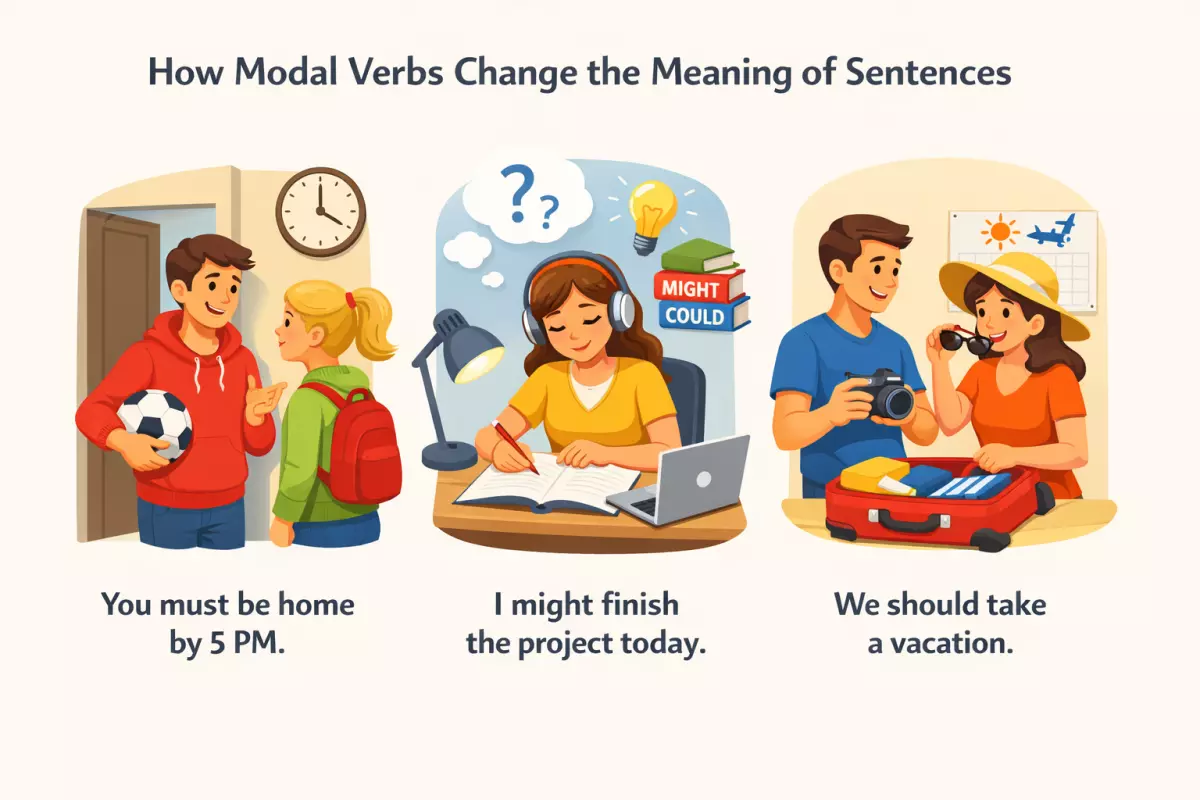 This article explains how modal verbs can drastically shift meaning, letting the same sentence show certainty, obligation, or possibility. It shows how context, tone, and goals change interpretation, and includes practice exercises rewriting sentences with different modals.
- Why modal verbs dramatically change the meaning of a statement
- How the same sentence can express different attitudes with different modals
- Examples showing how certainty, obligation, or possibility changes meaning
- How context influences the interpretation of modal verbs
- Situations where a small modal change alters the speaker's intention
- How tone and communication goals affect modal choice
- Exercises and practice activities rewriting sentences with different modal verbs
Small helper words like can, must, and might can change a sentence’s meaning in an instant. In everyday conversation, they show ability, permission, obligation, advice, or possibility, and they also affect tone, making you sound firm, polite, or unsure. Noticing these differences helps you understand others more accurately and choose your own words with greater control.
Why modal verbs dramatically change the meaning of a statement
Modal verbs don’t just add extra words; they change the speaker’s stance. With one modal, a sentence can shift from a simple fact to a request, a rule, a prediction, a refusal, or a cautious guess. This happens because modals encode meanings like obligation, permission, ability, probability, and willingness—often without changing the main verb at all.
What modals “do” to a sentence
- They change certainty: the same idea can sound definite, likely, possible, or doubtful.
- They change force: a statement can become advice, a command, or a soft suggestion.
- They change social tone: modals help you sound polite, firm, hesitant, or authoritative.
- They change time reference: many modals point to present/future, but modal + perfect forms can point to the past.
- They change responsibility: modals can imply duty (“must”), external rules (“have to”), or personal choice (“can”).
Common meaning shifts (with patterns you can reuse)
| Meaning shift | Typical modal pattern | Example |
|---|---|---|
| Ability / skill | can + base verb | She can swim. |
| Permission | can / may + base verb | You may leave early. |
| Obligation (strong) | must + base verb | You must wear a helmet. |
| Obligation (rule/necessity) | have to + base verb | I have to submit the form today. |
| Advice | should + base verb | You should back up your files. |
| Possibility | might / may / could + base verb | It might rain later. |
| Expectation / probability | should + base verb | The package should arrive tomorrow. |
| Prediction / strong likelihood | will + base verb | Prices will rise next year. |
| Willingness / refusal | will / won’t + base verb | He won’t answer my calls. |
| Request (polite) | could / would + base verb | Could you open the window? |
| Past deduction | must have + past participle | They must have missed the train. |
| Past possibility | might have / could have + past participle | She might have forgotten. |
Usage patterns that cause the biggest meaning changes
- Modal choice changes the “strength”: compare “It can be true” (general possibility) vs. “It must be true” (strong conclusion) vs. “It might be true” (uncertain).
- Negative modals flip the logic: “You must go” (required) vs. “You mustn’t go” (forbidden). This is not the same as “You don’t have to go” (not required).
- Questions with modals change function: “Can you…?” often asks for help, while “May I…?” asks for permission, and “Would you…?” sounds more formal or polite.
- Modal + perfect changes time and interpretation: “She must be tired” (present deduction) vs. “She must have been tired” (past deduction).
- Context decides the reading: “You can’t be serious” is usually a judgment (impossibility), not a statement about ability.
Quick accuracy checks
- ✅ Use a base verb after most modals: “She can drive.” ❌ not “can drives.”
- ✅ Use “to” after “have to/need to/ought to”: “I have to leave.”
- ✅ Use perfect forms for past guesses: “They might have left.”
- ✅ Distinguish prohibition vs. lack of necessity: “mustn’t” → forbidden; “don’t have to” → optional.
How the same sentence can express different attitudes with different modals
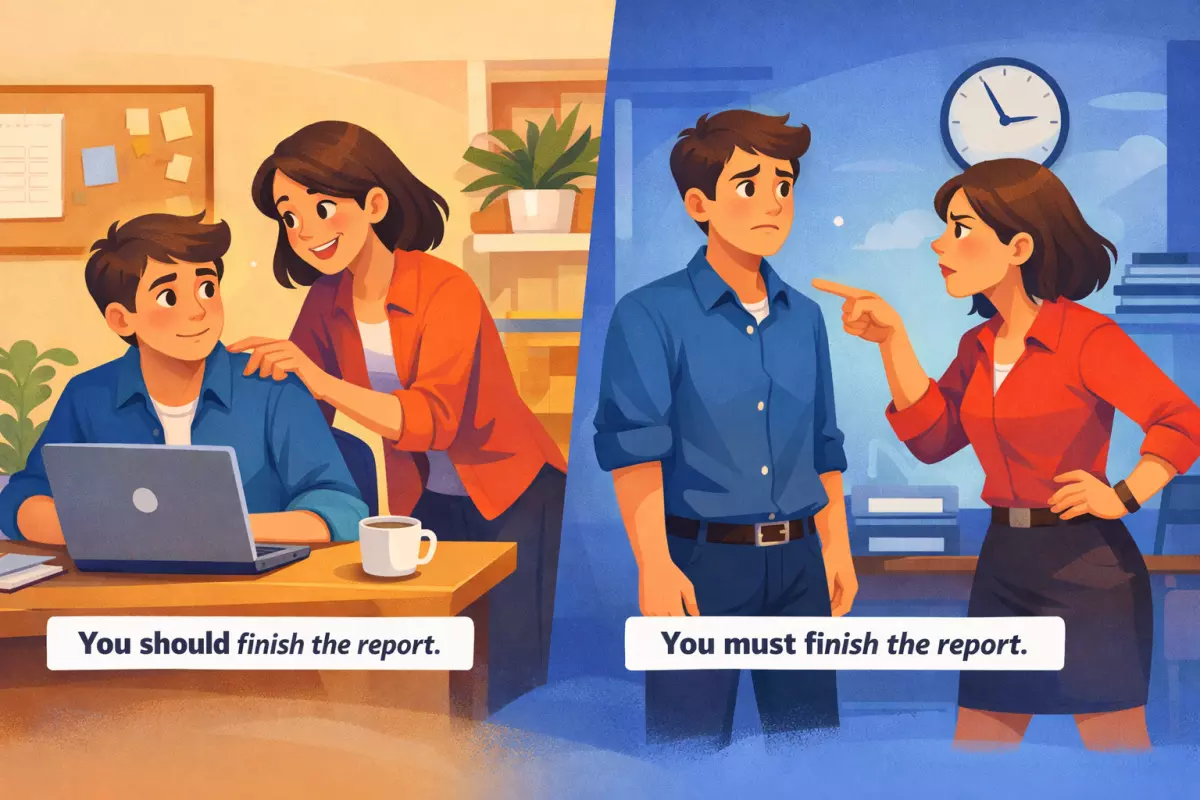
Changing only the modal verb can shift a sentence from advice to obligation, from a neutral guess to a confident conclusion, or from permission to a firm refusal. The main clause often stays the same, but the speaker’s stance changes: how sure they are, how strong the pressure is, or how polite the request sounds.
One base idea, different “speaker positions”
A useful pattern is to keep the same main verb and object, then swap the modal to see what attitude is added. Notice how modals typically signal one of these meanings: necessity, possibility, permission, ability, advice, or expectation.
| Same base sentence | Modal choice | Attitude / implied meaning |
|---|---|---|
| You ____ submit the form today. | must | Strong obligation; speaker treats it as required. |
| You ____ submit the form today. | have to | External requirement (rule, deadline); less “speaker-imposed” than must. |
| You ____ submit the form today. | should | Recommendation; expected or sensible, but not strictly required. |
| You ____ submit the form today. | might | Weak suggestion or tentative possibility; leaves room to choose otherwise. |
| You ____ submit the form today. | can | Permission/option is available (or general possibility, depending on context). |
| You ____ submit the form today. | may | More formal permission; can sound like an official allowance. |
| You ____ submit the form today. | needn’t | No necessity; it is not required (but it may still be allowed). |
| You ____ submit the form today. | mustn’t | Prohibition; it is not allowed (stronger than “shouldn’t”). |
| She ____ be at work already. | must | Confident logical conclusion (deduction), not obligation. |
| She ____ be at work already. | might | Uncertain guess; speaker is not confident. |
| She ____ be at work already. | can’t | Strong negative deduction: speaker thinks it’s impossible. |
| ____ you open the window? | Can | Common request; neutral and direct. |
| ____ you open the window? | Could | More polite/indirect request; softens the demand. |
| ____ you open the window? | Would | Polite request focusing on willingness; often sounds smoother in service contexts. |
| I ____ help you with that. | can | Ability/availability; “I’m able to.” |
| I ____ help you with that. | will | Willingness/decision; “I’m choosing to.” |
| I ____ help you with that. | could | Conditional/limited offer or a tentative suggestion; less forceful than can/will. |
| I ____ help you with that. | should | Sense of duty; speaker feels it’s the right thing to do. |
Patterns to watch when swapping modals
- Same words, different function: must can express obligation (You must leave) or deduction (He must be tired). Context decides which attitude is intended.
- Strength scale: modals often form a “force” ladder: might (weak) → may/can (possible/allowed) → should (advisable) → must/have to (required).
- Politeness through distance: past-form modals like could and would often make requests sound less blunt than can and will.
- Negative meanings are not symmetrical: mustn’t = prohibition, while don’t have to / needn’t = no obligation. Mixing them changes the attitude completely.
- Permission vs. ability: can can mean “is able to” or “is allowed to.” If the sentence could be read both ways, add context (At this office, you can park here).
- Advice vs. expectation: should can be guidance (You should rest) or probability (They should arrive soon). The second use expresses a forecast, not a recommendation.
Examples showing how certainty, obligation, or possibility changes meaning
Modal verbs shift a sentence along a scale from “definitely true” to “maybe,” or from “required” to “optional.” The patterns below show how small changes (must vs. should vs. might) create big differences in meaning, especially in everyday instructions, predictions, and polite requests.
Comparisons in common situations
| Base idea | Modal choice | Example sentence | Meaning shift (certainty/obligation/possibility) |
|---|---|---|---|
| Arriving on time | must | You must be on time. | Strong obligation; not optional. |
| Arriving on time | should | You should be on time. | Advice; expected but not strictly enforced. |
| Arriving on time | can | You can be on time if you leave now. | Ability/feasibility; it’s possible to succeed. |
| Arriving on time | might | You might be on time if traffic is light. | Uncertain possibility; depends on conditions. |
| Noise level | must not | You must not make noise here. | Prohibition; a rule against it. |
| Noise level | don’t have to | You don’t have to whisper. | No obligation; whispering is optional. |
| Door policy | may | You may enter now. | Permission; allowed by authority. |
| Door policy | can | You can enter now. | Often permission in speech; also “it’s possible.” |
| Future plan | will | I will call you tonight. | Firm intention/prediction; high commitment. |
| Future plan | might | I might call you tonight. | Uncertain plan; low commitment. |
| Past conclusion | must have | She must have left early. | Strong deduction; speaker is nearly sure. |
| Past conclusion | may have | She may have left early. | Possible explanation; not confirmed. |
| Past conclusion | can’t have | She can’t have left early. | Strong negative deduction; speaker is sure it’s not true. |
| Request | could | Could you open the window? | Polite request; less direct than “can.” |
| Request | would | Would you open the window? | Polite request focused on willingness. |
| Suggestion | should | You should try the earlier train. | Recommendation; best option in the speaker’s view. |
| Suggestion | could | You could try the earlier train. | One option among several; softer suggestion. |
Usage patterns to notice
- “Must” vs. “have to”: both express necessity, but “have to” often sounds more neutral or external (rules, circumstances): “I have to submit this by 5.”
- “Must not” vs. “don’t have to”: “must not” means prohibition (❌ not allowed), while “don’t have to” means no requirement (optional): “You don’t have to come.”
- Deduction with “must/can’t + base verb”: “He must be tired” (strong inference now) vs. “He can’t be tired” (speaker rejects that idea).
- Past deduction with “must/may/might/can’t have + past participle”: “They might have missed the bus” signals uncertainty; “They must have missed it” signals near certainty.
- Politeness through distance: “Could you…?” and “Would you…?” reduce directness compared with “Can you…?” even when the practical meaning is similar.
- Conditional softening: “might” and “could” often pair with if-clauses to show dependence: “We could finish today if we skip the meeting.”
- Commitment level in future statements: “will” sounds firm; “might” sounds tentative; “should” can sound like expectation: “The package should arrive tomorrow.”
- Permission vs. possibility: “may” is clearer for permission in formal contexts, while “can” frequently does both jobs in conversation, so context matters.
How context influences the interpretation of modal verbs
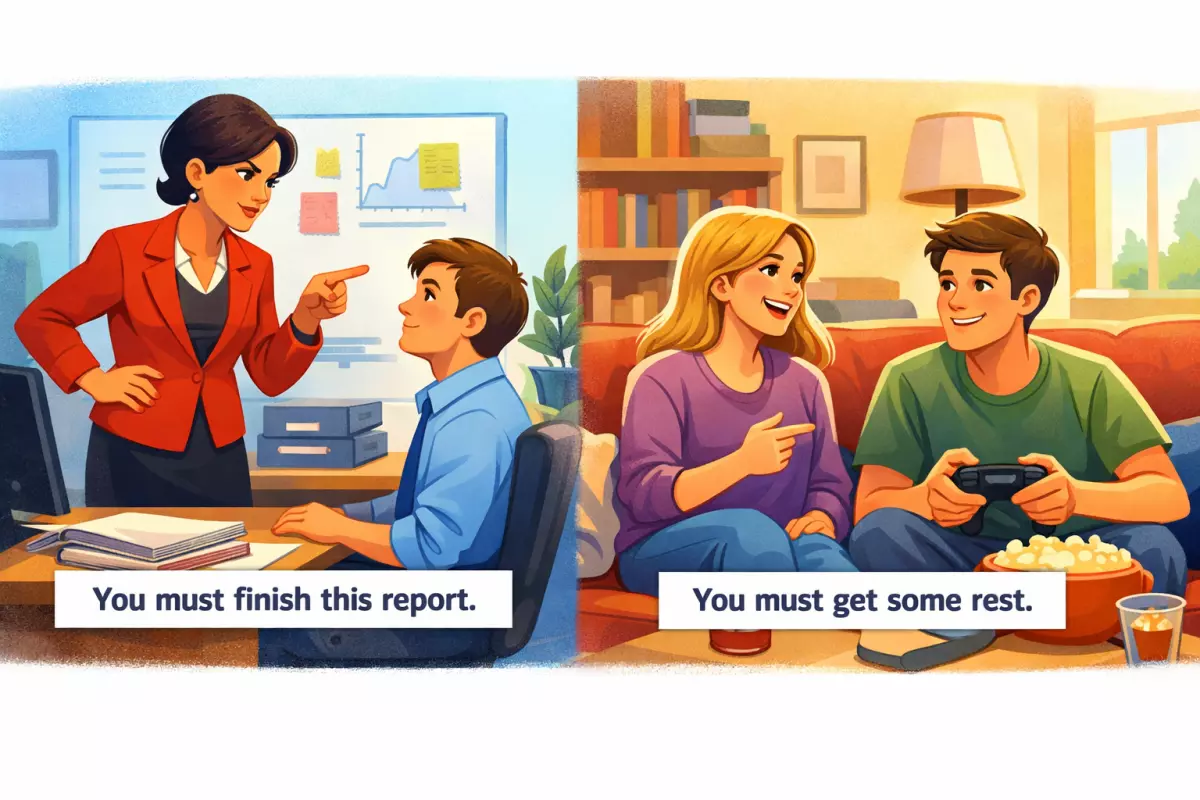
Modal verbs are flexible: the same word can express permission, ability, obligation, advice, or a guess. Readers decide which meaning is intended by using clues from the surrounding situation, the speaker’s role, and the type of statement (rule, plan, prediction, request).
Common context clues that change the meaning
- Who is speaking to whom: A manager saying “You must…” sounds like a rule; a friend saying it can sound like strong advice.
- Setting (workplace, classroom, home): “You can leave now” is often permission in a formal setting but may be simple ability in a casual one.
- Purpose of the sentence (request, instruction, prediction): “Could you open the window?” is a polite request, not a question about ability.
- Time reference: “must” (present inference) vs. “must have” (past inference) changes the interpretation from rule to deduction.
- Nearby words (probably, maybe, definitely): These push a modal toward uncertainty or certainty (“might” + “definitely” usually sounds inconsistent).
- Evidence mentioned: If the sentence includes clues (“The lights are off”), modals often signal inference (“They must be asleep”).
- Negation: “must not” is prohibition; “don’t have to” is lack of necessity—different meanings even though both relate to obligation.
- Question vs. statement: “May I…?” is a permission request; “It may…” is possibility.
- Conditional language (if, unless): “If you should need help…” uses “should” for a tentative condition, not obligation.
- Formality level: “May” is more formal than “can” for permission; “shall” can sound legal or official in modern use.
- Intonation and punctuation (in writing: “!” or softeners): “You must come!” can be enthusiastic insistence; “You must come, if you can” softens it.
- Shared background knowledge: In a known rule-based context (signs, policies), modals tend to be deontic (rules/permission), not epistemic (guesses).
Patterns: the same modal, different meanings in use
- Can
- Ability: “She can swim.”
- Permission: “You can use my laptop.”
- Typical behavior/possibility: “It can get noisy here.”
- Could
- Past ability: “When I was younger, I could run fast.”
- Polite request: “Could you send that today?”
- Weaker possibility: “It could rain later.”
- May
- Permission (formal): “May I come in?”
- Possibility: “This may be the right address.”
- Might
- Uncertain possibility: “I might be late.”
- Polite suggestion: “You might try restarting it.”
- Must
- Obligation/rule: “Employees must wear badges.”
- Strong deduction: “You must be tired after that trip.”
- Past deduction: “They must have missed the bus.”
- Should
- Advice/expectation: “You should see a doctor.”
- Probability (based on a plan): “The train should arrive at 6.”
- Formal condition: “Should you have questions, email us.”
High-impact contrasts to watch
- ✅ “You must not park here.” (prohibition) → ❌ “You don’t have to park here.” (no necessity; not a ban)
- ✅ “May I leave early?” (asking permission) → “I may leave early.” (possibility/plan, depending on context)
- ✅ “He can’t be at home.” (strong negative deduction) → “He can’t go home.” (lack of permission/ability; depends on the situation described)
- ✅ “You should be there by noon.” (expected timing) → “You should be there by noon.” (advice) — the difference comes from whether it’s a schedule prediction or guidance
When choosing a modal, match it to the situation you are describing: rules and authority contexts favor obligation and permission readings, while evidence-based statements favor inference and probability. Adding a short cue (a reason, a rule source, or a piece of evidence) often prevents ambiguity.
Situations where a small modal change alters the speaker's intention
In English, swapping one modal for another can shift a sentence from a friendly suggestion to a firm directive, from a neutral prediction to a cautious guess, or from permission to obligation. The grammar may stay almost identical, but the listener hears a different level of certainty, politeness, or pressure.
Common intention shifts caused by changing the modal
| Small modal change | Typical intention difference (with examples) |
|---|---|
| can → could |
Ability/possibility stays, but the tone softens or becomes more tentative. can: “Can you email me the file?” (direct request) could: “Could you email me the file?” (more polite/less imposing) |
| will → would |
Future/volition becomes more conditional, indirect, or polite. will: “I’ll call you tomorrow.” (plan/decision) would: “I would call tomorrow, but I’m in meetings.” (conditional/limited promise) |
| may → might |
Possibility becomes weaker or more cautious. may: “It may rain later.” (real possibility) might: “It might rain later.” (more uncertainty) |
| must → have to |
Obligation shifts from speaker-imposed to rule/situation-imposed (often). must: “You must submit it today.” (speaker authority/strong insistence) have to: “You have to submit it today.” (deadline/rule; can feel less personal) |
| must → should |
Obligation becomes advice or expectation rather than a requirement. must: “You must wear a helmet.” (non-negotiable) should: “You should wear a helmet.” (recommendation) |
| should → could |
Advice becomes an option; pressure decreases. should: “You should talk to your manager.” (guidance) could: “You could talk to your manager.” (one possible step) |
| can → may |
Permission becomes more formal (and sometimes more clearly “permission”). can: “Can I leave early?” (common, informal permission request) may: “May I leave early?” (more formal, deferential) |
| may → must (in rules) |
Permission becomes requirement; the listener loses choice. may: “Guests may use the pool.” (allowed) must: “Guests must shower first.” (required) |
| will → must (in conclusions) |
Inference becomes stronger and more confident. will: “That will be John at the door.” (confident guess) must: “That must be John at the door.” (even stronger inference) |
| mustn’t → don’t have to |
Prohibition vs no necessity (a frequent meaning trap). mustn’t: “You mustn’t park here.” (forbidden) ✅ don’t have to: “You don’t have to park here.” (not necessary; you may choose) ✅ |
Patterns to watch so the intention stays clear
- Requests: “Can you…?” is normal and direct; “Could you…?” and “Would you…?” usually sound more tactful in service, workplace, and email contexts.
- Offers: “I can…” often signals ability; “I could…” can sound like a tentative offer that invites the other person to decide.
- Advice vs obligation: “You should…” suggests a good idea; “You must…” signals a rule or urgent necessity. Mixing them can accidentally add pressure.
- Permission: “Can I…?” is everyday spoken English; “May I…?” adds formality. Choosing “may” can make the speaker sound more deferential or official.
- Possibility: “May” and “might” both express uncertainty, but “might” usually lowers confidence. In sensitive messages, “might” can sound more careful.
- Predictions: “It will…” feels more definite; “It might…” signals a forecast with less commitment.
- Rules and signs: “Must” reads as strict; “should” reads as guidance. If compliance is required, “should” can be too weak.
- Negative forms: “Mustn’t” means prohibition; “don’t have to” means no obligation. Confusing these changes the meaning completely.
- Indirectness: Past-form modals (could, would, might) often function as politeness markers rather than past time. The intention is softer, not necessarily historical.
- Authority and responsibility: “You must…” can imply the speaker is imposing the rule; “You have to…” often points to an external requirement (policy, deadline, law).
- Negotiation tone: “We could…” opens options; “We should…” pushes toward a preferred plan; “We must…” closes the discussion.
- Customer-facing language: “You may want to…” is a gentle suggestion; “You should…” can sound like a judgment if the listener is already stressed.
How tone and communication goals affect modal choice
Modal verbs don’t just add meaning; they also set the relationship between speaker and listener. The same basic message can sound polite, firm, tentative, or authoritative depending on whether you choose can, could, may, might, should, must, or a softer alternative like have to or be able to. A useful habit is to decide your goal first (request, advice, rule, prediction, offer), then pick the modal that matches the desired level of pressure and certainty.
Common goals and the modal patterns that fit them
- Polite requests (low pressure): Prefer could or would for a softer tone. Example: “Could you send the file by noon?”
- Direct requests (higher pressure): can is more straightforward and can sound brisk. Example: “Can you send the file by noon?”
- Asking permission (formal/neutral): may is traditional and more formal; can is common in everyday speech. Example: “May I leave early?” vs. “Can I leave early?”
- Giving permission: can is normal; may can sound official. Example: “You can leave now.” / “You may leave now.”
- Making offers: can and could sound helpful; shall is more formal (and more common in British usage). Example: “I can help you with that.” / “Shall I call them?”
- Suggestions: could and might keep the choice open. Example: “You could try restarting it.”
- Advice (neutral): should is the default for recommendations. Example: “You should back up your data.”
- Advice with stronger expectation: ought to can sound slightly moral or duty-based; it’s less common in casual speech. Example: “You ought to apologize.”
- Rules and obligations (strong): must signals authority or strict necessity. Example: “You must wear a badge.”
- Obligation stated as external requirement: have to often sounds less personal than must. Example: “We have to follow the policy.”
- Prohibition: must not is strict; can’t is common and clear in speech. Example: “You must not share passwords.” / “You can’t park here.”
- Softening criticism: could reduces blame compared with should. Example: “You could be a bit clearer here.”
- Talking about ability (neutral): can is standard. Example: “She can run 10K.”
- Ability in a specific situation: be able to is often better than can for one-time success. Example: “We were able to fix it quickly.”
- Possibility (open-ended): may or might keeps certainty low. Example: “It might rain later.”
- Probability (stronger prediction): should can express expectation without full certainty. Example: “They should arrive by six.”
- Certainty based on evidence: must can mean “I’m sure” (logical conclusion), not obligation. Example: “You must be tired after that trip.”
- Hedging in professional writing: may/might often sound appropriately cautious. Example: “This change may reduce errors.”
How to adjust tone without changing the core message
- Lower the force: switch must → should → could (rule → recommendation → option). Example: “You must submit today” → “You should submit today” → “You could submit today.”
- Raise the force: switch could → should → must when you need urgency or compliance. Example: “We could review this” → “We should review this” → “We must review this.”
- Sound less personal: prefer have to over must to frame the obligation as external. Example: “I have to ask for ID” (policy-driven) vs. “I must ask for ID” (speaker-driven).
- Make requests smoother: use could/would plus a brief reason. Example: “Could you resend it? The attachment didn’t come through.”
- Avoid unintended harshness: be careful with must in emails; it can read as an order. If the goal is cooperation, should or can may fit better.
- Keep uncertainty clear: choose might when you truly don’t know. Using will for guesses can sound overconfident. ✅ “It might take longer” ❌ “It will take longer” (if you lack evidence).
Exercises and practice activities rewriting sentences with different modal verbs
Rewrite each sentence by changing the modal verb while keeping the core meaning as close as possible. Notice what changes: strength (must vs. should), certainty (might vs. will), permission (can vs. may), or willingness/insistence (will vs. would). Keep the time reference consistent (present, past, or future) and adjust the verb form after the modal (base verb, have + past participle, be + -ing) when needed.
1) Swap the modal: same situation, different strength
- It is necessary that you submit the form today. (Rewrite with must.)
- It is a good idea for you to submit the form today. (Rewrite with should.)
- It is not necessary for you to submit the form today. (Rewrite with don’t have to.)
- It is prohibited to submit the form without a signature. (Rewrite with mustn’t.)
- It is possible that the meeting starts late. (Rewrite with might.)
- I am certain the meeting starts at 9. (Rewrite with will.)
- It is allowed to park here after 6 p.m. (Rewrite with can.)
- It is more formal to ask for permission to park here. (Rewrite with may.)
- I am willing to help you carry the boxes. (Rewrite with can or will.)
- It is a bad idea to skip breakfast. (Rewrite with shouldn’t.)
Show answers
- You must submit the form today.
- You should submit the form today.
- You don’t have to submit the form today.
- You mustn’t submit the form without a signature.
- The meeting might start late.
- The meeting will start at 9.
- You can park here after 6 p.m.
- You may park here after 6 p.m.
- I can help you carry the boxes. / I will help you carry the boxes.
- You shouldn’t skip breakfast.
2) Keep the time: present vs. past vs. “past possibility”
Use these patterns when you rewrite:
- Present/future: modal + base verb (must go, might rain, should call)
- Past certainty/obligation/possibility: modal + have + past participle (must have left, might have forgotten, should have called)
- Ongoing now: modal + be + -ing (may be waiting, must be joking)
- I’m sure she is at home. (Rewrite with must.)
- It’s possible he is sleeping. (Rewrite with might + continuous.)
- I’m sure they left already. (Rewrite with must + perfect.)
- It’s possible I made a mistake. (Rewrite with may + perfect.)
- It was a good idea to tell them earlier (but you didn’t). (Rewrite with should have.)
- It wasn’t necessary to buy water (and you bought it anyway). (Rewrite with didn’t need to.)
- It wasn’t necessary to buy water (and you did not buy it). (Rewrite with didn’t have to.)
- I’m sure he is not telling the truth. (Rewrite with can’t.)
Show answers
- She must be at home.
- He might be sleeping.
- They must have left already.
- I may have made a mistake.
- You should have told them earlier.
- You didn’t need to buy water.
- You didn’t have to buy water.
- He can’t be telling the truth.
3) Change the relationship: direct vs. polite vs. tentative
Rewrite each sentence twice: (A) more direct, (B) more polite/soft. Choose suitable modals such as can/could, will/would, may, should.
- Open the window. (A direct request; B polite request)
- Give me your email address. (A; B)
- Tell me the price. (A; B)
- Help me with this report. (A; B)
- Wait here. (A; B)
- Send the file today. (A; B)
Show answers
- A: Can you open the window? B: Could you open the window, please?
- A: Will you give me your email address? B: Could you give me your email address?
- A: Can you tell me the price? B: Could you tell me the price?
- A: Can you help me with this report? B: Could you help me with this report?
- A: Can you wait here? B: Could you wait here for a moment?
- A: You must send the file today. B: You should send the file today.
4) Spot the meaning shift: choose the best rewrite
For each item, rewrite the sentence using the modal in parentheses. Keep the intended meaning in the prompt; avoid changing it from advice to obligation (or from possibility to certainty).
- Advice (should): “It’s a good idea to back up your files.”
- Obligation (must): “It’s necessary to wear a helmet.”
- No obligation (don’t have to): “It isn’t necessary to print the ticket.”
- Prohibition (mustn’t): “It’s not allowed to smoke here.”
- Weak possibility (might): “There is a small chance the train is delayed.”
- Strong certainty (can’t): “I’m sure that explanation is wrong.”
- Past possibility (could have): “It’s possible they took the wrong bus.”
- Past criticism (should have): “It was a mistake not to call.”
Show answers
- You should back up your files.
- You must wear a helmet.
- You don’t have to print the ticket.
- You mustn’t smoke here.
- The train might be delayed.
- That explanation can’t be right.
- They could have taken the wrong bus.
- You should have called.
5) Quick checklist for self-correction
- After a modal, use the base verb: ✅ “She can drive” ❌ “She can drives”.
- For past guesses, use modal + have + past participle: “must have left,” “might have forgotten.”
- Separate “no obligation” from “prohibition”: “don’t have to” → optional; “mustn’t” → not allowed.
- Use “could” and “would” to soften requests; use “must” carefully because it can sound forceful.
- Check whether you changed the meaning accidentally (advice vs. rule, possibility vs. certainty).