Using Modal Verbs for Hypothetical Situations

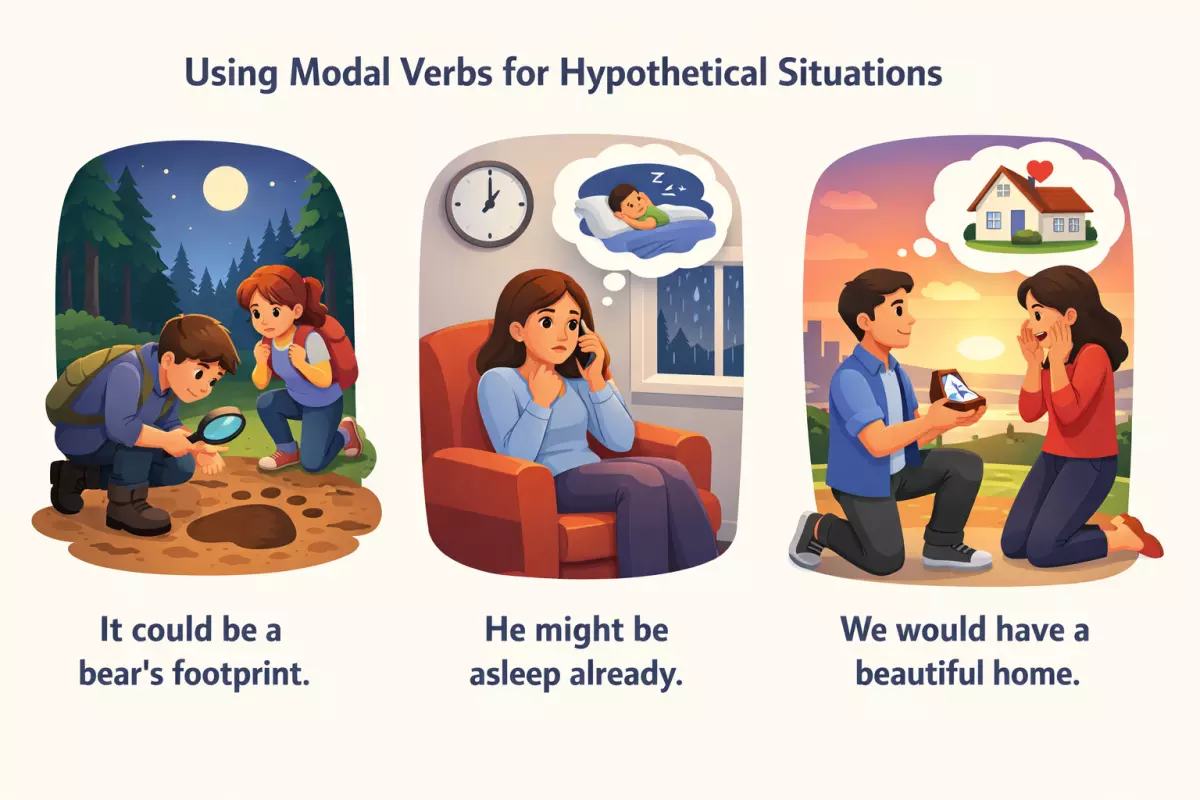 This article explains how English speakers talk about imagined or unreal situations using modal verbs. It covers would, could, and might patterns, how they show up in conditional thinking, differences from real statements, everyday examples, and practice exercises.
- How English speakers describe imagined or unreal situations
- Modal verbs commonly used in hypothetical statements
- Typical patterns with would, could, and might
- Examples of hypothetical language in everyday communication
- How modal verbs appear in conditional thinking
- Differences between real statements and hypothetical meaning
- Exercises and practice activities using modal verbs in hypothetical contexts
English uses modal verbs to talk about imagined or unreal situations, showing likelihood, intentions, advice, or what might have happened. In everyday conversation, modals help you sound polite, cautious, or confident without adding extra explanation. This guide will help you pick the best form for plans, suggestions, regrets, and possibilities so your meaning stays clear and natural.
How English speakers describe imagined or unreal situations
English often signals “not real right now” by combining a modal verb with a particular time reference (present, past, or future). The modal you choose shows your attitude (possibility, advice, regret, certainty), while the verb form after it shows when the situation is imagined to happen.
Core patterns used for unreal meaning
- Present or general unreal:
would/could/might + base verb(an imagined result or possibility now or generally). - Past unreal (regret or alternative past):
would/could/might + have + past participle(an imagined different outcome in the past). - Unreal necessity/expectation:
should/ought to + base verb(what would be right or expected, not necessarily true). - Unreal obligation in the past:
should/ought to + have + past participle(criticism or regret about a past action). - Unreal ability:
could + base verb(ability in a hypothetical situation, not an actual ability being used now). - Unreal permission:
could/might + base verb(permission as a possibility, often tentative). - Unreal certainty (deduction):
must/can’t + base verbfor present logic;must/can’t + have + past participlefor past logic. - Unreal preference (conditional):
would rather + base verb(what someone would prefer in an imagined choice).
Common modal choices and what they imply
- would: the most neutral way to describe an imagined result or behavior. “I would call, but I don’t have your number.”
- could: focuses on possibility or ability in the hypothetical. “We could leave early if the meeting ends on time.”
- might: weaker possibility than could; often more cautious. “I might go if I finish work.”
- should: advice, expectation, or mild obligation in an unreal frame. “You should talk to her if you’re worried.”
- ought to: similar to should, often slightly more formal. “They ought to apologize.”
- must / can’t: logical conclusions about an unreal explanation. “He can’t be serious.” / “She must be joking.”
High-value example patterns (with typical meanings)
If I had more time, I would travel more.(imagined present situation → imagined result)If we left now, we could catch the earlier train.(hypothetical action → possible outcome)If you asked, she might help.(hypothetical action → uncertain outcome)I would help, but I’m not allowed.(willingness blocked by reality)I could help, but I’m not free tonight.(possible in theory, not possible in reality)It might be easier to email them.(tentative suggestion)You should check the address before you go.(advice about a future action)They ought to tell everyone the plan.(expectation; not confirmed)You should have called me.(past regret/criticism)I could have warned you, but I didn’t know.(unreal past possibility)We would have arrived earlier if the road hadn’t been closed.(alternative past outcome)He might have missed the message.(uncertain explanation about the past)She must have forgotten.(strong deduction about the past)They can’t have seen us.(strong negative deduction about the past)I would rather stay home tonight.(preference in an imagined choice)- ✅
She might have been asleep.→ possible past state (uncertain)
❌She might was asleep.
Form reminders that prevent common errors
- After a modal, use the base verb: ✅
might go❌might goes. - For an unreal past, use
have + past participle: ✅could have done❌could have did. - Use
wouldmainly for results and preferences, not for the condition clause in standard “if” sentences: ✅If I had time, I would go.(notIf I would have time...in most cases). mightandcouldoften sound more tentative thanwould, which helps when you want to avoid sounding too certain about an unreal scenario.
Modal verbs commonly used in hypothetical statements

Hypothetical meaning is often built with a small set of modal verbs. Each one signals a different shade of distance from reality: imagined ability, polite possibility, advice about an unreal situation, or a past outcome that did not happen. The patterns below focus on the most common forms you will see in conditional sentences and other “unreal” contexts.
Core modals and the patterns they prefer
- would: the default choice for an imagined result or a “future in the past.” Common in second and third conditionals.
→ Pattern: would + base verb (present/future hypothetical) / would have + past participle (past hypothetical).
Example: If I had more time, I would travel more. / If I had known, I would have called. - could: hypothetical ability or a possible result (often slightly less certain than would).
→ Pattern: could + base verb / could have + past participle.
Example: If we left earlier, we could catch the first train. / We could have avoided the delay. - might: a weaker, more tentative possibility; useful when you do not want to sound too certain.
→ Pattern: might + base verb / might have + past participle.
Example: If you asked her, she might help. / He might have missed the message. - may: possibility with a more formal tone; less common than might in everyday hypotheticals, but still used.
→ Pattern: may + base verb / may have + past participle.
Example: If the weather improves, we may go out later. - should: expectation, recommendation, or a “soft” conditional meaning (“if it happens…”).
→ Pattern: should + base verb / conditional inversion: Should + subject + base verb.
Example: If you should need help, call me. / Should you need help, call me. - must: strong logical deduction (often about an imagined explanation rather than a planned action).
→ Pattern: must + base verb (present deduction) / must have + past participle (past deduction).
Example: If the lights are off, they must be asleep. / He must have forgotten. - can (limited in unreal conditionals): general possibility/ability; in hypotheticals it often appears in questions or with negatives, or it shifts to could for “unreal distance.”
✅ If you can finish today, we can review tomorrow. (real possibility)
✅ If you could finish today, we could review tomorrow. (more hypothetical/polite) - will (not usually “unreal”): used for real conditionals or willingness; for hypotheticals, it typically becomes would.
❌ If I will have time, I would go. → ✅ If I had time, I would go.
Common “unreal” combinations you should recognize
- would rather + past simple to express a present preference about someone else’s action: I’d rather you didn’t mention it.
- would like + to + verb for polite, imagined preference: I would like to speak to the manager.
- could + always/just to suggest an option in an imagined scenario: We could always take a taxi.
- might as well + base verb for a resigned choice: If we’re waiting anyway, we might as well sit down.
- should have + past participle for regret/criticism about an unreal past alternative: You should have told me earlier.
- would have to + base verb for necessity in an imagined situation: If we moved, we’d have to change schools.
- could have + past participle to show an unreal past possibility (often implying it did not happen): I could have helped, but I didn’t know.
- might have + past participle to show uncertain unreal past outcomes: If we had left later, we might have missed the flight.
- would + base verb for repeated behavior in an imagined past setting: In that situation, he would often refuse to answer.
- would + mind + -ing for polite hypothetical requests: Would you mind opening the window?
Typical patterns with would, could, and might
These modals often appear in set sentence shapes that signal imagined results, unreal conditions, or uncertain possibilities. Learning the common structures makes it easier to choose the right verb form (base verb, perfect form, or continuous form) and the right level of certainty.
1) Conditional “if” patterns (present/past and past perfect)
- If + past simple → would/could/might + base verb: If I had more time, I would help more.
- If + past simple → could + base verb (ability/option): If we left now, we could catch the early train.
- If + past simple → might + base verb (weaker possibility): If you asked politely, they might agree.
- If + past perfect → would have + past participle: If I had known, I would have called.
- If + past perfect → could have + past participle: If she had trained more, she could have won.
- If + past perfect → might have + past participle: If we had taken the map, we might have avoided getting lost.
- Mixed time: If + past perfect → would + base verb (past condition, present result): If I had slept earlier, I would feel better now.
- “If it weren’t for…” / “If it hadn’t been for…” + noun: If it weren’t for traffic, we would be on time.
2) Result-first conditionals (no “if” clause)
- would/could/might + base verb + if + past simple: I would go if I had a ride.
- would/could/might have + past participle + if + past perfect: We might have stayed longer if the hotel had been cheaper.
- Short answers in context: “Would you take the job?” “I would, if it paid more.”
3) “Without / but for” to express an unreal condition
- Without + noun → would/could/might + base verb: Without your help, I would struggle.
- But for + noun → would have + past participle: But for the warning, we would have missed the exit.
- Without + -ing → hypothetical result: Without checking the schedule, you might arrive too early.
4) “Suppose/Imagine/What if” for hypothetical questions
- Suppose + past simple: Suppose you won the lottery—what would you do?
- Imagine + past simple: Imagine we lived closer; we could meet every week.
- What if + past simple: What if they refused—how would we respond?
- What if + past perfect (past alternative): What if we had chosen the other route? We might have arrived earlier.
5) Degrees of certainty: would vs. could vs. might
- would = expected result in that imagined situation: If he apologized, I would forgive him.
- could = one possible outcome or ability: If we had more staff, we could open on Sundays.
- might = possibility, less certain: If you email today, they might reply tomorrow.
- Stacking meaning with context: If you spoke more slowly, I could understand (ability); I might understand (uncertain).
6) Perfect and continuous forms for timing
- would/could/might be + -ing (hypothetical in progress now): If I were on vacation, I would be lying on a beach.
- would/could/might have been + -ing (hypothetical in progress in the past): If you had called, I might have been sleeping.
- would have + past participle (completed past result): If we had left earlier, we would have arrived on time.
7) Polite, tentative hypothetical language in requests and suggestions
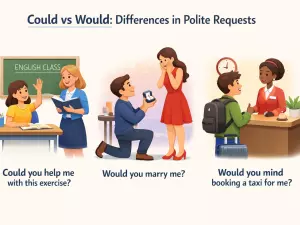
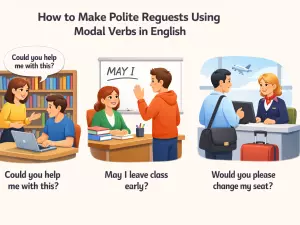
- Would you…? (polite request): Would you help me with this form?
- Could you…? (polite request, focuses on ability/feasibility): Could you send it by Friday?
- Might I…? (very formal permission): Might I ask a question?
- I would + verb (soft recommendation): I would check the dates again.
- It might be better to… (gentle suggestion): It might be better to wait until Monday.
8) Common pitfalls to avoid
- ✅ If I were you, I would… ❌ If I was you, I would… (formal written English prefers “were” in unreal conditions).
- ✅ If she had studied, she would have passed. ❌ If she had studied, she would pass. (match past perfect with “would have”).
- ✅ If we left now, we could arrive by 6. ❌ If we left now, we could have arrive by 6. (use base verb after “could”).
- Avoid double modals in standard English: ❌ If I had time, I would could help.
Examples of hypothetical language in everyday communication

In daily conversation, speakers often use modal verbs to talk about unreal, uncertain, or imagined situations. The patterns below show how modals combine with different verb forms to signal distance from reality, polite caution, or speculation about what could happen.
Common patterns and where you hear them
- Polite requests (softening):
“Could you open the window?” / “Would you mind waiting a minute?” - Offers and invitations:
“Would you like some tea?” / “Could I get you anything?” - Suggestions:
“You could try restarting your phone.” / “We might take a taxi if it rains.” - Possibility in the present/future (uncertain):
“It might snow later.” / “She may be in a meeting.” - Speculation about the present (guessing now):
“That could be the wrong address.” / “He might not know yet.” - Advice framed as hypothetical (less direct):
“You might want to back up your files.” / “You could consider a cheaper plan.” - Conditional results (would + base verb):
“I would help, but I’m working.” / “It would be easier with two people.” - Second conditional (unreal present):
“If I had more time, I would travel more.” / “If she lived closer, we could meet weekly.” - Third conditional (unreal past):
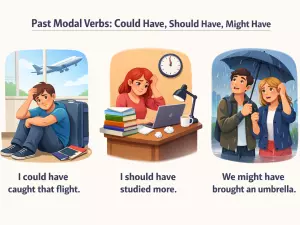
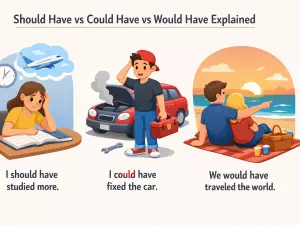
“If you had called, I would have picked you up.” / “We could have won if we had practiced.” - Regret and criticism (should have / could have):
“I should have brought a jacket.” / “You could have told me earlier.” - Past possibility (might have / may have):
“He might have missed the train.” / “They may have left already.” - Past deduction (must have) vs. uncertainty (could have):
“She must have forgotten.” (speaker feels sure) / “She could have forgotten.” (one possible explanation) - Rules and expectations (should / ought to) with a hypothetical tone:
“It should be fine by tomorrow.” / “The package ought to arrive today.” - Permission (more tentative than ‘can’):
“Could I leave a bit early?” / “May I ask a question?” - Negotiation and compromise:
“We could meet at 6, or we could do tomorrow.” / “I’d take the later flight if the price is lower.” - Imagined preferences (would rather / would prefer):
“I’d rather stay in tonight.” / “I would prefer a quiet table.”
Quick form reminders (so the meaning stays clear)
- Modal + base verb for present/future uncertainty: “might arrive,” “could happen,” “would help.”
- Modal + be + -ing for “right now” guesses: “may be waiting,” “could be working.”
- Modal + have + past participle for past possibility or regret: “might have left,” “should have checked,” “would have gone.”
- ✅ “If I were you, I would…” → more standard for unreal advice than ❌ “If I was you…” in careful usage.
- ✅ “I would go if I had time.” → avoid ❌ “I will go if I had time.” when the condition is unreal.
How modal verbs appear in conditional thinking
Conditionals often combine an if-clause (the condition) with a main clause (the result). Modal verbs in the main clause help you show how certain, likely, permitted, or advisable the result is, and they also signal whether you are talking about a real possibility, a remote one, or an unreal past.
Core patterns to notice
- If + present simple → modal in the main clause for real or general situations:
“If you feel sick, you should rest.” - If + past simple → modal + base verb for remote or unlikely present/future:
“If I had more time, I could help.” - If + past perfect → modal + have + past participle for unreal past outcomes:
“If they had left earlier, they might have arrived on time.” - Modal choice adds meaning beyond the conditional form: might (weak possibility), could (ability/option), would (expected result), should (advice/expectation), must (strong necessity or logical conclusion).
Modal meanings in conditional results
- would for a predicted result in an unreal or imagined situation: “If I lived closer, I would visit more often.”
- could for ability or available options: “If we had the key, we could open the door.”
- might / may for possibility (often less certain than would): “If you ask politely, they might agree.”
- should for expectation or advice tied to the condition: “If the weather clears, the roads should be safer.”
- must for strong necessity (rules/requirements) or strong inference: “If you want to enter, you must show ID.”
- can for general possibility or permission in real conditions: “If you finish early, you can leave.”
Common conditional templates with examples
- If + present, can + base: “If you need help, you can call me.”
- If + present, should + base: “If you’re unsure, you should double-check.”
- If + present, might + base: “If you take the train, you might save time.”
- If + past, would + base: “If I knew his number, I would text him.”
- If + past, could + base: “If we had a bigger budget, we could hire more staff.”
- If + past, might + base: “If she tried again, she might succeed.”
- If + past perfect, would have + past participle: “If you had warned me, I would have prepared.”
- If + past perfect, could have + past participle: “If they had trained, they could have won.”
- If + past perfect, might have + past participle: “If we had left earlier, we might have caught the show.”
- If + present perfect, modal + base (to connect a recent condition to a present result): “If you’ve already paid, you should have a receipt.”
Frequent learner pitfalls (and fixes)
- ✅ “If I were you, I would apologize.” ❌ “If I was you, I would apologize.” (Formal/standard advice uses were.)
- ✅ “If she had known, she would have called.” ❌ “If she had known, she would called.” (Past unreal needs would have + past participle.)
- ✅ “If you heat ice, it will melt.” ❌ “If you would heat ice, it will melt.” (Don’t use would in the if-clause for normal cause-and-effect.)
- ✅ “If you study, you might pass.” ❌ “If you study, you may to pass.” (Modals take the base verb: no to.)
- ✅ “If we had time, we could go.” ❌ “If we had time, we can go.” (Remote conditions usually pair with could/would/might.)
Choosing the modal is often the main decision: the conditional structure sets the time and reality level, while the modal expresses your stance—certainty, possibility, ability, permission, advice, or obligation—about what follows from the condition.
Differences between real statements and hypothetical meaning
English often signals whether you mean a fact, a likely outcome, or an imagined situation through modal choice, verb form, and time reference. The same event can be framed as real (grounded in evidence) or hypothetical (based on conditions, wishes, or speculation) by changing these patterns.
| Real / evidence-based meaning | Hypothetical / imagined meaning |
|---|---|
| Certainty or strong evidence: uses will, must, or no modal when stating facts. Example: “She is at work.” / “She will be at work by now.” |
Unreal or conditional framing: uses would, could, might with conditional structures. Example: “She would be at work if she hadn’t called in sick.” |
| Real present/future: present simple for schedules and routines; will for decisions/predictions. Example: “The train leaves at 6.” / “I’ll call you later.” |
Imagined present/future: past form to mark distance (not past time). Example: “If the train left at 6, we’d make it.” / “I wish it were earlier.” |
| Real past (known outcome): past simple or present perfect; modals for obligation in the past are factual. Example: “They left early.” / “We had to leave early.” |
Imagined past (counterfactual): would have, could have, might have + past participle. Example: “We would have left earlier if we’d known.” |
| Ability and permission (actual): can / be able to for real ability; can / may for permission. Example: “I can swim.” / “You can leave now.” |
Ability and permission (imagined): could for unreal ability/permission in a scenario. Example: “I could swim across if the water were warmer.” / “Could I leave early if we finished?” |
Key usage patterns that signal “real” vs. “hypothetical”
- No modal often sounds most factual: “He lives nearby.”
- Will commonly marks a real decision or a confident prediction: “I’ll email the file tonight.”
- Must can be real obligation (“You must wear a helmet”) or a strong logical conclusion (“She must be home”). In conclusions, it still leans on evidence rather than imagination.
- Would frequently marks an imagined result or a polite, distanced stance: “I would help if I had time.”
- Could often signals a possible option in an unreal scenario: “We could stay longer if we didn’t have work tomorrow.”
- Might is useful for weaker, speculative outcomes, especially in conditional thinking: “If we left now, we might catch the earlier bus.”
- Past simple in an if-clause usually indicates an unreal present/future: “If I knew his number, I’d call.”
- Past perfect in an if-clause typically indicates an unreal past: “If I had known, I would have called.”
- Wish + past marks a present unreal situation: “I wish I had more time.”
- Wish + past perfect marks regret about the past: “I wish I had studied earlier.”
- It’s time + past suggests a change is needed (not past time): “It’s time we left.”
- Suppose/Imagine + past helps set up a scenario: “Suppose you won the lottery—what would you do?”
- Would rather + past expresses preference about someone else’s action: “I’d rather you didn’t tell anyone.”
- Could have / might have often introduces alternative past outcomes: “They could have taken a taxi.”
Common contrasts to avoid confusion
- ✅ “If I have time, I will call.” (real possibility) → ✅ “If I had time, I would call.” (unreal/imagined)
- ✅ “She can come tomorrow.” (real ability/permission) → ✅ “She could come tomorrow if she finished early.” (conditional option)
- ✅ “He must be tired.” (reasoned conclusion) → ✅ “He would be tired if he worked all night.” (scenario-based)
- ❌ “If I would have time, I would call.” → ✅ “If I had time, I would call.”
When choosing a modal, focus on what you are committing to: a real-world claim backed by facts or evidence, or a situation you are constructing to explore outcomes. The modal and the verb form work together to show that difference clearly.
Exercises and practice activities using modal verbs in hypothetical contexts
Build accuracy with imagined situations by practicing the most common patterns: modal + base verb (present/future possibility), modal + have + past participle (past speculation), and conditional forms like would, could, and might for unreal or less certain outcomes. Work through the activities below and focus on matching the verb form to the time reference.
1) Choose the best modal (meaning first, then form)
- If I had more time, I ______ learn another language.
- She isn’t answering. She ______ be in a meeting.
- They left early, so they ______ have missed the announcement.
- If we took the train, we ______ arrive before noon.
- He looks upset. He ______ have heard the news already.
- If you were more careful, you ______ make fewer mistakes.
- I’m not sure, but the keys ______ be on the kitchen table.
- If I were you, I ______ not mention that topic.
- We ______ have gone hiking, but the weather turned bad.
- With a better map, we ______ have found the place faster.
Show answers
- would
- might
- may
- could
- must
- would
- could
- would
- would
- could
2) Complete the sentence with the correct time form
Use the cue in parentheses to choose between modal + base verb and modal + have + past participle.
- He isn’t here yet. He ______ (possible, now) be stuck in traffic.
- He wasn’t here yesterday. He ______ (possible, past) have been sick.
- They’re late. They ______ (strong logical guess, now) be lost.
- They were late. They ______ (strong logical guess, past) have taken the wrong exit.
- Don’t worry. It ______ (small possibility, future) rain later.
- We got soaked. It ______ (small possibility, past) have started raining earlier than expected.
- If you asked politely, she ______ (ability/possibility, future) help you.
- If you had asked politely, she ______ (ability/possibility, past) have helped you.
Show answers
- might
- might
- must
- must
- may
- may
- could
- could
3) Rewrite to make it hypothetical (keep the meaning)
Rewrite each sentence using the cue. Keep the original time reference.
- I don’t have enough money, so I can’t buy it. (would)
- It’s possible that she is at home. (might)
- It’s certain that he forgot. (must have)
- We didn’t take a taxi, so we arrived late. (could have)
- I advise you not to respond immediately. (would)
- It’s possible they saw us. (may have)
- It’s not necessary to bring food; there will be snacks. (don’t need to)
- It was a mistake to say that. (shouldn’t have)
Show answers
- If I had enough money, I would buy it.
- She might be at home.
- He must have forgotten.
- We could have arrived on time if we had taken a taxi.
- If I were you, I wouldn’t respond immediately.
- They may have seen us.
- You don’t need to bring food; there will be snacks.
- You shouldn’t have said that.
4) Error correction (fix the modal pattern)
Each sentence has one modal-related error. Rewrite it correctly.
- If I would know his number, I would call him.
- She might to be tired after the trip.
- They must have went to the wrong building.
- He could has finished earlier if he started sooner.
- If you had told me, I will have helped.
- We should to leave now if we want to catch the bus.
- It may raining later.
- You mustn’t have forgotten; I reminded you.
Show answers
- If I knew his number, I would call him.
- She might be tired after the trip.
- They must have gone to the wrong building.
- He could have finished earlier if he had started sooner.
- If you had told me, I would have helped.
- We should leave now if we want to catch the bus.
- It may rain later.
- You can’t have forgotten; I reminded you.
5) Pattern drills (quick, high-frequency transformations)
- Unreal present advice: “If I were you, I would…” + base verb (If I were you, I would wait.)
- Unreal past regret: “If I had…, I would have…” + past participle (If I had left earlier, I would have arrived on time.)
- Past possibility: might/may/could + have + past participle (They might have missed the turn.)
- Past certainty: must + have + past participle (She must have misunderstood.)
- Past impossibility: can’t/couldn’t + have + past participle (He can’t have said that.)
- Polite hypothetical request: could/would + base verb (Could you help me for a moment?)
- Soft prediction: might/may + base verb (It might get colder tonight.)
- Hypothetical ability: could + base verb (I could do it if I had the tools.)
- Criticism of past action: should(n’t) + have + past participle (You shouldn’t have ignored the warning.)
- Expectation (past): should + have + past participle (They should have arrived by now.)
- Willingness (hypothetical): would + base verb (I would join you, but I’m working.)
- Conditional result emphasis: would/could/might + base verb (It would be easier with a checklist.)
6) Short writing prompts (use at least 4 different modals)
- Write 4–6 sentences about what you would do if you could live anywhere for a year.
- Write 4–6 sentences speculating about why a friend didn’t reply yesterday (include at least one “must have” and one “can’t have”).
- Write 4–6 sentences about a past decision you regret, using “should have,” “could have,” and “would have.”