How Modal Verbs Work in English Conditional Sentences

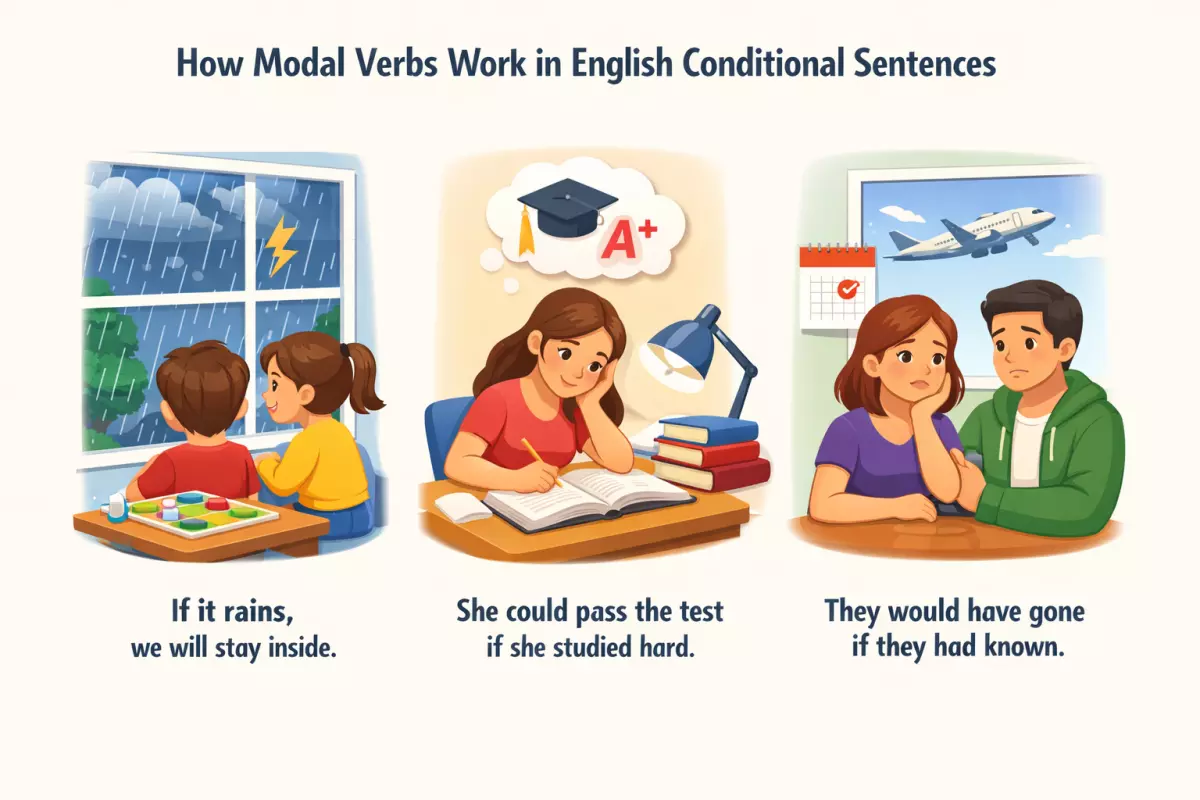 Covers how modal verbs work in if-clauses and result clauses, why speakers swap them for standard conditional forms, and how they shift certainty. Reviews can, could, may, might, with examples for permission, possibility, advice, plus softening results and practice exercises.
- How modal verbs interact with if-clauses and result clauses
- Why speakers sometimes replace standard conditional verbs with modal verbs
- How modal verbs change the level of certainty in conditional statements
- Common modal verbs used in conditional situations such as can, could, may, and might
- Examples of conditions that express permission, possibility, or advice
- How speakers use modal verbs to soften or qualify conditional results
- Exercises and practice activities with modal verbs in conditional sentences
Modal auxiliaries can change the meaning of if sentences, turning a basic condition into advice, possibility, permission, or regret. In everyday speech we use them to show certainty and intention: You might go if you finish early, you should call if you’re running late, you could have helped if you’d known. This guide helps you pick the right form so your message stays clear, natural, and accurate.
How modal verbs interact with if-clauses and result clauses
In conditional sentences, modal verbs can appear in the if-clause, the result clause, or both. Where you place the modal changes the meaning: ability, permission, advice, possibility, willingness, or obligation can belong to the condition itself or to the outcome.
1) Modals in the result clause (most common)
When the if-clause states the condition and the main clause states the consequence, modals in the result clause show how certain, necessary, or advisable the consequence is.
- Will / won’t for likely results: If you heat ice, it will melt.
- Can / can’t for ability/possibility: If we leave now, we can catch the early train.
- May / might for weaker possibility: If it rains, the match might be canceled.
- Should for expected results: If you follow the instructions, it should work.
- Must for strong logical conclusion: If the lights are off, they must be asleep.
- Could for conditional possibility: If you ask politely, they could agree.
- Would for hypothetical results: If I had more time, I would travel more.
- Could have / might have / would have for past hypotheticals: If you had told me, I would have helped.
2) Modals in the if-clause (less common, but very useful)
Putting a modal in the if-clause changes the condition itself. This often expresses permission, willingness, or uncertainty about whether the condition will be met.
- If you can (ability/possibility as the condition): If you can finish today, we’ll review it tomorrow.
- If you can’t (inability as the condition): If you can’t come, let me know early.
- If you may (formal permission): If I may ask, what’s the deadline?
- If you will (willingness; often formal/old-fashioned): If you will sign here, we can proceed.
- If you would (polite willingness): If you would wait a moment, I’ll check.
- If it might (uncertainty in the condition): If it might snow tonight, we should drive earlier.
- If you should (rare; “in case” meaning): If you should need help, call this number.
3) When both clauses use modals
Using modals on both sides is common when the condition is uncertain or dependent on ability/willingness, and the result is also only possible or recommended.
- If you can get a seat, you might enjoy the show more.
- If they would listen, we could solve this quickly.
- If we should run into traffic, we may arrive late.
- If you might be late, you should text me.
4) Matching modal meaning to conditional type
- Real present/future conditions often pair: if + present, result with will / can / may / might / should.
- Unreal present/future often pair: if + past, result with would / could / might.
- Unreal past often pair: if + past perfect, result with would have / could have / might have.
5) Common pattern choices (and what they imply)
- If + present, will: straightforward prediction (If you press this button, it will start.)
- If + present, can: practical option/ability (If you’re free, you can join us.)
- If + present, should: advice in the result (If you feel sick, you should rest.)
- If + past, would: hypothetical situation (If I knew, I would tell you.)
- If + past, could: hypothetical ability/opportunity (If I had a car, I could drive.)
- If + past perfect, would have: missed past result (If we had left earlier, we would have arrived on time.)
6) Frequent learner issues to avoid
- ❌ If it will rain, we’ll stay home. → ✅ If it rains, we’ll stay home. (Use present in the if-clause for most real conditions.)
- ❌ If I would have time, I would help. → ✅ If I had time, I would help. (Use past simple in the if-clause for unreal present.)
- ❌ If you can have finished, call me. → ✅ If you have finished, call me. (Don’t force a modal into the if-clause when simple tense fits.)
- ✅ Use if you should mainly for “in case”: If you should have any questions, email me.
Why speakers sometimes replace standard conditional verbs with modal verbs

In everyday English, speakers often choose modals (like would, could, might, should) instead of a more “standard” conditional form because modals communicate attitude, politeness, uncertainty, obligation, or ability more precisely than a plain verb tense can. This is especially common in the result clause, but it also happens in the if-clause when people are being tentative or diplomatic.
Common reasons and the patterns they create
- To show politeness or reduce directness (requests, offers, suggestions): speakers prefer modals over direct imperatives or blunt statements.
- ✅ If you could send it today, I’d appreciate it.
- ✅ If you would just sign here, we can start.
- To express uncertainty about the result: might and may keep the outcome open instead of sounding definite.
- ✅ If we leave now, we might catch the earlier train.
- ✅ If he calls, I may be able to join later.
- To highlight ability or practical possibility: can/could often replaces a simple future or “would” when capability is the key meaning.
- ✅ If you give me the file, I can finish the report.
- ✅ If we had more time, we could do it properly.
- To add advice, duty, or expectation: should is used when the speaker is recommending a course of action, not just predicting one.
- ✅ If you feel worse, you should see a doctor.
- ✅ If you want fewer errors, you should review the checklist.
- To make a “conditional offer” sound cooperative: would can signal willingness rather than simple future time.
- ✅ If you need help, I would be happy to look at it.
- ✅ If they asked, she would agree to it.
- To soften the if-clause itself: modals in the condition can make the situation sound less demanding or less certain.
- ✅ If you should have any questions, let me know. (formal, “in case”)
- ✅ If you would like to reschedule, we can. (polite preference)
- To match the time frame more naturally: speakers choose modals that fit present/future vs. hypothetical past meanings.
- ✅ If she arrives early, we can start.
- ✅ If she had arrived early, we could have started.
- To avoid sounding too certain or too absolute: modals help speakers hedge claims and leave room for exceptions.
- ✅ If you mix those two, it might react badly.
- ✅ If we push the deadline, the client could complain.
- To express permission or rules: can/may appear when the condition triggers permission.
- ✅ If you finish the test, you may leave.
- ✅ If you have ID, you can enter.
- To keep the conditional structure but shift the meaning: changing the modal changes the “type” of result (ability, advice, likelihood, willingness) even when the grammar stays similar.
- ✅ If you call now, she will answer. (prediction)
- ✅ If you call now, she might answer. (uncertain)
- ✅ If you call now, she can answer. (availability/ability)
Usage notes: what to watch for
- “If + would” is limited: it’s common for polite requests or preferences, but it’s usually avoided for simple cause-and-effect prediction.
- ✅ If you would wait a moment, I’ll check. (request)
- ❌ If it would rain, we’ll stay home. → ✅ If it rains, we’ll stay home.
- Modal choice signals meaning more than “conditional type” labels do: focus on what you want to express—likelihood (might), advice (should), ability (can/could), willingness (would), permission (may/can).
- Past modals often mark unreal past results: would have, could have, might have are typical when the condition was not met.
- ✅ If I’d known, I would have told you.
- ✅ If we’d left earlier, we could have avoided traffic.
How modal verbs change the level of certainty in conditional statements
In conditional sentences, modal verbs let you adjust how sure, likely, or necessary the result is. They don’t change the basic conditional structure (the if-clause plus the result clause), but they change the speaker’s judgment: prediction, possibility, advice, obligation, or ability.
Common certainty “levels” expressed with modals
- High certainty (strong prediction): use will when you see the result as expected or almost guaranteed in the situation described.
✅ If you heat ice, it will melt. - Medium certainty (reasonable expectation): use should for outcomes you expect under normal conditions, but not as a firm promise.
✅ If you follow the instructions, it should work. - Lower certainty (possibility): use may or might to show the result is possible but not assured.
✅ If we leave now, we might catch the earlier train. - Conditional certainty (depends on a condition being met): use would for hypothetical or imagined results (often in second/third conditionals).
✅ If I had more time, I would travel more.
Patterns that change meaning (not just grammar)
- Will vs. may/might in the result clause: will predicts; may/might hedges.
✅ If she calls, I will answer. → strong intention/expectation
✅ If she calls, I might answer. → uncertain/depends on circumstances - Should for “expected result” or “recommendation”: it can sound like a prediction or like advice, depending on context.
✅ If you press this button, the machine should start.
✅ If you’re tired, you should go to bed. - Could for ability/possibility: it often signals that the result is available as an option, not a definite outcome.
✅ If you practice daily, you could improve quickly. - Must for strong necessity in the result: it adds obligation rather than probability.
✅ If you want to pass, you must submit the assignment on time. - Can for general ability or permission: it can make the result sound like a practical consequence (what becomes possible).
✅ If you finish early, you can leave.
Useful model sentences (mix-and-match)
- If you study regularly, you will remember more.
- If you study regularly, you should remember more.
- If you study regularly, you may remember more.
- If you study regularly, you might remember more.
- If you study regularly, you could remember more.
- If you want clearer writing, you should shorten your sentences.
- If you need a quiet place, you can use the library.
- If you’re not careful, you might lose your data.
- If the weather improves, we may go hiking.
- If the weather improves, we will go hiking. (sounds like a plan/decision)
- If you had the receipt, you could return it.
- If you had the receipt, you would be able to return it. (more definite in the hypothetical)
- If he apologized, I would forgive him.
- If he apologized, I might forgive him. (less commitment)
- If you want to avoid delays, you must arrive early.
Form notes that help avoid common mistakes
- Use one modal per verb phrase: ❌ If you study, you will can pass. ✅ If you study, you will pass. / If you study, you can pass.
- Match time and reality: would commonly pairs with past forms in the if-clause for unreal situations.
✅ If I knew the answer, I would tell you. - Keep modals in the result clause for meaning shifts: changing the modal changes certainty more than changing the conditional type.
✅ If we hurry, we might make it. → possibility
✅ If we hurry, we will make it. → confident prediction
Common modal verbs used in conditional situations such as can, could, may, and might

In conditional sentences, these modals help you express ability, permission, possibility, and uncertainty. The choice of modal often depends on two things: (1) how real the condition feels (likely vs. imagined) and (2) how strong the result is (ability vs. chance vs. polite permission).
Core patterns to notice
- If + present → modal + base verb (real/possible condition): If it rains, we might stay home.
- If + past → could/might + base verb (hypothetical/unreal now): If I had more time, I could help.
- If + past perfect → could/might have + past participle (unreal past): If you had called, we could have met.
- Modals do not take -s in the third person: ✅ If she has time, she can come. ❌ she cans come
- After a modal, use the base form: ✅ might go ❌ might goes
How each modal works in conditional meaning
- Can (ability in a real situation): If you practice daily, you can improve quickly.
- Can (permission in a real situation, informal): If you finish your work, you can leave early.
- Could (ability in a hypothetical situation): If I were taller, I could reach the shelf.
- Could (polite permission/request in a condition): If you have a moment, could you check this?
- Could (possible result, often weaker than can): If we take the highway, we could arrive sooner.
- May (permission, more formal): If you need to step out, you may do so now.
- May (possibility, somewhat formal): If the weather changes, the flight may be delayed.
- Might (possibility with more uncertainty): If he’s busy, he might not answer.
- Might (tentative suggestion in an if-clause context): If you’re unsure, you might ask for clarification.
Example sets by conditional type (expanded)
- Type 1 (real/likely): If you hurry, you can catch the bus.
- Type 1 (real/likely): If the meeting runs late, we may start without you.
- Type 1 (real/likely): If the price drops, more people might buy it.
- Type 1 (real/likely): If you follow the instructions, you can avoid mistakes.
- Type 1 (real/likely): If you submit today, you may receive feedback tomorrow.
- Type 2 (hypothetical now): If I knew his number, I could call him.
- Type 2 (hypothetical now): If we lived closer, we might visit more often.
- Type 2 (hypothetical now): If she had a car, she could commute more easily.
- Type 2 (hypothetical now): If it weren’t so expensive, we might buy it.
- Type 2 (hypothetical now): If you were free this evening, you could join us.
- Type 3 (unreal past): If you had told me earlier, I could have helped.
- Type 3 (unreal past): If they had left on time, they might have caught the train.
- Type 3 (unreal past): If the signs had been clearer, we could have found the entrance.
- Type 3 (unreal past): If I had studied more, I might have passed.
- Type 3 (unreal past): If you had asked, you may have received permission.
Common usage notes and frequent learner errors
- Use could rather than can for unreal conditions: ✅ If I had more money, I could travel. ❌ If I had more money, I can travel.
- May and might both express possibility; might usually sounds less certain: If he’s not home, he may be at work vs. he might be at work.
- For past results, use could have/might have + past participle: ✅ If you had warned me, I might have prepared.
- Avoid using will after if for basic conditionals; use a present form instead: ✅ If it rains, we might cancel. ❌ If it will rain, we might cancel.
- Permission meaning is context-dependent: If you’re done, you can leave (informal) vs. you may leave (more formal).
Examples of conditions that express permission, possibility, or advice
In conditional sentences, modal verbs often show what is allowed, what might happen, or what someone recommends in a particular situation. The modal usually appears in the main clause, while the if-clause sets the condition (real, likely, or hypothetical).
Common patterns to notice
- If + present simple, can/may/might/should + base verb (real or general situations):
“If you finish early, you can leave.” - If + present simple, can’t/mustn’t + base verb (rules and restrictions):
“If the light is red, you mustn’t cross.” - If + past simple, could/might/should + base verb (hypothetical or more polite):
“If you had a minute, you could help me.” - If + past perfect, could have/might have/should have + past participle (past hypotheticals and regrets):
“If you had called, we could have met earlier.” - Unless + present simple, can’t/won’t + base verb (negative condition):
“Unless you show ID, you can’t enter.”
Example sentences (permission)
- If you have your badge, you can enter the lab.
- If you need a break, you may step outside for a few minutes.
- If the manager approves it, we can work from home tomorrow.
- If you’re over 18, you can sign the form yourself.
- If you want to borrow the car, you must return it by 9 p.m. (permission with a condition attached)
- If you don’t have a ticket, you can’t come in.
- Unless you have permission, you mustn’t share the files.
Example sentences (possibility and uncertainty)
- If it rains this afternoon, the match might be delayed.
- If you take the earlier train, you may get there before lunch.
- If the server is down, the page might not load.
- If she’s in a meeting, she may not answer right away.
- If you don’t back up your work, you could lose everything.
- If we leave now, we might avoid traffic.
- If you mix those chemicals, it could produce toxic gas.
Example sentences (advice and recommendations)
- If you feel sick, you should stay home.
- If you want clearer writing, you should keep your sentences shorter.
- If you’re not sure, you should ask for clarification.
- If you’re driving at night, you should slow down.
- If your password is weak, you should change it.
- If you want to be polite, you could email first (soft advice).
- If you have time, you might want to review the notes again (very gentle suggestion).
Accuracy notes (typical learner issues)
- Use the base verb after a modal: ✅ “If you’re tired, you should rest.” ❌ “should to rest.”
- Don’t put will after if for normal conditions: ✅ “If it rains, we’ll stay in.” ❌ “If it will rain, we’ll stay in.”
- For past hypotheticals, keep the “perfect” form in the if-clause: ✅ “If you had left earlier, you might have arrived on time.”
How speakers use modal verbs to soften or qualify conditional results
In conditional sentences, modal verbs in the result clause help speakers avoid sounding too certain, too direct, or too absolute. Instead of presenting the outcome as guaranteed, modals add shades of probability, permission, advice, obligation, or willingness. This is especially common in real-life conversation, where outcomes depend on context, other people, or practical limits.
Common ways modals change the “if …, then …” meaning
- Reduce certainty with probability modals: use may, might, or could to show the result is possible, not assured.
- If we leave now, we might catch the earlier train.
- If you ask her, she may agree.
- If you try a different route, it could be faster.
- Make predictions less forceful: replace a firm will with should when you expect something, but you’re not guaranteeing it.
- If the weather stays clear, the plane should land on time.
- If you follow the instructions, it should work.
- Offer advice rather than a command: use should, ought to, or could to sound helpful instead of controlling.
- If you feel sick, you should rest.
- If you want a quieter seat, you could move to the back.
- If you’re unsure, you ought to ask for clarification.
- Give permission or make polite offers: use can or may to frame the result as allowed or available.
- If you finish early, you can go home.
- If you need a break, you may step outside.
- Express willingness or refusal: use will/won’t to show what someone is willing (or not willing) to do if the condition is met.
- If you apologize, I will listen.
- If he keeps interrupting, she won’t continue the meeting.
- Add necessity or obligation: use must, have to, or need to when the condition triggers a requirement.
- If you want to enter, you must show ID.
- If the deadline changes, we will have to reschedule.
- If you’re using that software, you need to update it.
- Show ability or practical feasibility: use can and could to highlight what is possible in terms of skill, time, or resources.
- If I get the data today, I can finish the report.
- If we had more staff, we could extend the hours.
Useful patterns speakers rely on
- If + present, modal + base verb (real condition, softened result):
- If you call now, they might answer.
- If you’re free later, you can join us.
- If + past, modal + base verb (hypothetical condition, cautious result):
- If I knew his number, I could text him.
- If she had more time, she would probably help.
- If + past perfect, modal + have + past participle (past unreal, qualified outcome):
- If we’d left earlier, we might have avoided traffic.
- If you’d told me, I could have prepared.
- If + present, modal + be + -ing (result as a likely ongoing situation):
- If he’s driving now, he might be heading to the office.
Small choices that make conditionals sound more natural
- “Could” often sounds more tactful than “can” when offering options: If you want, you could email them first.
- “Might” is usually weaker than “may” in everyday speech: If we hurry, we might make it.
- “Should” suggests expectation, not a promise: If you restart it, the error should disappear.
- “Must” can feel strict; speakers often choose have to for a more neutral obligation: If you want access, you have to register.
- Stacking softeners is possible but should stay clear: If you ask nicely, they might be able to help.
Exercises and practice activities with modal verbs in conditional sentences
Use these tasks to build control of common patterns: if-clause + main clause, choosing the right modal for meaning (ability, advice, possibility, permission, obligation, deduction) and the right conditional type (real, unreal, past unreal, mixed).
1) Choose the best modal (meaning focus)
Complete each sentence with one modal: can, could, may, might, should, would, must. Keep the conditional structure as given.
- If you leave now, you ____ catch the 7:10 train.
- If I were you, I ____ talk to your manager first.
- If she had the key, she ____ open the storage room.
- If we don’t get confirmation today, we ____ need to reschedule.
- If he were more careful, he ____ not make so many mistakes.
- If you had asked earlier, I ____ have helped you.
- If the lights are off, they ____ be closed.
- If you finish your part, you ____ leave early (permission).
- If I had more time, I ____ learn another language.
- If it rains later, the ceremony ____ be moved indoors.
Show answers
- can
- should
- could
- might
- would
- would
- must
- may
- would
- might
2) Fix the form (tense and modal placement)
Each item has a problem with tense, modal form, or conditional type. Rewrite it correctly.
- If I will see her, I would tell her the news.
- If you would study more, you will pass.
- If he had known, he would can help.
- If we were there yesterday, we will meet them.
- If she didn’t forget her ID, she might enters the building.
- If I had time tomorrow, I would have joined you.
- If they arrive early, they would can set up the room.
- If you had followed the map, you might not got lost.
Show answers
- If I see her, I will tell her the news.
- If you studied more, you would pass.
- If he had known, he would have been able to help.
- If we had been there yesterday, we would have met them.
- If she didn’t forget her ID, she might enter the building.
- If I had time tomorrow, I would join you.
- If they arrive early, they will be able to set up the room.
- If you had followed the map, you might not have got/gotten lost.
3) Match conditional type to intent (pattern selection)
Choose the best completion (A or B) based on the meaning. Pay attention to whether the situation is real/possible now, hypothetical now, or hypothetical in the past.
- If you heat ice, it ____. (general truth)
A) will melt B) would melt - If I had his number, I ____ call him. (I don’t have it)
A) will B) would - If they had left earlier, they ____ have missed the traffic. (past regret)
A) might B) might to - If you don’t back up your files, you ____ lose them. (warning/possibility)
A) might B) would have - If she were more confident, she ____ speak up in meetings. (hypothetical habit)
A) would B) will - If I had known about the delay, I ____ have taken a later bus. (alternative past action)
A) would B) can - If you finish early, you ____ go home. (permission)
A) may B) might have - If the door is locked, someone ____ be inside. (deduction)
A) must B) should have
Show answers
- A
- B
- A
- A
- A
- A
- A
- A
4) Build sentences from prompts (controlled production)
Write one correct sentence for each prompt. Use the modal given and keep the time reference clear.
- (real future possibility) If + you / miss the last train + might
- (advice) If + I / be you + should
- (unreal present ability) If + he / be taller + could
- (past unreal outcome) If + we / leave earlier + would have
- (permission) If + you / show ID + may
- (deduction) If + the lights / be on + must
Show answers
- If you miss the last train, you might have to take a taxi.
- If I were you, I should talk to them directly.
- If he were taller, he could reach the top shelf.
- If we had left earlier, we would have arrived on time.
- If you show ID, you may enter.
- If the lights are on, someone must be home.
5) Quick pattern checklist (self-correction)
- Use if + present for real conditions: If it rains, we might cancel.
- Use if + past for unreal present: If I were free, I would/could come.
- Use if + past perfect for unreal past: If they had left, they would/might have arrived earlier.
- After modals, use the base verb: may go, might help, should call (not “may goes”).
- For past ability, avoid “would could”; use would have been able to when needed.
- Use must for strong deduction, might/may for uncertain deduction: If he’s not answering, he might be busy.
- Use should for advice/expectation, not for permission: If you finish, you may leave (permission).
- Keep time consistent; mixed conditionals are possible, but only when the meaning requires it (past cause → present result).