Modal Verbs in Type 2 and Type 3 Conditionals Explained

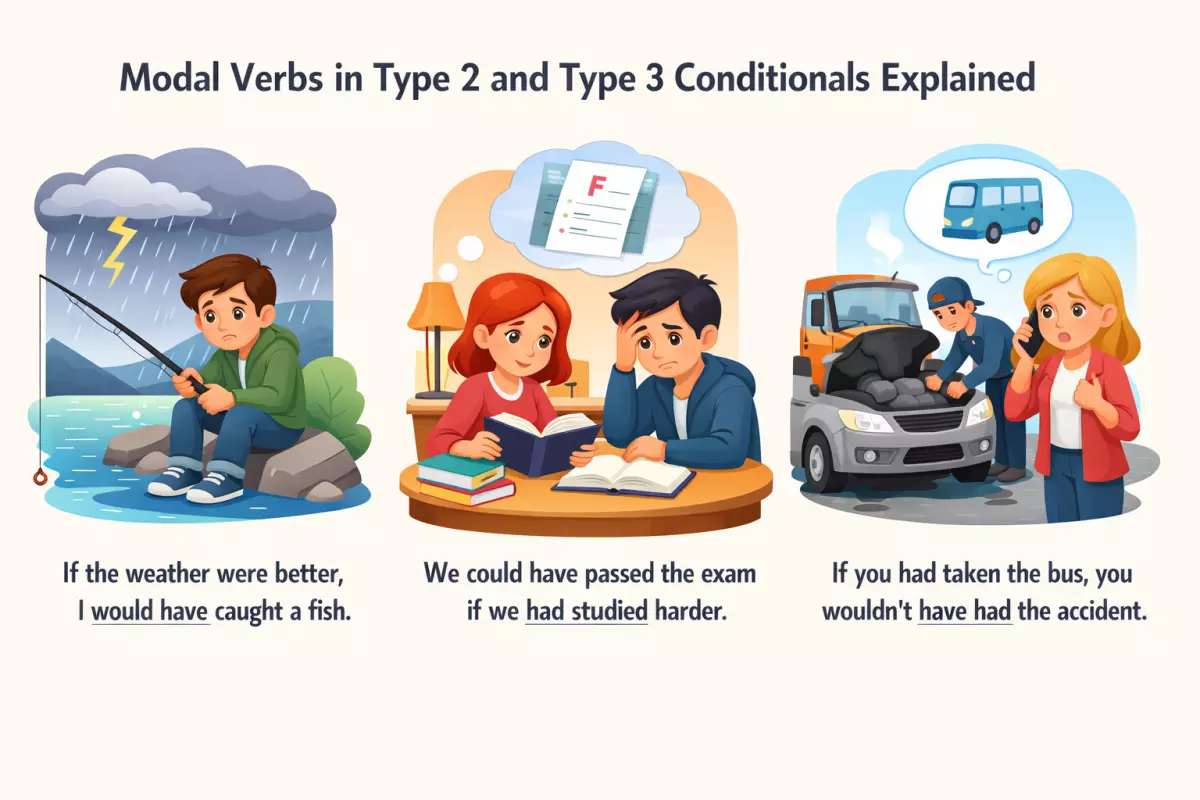 This article shows how modal verbs work in unreal conditionals, focusing on would, could, and might in Type 2 and Type 3 forms. It explains how they change the meaning of the result clause and express regret, possibility, or uncertainty, with comparisons and practice exercises.
- How modal verbs appear in unreal conditional structures
- The role of would, could, and might in Type 2 conditionals
- How Type 3 conditionals describe imagined past outcomes
- How modal verbs affect the meaning of the result clause
- Examples comparing different modal choices in hypothetical situations
- How speakers express regret, possibility, or uncertainty in unreal conditions
- Exercises and practice activities using modal verbs in Type 2 and Type 3 conditionals
Using can, could, might, should, or would in unreal past and past-perfect if clauses can be confusing, but it mainly comes down to the meaning you want. In Type 2 and Type 3 conditionals, these modals express ability, possibility, advice, or regret in imagined situations. If you match the modal to what you would actually say, the sentence will sound natural.
How modal verbs appear in unreal conditional structures
In unreal conditionals, modal verbs help you express possibility, advice, ability, permission, or obligation in situations that are imagined rather than real. The key is that the conditional tense pattern stays the same, while the modal changes the meaning of the result (and sometimes the condition).
Core placement pattern
- If-clause (Type 2): past simple (or were for all persons in formal style) → main clause: would/could/might + base verb
- If-clause (Type 3): past perfect → main clause: would/could/might + have + past participle
- Modal verbs usually appear in the main clause to show the speaker’s attitude to the outcome (certainty, ability, permission, etc.).
- Modals can also appear in the if-clause when the condition itself involves ability, permission, or willingness, but the tense still shifts back (e.g., could in Type 2; could have in Type 3).
Common modals in Type 2 (present/future unreal) and what they signal
- would: the imagined result feels likely in that unreal situation (If I had more time, I would travel more.)
- could: ability or practical possibility (If we lived closer, we could meet every week.)
- might: weak possibility or uncertainty (If I knew his number, I might call him.)
- would be able to: specific ability in that scenario (If she had the key, she would be able to open the office.)
- couldn’t: lack of ability/possibility (If it were cheaper, I couldn’t refuse.)
- might not: uncertain negative outcome (If they offered me the job, I might not accept.)
- should (less common in the result): advice/expected action (If you had any doubts, you should ask now.)
- would have to: obligation in the imagined situation (If I moved abroad, I would have to learn the language.)
- could have to: possible obligation (If the rules changed, we could have to register again.)
- wouldn’t: refusal/negative willingness (If he were here, he wouldn’t agree.)
Common modals in Type 3 (past unreal) and what they signal
- would have + past participle: the result that did not happen (If I had seen you, I would have said hello.)
- could have + past participle: past ability/opportunity that was missed (If she had left earlier, she could have caught the train.)
- might have + past participle: uncertain past result (If we had taken a taxi, we might have arrived on time.)
- would have been able to: specific achieved ability in the past scenario (If he had trained more, he would have been able to finish the race.)
- couldn’t have + past participle: impossible past result (If I had tried, I couldn’t have changed their minds.)
- might not have + past participle: uncertain negative past result (If you had told me, I might not have gone.)
- should have + past participle: criticism/regret about a better past choice (If you had been unsure, you should have checked the details.)
- would have had to: past obligation in the unreal timeline (If they had refused, we would have had to find another supplier.)
- could have had to: possible past obligation (If the audit had happened, we could have had to provide more documents.)
- wouldn’t have + past participle: refusal/negative willingness in the imagined past (If she had asked, I wouldn’t have ignored her.)
Frequent accuracy points (form and meaning)
- ✅ Type 2 result uses a base verb after the modal: “would/could/might go” → ❌ not “would goes”.
- ✅ Type 3 result needs have + past participle: “would have gone” → ❌ not “would have went”.
- could in Type 3 often means “had the chance to,” not just general ability; use was/were able to when you mean a single successful action.
- might keeps the meaning of uncertainty; it does not imply the result was likely, only possible.
- should have expresses evaluation (regret/criticism), not a neutral alternative past.
- In formal English, “If I were …” is preferred, but “If I was …” is common in everyday speech.
The role of would, could, and might in Type 2 conditionals
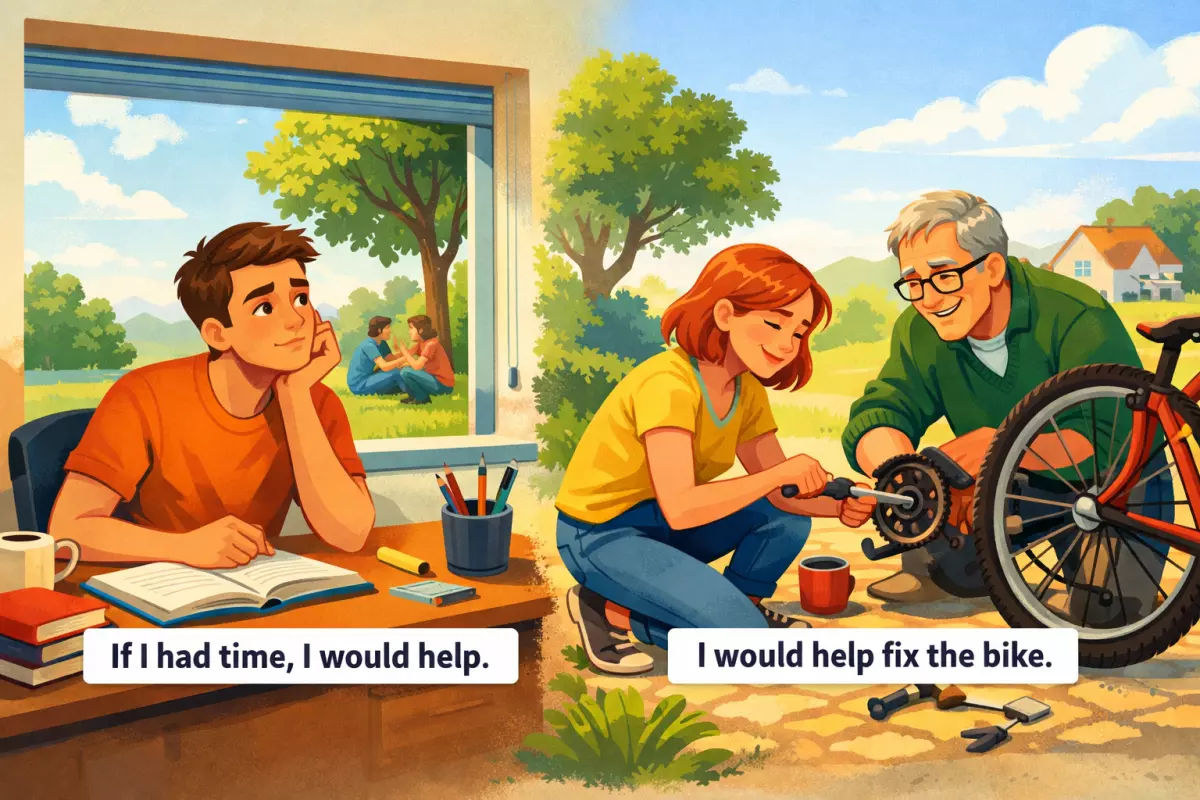
In Type 2 conditionals, modal verbs in the main clause show the result as hypothetical (not real now). The if-clause typically uses past simple to signal “unreal present/future,” and the main clause uses a modal to express what would happen, what is possible, or what is uncertain.
Core pattern and where the modals go
- Standard form: If + past simple, … would/could/might + base verb.
- Comma rule: Use a comma when the if-clause comes first: If I had time, I would help.
- Order can change: I would help if I had time.
- “Were” option: With be, many speakers use “were” for all subjects in more formal English: If I were you, I would… (also common: If I was you…).
What each modal adds to meaning
- Would is the default for a likely or expected hypothetical result: it presents the outcome as the natural consequence in that imagined situation.
- Could highlights ability or possibility (often “it would be possible for me to…”): it focuses on what someone is capable of doing or what options exist.
- Might expresses uncertainty: the result is only one possible outcome, not a confident prediction.
- Could vs. might: “Could” often suggests a real capacity/option; “might” suggests a weaker chance or a guess.
High-value examples (with typical contexts)
- If I had more free time, I would join the class. (expected result)
- If she knew his number, she would call him. (straightforward hypothetical)
- If we lived closer, we would visit more often. (imagined change, regular result)
- If I were the manager, I would change the schedule. (advice/stance)
- If you studied a bit each day, you could improve quickly. (ability/possibility)
- If he trained more, he could run a marathon. (capacity)
- If we had a bigger budget, we could hire another designer. (option available)
- If I spoke French, I could apply for that role. (ability)
- If you asked her directly, she might say yes. (uncertain outcome)
- If they left now, they might catch the earlier train. (possibility, not guaranteed)
- If I didn’t have meetings, I might work from a café. (one possible choice)
- If the weather improved, we might go hiking. (dependent, uncertain)
Negative and question forms
- Negative main clause: If I had the key, I wouldn’t open it without asking.
- Negative with could: If she were here, she couldn’t ignore the problem.
- Negative with might: If we took a taxi, we might not arrive any faster.
- Questions (less common but possible): What would you do if you won the scholarship?
- Polite/soft questions: If I sent the draft today, could you review it?
Common accuracy points
- ✅ If I had the money, I would buy it. → past simple in the if-clause + modal in the result clause.
- ❌ If I would have the money, I buy it. → avoid “would” in the if-clause for Type 2.
- ✅ If I were you, I would talk to her. → “were” is a common formal choice with advice.
- ✅ If we had more time, we could look at another option. → “could” fits when you mean “it would be possible.”
- ✅ If you changed the subject, he might relax. → “might” fits when you are not sure of the result.
How Type 3 conditionals describe imagined past outcomes
Type 3 conditionals talk about an unreal past: you imagine a different earlier situation and describe a different result. Because the time is finished, the grammar uses perfect forms to show “too late to change,” often with modal verbs to add shades of possibility, certainty, advice, or criticism.
Core pattern and meaning
- If-clause (past condition):
if + past perfect(affirmative or negative) - Main clause (imagined result):
would/could/might/should + have + past participle - Use: regret, hindsight, missed chances, alternative history, and evaluation of past decisions
Modal verbs in the result clause: what each one suggests
would have + past participle→ the most neutral “alternate result” (often fairly certain in the speaker’s mind)could have + past participle→ ability or opportunity existed, but it didn’t happenmight have + past participle→ a possible result, not guaranteedshould have + past participle→ expectation, advice in hindsight, or mild criticismmust have + past participle→ strong logical conclusion about the past (less common inside a full Type 3 conditional, but used when the speaker is inferring)
High-utility example patterns (with common meanings)
- If I had left earlier, I would have arrived on time. (different result, likely)
- If she had studied more, she would have passed the exam. (cause-and-effect)
- If we had taken a taxi, we could have caught the train. (missed opportunity)
- If they had asked, I could have helped. (ability was available)
- If you had told me, I might have changed my mind. (possible, uncertain)
- If he hadn’t ignored the warning, he might have avoided the accident. (probable but not certain)
- If I had known about the meeting, I would have joined. (missing information)
- If we had booked earlier, we wouldn’t have paid so much. (negative result avoided)
- If she had listened, she should have understood the instructions. (expectation/critique)
- If you had checked the address, we wouldn’t have gotten lost. (regret)
- If I had been more careful, I wouldn’t have broken it. (self-blame)
- If the team had trained harder, they could have won. (potential outcome)
- If the weather had been better, we might have gone hiking. (conditional possibility)
- If he hadn’t spent so much, he would have saved enough. (alternate past financial result)
- If you had called earlier, I would have picked you up. (missed coordination)
Common form choices and frequent mistakes
- ✅
If + had + past participle(not simple past): “If I had seen you…” ❌ “If I saw you…” (when the meaning is unreal past) - ✅
would havein the result clause: “I would have called.” ❌ “I would call.” (that sounds like present/future hypothetical) - Avoid
would havein the if-clause in standard usage: ❌ “If I would have known…” ✅ “If I had known…” - Negatives can appear in either clause to change the meaning: “If she hadn’t taken that job, she would have stayed here.”
- Use
might havewhen you want uncertainty; usewould havewhen you’re presenting the result as the clear consequence.
How modal verbs affect the meaning of the result clause
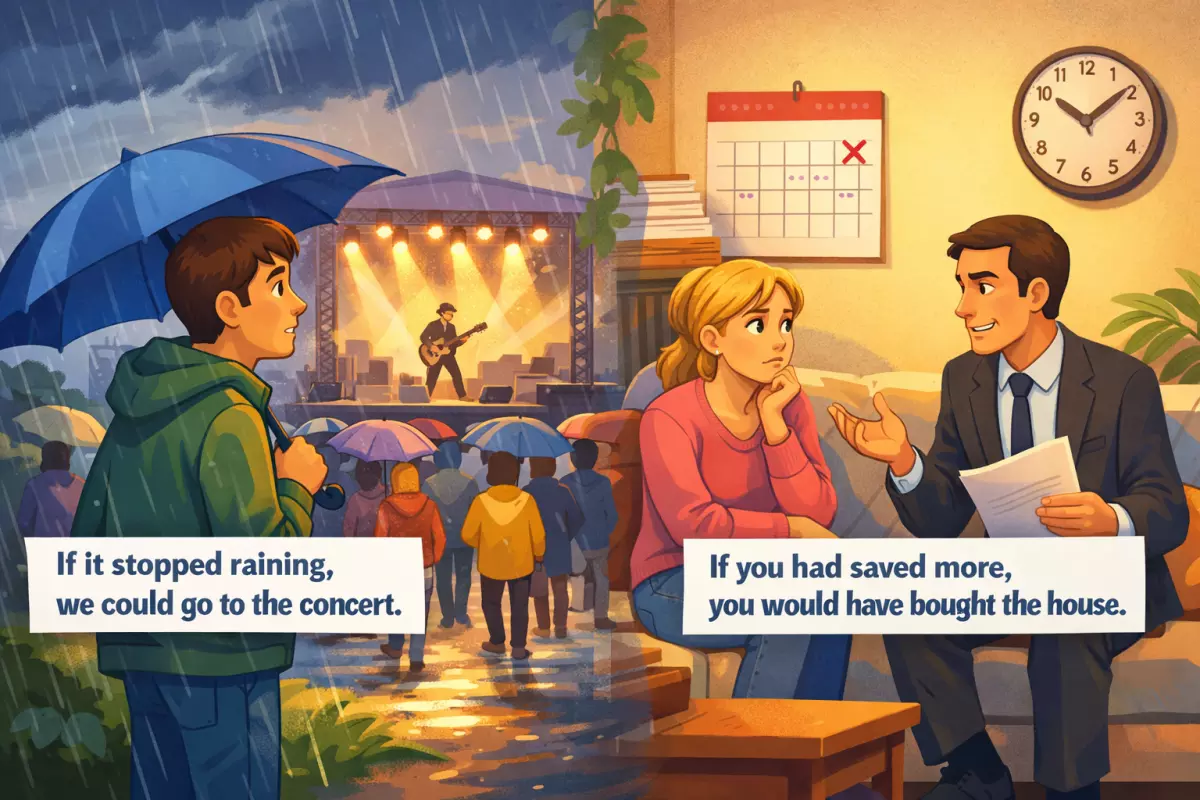
In Type 2 and Type 3 conditionals, the result clause (the part with would and other modals) is where you show attitude: certainty, possibility, advice, ability, permission, or criticism. Changing the modal changes the meaning, even though the conditional structure stays the same.
Core pattern
- Type 2 (unreal present/future): If + past simple, modal + base verb (e.g., could go, might help).
- Type 3 (unreal past): If + past perfect, modal + have + past participle (e.g., could have gone, might have helped).
What different modals communicate in the result clause
- would: expected result in an unreal situation (neutral prediction).
- Type 2: If I had more time, I would exercise more.
- Type 3: If I had known, I would have called you.
- could: ability or a realistic option (focus on capability/possibility, not certainty).
- Type 2: If we lived closer, we could meet more often.
- Type 3: If you had asked, I could have helped.
- might / may: weaker possibility; the result is not guaranteed.
- Type 2: If you spoke more slowly, people might understand you better.
- Type 3: If we had left earlier, we might have caught the train.
- should: advice or expectation; often suggests the result is desirable or “the right outcome.”
- Type 2: If you took breaks, you should feel less tired.
- Type 3: If they had followed the instructions, it should have worked.
- must: strong logical conclusion (rare in pure “result” meaning, common for deduction).
- Type 2 (deduction): If he were at home, he must be asleep by now.
- Type 3 (deduction): If she had seen the message, she must have replied.
- can: general possibility or ability; in Type 2 results it often sounds more general than hypothetical.
- Type 2 (general): If you heat ice, it can melt quickly.
- For unreal results, could is usually the safer choice.
- will: willingness/insistence rather than a hypothetical result; it can sound like refusal or a habit.
- ❌ If I had more time, I will help. → ✅ If I had more time, I would help.
- But: If he were here, he will insist on paying. (insistence/habit, not a typical conditional “result”)
Using modal combinations for nuance
- would + probably / definitely: adjusts certainty without changing the modal.
- Type 2: If I knew her number, I would probably text her.
- Type 3: If we had checked the address, we definitely would have arrived on time.
- wouldn’t / couldn’t: negative results can mean refusal or inability; context decides.
- Type 2: If he respected the rules, he wouldn’t do that. (expected behavior)
- Type 3: If the file had been saved, we couldn’t have lost it. (impossibility)
- might not / may not: uncertainty in the negative result (not “definitely not”).
- Type 2: If you change jobs, you might not earn more at first.
- Type 3: If we had taken a taxi, we might not have missed the start.
Common usage patterns to notice
- Type 2: would vs could vs might often forms a scale: would (most expected) → could (possible/able) → might (uncertain).
- Type 3: modal + have + past participle is the standard way to show an unreal past outcome: would have missed, could have won, might have forgotten.
- should have in Type 3 often implies criticism or regret about the past result.
- If you had set an alarm, you should have woken up on time. (implied: you didn’t, and that was a mistake)
- When you want a plain hypothetical consequence, would is the default; choose other modals when you want to add meaning (ability, uncertainty, advice, deduction).
Examples comparing different modal choices in hypothetical situations
Modal verbs change the meaning of Type 2 and Type 3 conditionals by adding ideas like ability, advice, permission, certainty, or criticism. The core pattern stays the same, but the modal you choose signals how you want the listener to interpret the hypothetical result.
| Communicative goal | Type 2: unreal present/future | Type 3: unreal past |
|---|---|---|
| Ability / possibility (could) | If I had more time, I could help you. | If I had had more time, I could have helped you. |
| Advice / recommendation (should) | If I were you, I should talk to your manager. | If you had asked earlier, you should have talked to your manager first. |
| Strong intention / willingness (would) | If I lived closer, I would visit more often. | If I had lived closer, I would have visited more often. |
| Permission / polite option (could / might) | If it were allowed, we could park here. | If it had been allowed, we could have parked here. |
| Weaker possibility / uncertainty (might) | If I knew his number, I might call him. | If I had known his number, I might have called him. |
| Logical conclusion / expectation (would) | If the data were correct, the results would match. | If the data had been correct, the results would have matched. |
Patterns to notice (so you can build your own sentences)
- Type 2 form: If + past simple / were → modal + base verb (would/could/should/might + verb).
- Type 3 form: If + past perfect → modal + have + past participle (would/could/should/might + have + V3).
- Meaning shift: swapping the modal changes the speaker’s attitude (certainty, advice, criticism, possibility) more than the basic conditional meaning.
Mini-scenarios showing how the modal changes the message
- Job offer (Type 2): If they offered me the role, I would accept. (clear decision) / I might accept. (uncertain) / I could accept. (possible, maybe depends on conditions)
- Missed train (Type 3): If I had left earlier, I would have caught the train. (expected result) / I might have caught it. (not guaranteed) / I could have caught it. (it was possible)
- Health advice (Type 2): If you exercised regularly, you would feel better. (prediction) / you might feel better. (less certain) / you should exercise regularly. (advice)
- Project delay (Type 3): If we had planned better, we would have finished on time. (likely outcome) / we could have finished on time. (ability/possibility) / we should have planned better. (criticism/regret)
- Money situation (Type 2): If I had more savings, I could take a break. (ability) / I would take a break. (intention) / I might take a break. (uncertain)
- Lost email (Type 3): If you had checked your spam folder, you would have found the message. (expected) / you might have found it. (not sure it was there)
- Rules and permission (Type 2): If it weren’t against policy, we could share the file. (permission/allowed) / we would share the file. (willingness/intention)
- Risky choice (Type 3): If they had invested earlier, they could have made a profit. (possible) / they might have made a profit. (uncertain) / they would have made a profit. (speaker treats it as very likely)
- Social plans (Type 2): If I weren’t working tonight, I would join you. (strong willingness) / I could join you. (possible) / I might join you. (weak commitment)
- Communication mistake (Type 3): If I had explained it clearly, you wouldn’t have misunderstood. (expected prevention) / you might not have misunderstood. (less certain)
- Polite suggestion (Type 2): If you had a moment, you could review this. (soft request) vs. If you had a moment, you should review this. (stronger push)
- Blame vs. possibility (Type 3): If you had backed up your files, you could have recovered everything. (missed possibility) vs. you should have backed up your files. (criticism)
Common form errors to avoid
- ❌ If I had more time, I could have helped. → ✅ If I had more time, I could help. (Type 2 needs modal + base verb)
- ❌ If I had had more time, I could help. → ✅ If I had had more time, I could have helped. (Type 3 needs modal + have + V3)
- ❌ If I would have known, I would have called. → ✅ If I had known, I would have called. (use past perfect in the if-clause for Type 3)
How speakers express regret, possibility, or uncertainty in unreal conditions
In unreal conditionals, modal verbs let speakers fine-tune meaning beyond “not real.” They can signal emotional distance (regret), degrees of likelihood (possibility), or limited knowledge (uncertainty). The key is matching the modal with the time reference: Type 2 usually points to an unreal present/future, while Type 3 points to an unreal past.
Common modal patterns and what they communicate
- Regret about the past (Type 3): if + past perfect → would/should/could/might + have + past participle.
- “If I had known, I would have called you.” (clear regret)
- “If we had left earlier, we could have caught the train.” (missed ability/opportunity)
- “If you had told me, I might have helped.” (possible different outcome, not certain)
- Criticism or “you made the wrong choice” (Type 3): should have often carries judgment.
- “If you had asked, I should have explained.” (expected action in that past situation)
- ✅ “If he had studied, he should have passed.” (speaker thinks passing was the likely/expected result)
- ❌ “If he had studied, he should pass.” (time mismatch)
- Softened regret or polite distance (Type 3): would have liked/loved/preferred frames disappointment gently.
- “If I’d had time, I would have liked to stay longer.”
- “If she’d been free, she would have loved to join.”
- Unreal present/future with possibility (Type 2): if + past simple → might/could + base verb.
- “If I had more time, I might take another course.” (one possible plan)
- “If we lived closer, we could meet more often.” (possible because conditions would allow it)
- Unreal present/future with stronger prediction (Type 2): would + base verb suggests a more confident result.
- “If you practiced daily, you would improve quickly.”
- “If it weren’t raining, we would go for a walk.”
- Uncertainty about a past result (Type 3): might have highlights that the speaker can’t be sure.
- “If he had taken the earlier flight, he might have arrived on time.” (possible, not guaranteed)
- “If they had invested, they might have lost money.” (uncertain alternative past)
- “Ability” vs. “permission” meanings (Type 2/3): could can mean different things; context decides.
- Ability: “If I were taller, I could reach the shelf.”
- Opportunity: “If we had booked earlier, we could have gotten better seats.”
- Permission (less common in conditionals, but possible): “If the manager agreed, we could leave early.”
- Advice in unreal situations (Type 2): should + base verb gives a recommendation about a hypothetical present/future.
- “If I were you, I should apologize.” (also common: “I would apologize”)
- “If she wanted faster results, she should train differently.”
- Mixed time references for realistic nuance: speakers sometimes combine a past condition with a present result.
- “If I had taken that job, I would be living abroad now.” (past choice → present consequence)
- “If she had saved more, she could buy a car now.” (past habit → present ability)
- Common form checks (to avoid time clashes):
- Type 2 result: would/could/might + base verb (not “would have”).
- Type 3 result: would/could/might + have + past participle (not base verb).
- Past participle matters: ✅ “would have gone” / ❌ “would have go”.
Choosing the right modal for the meaning you want
- Use would when the imagined result feels like the natural consequence in that unreal world.
- Use might when you want to keep the outcome open and avoid sounding certain.
- Use could when the focus is ability, opportunity, or a condition that makes something possible.
- Use should for advice, expectations, or mild criticism—often with a stronger “judgment” flavor in Type 3.
Exercises and practice activities using modal verbs in Type 2 and Type 3 conditionals
Use these tasks to build accuracy with form and meaning. Focus on two patterns: Type 2 (unreal present/future) and Type 3 (unreal past). Pay attention to where the modal verb goes (main clause) and which time reference the conditional clause expresses.
1) Quick form reminders (use as a checklist)
- Type 2 basic shape: If + past simple, modal + base verb (or would + base verb).
- Type 2 with ability/permission/advice: If I had..., I could/might/should + base verb.
- Type 3 basic shape: If + past perfect, modal + have + past participle.
- Type 3 with possibility/regret: If they had..., they might/could/should have + past participle.
- Keep the conditional clause time consistent: Type 2 uses past form for present/future meaning; Type 3 uses past perfect for past meaning.
- Use were (not was) in formal Type 2 with “I/he/she/it” (If I were...).
2) Choose the best modal (Type 2)
Complete each sentence with could / might / should / would (one best answer).
- If I had a car, I ______ drive to work instead of taking the bus.
- If she spoke French, she ______ apply for the job in Paris.
- If you wanted to save money, you ______ cook at home more often.
- If we had more time, we ______ visit the museum after lunch (but I’m not sure).
- If he were more careful, he ______ make fewer mistakes.
- If they lived closer, they ______ come over more often.
- If I knew his number, I ______ call him right now.
- If the weather were better, we ______ go hiking this weekend.
Show answers
- could
- could
- should
- might
- would
- would
- would
- would
3) Choose the best modal (Type 3)
Complete each sentence with could have / might have / should have / would have (one best answer).
- If I had set an alarm, I ______ arrived on time.
- If she had studied more, she ______ passed the exam (it was possible, not certain).
- If you had asked me, I ______ helped you.
- If they had left earlier, they ______ caught the train.
- If he had worn a helmet, he ______ avoided the injury (advice/regret).
- If we had known about the roadworks, we ______ taken a different route.
- If I hadn’t lost my phone, I ______ called you yesterday.
- If she had listened carefully, she ______ understood the instructions.
Show answers
- would have
- might have
- would have
- could have
- should have
- would have
- would have
- would have
4) Correct the errors (focus on modal placement and verb form)
Each item contains one problem. Rewrite it correctly.
- If I would have more free time, I could learn Japanese.
- If she had told me, I would helped.
- If we were rich, we would have bought a bigger house last year.
- If he had taken the earlier flight, he would arrive on time.
- If I knew, I would have told you yesterday.
- If they had more experience, they might have got the job.
- If you had listened, you would understand.
- If I were you, I will apologize.
Show answers
- If I had more free time, I could learn Japanese.
- If she had told me, I would have helped.
- If we were rich, we would buy a bigger house. (Or: If we had been rich, we would have bought a bigger house last year.)
- If he had taken the earlier flight, he would have arrived on time.
- If I had known, I would have told you yesterday.
- If they had more experience, they might get the job. (Or: If they had had more experience, they might have got/gotten the job.)
- If you had listened, you would have understood.
- If I were you, I would apologize.
5) Match meaning to modal choice (micro-drills)
Choose the option (A or B) that best matches the meaning in brackets.
- If I had his email, I (A) would contact him (B) might contact him. (I’m not sure I’d do it.)
- If she had taken the offer, she (A) could have moved abroad (B) should have moved abroad. (It was possible, not a recommendation.)
- If you were more organized, you (A) would miss fewer deadlines (B) might miss fewer deadlines. (Cause-and-effect, expected result.)
- If they had checked the address, they (A) wouldn’t have got lost (B) might not have got lost. (Very likely prevention.)
- If I were in your position, I (A) would talk to my manager (B) could talk to my manager. (Advice: best course of action.)
- If he had driven more slowly, he (A) could have avoided the ticket (B) would have avoided the ticket. (Not certain; depends on the situation.)
Show answers
- B
- A
- A
- A
- A
- A
6) Production practice (write your own)
- Write 5 Type 2 sentences about your current life using: could (ability), might (uncertainty), should (advice), would (expected result), and wouldn’t (negative result).
- Write 5 Type 3 sentences about a past day using: could have (possibility/ability), might have (uncertain past), should have (regret), would have (different outcome), and wouldn’t have (prevented outcome).
- Optional constraint: include at least two negative forms (couldn’t / wouldn’t / might not / shouldn’t have).
- Self-check: confirm your main clause uses base verb (Type 2) or have + past participle (Type 3).