Using Modal Verbs for Logical Deduction in English

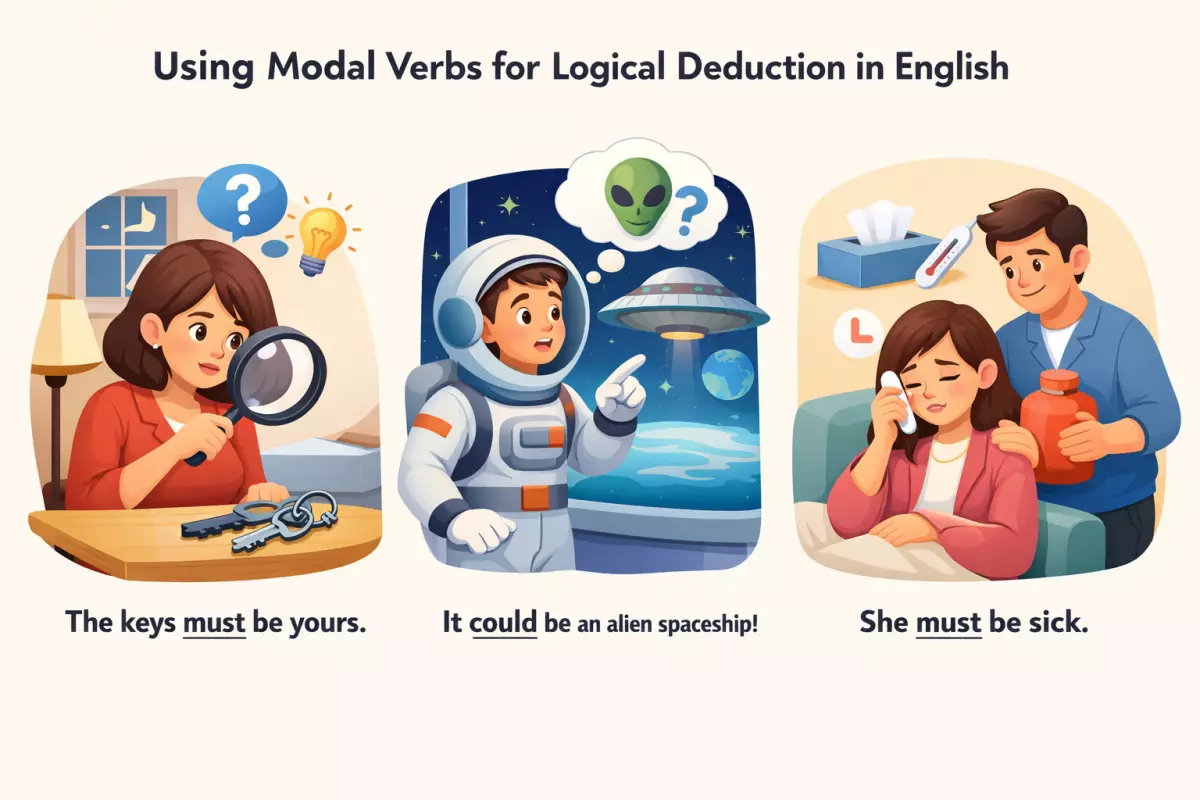 The article explains how English speakers use modal verbs to make logical deductions, comparing strong vs weak deduction. It shows how must, might, may, and could express different certainty levels, with evidence-based examples, context tips, and practice exercises.
- How English speakers use modal verbs to draw logical conclusions
- The difference between strong and weak deduction in modal verbs
- How must, might, may, and could signal different levels of certainty
- Situations where speakers infer information from evidence
- Examples of deduction in everyday explanations and conversations
- How context determines which modal verb sounds most logical
- Exercises and practice activities with modal verbs for logical deduction
Using modal verbs to make smart guesses and conclusions can make everyday English clearer. In real life we rarely have all the facts, so we read clues like a wet coat, a late reply, or a strange noise next door. Choosing must, might, could, or can’t helps you show how sure you are, sound more natural, and avoid stating assumptions as facts.
How English speakers use modal verbs to draw logical conclusions
English often signals reasoning with modal verbs, especially when a speaker is inferring a cause from evidence rather than stating a known fact. The key is matching the modal to the strength of the evidence and choosing the right time frame (present, past, or ongoing).
Core deduction patterns (present, ongoing, past)
- Present deduction: must + base verb for a strong conclusion. Example: “She must be at work; her car isn’t here.”
- Present negative deduction: can’t + base verb for a strong negative conclusion. Example: “He can’t be the manager; he’s only 19.”
- Weaker present deduction: may/might/could + base verb for possibility. Example: “They might live nearby; I see them often.”
- Ongoing situation (now): must/can’t/may/might/could + be + -ing. Example: “The baby must be sleeping; it’s very quiet.”
- Past deduction: must/can’t/may/might/could + have + past participle. Example: “She must have missed the train; she’s not here yet.”
- Past ongoing: must/can’t/may/might/could + have been + -ing. Example: “He might have been working late; he didn’t answer.”
Choosing the modal: strength of evidence
- Must = the speaker sees the conclusion as the most logical explanation. It’s common with clear clues (times, locations, visible results).
- Can’t = the speaker rules something out based on strong contradiction with the evidence. In deduction, can’t is more natural than “must not.”
- May / might / could = the speaker keeps several explanations open. Might is often the most cautious; could can suggest “one possible explanation.”
Common evidence-to-conclusion moves speakers make
- Use a concrete clue first, then the modal conclusion: “The lights are off, so they must be out.”
- Use contrast to show uncertainty: “He’s usually on time, but he might have forgotten.”
- Use “so” and “that’s why” to frame inference: “The roads are blocked, so we can’t get through.”
- Use “I guess / I think” to soften the claim while keeping the modal: “I think she may be in a meeting.”
- Use “probably” with must or might to fine-tune certainty: “They must probably know already” (less common) vs. “They probably must know already” (more natural placement: “They must know already” or “They probably know already”).
High-value example set (varied contexts)
- “This key can’t be the right one; it doesn’t fit.”
- “You must be tired after that flight.”
- “She might be stuck in traffic.”
- “They could be joking, but I’m not sure.”
- “He must be working from home today; his laptop is open.”
- “The kids can’t be sleeping; I can hear them.”
- “She must have left early; her desk is empty.”
- “He can’t have said that; it’s completely out of character.”
- “They might have taken a different route.”
- “You could have misunderstood the email.”
- “The package must have been delivered; the tracking says ‘received.’”
- “She might have been waiting outside when it started raining.”
Frequent pitfalls (and the usual fix)
- ✅ “He can’t be at home.” ❌ “He mustn’t be at home.” (For deduction, can’t is the standard choice; mustn’t usually means prohibition.)
- ✅ “They must have forgotten.” ❌ “They must forgot.” (Past deduction needs have + past participle.)
- ✅ “She might be busy.” ❌ “She might is busy.” (After a modal, use the base form, not a conjugated verb.)
- ✅ “He may be late.” ❌ “He may to be late.” (No “to” after modals.)
- ✅ “You can’t have seen him yesterday.” ❌ “You can’t saw him yesterday.” (Keep the perfect form for past inference.)
When these patterns are used consistently, the listener can tell whether the speaker is certain, ruling something out, or simply offering a plausible explanation. The modal choice and the time form do most of the work.
The difference between strong and weak deduction in modal verbs

English uses different modal verbs to show how confident a speaker is about a conclusion. Some forms signal a near-certainty based on evidence, while others present a possibility with limited support. Choosing the right modal is mostly about matching your confidence level to the strength of the clues you have.
| Deduction strength | Typical modals | Meaning (confidence) | Example |
|---|---|---|---|
| Strong | must, can’t (couldn’t) | Very likely / logically necessary; or logically impossible | She must be at work; her car is gone. / He can’t be serious. |
| Medium | should, ought to | Expected or probable from what you know | They should be home by now; the train arrived at six. |
| Weak | may, might, could | Possible; several explanations are still open | She might be in a meeting. / It could be a mistake. |
| Very weak / speculative | might possibly, could perhaps | Remote possibility; speaker is cautious | It might possibly be related, but I’m not sure. |
Core patterns to build deductions
Once you choose a strength level, the grammar pattern usually stays consistent. These are the most common structures for present, past, and ongoing situations.
- Present state: modal + be + noun/adjective
✅ She must be tired. / He might be a new hire. - Present action: modal + base verb
✅ They must know the answer. / She may work from home. - Ongoing (now): modal + be + -ing
✅ He must be driving. / They could be waiting outside. - Past event: modal + have + past participle
✅ She must have left early. / He might have forgotten. - Past ongoing: modal + have been + -ing
✅ They must have been arguing. / She could have been sleeping.
How to choose: evidence and alternatives
Strength is not about sounding formal; it’s about how tightly the evidence points to one conclusion.
- Use must when the clues strongly support one explanation and competing explanations feel unlikely.
- Use can’t when the conclusion conflicts with what you know (it doesn’t fit the facts).
- Use should/ought to when the conclusion is reasonable based on schedules, habits, norms, or typical outcomes.
- Use may/might/could when you can name multiple plausible explanations and you are not committing to one.
- Use might (often) for extra caution; it commonly feels weaker than may in everyday speech.
Common usage notes (and frequent mistakes)
- Deduction vs. permission: may can mean permission, but in deductions it means possibility.
✅ He may be late (possible). → Different from: You may leave (permission). - Mustn’t is usually prohibition, not deduction.
❌ He mustn’t be at home (often sounds like “He is not allowed to be at home”).
✅ He can’t be at home (deduction: impossible). - Couldn’t can work like can’t for impossibility, often sounding slightly softer or more tentative in some contexts.
✅ That couldn’t be true. - Match time correctly: use have + past participle for past conclusions.
❌ She must be left early. ✅ She must have left early. - Avoid over-strong claims: if your evidence is thin, must can sound unjustified; switch to might/could.
Quick example set (same situation, different strength)
- Strong: The lights are off and the door is locked. They must be closed.
- Medium: It’s after business hours, so they should be closed.
- Weak: They might be closed, but maybe someone is still inside.
- Negative strong: They can’t be open; there’s a sign saying “Closed.”
How must, might, may, and could signal different levels of certainty
In logical deduction, these modal verbs help you show how confident you are about a conclusion based on evidence. They sit on a rough scale from strong inference (must) to weaker possibility (might/may/could). The key is matching the modal to the strength of your evidence, not to what you want to be true.
| Modal | Certainty level (typical) | What it means in deduction | Example (present) |
|---|---|---|---|
| must | High | The only reasonable conclusion from the evidence | She must be at work; her car is in the staff parking lot. |
| may | Medium | A real possibility; evidence suggests it, but other outcomes remain likely | He may know the answer; he studied the topic last week. |
| could | Medium to low | One possible explanation among several (often highlights alternatives) | The delay could be due to traffic. |
| might | Low | A weaker possibility; the speaker is cautious or evidence is thin | They might be home, but the lights are off. |
Core patterns for deduction
Deduction modals commonly appear in a few reliable structures. Using the right structure matters as much as choosing the modal.
- must + base verb (present/future deduction): She must live nearby.
- may/might/could + base verb (present/future possibility): He might arrive late.
- must + be + -ing (deduction about an activity now): They must be waiting outside.
- may/might/could + be + -ing (possible activity now): She may be working from home today.
- must + have + past participle (past deduction): You must have left your phone in the taxi.
- may/might/could + have + past participle (past possibility): He could have misunderstood the instructions.
- must not + base verb (negative deduction: strong conclusion something is not true): This must not be the right address.
- may not / might not + base verb (negative possibility): They might not know about the change.
Choosing the modal: evidence strength and alternatives
When you decide between these modals, focus on two questions: (1) How strong is the evidence? (2) How many competing explanations are still plausible?
- Use must when the evidence points to one dominant conclusion and alternatives feel unlikely.
- Use may when you see a reasonable possibility, but you are not ready to commit to it.
- Use could when you want to present one explanation as an option, especially when several causes are possible.
- Use might when you are being cautious, the evidence is limited, or you want to sound less definite.
Common example sets (present and past)
- The office is dark; everyone must be in a meeting.
- The office is dark; everyone may be in a meeting.
- The office is dark; everyone could be in a meeting.
- The office is dark; everyone might be in a meeting.
- She isn’t answering; she must be on a call.
- She isn’t answering; she might be on a call.
- He looks exhausted; he must have worked late.
- He looks exhausted; he may have worked late.
- He looks exhausted; he could have worked late (or slept badly).
- He looks exhausted; he might have worked late.
- The package isn’t here; it must have been delivered to the wrong apartment.
- The package isn’t here; it could have been delayed at the depot.
- They’re speaking quietly; they must be discussing something private.
- They’re speaking quietly; they might be discussing something private.
Frequent pitfalls to avoid
- ✅ Deduction: She must be at home. ❌ She must to be at home. (No to after modals.)
- ✅ Past deduction: They must have missed the bus. ❌ They must missed the bus. (Use have + past participle for past.)
- ✅ Negative deduction: He must not know. ❌ He doesn’t must know. (Don’t combine do/does with a modal.)
- Don’t use must when you only have a weak clue; switch to might/may/could to keep the claim proportional to the evidence.
Situations where speakers infer information from evidence

Logical deduction is most natural when you have a clue (something you see, hear, or know) and you want to state what is likely true. English modal verbs let you show how strong your conclusion is, from near certainty (must) to possibility (may/might/could) to negative certainty (can’t).
Common real-life contexts and the modal patterns they trigger
- Visible results (cause → effect): use must for a strong conclusion from clear evidence.
- “The ground is wet. It must have rained.”
- “The lights are off and it’s silent. They must be asleep.”
- Contradictory evidence: use can’t to reject a conclusion because it doesn’t fit the facts.
- “He’s in a meeting right now. He can’t be at home.”
- “This key doesn’t fit. It can’t be the right one.”
- Uncertain clues: use might/may/could when the evidence points in a direction but isn’t decisive.
- “She’s not answering. She might be driving.”
- “That sound could be the washing machine.”
- Explaining someone’s absence: choose the modal based on how strong your supporting details are.
- “His coat is gone. He must have left.”
- “He said he was tired. He might have gone to bed early.”
- ❌ “He can’t have left” (only if you have evidence he stayed, e.g., his car is still here).
- Interpreting tone, mood, or behavior: deductions about feelings often use must (strong) or might (tentative).
- “She’s smiling and relaxed. She must be happy about it.”
- “He’s very quiet today. He might be upset.”
- Inferring identity: use must be when the match is obvious; use could be when several options fit.
- “That’s her handwriting. It must be her note.”
- “Someone’s at the door. It could be the courier.”
- Making sense of a problem or error: modals help you reason from symptoms to a likely cause.
- “The file won’t open. It must be corrupted.”
- “The Wi‑Fi is slow. There might be an outage.”
- “The password is correct. The account can’t be locked, can it?” (speaker checks a deduction)
- Judging past events from present evidence: use must have + past participle for strong past deductions.
- “You’re soaking wet. You must have gotten caught in the rain.”
- “The cookies are gone. Someone must have eaten them.”
- Ruling out a past explanation: use can’t have + past participle when the past scenario conflicts with what you know now.
- “She called me from the airport at 9. She can’t have arrived at 8.”
- “The door was locked all night. He can’t have entered through it.”
- Speculating about past possibilities: use might/may/could have + past participle when several past explanations remain open.
- “He’s late. He might have missed the bus.”
- “They didn’t reply. They could have forgotten.”
- Interpreting rules and routines: deductions often rely on what “normally happens,” so speakers soften with should (expectation) rather than certainty.
- “The train left at 6, so it should be here soon.”
- “If the office is open, someone should have answered.”
- Reconciling two facts: speakers use modals to show they are reasoning through a mismatch.
- “He said he’s abroad, but his car is here. He must be visiting later, or he might have left it.”
- “This looks new. It can’t have been used much.”
Quick usage reminders that prevent common deduction mistakes
- Use must for conclusions, not obligations: ✅ “She must be tired.” ❌ “She must tired.”
- For negative deduction, prefer can’t (not mustn’t): ✅ “It can’t be true.” ❌ “It mustn’t be true.”
- Match time with the right form:
- present: must/might/can’t + base verb (“He must be home.”)
- past: must/might/can’t have + past participle (“He must have gone home.”)
Examples of deduction in everyday explanations and conversations
In day-to-day talk, speakers often infer what is true, likely, or impossible from small clues (sounds, timing, routines, evidence). English uses modal verbs to show how strong that inference is: must for a confident conclusion, might/could for a possibility, and can’t for a logical impossibility. The patterns below show how these choices work in common situations.
Quick patterns to copy
- Now (present deduction): must / might / could / can’t + base verb (be, know, have, etc.).
- Earlier (past deduction): must / might / could / can’t + have + past participle.
- In progress (deduction about an action happening): must / might / could / can’t + be + -ing.
- State vs. action: use be for states (must be tired) and be + -ing for actions (must be sleeping).
Everyday mini-dialogues (with the implied evidence)
- A: The lights are off and it’s quiet. B: They must be asleep. (strong conclusion from the scene)
- A: She isn’t answering. B: She might be in a meeting. (possible explanation)
- A: His car is gone. B: He could be at the gym. (one reasonable option)
- A: The office is locked, and it’s Sunday. B: They can’t be working today. (impossible given the facts)
- A: The kitchen smells like coffee. B: Someone must have made coffee. (past action inferred from evidence)
- A: I left my phone on the table, but it’s not here. B: You must have put it somewhere else. (confident guess about a past action)
- A: The package isn’t at the door. B: It might have been delivered to the wrong address. (past possibility; passive fits “delivered”)
- A: She says she was at home all evening, but her coat is wet. B: She can’t have stayed in all night. (past impossibility)
- A: I hear typing. B: He must be working. (deduction about an action in progress)
- A: The kids are unusually quiet. B: They might be up to something. (uncertain inference)
- A: The bus is late again. B: There must be heavy traffic. (likely cause)
- A: The train arrived early today. B: It can’t be the same schedule as yesterday. (rules out one explanation)
- A: He looks exhausted. B: He must have been up late. (past state inferred from current evidence)
- A: She knows all the answers. B: She must have studied a lot. (past action inferred)
- A: The dog is barking nonstop. B: Someone might be at the door. (possible cause)
- A: The screen is cracked, but he says he never dropped it. B: It must have fallen at some point. (strong conclusion from result)
Common usage notes (to avoid typical mistakes)
- Don’t use “must” for past deduction without “have”: ❌ He must forgot. → ✅ He must have forgotten.
- Use “can’t” (not “mustn’t”) for logical impossibility: ❌ She mustn’t be at home (this sounds like prohibition). → ✅ She can’t be at home.
- Choose the time form that matches your evidence: “He must be at work” (now) vs. “He must have been at work” (earlier).
- Use “could” and “might” to keep options open: “It could be the router” suggests one possibility, not a firm conclusion.
- Negative deductions keep the same structure: “They can’t have left yet” (not possible) vs. “They might not have left yet” (uncertain).
How context determines which modal verb sounds most logical
Choosing the best modal for deduction depends on what kind of evidence you have, how certain you are, and whether you are talking about the present, past, or future. The same situation can sound more or less logical depending on whether the speaker is using direct clues (what you can see/hear), background knowledge (what is typical), or a process of elimination.
Key contextual factors that guide modal choice
- Strength of evidence (certainty level): Use must for a strong conclusion, may/might/could for a possibility, and can’t/couldn’t for a strong negative conclusion.
- Type of evidence: Physical clues often support must (a firm inference), while incomplete information often calls for might (a cautious inference).
- Time reference: Present deductions typically use must be / can’t be; past deductions use must have + past participle / can’t have + past participle.
- What you’re judging: For states/identity use be (He must be tired). For actions use a continuous form (She must be working). For completed past actions use perfect (They must have left).
- Whether alternatives are still open: If several explanations remain, could/might sounds more logical than must.
- Speaker stance: Might signals caution; must signals commitment to a conclusion; can’t signals confident rejection.
- Register and tone: In careful or formal reasoning, may can sound more measured than might (though both express possibility).
- Negation patterns: Deduction commonly uses can’t (not mustn’t) for “logically impossible.” Mustn’t usually means prohibition, not deduction.
- Frequency/typicality vs. one-off events: General expectations can support must only if the situation strongly matches the usual pattern; otherwise prefer might.
- Information source clarity: If you’re guessing without clear support, could often feels safer than must.
Common context-to-modal patterns (with examples)
- Direct clue → strong conclusion: “The lights are off and the door is locked. They must be out.”
- Direct clue → strong negative conclusion: “His car is still here. He can’t have left yet.”
- Incomplete clue → possibility: “She isn’t answering. She might be in a meeting.”
- Several plausible explanations → keep options open: “The package is late. It could have been delayed in transit.”
- Process of elimination → must: “No one else has a key, so it must have been Sam.”
- Expectation contradicted → can’t: “He said he was at work, but I saw him downtown. He can’t have been at work.”
- Present state → must be / might be: “You’re yawning—you must be tired.” / “You look pale—you might be sick.”
- Action in progress → must be + -ing: “Don’t call now; they must be sleeping.”
- Completed past event → must have + past participle: “The email bounced. I must have typed the address wrong.”
- Ongoing situation up to now → must have been + -ing: “Her hands are dirty; she must have been gardening.”
- Weak evidence → might: “I’m not sure, but that might be the right file.”
- Hedged suggestion, not a firm inference → could: “It could be a software issue (but we need more data).”
- Logical impossibility (deduction) → can’t: “That can’t be the final version; it’s missing pages.”
- ❌ Prohibition vs. deduction: “You mustn’t be late” (rule) vs. “He can’t be late” (deduction).
- Past impossibility → can’t have: “They can’t have finished already; they started an hour ago.”
- Polite, measured possibility → may: “This may be a reporting error.”
Quick checks to make your deduction sound natural
- If you mean “I’m sure,” choose must (not might).
- If you mean “I’m not sure,” choose might/could/may (not must).
- If you mean “I’m sure it’s not true,” choose can’t/couldn’t (not mustn’t).
- Match the time: must be (now), must have been (then), must be + -ing (in progress).
- When evidence is thin, prefer softer modals to avoid sounding overconfident.
Exercises and practice activities with modal verbs for logical deduction
Build accuracy by practicing two decisions each time: (1) how strong your conclusion is (near-certain, likely, possible, or impossible), and (2) which time frame you’re talking about (now/recent vs. past). Use these activities to reinforce the most common patterns: must / can’t for strong conclusions, may / might / could for weaker ones, and must have / can’t have / may have for past deductions.
1) Choose the best modal (present deduction)
Complete each sentence with must, can’t, might, may, or could. Focus on what the evidence suggests, not what you want to be true.
- The lights are off and the door is locked. They ______ be home.
- She’s speaking fluent Italian after one short lesson. She ______ be a complete beginner.
- He isn’t answering his phone. He ______ be in a meeting.
- This milk smells sour. It ______ be fresh.
- The streets are wet, but the sky is clear now. It ______ have rained earlier (choose a present-time modal anyway and think about what you can infer now).
- That’s not his signature; it looks different. It ______ be his handwriting.
- They’re laughing in the next room. They ______ be arguing.
- The package is very light. It ______ contain a book.
- Her car is in the driveway. She ______ be nearby.
- The computer is making a strange noise. Something ______ be wrong.
Show answers
- can’t
- can’t
- might / may / could
- can’t
- might / may / could
- can’t
- can’t
- can’t
- might / may / could
- might / may / could
2) Choose the best modal (past deduction)
Complete each sentence with must have, can’t have, might have, may have, or could have. Use have + past participle to show you’re deducing something about the past.
- There are crumbs on the counter. Someone ______ eaten here.
- He was with us all evening, so he ______ sent that email at 7 p.m.
- Her phone is dead. She ______ forgotten to charge it.
- The window is broken from the inside. The thief ______ entered through it.
- They arrived two hours early. They ______ misunderstood the schedule.
- The file is missing, but the backup is still there. She ______ deleted everything.
- We can’t find the keys anywhere. You ______ left them in the taxi.
- He got an A without studying much. He ______ guessed well, or he ______ known the material already.
- The dog is wet and there are paw prints. It ______ been outside.
- The alarm didn’t go off. I ______ set it correctly.
Show answers
- must have
- can’t have
- might have / may have / could have
- can’t have
- must have
- can’t have
- might have / may have / could have
- might have / may have / could have; might have / may have / could have
- must have
- must have
3) Match evidence to strength (quick pattern drill)
- Near-certain conclusion (now): use must for “yes” and can’t for “no.” Example: “The screen is cracked. It must be damaged.” / “It can’t be new.”
- Possible but uncertain (now): use might / may / could. Example: “He might be stuck in traffic.”
- Near-certain conclusion (past): use must have / can’t have. Example: “They must have missed the bus.”
- Possible but uncertain (past): use might have / may have / could have. Example: “She could have taken a different route.”
- Ongoing situation: use must be + -ing or might be + -ing when the evidence points to an action in progress. Example: “He must be working—his laptop is open and the document is updating.”
4) Error correction (spot what breaks the deduction pattern)
Rewrite each sentence so it expresses logical deduction correctly. Pay attention to time markers and form.
- He must to be tired; he’s yawning.
- They can’t have here; the office is locked.
- She must have go home early; her coat is gone.
- It might raining; the clouds are dark.
- He can’t be seen the message; he replied immediately.
- We must have been know each other before.
- She may to have missed the train.
- They can’t have left yet; I just saw them outside.
Show answers
- He must be tired; he’s yawning.
- They can’t be here; the office is locked.
- She must have gone home early; her coat is gone.
- It might be raining; the clouds are dark.
- He can’t have seen the message; he replied immediately.
- We must have known each other before.
- She may have missed the train.
- They can’t have left yet; I just saw them outside.
5) Production task (from clues to conclusions)
Use the prompts to write two deductions for each situation: one strong (must/can’t) and one weaker (might/may/could). If the clues are clearly about the past, use have + past participle.
- Clue: The fridge door is open; the kitchen light is on.
- Clue: His hands are covered in paint; there’s a wet brush on the floor.
- Clue: The meeting started 20 minutes ago; her status is “offline.”
- Clue: The receipt is dated yesterday; the item is already assembled.
- Clue: The car won’t start; the headlights were left on all night.
When you check your own writing, confirm these form rules: ✅ must/can’t + base verb (be, know, understand) and ✅ must/can’t/might + have + past participle for past time. ❌ Avoid “must to,” “can’t have + base verb,” and mixing present modals with clearly finished past events.