How Modal Verbs Show Present-Time Speculation

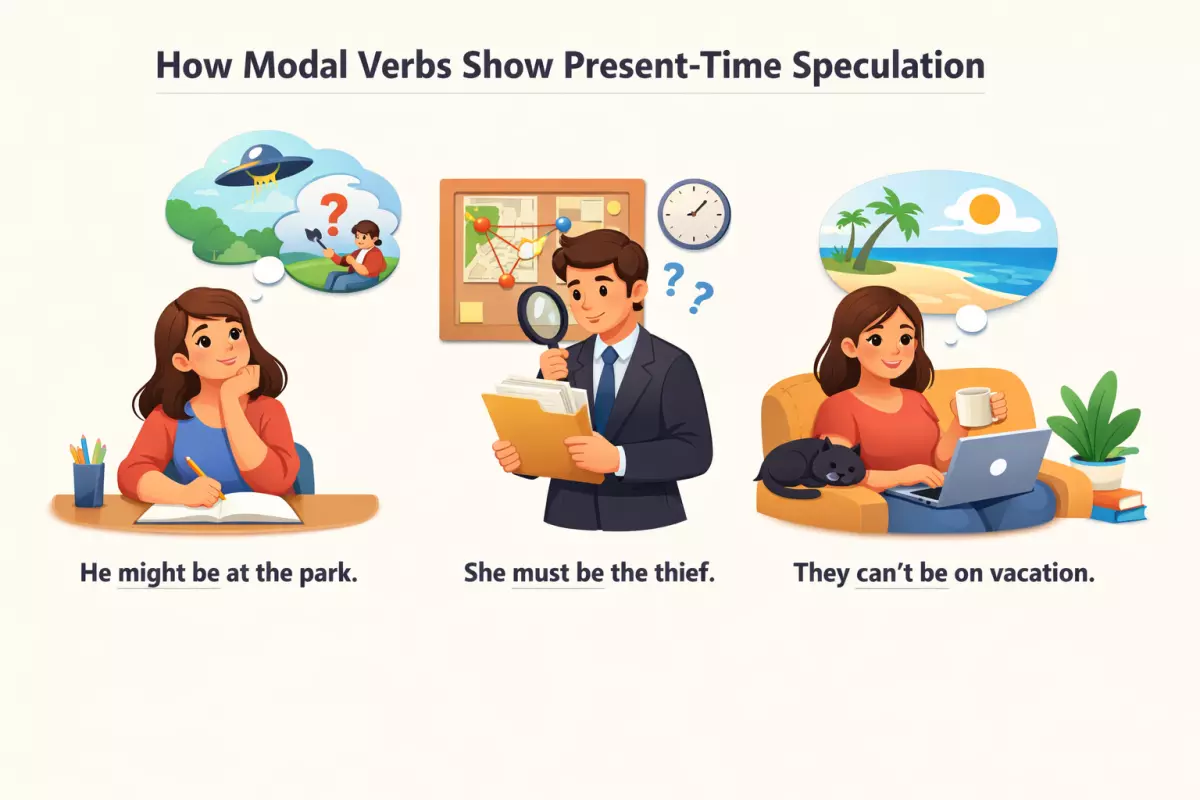 Learn how English speakers guess about what’s happening now using modal verbs. It covers which modals show strong vs weak present speculation, how they pair with progressive forms, real examples, how context shifts certainty, cautious assumptions, plus exercises to practice.
- How speakers guess about current situations using modal verbs
- Which modal verbs express strong or weak speculation about the present
- How modal verbs combine with progressive verb forms
- Examples of guessing what someone is doing right now
- How context influences the strength of speculation
- How speakers express cautious assumptions about present events
- Exercises and practice activities expressing present-time speculation
Do you ever find yourself guessing what is happening right now and using words like might, could, or must to show how sure you are? In everyday English, these modal verbs help you talk about the present without claiming certainty. They let you soften a guess, point to a strong conclusion, or show doubt in just a few words, making your speech clearer and more natural.
How speakers guess about current situations using modal verbs
To make a present-time guess, English commonly combines a modal verb with a simple verb form (often be or a stative verb) to show how sure the speaker is. The modal you choose signals probability, not time; the “right now” meaning usually comes from context (what you can see, what just happened, what is happening at the moment).
Core patterns for present speculation
- Modal + base verb: must / might / may / could / can’t + be / have / know / feel (used for what seems true now).
- Modal + be + -ing: must / might / may / could / can’t + be + working / sleeping / waiting (used for what is probably happening right now).
- Modal + base verb with a state: must / might / may / could / can’t + live / want / need (used for current states, preferences, needs).
- Questions: Could he be…?, Where might they be? (used to invite a guess rather than ask for known information).
- Negative deduction: can’t / couldn’t + be (used when evidence strongly suggests something is not true now).
Choosing a modal by strength of evidence
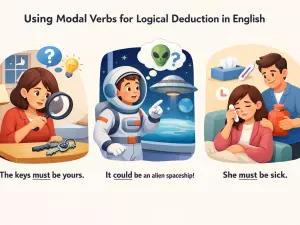
- must = strong logical conclusion from evidence: “The lights are on; she must be home.”
- might / may = possible, but not certain: “He might be in a meeting.” / “She may be busy.”
- could = one plausible explanation among others: “They could be stuck in traffic.”
- can’t / couldn’t = strong conclusion that something is impossible or very unlikely: “That can’t be the right address.”
- should = expectation (not pure deduction): “He should be at work now.” (This can be wrong if plans changed.)
High-utility example sentences (present-time meaning)
- “You’re shivering—you must be cold.”
- “The phone’s on silent; she might be in class.”
- “They’re not answering; they may be driving.”
- “He could be joking, but I’m not sure.”
- “This can’t be the file we need; it’s empty.”
- “Where could my keys be?”
- “She must be the new manager; everyone is listening to her.”
- “He might know the answer—ask him.”
- “They may not be aware of the change yet.”
- “That couldn’t be correct; the totals don’t match.”
- “He must be working late; his car is still here.”
- “She might be feeling unwell today.”
- “The kids could be asleep already.”
- “This can’t be happening right now.”
- “He should be nearby—he left five minutes ago.”
Common usage notes and frequent mistakes
- Use “must” for conclusions, not obligations, when the meaning is speculation: “He must be tired” (deduction), not a command.
- Prefer “can’t” for present negative deduction: ✅ “She can’t be at home.” ❌ “She mustn’t be at home.” (mustn’t usually means prohibition.)
- Use “be + -ing” when you mean an action in progress: “She might be studying” (in progress) vs. “She might study” (habit/future possibility).
- Avoid adding “to” after a modal: ✅ “He might be late.” ❌ “He might to be late.”
- Keep the main verb in base form after the modal: ✅ “They may know.” ❌ “They may knows.”
- Don’t use “will” as a neutral guess about the present: “He will be at home” often sounds like a confident prediction/assumption; for a cautious guess, “He might be at home” is clearer.
Which modal verbs express strong or weak speculation about the present
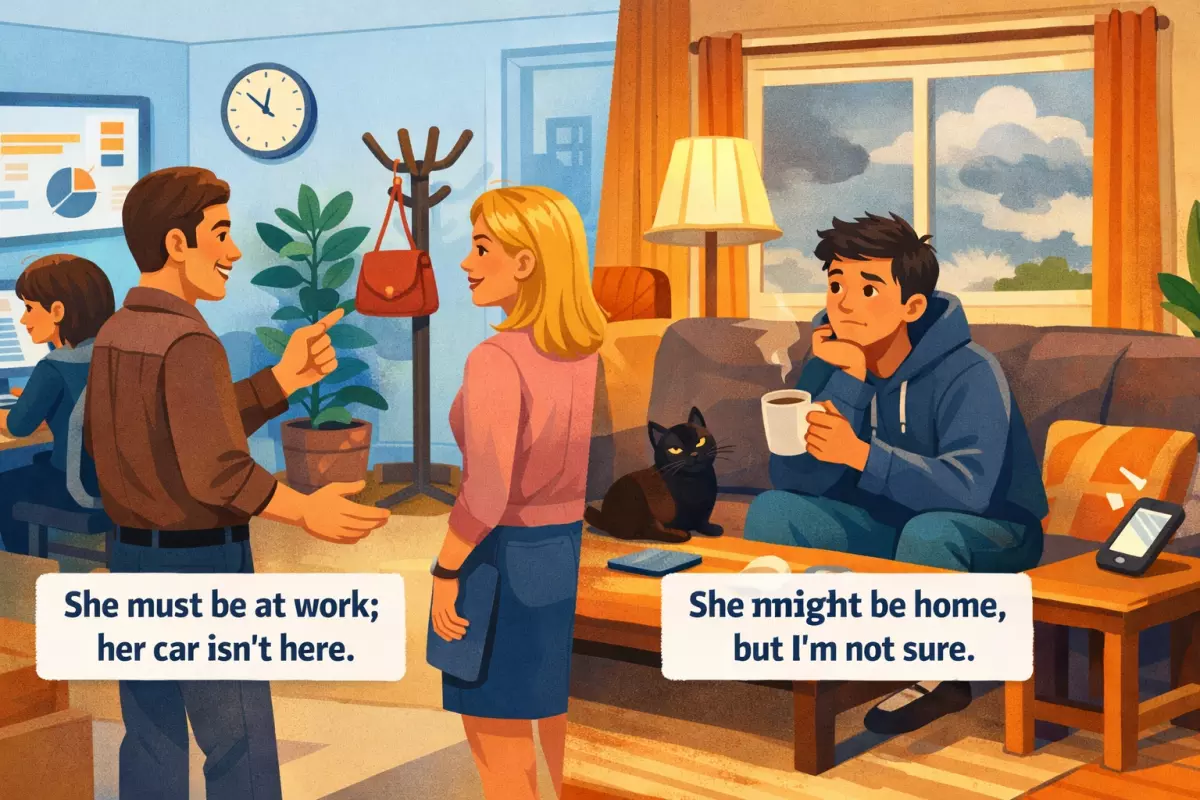
English modals signal how confident a speaker is about what is true now. Some forms sound close to a logical conclusion, while others keep the claim tentative. The key is choosing the right modal (and the right structure) for the strength of your guess.
| Strength of speculation (present) | Modal pattern | Typical meaning | Example (present-time) |
|---|---|---|---|
| Very strong | must + base verb | Near certainty based on evidence | She must be at work; her car isn’t here. |
| Strong | have (got) to + base verb | Strong conclusion (often from facts); less “logical” tone than must in some contexts | This has to be the right address. |
| Medium | should / ought to + base verb | Expectation; “probably true” if things are normal | They should be home by now. |
| Medium | will + base verb | Confident assumption about what is happening now (common in conversation) | Don’t call yet—he will be in a meeting. |
| Medium | may / might / could + base verb | Possibility (might often sounds weaker than may; could is “one possible explanation”) | She might be stuck in traffic. |
| Weak / cautious | can + base verb (limited) | General possibility; often about what is possible in general rather than a specific “now” guess | It can be hard to find parking here. |
Core usage patterns to keep your meaning clear
- Use “modal + be + -ing” for an action in progress now: He must be working. / She might be sleeping. / They could be waiting outside.
- Use “modal + be” for a state or identity now: It must be true. / He may be the manager. / This should be enough.
- Avoid “must” for permission in modern English: ❌ You must be quiet? (sounds like obligation) ✅ You can be quiet? / Could you be quiet?
- Don’t use “mustn’t” for negative speculation: ❌ He mustn’t be at home (means “it is forbidden”) ✅ He can’t be at home (strong negative conclusion).
Negative speculation: strong vs. weak
- Strong negative conclusion: can’t + base verb → “almost certainly not” (He can’t be serious. / She can’t be at the office; the lights are off.)
- Weaker negative possibility: may not / might not + base verb → “possibly not” (He might not be ready yet. / They may not be aware of the change.)
- Expectation (negative): shouldn’t + base verb → “I don’t expect it” (The package shouldn’t be late.)
Quick guidance for choosing the right modal
- Choose must when you have clear evidence and you’re drawing a firm conclusion.
- Choose should/ought to when you’re relying on what normally happens (schedules, routines, typical outcomes).
- Choose may/might/could when you want to keep multiple explanations open.
- Choose will when you’re making a confident assumption about a present situation (often based on experience).
- Use can’t (not mustn’t) to express “that’s impossible” about the present.
How modal verbs combine with progressive verb forms
To speculate about what is happening right now (or around now), English often uses a modal verb plus a progressive form. The basic shape is modal + be + verb-ing, which keeps the meaning in the present while adding an “in progress” viewpoint.
Core pattern and meaning
- Form: modal + be + present participle (verb-ing)
- Time reference: typically “now,” “these days,” or “at the moment” (a current, unfolding situation)
- Function: present-time inference rather than a statement of fact
- Typical modals for speculation: must (strong inference), might/may/could (weaker possibility), can’t (strong negative inference)
Common combinations for present-time speculation (with examples)
- must be + -ing (very likely): “She must be working late; her office light is still on.”
- might be + -ing (possible): “He might be sleeping; he didn’t answer the phone.”
- may be + -ing (possible, slightly more formal): “They may be waiting outside.”
- could be + -ing (possible; one option among others): “The noise could be coming from the pipes.”
- can’t be + -ing (very unlikely/ruled out): “You can’t be serious.” / “He can’t be driving; his car is here.”
- should be + -ing (expectation about what’s happening now): “She should be arriving any minute.”
- ought to be + -ing (expectation, a bit formal): “They ought to be heading back by now.”
- will be + -ing (assumption about the present, often confident): “Don’t call at noon—he will be having lunch.”
- won’t be + -ing (confident negative assumption): “She won’t be using her phone during the exam.”
- would be + -ing (inference from a past viewpoint or in conditional framing): “At this time, he would be working if he followed his usual routine.”
What learners often get wrong
- ✅ “She must be studying.” → matches “now” + ongoing activity
❌ “She must studying.” (missing be) - ✅ “They might be waiting.”
❌ “They might waiting.” (missing auxiliary) - ✅ “He can’t be driving.”
❌ “He mustn’t be driving.” (different meaning: mustn’t is prohibition, not logical deduction)
Choosing progressive vs. simple form
- Use modal + be + -ing when the action is viewed as ongoing: “She must be talking to a client.”
- Use modal + base verb when focusing on a general fact or a completed result: “She must know the answer.”
- With many stative verbs (know, believe, own, like), the progressive is unusual, so speculation typically stays in the simple form: “He must know.” (not “must be knowing” in most contexts)
Adding context markers
- Right now / at the moment: “They might be meeting right now.”
- These days / lately: “He may be working from home these days.”
- Still / already: “She must still be waiting.” / “They could already be leaving.”
Examples of guessing what someone is doing right now
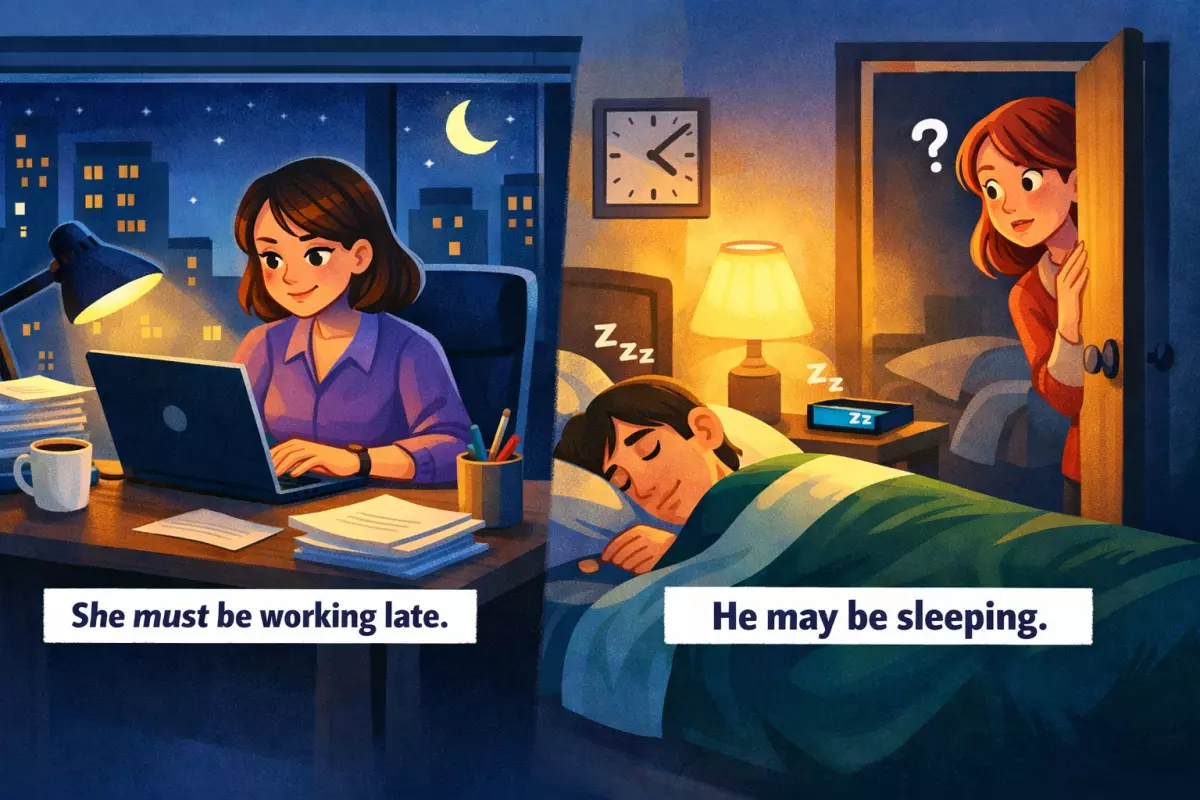
When you infer a current action from evidence (noise, absence, context), English often uses modal verbs plus a progressive form: modal + be + -ing. The modal choice shows how sure you are, while the progressive keeps the meaning tied to “right now” or “around now.”
Common patterns to copy
- must be + -ing (strong conclusion): “She must be working late.”
- may be + -ing (possible): “He may be sleeping.”
- might be + -ing (weaker possibility): “They might be waiting outside.”
- could be + -ing (one plausible explanation): “She could be driving, so she can’t answer.”
- can’t be + -ing (strong negative conclusion): “He can’t be telling the truth.”
Example sentences (with typical contexts)
- “Don’t call again—she must be meeting a client right now.”
- “It’s very quiet upstairs; the baby may be sleeping.”
- “His car is still here, so he might be working from home today.”
- “She isn’t picking up. She could be driving.”
- “The lights are on in the office; someone must be finishing the report.”
- “They’re not at their desks—they may be having lunch.”
- “He looks stressed; he might be dealing with a deadline.”
- “If the line is busy, she could be talking to her manager.”
- “You hear music next door—they must be practicing again.”
- “No one answered the door. They may be taking a nap.”
- “Her calendar is blocked off; she must be presenting to the team.”
- “He left his phone on the table; he might be running a quick errand.”
- “The dog is barking nonstop; someone could be approaching the house.”
- “They’re typing and whispering—they must be planning something.”
- “If he’s not replying, he may be sitting in a meeting.”
- “She’s online but not responding; she might be multitasking.”
Quick accuracy checks
- Use the progressive for an action in progress: ✅ “She must be studying.” ❌ “She must study.” (this sounds like obligation, not a guess)
- Use must for a confident inference based on evidence, not a personal preference: “He must be joking” (you have reasons to think so).
- Use can’t for a confident negative conclusion: “They can’t be waiting outside—look, the street is empty.”
- Choose may/might/could when you’re leaving room for other explanations: “She might be working” (not certain).
How context influences the strength of speculation
The same modal verb can sound cautious, confident, or even doubtful depending on the surrounding details. Time markers, evidence in the situation, and the speaker’s purpose all shape how strongly the listener interprets present-time guessing.
Context cues that make speculation stronger or weaker
- Direct sensory evidence (stronger): what you can see, hear, smell, or feel now.
Example: “The lights are on—she must be home.” - Indirect clues (medium): signs that point to a conclusion but are not proof.
Example: “His coat is gone; he may be out.” - No evidence (weaker): a guess without supporting details.
Example: “He might be home, I’m not sure.” - Quality of the evidence: one clear clue can outweigh several weak ones.
Example: “Her car is in the driveway—she should be here.” - Shared background knowledge: what both speakers already know changes the force of the modal.
Example: “It’s Monday; he will be in meetings.” (habit-based inference) - Routine vs. unusual situations: habits make predictions sound firmer.
Example: “At this hour, they must be asleep.” - Specificity of details: specific facts raise confidence; vague language lowers it.
Example: “She said ‘I’m downstairs’—she must be nearby.” vs. “She might be around.” - Time anchoring to “now”: present markers strengthen present-time reading.
Example: “Right now, he may be driving.” - Competing explanations: more alternatives usually soften the modal choice.
Example: “The phone’s off—she could be busy or her battery died.” - Question vs. statement: questions often signal less commitment than declaratives.
Example: “Could he be at work?” tends to sound less firm than “He could be at work.” - Negation placement: “can’t” often expresses strong negative deduction; “may not” is usually weaker.
Example: “He can’t be at home (I just saw him downtown).” vs. “He may not be at home.” - Adverbs that tune certainty: words like “probably,” “possibly,” “definitely” adjust the strength without changing the modal.
Example: “She must probably be there” is awkward; “She must be there” or “She’s probably there” is cleaner. - Politeness and softening: speakers may choose weaker modals to avoid sounding blunt.
Example: “You might be looking at the wrong file.” - Formality and register: some modals sound more natural in certain contexts.
Example: “He may be in his office” (more formal) vs. “He might be in his office” (more everyday). - Goal of the utterance: advising, warning, or diagnosing often pushes toward stronger inference language.
Example: “That noise could be a problem” (cautious) vs. “That noise must be addressed” (directive, not speculation). - Ongoing vs. simple aspect: progressive forms can make the guess feel more immediate and situational.
Example: “He may be working” (in progress now) vs. “He may work” (habit/role reading).
Practical pattern: match the modal to the evidence
- Use must when the context strongly points to one conclusion and alternatives are unlikely.
- Use may/might/could when the context supports a possibility but other explanations remain plausible.
- Use can’t when present evidence clearly rules something out.
- When evidence is thin, add a reason clause to keep the speculation grounded: “He might be late because the trains are delayed.”
How speakers express cautious assumptions about present events
To make a careful guess about what is happening now, English often combines a modal verb with a present-time structure. The choice of modal signals how confident the speaker is, while the verb form after it shows that the meaning is “right now” rather than past or future.
Core pattern: modal + base verb (general present inference)
Use modal + base verb when you’re drawing a conclusion about the current situation based on limited evidence. This is common with states, routines, and facts that seem true at the moment.
- may + base verb: a possibility with no strong commitment. ✅ “She may be in a meeting.”
- might + base verb: similar to may, often a touch more tentative. ✅ “They might know the answer.”
- could + base verb: a possible explanation among others. ✅ “It could be a network issue.”
- must + base verb: a strong logical conclusion (still not a fact). ✅ “He must be at work; his car is gone.”
- can’t / couldn’t + base verb: strong negative conclusion. ✅ “She can’t be serious.”
- should / ought to + base verb: expectation based on what’s normal. ✅ “The train should arrive any minute.”
- will + base verb (inference): confident assumption about a present state. ✅ “That will be John on the phone.”
- would + base verb (inference): a more tentative or “at-a-distance” version of will. ✅ “That would be the manager’s office.”
Right-now evidence: modal + be + -ing (present continuous inference)
When the speaker is guessing about an action in progress, the usual form is modal + be + verb-ing. This points to something unfolding at the moment of speaking.
- ✅ “She might be driving, so she can’t answer.”
- ✅ “They could be waiting outside.”
- ✅ “He must be working late; the lights are on.”
- ✅ “You may be misunderstanding the instructions.”
- ✅ “This can’t be happening again.”
- ❌ “He must working late.” → ✅ “He must be working late.”
Choosing a modal by confidence level
A helpful way to keep the meaning consistent is to match the modal to your evidence. Strong evidence tends to pair with stronger modals; weak or incomplete evidence pairs with softer ones.
- High confidence (logical conclusion): “must” / “can’t” + base verb or “be + -ing”
- Medium confidence (reasonable expectation): “should” / “ought to” + base verb
- Low confidence (open possibility): “may” / “might” / “could” + base verb or “be + -ing”
- Context-driven inference: “will” / “would” + base verb (often with identification: who it is, what that sound is, what something means)
Common usage patterns that keep the tone cautious
Speakers often add small framing phrases to show that the statement is an assumption, not a report of fact. These are especially useful in professional or sensitive contexts.
- Evidence marker: “From what I can see, she might be upset.”
- Limited knowledge: “I’m not sure, but it could be a typo.”
- Softening adverbs: “He may possibly be on another call.”
- Alternative explanations: “It could be the battery, or it might be the charger.”
- Question form for politeness: “Could he be in a meeting right now?”
- Tag for tentativeness: “She might be new, isn’t she?”
- Contrast with facts: “The screen is frozen, so it could be a software issue.”
Exercises and practice activities expressing present-time speculation
Use these tasks to practice choosing modals that match how sure you are right now. Focus on the pattern modal + base verb for present-time guesses (not past forms like must have), and pay attention to whether you’re making a logical conclusion, a cautious guess, or saying something is possible.
1) Choose the best modal (must / might / may / could / can’t)
Complete each sentence with one modal. More than one may be possible sometimes, but choose the best fit for the certainty level suggested.
- The lights are off and nobody answers the door. They ______ be home.
- She’s not picking up. She ______ be in a meeting.
- This key doesn’t fit any lock here. It ______ be the right key.
- He speaks with a strong Canadian accent. He ______ be from Canada.
- The road is blocked, so this ______ be the correct route.
- There are empty plates on the table. They ______ be eating right now.
- It’s only 9 a.m. The shop ______ be open yet.
- I’m not sure, but that ______ be the manager over there.
- Her office door is closed. She ______ be on a call.
- The file is missing from the folder. It ______ be in the wrong directory.
Show answers
- can’t
- might
- can’t
- could
- can’t
- must
- can’t
- might
- may
- could
2) Match the evidence to the modal strength
Rewrite each idea using the modal shown in brackets. Keep the meaning in the present.
- I’m almost certain he’s at work. (must)
- I’m sure this isn’t the right address. (can’t)
- It’s possible the train is late. (might)
- It’s a reasonable guess she knows the answer. (could)
- It’s possible (but not certain) they’re busy. (may)
- I’m nearly certain the computer is overheating. (must)
- I’m sure he isn’t telling the truth. (can’t)
Show answers
- He must be at work.
- This can’t be the right address.
- The train might be late.
- She could know the answer.
- They may be busy.
- The computer must be overheating.
- He can’t be telling the truth.
3) Fix the form (present-time speculation patterns)
Each sentence has a form problem (wrong verb form, wrong structure, or a modal used incorrectly). Rewrite each one correctly for a present-time guess.
- He must to be tired.
- They might are at home.
- She can’t be knows the answer.
- It may to rain today.
- This must is the correct file.
- He could be goes by bus.
- That can’t be happen.
- They must be arrive now.
- She might be to work today.
- It could be is a scam.
Show answers
- He must be tired.
- They might be at home.
- She can’t know the answer. / She can’t be knowing the answer. (less common)
- It may rain today.
- This must be the correct file.
- He could go by bus. / He could be going by bus.
- That can’t happen.
- They must be arriving now. / They must arrive now. (less natural)
- She might be at work today.
- It could be a scam.
4) Speaking/writing prompts (controlled speculation)
Use the prompts to produce 2–3 sentences each. Include at least one strong conclusion (must / can’t) and one weaker possibility (might / may / could).
- You hear loud music from your neighbor’s apartment.
- A colleague hasn’t replied for three hours during work time.
- The classroom is empty, but the lights are on.
- Your phone battery drops from 40% to 5% quickly.
- A friend arrives wearing formal clothes on a weekday.
- A website offers an expensive product for a very low price.
- The bus is late, and the traffic is heavy.
- Someone keeps looking at their watch during a meeting.
- The soup tastes unusually salty.
- Your package tracking hasn’t updated since yesterday.
- A dog is barking continuously in the yard next door.
- The elevator is stuck on the same floor for a long time.
5) Accuracy checklist (quick self-edit)
- Use must + base verb for a strong present conclusion: He must know / She must be at work.
- Use can’t + base verb for a strong negative conclusion: That can’t be true.
- Use might/may/could + base verb for possibility: It might rain / She could be busy.
- After a modal, don’t add to or change the verb: ✅ must be ❌ must to be.
- Choose be + -ing when you mean “in progress now”: They might be driving.
- Avoid mixing present guesses with past forms unless you truly mean the past: present → must be; past → must have been.