How Modal Verbs Work with Passive Voice

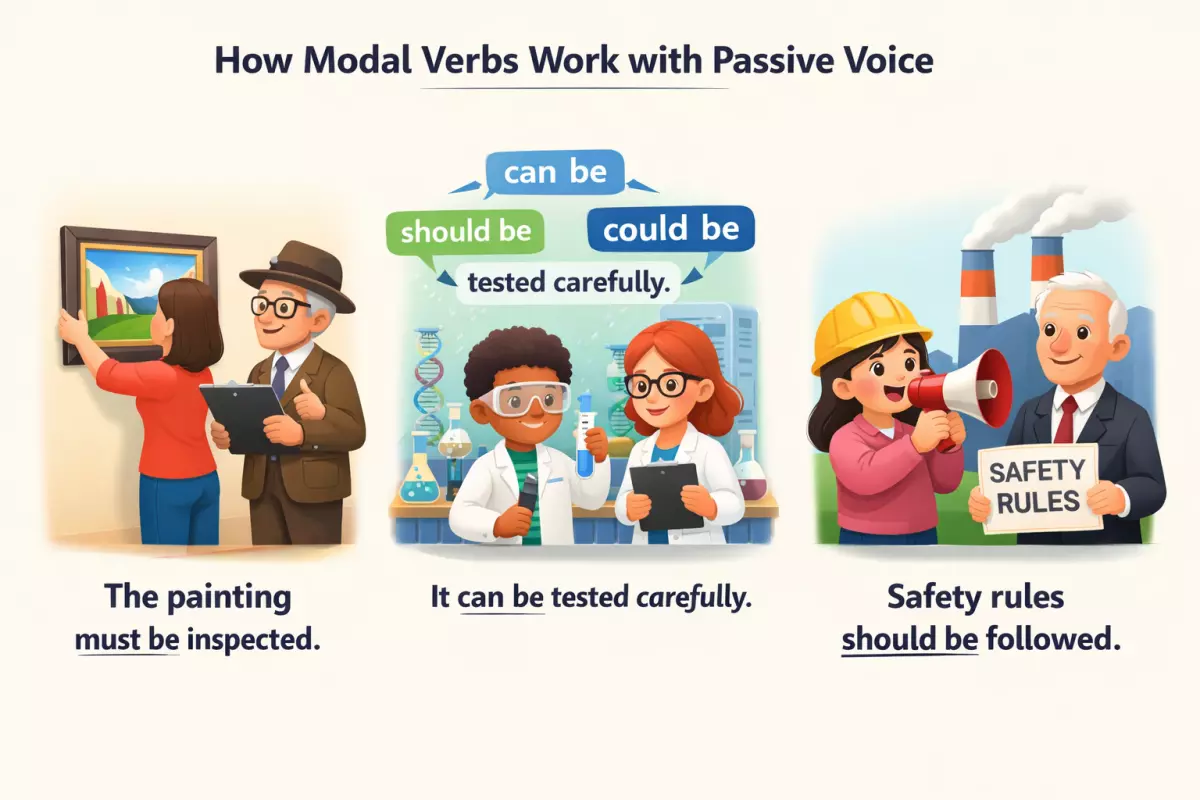 Covers how modal verbs work with the passive voice, using the modal plus be plus past participle pattern. Explains how focus shifts from the doer to the action, gives real examples like can be completed and must be approved, and shows use in instructions, reports, and formal writing, plus practice exercises.
- How modal verbs interact with passive voice in English grammar
- The structure modal verb plus be plus past participle
- How passive modal sentences shift focus from the actor to the action
- Examples such as can be completed or must be approved in real contexts
- Situations where passive modal structures appear in instructions and reports
- How speakers choose passive modal forms in formal communication
- Exercises and practice activities using modal verbs in passive sentences
Modal verbs can feel tricky in the passive because you express possibility, obligation, or permission while focusing on what happens to something rather than who acts. In everyday English, this helps you sound polite, cautious, or official: a form must be completed, a package may be delayed, a rule can be broken. Learn the pattern and you will use it confidently.
How modal verbs interact with passive voice in English grammar
When a clause uses a modal (can, could, may, might, must, should, will, would, etc.) and the focus is on the receiver of the action, English typically combines the modal with be plus a past participle. The modal keeps its meaning (ability, permission, obligation, probability), while the passive structure shifts attention to what happens to the subject.
Core pattern
- Basic form: modal + be + past participle (V3) → “The report must be submitted by Friday.”
- Negative: modal + not + be + V3 → “The door cannot be opened from the outside.”
- Question: modal + subject + be + V3 → “Can the package be delivered today?”
- With an agent (optional): modal + be + V3 + by + agent → “The decision should be made by the committee.”
How meaning stays the same while voice changes
- Ability: “They can solve the problem.” → “The problem can be solved.”
- Permission: “You may use the room.” → “The room may be used.”
- Advice/expectation: “You should follow the guidelines.” → “The guidelines should be followed.”
- Obligation: “They must pay the fee.” → “The fee must be paid.”
- Possibility: “Someone might misinterpret the message.” → “The message might be misinterpreted.”
Passive with perfect and continuous modal forms
- Perfect passive (past reference): modal + have been + V3 → “The email should have been sent earlier.”
- Perfect negative: modal + not + have been + V3 → “The files might not have been backed up.”
- Continuous passive (less common, but possible): modal + be being + V3 → “The issue may be being investigated.”
- Perfect continuous passive (rare and heavy): modal + have been being + V3 → “The system may have been being monitored for weeks.”
Common usage patterns and choices
- Prefer passive when the agent is unknown or unimportant: “The rules must be followed.” (No need to say who enforces them.)
- Use “by + agent” when responsibility matters: “The forms must be signed by a parent.”
- Choose the modal based on stance: must (strong obligation), should (recommendation), may/might (uncertainty), can/could (ability/possibility), will/would (prediction/typical behavior).
- Keep tense marking on the modal, not on “be”: ✅ “The meeting will be postponed.” ❌ “The meeting will is postponed.”
- Match time with the right passive form: present/future meaning usually uses modal + be + V3; past criticism or missed obligation often uses should have been + V3.
Expanded example set (quick reference)
- “The contract can be renewed each year.”
- “The lights must be turned off before leaving.”
- “The results may be announced tomorrow.”
- “The application should be completed online.”
- “The device could be damaged by heat.”
- “The package will be collected at noon.”
- “The policy would be changed under the new plan.”
- “The tickets might not be refunded.”
- “The cause must have been identified by now.”
- “The message should have been forwarded to support.”
- “The documents may have been misplaced.”
- “The complaint could have been handled more carefully.”
- “The suspect may be being questioned at the station.”
- “The schedule can be adjusted if needed.”
- “The instructions must be followed exactly.”
The structure modal verb plus be plus past participle

To make a passive sentence with a modal, keep the modal in front, add be, and then use the past participle of the main verb. This pattern shifts attention to the action or result, while the doer can be omitted or added later with by.
Core pattern and word order
- Form: modal + be + past participle (+ optional by + agent)
- What stays the same: the modal (can, could, may, might, must, should, will, would) does not change for person or number.
- What changes: the past participle changes with the verb (write → written, make → made, see → seen).
- Object becomes subject: the thing affected by the action is placed in subject position.
- Agent is optional: include by + noun/pronoun only when the doer matters or adds clarity.
Common modals in passive: meaning and typical use
- can be + past participle → ability/possibility: “The file can be recovered.”
- could be + past participle → weaker possibility/past ability: “The cause could be explained later.”
- may be + past participle → formal possibility/permission: “A refund may be issued.”
- might be + past participle → uncertain possibility: “The meeting might be postponed.”
- must be + past participle → necessity/strong conclusion: “The form must be signed.”
- should be + past participle → advice/expectation: “The data should be checked.”
- will be + past participle → future certainty: “The results will be announced tomorrow.”
- would be + past participle → conditional/hypothetical: “The issue would be resolved if we had access.”
Examples across contexts (with and without an agent)
- The package can be delivered today.
- The lights must be turned off before you leave.
- Your request will be processed within 24 hours.
- The report should be reviewed by a supervisor.
- The password may be reset in the settings menu.
- The error could be caused by a missing update.
- The schedule might be changed due to weather.
- The contract must be signed by both parties.
- All visitors should be informed of the rules.
- The final decision will be made by the committee.
- The documents can be scanned at reception.
- The problem would be solved with more time.
- The samples must be stored at low temperature.
- The announcement may be delayed until next week.
Frequent errors to avoid
- ❌ “The form must signed.” → ✅ “The form must be signed.”
- ❌ “The form must be sign.” → ✅ “The form must be signed.”
- ❌ “The results will are announced.” → ✅ “The results will be announced.”
- ❌ “The data should be check.” → ✅ “The data should be checked.”
When you need to include time, place, or manner, add those details after the past participle: “The equipment must be returned by Friday,” “The forms should be submitted online,” “The issue could be resolved quickly.” This keeps the modal construction intact while adding useful context.
How passive modal sentences shift focus from the actor to the action
Passive voice with modal verbs helps you highlight the event, rule, or outcome instead of the person doing it. This is useful when the actor is unknown, unimportant, obvious from context, or deliberately left unstated (common in policies, instructions, and formal reports).
Core pattern and what it emphasizes
The basic structure is:
- Subject (receiver of the action) + modal + be + past participle (e.g., “The form must be signed.”)
- Optional: add by + agent only when the doer matters (e.g., “The form must be signed by a supervisor.”)
Because the subject is the receiver, the sentence naturally centers on what happens to that subject (the requirement, permission, ability, or expectation), not on who performs the action.
Common reasons to choose a passive modal
- Rules and obligations: the requirement matters more than the person enforcing it.
- Procedures and instructions: the steps matter; the actor is “whoever is responsible.”
- Reports and audits: focus stays on actions taken and outcomes achieved.
- Diplomatic or neutral tone: avoids assigning blame or spotlighting an individual.
- Unknown or irrelevant agent: the doer is not available or not needed for clarity.
Usage patterns that shift attention away from the agent
- Omit the agent entirely when it adds no value: “All devices must be inspected.”
- Use “by + agent” selectively to restore responsibility: “All devices must be inspected by a certified technician.”
- Choose the receiver as the subject to foreground the affected item: “The shipment should be tracked,” not “We should track the shipment.”
- Prefer passive modals in policy language to keep statements general: “Passwords must be changed regularly.”
- Use passive modals to soften directives while keeping them clear: “The report should be submitted by Friday.”
Example set (active → passive with a modal)
- “You must submit the application.” → “The application must be submitted.”
- “We can complete the repair today.” → “The repair can be completed today.”
- “They should notify customers.” → “Customers should be notified.”
- “You may use this entrance.” → “This entrance may be used.”
- “We will deliver the items tomorrow.” → “The items will be delivered tomorrow.”
- “The team might postpone the meeting.” → “The meeting might be postponed.”
- “Staff have to lock the door.” → “The door has to be locked.”
- “You need to back up the files.” → “The files need to be backed up.”
- “Someone ought to clean the filters.” → “The filters ought to be cleaned.”
- “You must not disclose the data.” → “The data must not be disclosed.”
- “We can’t change the schedule.” → “The schedule can’t be changed.”
- “They shouldn’t store chemicals here.” → “Chemicals shouldn’t be stored here.”
- “You may not enter the lab.” → “The lab may not be entered.”
- “We should review the contract.” → “The contract should be reviewed.”
Common form issues to avoid
- ❌ “The application must submitted.” → ✅ “The application must be submitted.”
- ❌ “The application must be submit.” → ✅ “The application must be submitted.”
- ❌ “The application is must be submitted.” → ✅ “The application must be submitted.”
- ❌ “The door must be locked by.” → ✅ “The door must be locked.” (or add an agent: “by security.”)
When you choose a passive construction with a modal, the grammar supports a message that is centered on requirements, permissions, and outcomes. Add the agent only when accountability or clarity depends on it; otherwise, keeping it implicit maintains a clean focus on the action itself.
Examples such as can be completed or must be approved in real contexts
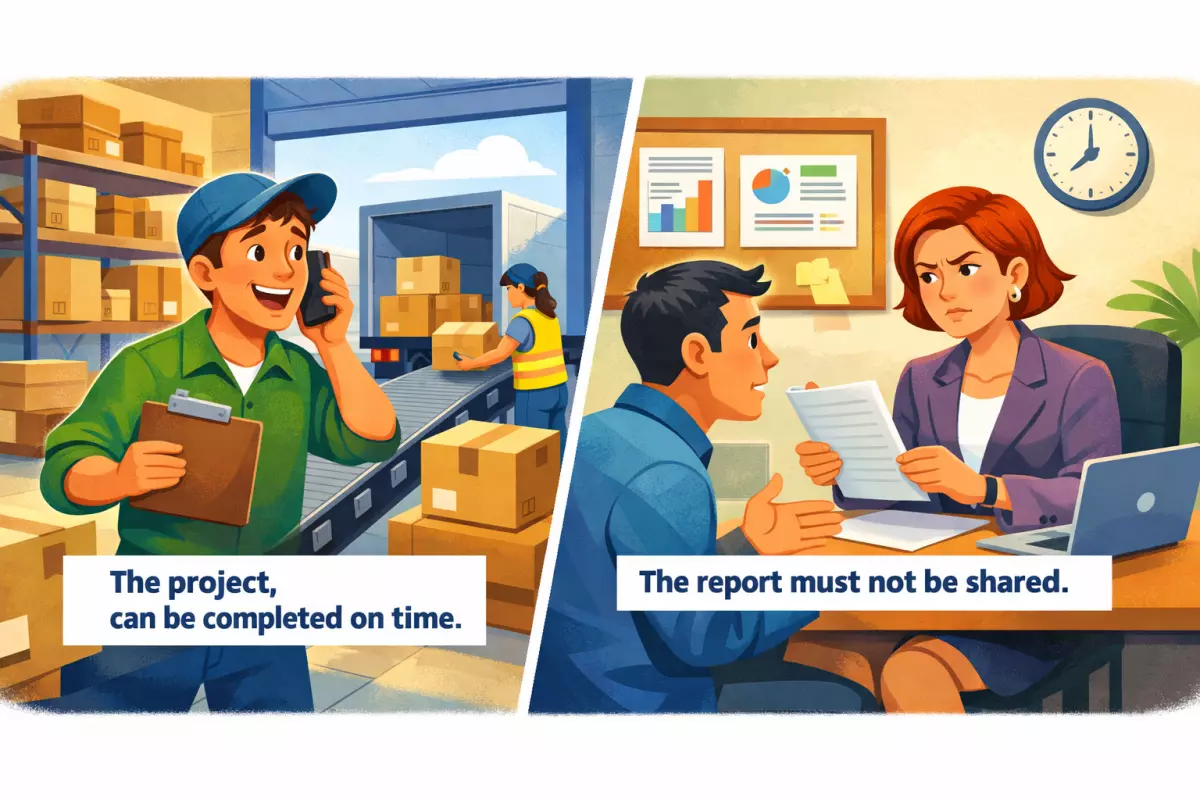
In real writing and workplace speech, modal verbs commonly appear before be + past participle to show ability, permission, obligation, probability, or advice while keeping the focus on the action or result rather than the doer. The basic pattern is:
- modal + be + past participle (e.g., can be shipped, must be approved)
- modal + not + be + past participle for prohibition/negative necessity (e.g., must not be shared)
- modal + have been + past participle for past time reference (e.g., should have been sent)
Common patterns by purpose (with realistic examples)
- Ability / possibility (can, could): The report can be generated automatically.
- General possibility (may, might): The meeting may be postponed due to travel delays.
- Strong necessity (must): All expenses must be documented before reimbursement.
- Requirement from rules (have to): The form has to be signed by a supervisor.
- Advice / best practice (should): Customer data should be encrypted at rest.
- Weaker advice (ought to): The issue ought to be escalated if it persists.
- Expectation (should): The package should be delivered by Friday.
- Permission (can, may): The device may be returned within 30 days.
- Prohibition (must not, may not): These files must not be uploaded to personal storage.
- Conditional possibility (could): The timeline could be shortened with extra staff.
- Polite request (could, can): Could the invoice be resent to this address?
- Typical process (will): Your account will be reviewed within 24 hours.
- Refusal / unwillingness (won’t): The error won’t be fixed until the patch is installed.
- Plan/arrangement (will): The old system will be replaced next quarter.
Past-time versions (modal + have been + past participle)
Use have been when the passive action happened (or should have happened) before now. This is common in audits, incident reports, and retrospectives.
- Missed obligation: The request should have been approved earlier.
- Speculation about a past event: The email may have been filtered as spam.
- Reasonable guess: The document might have been deleted by mistake.
- Strong inference: The password must have been changed after the breach.
- Past possibility: The issue could have been prevented with a backup.
Accuracy checks (common form errors)
- ✅ The application must be submitted by noon. → ❌ The application must submitted by noon.
- ✅ The files should have been backed up. → ❌ The files should have backed up.
- ✅ The policy may not be changed without notice. → ❌ The policy may not changed without notice.
Situations where passive modal structures appear in instructions and reports
Passive modal patterns (modal + be + past participle) are common when the focus is on the action or requirement rather than the person doing it. They help writers sound neutral, procedural, and consistent, especially in documents that describe standards, steps, and outcomes.
Where you will see them most often
- Safety instructions and warnings: the doer is less important than the rule. Example: “Protective gloves must be worn.”
- Standard operating procedures (SOPs): steps are written as repeatable actions. Example: “The unit should be calibrated before use.”
- Compliance and policy documents: requirements are stated impersonally. Example: “All records must be retained for five years.”
- Quality control and audits: criteria and checks are emphasized. Example: “Samples must be inspected upon arrival.”
- Technical manuals: the process is foregrounded. Example: “The filter can be replaced without shutting down the system.”
- Lab protocols and research methods: the method matters more than the actor. Example: “The solution should be stored at 4°C.”
- Incident reports: writers avoid assigning blame while stating necessity. Example: “The area must be secured immediately.”
- Maintenance logs: actions are recorded as completed or required. Example: “The valve should be lubricated monthly.”
- Project status reports: obligations and next steps are framed neutrally. Example: “The draft must be reviewed by Friday.”
- Customer service and troubleshooting guides: instructions stay user-focused without naming an agent. Example: “The device should be restarted.”
- Legal and contractual language: duties are expressed formally. Example: “Payment must be made within 30 days.”
- Medical instructions: emphasis is on correct procedure. Example: “The medication should be taken with food.”
Typical modal choices and what they signal
- must be + past participle for strict obligation: “ID badges must be displayed.”
- should be + past participle for recommendation or best practice: “Data should be backed up daily.”
- can be + past participle for permission/possibility: “The form can be submitted online.”
- may be + past participle for formal permission or cautious possibility: “Additional tests may be required.”
- will be + past participle for scheduled or expected procedure: “Results will be emailed to participants.”
- shall be + past participle for formal requirements (often legal/contractual): “The equipment shall be returned in good condition.”
Common patterns in instructions (with quick correctness checks)
- ✅ “The lid must be closed before operation.” → modal + be + past participle
- ❌ “The lid must closed before operation.” → missing be
- ✅ “All chemicals should be labeled clearly.”
- ❌ “All chemicals should labeled clearly.”
- ✅ “The file can be accessed with administrator rights.”
- ✅ “The issue may be caused by overheating.” (possibility, not instruction)
How reports use passive modals to stay neutral
- To describe required follow-up without naming a person: “Corrective action must be taken.”
- To state what is expected in a process: “The request will be processed within 48 hours.”
- To express uncertainty carefully: “The discrepancy may be explained by a logging error.”
- To recommend improvements without blame: “The procedure should be updated to include a final check.”
- To document constraints: “Access to the site cannot be granted during maintenance.”
How speakers choose passive modal forms in formal communication
In formal writing and professional speech, passive voice with modals is often chosen to manage tone: it can foreground procedures and outcomes, reduce emphasis on who acted, and keep statements appropriately cautious. The core pattern is simple: modal + be + past participle (for example, “must be completed”). The more advanced choices come from selecting the right modal, time frame, and level of certainty.
Common selection patterns in formal contexts
- Use passive modals to focus on the action or requirement when the agent is unknown, irrelevant, or intentionally backgrounded: “The form must be signed (by the applicant).”
- Choose “must be + past participle” for non-negotiable obligations (rules, safety, compliance): “All visitors must be registered.”
- Choose “should be + past participle” for recommendations and standards (best practice rather than strict duty): “Reports should be reviewed before submission.”
- Choose “may be + past participle” for permission or possibility depending on context: “Exceptions may be granted” (permission) / “The results may be influenced by…” (possibility).
- Choose “can be + past participle” for general capability or typical feasibility: “The device can be operated remotely.”
- Choose “could be + past participle” to soften claims or present tentative explanations: “The discrepancy could be caused by a data entry error.”
- Choose “will be + past participle” for scheduled or assured future outcomes: “The invoice will be issued within five business days.”
- Choose “would be + past participle” for conditional or policy-based outcomes: “A refund would be provided if the item is returned unopened.”
- Use “must not be + past participle” for prohibitions: “Confidential files must not be shared.”
- Use “should not be + past participle” for discouraged actions: “Personal data should not be retained longer than necessary.”
- Prefer passive modals in process descriptions (SOPs, guidelines) to keep steps consistent: “The sample should be stored at 4°C.”
- Prefer active voice when responsibility must be explicit (accountability, instructions to a role): “The manager must approve the request,” not “The request must be approved.”
Choosing time and aspect: present, perfect, and continuous
- Present/future requirement: modal + be + past participle → “The contract must be signed by Friday.”
- Past expectation or criticism: modal + have been + past participle → “The issue should have been reported earlier.”
- Uncertain past inference: may/might/could + have been + past participle → “The email may have been sent to the wrong address.”
- Ongoing process (less common, but useful): modal + be being + past participle → “The system may be being monitored during the upgrade.”
- Completed future by a deadline: will + have been + past participle → “The audit will have been completed by year-end.”
Formality and risk management: hedging vs. commitment
- High commitment: “must be,” “will be” → used for firm rules, deadlines, and guaranteed outcomes.
- Moderate commitment: “should be” → used for guidance, targets, and expected practice.
- Low commitment / hedging: “may be,” “might be,” “could be” → used for cautious interpretation, early findings, or incomplete evidence.
- Policy framing: passive modals can present requirements as system-level norms: “Requests must be submitted through the portal.”
Accuracy checks: forms that sound formal but are wrong
- ✅ “The documents must be filed today.” → ❌ “The documents must filed today.”
- ✅ “The payment should have been processed already.” → ❌ “The payment should been processed already.”
- ✅ “The device can be repaired on site.” → ❌ “The device can repaired on site.”
- ✅ “The data may have been misclassified.” → ❌ “The data may been misclassified.”
In practice, the best choice depends on what the message needs to do: impose a requirement, describe a standard, predict an outcome, or cautiously interpret evidence. Modals paired with passive voice let formal communication stay precise about obligation and certainty while keeping the focus on actions and results.
Exercises and practice activities using modal verbs in passive sentences
Practice the pattern first, then vary the modal and the time reference. The core form is modal + be + past participle (for example: must be completed). For past meaning, use modal + have been + past participle (for example: must have been completed).
1) Build the correct passive form (present/future meaning)
- (send) The documents __________ by email today. (can)
- (approve) The budget __________ by the director. (must)
- (finish) The report __________ by Friday. (should)
- (repair) The elevator __________ this week. (might)
- (keep) Personal data __________ confidential. (must)
- (reserve) Seats __________ in advance. (should)
- (translate) The instructions __________ into Spanish. (can)
- (reduce) Noise __________ during the exam. (should)
- (provide) A receipt __________ on request. (will)
- (return) The equipment __________ after use. (must)
Show answers
- can be sent
- must be approved
- should be finished
- might be repaired
- must be kept
- should be reserved
- can be translated
- should be reduced
- will be provided
- must be returned
2) Switch to past meaning (use “have been”)
- (deliver) The package __________ yesterday. (should)
- (lock) The door __________ before we left. (must)
- (update) The software __________ last night. (may)
- (cancel) The meeting __________ due to weather. (might)
- (sign) The form __________ by a parent. (must)
- (check) The figures __________ more carefully. (should)
- (send) The invoice __________ already. (could)
- (store) The samples __________ at a lower temperature. (should)
Show answers
- should have been delivered
- must have been locked
- may have been updated
- might have been canceled
- must have been signed
- should have been checked
- could have been sent
- should have been stored
3) Choose the best modal for the meaning
Fill each blank with one modal: must / should / can / could / may / might. Use passive structure.
- Employees __________ be trained before using the machine. (obligation)
- The issue __________ be solved with a restart. (possibility)
- All IDs __________ be checked at the entrance. (rule)
- The results __________ be announced tomorrow. (uncertain plan)
- This form __________ be completed online. (ability/option)
- The mistake __________ have been noticed earlier. (advice/criticism)
- The files __________ have been deleted by accident. (possibility)
- Extra time __________ be given to students with accommodations. (permission/allowed)
Show answers
- must be trained
- might be solved
- must be checked
- may be announced
- can be completed
- should have been noticed
- might have been deleted
- may be given
4) Fix the errors (focus on word order and missing “be”)
Rewrite each sentence correctly. Watch for the missing passive auxiliary and the correct placement of not.
- ❌ The report must completed today.
- ❌ The tickets can bought online.
- ❌ The door should be not left open.
- ❌ The files might been deleted.
- ❌ The package must have delivered yesterday.
- ❌ This rule can be ignored not.
- ❌ The meeting could been postponed.
- ❌ The password must changed regularly.
Show answers
- ✅ The report must be completed today.
- ✅ The tickets can be bought online.
- ✅ The door should not be left open.
- ✅ The files might have been deleted.
- ✅ The package must have been delivered yesterday.
- ✅ This rule cannot be ignored. / This rule can’t be ignored.
- ✅ The meeting could have been postponed.
- ✅ The password must be changed regularly.
5) Production practice (controlled writing)
- Policy rewrite: Take 5 active rules (for example, “Staff must wear badges”) and rewrite each as a passive sentence with a modal (for example, “Badges must be worn”).
- Time-shift drill: Write 6 sentences in modal + be + past participle, then rewrite each one for past meaning using modal + have been + past participle.
- Strength contrast: Write 3 pairs that show different force: must be (strong obligation) vs should be (recommendation) with the same verb (for example, must be backed up vs should be backed up).
- Uncertainty ladder: Describe one event using may be and might be, then describe a past guess using may have been and might have been.
- Negative forms: Create 6 negatives using must not be, should not be, and cannot be. Keep the same subject so you can compare meaning.