Using Modal Verbs in English Reported Speech

 This article explains how indirect speech can change modal verbs, which ones usually shift, and when can becomes could. It also covers modals in reported questions and requests, cases where modals stay the same, how context affects meaning, and practice exercises.
- How indirect speech affects modal verb forms in English
- Which modal verbs typically change when speech is reported
- Examples where can becomes could in reported statements
- How modal verbs behave in reported questions and requests
- Situations where modal verbs keep the same form in reported speech
- How context determines whether the modal meaning changes
- Exercises and practice activities converting speech into reported form
When you report what someone said, modal verbs often shift in reported speech, changing how certain, necessary, or possible the message sounds. We do this all the time when sharing advice, warnings, or plans. Learn how can, must, and will commonly move back in time, when they stay the same, and how to pick the form that best preserves the original meaning.
How indirect speech affects modal verb forms in English
In reported speech, modal verbs often change form because the reporting verb (for example, said, told, asked) pushes the message “one step back” in time. This backshift is common, but it is not automatic: modals that express ability, permission, obligation, advice, prediction, or deduction may stay the same or shift depending on meaning, time reference, and how “current” the information still is.
Common backshift patterns for modals
| Direct speech modal | Typical reported form | What the change usually signals | Example (direct → reported) |
|---|---|---|---|
| can | could | Ability/permission seen from a “past” viewpoint | “I can swim.” → He said (that) he could swim. |
| may | might | Less direct permission/possibility; more distance | “You may leave.” → She said we might leave. |
| will | would | Future-in-the-past; prediction from an earlier time | “I will call tomorrow.” → He said he would call the next day. |
| shall | should / would | Offers/suggestions (should) or future-in-the-past (would) | “Shall I open it?” → He asked if he should open it. |
| must | had to / must | Had to = past obligation; must = still true/still required | “I must work late.” → She said she had to work late. |
| need to | needed to | Requirement moved into the past | “I need to go.” → He said he needed to go. |
| have to | had to | External obligation backshifted | “We have to pay.” → They said they had to pay. |
| might | might | Often unchanged because it is already “remote” | “It might rain.” → She said it might rain. |
| could | could | Often unchanged; already a backshifted/remote form | “I could help.” → He said he could help. |
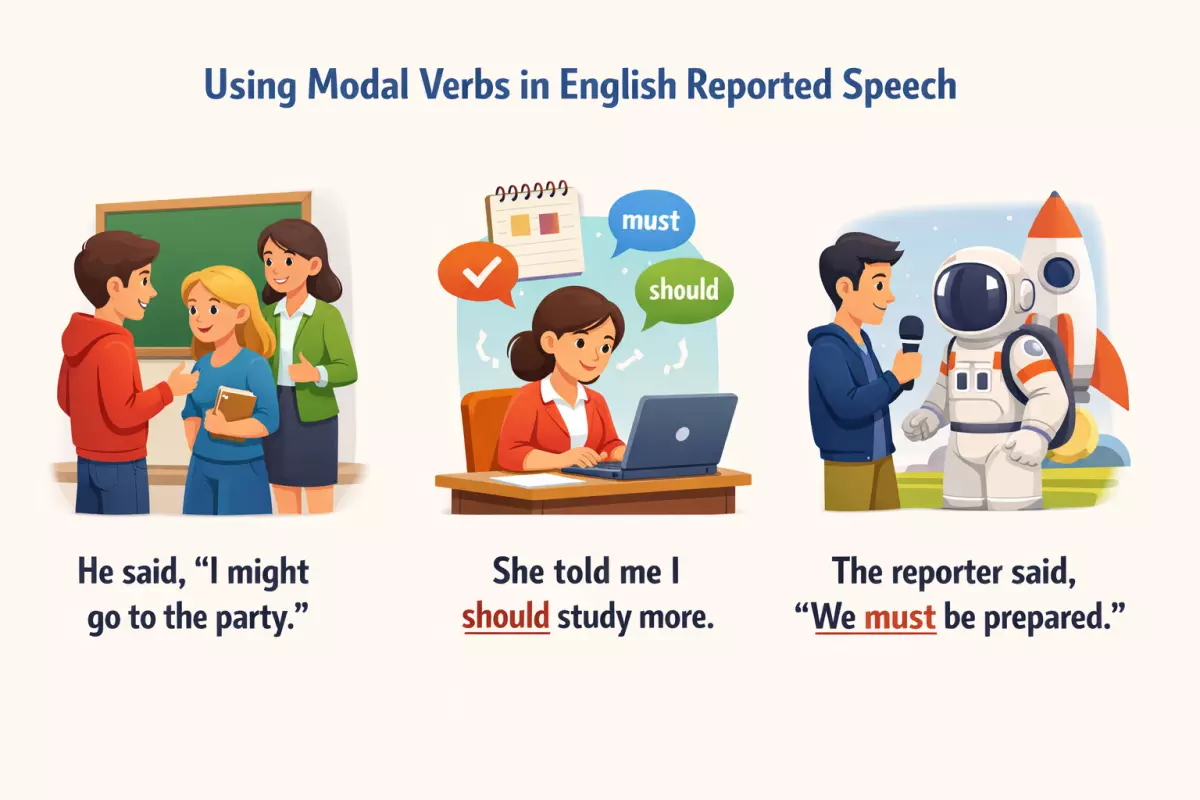
| should | should | Advice usually stays the same | “You should rest.” → The doctor said I should rest. |
| would | would | Habitual past/future-in-the-past typically unchanged | “I would never do that.” → She said she would never do that. |
| ought to | ought to | Advice/moral obligation usually unchanged | “You ought to apologize.” → He said I ought to apologize. |
When modals do not change
Keeping the same modal is common when the speaker’s meaning is still true now, when the modal already expresses distance (for example, might, could), or when you are reporting a general rule rather than a time-bound statement. The choice is about meaning first, not about applying a mechanical tense rule.
- General truths and rules: “Students must wear ID.” → The notice said students must wear ID.
- Still-valid instructions: “You must submit it online.” → She said we must submit it online (still required).
- Advice and recommendations: “You should see a dentist.” → He said I should see a dentist.
- Possibility already remote: “It might be a scam.” → She said it might be a scam.
- Ability already in could: “I could do it today.” → He said he could do it today.
Meaning changes to watch for
Some shifts are not just grammatical; they change the nuance. Reporting accurately often means choosing between two possible forms based on whether the obligation, permission, or prediction still applies.
- must → had to usually reports a past obligation that was true then: “I must leave now.” → He said he had to leave then.
- must can stay must when the requirement remains: “You must be quiet.” → The librarian said we must be quiet.
- may → might often sounds less direct or more tentative: “You may want to check.” → She said I might want to check.
- can → could can indicate either past ability or a more polite/less certain tone in the report: “I can’t come.” → He said he couldn’t come.
- will → would is the normal way to report future plans from a past viewpoint: “I’ll email you.” → She said she’d email me.
Time words often shift along with the modal
Modal changes frequently come with adjusted time references, because the report is anchored to the reporting moment rather than the original moment.
- “I will do it tomorrow.” → He said he would do it the next day.
- “You must finish it today.” → She said we had to finish it that day.
- “I can meet you here.” → He said he could meet me there.
Which modal verbs typically change when speech is reported
When you move from direct speech to reported speech, modal verbs often “shift back” to match the new time perspective (the reporting verb is frequently in the past). Not every modal changes, and even the ones that do can stay the same when the meaning is still true now, the report is very close in time, or the speaker is reporting a general rule.
| Direct speech modal | Common reported form | Typical meaning carried over | Example (direct → reported) |
|---|---|---|---|
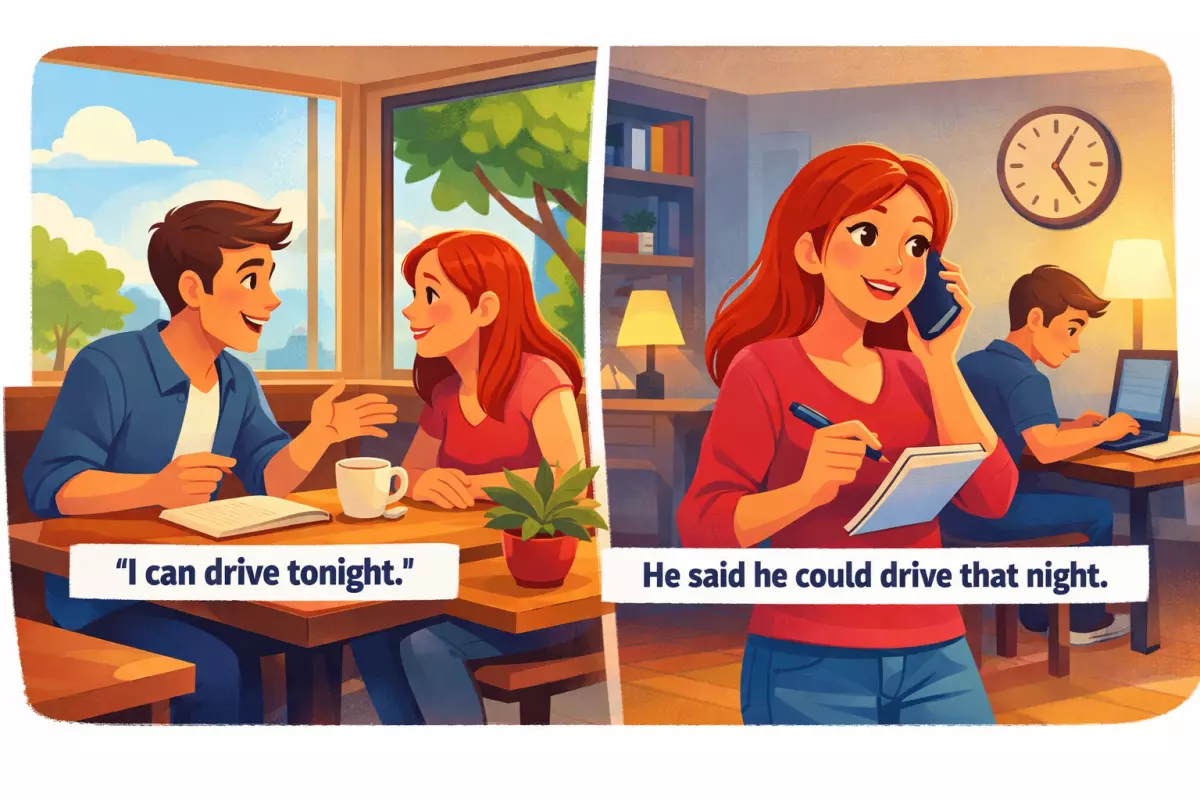
| can | could | ability, possibility, permission | “I can drive.” → He said (that) he could drive. |
| may | might | possibility; formal permission | “It may rain.” → She said (that) it might rain. |
| will | would | prediction, willingness, intention | “I will call you.” → He said (that) he would call me. |
| shall | should | offers/suggestions (BrE), future in older style | “Shall we start?” → She asked if we should start. |
| must | had to / must | obligation, necessity; strong deduction | “I must leave now.” → He said (that) he had to leave then. |
| need (to) | needed to | necessity | “I need to rest.” → She said (that) she needed to rest. |
| have to | had to | external obligation | “I have to work late.” → He said (that) he had to work late. |
| ought to | ought to (often unchanged) | advice, moral duty | “You ought to apologize.” → She said (that) I ought to apologize. |
Notes on the most common shifts
- can → could: This is the most frequent change. It covers ability (“can swim”), possibility (“can be dangerous”), and permission (“can I leave?”). In reported questions, the same shift applies: “Can you help?” → He asked if I could help.
- may → might: Often used for uncertainty and cautious predictions. “It may take a while.” → She said it might take a while. For permission, the reported form is also common: “May I come in?” → He asked if he might come in.
- will → would: Used for future-in-the-past and for willingness. “I will not agree.” → He said he would not agree. “I’ll help you.” → She said she would help me.
- shall → should: Most often appears when reporting offers or suggestions. “Shall I open the window?” → He asked if he should open the window.
- must → had to: Common when “must” expresses obligation and the duty is tied to the past situation. “I must finish today.” → She said she had to finish that day. However, “must” can stay as “must” when reporting rules or strong logical conclusions.
Why some modals do not always change
Some modal verbs are already “past-like” in form (for example, could, would, might, should) and usually remain the same in reported speech. Others (such as ought to) often stay unchanged because there is no widely used “backshifted” alternative in modern English. Context decides: if the speaker is reporting a continuing truth or a standing rule, keeping the original modal can sound more natural than forcing a shift.
Examples where can becomes could in reported statements
When you report what someone said, can often shifts back to could because the reporting verb is in the past (for example, said, told, asked). This backshift is common for ability, permission, and possibility. The change is not automatic in every situation, but it is the default pattern in many reported statements.
Ability (general or at that time)
- Direct: “I can swim.” → Reported: He said (that) he could swim.
- Direct: “She can speak French.” → Reported: They said (that) she could speak French.
- Direct: “I can’t hear you.” → Reported: She said (that) she couldn’t hear me.
- Direct: “We can finish today.” → Reported: They said (that) they could finish that day.
- Direct: “I can help after lunch.” → Reported: He said (that) he could help after lunch.
- Direct: “I can do it myself.” → Reported: She said (that) she could do it herself.
Permission (allowed to)
- Direct: “You can leave early.” → Reported: The manager said (that) I could leave early.
- Direct: “We can use this room.” → Reported: They said (that) we could use that room.
- Direct: “You can’t park here.” → Reported: The officer said (that) we couldn’t park there.
- Direct: “You can take two.” → Reported: She said (that) I could take two.
- Direct: “You can stay if you want.” → Reported: He said (that) I could stay if I wanted.
Possibility (it’s possible)
- Direct: “It can get cold at night.” → Reported: He said (that) it could get cold at night.
- Direct: “The road can be dangerous.” → Reported: She warned (that) the road could be dangerous.
- Direct: “This can happen to anyone.” → Reported: They said (that) that could happen to anyone.
- Direct: “It can take a while.” → Reported: He said (that) it could take a while.
Requests and offers (reported with asked/offered)
- Direct: “Can you help me?” → Reported: She asked if I could help her.
- Direct: “Can we meet tomorrow?” → Reported: He asked if we could meet the next day.
- Direct: “Can I call you later?” → Reported: She asked if she could call me later.
- Direct: “Can you open the window?” → Reported: He asked if I could open the window.
- Direct: “I can carry that for you.” → Reported: He offered to carry that for me.
Common pattern notes (when the shift is expected)
- With a past reporting verb, the typical sequence is: can → could (He said he could come).
- Negative forms follow the same pattern: can’t → couldn’t (She said she couldn’t attend).
- In reported questions, can usually becomes could after asked if/whether (They asked whether we could wait).
- If the speaker is reporting something that is still true now, keeping can is sometimes possible, but could remains the safer default in past reporting contexts.
How modal verbs behave in reported questions and requests
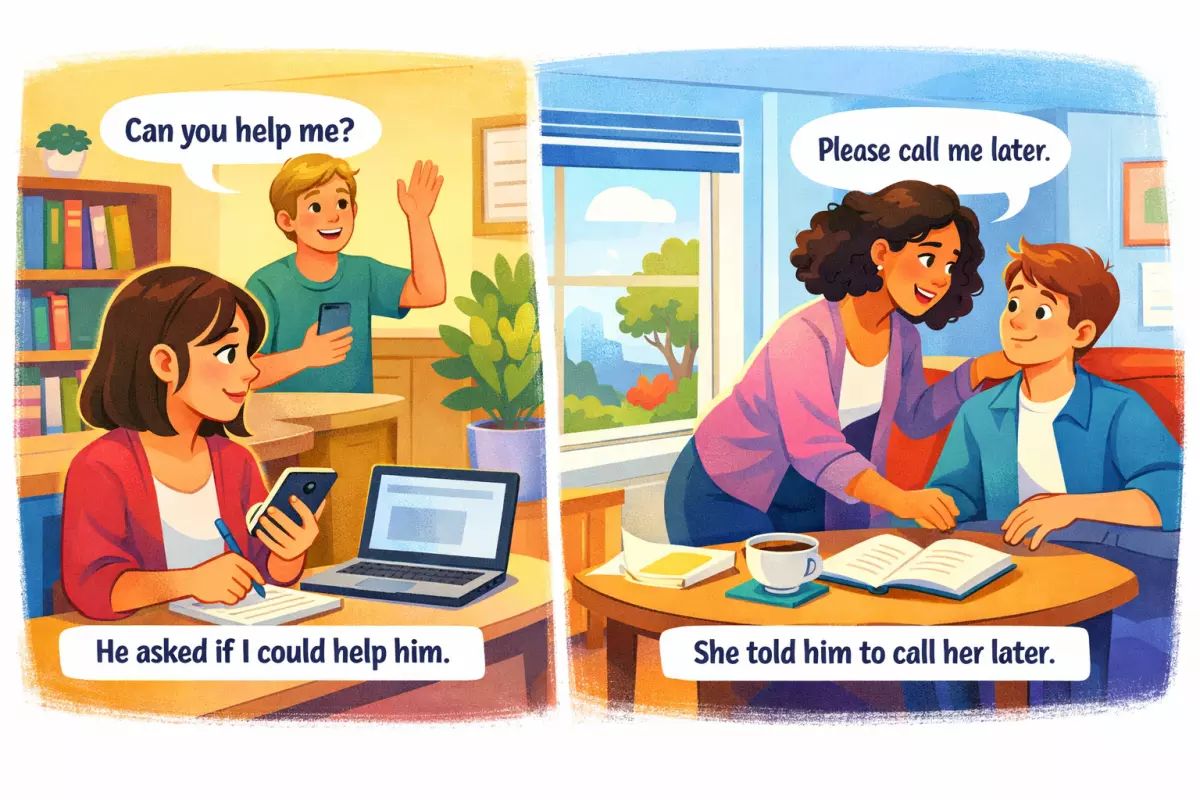
In reported questions and reported requests, modal verbs often change form because the speaker is moving the message into the past (backshifting) and because the sentence type changes (question → statement; request → infinitive clause). The key is to keep the meaning (ability, permission, obligation, advice, possibility) while adjusting grammar and word order.
Reported questions: modals, word order, and backshift
When you report a question, you normally use statement word order (subject before verb) and remove do/does/did. Modal verbs may backshift, but they can also stay the same when the meaning is still true or when the modal has no clear past form.
- Word order changes:
✅ “Where can I park?” → He asked where he could park.
❌ He asked where could he park. - Yes/no questions use if/whether:
“Can you help?” → She asked if I could help. - can → could (common backshift for ability/permission):
“Can we leave early?” → They asked if they could leave early. - will → would (future/volition):
“Will you call me?” → He asked if I would call him. - may → might (permission/possibility, often more tentative):
“May I sit here?” → She asked if she might sit there. - shall → should (offers/suggestions, formal):
“Shall we start?” → He asked whether they should start. - must often changes depending on meaning:
Obligation: “I must leave now” → He said he had to leave then.
Deduction: “It must be late” → She said it must be late. - could, would, should, might usually stay the same (already “past-like”):
“What should I do?” → She asked what she should do. - Needn’t often stays the same or becomes didn’t need to depending on time reference:
“Needn’t I pay?” → He asked if he needed to pay. - Time and place words often shift too:
“Can you meet here tomorrow?” → She asked if I could meet there the next day.
Reported requests: modals often become an infinitive structure
Requests are frequently reported with verbs like ask, tell, request, and then an object + to-infinitive. The original modal (can/could/will/would) may disappear because the request is now expressed by the reporting verb and the infinitive.
- can/could requests → asked + object + to:
“Can you open the window?” → She asked me to open the window. - will/would requests → asked + object + to:
“Would you email the file?” → He asked her to email the file. - Negative requests use not to:
“Please don’t tell anyone.” → She asked me not to tell anyone. - More formal requests may keep a modal in a that-clause (less common):
“You must submit it by Friday.” → He insisted that we should submit it by Friday. - Permission questions vs. permission requests:
“May I leave?” (question) → He asked if he might leave.
“May I leave?” (requesting permission) → He asked to leave. - Politeness can be preserved with reporting verbs:
“Could you possibly wait?” → She politely asked us to wait. - “Let’s …” suggestions often become suggested + -ing or suggested that:
“Let’s take a taxi.” → He suggested taking a taxi. - Requests with question words can be reported as an infinitive clause:
“Could you tell me where the station is?” → She asked him to tell her where the station was.
Choosing whether to backshift the modal
Backshifting is common after a past reporting verb (asked, wondered, wanted to know), but it is not automatic. If the situation is still current, keeping the original modal can sound more accurate.
- Backshift for distance in time: “Can you drive?” → He asked if I could drive.
- No backshift for still-true facts: “Can penguins fly?” → She asked if penguins can fly.
- No backshift when the modal already expresses tentativeness: “What should we do?” → He asked what we should do.
- Meaning controls form (especially with must): obligation often becomes had to; logical certainty often stays must.
Situations where modal verbs keep the same form in reported speech
Not every modal changes when you move from direct speech to indirect speech. In several common patterns, the modal stays exactly as it is because it already expresses the right time reference, because it has no distinct past form, or because the speaker is reporting something that is still true or still relevant.
1) Modals that usually do not backshift
Some modals are typically unchanged in reporting because they have no separate past form in modern English or because a backshift would be unusual.
- must (often stays must for obligation/deduction): “I must leave.” → He said he must leave.
- should: “You should rest.” → She said I should rest.
- ought to: “You ought to apologize.” → He said I ought to apologize.
- might: “It might rain.” → She said it might rain.
- could: “I could help later.” → He said he could help later.
- would: “I would never do that.” → She said she would never do that.
2) When the report focuses on a general truth or something still true
If the statement is a fact, a rule, or something the reporter treats as still valid now, the modal often remains the same rather than being pushed further back in time.
- “Students must show ID.” → The receptionist said students must show ID.
- “You should drink more water.” → The doctor said I should drink more water.
- “We can’t park here.” → The guard said we can’t park there. (reported as a current rule)
- “It may take a few days.” → They said it may take a few days. (still possible now)
3) When the original speaker’s words are being kept as a recommendation or obligation
When you report advice, expectations, or obligations as the same forceful message (not as a past situation), keeping the modal is natural.
- “You must wear a helmet.” → He told me I must wear a helmet.
- “You should email first.” → She said I should email first.
- “You ought to check the figures.” → He said we ought to check the figures.
- ✅ She said I must call. ❌ She said I had to call. (incorrect if you mean the obligation still applies now)
4) When backshifting would change the meaning
Sometimes a “past” equivalent is possible, but it changes the message. In these cases, the unchanged modal is used to preserve the original meaning.
- must (deduction): “He must be tired.” → She said he must be tired. (a conclusion she holds)
- may vs might: “It may be true.” → He said it may be true. (still a live possibility)
- can (ability now): “I can meet today.” → She said she can meet today. (ability/availability still valid)
- will (strong intention): “I will complain.” → He said he will complain. (intention still stands)
5) Reporting with a present reporting verb (no backshift context)
When the reporting verb is in the present (or present perfect), reported speech often keeps the same modal because the grammar does not push the message into a “past reporting” frame.
- “I can’t come.” → She says she can’t come.
- “You must be quiet.” → The sign says you must be quiet.
- “We may be late.” → He has said they may be late.
- “You should try again.” → She has told me I should try again.
6) Fixed or semi-fixed patterns where the modal is normally unchanged
Some reporting patterns naturally keep the modal because they function like set expressions in English.
- might as well: “We might as well leave.” → He said we might as well leave.
- would rather: “I’d rather stay home.” → She said she would rather stay home.
- could do with: “I could do with a break.” → He said he could do with a break.
- should have + past participle: “You should have called.” → She said I should have called.
How context determines whether the modal meaning changes
In reported speech, the same modal verb can keep its original meaning or shift to a different one depending on what the speaker was doing: predicting, giving permission, expressing ability, or stating a rule. The key is to identify the function first, then decide whether backshifting changes meaning or simply changes time reference.
Decide the function before you change the form
Many “changes” are not really about grammar rules but about preserving the original intention. A modal used for a general truth, a standing rule, or a present-time ability often stays the same. A modal used to predict a future event from a past viewpoint often shifts.
- Prediction vs. obligation: “will” as a prediction commonly backshifts to “would,” but “will” in fixed willingness/insistence can behave differently depending on meaning.
- Ability (skill) vs. ability (opportunity): “can” for general ability often becomes “could,” but “could” may also signal a different level of certainty or politeness if you are not careful.
- Permission vs. possibility: “may” can mean permission or possibility; in reporting, “might” often keeps the possibility sense, while permission is frequently reported with “could” or “was allowed to” for clarity.
- Advice vs. expectation: “should” can be advice (“You should rest”) or expectation (“It should arrive today”); both often stay “should,” but the surrounding time markers may need adjustment.
- Rules vs. one-time instructions: “must” for a rule can stay “must,” but for a one-time requirement in the past it often becomes “had to.”
- Logical deduction: “must” meaning deduction (“He must be tired”) usually stays “must” because it’s about reasoning, not a past command.
- Requests and offers: “can/could/will/would” in requests are often reported with “asked (me) to…” rather than keeping the modal, to avoid changing politeness level.
- Habitual meaning: “would” can mark past habit (“When we were kids, we would…”) and should not be confused with backshifted “would” from “will.”
Common context patterns that guide your choice
- General truth or timeless fact: keep the modal if the statement is still true now. Example: “Water can freeze at 0°C.” → He said water can freeze at 0°C.
- Past viewpoint prediction: “will” → “would” when the future was viewed from the past. Example: “It will rain later.” → She said it would rain later.
- Still-valid obligation (rule/policy): keep “must” if the rule remains. Example: “Employees must wear badges.” → He said employees must wear badges.
- Past obligation (one situation): “must” → “had to” when the requirement applied then. Example: “I must leave now.” → He said he had to leave.
- Permission given in the past: prefer “could” or “was allowed to” to show permission clearly. Example: “You may leave early.” → She said I could leave early / was allowed to leave early.
- Possibility assessment: “may” often → “might” when reporting, especially if you want to keep uncertainty. Example: “It may be a scam.” → He said it might be a scam.
- Ability as a stable skill: “can” → “could” is common, but keeping “can” is possible if it’s still true and you want present relevance. Example: “I can swim.” → She said she could swim (or can swim, if still true and relevant).
- Opportunity in a specific situation: “can” often becomes “could” or a past form to match the time. Example: “I can meet tomorrow.” → He said he could meet the next day.
- Advice that remains advice: “should” usually stays “should.” Example: “You should see a doctor.” → She said I should see a doctor.
- Expectation about timing: keep “should,” but adjust the time phrase. Example: “It should arrive today.” → He said it should arrive that day.
- Strong recommendation vs. mild suggestion: avoid switching “should” to “could” unless you intend to soften the meaning.
- Polite requests: report the action, not the modal, to preserve intent. Example: “Could you email me?” → She asked me to email her.
- Offers: “I’ll help” is often best reported as “offered to help,” not just “said he would help,” if the offer itself matters.
- Refusals/insistence: “won’t” can mean refusal, not future. Example: “He won’t listen.” → She said he wouldn’t listen (refusal), not simply a future-in-the-past.
- Conditional meaning: modals inside conditionals may not change the same way; keep the conditional logic clear rather than forcing a backshift.
Quick checks to avoid meaning drift
- Ask: “Is this modal about time (future from then) or about attitude (permission, obligation, deduction)?”
- If changing the modal makes the statement sound more polite, more doubtful, or more forceful than the original, consider a different reporting structure (for example, “told/ordered/allowed/asked/offered”).
- When the original rule still applies, keeping the modal often sounds more natural than forcing a past form.
- When the requirement was specific to that moment, “had to” is usually clearer than keeping “must.”
- Use time expressions to carry time shifts (“today” → “that day,” “tomorrow” → “the next day”) so the modal doesn’t have to do all the work.
Exercises and practice activities converting speech into reported form
Focus on how the modal meaning changes (or stays the same) when you shift from direct quotes to indirect statements. The key patterns are: (1) whether the reporting verb is in the past, (2) whether the modal refers to ability/permission/obligation, and (3) whether the speaker is talking about a past fact, a present situation, or a future plan.
1) Quick transformation drill (statements)
- “I can stay late.” → He said (that) he ______ stay late.
- “You must wear a helmet.” → She said (that) I ______ wear a helmet.
- “We may be late.” → They said (that) they ______ be late.
- “I will call you tonight.” → He said (that) he ______ call me that night.
- “You should see a doctor.” → She said (that) I ______ see a doctor.
- “I have to leave now.” → He said (that) he ______ leave then.
- “You don’t have to pay today.” → She said (that) I ______ pay that day.
- “I might move to Berlin.” → He said (that) he ______ move to Berlin.
- “We could help you.” → They said (that) they ______ help me.
- “You mustn’t touch that.” → He said (that) I ______ touch that.
- “I can’t attend the meeting.” → She said (that) she ______ attend the meeting.
- “I shall email the report.” → He said (that) he ______ email the report.
Show answers
- could
- had to
- might
- would
- should
- had to
- didn’t have to
- might
- could
- mustn’t
- couldn’t
- would
2) Choose the best reported form (meaning check)
Select the option that keeps the original meaning. Pay attention to whether the speaker is describing a rule, giving advice, or stating a possibility.
- “You must be quiet in the library.”
A) He said we must be quiet in the library.
B) He said we had to be quiet in the library. - “I can’t swim.”
A) She said she couldn’t swim.
B) She said she mustn’t swim. - “You may leave early today.”
A) She said I might leave early that day.
B) She said I could leave early that day. - “We will probably win.”
A) They said they would probably win.
B) They said they could probably win. - “You don’t have to bring anything.”
A) He said I didn’t have to bring anything.
B) He said I mustn’t bring anything. - “It might rain later.”
A) She said it might rain later.
B) She said it would rain later. - “You should apologize.”
A) He said I should apologize.
B) He said I had to apologize. - “I must finish this today.” (speaker’s strong personal necessity)
A) She said she had to finish it that day.
B) She said she must finish it that day.
Show answers
- B
- A
- B
- A
- A
- A
- A
- A
3) Error correction (spot the pattern)
Each sentence has one modal-related issue. Rewrite it so it follows standard backshift and keeps the meaning.
- ❌ He said he can help me. → ____________________
- ❌ She told me I must to leave. → ____________________
- ❌ They said they will arrive at 8. → ____________________
- ❌ He said I didn’t must pay. → ____________________
- ❌ She said I could to park there. → ____________________
- ❌ He said I mustn’t to use my phone. → ____________________
- ❌ She said she had can speak Japanese. → ____________________
- ❌ They told us we should to wait. → ____________________
Show answers
- He said he could help me.
- She told me I had to leave.
- They said they would arrive at 8.
- He said I didn’t have to pay. (or: He said I mustn’t pay, if the meaning is prohibition)
- She said I could park there.
- He said I mustn’t use my phone.
- She said she could speak Japanese.
- They told us we should wait.
4) Mini role-play prompts (produce your own reported speech)
- Office update: A manager gives rules for a meeting (use: must, mustn’t, can, can’t).
- Travel change: An airline agent explains options after a cancellation (use: can, could, may, might).
- Health advice: A doctor gives recommendations (use: should, shouldn’t, have to).
- School policy: A teacher explains homework expectations (use: have to, don’t have to, must).
- Neighbor request: Someone asks for help politely (use: could, would).
- Uncertain plan: A friend talks about next weekend (use: might, may, could).
- Past ability: Someone describes skills as a child (use: could, couldn’t).
- Permission: A parent allows something for one day only (use: can/could for permission).
5) Pattern reminders to apply while practicing
- can → could for reported ability/permission when the reporting verb is past: “I can drive.” → He said he could drive.
- will → would for future-in-the-past: “I’ll call.” → She said she would call.
- must → had to for obligation in many contexts: “You must leave.” → He said we had to leave.
- mustn’t usually stays mustn’t because prohibition remains prohibition: “You mustn’t enter.” → She said we mustn’t enter.
- may → might is common, but may can stay when the possibility still feels current: “It may snow.” → He said it may/might snow.
- should often stays should because advice does not need backshift: “You should rest.” → She said I should rest.
- have to → had to for necessity: “I have to go.” → He said he had to go.
- don’t have to → didn’t have to for lack of necessity: “You don’t have to pay.” → She said I didn’t have to pay.
- Avoid adding to after modal verbs: ❌ must to / could to / should to → ✅ must / could / should + base verb.
- Check meaning before changing modals: didn’t have to (no necessity) is different from mustn’t (prohibition).