Modal Verbs in Academic Writing and Formal Style

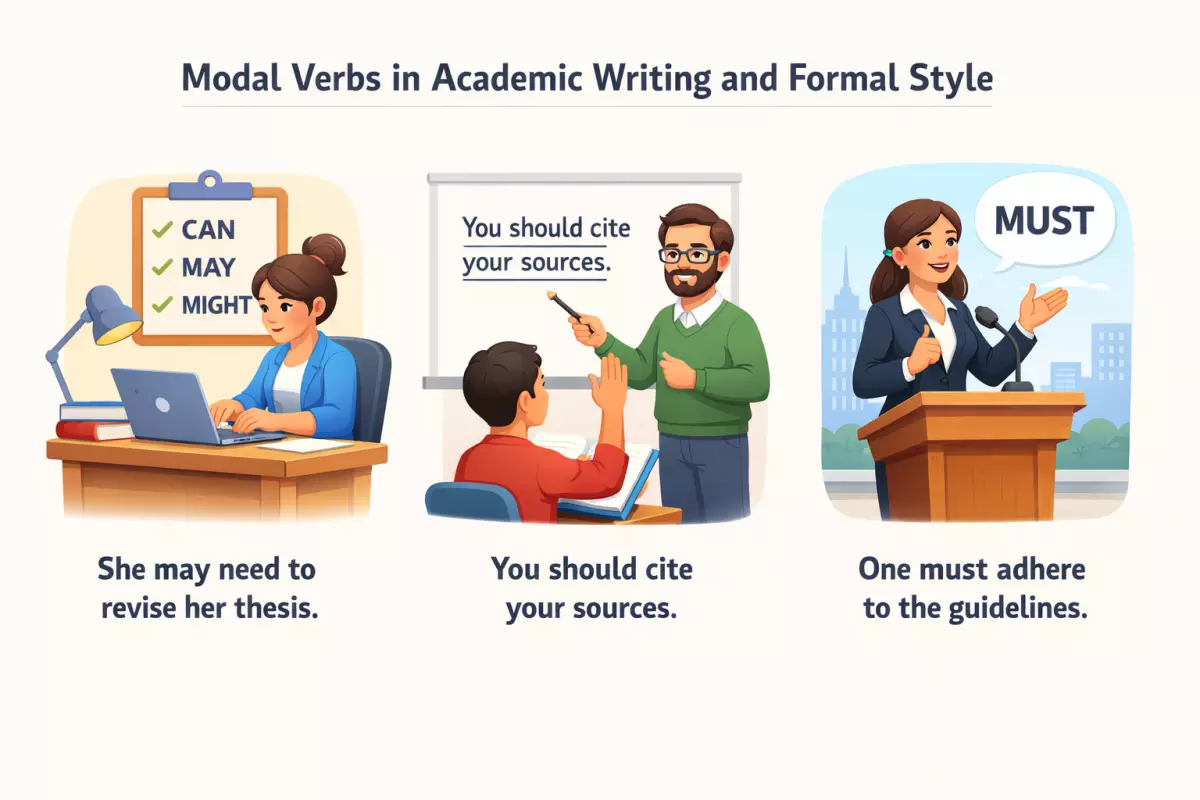 This article explains why academic writing leans on modal verbs, how they signal probability and interpretation, and gives research-focused examples of may, might, and could. It also shows how modals soften claims, when must or should fit, how tone affects choices, plus exercises.
- Why academic writing often relies on modal verbs
- How modal verbs help express probability and interpretation
- Examples of may, might, and could in research discussions
- How modal verbs soften claims and avoid absolute statements
- Situations where must or should appear in academic argumentation
- How academic tone influences the choice of modal verbs
- Exercises and practice activities using modal verbs in academic sentences
In academic writing, small helping verbs such as can, may, and must shape how confident or cautious your claims sound. Choosing them carefully keeps your argument balanced: firm when evidence is strong, restrained when it is limited, and respectful when engaging with other researchers. This guide explains how to select these verbs so your tone matches common university assignments.
Why academic writing often relies on modal verbs
Academic style often needs to sound careful, evidence-based, and appropriately limited. Modal verbs help writers express degrees of certainty, avoid overgeneralising, and signal how strongly a claim should be taken. They also support common research moves such as making recommendations, outlining implications, and acknowledging constraints.
Core functions of modals in formal academic style
- Hedging claims to match the strength of the evidence (e.g., using may, might, could rather than absolute statements).
- Expressing likelihood without implying proof (e.g., may = possible; might = less certain; could = one plausible explanation).
- Indicating logical inference while leaving room for alternative interpretations (e.g., could suggest; may indicate).
- Stating limitations and scope (e.g., results may not generalise; the sample may bias outcomes).
- Maintaining an objective tone by avoiding personal certainty and overly strong evaluation (modals reduce the “all-or-nothing” feel).
- Framing cautious recommendations in discussion and conclusion sections (e.g., future work should examine; practitioners may consider).
- Expressing obligation and necessity in methods, ethics, and reporting standards (e.g., data must be anonymised; participants must consent).
- Signalling weaker obligation when describing best practice rather than rules (e.g., authors should report confidence intervals).
- Describing ability and feasibility in procedures and analysis (e.g., the model can detect; the approach cannot handle missing values).
- Softening critique in literature review and peer evaluation (e.g., the argument may overlook; the study could benefit from).
- Presenting alternative explanations without committing to one (e.g., differences could arise from; this may reflect).
- Managing disciplinary caution, especially where claims are probabilistic (common in empirical and interpretive fields).
Common modal patterns that appear in research writing
- May/might + base verb: “This may indicate a shift in…” / “The discrepancy might result from…”
- Could + base verb (plausible explanation): “The increase could be due to…”
- Should + base verb (recommendation/expected practice): “Future studies should include…”
- Must + base verb (requirement/strong necessity): “Variables must be controlled to…”
- Can/cannot + base verb (capability/constraint): “This method can be applied to…” / “It cannot account for…”
- May not / might not (qualified negation): “These findings may not generalise to…”
- Could be + adjective/noun phrase (tentative evaluation): “This could be a limitation.”
- May have + past participle (tentative past cause): “The survey may have influenced responses.”
- Should be + past participle (recommended reporting): “All measures should be reported.”
- Must be + past participle (required procedure): “Data must be stored securely.”
- Can be + past participle (general possibility): “This effect can be observed in…”
- Modal + adverb to fine-tune strength: “may partly explain,” “could potentially affect,” “should ideally include.”
Accuracy and appropriateness: choosing the right strength
- ✅ Use may/might when evidence is suggestive but not decisive; ❌ avoid turning a correlation into certainty with “proves” or “shows” without support.
- ✅ Use could to introduce a plausible mechanism among several; ❌ avoid implying it is the only explanation.
- ✅ Use should for recommendations and expected practice; ❌ avoid must unless it is a genuine requirement (ethical, legal, methodological necessity).
- ✅ Use can for capability and general possibility; ❌ avoid using it as a substitute for may when you mean uncertainty rather than ability.
- ✅ Keep modals consistent with your evidence level across the paragraph; ❌ avoid mixing cautious language with absolute conclusions in the same claim.
How modal verbs help express probability and interpretation

Academic writing often needs controlled statements that separate what the evidence shows from what the writer infers. Modal verbs are a practical way to signal degrees of certainty, keep claims appropriately cautious, and guide the reader toward an interpretation without overstating it.
Common probability scales in formal prose
Modals can be grouped by how strongly they suggest likelihood. The exact strength depends on context, but these patterns are widely recognized in research writing.
| Likelihood level (typical) | Modal patterns used in academic style | Example in context |
|---|---|---|
| Strong inference (high probability) | must + base verb; cannot/can’t + base verb (negative inference) | The discrepancy must reflect measurement error rather than sampling variation. |
| Moderate probability | should + base verb; ought to + base verb | These controls should reduce confounding in the final model. |
| Possible (open but uncertain) | may + base verb; might + base verb; could + base verb | The intervention may improve adherence in older participants. |
| Low probability / weak commitment | might + base verb; could + base verb (often with limiting adverbs) | This pattern might indicate a short-term adaptation rather than a stable change. |
Usage patterns that strengthen interpretation without overclaiming
- Evidence → inference: Use a modal after reporting results to mark the shift from observation to explanation (e.g., “The slope increased; this may suggest…”).
- Modal + reporting verb: “may indicate,” “might reflect,” “could imply,” “should reduce,” which keeps the claim interpretive rather than absolute.
- Modal + be + adjective/noun: “may be consistent with,” “could be a consequence of,” “might be attributable to,” useful for aligning with prior work.
- Modal + passive: “may be explained by,” “could be driven by,” “should be interpreted as,” which foregrounds the phenomenon over the writer.
- Modal + conditional framing: “If X holds, Y may follow,” clarifying that the conclusion depends on assumptions.
- Modal + limitation cue: “may be limited by,” “could be affected by,” helping integrate constraints into the interpretation.
- Modal + quantifier/hedge: “may partly account for,” “could largely explain,” allowing calibrated strength rather than all-or-nothing wording.
High-value sentence frames (adaptable templates)
- The observed association may be explained by [mechanism/constraint].
- This result might reflect [process] rather than [alternative].
- The difference could arise from [methodological factor].
- The pattern should be interpreted in light of [context/assumption].
- Given [evidence], the most plausible account must involve [key factor].
- These findings may indicate that [interpretation], although [limitation].
- The null effect could be due to [power/measurement], not necessarily [theory].
- Under this model, [variable] should increase as [condition] changes.
- The discrepancy cannot be attributed solely to [factor] given [reason].
- Such variation might be expected in [population/setting].
- These estimates may be biased if [assumption] is violated.
- The intervention could have differential effects across [subgroups].
Common pitfalls and cleaner revisions
- ❌ “This proves that…” → ✅ “This suggests that…” or “This may indicate that…”
- ❌ “It is certain that…” (without strong evidence) → ✅ “It is likely that…” or “It may be that…”
- ❌ Overusing may for every claim → ✅ Mix levels: use must/cannot for constrained inference, should for expected effects, and may/might/could for open possibilities.
- ❌ Stacking multiple hedges (“may possibly suggest”) → ✅ Choose one clear marker (“may suggest”).
- ❌ Using can when you mean uncertainty → ✅ Use may/might for probability; reserve can for general capability or typicality (“X can occur when…”).
Examples of may, might, and could in research discussions
In research writing, these modals help you calibrate how strongly you commit to a claim. They are common in interpretations, limitations, and recommendations, where the evidence supports a direction but not certainty. The key is matching the modal to the strength of your support and the function of the sentence.
Typical functions and sentence patterns
- May often signals a plausible interpretation based on the results: “X may indicate Y.”
- Might commonly marks a more tentative inference or a possibility among alternatives: “X might reflect Y rather than Z.”
- Could frequently introduces potential mechanisms, explanations, or future actions: “X could be explained by Y.”
- Use modal + base verb for claims: “may suggest,” “might reduce,” “could influence.”
- Use modal + be + past participle for cautious passive reporting: “may be driven,” “might be confounded,” “could be underestimated.”
- Use modal + have + past participle for uncertainty about past causes: “may have resulted,” “might have biased,” “could have affected.”
Expanded example bank (by research move)
- Interpreting findings: “The increase in adherence may reflect improved access to follow-up care.”
- Interpreting findings: “The observed plateau might indicate a ceiling effect in the measurement instrument.”
- Interpreting findings: “The association could arise from shared underlying risk factors.”
- Linking to theory: “These results may support a threshold model of response.”
- Linking to theory: “The pattern might be consistent with attentional reallocation under load.”
- Linking to theory: “The divergence could be reconciled by assuming heterogeneous treatment effects.”
- Explaining discrepancies: “Differences in sampling frames may account for the conflicting estimates.”
- Explaining discrepancies: “The null result might be attributable to limited statistical power.”
- Explaining discrepancies: “The contrast could be due to variation in task difficulty across studies.”
- Stating limitations: “Self-report measures may introduce recall bias.”
- Stating limitations: “Unmeasured confounding might have influenced the magnitude of the effect.”
- Stating limitations: “The effect could be overestimated if attrition is non-random.”
- Discussing mechanisms: “The intervention may reduce stress by increasing perceived control.”
- Discussing mechanisms: “The shift might occur because participants adapt their strategies over time.”
- Discussing mechanisms: “The response could be mediated by changes in sleep quality.”
- Generalizing cautiously: “The findings may generalize to similar urban settings with comparable service coverage.”
- Generalizing cautiously: “The conclusions might not extend to populations with different baseline risk.”
- Generalizing cautiously: “The model could be transferable to related domains after recalibration.”
- Recommending future work: “Future studies may examine whether the effect persists beyond six months.”
- Recommending future work: “Subgroup analyses might clarify which participants benefit most.”
- Recommending future work: “A longitudinal design could test the proposed causal pathway.”
Common accuracy checks
- ✅ “This may suggest that…” → appropriate when evidence points in a direction but does not prove causality.
- ❌ “This may proves that…” → avoid mixing hedging with certainty; use “may suggest/indicate” instead.
- ✅ “This might be due to…” → useful when multiple explanations remain viable.
- ✅ “This could be explained by…” → works well for proposing a mechanism without claiming it is confirmed.
- ❌ “This could be because of X (therefore X caused it).” → if causality is not established, keep the causal language tentative throughout.
How modal verbs soften claims and avoid absolute statements

Academic prose often needs to present conclusions with appropriate caution. Modal verbs help writers signal probability, limit the scope of a statement, and separate evidence-based inference from certainty. This is especially useful when data are incomplete, results are context-dependent, or alternative explanations remain plausible.
Common hedging modals and what they typically signal
- May: a reasonable possibility based on available evidence (often neutral and cautious).
- Might: a weaker or more tentative possibility than may, or one among several options.
- Could: possibility or potential under certain conditions; also useful for offering interpretations.
- Can: general tendency or capacity (safer than universal claims, but still needs careful use).
- Should: expectation or inference when evidence strongly suggests an outcome, without claiming certainty.
- Would: conditional or model-based prediction; common in discussing hypothetical scenarios or implications.
- Must: strong inference (use sparingly in research writing unless the logic is genuinely unavoidable).
High-value patterns for cautious claims
- Modal + base verb: “The intervention may reduce symptoms in older adults.”
- Modal + be + adjective/noun: “This difference could be clinically meaningful.”
- Modal + have + past participle (tentative explanation of past results): “Selection bias may have influenced the estimates.”
- Modal + be + past participle (cautious passive): “The association might be explained by confounding.”
- Modal + depend on (explicit conditions): “The effect may depend on baseline severity.”
- Modal + vary (limits generalization): “Responses could vary across settings.”
- Modal + suggest/indicate (evidence framed as interpretation): “These results may suggest a dose–response relationship.”
- Modal + help (careful causal language): “The protocol may help reduce measurement error.”
- Modal + be consistent with (alignment, not proof): “The pattern could be consistent with an adaptive mechanism.”
- Modal + reflect (interpretation without overclaiming): “The increase might reflect seasonal variation.”
- Modal + contribute to (partial causality): “Stress may contribute to poorer adherence.”
- Modal + appear/seem (surface-level claim): “The groups may appear similar at baseline.”
Editing moves: from absolute to appropriately qualified
- ❌ “This proves that X causes Y.” → ✅ “These findings may indicate that X contributes to Y under the conditions tested.”
- ❌ “The treatment eliminates risk.” → ✅ “The treatment may reduce risk in the studied population.”
- ❌ “All participants benefited.” → ✅ “Participants could benefit, although responses may vary.”
- ❌ “The difference is due to age.” → ✅ “The difference might be due to age, but unmeasured factors could also play a role.”
- ❌ “This method is the best approach.” → ✅ “This method may be an effective approach for the specified task.”
- ❌ “The model accurately predicts outcomes.” → ✅ “The model can predict outcomes within the observed range and may generalize to similar contexts.”
Choosing the right strength of commitment
- Use may/might when evidence supports a possibility but alternatives remain credible.
- Use could to highlight conditionality (“under these assumptions”) or to introduce plausible mechanisms.
- Use should for well-supported expectations (often paired with methods or theory), but avoid implying guaranteed outcomes.
- Use can for general patterns, and add scope limits (population, time frame, setting) to prevent overgeneralization.
- Avoid relying on must unless the inference is logically necessary; otherwise, it can read as overstated.
Used carefully, modals let you align wording with the strength of the evidence: they keep claims defensible, reduce overgeneralization, and make room for uncertainty without sounding vague.
Situations where must or should appear in academic argumentation
In formal argumentation, must and should are most effective when they express a clearly justified obligation, a logically necessary conclusion, or a disciplined recommendation grounded in evidence. They work best when the writer makes the source of the necessity visible (method, data, theory, ethics, policy, or definitions) rather than sounding like personal preference.
Common contexts where must is appropriate
- Logical necessity from premises: use must when the conclusion follows tightly from stated assumptions. Example: “Given the definition of X, the outcome must be classified as Y.”
- Methodological requirements: use it for non-negotiable steps in a procedure. Example: “To avoid selection bias, participants must be randomly assigned.”
- Validity and reliability conditions: when a condition is required for the results to be interpretable. Example: “The instrument must demonstrate adequate internal consistency.”
- Constraints set by the research design: when the design forces a specific handling of variables or data. Example: “Because the data are non-independent, the model must account for clustering.”
- Ethical or regulatory compliance: when rules apply (ethics boards, consent, data protection). Example: “Informed consent must be obtained before data collection.”
- Definitions and conceptual boundaries: when a term’s definition imposes limits. Example: “If the construct is defined as stable, it must be measured across time.”
- Necessary controls in causal claims: when omitting a control would undermine the inference. Example: “Confounders must be controlled to support a causal interpretation.”
- Minimum reporting standards: when transparency is required for replication. Example: “The analysis pipeline must be reported in sufficient detail to reproduce results.”
- Boundary conditions for generalization: when claims depend on a stated scope. Example: “These findings must be interpreted within the sampled population.”
- Strong critique of flawed reasoning: when a step is unavoidable to fix an argument. Example: “The argument must address alternative explanations to be persuasive.”
Common contexts where should is appropriate
- Evidence-based recommendations: use should for guidance supported by findings but not strictly required. Example: “Future studies should include a more diverse sample.”
- Best-practice methodological advice: when multiple options exist but one is preferable. Example: “Researchers should preregister hypotheses to reduce flexibility.”
- Pragmatic choices under constraints: when the ideal is clear but resources vary. Example: “Where feasible, measurements should be taken at multiple time points.”
- Interpretive caution: when recommending how to read results. Example: “The effect size should be interpreted alongside confidence intervals.”
- Policy or practice implications: when translating results into action without claiming inevitability. Example: “Interventions should target the highest-risk groups first.”
- Normative claims with stated criteria: when arguing what is advisable given a value framework. Example: “If equity is prioritized, funding should be allocated to underserved areas.”
- Limitations and future work: when identifying what would strengthen the evidence base. Example: “Replications should test whether the pattern holds across contexts.”
- Recommendations for reporting clarity: when urging clearer communication. Example: “Authors should specify exclusion criteria and missing-data handling.”
- Risk management: when advising steps that reduce risk rather than satisfy a strict rule. Example: “Data should be backed up and version-controlled throughout the project.”
- Balanced critique: when pointing to improvements without declaring the work invalid. Example: “The discussion should more directly connect results to the stated hypotheses.”
Useful patterns that keep modality academic
- Anchor the obligation with a reason clause: “To ensure X, Y must…” / “To improve X, Y should…”
- Attribute necessity to a framework: “Under this model, X must…” / “According to these guidelines, X should…”
- Use conditional framing to avoid overreach: “If the goal is X, then Y should…”
- Prefer precise scope markers: “In this dataset/setting/sample, X must…” rather than broad universal claims.
- Distinguish requirement vs. recommendation: ✅ “To meet the inclusion criteria, participants must…” → “To improve representativeness, recruitment should…”
- Avoid unsupported commands: ❌ “Researchers must consider…” when no methodological, logical, or ethical basis is given; replace with “Researchers should consider…” or add the rationale.
How academic tone influences the choice of modal verbs
In formal scholarly prose, modal verbs help manage commitment: they let writers state what is likely, what is required, what is permitted, and what is only a tentative interpretation. The expected register favors careful calibration over certainty, so modals are often chosen to protect accuracy, reflect evidence strength, and maintain an appropriately cautious stance.
Common patterns in formal register
- Hedging claims with evidence-based probability: prefer may, might, could to signal plausible interpretations rather than facts.
- Stronger inference when warranted: use should or would for reasoned expectations grounded in analysis (not personal opinion).
- Limiting overstatement: avoid presenting assumptions as certainties; replace absolute phrasing with modals when the data do not fully determine the conclusion.
- Separating observation from interpretation: reserve non-modal statements for direct results; use modals for explanations, mechanisms, or generalizations.
- Framing recommendations and implications: use should for justified recommendations, and may for possible implications.
- Expressing methodological constraints: use can to describe capability or scope (what a method enables), and cannot for clear limitations.
- Stating necessity with precision: use must mainly for logical necessity or strict requirements; otherwise prefer need to or should depending on strength.
- Using permission modals sparingly: may can indicate permission in procedures (e.g., “Participants may withdraw…”), but in analysis it usually signals possibility.
- Maintaining neutral tone: avoid modals that sound conversational or forceful when a neutral alternative exists (e.g., prefer “may indicate” over “has to mean”).
- Keeping claims consistent across a paragraph: do not shift from may to must without adding stronger evidence or a clear logical step.
- Reducing ambiguity: when can could mean ability or possibility, consider may/might for uncertainty and can for capacity.
- Handling general truths carefully: use modals to avoid overgeneralizing from limited samples (e.g., “These findings may apply to…”).
Modal choices by rhetorical function (with examples)
- Possibility (tentative interpretation): “This pattern may reflect sampling bias.”
- Weaker possibility (more distance): “The discrepancy might be due to measurement error.”
- Conditional possibility: “Under these conditions, the method could produce inflated estimates.”
- Expectation from reasoning: “If the model is correct, performance should improve after calibration.”
- Hypothetical outcome: “A larger sample would likely reduce variance.”
- Ability/capacity: “This approach can detect low-frequency events.”
- Limitation: “The survey cannot capture informal caregiving hours reliably.”
- Requirement (procedural/ethical): “All participants must provide informed consent.”
- Logical necessity (argument structure): “Given these premises, the coefficient must be negative.”
- Recommendation (measured): “Future studies should control for baseline differences.”
- Permission in protocols: “Participants may withdraw at any time without penalty.”
- Prohibition/constraint: “Researchers must not store identifiable data on personal devices.”
Editing cues: tightening or softening commitment
- ✅ “The data suggest X, which may indicate Y.” → separates evidence from interpretation.
- ❌ “This proves Y.” → often too strong unless the design supports proof.
- ✅ “The results can be explained by Z.” → signals one plausible explanation, not the only one.
- ❌ “The results must be explained by Z.” → overstates unless alternatives are ruled out.
- ✅ “This should improve reliability.” → appropriate for justified expectation.
- ❌ “This will improve reliability.” → too definitive without confirmatory evidence.
Exercises and practice activities using modal verbs in academic sentences
Use the tasks below to practice choosing modals that match the level of certainty, obligation, and caution expected in formal prose. Focus on common academic patterns such as hedging (limiting claims), stating requirements, and making recommendations based on evidence.
1) Choose the best modal for the claim strength
Select the single best option (A, B, C, or D) for each sentence.
- The observed increase in yield ______ be explained by changes in irrigation practices. (A) must (B) may (C) should (D) will
- Given the measurement error, the true effect ______ be smaller than reported. (A) could (B) must (C) will (D) shall
- Under the stated assumptions, the solution ______ satisfy the boundary conditions. (A) might (B) must (C) could (D) may
- The discrepancy ______ indicate model misspecification rather than random noise. (A) should (B) may (C) must (D) will
- With a larger sample, the confidence interval ______ narrow. (A) can (B) would (C) must (D) might
- These findings ______ not be generalized beyond the study population. (A) should (B) may (C) can (D) must
- If the catalyst is inactive, the reaction ______ proceed at the reported rate. (A) cannot (B) must not (C) should not (D) may not
- Because the variable is constant, it ______ influence the outcome in this model. (A) cannot (B) might (C) should (D) may
Show answers
- B
- A
- B
- B
- B
- A
- A
- A
2) Rewrite to improve academic caution (hedging)
Rewrite each sentence to sound appropriately cautious for a research paper. Keep the meaning, but reduce overcertainty where needed.
- This intervention will eliminate selection bias.
- The results prove that the new algorithm is optimal.
- This survey shows that social media causes anxiety.
- The proposed framework is the only valid explanation for the observed pattern.
- These data demonstrate that the policy has no negative effects.
- The difference is due to temperature alone.
Show answers
- This intervention may reduce selection bias.
- The results suggest that the new algorithm may be close to optimal under the tested conditions.
- This survey indicates that social media use may be associated with anxiety.
- The proposed framework may provide an explanation for the observed pattern.
- These data suggest that the policy may have limited negative effects in the measured outcomes.
- The difference may be due primarily to temperature, although other factors cannot be ruled out.
3) Rewrite to increase precision (avoid vague modals)
Replace the modal with a clearer academic construction when the sentence needs specificity (method, condition, or evidence threshold).
- Participants should complete the questionnaire.
- The device may fail during testing.
- The model can be improved.
- Researchers must consider confounding variables.
- This approach might work in practice.
Show answers
- Participants are required to complete the questionnaire before the interview.
- The device may fail if operated above the specified temperature range.
- The model can be improved by adding interaction terms and validating on an external dataset.
- Researchers must consider confounding variables when estimating causal effects.
- This approach might work in practice if the implementation constraints (latency and data availability) are met.
4) Pattern drills: common academic modal structures
- Hedged inference: “X may/might/could indicate Y (rather than Z).”
- Evidence-based necessity: “Given A, X must be true.”
- Methodological limitation: “These results may not generalize to…”
- Capability/feasibility: “This method can be applied to…”
- Prohibition/impossibility: “X cannot be attributed to Y in this design.”
- Recommendation: “Future studies should examine…”
- Conditional prediction: “If A holds, X would be expected to…”
- Risk/uncertainty: “Measurement error could account for…”
- Requirement in protocols: “All samples must be stored at…”
- Polite constraint: “To avoid bias, researchers should not…”
- Scope control: “This analysis can only address…”
- Alternative explanation: “The pattern may reflect X, but it could also reflect Y.”
- Strengthening a claim carefully: “The convergence of results suggests that X may be robust.”
- Reporting uncertainty: “The parameter estimate might be sensitive to…”
- Norms/ethics: “Participants must provide informed consent.”
5) Edit for formality and correct modal usage
Revise each sentence to match formal style and correct modal meaning. Keep the content, but fix register and logic.
- The results gotta mean the treatment works.
- This variable must not affect the outcome (but we are not sure).
- The samples should be contaminated because the lab was busy.
- The policy can reduce emissions, therefore it will reduce emissions everywhere.
- The theory may explains the discrepancy.
- The committee shall consider the limitations in the discussion section.
Show answers
- The results suggest that the treatment may be effective.
- This variable may not affect the outcome, although uncertainty remains.
- The samples may have been contaminated because the laboratory conditions were suboptimal.
- The policy can reduce emissions under certain conditions; however, it may not do so in all contexts.
- The theory may explain the discrepancy.
- The discussion section should consider the limitations.