Modal Verbs for Everyday Decisions and Solutions

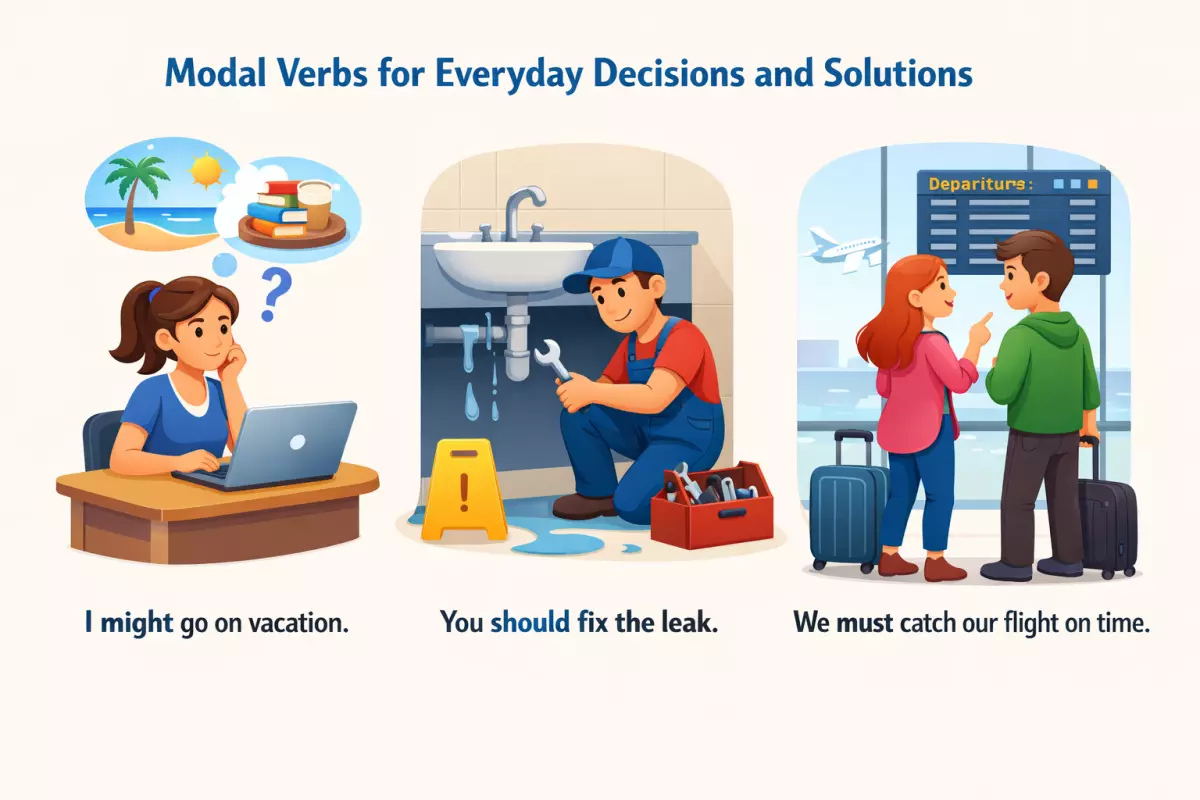 This article explains how modal verbs help you suggest possible solutions, discuss choices, and explore alternatives using could and might. It includes everyday problem-solving examples, shows how modals express uncertainty, compares multiple options, and offers practice exercises.
- How modal verbs help speakers suggest possible solutions
- Common modal verbs used when discussing choices or options
- How speakers explore alternatives using could and might
- Examples of everyday problem-solving conversations
- How modal verbs help express uncertainty while proposing ideas
- Situations where speakers compare several possible solutions
- Exercises and practice activities using modal verbs in problem-solving situations
In everyday decisions and small problem solving, modal helper verbs help you show what is possible, necessary, or recommended in a few words. This article explains how to use can, could, should, must, and might in real situations such as planning, giving advice, and choosing next steps. You will learn to sound clear and polite without being too formal, while keeping your meaning accurate.
How modal verbs help speakers suggest possible solutions
When speakers propose fixes, they often need to balance clarity with politeness and uncertainty. Modal verbs make that possible by showing how strong a suggestion is (firm advice vs. a gentle idea), how likely an outcome seems, or what is allowed or required. They also help speakers negotiate options without sounding demanding.
Core patterns for offering solutions
- Modal + base verb: “We could reschedule.” / “You should call support.”
- Modal + be + -ing (for temporary situations): “It might be causing the delay.”
- Modal + have + past participle (for past options and hindsight): “We could have avoided this with a backup.”
- Modal questions (to invite agreement): “Could we try a different approach?” / “Should we ask for help?”
- Negative modals (to rule out bad options): “We shouldn’t share that file.” / “You mustn’t reset it during updates.”
Choosing the right modal for the type of solution
- Could for options and brainstorming: “We could split the task into two parts.”
- Can for practical ability or available actions: “I can send the revised version today.”
- May / might for uncertain causes and cautious proposals: “It might be a settings issue.” / “We may need more time.”
- Should / ought to for advice and best practice: “You should back up the folder first.”
- Must / have to for strong necessity or rules: “We have to confirm the address before shipping.”
- Would for polite, conditional suggestions: “It would help to restart the router.”
- Need to (semi-modal) for clear requirements without sounding harsh: “We need to update the password.”
Useful sentence frames (with example solutions)
- “We could …” → “We could try a simpler layout.”
- “You might want to …” → “You might want to check the spam folder.”
- “It may be better to …” → “It may be better to wait until traffic is lower.”
- “We should probably …” → “We should probably document the steps.”
- “We have to … before we …” → “We have to save the file before we close the app.”
- “You can … if you want” → “You can use the template if you want.”
- “Could we … instead?” → “Could we meet tomorrow instead?”
- “Should we … first?” → “Should we restart it first?”
- “We mustn’t …” → “We mustn’t publish unverified numbers.”
- “We don’t have to …” → “We don’t have to decide today.”
- “It might help to …” → “It might help to clear the cache.”
- “That would …” → “That would reduce confusion for new users.”
- “If we …, we could …” → “If we automate the report, we could save time.”
- “To avoid this, we should …” → “To avoid this, we should label the versions.”
Common usage notes (accuracy and tone)
- Use “could” to keep suggestions open: “We could move it to Friday” sounds less forceful than “We should move it to Friday.”
- Use “might” for tentative diagnosis: “It might be the cable” avoids claiming certainty without evidence.
- Prefer “should” for guidance, “must/have to” for non-negotiables: “You should submit it today” (advice) vs. “You have to submit it today” (requirement).
- Avoid double modals: ❌ “We might could try…” ✅ “We might try…” or “We could try…”
- Keep the main verb in base form after a modal: ❌ “We should to check” ✅ “We should check.”
- Use “don’t have to” for lack of necessity: “You don’t have to redo it” (not required) is different from “You mustn’t redo it” (not allowed).
Common modal verbs used when discussing choices or options
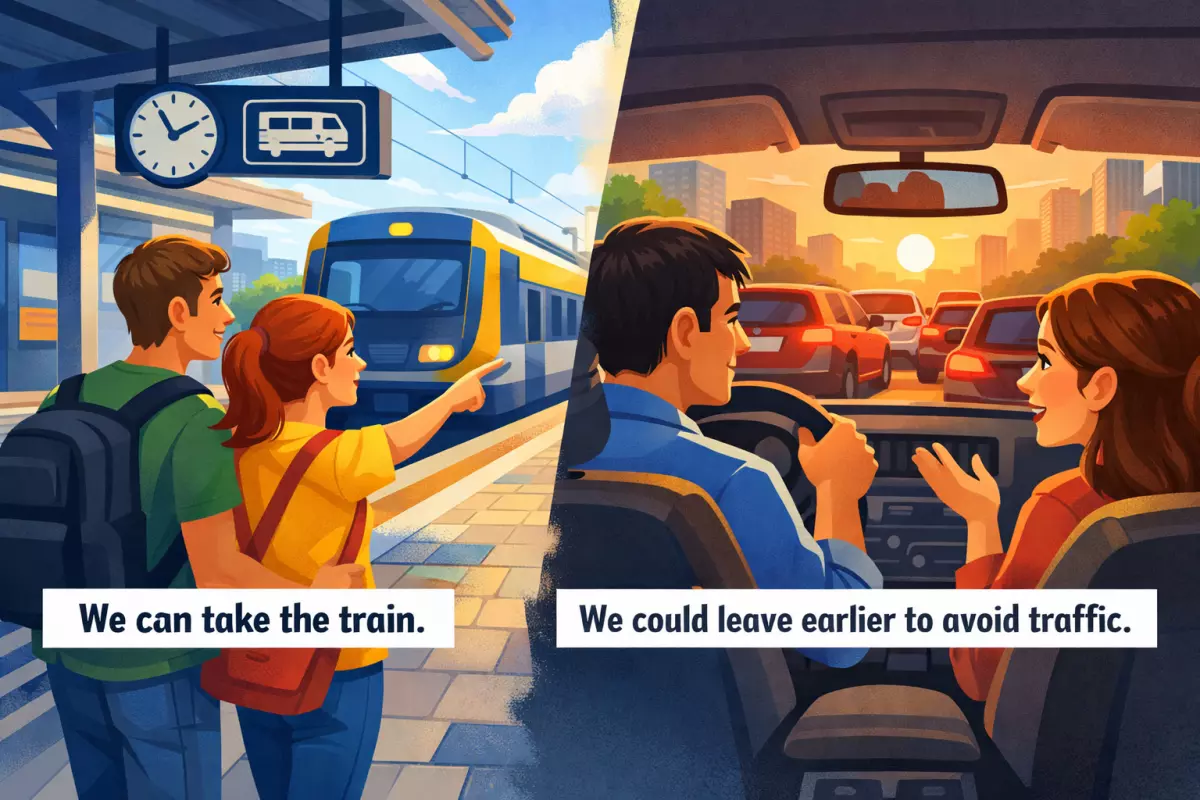
When you weigh alternatives, modal verbs help you express ability, permission, advice, obligation, probability, and willingness. The key is matching the modal to the strength of the recommendation and the level of certainty you want to show.
Core modals for decisions
- can (ability/possibility): “We can take the train.” / “You can try restarting the router.”
- could (weaker possibility/polite suggestion): “We could leave earlier to avoid traffic.”
- may (permission/formal possibility): “You may submit the form online.” / “It may rain later.”
- might (uncertain possibility): “We might need more time.”
- should (advice/expected best option): “You should back up your files first.”
- ought to (advice with a moral/strong expectation): “You ought to tell them about the delay.”
- must (strong obligation/necessity): “We must decide by Friday.”
- have to (external requirement): “I have to renew my license this week.”
- need to (necessity, often practical): “You need to update the app to fix the bug.”
- don’t have to (no obligation): “You don’t have to attend the meeting.”
- mustn’t (prohibition): “You mustn’t share that password.”
- will (decision/intent, confident prediction): “I’ll call them now.” / “This will save time.”
- would (polite preference/hypothetical choice): “I’d choose the cheaper plan.” / “Would you like to reschedule?”
- shall (offers/suggestions in some varieties): “Shall we order food or cook?”
Useful patterns for presenting options
- Option + can/could: “You can pay monthly.” / “You could switch to the annual plan.”
- We/You might want to + verb: “You might want to compare prices first.”
- Should we + verb…?: “Should we wait, or should we go now?”
- If we + verb, we might/could + verb: “If we leave at 7, we might miss traffic.”
- We don’t have to + verb (removing pressure): “We don’t have to decide today.”
- We have to / need to + verb (setting constraints): “We need to stay within budget.”
- Would rather / would prefer: “I’d rather walk.” / “I’d prefer to email them.”
Common form notes and quick corrections
- Modal + base verb: ✅ “We should go now.” ❌ “We should to go now.”
- Negative placement: “You shouldn’t rush.” / “We don’t have to rush.”
- Questions: “Can we change the date?” / “Should I send a message first?”
- Past reference with modals: “We should have checked the address.” / “It might have been a mistake.”
- Strength scale for recommendations: might (soft) → could → should/ought to → must/have to (strong)
How speakers explore alternatives using could and might
When you want to consider options without committing to one plan, could and might help you sound open-minded and flexible. They are common in everyday problem-solving because they present ideas as possible routes rather than fixed decisions.
Core meanings in option-talk
- Could often introduces a practical option or suggestion: “We could take the train.”
- Might often signals a weaker commitment or a possibility you are not sure аbout: “We might take the train, depending on the weather.”
- Both modals keep the tone non-final, which is useful for brainstorming and negotiating.
Common sentence patterns
- Subject + could/might + base verb: “I could call support.” / “I might wait until tomorrow.”
- Could/might + subject + base verb? (suggesting gently): “Could we try restarting it?” / “Might we need a new adapter?”
- We could… or… (presenting choices): “We could meet at 6, or we could do a quick call.”
- Could/might + also (adding another alternative): “We could also email them.” / “We might also ask Alex.”
- Could/might + just (minimizing the step): “We could just reschedule.” / “We might just leave early.”
- Could/might + need to (possible requirement): “We could need a backup plan.” / “We might need to update the app.”
- Could/might + be + -ing (possible ongoing situation): “The system could be blocking it.” / “They might be running late.”
- Could/might + have + past participle (past possibility): “We could have missed the turn.” / “It might have been sent to spam.”
Using could vs. might to manage certainty
Choose could when you want to put forward an actionable idea. Choose might when you want to keep more distance from the idea or emphasize uncertainty. In many real conversations, speakers mix both to explore a range of options—from more workable to more tentative.
Useful phrases for exploring solutions (with examples)
- “We could try a different approach.”
- “I could check the settings.”
- “You could ask for a refund.”
- “We could split the task.”
- “We could move it to next week.”
- “We could do it step by step.”
- “We might be able to finish today.”
- “It might help to restart the router.”
- “We might want to confirm the details first.”
- “I might need a bit more time.”
- “They might not have seen the message.”
- “This could solve the issue.”
- “That could be the reason.”
- “There might be a simpler option.”
- “We could either call or send an email.”
- “We might have to change the plan if it rains.”
Common learner errors to avoid
- ✅ “We could go now.” ❌ “We could to go now.” (Use the base verb after the modal.)
- ✅ “It might be true.” ❌ “It might to be true.”
- ✅ “Could you help me?” ❌ “Could you to help me?”
- ✅ “We might have missed it.” ❌ “We might missed it.” (Use have for past possibility.)
In decision-making conversations, these modals let you test ideas, invite input, and adjust plans without sounding overly certain. That flexibility is exactly why they appear so often in everyday choices and quick problem-solving.
Examples of everyday problem-solving conversations
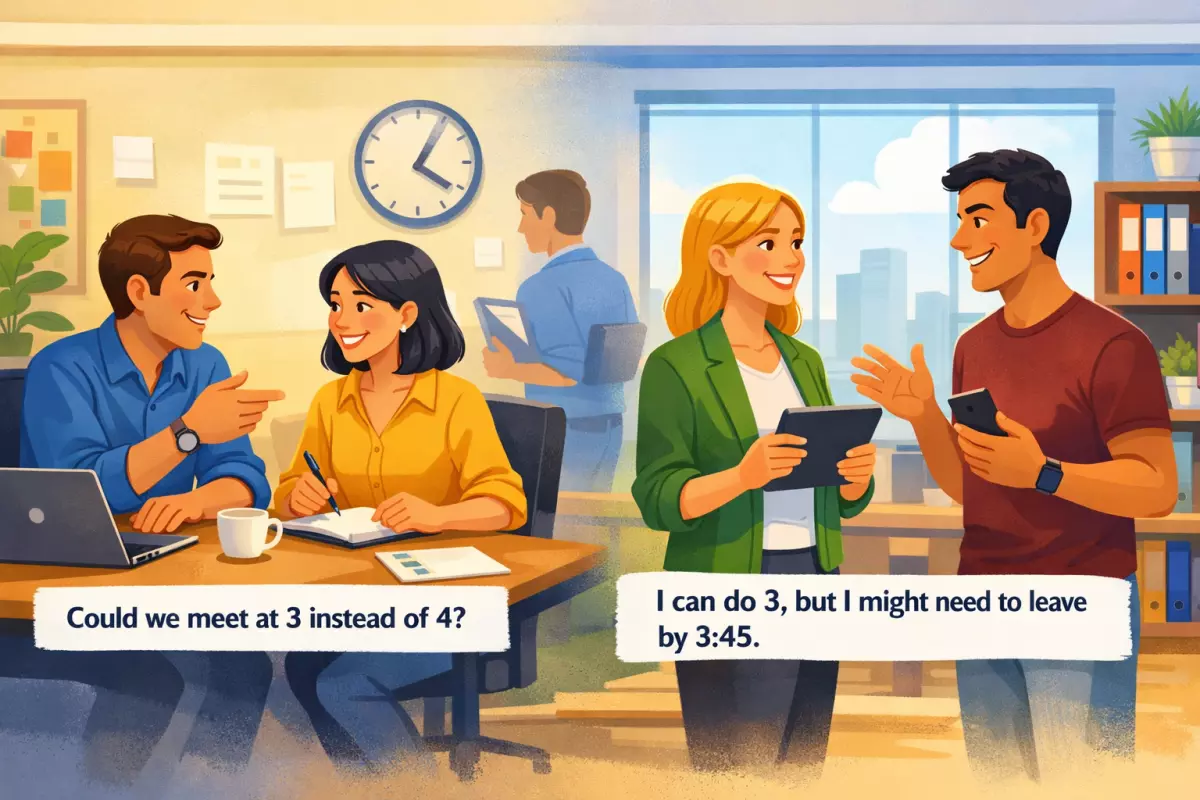
Use these short dialogues to notice how modal verbs soften suggestions, express necessity, show ability, and negotiate options. Pay attention to the pattern modal + base verb (no “to” after most modals) and how questions help people agree on a practical next step.
-
1) Choosing a meeting time (polite suggestion + checking availability)
A: We’re running out of time. Could we meet at 3 instead of 4?
B: I can do 3, but I might need to leave by 3:45.
Pattern: Could we + verb…? / I can… but I might…
-
2) Fixing a Wi‑Fi issue (probability + quick action)
A: The internet is down again. What should we try first?
B: It might be the router. We should restart it.
Pattern: What should we…? / It might be… / We should…
-
3) Deciding whether to drive or take the bus (advice + caution)
A: Traffic looks bad. Should we take the bus?
B: We could, but we may have to stand. Driving might take longer.
Pattern: Should we…? / We could… but… / might take…
-
4) Handling a late delivery (obligation + next step)
A: The package still isn’t here. What do we do?
B: We should contact support. They might have an update.
Pattern: We should + verb / They might + verb
-
5) Splitting chores at home (negotiation + willingness)
A: The kitchen is a mess. Who does what?
B: I can wash the dishes, and you could wipe the counters.
Pattern: I can… / you could… (balanced, cooperative tone)
-
6) Planning a budget (necessity vs. option)
A: We’re overspending. Do we have to cut something?
B: We don’t have to cancel everything, but we should reduce eating out.
Pattern: Do we have to…? / don’t have to… / should…
-
7) Making a decision with limited information (tentative language)
A: Is this the right file?
B: It could be, but I’m not sure. We might need to check the date.
Pattern: could be / might need to + verb
-
8) Asking for help at work (polite request)
A: Could you review this email before I send it?
B: Sure. I can look now, or I could do it after lunch.
Pattern: Could you + verb…? / I can… or I could…
-
9) Dealing with a noisy neighbor (softening + recommendation)
A: The music is really loud. What should I do?
B: You could talk to them first. If that doesn’t work, you may need to call the building manager.
Pattern: You could… / you may need to…
-
10) Choosing a restaurant (preference + possibility)
A: I’m not sure what I want. Where should we go?
B: We could try the new place, or we can keep it simple and get pizza.
Pattern: We could… or we can…
-
11) Safety and rules (must vs. should)
A: Do we have to wear helmets?
B: Yes, we must on this trail. You should also bring water.
Pattern: have to / must (rule) vs. should (recommendation)
-
12) Making an appointment (ability + constraint)
A: Can you do Thursday morning?
B: I can’t Thursday, but I could do Friday at 10.
Pattern: Can you…? / I can’t… but I could…
-
13) Troubleshooting a printer (step-by-step suggestions)
A: It won’t print. Any ideas?
B: We should check the paper tray. Then we can reconnect it to the network.
Pattern: should (first step) → can (next action)
-
14) Responding to an urgent message (priority + obligation)
A: The client is asking for an update.
B: We need to reply today. We can send a short note now and a full update later.
Pattern: need to (strong necessity) / can (practical option)
Common accuracy reminders: ✅ “We should call” (modal + base verb) ❌ “We should to call.” For stronger force, use must or have to; for softer suggestions, use could; for uncertain outcomes, use might or may.
How modal verbs help express uncertainty while proposing ideas
When you suggest a plan but don’t want to sound 100% certain, modal verbs let you signal probability, caution, and openness to other options. They help you “float” an idea, invite feedback, and avoid overpromising.
Core pattern: modal + base verb
Most modals use the same structure: modal + base form (no to, no -s).
- ✅ We might try a different route. ❌ We might to try a different route.
- ✅ It could work if we start earlier. ❌ It could works if we start earlier.
- ✅ You may want to back up the files first. ❌ You may wants to back up the files first.
Choosing a modal to match your level of certainty
Different modals communicate different “distance” from certainty. Use them to calibrate how strong your suggestion sounds.
- might: a tentative idea; low confidence. Example: We might postpone until Friday.
- may: a cautious possibility; slightly more formal. Example: This may reduce the risk.
- could: a possible option or solution; often sounds practical. Example: We could split the tasks.
- should: a recommendation with moderate confidence. Example: We should confirm the budget first.
- would: a proposal framed as hypothetical/polite. Example: I would suggest a shorter meeting.
Useful sentence frames for proposing ideas
These patterns keep the tone collaborative and make it clear you’re offering an option, not issuing a command.
- We could + base verb → We could test it with a small group.
- We might + base verb → We might need an extra day.
- It may/might be worth + -ing → It might be worth checking the warranty.
- Maybe we could + base verb → Maybe we could call them first.
- Could we + base verb? (gentle suggestion) → Could we move this to the afternoon?
- Should we + base verb? (invite agreement) → Should we ask for a second quote?
- We could always + base verb (backup plan) → We could always reschedule if needed.
- It could be + adjective + to + base verb → It could be helpful to write it down.
- That might + base verb (reacting to an idea) → That might solve the timing issue.
- This could mean + noun/-ing (soft consequence) → This could mean adding a step.
- We may have to + base verb (tentative necessity) → We may have to adjust the schedule.
- It might not + base verb (gentle warning) → It might not scale well.
Adding “hedges” to sound careful, not vague
Modals often pair with short modifiers that show you’re estimating rather than declaring. Place them before the main verb or at the end of the clause.
- probably: It could probably work with fewer steps.
- possibly: We might possibly finish today.
- maybe: Maybe we could simplify the form.
- in theory: It should work in theory.
- at least: We could at least gather the data.
- for now: We could keep it simple for now.
Common pitfalls and quick fixes
- Overstating certainty: If you’re not sure, avoid “will” and switch to “might/could.” → It will fix it (too strong) vs. It might fix it (more accurate).
- Confusing possibility with advice: “Could” suggests options; “should” suggests a recommendation. → We could review it (option) vs. We should review it (advice).
- Missing the base form: Keep the main verb unchanged after the modal. → She might need help (not “needs”).
- Too many hedges: One modal plus one softener is usually enough. → We might possibly maybe try… (over-hedged).
Situations where speakers compare several possible solutions
When people weigh options, modal verbs help them rank ideas by practicality, urgency, cost, risk, and social acceptability. The most common patterns combine a modal with comparison language (better, easier, safer, more likely) and with conditional framing (if we…, then we can/should…).
Common comparison patterns with modals
- Option A vs. option B: “We could take the train, or we could drive.” (neutral alternatives)
- Recommendation: “We should book now; it’s cheaper than waiting.” (strong advice)
- Stronger recommendation: “We ought to ask first; it’s more polite.” (principle-based advice)
- Best choice: “We should probably choose the earlier flight.” (softened, realistic advice)
- Practical ability: “We can meet at 6, but we can’t stay late.” (feasibility limits)
- Possibility vs. probability: “It might rain, but it will probably clear up later.”
- Risk management: “We could try it, but it might not work.” (trade-off)
- Stronger necessity: “We must back up the files before updating.” (non-negotiable)
- External requirement: “We have to follow the policy, even if it’s slower.”
- Permission-based option: “We may leave early if we finish the report.” (formal permission)
- Polite suggestion: “You could email them first; it’s less intrusive than calling.”
- Preference + modal: “I’d rather we didn’t rush; we can decide tomorrow.”
- Conditional comparison: “If we take a taxi, we can save time; if we walk, we might be late.”
- Cost/effort framing: “We could fix it ourselves, but we might waste a whole day.”
- Social impact: “We should tell them now; otherwise they might feel ignored.”
Choosing the right modal when comparing options
- Use “could” to list workable alternatives without committing: “We could reschedule / we could shorten the meeting.”
- Use “can” to talk about what is realistically possible (time, rules, ability): “We can do it today, but we can’t finish by noon.”
- Use “might / may” to introduce uncertainty and keep the tone cautious: “That might be faster, but it may cause errors.”
- Use “should / shouldn’t” to rank options and give guidance: “We should choose the safer route; we shouldn’t cut corners.”
- Use “must / have to” when one option is required (safety, law, deadlines): “We have to submit it today, so we must prioritize the summary.”
- Use “need to” to highlight necessity while sounding less forceful than “must”: “We need to confirm the address before we go.”
Useful language for weighing pros and cons
- “Which option should we go with?”
- “We could do X, but then we’d have to do Y.”
- “If we choose A, we might save money; if we choose B, we can save time.”
- “We should probably avoid that; it might cause delays.”
- “We can try the simple fix first; if it doesn’t work, we can replace the part.”
- ✅ “We should take a backup, just in case.” → advice + precaution
- ❌ “We must maybe change the plan.” → avoid mixing strong certainty (“must”) with uncertainty (“maybe”); prefer “should” or “might need to”
Exercises and practice activities using modal verbs in problem-solving situations
Use the activities below to practice choosing modal verbs that match the goal of a solution: giving advice, stating rules, showing possibility, making a plan, or explaining a logical conclusion. Focus on the pattern modal + base verb (no to
after most modals) and on how meaning changes with the modal you select.
1) Quick pattern reminders (choose the right shape)
- Advice: should / shouldn’t + base verb (You should restart the router.)
- Strong advice/expectation: ought to + base verb (You ought to back up your files.)
- Obligation: must / have to + base verb (You must wear a helmet. / You have to submit the form.)
- No obligation: don’t have to + base verb (You don’t have to pay today.)
- Prohibition: mustn’t + base verb (You mustn’t share your password.)
- Permission: can / may + base verb (You can leave early. / You may use the meeting room.)
- Possibility: might / may / could + base verb (It might rain; bring a jacket.)
- Ability: can / can’t + base verb (I can’t access the file.)
- Requests: could / can + subject + base verb? (Could you check the settings?)
- Logical deduction: must / can’t + base verb (It must be the wrong address. / It can’t be the same file.)
2) Scenario choice: pick the best modal for the goal
Complete each sentence with one modal (or modal phrase). Choose from: should, shouldn’t, must, mustn’t, have to, don’t have to, can, can’t, could, might, may.
- The printer is jammed again. You ______ open the back panel and remove the paper carefully.
- This area is restricted. Visitors ______ enter without a badge.
- The deadline is tomorrow, but the manager said the report is optional. We ______ submit it today.
- The app keeps crashing after the update. It ______ be a compatibility issue.
- I’m not sure the meeting room is free. We ______ book it in advance.
- Your phone battery is at 2%. You ______ keep streaming video right now.
- We’re lost. ______ you check the map and confirm the address?
- The file is missing from the folder. Someone ______ have moved it.
- To access payroll, you ______ use two-factor authentication. It’s required.
- It’s a small scratch, not a crack. It ______ be serious, but watch it for changes.
- You ______ park here after 6 p.m.; the sign allows it.
- The door is locked and the lights are off. They ______ be open.
Show answers
- should
- mustn’t
- don’t have to
- might / could
- should / might
- shouldn’t
- Could
- might
- must / have to
- may / might
- can / may
- can’t
3) Fix the form: modal + base verb (no extra endings)
Rewrite each sentence so the modal structure is correct. Keep the meaning as close as possible.
- You should to call the customer back today.
- He can repairs it if you give him the tools.
- We mustn’t to share this link publicly.
- They might goes to the wrong location.
- Could you to send me the updated file?
- I don’t have to paying for shipping.
- She must finishes the checklist before leaving.
- We may to need a second opinion.
Show answers
- You should call the customer back today.
- He can repair it if you give him the tools.
- We mustn’t share this link publicly.
- They might go to the wrong location.
- Could you send me the updated file?
- I don’t have to pay for shipping.
- She must finish the checklist before leaving.
- We may need a second opinion.
4) Advice vs. obligation vs. prohibition (same problem, different pressure)
For each situation, write three versions: one with should (recommendation), one with must/have to (requirement), and one with mustn’t (ban). This builds control over how strong your solution sounds.
- A coworker keeps clicking suspicious email links.
- A team member is late to every client call.
- A roommate leaves the stove on after cooking.
- A student forgets to cite sources in assignments.
5) Problem-solving role cards (pair or group speaking)
- Tech support: Use at least 3 suggestions with should/shouldn’t and 2 possibilities with might/could.
- Office policy: Explain 3 rules with must/mustn’t and 2 permissions with can/may.
- Travel disruption: Offer 3 options with could and 2 predictions with might.
- Safety briefing: Give 4 prohibitions with mustn’t and 2 requirements with have to.
- Budget planning: Use don’t have to for non-essentials and must for essentials; include 2 polite requests with could.
6) Mini decision ladder (from uncertain to certain)
Practice moving from a weak guess to a strong conclusion. Use these steps to describe the same issue with different certainty levels:
- Low certainty: It might be a settings problem.
- Medium certainty: It could be a settings problem.
- Higher certainty: It may be a settings problem (more formal).
- Strong conclusion: It must be a settings problem (based on evidence).
- Strong negative conclusion: It can’t be a settings problem (if evidence rules it out).
Now apply the ladder to these prompts (say or write 3–5 sentences per prompt):
- The package tracking hasn’t updated for five days.
- The internet works on phones but not on the laptop.
- The room is double-booked even though you reserved it.