How Modal Verbs Help When Making Decisions

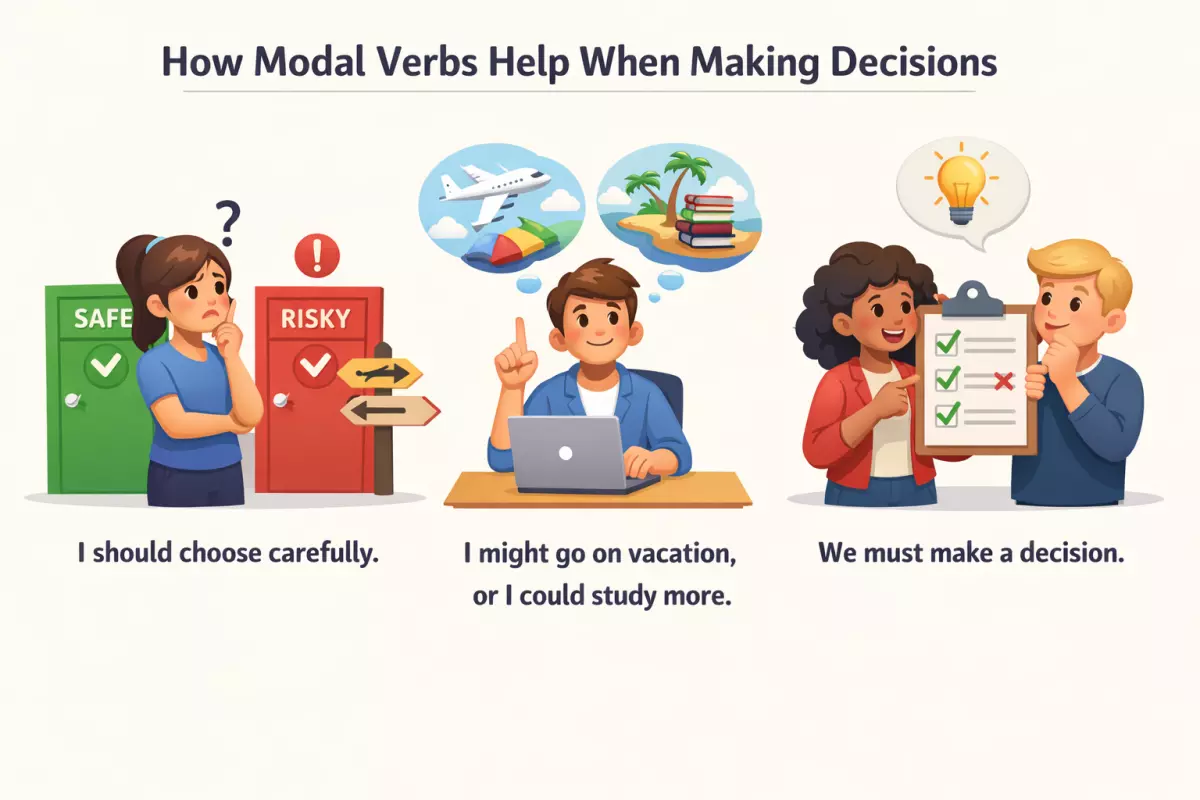 This article explains how speakers use modal verbs to think through decisions, offer options and recommendations, and compare alternatives with could, might, and should. It includes conversation examples, shows how tone and context affect choice, and ends with practice exercises.
- How speakers use modal verbs when thinking through decisions
- Modal verbs that express options, suggestions, and recommendations
- How could, might, and should appear when discussing alternatives
- Examples of conversations where people evaluate possible actions
- How modal verbs guide discussions toward a final decision
- How tone and context influence which modal verb is chosen
- Exercises and practice activities expressing decisions with modal verbs
Modal verbs can subtly steer decision-making by signaling how certain you feel, what you’re prepared to do, or what you believe is required. In everyday situations like picking a job, planning a trip, or replying to a friend, words like might, could, should, and must express possibility, advice, obligation, and intent. Using them well makes your meaning clearer and your choices sound more confident.
How speakers use modal verbs when thinking through decisions
When people weigh options out loud, they often reach for modal verbs to show how sure they are, what they’re willing to do, what they’re allowed to do, or what seems necessary. The choice of modal (and the structure that follows) signals whether an idea is a firm plan, a tentative guess, a rule-based constraint, or a polite suggestion.
Common decision-making moves and the modals that express them
- Float a possibility with might or may: “We might postpone the launch.” / “I may take the earlier train.”
- Predict what’s likely with will or should: “That will save time.” / “This should work if the data is clean.”
- Show uncertainty vs. confidence by shifting the modal: “It could be a bug” (open) vs. “It must be a bug” (strong conclusion).
- Offer a cautious recommendation with should or ought to: “We should get a second quote.” / “You ought to back up the files first.”
- State necessity with must or have to: “We must decide today.” / “I have to submit it by 5.”
- Reduce pressure with don’t have to (lack of necessity): “We don’t have to answer right now.”
- Talk about rules/permission with can, may, or be allowed to: “We can expense this.” / “You may leave early.” / “Are we allowed to change vendors?”
- Set boundaries with negatives: “We can’t exceed the budget.” / “You mustn’t share that file.”
- Check feasibility with can and could: “Can we finish by Friday?” / “Could we automate that step?”
- Make a polite proposal with could or might: “We could try a smaller pilot.” / “We might start with the simplest option.”
- Invite input using question forms: “Should we call them now?” / “Could you review this?” / “May I suggest another approach?”
- Express willingness with will or would: “I’ll handle the email.” / “I’d talk to finance first.”
- Signal reluctance or limits with won’t or wouldn’t: “I won’t approve that without numbers.” / “I wouldn’t sign until legal reviews it.”
- Compare options indirectly with modals plus conditionals: “If we wait, prices might drop.” / “If we switch tools, it could slow us down at first.”
- Reframe a decision as a logical conclusion with must: “Given the timeline, we must prioritize the core features.”
Patterns speakers rely on (form + meaning)
- Modal + base verb: “We should leave now.” (not “should leaves/left”) ✅
- Modal + not to block an option: “We can’t afford delays.” / “You shouldn’t skip testing.”
- Modal questions to test a plan: “Could we move the meeting?” / “Should I reply today?”
- Modal + have + past participle for hindsight and review: “We should have checked earlier.” / “They might have missed the email.”
- Must vs. have to for source of necessity: “I must…” often sounds like an internal decision; “I have to…” often points to external requirements.
- Could vs. can to soften: “Can we change it?” (direct) vs. “Could we change it?” (more tentative/polite).
- Might vs. may for tone: both express possibility, but might often sounds more tentative in everyday discussion.
Example clusters used while narrowing choices
- “We could do A, or we could do B.” (presenting alternatives)
- “If we choose A, we might lose flexibility.” (flagging risk)
- “B should be cheaper in the long run.” (expected benefit)
- “We must meet the deadline, so…” (non-negotiable constraint)
- “We don’t have to decide today; we can gather more info.” (reducing urgency + opening a step)
- “I would start with a small test.” (preference framed as advice)
- “We may need approval first.” (possible prerequisite)
- “We can’t rely on that data yet.” (blocking a basis for the decision)
- “You shouldn’t promise a date until we confirm.” (preventing a premature commitment)
- “This must be the cause, given the logs.” (reasoned conclusion)
Modal verbs that express options, suggestions, and recommendations

When you are weighing choices, certain modal verbs help you signal how open the decision is, how strong the advice sounds, and whether you are offering a gentle idea or a firm recommendation. The key is matching the modal to the level of pressure you intend and using the correct grammar pattern after it.
Common modals and what they communicate
- Could: presents one possible option without pressure. Often used to brainstorm.
Example: “We could take the train instead of driving.” - Can: highlights an available option or practical possibility (often about ability or feasibility).
Example: “You can submit the form online.” - May: offers a polite, formal-sounding possibility; less common in casual speech for suggestions.
Example: “You may want to check the warranty first.” - Might: suggests a weaker possibility than could; useful when you want to sound cautious.
Example: “We might wait until prices drop.” - Should: gives advice or a recommendation; stronger than could/might, but not absolute.
Example: “You should compare at least two quotes.” - Ought to: similar to should, often slightly more formal or moral in tone.
Example: “You ought to back up your files before updating.” - Had better: strong advice with an implied consequence; can sound like a warning.
Example: “You’d better leave early to avoid traffic.” - Would: used to propose a preferred choice or a polite suggestion, especially with “I would…”.
Example: “I would choose the extended plan for peace of mind.” - Could + always: adds a fallback option, reducing risk in the decision.
Example: “We could always reschedule if it rains.” - Should probably: softens advice and makes it sound less forceful.
Example: “You should probably read the reviews first.”
Core grammar patterns to use
- Modal + base verb: the default structure.
✅ “You should call them today.” ❌ “You should to call them today.” - Modal + not + base verb: negative advice or a recommendation to avoid something.
Example: “You shouldn’t sign anything yet.” - Modal + be + adjective/noun: evaluates an option.
Example: “It might be a good idea to wait.” - Modal + have + past participle: reflects on a past decision (useful for reviewing choices).
Example: “We should have checked the return policy.” - Question forms for collaborative decisions: invite input rather than giving advice.
Examples: “Should we order now?” / “Could we meet tomorrow instead?”
Useful suggestion frames for decision-making
- “We could + base verb…” (generate options): “We could split the tasks.”
- “You might want to + base verb…” (gentle advice): “You might want to confirm the deadline.”
- “I would + base verb…” (personal recommendation): “I would keep a copy of the receipt.”
- “Should we + base verb…?” (group choice): “Should we book the earlier flight?”
- “Could you + base verb…?” (polite request that supports a decision): “Could you check availability?”
- “You’d better + base verb…” (strong warning-style advice): “You’d better update your password.”
- “We might + base verb…” (tentative plan): “We might postpone until next week.”
- “You can always + base verb…” (reassuring fallback): “You can always change it later.”
- “You should probably + base verb…” (softened recommendation): “You should probably test it first.”
- “You may want to + base verb…” (formal, polite suggestion): “You may want to review the terms.”
Choosing between these modals is mainly about strength: could/might keep the tone open and exploratory, should/ought to sound like clear guidance, and had better signals urgency or likely consequences. Using the right pattern after the modal keeps the recommendation clear and grammatically correct.
How could, might, and should appear when discussing alternatives
When you weigh options, modal verbs help you separate brainstorming from prediction and from advice. Could is useful for generating possibilities, might for signaling uncertainty about what will happen, and should for recommending a choice based on reasons, rules, or priorities.
Core meanings in option-talk
- Could = one possible option or ability; often used to open the menu of choices.
- Might = a possible outcome, but not certain; often used to express risk or a tentative forecast.
- Should = the recommended option; often tied to goals, evidence, expectations, or obligations.
Common sentence patterns you’ll see
- Could + base verb: “We could postpone the launch.”
- Could also (adding another option): “We could also run a smaller pilot.”
- Might + base verb: “Customers might prefer the cheaper plan.”
- Might not (flagging downside): “It might not scale well.”
- Should + base verb: “We should choose the plan with lower churn risk.”
- Should probably (softened recommendation): “We should probably get legal review first.”
- Shouldn’t (warning): “We shouldn’t commit before we see the numbers.”
- Could vs. should (possibility vs. best choice): “We could expand now, but we should wait for Q3 data.”
- Might vs. should (uncertain outcome vs. guidance): “It might upset some users, so we should communicate early.”
- If… could / might / should (conditional reasoning): “If we cut features, we might ship sooner, but we should confirm what users value.”
Practical ways they work together in decision language
- Start with options (could): “We could A, we could B, or we could do a hybrid.”
- Evaluate consequences (might): “Option A might reduce costs, but it might increase support tickets.”
- Conclude with a recommendation (should): “Given the timeline, we should pick the hybrid approach.”
- Keep brainstorming open: “We could revisit this after the pilot results.”
- Show uncertainty without sounding careless: “This might be too optimistic without more data.”
- Link advice to criteria: “We should choose the alternative that meets the compliance requirement.”
Example set: choosing between alternatives
- “We could outsource the work, or we could hire a contractor.”
- “We might save time by outsourcing, but we might lose some control.”
- “We should compare total cost over six months, not just the hourly rate.”
- “We could keep the current vendor and renegotiate terms.”
- “That change might delay the release by a week.”
- “We should test the new flow with a small group first.”
- “We could simplify the scope to hit the deadline.”
- “Users might interpret the message as an error.”
- “We should update the wording to reduce confusion.”
- “We could wait for more information, but we might miss the window.”
- “We should decide by Friday so the team can plan.”
- “We could choose the cheaper option, but it might cost more later.”
Accuracy notes (common learner pitfalls)
- ✅ “We could try a pilot.” ❌ “We could to try a pilot.” (Modal verbs take the base verb, not “to + verb.”)
- ✅ “It might work.” ❌ “It might works.” (No -s on the main verb after a modal.)
- ✅ “We should decide soon.” ❌ “We should to decide soon.” (No “to” after should.)
- ✅ “We could go with A, but we should check the budget.” (Use could for options, should for the advised step.)
Examples of conversations where people evaluate possible actions
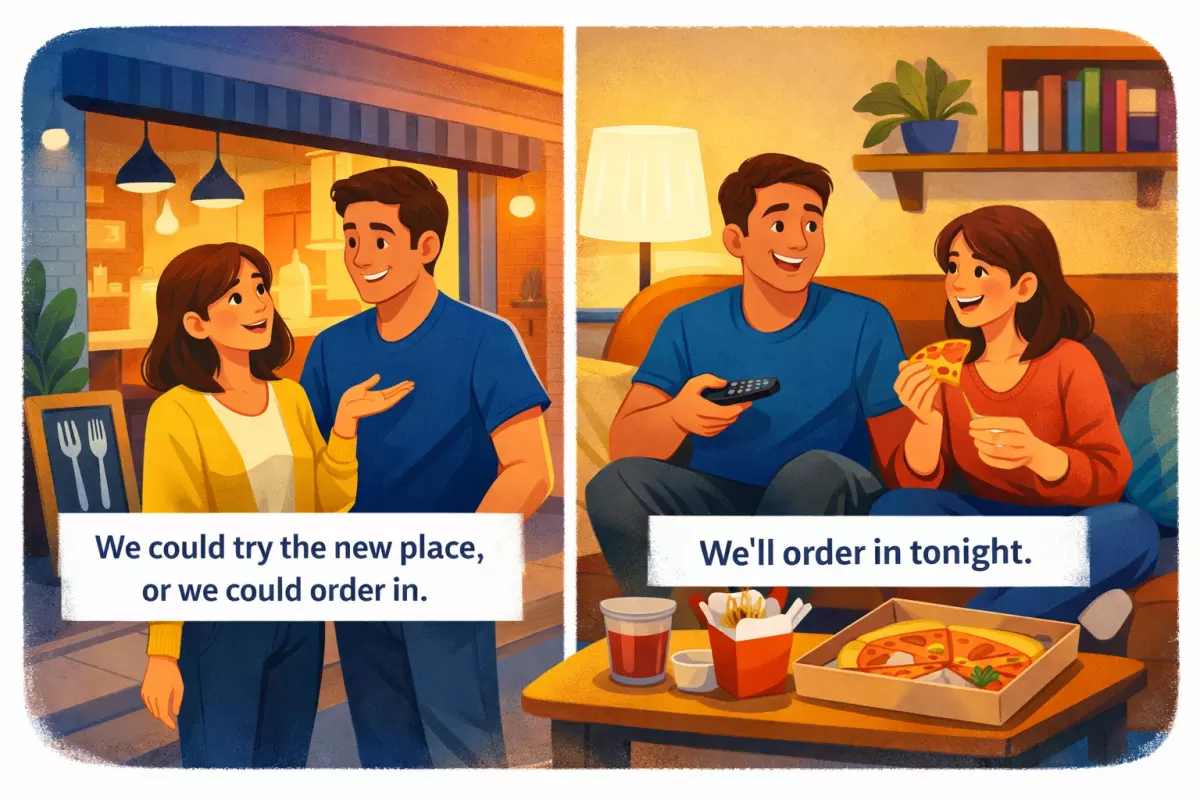
Decision talk often relies on modal verbs to show how certain, necessary, allowed, or advisable an option is. The same basic situation can sound like a firm plan (will), a suggestion (could), a rule (must), or a cautious guess (might) depending on the modal you choose.
Short dialogues with common modal patterns
-
Choosing a restaurant (suggestion vs. preference)
A: “Where should we eat?”
B: “We could try the new place, or we could order in.”
Pattern: could + base verb to list options without pressure. -
Making a plan (commitment)
A: “Are you free after work?”
B: “I will meet you at 6.”
Pattern: will signals a decision is made. -
Uncertainty about timing (possibility)
A: “Will the train be on time?”
B: “It might be delayed because of the weather.”
Pattern: might softens the claim and leaves room for change. -
Advice (gentle recommendation)
A: “I’m not sure how to answer that email.”
B: “You should keep it short and ask for a clear next step.”
Pattern: should = advice, not an order. -
Rules and obligations (non-negotiable)
A: “Can I submit it tomorrow?”
B: “No, it must be submitted by 5 p.m.”
Pattern: must expresses a strict requirement. -
Permission (allowed vs. not allowed)
A: “Can I leave early today?”
B: “You can if you’ve finished your tasks.”
Pattern: can is common for permission in everyday speech. -
Polite refusal (softening “no”)
A: “Can you join the call at 9?”
B: “I can’t at 9, but I could do 10.”
Pattern: negative ability/availability + alternative with could. -
Evaluating risk (strong advice)
A: “Should I invest all of it in one stock?”
B: “You shouldn’t put everything in one place.”
Pattern: shouldn’t warns against an action without sounding like a command. -
Negotiating responsibilities (necessity vs. choice)
A: “Do I have to attend the meeting?”
B: “You don’t have to, but you should read the notes afterward.”
Pattern: don’t have to = no obligation; should = good idea. -
Offering help (willingness)
A: “I’m behind on this report.”
B: “I can review it tonight if you want.”
Pattern: can expresses ability/availability; “if you want” keeps it optional. -
Speculating from evidence (probability)
A: “Why isn’t Sam answering?”
B: “He may be in a meeting.”
Pattern: may/might for a reasonable guess. -
Setting a condition (decision depends on something)
A: “Should we book the tickets now?”
B: “We can book them today if the price stays the same.”
Pattern: can + condition to show a plan is possible, not final. -
Comparing options (weighing pros and cons)
A: “Do we drive or take the bus?”
B: “We could drive, but we might get stuck in traffic.”
Pattern: could for an option; might for a possible downside. -
Stating a strong personal rule (self-imposed necessity)
A: “Are you going out tonight?”
B: “I have to finish this assignment.”
Pattern: have to often sounds more practical and external than must. -
Requesting action (polite, decision-friendly)
A: “Could you send me the file today?”
B: “Sure, I can send it after lunch.”
Pattern: Could you…? for polite requests; response with can for ability/availability.
Useful usage notes to notice in these exchanges
-
Modal + base verb: “could try,” “might be,” “should keep,” “must submit.” Modals do not take “to” in this structure. ✅ “We should go.” ❌ “We should to go.”
-
Strength scale: might/may (uncertain) → could (one possible option) → should (recommended) → must/have to (required).
-
Separating “no obligation” from “not allowed”: “You don’t have to attend” (optional) vs. “You can’t attend” (forbidden or impossible).
-
Softening disagreements: Using might and could helps present alternatives without sounding absolute: “We could…” / “It might…”
How modal verbs guide discussions toward a final decision
In group talk, modal verbs help speakers move from open brainstorming to a settled plan by signaling how strong a suggestion is, how certain a claim sounds, and how urgent an action feels. Choosing the right modal also keeps disagreement polite: it lets people challenge ideas without sounding absolute or dismissive.
1) Start wide: use softer modals to invite options
Early in a discussion, low-pressure language encourages more ideas and reduces defensiveness. Modals like could and might are useful because they frame proposals as possibilities rather than demands.
- We could run a small pilot before committing.
- We might postpone the launch until the data is clearer.
- Could we compare two vendors side by side?
- Might we be missing a cheaper alternative?
- We may want to gather one more week of feedback.
- It could be worth asking support what issues come up most.
2) Narrow choices: use modals to rank and evaluate
Once options exist, speakers often need language for weighing trade-offs. Modals help express likelihood, expected outcomes, and conditional reasoning without claiming certainty.
- This should reduce onboarding time, based on last quarter’s results.
- That might increase costs if usage spikes.
- It could solve the short-term issue but create a maintenance burden.
- We may see fewer complaints if we simplify the form.
- It would be safer to roll out in phases.
- That should work, as long as the API limit stays the same.
- It might be better to prioritize reliability over new features.
3) Introduce constraints: use necessity and permission modals
As the conversation becomes more practical, modals clarify what is required, what is allowed, and what is prohibited. This is where must, have to, can, and can’t prevent vague agreement.
- We must meet the compliance deadline.
- We have to confirm the budget before signing.
- We can reuse the existing design system to save time.
- We can’t ship without security review.
- Do we have to include all features in version one?
- Can we approve this today, or is legal required?
4) Manage disagreement: use modals to soften or strengthen a challenge
Modal choices let speakers disagree with the idea rather than the person. Softening modals keep the tone collaborative; stronger modals are useful when risk is high and clarity matters.
- ✅ We might want to reconsider the timeline. → (gentle pushback)
- ✅ Could there be a hidden cost we haven’t modeled? → (invites review)
- ✅ We should validate that assumption with data. → (firm but constructive)
- ✅ We must address the outage risk before launch. → (non-negotiable constraint)
- ❌ You’re wrong. → ✅ That might not hold if demand doubles.
- ❌ This will fail. → ✅ It could fail if we skip testing.
5) Close the discussion: use commitment modals to finalize actions
To reach a decision, teams often shift to modals that express commitment and next steps. Will is common for firm plans; should can summarize agreed recommendations; need to (semi-modal) is useful for immediate tasks.
- We will choose Vendor B and start onboarding Monday.
- I’ll draft the rollout plan and share it by 3 p.m.
- We should document the decision and the reasons behind it.
- We need to assign an owner for each milestone.
- We’ll revisit the metrics after two weeks and adjust if necessary.
- Should we schedule a checkpoint meeting to confirm progress?
A useful pattern is the progression from possibility (could/might) to recommendation (should) to requirement (must/have to) to commitment (will). When speakers match the modal to the stage of the conversation, the group can explore freely, evaluate realistically, and end with clear, actionable decisions.
How tone and context influence which modal verb is chosen
Modal choice often comes down to what you want your decision language to sound like: firm or tentative, personal or impersonal, collaborative or directive. The same basic idea can be framed as advice, obligation, permission, prediction, or a cautious suggestion depending on the situation and relationship.
Common context patterns and the modal verbs that fit
- Giving firm guidance (high authority, clear rule): use must or have to.
- “We must decide by Friday.” (speaker sets a strong requirement)
- “We have to submit the form today.” (external deadline or practical necessity)
- Sounding less forceful while still recommending: use should or ought to.
- “We should compare two options before choosing.”
- “You ought to check the cancellation policy.” (slightly formal, moral/rightness flavor)
- Making a suggestion without pressure (team discussions): use could.
- “We could wait a week and see the updated numbers.”
- “You could ask for a second opinion.”
- Requesting input politely (softening a decision push): use could, would, or might.
- “Could we review the risks first?”
- “Would you be open to option B?”
- “Might it be better to postpone?”
- Expressing uncertainty or caution (avoiding overclaiming): use might or may.
- “This might be the cheapest long-term choice.”
- “There may be hidden costs.” (more formal, common in reports)
- Stating confidence based on evidence (reasoned conclusion): use must (deduction) or will (strong expectation).
- “Given the data, this must be the main cause.” (logical inference, not obligation)
- “If we delay, prices will rise.” (prediction/expectation)
- Talking about willingness and commitment (decision as a promise): use will.
- “I will take responsibility for the final call.”
- “We will follow up tomorrow.”
- Negotiating and proposing terms (conditional decisions): use would.
- “I would agree if we set a clear timeline.”
- “We would choose option A, but only if support is included.”
- Asking for permission or approval (hierarchies, procedures): use may or can.
- “May I proceed with the purchase?” (formal)
- “Can we move forward with this plan?” (common, conversational)
- Refusing or setting boundaries (clear “no”): use can’t, won’t, or mustn’t.
- “We can’t approve this without documentation.” (constraint)
- “I won’t sign until I’ve reviewed the details.” (firm stance)
- “You mustn’t share this information.” (prohibition; stronger than “shouldn’t”)
- Choosing a more diplomatic tone (reducing directness): prefer could/might over should, and should over must.
- ✅ “We might want to revisit the budget.” → softer than “We must revisit the budget.”
- ✅ “You could consider another vendor.” → less judgmental than “You should choose another vendor.”
- Making decisions sound more objective (process-focused): use have to, need to, or passive structures with modals.
- “We need to follow the policy.” (practical requirement)
- “The proposal has to be reviewed before approval.” (shifts focus from the speaker)
- Choosing between “must” and “have to” based on source of obligation: use must for speaker-driven urgency; use have to for external rules or circumstances.
- “You must tell me today.” (speaker insists)
- “You have to show ID.” (rule/procedure)
In decision-making language, small modal shifts can prevent misunderstandings: must can sound like an order, should can sound like advice, and could/might often signal openness to alternatives. Paying attention to authority, relationship, and how certain the evidence is will usually point to the most natural modal.
Exercises and practice activities expressing decisions with modal verbs
Use the activities below to practice choosing modal verbs that match how strong a decision is (obligation, advice, possibility, willingness, or refusal). Focus on the pattern modal + base verb (no to
after most modals) and on how meaning changes when you switch the modal.
1) Choose the best modal for the decision (multiple choice)
- We ____ submit the application by Friday, or we’ll miss the deadline. (must / might / could)
- I’m not sure yet, but I ____ take the earlier train to avoid traffic. (might / must / can’t)
- You ____ talk to your manager before you accept the offer; it’s a big change. (should / may / would)
- We ____ cut costs this quarter; the budget has been reduced. (have to / may / could)
- I ____ sign the contract today; I need legal advice first. (can’t / should / might)
- If you want the best price, you ____ book in advance. (should / mustn’t / could)
- We ____ postpone the meeting; the client hasn’t confirmed. (might / must / have to)
- You ____ ignore the safety instructions, even if you’re in a hurry. (mustn’t / might / should)
- I ____ help with the presentation, but I’ll need the slides by noon. (can / must / may not)
- Given the evidence, they ____ be the right supplier for us. (can’t / might / should)
Show answers
- must
- might
- should
- have to
- can’t
- should
- might
- mustn’t
- can
- might
2) Rewrite to change the strength of the decision
Rewrite each sentence as directed. Keep the main meaning, but adjust the strength (stronger/weaker/more polite). Use one modal in each rewrite.
- Make it stronger: “We should review the numbers again.”
- Make it weaker: “I must decide today.”
- Make it more polite: “You must send the documents now.”
- Make it stronger: “We might cancel the trip.”
- Make it weaker: “You have to attend the training.”
- Make it more cautious: “This plan will work.”
- Make it more direct refusal: “I might join the call.”
- Make it more open/optional: “You must take the promotion.”
Show answers
- We must review the numbers again.
- I might decide today.
- You should send the documents now.
- We may cancel the trip.
- You might attend the training.
- This plan might work.
- I can’t join the call.
- You could take the promotion.
3) Fix the form (modal patterns)
Correct each sentence. Watch for: modal + base verb, negatives, and common mix-ups like to
after a modal.
- I must to decide by noon.
- We don’t should rush this choice.
- She can decides later.
- You mustn’t to sign anything yet.
- They might can deliver tomorrow.
- He shoulds talk to HR first.
- I have to can leave early today.
- We may not to need a second interview.
- You can’t to ignore the warning signs.
- We could to choose the cheaper option.
Show answers
- I must decide by noon.
- We shouldn’t rush this choice.
- She can decide later.
- You mustn’t sign anything yet.
- They might deliver tomorrow.
- He should talk to HR first.
- I have to leave early today.
- We may not need a second interview.
- You can’t ignore the warning signs.
- We could choose the cheaper option.
4) Decision-making mini prompts (short production)
Answer each prompt with one or two sentences. Use at least one modal per answer, and choose modals that fit your level of certainty or pressure.
- You’re choosing between two apartments: one is cheaper, one is closer to work. What do you decide, and why?
- A teammate suggests launching a feature without testing. What do you say?
- You’re unsure whether to accept an invitation because you may be tired. What do you decide?
- You have a deadline tomorrow but a friend asks for help tonight. What do you decide?
- You’re planning a trip and the forecast looks bad. What do you decide?
- You’re offered a job with a higher salary but longer commute. What do you decide?
5) Useful sentence frames to practice (mix and match)
- Strong obligation: “We must ___ before ___.”
- External requirement: “We have to ___ because ___.”
- Advice: “You should ___ if you want to ___.”
- Warning: “You mustn’t ___; it could ___.”
- Possibility: “I might ___, depending on ___.”
- Option: “We could ___, or we could ___.”
- Permission/green light: “You can ___ once ___.”
- Refusal: “I can’t ___ right now, but I can ___.”
- Deduction: “It can’t be ___; the data shows ___.”
- Polite suggestion: “We could consider ___.”
- Hedged plan: “We may need to ___.”
- Decision boundary: “We shouldn’t ___ until ___.”
- Conditional decision: “If ___, we might ___.”
- Trade-off: “We could ___, but we might ___.”
- Deadline pressure: “We have to ___ by ___.”
- Risk control: “We mustn’t ___ without ___.”