Nouns Ending in -y: Simple Spelling Change Rules

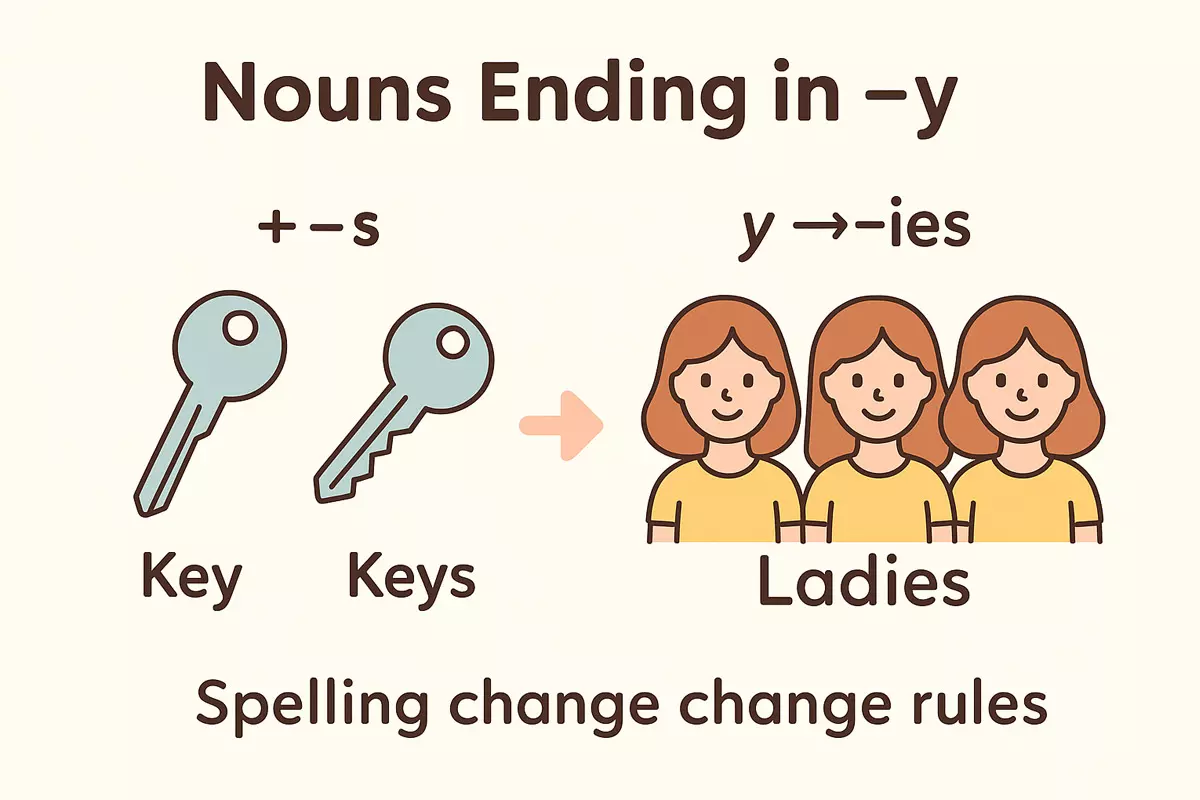 Here we rules for making plurals of nouns ending in -y, explaining the consonant plus y to -ies and vowel plus y to -ys patterns. It also provides examples, exceptions, pronunciation notes, and a plural rewrite exercise.
Mastering the subtle shift in spelling for words ending in y can make writing clearer and more accurate. It is important to know when to change the y to an i before adding endings like -es or -ed, as in the words "parties" or "carried," and when to simply add an s, as in "boys" or "days." By understanding these rules, writers can avoid common spelling mistakes and ensure their work appears polished and professional. Developing this skill not only improves spelling but also boosts overall writing confidence.
Consonant + y → -ies
When a singular noun ends with a consonant followed by the letter y, forming the plural involves replacing the y with ies. This change helps the word sound natural in English and keeps the spelling consistent. The rule applies regardless of the noun’s length or origin, as long as the letter directly before the y is not a vowel.
How It Works
If a word like city ends in a consonant plus y, the plural becomes cities. You drop the y and add ies instead of simply tacking on an s.
Common Examples
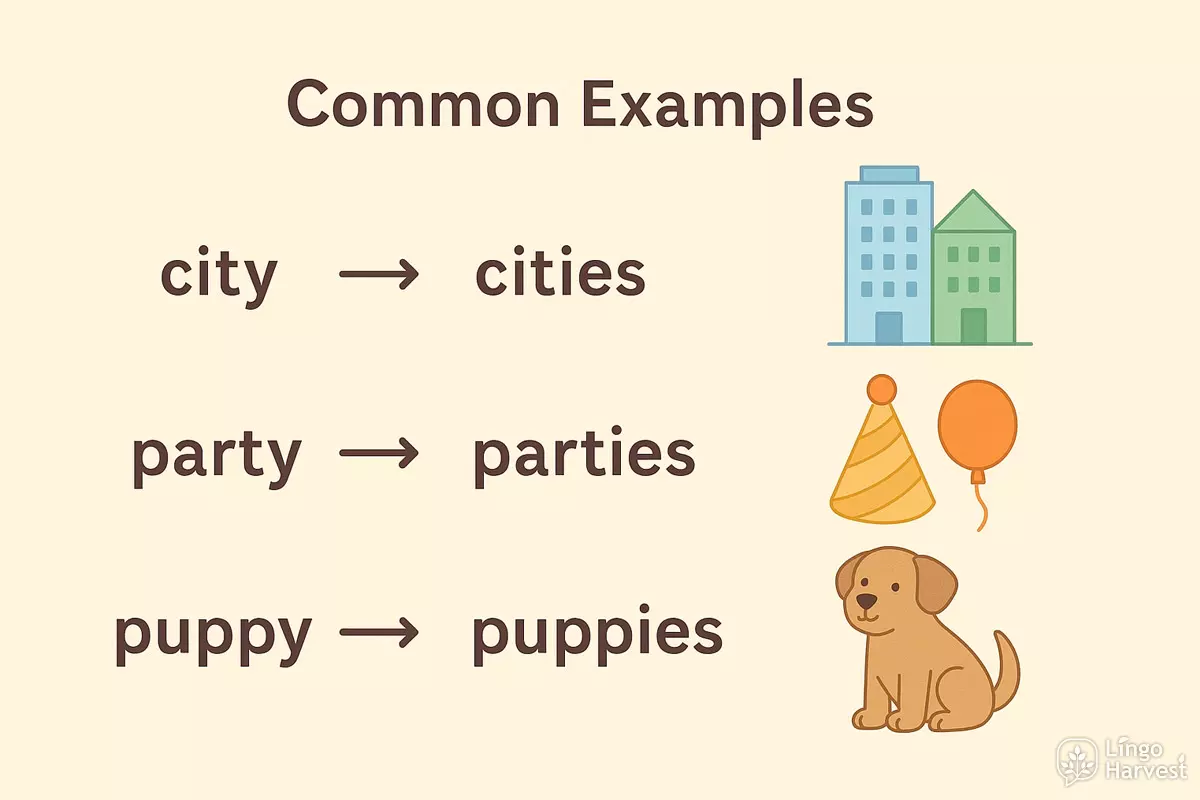
- city → cities
- party → parties
- puppy → puppies
- family → families
- country → countries
- army → armies
- library → libraries
- story → stories
- baby → babies
- activity → activities
- lady → ladies
- penny → pennies
- category → categories
- enemy → enemies
- fly → flies
- berry → berries
- mystery → mysteries
- copy → copies
When the Rule Applies
This pattern holds for any regular noun where the final y follows a consonant. It does not apply if the y follows a vowel (like in boy or key), where you simply add an s for the plural.
Quick Comparison
| Singular (Consonant + y) | Plural (-ies form) |
|---|---|
| puppy | puppies |
| family | families |
| party | parties |
| story | stories |
| berry | berries |
Remember, spotting the consonant before the y is the key. This spelling shift helps keep English plurals logical and easy to pronounce.
Vowel + y → -ys
When a noun ends with a vowel immediately followed by the letter y, forming the plural is straightforward: just add -s at the end. There’s no need to change the y to i or add -es. This rule keeps things simple and avoids confusion with other patterns.
How It Works
If the final two letters of a noun are a vowel (a, e, i, o, u) and y, you only append -s for the plural form. The y stays unchanged. This is different from nouns ending in a consonant plus y, which require a spelling change.
Common Examples
- boy → boys
- day → days
- key → keys
- toy → toys
- monkey → monkeys
- journey → journeys
- valley → valleys
- donkey → donkeys
- turkey → turkeys
- alley → alleys
- chimney → chimneys
- play → plays
- essay → essays
- relay → relays
- guy → guys
- ray → rays
- delay → delays
- holiday → holidays
- journey → journeys
Quick Reference: Vowel + y Pluralization
Here’s a summary to help you spot this pattern:
- If a noun ends in a vowel + y, just add -s.
- No spelling change is made to the base word.
- Contrast: With consonant + y, change y to i and add es (e.g., city → cities).
Why This Rule Matters
Recognizing the difference between vowel + y and consonant + y endings helps you avoid common mistakes in English spelling. It’s a simple rule, but it makes pluralizing these nouns much more predictable. Just remember to check the letter before the y—if it’s a vowel, the plural is easy!
Common Examples
When studying how to form plurals for words ending in -y, it helps to look at specific words and see how the spelling rules are applied. The way the final -y changes depends on the letter that comes just before it. Here’s a closer look at some frequent patterns.
Words Ending in a Consonant + -y
If a noun ends with a consonant followed by -y, the -y is replaced with -ies in the plural form. This pattern is very common and easy to spot. Here are several examples:
- city → cities
- puppy → puppies
- lady → ladies
- family → families
- party → parties
- story → stories
- baby → babies
- country → countries
- penny → pennies
- army → armies
- activity → activities
- library → libraries
Words Ending in a Vowel + -y
For nouns where -y follows a vowel (a, e, i, o, u), the spelling rule is different: simply add -s to make the plural. The -y does not change. Some examples include:
- boy → boys
- key → keys
- toy → toys
- day → days
- monkey → monkeys
- journey → journeys
- valley → valleys
- donkey → donkeys
- tray → trays
- alley → alleys
Visual Comparison of Plural Forms
Below is a table showing how the plural forms differ, depending on the letter before the -y. This side-by-side view highlights the spelling change at a glance.
| Singular (Consonant + -y) | Plural (-y → -ies) | Singular (Vowel + -y) | Plural (+ s) |
|---|---|---|---|
| city | cities | boy | boys |
| puppy | puppies | key | keys |
| baby | babies | monkey | monkeys |
| party | parties | day | days |
| story | stories | toy | toys |
Frequent Exceptions
Many English nouns ending in -y don’t always follow the standard rule of changing -y to -ies for plurals. While the general guideline is to replace -y with -ies after a consonant (e.g., “puppy” → “puppies”), there are quite a few words that go against this pattern or have unique forms. Recognizing these can save you from common mistakes.
Words That Keep the -y in Plural
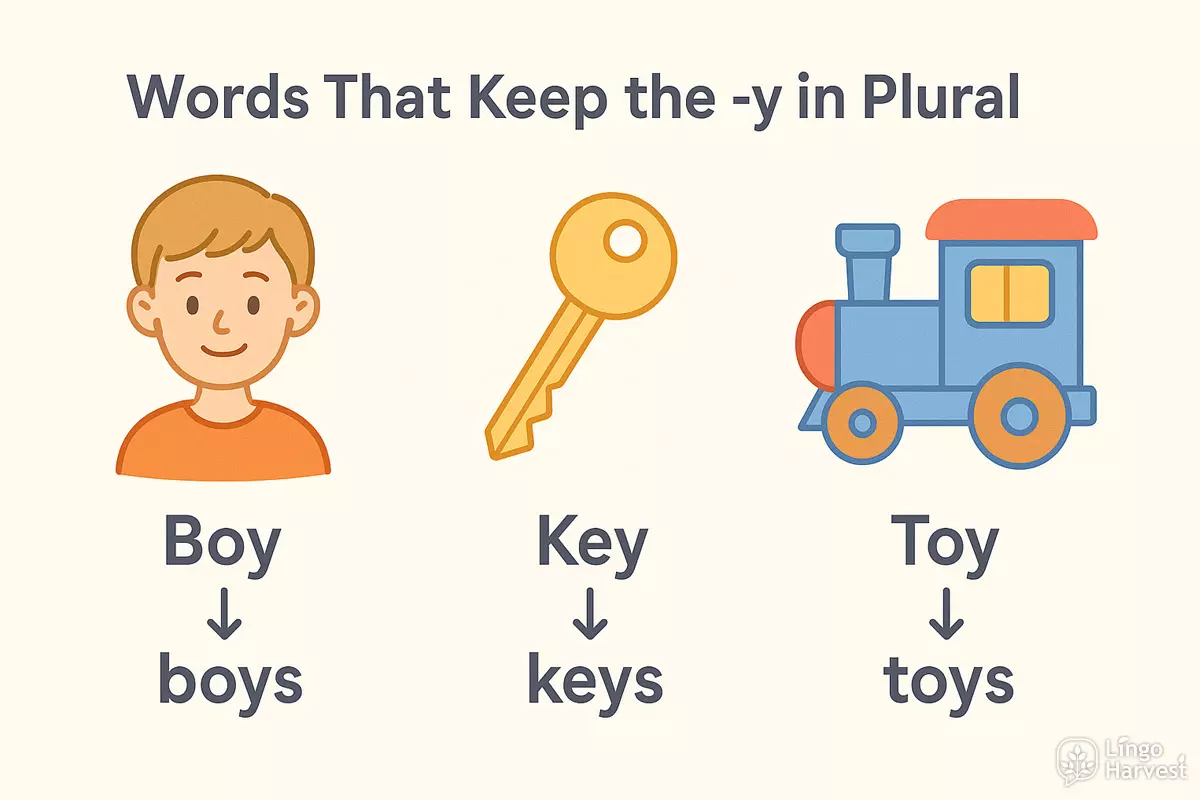
Some nouns ending in -y simply add -s in the plural, especially if the -y follows a vowel. Here are common examples:
- Day → days
- Boy → boys
- Key → keys
- Toy → toys
- Journey → journeys
- Valley → valleys
- Monkey → monkeys
- Turkey → turkeys
- Essay → essays
- Attorney → attorneys
These cases break from the usual rule, so it helps to remember that a vowel before -y usually means you just add -s.
Irregular Plurals and Unusual Endings
Not every noun ending in -y fits neatly into a rule. Some have irregular plural forms or are rarely used in plural at all:
- Money → monies or moneys (both accepted, but rare)
- Alley → alleys
- Quarry → quarries (follows the consonant rule, but the singular and plural can be confused with unrelated words like “queries”)
- Sky → skies (note the spelling change, but “skys” is a common error)
- Fly (the insect) → flies; fly (the zipper) → flys (in clothing context, though rare)
Special Cases: Foreign Words and Proper Nouns
Loanwords and proper nouns sometimes maintain their original pluralization or resist change altogether. Consider these:
- Soliloquy → soliloquies
- Embassy → embassies
- Mary → Marys (as in several people named Mary)
- Colloquy → colloquies
- City → cities (standard rule, but often confused because of unique pronunciation)
Comparison Table: Pluralization Patterns
| Singular | Plural | Pattern |
|---|---|---|
| Baby | Babies | -y after consonant: change to -ies |
| Boy | Boys | -y after vowel: add -s |
| City | Cities | -y after consonant: change to -ies |
| Turkey | Turkeys | -y after vowel: add -s |
| Fly | Flies | Irregular: -y after consonant, but meaning changes in different contexts |
| Alley | Alleys | -y after vowel: add -s |
| Embassy | Embassies | -y after consonant: change to -ies |
As you can see, the context of the letter before -y, as well as the word’s origin and meaning, often determines how the plural is formed. Keeping an eye out for these patterns and outliers is the best way to master plural spelling for this group of nouns.
Pronunciation Notes
Understanding how the -y ending sounds in English nouns can help with both spelling and speaking. The way the final -y is pronounced doesn’t change when forming plurals, but it’s useful to notice patterns in the way -y interacts with the letters before it.
How the -y Ending Sounds
In most cases, nouns ending in -y after a consonant are pronounced with the long "ee" sound, like in "city" or "baby." This stays the same whether the noun is singular or plural. When the -y comes after a vowel, such as in "key" or "toy," the pronunciation can shift, but the -y itself still has the "ee" or a "y" glide sound.
Common Pronunciation Patterns
- -y after a consonant: sounds like /i/ (as in "puppy")
- -y after a vowel: often sounds like /i/ or a diphthong (as in "boy")
- Adding -es to make plurals does not affect the way -y is pronounced
- Stress usually remains on the same syllable after adding -ies
Examples: Singular and Plural Forms
Below are some examples showing how the pronunciation remains consistent even as the spelling changes:
- baby /ˈbeɪ.bi/ → babies /ˈbeɪ.biːz/
- city /ˈsɪ.ti/ → cities /ˈsɪ.tiːz/
- party /ˈpɑːr.ti/ → parties /ˈpɑːr.tiːz/
- puppy /ˈpʌp.i/ → puppies /ˈpʌp.iːz/
- lady /ˈleɪ.di/ → ladies /ˈleɪ.diːz/
- penny /ˈpen.i/ → pennies /ˈpen.iːz/
- story /ˈstɔːr.i/ → stories /ˈstɔːr.iːz/
- fly /flaɪ/ → flies /flaɪz/
- berry /ˈber.i/ → berries /ˈber.iːz/
- army /ˈɑːr.mi/ → armies /ˈɑːr.miːz/
Special Notes on Vowel + y Endings
Nouns ending in a vowel plus -y (like "boy" or "key") simply add -s for plurals, and the pronunciation of -y is not affected.
- key /kiː/ → keys /kiːz/
- boy /bɔɪ/ → boys /bɔɪz/
- toy /tɔɪ/ → toys /tɔɪz/
- day /deɪ/ → days /deɪz/
Quick Reference Table
| Singular | Plural | IPA Pronunciation |
|---|---|---|
| puppy | puppies | /ˈpʌp.i/ → /ˈpʌp.iːz/ |
| city | cities | /ˈsɪ.ti/ → /ˈsɪ.tiːz/ |
| lady | ladies | /ˈleɪ.di/ → /ˈleɪ.diːz/ |
| berry | berries | /ˈber.i/ → /ˈber.iːz/ |
| army | armies | /ˈɑːr.mi/ → /ˈɑːr.miːz/ |
In summary, although the spelling of nouns ending in -y changes when forming the plural, the way you say the -y remains steady. Listening to and practicing these patterns will help you sound more natural and confident.
Practice: Rewrite in Plural
Learning to change nouns ending in -y to their plural forms is all about spotting patterns. When a noun ends in -y after a consonant, you usually swap the -y for -ies. If it’s after a vowel, just add -s. Let’s put these rules into action with some practical exercises and examples.
Task: Transform These Nouns
Below is a list of singular words ending in -y. Write their plural forms, applying the correct rule. Pay attention to the letter before the -y!
- city
- lady
- boy
- party
- day
- family
- key
- puppy
- story
- tray
- baby
- country
- toy
- fly
- berry
Show answers
- cities
- ladies
- boys
- parties
- days
- families
- keys
- puppies
- stories
- trays
- babies
- countries
- toys
- flies
- berries
Comparison Table: Spelling Changes for -y Nouns
Here’s a reference chart to help you visualize the rule:
| Singular | Plural | Rule Applied |
|---|---|---|
| puppy | puppies | Consonant + y → change to -ies |
| berry | berries | Consonant + y → change to -ies |
| tray | trays | Vowel + y → add -s only |
| boy | boys | Vowel + y → add -s only |
| baby | babies | Consonant + y → change to -ies |
| key | keys | Vowel + y → add -s only |
Quick Practice: Spot the Pattern
Decide which rule you would use for each noun below. Is it “change -y to -ies” or “just add -s”?
- army
- monkey
- daisy
- fly
Show answers
- army → armies (consonant + y: change to -ies)
- monkey → monkeys (vowel + y: add -s)
- daisy → daisies (consonant + y: change to -ies)
- fly → flies (consonant + y: change to -ies)
By practicing with a diverse set of words, you’ll quickly get comfortable with these spelling changes for plural nouns ending in -y. Review the table above whenever you’re unsure, and keep challenging yourself with new examples.