Countable vs Uncountable Nouns: Easy Memory Trick for Learners

 Here we the basics of countable and uncountable nouns, provides typical examples, explains quantifiers such as much, many, and some, discusses words that change type, offers a visual memory tip, and includes a sorting practice.
Many English learners have trouble remembering which words are countable and which are uncountable, but there is a simple trick to make it easier. If you can add a number in front of the word and it sounds correct, such as two books or three apples, then the word is countable. If it sounds strange to use a number, like three rice or two information, the word is uncountable and you should use words like some, much, or a little instead. This shortcut can help you make quick, correct choices in everyday English.
Countable Nouns Overview
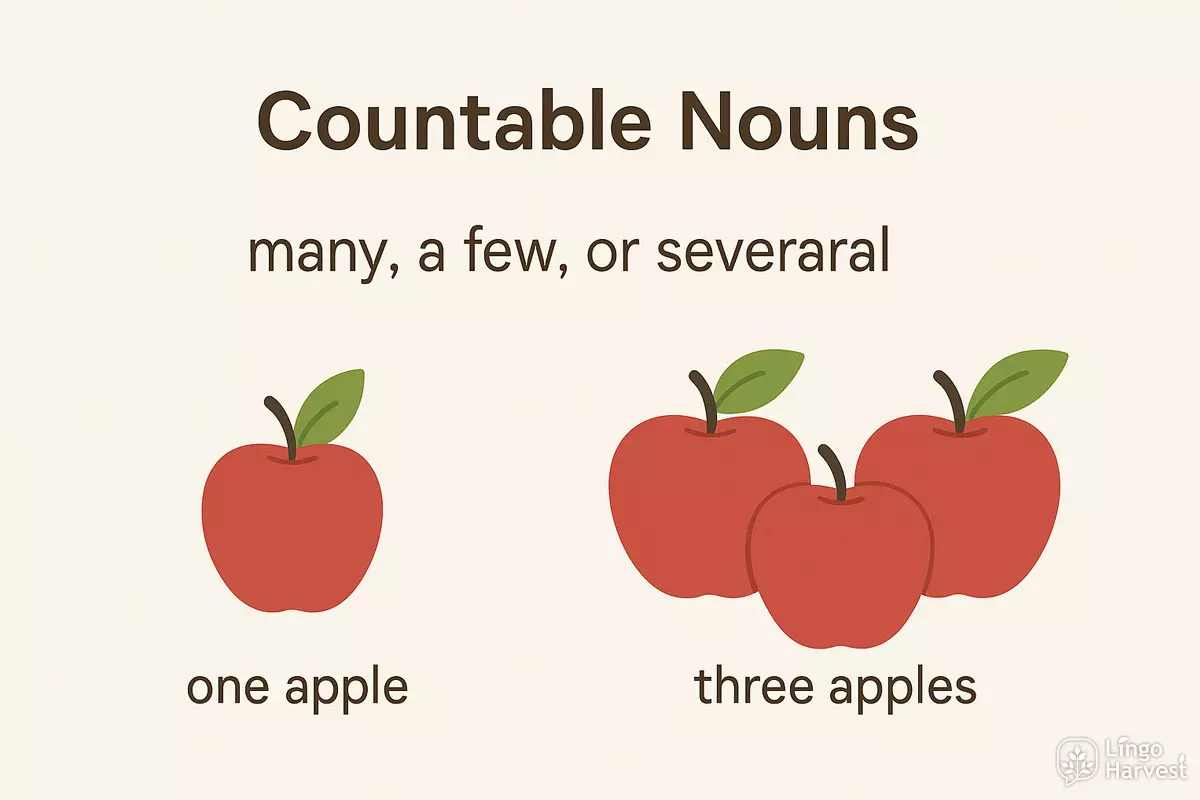
Words that refer to things you can count individually are called countable nouns. These nouns have both singular and plural forms, making them easy to use with numbers and quantifiers like "many," "a few," or "several." For example, you can say "one apple" or "three apples" because "apple" is something you can count.
How to Recognize Countable Nouns
Look for nouns that can take an "s" or "es" ending in the plural. If you can ask "How many?" before the noun and it makes sense, it’s likely countable. These words often refer to objects, people, animals, or ideas that can be separated into units.
- book → books
- cat → cats
- child → children
- car → cars
- idea → ideas
- egg → eggs
- table → tables
- city → cities
- friend → friends
- question → questions
- house → houses
- student → students
- dog → dogs
- mistake → mistakes
- pen → pens
- job → jobs
- apple → apples
- shoe → shoes
- chair → chairs
- letter → letters
Common Patterns with Countable Nouns
These nouns can be used with numbers and certain words that show quantity. For example:
- two oranges
- many chairs
- a few tickets
- several ideas
- hundreds of students
Singular and Plural Forms
Here’s a quick comparison of singular and plural forms for countable nouns:
| Singular | Plural |
|---|---|
| apple | apples |
| child | children |
| box | boxes |
| city | cities |
| dog | dogs |
Remember, you can use "a/an" before singular countable nouns (e.g., "a chair," "an egg"). For plurals, use numbers or quantifiers: "three chairs," "some eggs." This basic rule helps you decide when to use articles or quantifiers with these nouns.
Uncountable Nouns Overview
Uncountable nouns, sometimes called mass nouns, refer to substances, concepts, or items that cannot be separated into individual elements or counted as single units. These words typically describe things we think of as a whole or a mass rather than distinct objects. For example, “milk,” “advice,” and “information” are all uncountable, because you cannot say “one milk” or “two advices.”
What Makes a Noun Uncountable?
The main feature is that these nouns do not have a plural form and are not used with the indefinite article “a” or “an.” Instead, they are measured with words like “some,” “much,” or expressions such as “a piece of.” This can be tricky for learners, especially when their native language uses countable forms for similar concepts.
Common Categories
Uncountable nouns often fall into several broad categories:
- Liquids: water, juice, oil, wine
- Materials: wood, iron, plastic, paper
- Abstract ideas: happiness, knowledge, love, music
- Food and substances: rice, bread, cheese, sugar, salt
- Weather words: rain, snow, fog, sunshine
- Information and communication: news, advice, information, research
- Natural phenomena: gravity, electricity, heat
- Groups or collections: furniture, luggage, equipment, traffic
- Other examples: money, homework, progress, patience
Usage Patterns and Common Mistakes
It’s easy to make errors with these nouns, especially when translating directly from another language. For instance, we say “some money” or “a piece of advice,” not “a money” or “an advice.” To make these nouns countable, use a unit or measurement:
- a glass of water
- a slice of bread
- a bit of information
- a piece of furniture
Quick Reference: Countable vs. Uncountable Forms
| Countable Example | Uncountable Equivalent |
|---|---|
| apple / apples | fruit |
| book / books | literature |
| job / jobs | work |
| suggestion / suggestions | advice |
| fact / facts | information |
| bag / bags | luggage |
Remember, uncountable nouns help us talk about things as a whole, not as separate items. When in doubt, check if you can use numbers or “a/an” with the word—if not, it’s probably uncountable!
Typical Examples
Understanding which nouns you can count and which you cannot is easier with clear illustrations. Below you'll find sets of words and example sentences to highlight the difference between items you can number individually and those that represent a general mass or concept.
Common Countable Nouns
These refer to objects, people, or ideas you can count one by one. You can use numbers or "a/an" with them, and they have plural forms.
- book
- apple
- cat
- car
- idea
- friend
- chair
- dog
- house
- student
For example: "I have three books." ✅ "She bought an apple." ✅
Usual Uncountable Nouns
These words describe things you cannot count as separate units. They often refer to substances, qualities, or abstract concepts. They don’t use "a/an" or plurals.
- water
- rice
- information
- advice
- money
- furniture
- music
- sand
- milk
- bread
For example: "There is some water in the glass." ✅ "She gave me useful advice." ✅
Comparison Table: Countable vs. Uncountable Nouns
| Countable Noun | Uncountable Noun |
|---|---|
| an apple / apples | rice |
| a chair / chairs | furniture |
| a coin / coins | money |
| a suggestion / suggestions | advice |
| a bottle / bottles | water |
Sentences to Spot the Difference
Notice how you can use numbers or "a/an" with the first group, but not with the second:
- "Can I have two chairs?" ✅
- "Can I have two furnitures?" ❌ (Incorrect: "furniture" is uncountable)
- "She found three coins in her pocket." ✅
- "She found three moneys in her pocket." ❌
Quantifiers: Much, Many, Some
Understanding which words to use with countable and uncountable nouns helps learners sound more natural in English. Words like "much," "many," and "some" act as quantifiers—they tell us about the quantity of something, but the choice depends on whether the noun can be counted or not.
When to Use Each Quantifier
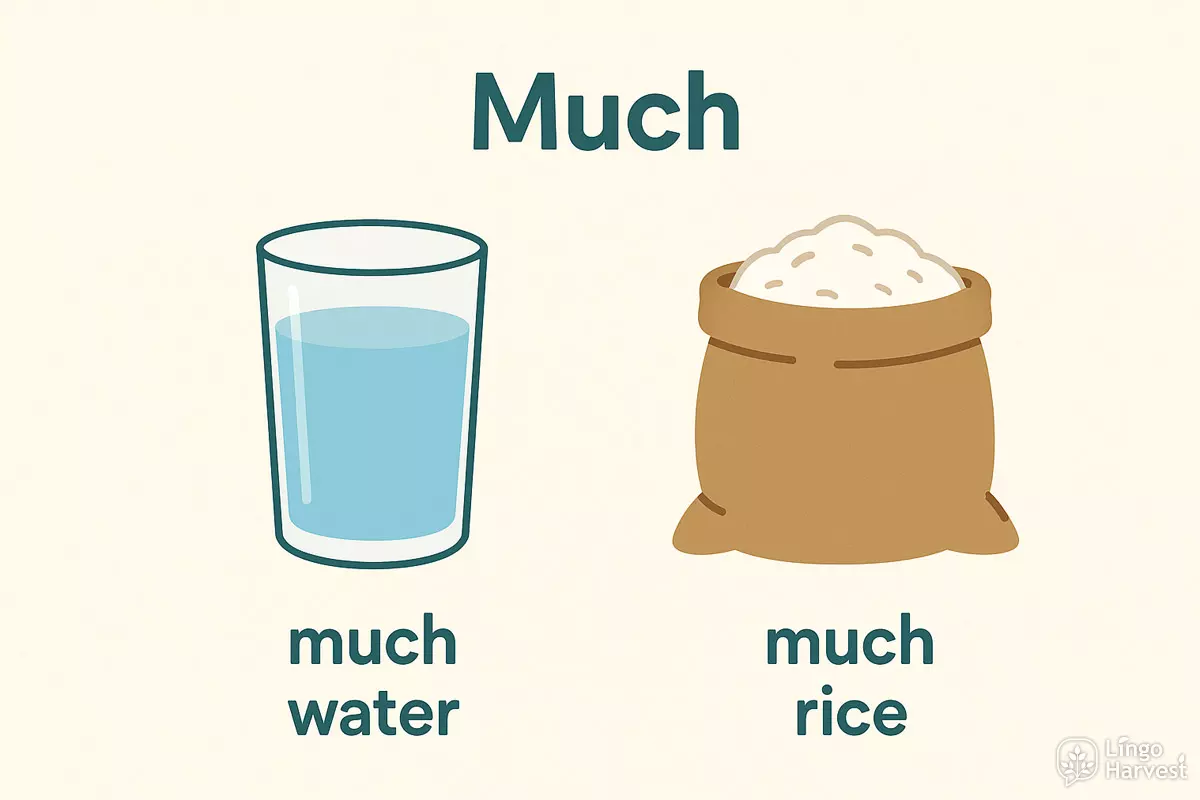
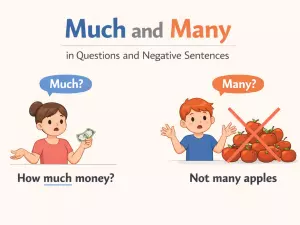
- Many is used with countable nouns. For example: "many books," "many apples," "many ideas."
- Much is used with uncountable nouns. For example: "much water," "much information," "much rice."
- Some is more flexible and works with both countable and uncountable nouns, especially in positive sentences or offers: "some chairs," "some milk."
Quick Reference Table
| Quantifier | Used With | Example |
|---|---|---|
| Many | Countable nouns | many friends, many cars |
| Much | Uncountable nouns | much sugar, much time |
| Some | Both types | some apples, some advice |
| Not much / Not many | Uncountable / Countable | not much money, not many chairs |
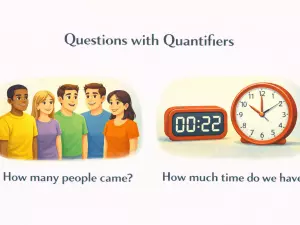
| How much / How many | Uncountable / Countable | How much cheese? How many eggs? |
Common Patterns and Examples
Here are typical phrases you’ll hear in daily English. Notice how the choice of quantifier changes with the noun type:
- How many students are in the class?
- How much juice is left?
- There aren’t many buses at night.
- We don’t have much homework today.
- Would you like some tea?
- She bought some oranges.
- He didn’t eat much bread.
- They didn’t see many animals at the zoo.
- Can I have some information?
- There are some pencils on the table.
- They don’t need much advice.
- Do you have many questions?
- There isn’t much snow this year.
- I don’t have many coins.
- We need some help.
- Is there much traffic?
- Are there many options?
- She added some sugar to her coffee.
Tips for Remembering
Think of "many" for things you can count one by one (books, dogs, chairs) and "much" for things that are measured in bulk (water, advice, rice). "Some" is your safe choice when you’re not sure or when making offers and requests. Keeping this pattern in mind will help you avoid common mistakes and speak more confidently.
Words That Change Type
Some English nouns can be both countable and uncountable, depending on the context and meaning. This flexibility often causes confusion for learners, but it is also a helpful way to expand your vocabulary. The difference usually depends on whether you’re talking about a general concept or specific items.
Context Makes the Difference
The meaning of a noun can shift when you use it in a different situation. For example, “chicken” can mean the animal as food (uncountable: “I ate chicken for lunch”) or an individual bird (countable: “There are five chickens in the yard”). Many other words work in a similar way, so it’s important to notice how they’re used in real conversations and texts.
Common Examples of Flexible Nouns
Here are some typical nouns that can function as either count or non-count, depending on the meaning:
- Paper: “I bought some paper” (material, uncountable) vs. “I read three papers” (newspapers, countable)
- Light: “Light travels fast” (energy, uncountable) vs. “There are three lights in the room” (lamps, countable)
- Hair: “She has long hair” (all hair, uncountable) vs. “There’s a hair in my soup” (one strand, countable)
- Glass: “The window is made of glass” (material, uncountable) vs. “Two glasses of water, please” (drinking vessels, countable)
- Time: “Time passes quickly” (concept, uncountable) vs. “We visited Paris three times” (occasions, countable)
- Experience: “She has a lot of experience” (knowledge, uncountable) vs. “It was an exciting experience” (event, countable)
- Iron: “Iron is a useful metal” (substance, uncountable) vs. “I bought two irons” (appliances, countable)
- Chicken: “Chicken is delicious” (meat, uncountable) vs. “We have three chickens” (animals, countable)
- Room: “There isn’t much room in here” (space, uncountable) vs. “There are five rooms in the house” (spaces, countable)
- Work: “I have a lot of work to do” (tasks, uncountable) vs. “He has had many works published” (books/pieces, countable)
- Chocolate: “Chocolate is my favorite treat” (substance, uncountable) vs. “I bought three chocolates” (individual candies, countable)
- Stone: “The wall is made of stone” (material, uncountable) vs. “She threw two stones” (objects, countable)
- Toast: “Would you like some toast?” (food, uncountable) vs. “I’ll have two toasts” (slices, countable in some dialects)
- Fruit: “Fruit is healthy” (category, uncountable) vs. “There are many fruits in the basket” (types/kinds, countable)
- Water: “Water is essential” (liquid, uncountable) vs. “Two waters, please” (glasses/bottles, countable in restaurants)
Why This Matters for Learners
Understanding these shifts helps you sound more natural and avoids common mistakes. When you see a noun, ask yourself: is it a substance or a thing? An idea or an event? This simple question can guide you to the right usage.
Quick Comparison Table
| Word | Uncountable Use | Countable Use |
|---|---|---|
| Paper | Could you give me some paper? (material) | I read two papers today. (newspapers) |
| Hair | She has curly hair. (all hair) | I found a hair on my shirt. (one strand) |
| Glass | The table is made of glass. (substance) | We need four glasses. (drinking vessels) |
| Chicken | Chicken is tasty. (meat/food) | There are three chickens outside. (animals) |
| Room | There isn’t enough room. (space) | The house has six rooms. (spaces) |
Practice spotting these shifts in everyday English. Noticing when a noun changes its category will help you use it correctly and confidently.
Visual Trick for Remembering
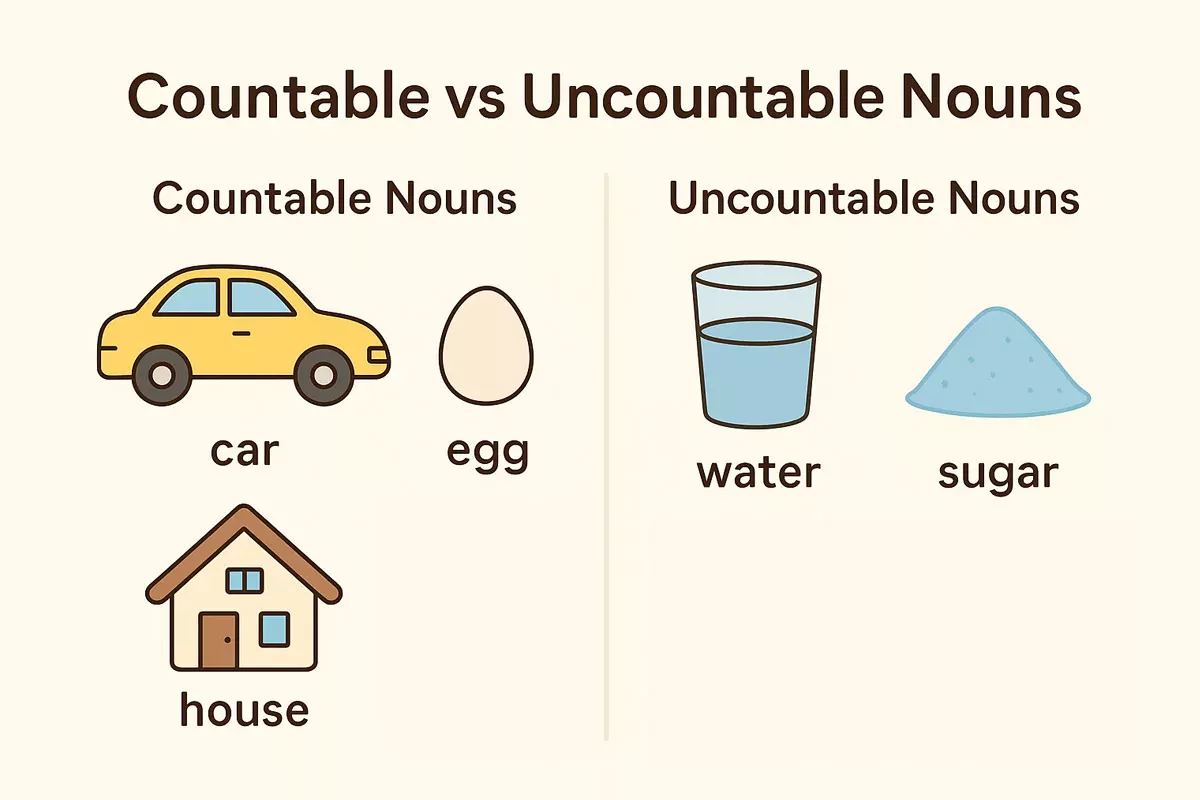
If you struggle to keep track of which nouns you can count and which you can’t, it helps to picture them in your mind. Imagine if the noun fits easily into a container, or if you could see it as separate pieces or items. If you can count them one by one, like apples or chairs, they’re countable. If the noun feels more like a mass or something you can pour or scoop, such as water or rice, it’s uncountable.
Picture This: Countable vs Uncountable
Try visualizing two baskets: one filled with individual objects, and the other with something that can’t be separated into clear pieces. This mental image helps you decide quickly which category a word belongs to.
- Countable: apples, coins, bottles, books, cats, cars, pencils, emails, eggs, chairs
- Uncountable: water, information, rice, advice, furniture, music, air, sugar, news, money
Quick Check: Can You Add "a" or a Number?
Another handy method is to see if you can put “a” or a number in front of the word. For example, “a chair” or “three books” makes sense, but “a water” or “five rice” does not. This simple check covers most cases.
| Countable Nouns ✅ | Uncountable Nouns ❌ |
|---|---|
| one apple, two apples | water (not: one water, two waters) |
| a book, three books | advice (not: an advice, two advices) |
| four cars, many cars | information (not: informations) |
| an egg, some eggs | furniture (not: furnitures) |
| two emails, several emails | music (not: musics) |
Memory Tip: The Container Test
For words you aren’t sure about, imagine putting them into a box. If you can count how many boxes or items are there, it’s likely a countable noun. If you need to measure it in liters, kilos, or pieces, it’s probably not countable on its own. For example, “three bottles of water” works because “bottle” is countable, but “water” itself is not. Try using these visual cues and the “a/number” test next time you’re unsure. With practice, you’ll find it much easier to remember the difference!
Practice: Sort the Nouns
Understanding which nouns are countable and which are not is essential for choosing the right articles and quantifiers in English. To sharpen your skills, try sorting these words into the correct categories. Use your knowledge of whether you can count the items (using numbers, like "two apples") or not (like "milk" or "advice").
Below, you’ll find a mixed list of nouns commonly encountered by learners. Do your best to decide which belong to the countable group, and which are uncountable. Remember: some words might surprise you!
Task: Classify Each Noun
Place each noun from the list into one of two groups: countable or uncountable. Think about whether you could use numbers or "a/an" in front of the word.
- apple
- water
- bread
- car
- information
- child
- rice
- idea
- furniture
- dog
- music
- book
- money
- news
- egg
- cheese
- person
- sand
- question
- advice
Need a Hint?
If you can add -s to make a plural (like "dogs"), it is usually a countable noun. If not, it is typically uncountable (like "rice" or "music").
Check Your Answers
Show answers
- apple
- car
- child
- idea
- dog
- book
- egg
- person
- question
- water
- bread
- information
- rice
- furniture
- music
- money
- news
- cheese
- sand
- advice
Compare: Typical Usage Patterns
See how these two types of nouns behave in sentences:
| Countable Example | Uncountable Example |
|---|---|
| I have three books. | I need some information. |
| She bought an apple. | He drank a glass of water. |
| We saw two dogs in the park. | There is a lot of sand on the beach. |
| Did you ask a question? | She gave me good advice. |
By practicing with real examples, you’ll remember which nouns you can count and which you cannot. Try making your own sentences with words from each group to reinforce your memory.