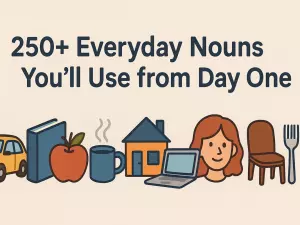
100+ Everyday Nouns You'll Use from Day One

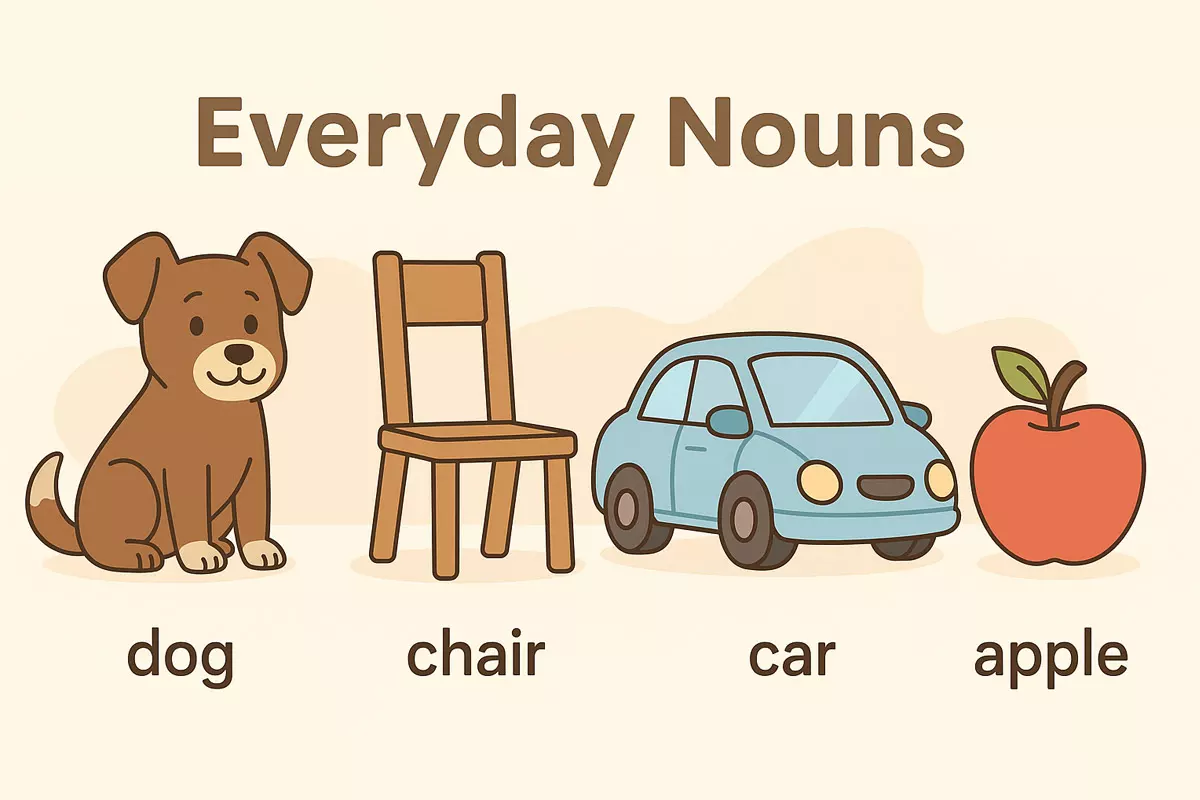 The article defines everyday nouns and their main categories, such as people, places, things, and time. It also covers common nouns learners first encounter, basic grammar rules, frequent collocations, typical mistakes, and provides short practice exercises.
- What counts as an everyday noun
- Core categories: people, places, things, time
- High-frequency nouns learners meet first
- Singular and plural forms in common patterns
- Articles with everyday nouns in simple sentences
- Typical collocations with the most frequent nouns
- Common mistakes with basic nouns
- Short practice: complete and create sentences with target nouns
Learning a new language may seem overwhelming at first, but focusing on the most common words you’ll encounter in daily life can make the process much more manageable. This guide introduces essential vocabulary related to everyday objects and people, helping you build a strong foundation from the very beginning. By practicing these frequently used terms, you’ll gain confidence and be better prepared for real-life conversations, making your language learning journey smoother and more enjoyable.
What counts as an everyday noun
Everyday nouns are the words we reach for constantly, whether we’re describing our surroundings, talking about people, or naming objects we use. These are the terms that help us identify the world around us without needing to pause and think. If you’re learning a new language or just building your vocabulary, focusing on these practical, high-frequency words is a smart move.
Core characteristics of everyday nouns
- High frequency: Used in daily routines and conversations.
- Concrete meaning: Usually refer to physical things you can see, touch, or use.
- Broad utility: Useful across many contexts—at home, work, school, or outdoors.
- Simple forms: Typically not technical or specialized vocabulary.
Common types of everyday nouns
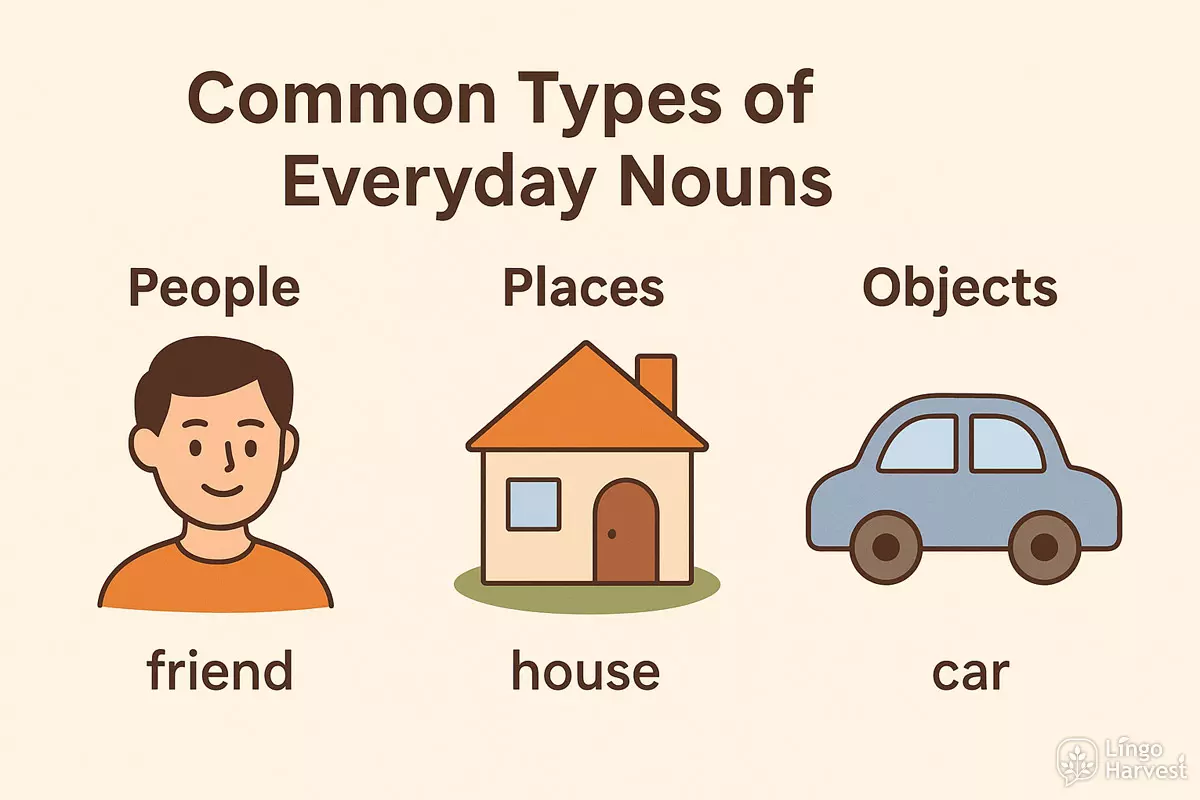
Most frequently, these words fall into a few main categories:
- People: friend, teacher, child, neighbor, parent
- Places: house, school, store, park, city
- Objects: table, phone, bag, car, chair
- Food and drink: bread, water, apple, coffee, rice
- Animals: dog, cat, bird, fish, horse
- Body parts: hand, eye, head, leg, mouth
- Time words: day, week, morning, night, hour
- Weather and nature: sun, rain, tree, flower, wind
- Clothing: shirt, shoe, dress, jacket, hat
- Household items: spoon, bed, door, lamp, clock
Comparing everyday nouns to specialized terms
To clarify the distinction, here’s how typical daily-use nouns stack up against more technical words:
| Everyday Noun | Specialized/Technical Noun |
|---|---|
| Chair | Ergonomic seat |
| Dog | Canine mammal |
| Doctor | Cardiologist |
| Car | Hybrid vehicle |
| Book | Anthology |
| Tree | Deciduous species |
In daily speech, we almost always use the simpler, more familiar option—unless we need to be precise. This is what makes these words so essential from day one of communication.
Core categories: people, places, things, time
Everyday nouns fall into several main types that help us express who or what we’re talking about, where events happen, what objects are involved, and when things take place. Understanding these basic groups makes it much easier to build your vocabulary and start using new words right away.
People: Who is Involved?
Terms for people are essential from day one. You’ll use them constantly to talk about yourself, your friends, family, and others around you. Here are some common examples:
- friend
- teacher
- child
- parent
- neighbor
- stranger
- colleague
- student
- doctor
- customer
- boss
- guest
Places: Where Things Happen
Words for locations help you ask for directions, describe where you are, or set the scene. These are some of the most frequent nouns for places:
- school
- home
- store
- office
- park
- restaurant
- hospital
- library
- station
- airport
- hotel
- market
Things: Everyday Objects
Objects make up a huge part of daily conversation. These nouns let you talk about what you see, use, or need. Here’s a selection of items you’ll likely mention:
- phone
- key
- book
- bag
- pen
- table
- car
- chair
- water
- money
- ticket
- food
Time: When Events Occur
Talking about when something happens is just as important as what or who. Time-related nouns help you describe schedules, routines, and events. You’ll hear these a lot:
- morning
- afternoon
- evening
- night
- today
- tomorrow
- yesterday
- week
- month
- year
- minute
- hour
Quick Reference: Sample Nouns by Category
| People | Places | Things | Time |
|---|---|---|---|
| friend | school | phone | morning |
| teacher | office | book | evening |
| neighbor | park | key | today |
| doctor | store | bag | week |
| student | library | ticket | year |
By sorting new words into these groups, you’ll notice patterns and quickly expand your vocabulary. Practice using nouns from each set in your own sentences to make your learning more active and memorable.
High-frequency nouns learners meet first
When you begin learning any language, certain words pop up everywhere—these are the most common nouns that help you navigate daily life. Mastering these essential terms early on makes communication smoother and helps you quickly understand basic conversations, instructions, and signs.
Why high-use nouns matter
Focusing on the most frequent nouns gives you a strong foundation. These words appear in greetings, questions, and simple exchanges, giving you confidence from your very first interactions. Whether you're asking for directions, shopping, or introducing yourself, these terms are the building blocks.
Core everyday nouns
Here’s a handy list of universal nouns you’ll encounter almost immediately. These cover people, places, objects, and concepts relevant to daily routines:
- person
- name
- friend
- family
- house
- city
- country
- food
- water
- time
- day
- money
- work
- school
- language
- question
- answer
- child
- car
- phone
Patterns in frequent nouns
Many of the most common nouns relate to immediate needs or social situations. Words for people, basic objects, and locations come up repeatedly, as do terms for time and necessities.
| Category | Example Nouns |
|---|---|
| People | friend, family, child, person |
| Places | house, city, school, country |
| Everyday Objects | car, phone, food, water |
| Abstract Concepts | time, day, name, language, work, money |
By focusing on these high-frequency terms, you’ll be well-equipped to handle most beginner-level situations and start building practical vocabulary right away.
Singular and plural forms in common patterns
Understanding how nouns change from singular to plural is one of the most useful grammar skills for beginners. Most everyday words follow simple rules, but there are also many exceptions you’ll encounter quickly.
Regular plural endings
Most nouns simply add -s or -es to show more than one. Here are some examples you’ll use from your first lessons:
- book → books
- apple → apples
- pen → pens
- box → boxes
- bus → buses
- class → classes
- dog → dogs
- car → cars
- table → tables
- cup → cups
Notice that words ending in -s, -sh, -ch, -x, or -z usually take -es in the plural.
Common irregular plurals
Some nouns don’t follow the standard pattern. Here are some frequent ones:
- child → children
- man → men
- woman → women
- person → people
- foot → feet
- tooth → teeth
- mouse → mice
- goose → geese
- leaf → leaves
- knife → knives
- life → lives
- ox → oxen
Comparing regular and irregular forms
Below is a quick reference for some everyday nouns, showing how they change from one to many:
| Singular | Plural |
|---|---|
| cat | cats |
| bus | buses |
| woman | women |
| foot | feet |
| child | children |
| box | boxes |
| life | lives |
| person | people |
| apple | apples |
| mouse | mice |
Unchanging and special plurals
A few words look the same in both forms, or have unique endings:
- sheep → sheep
- deer → deer
- fish → fish (sometimes fishes)
- series → series
- species → species
Articles with everyday nouns in simple sentences
Understanding how to use articles (a, an, the) with common nouns is essential for clear communication in English. Articles help specify whether you are talking about something in general or something specific. Here, we’ll look at how these words fit naturally into short, practical sentences with everyday vocabulary.
How articles work with daily nouns
The indefinite articles a and an are used when mentioning something for the first time or when it’s not specific. The is used when both the speaker and listener know exactly what is meant. Applying these rules with basic nouns is a great way to build confidence from the start.
Examples: Simple sentences with articles and common nouns
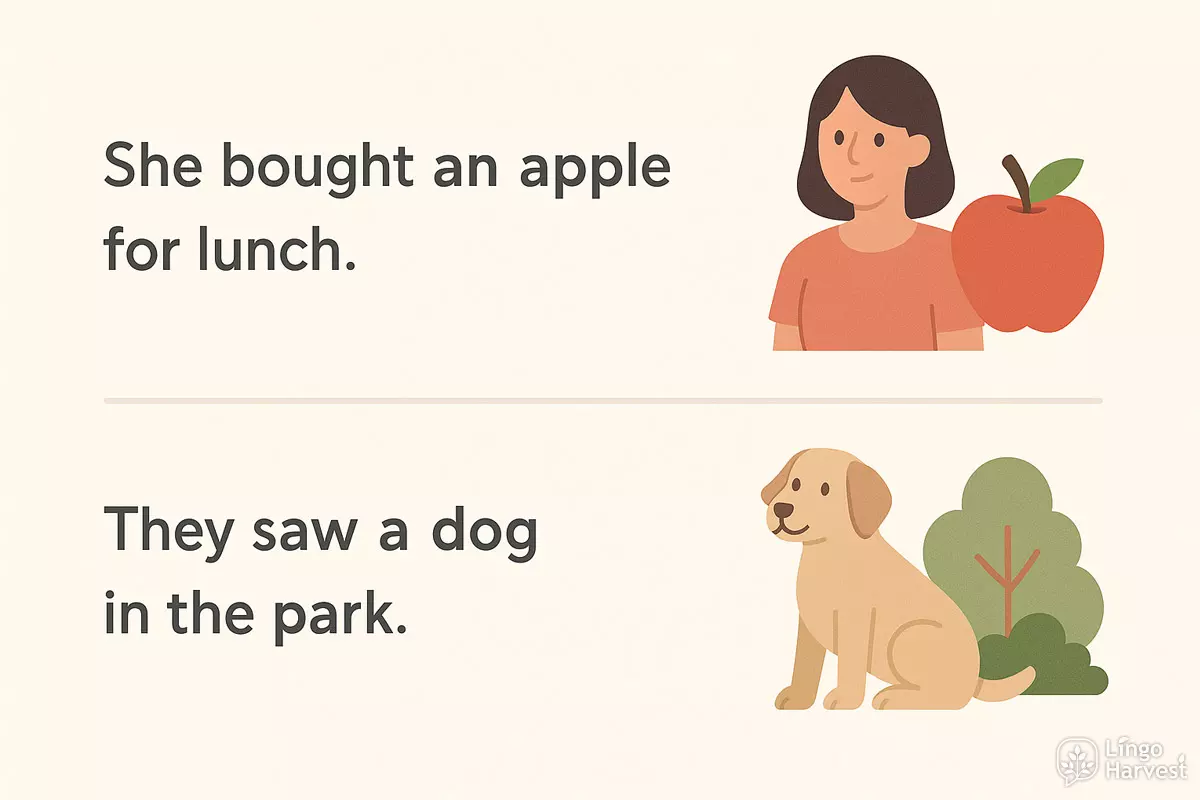
- I have a book in my bag.
- She bought an apple for lunch.
- They saw a dog in the park.
- Please close the door.
- He is reading the newspaper.
- There is a car outside.
- Give me the pen, please.
- We need a chair for the guest.
- She put an umbrella by the table.
- Can you pass the salt?
- The teacher is in the classroom.
- I saw a cat on the roof.
- He opened the window.
- She found a coin on the street.
- Let’s sit on the bench.
- He wants a sandwich for lunch.
- We heard an owl at night.
- She is looking for the keys.
- There’s a message for you.
- Look at the sky!
Quick reference: Choosing the correct article
| Article | When to use | Example |
|---|---|---|
| a | With singular nouns starting with a consonant sound | a dog, a table, a book |
| an | With singular nouns starting with a vowel sound | an apple, an umbrella, an egg |
| the | When the noun is specific or already mentioned | the car, the teacher, the window |
Practicing with these sentence patterns will help you get comfortable using articles in everyday conversation. As you learn new nouns, try making your own short statements or questions to reinforce the pattern.
Typical collocations with the most frequent nouns
Understanding how nouns combine with other words helps you sound more natural in conversation. Many everyday nouns frequently appear in set phrases or with specific adjectives and verbs. Learning these patterns can boost your confidence and fluency from the start.
Common adjective + noun combinations
Adjectives often pair with high-frequency nouns to convey precise meaning. Here are some examples:
- strong coffee
- cold water
- big problem
- new job
- hard question
- good idea
- old friend
- busy street
- fresh bread
- high temperature
Typical verb + noun patterns
Certain verbs are commonly used with specific nouns. These combinations often form natural-sounding expressions:
- make a decision
- take a break
- ask a question
- have lunch
- give advice
- find a solution
- lose weight
- catch a bus
- pay attention
- save money
- set an alarm
- miss a chance
Prepositions and frequent nouns
Prepositions also play a big role in fixed phrases. Some nouns almost always appear with certain prepositions:
- on time
- in trouble
- at home
- under control
- for sale
- by chance
- on purpose
- in charge
- at risk
- on holiday
Overview table: Collocations with core nouns
| Noun | Common Collocations |
|---|---|
| time | spend time, save time, waste time, on time |
| money | make money, save money, spend money, lose money |
| question | ask a question, answer a question, good question, hard question |
| job | find a job, lose a job, new job, job offer |
| friend | old friend, close friend, make friends, best friend |
| decision | make a decision, tough decision, final decision |
Exploring these word partnerships helps you notice patterns and anticipate what comes next in real conversations. By practicing with these combinations, you’ll be able to communicate more smoothly and understand others more easily.
Common mistakes with basic nouns
When learning a new language, it’s easy to trip up with simple vocabulary. Beginners often overlook details like gender, plural forms, or using the wrong article. These slip-ups can lead to confusion or even change the meaning of a sentence. Let’s look at where people most often go wrong, and how to avoid these issues from your very first words.
Mixing up singular and plural forms
It’s common to forget to switch between singular and plural. In English, most nouns add -s or -es, but some are irregular. For example, “child” vs. “children” or “mouse” vs. “mice.” Paying attention to these exceptions helps your meaning stay clear.
- One foot → two feet
- One man → several men
- One tooth → three teeth
- One person → many people
Confusing countable and uncountable nouns
Some words, like “information” or “advice,” can’t be counted. It’s a common error to say “an information” or “many advices.” Instead, use phrases like “some advice” or “a piece of information.”
- ❌ I have an information.
✅ I have some information. - ❌ She gave me many advices.
✅ She gave me some advice. - ❌ There are many breads.
✅ There is some bread.
Choosing the wrong article
Articles (“a,” “an,” “the”) often trip up learners. Use “an” before vowel sounds (“an apple”), “a” before consonant sounds (“a dog”), and “the” when you mean something specific. Not every language uses articles, so this can take practice.
Mix-ups with similar nouns
Words that look or sound alike can cause mistakes. Here are some common confusions:
- “house” vs. “home”
- “job” vs. “work”
- “journey” vs. “trip”
- “history” vs. “story”
- “fun” vs. “funny”
- “luggage” vs. “bag”
- “time” vs. “times”
- “paper” (material) vs. “a paper” (document)
- “people” vs. “peoples” (groups vs. plural of ‘people’ as nations)
- “glass” (material) vs. “a glass” (drinking vessel)
Irregular plural forms: Quick reference
| Singular | Irregular Plural | Regular Plural |
|---|---|---|
| child | children | childs ❌ |
| man | men | mans ❌ |
| mouse | mice | mouses ❌ |
| foot | feet | foots ❌ |
| person | people | persons (rare/official) |
Summary tips
- Double-check noun forms before using them.
- Learn irregular plurals and uncountable words early.
- Watch for small but important differences in meaning.
- Practice with real examples to build confidence.
Short practice: complete and create sentences with target nouns
Practicing with common nouns is a practical way to build your confidence and fluency. In this section, you'll find a mix of exercises to help you use high-frequency nouns in real-life contexts. You'll complete sentences, create your own, and review examples of how these words fit into everyday speech.
Complete the sentences
Fill in each blank with a suitable noun from the list: book, chair, phone, water, car, friend, city, dog, food, teacher.
- I left my ________ on the table by mistake.
- The ________ barked loudly at the stranger.
- Can you pass me a glass of ________, please?
- My ________ helped me with my homework.
- We drove to the ________ for a weekend trip.
Show answers
- phone
- dog
- water
- friend
- city
Make your own sentences
Choose five nouns from the following list and write a simple sentence for each: window, computer, coffee, street, music, family, school, door, time, bag.
- Example: "The computer is on the desk."
- Example: "My family visits every Sunday."
Show answers
- The window is open.
- I drink coffee in the morning.
- The street is quiet at night.
- She listens to music every day.
- My bag is heavy.
Compare usage: singular and plural
Understanding the difference between singular and plural nouns helps you communicate more clearly. Here’s a quick reference for common patterns:
| Singular | Plural | Example in a sentence |
|---|---|---|
| apple | apples | I have an apple. → I have two apples. |
| child | children | The child is playing. → The children are playing. |
| bus | buses | The bus is late. → The buses are late. |
| box | boxes | There is a box. → There are many boxes. |
| man | men | The man is tall. → The men are tall. |
Quick quiz: Which noun fits best?
Choose the most appropriate noun for each sentence:
- The ________ is ringing. (options: clock, apple, bag)
- My ________ teaches mathematics. (options: teacher, car, street)
- We sat on the ________ in the park. (options: bench, phone, dog)
- She forgot her ________ at home. (options: key, milk, tree)
Show answers
- clock
- teacher
- bench
- key
Try making your own sentences or mini-dialogues using any of the nouns from the tables and lists above. This will help reinforce both meaning and usage in different contexts.