Adjective to Noun Shifts in Academic English

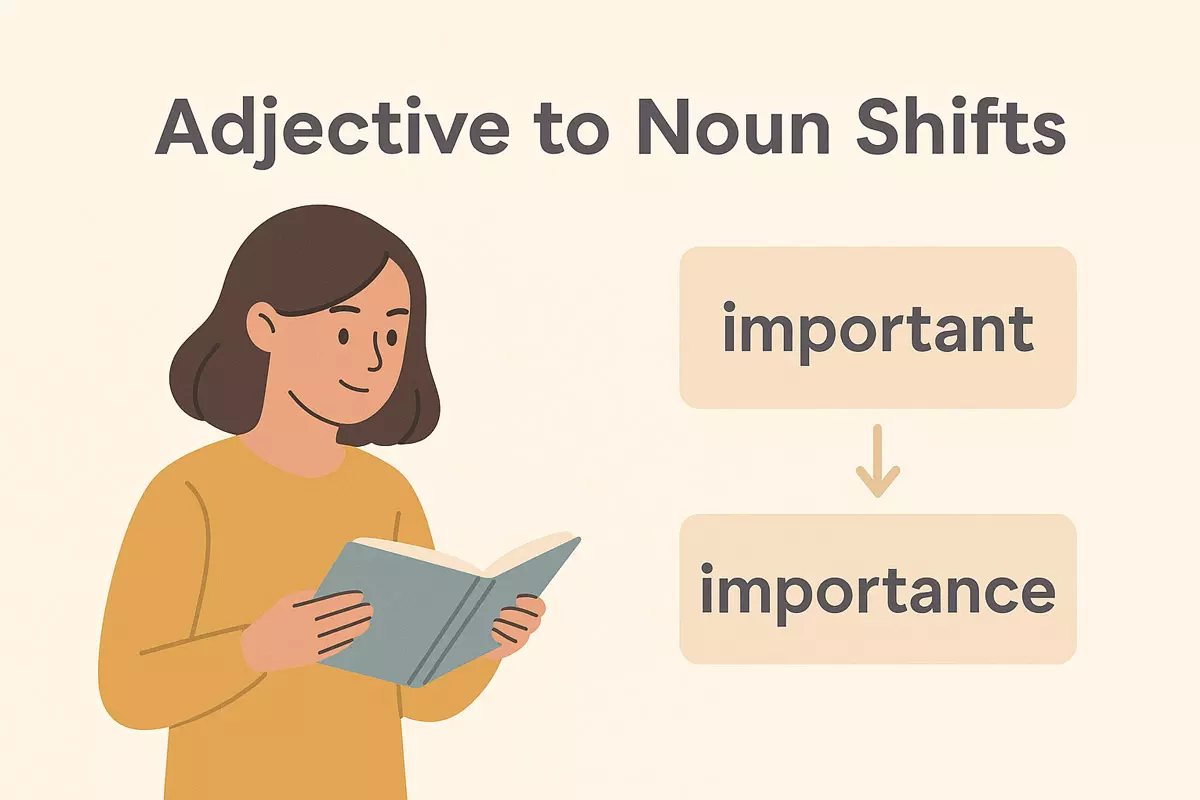 Here we why academic English uses nouns instead of adjectives, highlights common adjective-to-noun pairs and suffixes, explains meaning changes, points out when adjectives work better, warns against over-nominalization, and provides practice tasks.
- Why academic English prefers noun-based phrases
- Typical adjective → noun pairs (efficient → efficiency, equal → equality)
- Common suffixes in these shifts: -ity, -ness, -ence, -cy
- Changes in meaning when moving from quality to concept
- Where adjective forms are still better than noun forms
- Recognizing over-nominalized sentences
- Practice: convert between adjective and noun versions in context
In academic writing, words that initially describe qualities or characteristics are often adapted into noun forms, allowing them to function as subjects or objects within sentences. This linguistic transformation plays a significant role in shaping how arguments are structured and how ideas are communicated, as it enables writers to discuss abstract concepts with greater precision and clarity. By turning descriptive terms into concrete entities, scholarly authors can more effectively analyze and debate complex topics, enhancing the overall depth of their work.
Why academic English prefers noun-based phrases
Academic writing often relies on noun-centered constructions to achieve clarity, precision, and formality. By shifting from adjective-heavy or verb-based structures to those built around nouns, writers can create more abstract and generalizable statements. This approach helps condense complex ideas and present information in a way that is both neutral and objective.
Clarity and conciseness
Using nouns as the core of phrases allows for tighter, more focused sentences. Instead of spreading information across multiple clauses, noun-based forms encapsulate meaning more efficiently. For example, "the rapid increase in temperature" is clearer and more specific than "the temperature increased rapidly."
Formality and objectivity
Noun phrases contribute to a formal tone by minimizing personal or subjective language. Academic contexts favor expressions like "the effectiveness of the solution" rather than "how effective the solution is." This shift supports a more detached, analytical voice.
Abstractness and generalization
Nominalization — turning adjectives or verbs into nouns — enables discussion of abstract concepts, not just concrete events. Phrases like "the development of technology" or "the complexity of language" make it possible to analyze trends and categories rather than individual occurrences.
Common patterns of adjective-to-noun shifts
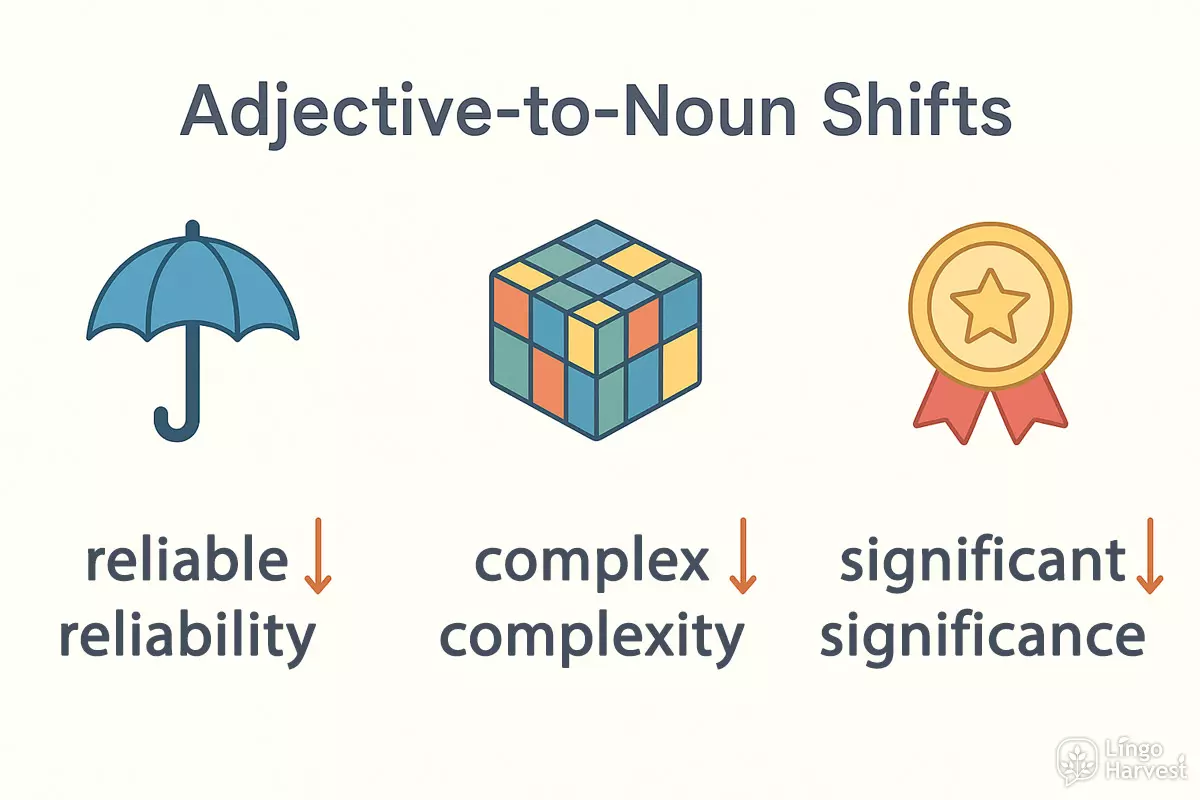
Writers often replace descriptive adjectives with abstract nouns to suit scholarly conventions. Here are typical examples:
- active → activity
- accurate → accuracy
- available → availability
- aware → awareness
- capable → capability
- certain → certainty
- complex → complexity
- consistent → consistency
- curious → curiosity
- dark → darkness
- different → difference
- diverse → diversity
- effective → effectiveness
- efficient → efficiency
- equal → equality
- flexible → flexibility
- innovative → innovation
- objective → objectivity
- patient → patience
- possible → possibility
- probable → probability
- reliable → reliability
- relevant → relevance
- responsible → responsibility
- responsive → responsiveness
- secure → security
- significant → significance
- similar → similarity
- stable → stability
Comparison: Adjective-based vs. noun-based constructions
The difference between the two styles is often seen in how arguments are structured and evidence is presented. Noun phrases can group related ideas, while adjective-based forms may sound conversational or imprecise.
| Adjective-based | Noun-based |
|---|---|
| The solution was effective. | The effectiveness of the solution was evident. |
| The results are significant. | The significance of the results is clear. |
| The data is reliable. | The reliability of the data was confirmed. |
| The process is complex. | The complexity of the process presents challenges. |
Summary
Favoring noun-based phrasing is not just a stylistic choice; it underpins the analytical and abstract nature of academic discourse. This convention supports dense, information-rich writing where relationships between concepts are foregrounded, allowing complex ideas to be discussed with precision and authority.
Typical adjective → noun pairs (efficient → efficiency, equal → equality)
Recognizing how adjectives shift into nouns is essential for academic English, especially when discussing abstract concepts or qualities. These transformations often involve predictable suffix changes, making it easier to expand vocabulary and express ideas more formally or precisely.
Suffix Choices and Their Effects
The suffix used can subtly change meaning or formality. For instance, -ity and -ness both form nouns, but -ity often appears in more formal, academic contexts, while -ness is more general. Some base adjectives take only one possible suffix, while others can form multiple nouns with slightly different meanings.
Table: Examples of Adjective to Noun Transformations
| Adjective | Noun Form |
|---|---|
| effective | effectiveness |
| productive | productivity |
| creative | creativity |
| inclusive | inclusivity |
| objective | objectivity |
| sensitive | sensitivity |
| innovative | innovation |
| informal | informality |
| formal | formality |
| stable | stability |
| visible | visibility |
| comprehensive | comprehensiveness |
| consistent | consistency |
| dependent | dependence |
| independent | independence |
| frequent | frequency |
| confident | confidence |
| precise | precision |
| tolerant | tolerance |
Understanding these adjective-to-noun shifts helps writers achieve greater precision and formality. By mastering these forms, students and professionals can communicate complex ideas more naturally in academic writing.
Common suffixes in these shifts: -ity, -ness, -ence, -cy
When turning adjectives into nouns in academic English, certain endings frequently appear. These endings, or suffixes, help form abstract nouns that capture qualities, states, or conditions. Recognizing them is helpful for both producing and understanding formal writing, as they often signal a shift from describing characteristics to naming concepts.
-ity: Expressing abstract qualities
The suffix -ity is widely used to form nouns from adjectives, especially in scholarly contexts. It often denotes a state or quality:
- active → activity
- possible → possibility
- complex → complexity
- curious → curiosity
- flexible → flexibility
- prior → priority
-ness: Indicating states or conditions
Adding -ness to an adjective creates a noun that refers to a general state or condition:
- happy → happiness
- aware → awareness
- weak → weakness
- dark → darkness
- effective → effectiveness
- kind → kindness
-ence and -cy: Turning adjectives into formal concepts
The endings -ence and -cy are also common in academic vocabulary, often creating more formal or technical nouns:
- different → difference
- absent → absence
- persistent → persistence
- efficient → efficiency
- urgent → urgency
- private → privacy
- accurate → accuracy
- vacant → vacancy
Comparing suffixes: Usage and meaning
Below is a summary comparing these common suffixes and their typical uses in academic English.
| Suffix | Function / Example |
|---|---|
| -ity | Forms abstract nouns (e.g., "complexity" from "complex") |
| -ness | Indicates state or quality (e.g., "darkness" from "dark") |
| -ence | Creates nouns for conditions or facts (e.g., "absence" from "absent") |
| -cy | Forms nouns, often denoting status (e.g., "efficiency" from "efficient") |
Understanding how these endings work can expand your vocabulary and help you express complex ideas more concisely in academic contexts. They are especially handy for summarizing qualities or describing general properties rather than specific instances.
Changes in meaning when moving from quality to concept
When adjectives are transformed into nouns in academic English, the resulting terms often shift from describing a property to encapsulating an abstract idea or category. This transition is more than a mere grammatical change; it frequently involves a broadening or redefinition of the original meaning.
From Description to Abstraction
Adjectives typically specify an attribute or quality of a noun—such as "efficient" describing a process. When these adjectives become nouns ("efficiency"), they refer not to the process itself, but to the concept or measure of how well something is performed. This shift allows for more nuanced academic discussion, as the new noun can be analyzed, quantified, or debated as a stand-alone entity.
Paradigm Shifts in Meaning
The process of nominalization often results in a more generalized or formal meaning. For example, "different" simply notes that two things are not the same, but "difference" can refer to the specific nature or degree of that distinction, or even an entire field of study (as in "cultural difference"). This movement from a concrete quality to an abstract idea is especially valuable in academic discourse, where concepts often require independent discussion.
| Adjective (Quality) | Noun (Concept) |
|---|---|
| relevant | relevance (the state or degree of being connected or appropriate) |
| complex | complexity (the quality of being intricate or complicated) |
| responsible | responsibility (the state or fact of being accountable) |
| creative | creativity (the use of imagination or original ideas) |
| productive | productivity (the effectiveness of productive effort) |
Implications for Academic Writing
Using noun forms derived from adjectives enables writers to discuss attributes as independent entities. This not only enhances precision but also supports more sophisticated argumentation. By referring to "stability" rather than just "stable," for example, authors can debate degrees, causes, and consequences of the concept, rather than merely describing a state. In summary, converting qualities into concepts through adjective-to-noun shifts enables richer, more abstract academic analysis and helps clarify discussions about properties, states, or conditions in scholarly texts.
Where adjective forms are still better than noun forms
In some academic contexts, choosing the adjective form over the corresponding noun leads to clearer, more concise writing. While nominalizations are common in scholarly texts, adjectives often provide greater precision or stylistic smoothness, especially when qualifying terms or reducing unnecessary complexity. Below, we explore typical scenarios and vocabulary where adjectives maintain an advantage.
Clarity and Flow in Modifying Nouns
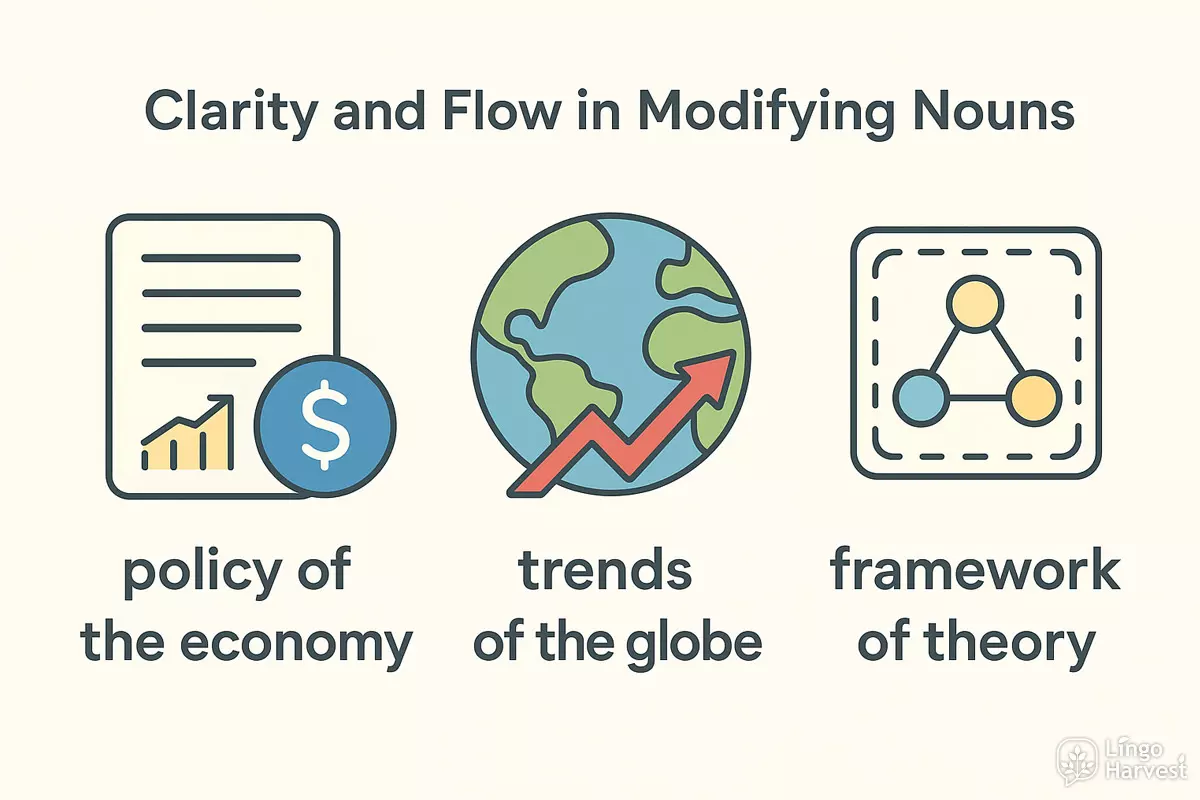
Adjectives are essential for modifying nouns directly, supporting readability and reducing wordiness. For example, "economic factors" is simpler and more direct than "factors of economy." Such constructions help avoid awkward phrasing and keep sentences streamlined.
- economic (vs. economy: "economic policy" → "policy of the economy")
- global (vs. globe: "global trends" → "trends of the globe")
- theoretical (vs. theory: "theoretical framework" → "framework of theory")
- practical (vs. practice: "practical approach" → "approach of practice")
- statistical (vs. statistics: "statistical data" → "data of statistics")
- environmental (vs. environment: "environmental impact" → "impact of environment")
- methodological (vs. methodology: "methodological issues" → "issues of methodology")
- cultural (vs. culture: "cultural context" → "context of culture")
- legal (vs. law: "legal framework" → "framework of law")
- medical (vs. medicine: "medical research" → "research of medicine")
- political (vs. politics: "political system" → "system of politics")
- psychological (vs. psychology: "psychological effects" → "effects of psychology")
- technological (vs. technology: "technological innovation" → "innovation of technology")
- historical (vs. history: "historical analysis" → "analysis of history")
- social (vs. society: "social structure" → "structure of society")
- ethical (vs. ethics: "ethical considerations" → "considerations of ethics")
- linguistic (vs. language: "linguistic features" → "features of language")
Comparison of Adjective and Noun Usage
In comparative or attributive contexts, the adjective form often feels more natural and less cumbersome. Consider the following structured comparison:
| Adjective Form (Preferred) | Noun Form (Less Preferred) |
|---|---|
| scientific method | method of science |
| educational policy | policy of education |
| philosophical argument | argument of philosophy |
| mathematical model | model of mathematics |
When Adjectives Enhance Precision
In technical writing, adjectives pinpoint the exact quality or aspect under discussion. For instance, "chemical properties" is more precise than "properties of chemistry" and is less likely to create ambiguity. This precision is valuable for both native and non-native readers, especially when dense information must be conveyed efficiently.
Summary
Overall, while noun forms have their place in academic English, adjective forms often enable smoother, more effective communication. They allow for direct modification, avoid clumsy circumlocutions, and help maintain a formal yet accessible tone. Strategic use of adjectives supports clarity, brevity, and reader engagement in scholarly writing.
Recognizing over-nominalized sentences
Spotting when a sentence is overloaded with nouns rather than verbs or adjectives is crucial for achieving clarity in academic English. Overuse of noun forms—often created from adjectives—can make writing unnecessarily dense and abstract, reducing readability. Writers and editors should pay attention to these patterns to improve flow and directness.
Common Signs of Excessive Nominalization
One way to detect this stylistic issue is to look for sentences packed with multiple nouns, especially those ending in suffixes like -tion, -ness, -ity, or -ment. These forms often originate from adjectives or verbs, shifting the focus away from actions or qualities and toward abstract entities. Watch for:
- Strings of nouns with minimal verbs (e.g., "The implementation of the regulation resulted in the reduction of pollution.")
- Verbs replaced by noun phrases (e.g., "The decision on the allocation" instead of "Deciding how to allocate")
- Adjectives turned into noun forms, obscuring the original meaning
- Sentences where the subject is a nominalization, not an agent or actor
- Overly formal or convoluted expressions that could be simplified
Comparing Direct and Nominalized Constructions
Dense noun-based writing can be rephrased for clarity by returning to adjective or verb forms. Here’s a comparison of typical patterns:
| Nominalized Version | More Direct Alternative |
|---|---|
| The assessment of the effectiveness was completed. | They completed assessing how effective it was. |
| There was an increase in the stability of the system. | The system became more stable. |
| The availability of data is essential. | Available data is essential. |
| The complexity of the process hinders understanding. | The process is too complex to understand easily. |
| Improvements in reliability were seen. | The system became more reliable. |
Why Does This Matter?
Overusing noun forms, especially those derived from adjectives, can obscure meaning and distance readers from the main point. By identifying these constructions, writers can revise sentences to be more active and concise, improving both style and comprehension.
Practice: convert between adjective and noun versions in context
Understanding how to shift between adjective and noun forms is essential for precise academic writing. This skill helps you vary your sentence structure and express complex concepts more clearly. Below, you’ll find context-based tasks and examples that encourage you to recognize and use both forms appropriately.
Common Adjective–Noun Pairs in Academic English
Many adjectives have corresponding noun forms, which are often used to create more formal or abstract statements. Here’s a list of frequently used pairs:
- active → activity
- effective → effectiveness
- responsible → responsibility
- significant → significance
- accurate → accuracy
- reliable → reliability
- efficient → efficiency
- capable → capability
- relevant → relevance
- different → difference
- similar → similarity
- comprehensive → comprehensiveness
- consistent → consistency
- possible → possibility
- probable → probability
- available → availability
- flexible → flexibility
- complex → complexity
- diverse → diversity
- objective → objectivity
Transforming Sentences: Context-Based Tasks
Try rewriting the following sentences by converting the adjective to its noun form, or vice versa, as indicated in parentheses.
- The effectiveness of this method is widely recognized. (Change to adjective form)
- Her responsibility is to oversee the project’s progress. (Change to adjective form)
- The results showed a high degree of accuracy. (Change to adjective form)
- The reliability of the data was questioned. (Change to adjective form)
- There was a clear difference between the two samples. (Change to adjective form)
- The model’s flexibility allows for adaptation. (Change to adjective form)
- It is important to consider the probability of error. (Change to adjective form)
- The availability of resources is limited. (Change to adjective form)
- We must ensure the consistency of results. (Change to adjective form)
- The significance of the findings cannot be overstated. (Change to adjective form)
Show answers
- This method is widely recognized as effective.
- She is responsible for overseeing the project’s progress.
- The results showed that they were highly accurate.
- The data was questioned for being less reliable.
- There were different aspects between the two samples.
- The model is flexible and allows for adaptation.
- It is important to consider how probable error is.
- Resources are not always available.
- We must ensure results are consistent.
- The findings are highly significant.
Table: Adjective and Noun Forms in Academic Sentences
| Adjective in Context | Noun in Context |
|---|---|
| The results are reliable. | The reliability of the results is high. |
| This approach is efficient. | The efficiency of this approach is notable. |
| The theory is complex. | The complexity of the theory is challenging. |
| The data is accurate. | The accuracy of the data is impressive. |
| The solution is possible. | The possibility of a solution exists. |
Quick Challenge: Identify the Needed Form
For each item, decide whether an adjective or noun form fits best. Write your answers.
- The __________ of the experiment was questioned. (reliable/reliability)
- This is a highly __________ method. (efficient/efficiency)
- They discussed the __________ of the findings. (significant/significance)
- The results were __________. (accurate/accuracy)
Show answers
- reliability
- efficient
- significance
- accurate
Practice with these patterns will help you become more versatile in your academic writing, allowing you to shift smoothly between descriptive and abstract forms as needed.