Nominal Style vs Verbal Style: When to Change for Clarity

 This article explains nominal and verbal styles, how to identify heavy nominal constructions, and their uses in technical or legal writing. It also covers when to use verbal style, finding hidden verbs, rewriting tips, and provides hands-on practice.
- Definitions: nominal style and verbal style
- Typical signals of heavy nominal style (many abstract nouns)
- Advantages of nominal style in technical and legal texts
- Advantages of verbal style in explanations and instructions
- How to spot hidden verbs inside long noun phrases
- Techniques for rewriting into more verbal sentences
- When to keep nominal style for emphasis or cohesion
- Practice: edit a paragraph by shifting between the two styles
Choosing between action-focused expressions and noun-heavy constructions can significantly impact the clarity of your writing. Opting for verbs and active language often makes sentences more direct and engaging, while excessive use of nouns can create dense, harder-to-read passages. Recognizing when to adjust your sentence structure allows your readers to follow your ideas more easily and helps your message come across with greater precision and effectiveness.
Definitions: nominal style and verbal style
Understanding the difference between nominal and verbal styles is essential for crafting clear and effective writing. These two approaches shape sentences in distinct ways, each with unique strengths and drawbacks.
Nominal style focuses on nouns and noun phrases to express actions, concepts, or processes. This often results in sentences where the main idea is embedded in a noun, making the writing more formal, abstract, or dense. For example, instead of saying “The committee decided,” a nominal construction would be “The decision of the committee.” This style is common in academic, bureaucratic, and technical contexts.
Verbal style, on the other hand, centers on verbs and verb phrases. Sentences in this style typically emphasize action and are more direct and dynamic. For instance, “The team analyzed the data” uses a clear verb to show who did what. Verbal style is often preferred for its clarity and straightforwardness, especially in instructional or narrative writing.
Key Features of Each Style
- Nominal Style: Relies heavily on nouns; often passive or impersonal; can make writing dense or formal.
- Verbal Style: Uses active verbs; generally more direct and concise; enhances readability and flow.
Common Patterns and Examples
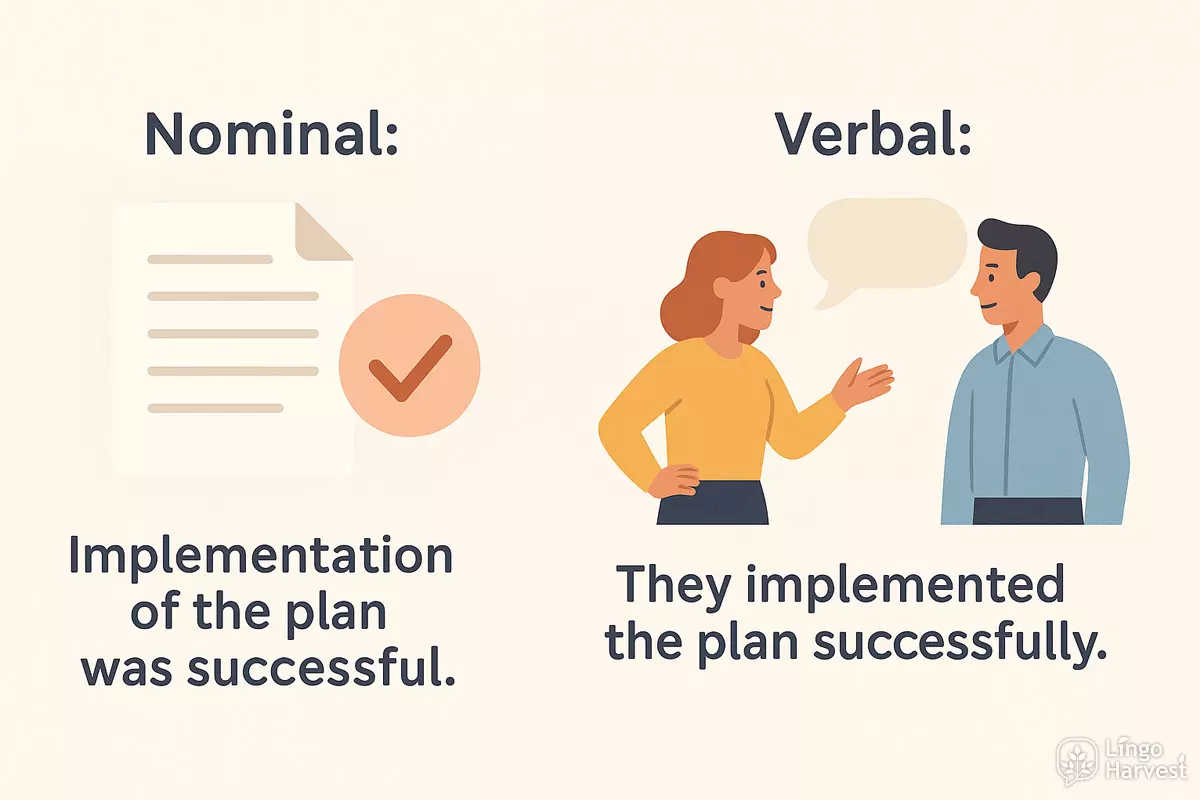
- Nominal: “Implementation of the plan was successful.”
- Verbal: “They implemented the plan successfully.”
- Nominal: “The completion of the project took months.”
- Verbal: “They completed the project in months.”
- Nominal: “There was a discussion about the budget.”
- Verbal: “They discussed the budget.”
- Nominal: “His explanation of the rules was clear.”
- Verbal: “He explained the rules clearly.”
- Nominal: “The investigation of the issue is ongoing.”
- Verbal: “They are investigating the issue.”
Side-by-Side Comparison
| Nominal Style | Verbal Style |
|---|---|
| The evaluation of the program was thorough. | They evaluated the program thoroughly. |
| Approval of the proposal is required. | They must approve the proposal. |
| Development of new features continues. | They are developing new features. |
| The presentation of results impressed everyone. | She presented the results and impressed everyone. |
| Completion of the task is necessary. | You need to complete the task. |
Choosing between these approaches depends on the audience, purpose, and desired tone. Understanding their definitions and characteristics helps writers decide when to use each for maximum clarity.
Typical signals of heavy nominal style (many abstract nouns)
Writers often slip into a dense, abstract mode of expression by overusing nouns formed from verbs or adjectives—especially in academic, bureaucratic, or technical writing. This can obscure meaning and distance readers from the action. Instead of showing who does what, sentences become loaded with static concepts, often making the prose harder to follow.
Common markers of noun-heavy constructions
Several features can reveal when writing leans too much on abstract nouns. Look for these patterns:
- Frequent use of words ending in -tion, -ment, -ance, -ity, -ness (e.g., formation, development, appearance, activity, readiness).
- Long noun phrases stacked together, often with multiple prepositional phrases ("the implementation of the strategy by the committee").
- Passive voice combined with noun-heavy subjects ("The evaluation was conducted...").
- Absence of clear agents—sentences often lack a "doer" or subject performing an action.
- Actions described as things rather than verbs ("the completion of the project" instead of "the team completed the project").
- Stringing together several abstract nouns in a single sentence ("consideration of the application for approval").
- Replacing simple verbs with noun-verb combinations ("make a decision" instead of "decide").
- Heavy reliance on prepositions like "of," "by," "for," and "to" linking abstract nouns.
- General lack of vivid, specific verbs.
- Sentences that feel static or impersonal, often with minimal context.
Examples of abstract noun overuse
Writers often use the following abstract nouns and noun-heavy phrases, which can signal a nominal style:
- Implementation
- Assessment
- Identification
- Participation
- Evaluation
- Development
- Provision
- Recognition
- Improvement
- Measurement
- Approval
- Observation
- Recommendation
- Application
- Interpretation
- Determination
- Preparation
- Communication
Comparison: Nominal vs. Verbal Style Patterns
| Nominal Construction | More Direct (Verbal) Alternative |
|---|---|
| The implementation of the plan was successful. | The team implemented the plan successfully. |
| There was an improvement in performance. | Performance improved. |
| She made a recommendation regarding policy changes. | She recommended policy changes. |
| An assessment of the risks was conducted. | We assessed the risks. |
| The preparation of the report took two weeks. | They prepared the report in two weeks. |
| Approval of the project was given by management. | Management approved the project. |
Why does nominal style matter?
While abstract nouns are sometimes necessary, overusing them can make writing vague and lifeless. Recognizing these signals helps writers shift toward a clearer, more engaging style—putting actions and agents front and center. This not only improves readability but also strengthens the connection between ideas and the people involved.
Advantages of nominal style in technical and legal texts
Nominal constructions—sentences built around nouns rather than verbs—play a central role in both technical documentation and legal writing. This approach often delivers greater precision and consistency, which is crucial in environments where every term must be unambiguous. By focusing on noun phrases, writers can reduce interpretive ambiguity, making it easier for readers to locate and reference specific concepts.
Clarity and Precision
Using nominalization enables the clear definition of complex processes, objects, or rights, which is essential when details matter. For example, “the implementation of the protocol” is more precise than “when you implement the protocol,” as it refers to a specific action or instance, not just the act itself.
Consistency and Structure
Documents that rely on noun-based phrasing can maintain a more uniform structure. This helps readers scan and compare terms, conditions, or procedures efficiently. Standardized terms also support cross-referencing, which is vital in lengthy contracts or manuals.
Facilitates Cross-Referencing
Nominal forms allow for easier indexing and referencing throughout a document. When a process or requirement is described as a noun, it can be repeated and referenced without confusion, supporting both navigation and legal enforceability.
Examples of Nominal Style in Practice
Nominal style appears frequently in specialized writing. Here are several common patterns and phrases:
- Completion of the task
- Approval of the proposal
- Termination of the agreement
- Violation of the policy
- Provision of services
- Assessment of risk
- Issuance of a permit
- Fulfillment of obligations
- Assignment of responsibilities
- Resolution of disputes
- Execution of the contract
- Submission of documentation
- Modification of terms
- Notification of changes
- Compliance with regulations
- Enforcement of penalties
- Observation of standards
- Determination of eligibility
- Withdrawal of consent
- Authorization of access
Summary Table: Nominal vs. Verbal Style in Technical and Legal Contexts
| Nominal Style Example | Verbal Style Equivalent |
|---|---|
| Termination of the agreement | If the agreement is terminated |
| Provision of information | When you provide information |
| Assessment of risk | When you assess risk |
| Fulfillment of obligations | When you fulfill your obligations |
| Modification of terms | When terms are modified |
| Submission of documentation | When you submit documentation |
When Nominal Style is Most Effective
Nominal phrasing is particularly effective when describing procedures, rules, or requirements that must be referenced repeatedly or defined precisely. It also suits situations where brevity and formality are paramount, such as legal contracts, regulatory texts, and technical specifications. Overall, noun-based structures support the needs of technical and legal communication by promoting clarity, uniformity, and efficient cross-referencing, making them a preferred choice in these fields.
Advantages of verbal style in explanations and instructions
Using a verbal approach—where actions and processes are expressed as verbs rather than abstract nouns—often leads to clearer, more direct communication. When you want readers to follow steps or understand how something works, phrasing sentences with strong verbs makes the message more accessible and actionable.
Clarity through Action
Verbal constructions put the focus on what needs to be done, helping readers visualize tasks and processes. For example, "Open the file" is immediately actionable compared to "The opening of the file." This shift reduces ambiguity and makes instructions easier to follow, especially for those new to the subject.
- Directness: Readers understand what is expected without unnecessary interpretation.
- Step-by-step guidance: Sequences of actions are easier to organize and follow.
- Reduced cognitive load: Sentences are shorter and less abstract, supporting faster comprehension.
- Engagement: The reader feels more involved when addressed with imperatives or active verbs.
- Consistency: Verbal forms help standardize the format of instructions, which is useful for manuals and guides.
- Ease of translation: Clear actions are simpler to translate without losing meaning.
- Minimizes misinterpretation: Less room for confusion compared to dense nominalized phrases.
- Supports learning: Action-oriented language aids memory and recall for procedural tasks.
- Natural flow: Mirrors spoken language, making explanations sound less formal and more approachable.
- Encourages brevity: Using verbs often results in more concise sentences.
Comparison: Nominal vs. Verbal Style in Instructions
| Nominal Style Example | Verbal Style Example |
|---|---|
| Completion of the installation is required. | Complete the installation. |
| The adjustment of the settings should be performed. | Adjust the settings. |
| Initiation of the backup is necessary. | Start the backup. |
| Verification of the results must occur. | Check the results. |
| The creation of a user profile is recommended. | Create a user profile. |
In summary, favoring verbs over nouns in guidance materials makes instructions more actionable and less prone to misunderstanding. This approach is especially helpful when your goal is to prompt action, clarify processes, or support users with varying backgrounds and language skills.
How to spot hidden verbs inside long noun phrases
Long noun clusters often hide action words, making writing less direct and harder to follow. Recognizing these disguised verbs helps you rewrite for clarity and energy. Instead of letting actions get buried under layers of nouns, you can reveal them and make sentences easier to understand.
Common signs that a verb is hiding in a noun phrase
Look for these typical patterns:
- Phrases with multiple nouns stacked together, such as "implementation of the plan"
- Words ending in -tion, -ment, -ance, -ence (e.g., "development," "appearance")
- Phrases starting with "the," "a," or "an" followed by a noun and a prepositional phrase ("the investigation of the accident")
- Passive constructions that avoid naming the doer of the action
- Sentences with few or no action verbs but many nouns
How to extract the action from noun-heavy constructions
To clarify your writing, try these steps:
- Identify the core noun (often ending in -tion, -ment, etc.)
- Ask yourself, "What is happening here?"
- Find the verb form related to the noun (e.g., "discussion" → "discuss")
- Restructure the sentence so the verb does the work
- Check if the new sentence is more direct and lively
Examples: Noun phrases and their hidden verbs
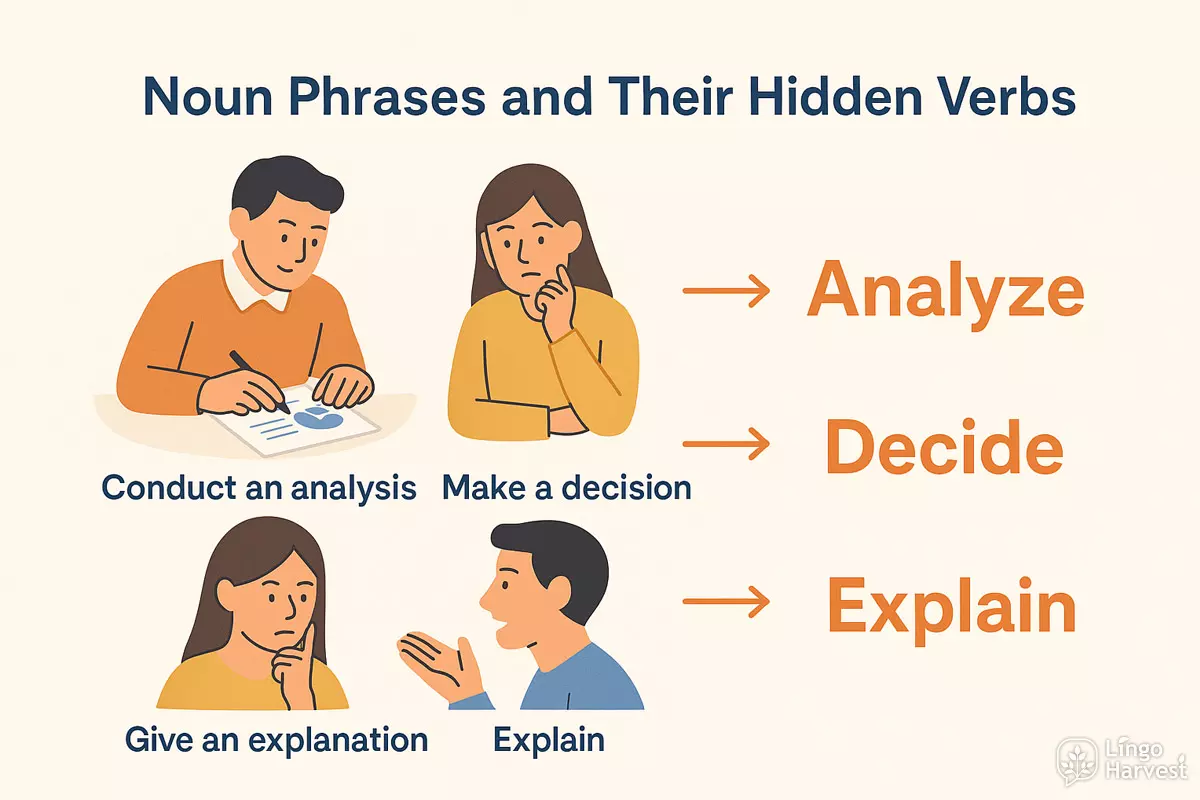
Here are some common patterns and how to reveal their underlying actions:
- Conduct an analysis → Analyze
- Make a decision → Decide
- Give an explanation → Explain
- Provide a recommendation → Recommend
- Offer an assessment → Assess
- Reach a conclusion → Conclude
- Carry out an investigation → Investigate
- Perform a review → Review
- Do an evaluation → Evaluate
- Submit an application → Apply
- Present a proposal → Propose
- Give an answer → Answer
- Make a selection → Select
- Hold a discussion → Discuss
- Initiate a response → Respond
- Offer a suggestion → Suggest
- Undertake an improvement → Improve
- Make a statement → State
- Reach agreement → Agree
- Provide information → Inform
Quick reference: Transforming noun phrases into verbs
| Noun Phrase | Action Verb |
|---|---|
| Preparation of the report | Prepare the report |
| Implementation of the strategy | Implement the strategy |
| Consideration of options | Consider options |
| Approval of the budget | Approve the budget |
| Identification of risks | Identify risks |
| Resolution of issues | Resolve issues |
| Observation of changes | Observe changes |
| Development of skills | Develop skills |
| Management of resources | Manage resources |
| Reduction of costs | Reduce costs |
By training yourself to spot these patterns, you’ll find it easier to write in a more active, engaging style. This not only clarifies your message but also makes your writing more concise and effective.
Techniques for rewriting into more verbal sentences
Transforming writing from a noun-heavy, abstract style to a clearer, more action-oriented form often means shifting from nominalizations to verbs. This not only makes sentences more direct but also livelier and easier to follow. Here are some practical strategies and patterns to help with this process.
Spotting Nominalizations
The first step is recognizing when a sentence relies too much on nouns formed from verbs (such as "decision," "implementation," "analysis"). These forms can make prose dense and indirect. Look for suffixes like -tion, -ment, -ance, and -ing.
Steps for Rewriting
- Identify the core action: Pinpoint the main verb hidden inside a noun. For example, "The implementation of the policy" contains the verb "implement."
- Change the noun to a verb: Rewrite the sentence so the action is performed by a subject. E.g., "The team implemented the policy."
- Reduce unnecessary prepositional phrases: Nominal style often strings together phrases like "in the process of" or "for the purpose of." Replace with a direct verb.
- Simplify sentence structure: Break long, abstract sentences into shorter, clearer ones with active verbs.
- Use active voice: Whenever possible, make the subject do the action.
Common Nominalizations and Their Verbal Forms
Below is a list of frequent nominalizations and their more concise verb counterparts. Swapping these out is a quick way to make writing more dynamic.
- make a decision → decide
- give an explanation → explain
- conduct an analysis → analyze
- provide a description → describe
- reach an agreement → agree
- offer a suggestion → suggest
- offer a recommendation → recommend
- give consideration → consider
- carry out an investigation → investigate
- make an observation → observe
- give approval → approve
- give information → inform
- make an improvement → improve
- have a discussion → discuss
- perform a review → review
- make a selection → select
- give permission → permit
- offer an invitation → invite
- submit an application → apply
Before-and-After Examples
Seeing transformations in context can clarify how to revise sentences for clarity and flow.
- Nominal: The completion of the project was achieved by the team.
Verbal: The team completed the project. - Nominal: The analysis of the results was conducted by experts.
Verbal: Experts analyzed the results. - Nominal: There was a discussion about the proposal.
Verbal: They discussed the proposal.
Quick Checklist for More Action-Oriented Sentences
- Is the main idea expressed as a verb?
- Does the sentence have a clear subject performing the action?
- Are there unnecessary noun phrases that could become verbs?
- Is the sentence free of excessive prepositions and passives?
With regular practice, moving from a dense, noun-based style to a more verbal, energetic approach becomes second nature. This shift improves clarity and keeps readers engaged.
When to keep nominal style for emphasis or cohesion
Sometimes, shifting to a noun-based structure isn’t just acceptable—it’s actually the best choice for clarity and flow. Using nominal forms (nouns like “development,” “analysis,” or “decision”) can help your writing achieve a stronger sense of unity, emphasize key ideas, and reduce unnecessary repetition. This approach is especially effective in academic, technical, or formal documents where precision and cohesion matter.
Highlighting central concepts or themes
Nominalization can spotlight the main subject or idea, making it easier for readers to track what’s most important. For instance, repeating a central noun throughout a section helps reinforce the topic and links sentences together.
- Consistency: Using the same noun form maintains a clear thread, especially in lengthy discussions.
- Focus: Nominals can distill complex processes into a single idea, keeping attention on the core message.
- Comparisons: Abstract nouns make it easier to compare ideas across sentences or paragraphs.
- Summarizing: They help condense actions or events into a concise summary statement.
Creating cohesion between sentences
When you want to link multiple sentences or ideas, noun forms act as anchors. This is particularly useful in reports or essays where you refer back to earlier points.
- Reference: Using a nominal allows you to refer back to a previous idea without repeating the whole action.
- Transitions: Starting a sentence with a nominal can connect it smoothly to the previous one.
- Parallel structure: Nominals help create balanced sentences when listing several related concepts.
- Reducing ambiguity: Noun forms clarify which idea or process you’re discussing, especially when multiple actions are mentioned.
Examples: Effective use of nominalization
Below are some cases where opting for a noun-based structure enhances clarity or cohesion:
- “Implementation of the policy resulted in greater efficiency.” (Emphasizes the act of implementing as a whole process)
- “The analysis revealed several trends.” (Keeps focus on the process as a single entity)
- “After the decision, morale improved.” (Links back to a previously discussed choice)
- “Their cooperation was essential for success.” (Condenses ongoing actions into one concept)
- “The investigation continued for weeks.” (Highlights the event, not just the act of investigating)
- “This solution offers simplicity.” (Distills a complex process into a single quality)
- “Reduction in costs benefited the company.” (Focuses on the outcome as a noun)
- “Discussion of the results followed.” (Shows sequence and maintains cohesion)
- “The development of the project took months.” (Summarizes the process over time)
- “Selection of candidates was rigorous.” (Emphasizes the process as a distinct stage)
- “The proposal’s rejection surprised everyone.” (Captures the outcome in a noun phrase)
- “Failure to comply will result in penalties.” (Abstracts non-compliance as a concept)
When nominal style supports your argument
Writers often rely on noun-based forms to lend authority or formality to their statements. Academic and professional texts, in particular, benefit from this because it allows complex relationships or processes to be discussed succinctly and with emphasis. In summary, using nominal structures is not just a stylistic preference—it can be a deliberate strategy to strengthen cohesion, maintain emphasis, and guide your reader through complex material. Consider where noun-based phrasing clarifies your point or ties ideas together, rather than defaulting to verb-based sentences in every case.
Practice: edit a paragraph by shifting between the two styles
Understanding how to shift between nominal and verbal styles can make your writing clearer or more concise, depending on your goals. Let's explore this by editing a paragraph in both styles. First, review the two versions below: one uses nominalizations heavily, while the other favors active verbs.
Original Paragraph (Nominal Style)
The implementation of new procedures for the management of data resulted in the improvement of efficiency within the department. The evaluation of the outcomes was conducted by the team, leading to the identification of several issues. The recommendation was the initiation of further training for staff.
Revised Paragraph (Verbal Style)
The department became more efficient after the team implemented new data management procedures. They evaluated the results and identified several issues. They recommended that staff receive more training.
| Nominal Style Example | Verbal Style Example |
|---|---|
| The development of the project was rapid. | The team developed the project rapidly. |
| The analysis of the data took several hours. | They analyzed the data for several hours. |
| Completion of the assignment is required by Friday. | You must complete the assignment by Friday. |
| Approval of the budget occurred last week. | The committee approved the budget last week. |
| Discussion of the proposal continued for days. | They discussed the proposal for days. |
Try It Yourself
Practice rewriting the following sentences. Shift each from nominal to verbal style or vice versa, depending on which is provided. Aim for clarity and conciseness.
- Preparation of the report was completed by the assistant.
- The manager approved the plan yesterday.
- Investigation of the problem is necessary.
- The team will review the results next week.
Show answers
- The assistant prepared the report.
- Approval of the plan occurred yesterday.
- We need to investigate the problem.
- A review of the results will take place next week.
Tips for Shifting Between Styles
- Look for nouns ending in -tion, -ment, -ance, or -ing; these often signal nominalization.
- To shift to verbal style, turn the noun back into its verb form and clarify the subject.
- For nominal style, use a noun form of the verb and focus on the process or result rather than the actor.
- Verbal style is often clearer and more direct, especially in instructions or action-based writing.
- Nominal style can be useful for emphasizing processes, concepts, or when the actor is unimportant or unknown.
Practicing these shifts will help you choose the style that best serves your communicative purpose—whether that's directness or formality.