Nouns as Objects in English: Direct and Indirect Use Explained

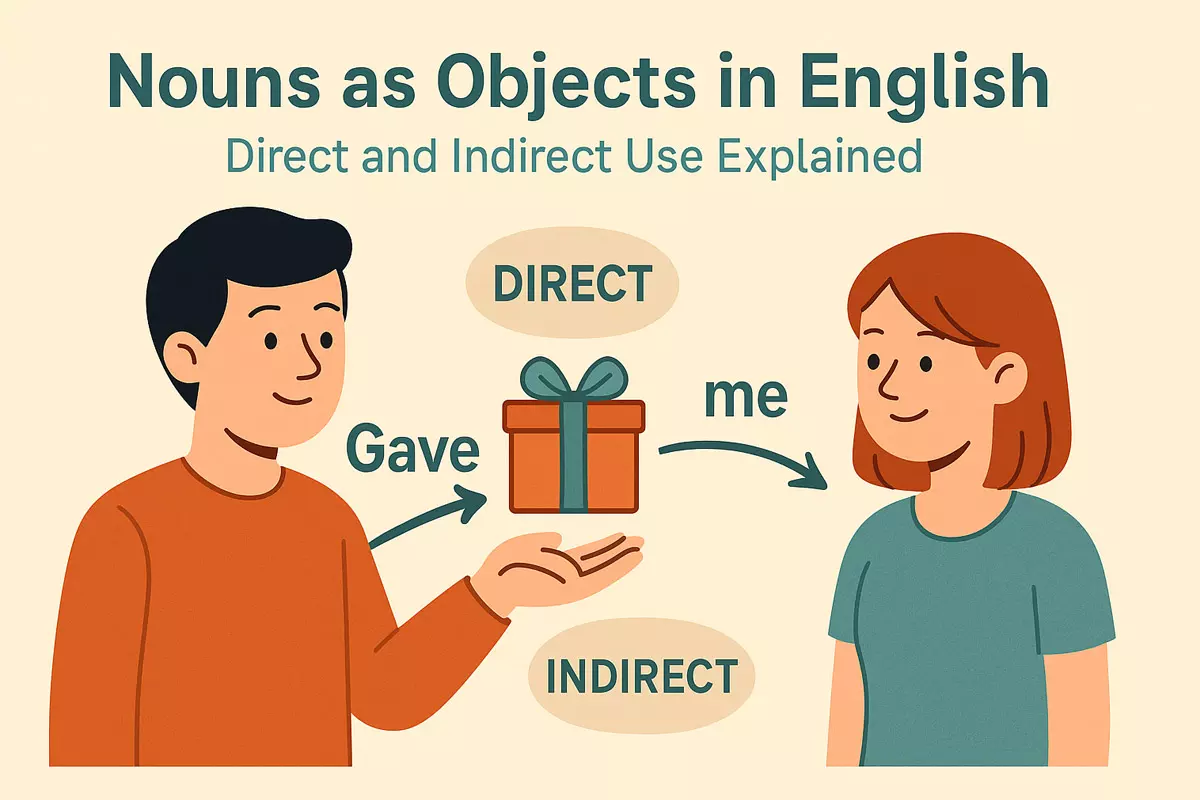 The article explains verb–object patterns in English, how to identify direct and indirect objects, and the word order when two noun objects are used. It also covers prepositional objects with to and for, common learner errors, and offers practice exercises.
- Review of verb–object patterns in English
- What direct objects are and how to find them
- What indirect objects are and where they appear
- Word order differences with two noun objects
- Using prepositional objects with to and for
- Common learner errors with object nouns
- Practice: identify and rewrite sentences with objects
Understanding how English sentences identify people, places, or things that receive an action is key to effective communication. These receivers, known as objects, can be directly affected by the action of the verb or may be indirectly involved. Recognizing the role of these words in a sentence helps clarify meaning and ensures that messages are conveyed accurately. By learning how objects function in various contexts, you can construct sentences that are both precise and easy to understand, ultimately improving your overall language skills.
Review of verb–object patterns in English
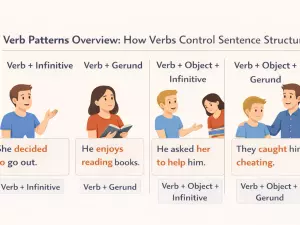
Understanding how verbs interact with objects is a core part of English grammar. Verbs often require, or allow, one or more objects—typically nouns or pronouns—to complete their meaning. These objects can be direct, indirect, or sometimes omitted, depending on the verb and the intended meaning. Recognizing these patterns helps learners construct clear, accurate sentences.
Common verb–object structures
The most frequent pattern is the verb followed by a direct object. Some verbs also take an indirect object, either before the direct object (without a preposition) or after (with a preposition). Here are some typical structures:
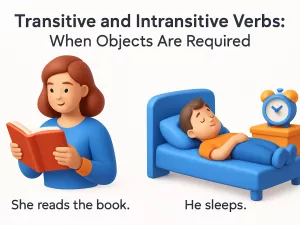
- Verb + Direct Object: She reads a book.
- Verb + Indirect Object + Direct Object: He gave his friend a gift.
- Verb + Direct Object + to/for + Indirect Object: She sent a letter to her boss.
- Verb (no object): He sleeps.
Examples of verbs with objects
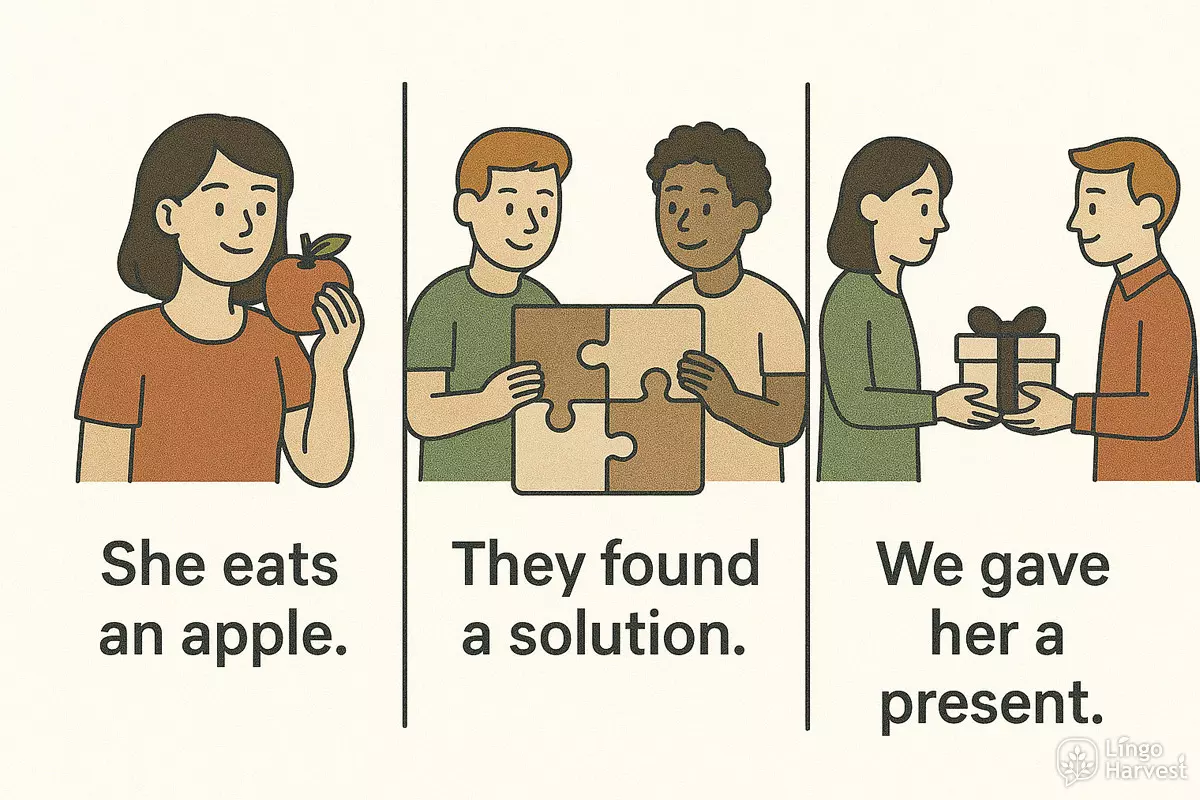
Many English verbs require or allow objects. Here’s a diverse selection, illustrating different usage patterns:
- eat (She eats an apple.)
- find (They found a solution.)
- give (We gave her a present.)
- show (He showed me the way.)
- teach (She teaches students English.)
- tell (I told them a story.)
- buy (He bought his sister a gift.)
- send (We sent an email to our client.)
- ask (She asked him a question.)
- bring (You brought me flowers.)
- call (They called the doctor.)
- invite (We invited our friends.)
- love (He loves music.)
- prefer (She prefers tea.)
- need (I need help.)
- enjoy (They enjoy playing tennis.)
- help (Can you help me?)
- visit (We visited the museum.)
Direct vs. Indirect Object Comparison
Some verbs can take both a direct and an indirect object. The direct object receives the action, while the indirect object benefits from or is affected by it. The table below summarizes how these objects appear in sentences:
| Verb | Direct Object | Indirect Object (no preposition) | Indirect Object (with preposition) |
|---|---|---|---|
| give | a book | He gave me a book. | He gave a book to me. |
| send | a message | She sent her friend a message. | She sent a message to her friend. |
| buy | a coffee | I bought him a coffee. | I bought a coffee for him. |
| show | the photo | She showed us the photo. | She showed the photo to us. |
Practice: Identify the Object(s)
For each sentence, identify the direct and/or indirect object. Write your answers as "Direct object: ___, Indirect object: ___".
- Maria sent her sister a postcard.
- They offered the guests some tea.
- He fixed the car.
- Lucy told a joke to her friends.
- The teacher gave the students homework.
- I bought my brother a gift.
- She showed the class the photo.
- We cooked our parents dinner.
- He wrote his boss an email.
- They built the town a new bridge.
Show answers
- Direct object: a postcard, Indirect object: her sister
- Direct object: some tea, Indirect object: the guests
- Direct object: the car, Indirect object: none
- Direct object: a joke, Indirect object: her friends
- Direct object: homework, Indirect object: the students
- Direct object: a gift, Indirect object: my brother
- Direct object: the photo, Indirect object: the class
- Direct object: dinner, Indirect object: our parents
- Direct object: an email, Indirect object: his boss
- Direct object: a new bridge, Indirect object: the town
What direct objects are and how to find them
A direct object is the receiver of the action in a sentence. It answers the questions “what?” or “whom?” after the verb. Typically, the direct object is a noun or noun phrase, and it follows the main verb directly. Recognizing direct objects can help you understand sentence structure and clarify meaning.
How to identify the direct object in a sentence
To find the direct object, start by locating the verb. Then, ask “what?” or “whom?” about the verb. The answer is your direct object. Here are some steps you can use:
- Find the action word (verb) in the sentence.
- Ask “what?” or “whom?” after the verb.
- The noun or noun phrase that answers this question is the direct object.
Examples of direct objects in sentences
Below are various sentences with the direct object highlighted for clarity:
- She wrote the letter.
- They watched a movie.
- We built a sandcastle.
- He reads books every night.
- The cat caught a mouse.
- I lost my keys.
- The teacher explained the rules.
- She painted a picture.
- We admire her talent.
- He found an old coin.
- They play chess after school.
- She bought a new phone.
- I heard a noise outside.
- We visited the museum.
- The chef prepared the meal.
- He answered the question.
- The dog chased the ball.
- She sent a message.
Common verbs that take direct objects
Many English verbs are transitive, meaning they need a direct object to complete their sense. Here are some frequently used verbs that often take a direct object:
- Eat → I eat breakfast at 8 a.m.
- Make → She made a cake for her sister.
- See → We saw a movie last night.
- Buy → He bought a new phone yesterday.
- Find → I found my keys under the sofa.
- Fix → They fixed the broken window.
- Bring → Please bring your passport.
- Hold → He held the door open for me.
- Read → She reads the news every morning.
- Take → I took a photo of the sunset.
- Send → We sent an email to the client.
- Write → He wrote a letter to his boss.
- Open → She opened the box carefully.
- Close → Please close the window.
- Show → Can you show me the report?
- Tell → Tell me the truth.
- Give → She gave me some advice.
- Call → I called my friend after work.
- Love → They love their new apartment.
- Help → Could you help me with this problem?
Quick test: spot the direct object
Try finding the direct object in these sentences:
- Maria baked a cake.
- We saw the parade.
- He fixed the car.
- They invited their friends.
In each case, the noun or noun phrase after the verb is the direct object. Identifying these helps strengthen your understanding of English sentence construction.
What indirect objects are and where they appear
An indirect object is a noun or pronoun that receives the benefit or result of the action performed by the verb, usually alongside a direct object. In English sentences, the indirect object often answers the questions “to whom?”, “for whom?”, or “for what?” in relation to the verb. It is frequently a person or recipient, but not always.
Position in the sentence
Indirect objects typically come directly before the direct object, especially when there’s no preposition. For example: “She gave her friend a gift.” Alternatively, you can place the indirect object after the direct object if you use a preposition (to or for): “She gave a gift to her friend.”
How to identify an indirect object
- Look for the recipient of the action or the person/thing benefiting from it.
- Check if you can insert “to” or “for” before the noun without changing the meaning.
- It usually appears with verbs of giving, sending, showing, telling, or making.
Common verbs that take indirect objects
- Give → She gave her friend a gift.
- Send → He sent his boss an email.
- Show → I showed the students the answer.
- Tell → She told me a secret.
- Lend → He lent his brother some money.
- Offer → They offered the guests some coffee.
- Bring → Please bring me the documents.
- Read → She read the children a story.
- Buy → I bought my parents a souvenir.
- Make → She made her son a sandwich.
- Pass → Can you pass me the salt?
- Write → He wrote his colleague a message.
- Throw → He threw the dog a ball.
- Pay → They paid the waiter a tip.
- Teach → She teaches her students English.
- Sell → He sold his neighbor a bike.
- Hand → She handed the manager the report.
- Cook → He cooked his family dinner.
Examples in context
Here are some sentences showing where indirect objects can appear:
- He sent his mother a postcard. → Indirect object: “his mother”
- She told the class a story. → “the class” is the recipient
- The teacher gave us homework.
- I made my brother a sandwich.
- They offered me a ride.
- We showed our friends the city.
- She bought her parents flowers.
- Can you lend me your pen?
- He cooked his wife dinner.
- Did you write him a letter?
Direct vs. indirect object pattern
| Verb | Indirect Object (Recipient) | Direct Object (Thing Given) | Sentence Example |
|---|---|---|---|
| Give | her | the book | He gave her the book. |
| Send | them | a message | She sent them a message. |
| Show | us | the way | He showed us the way. |
| Buy | my friend | a coffee | I bought my friend a coffee. |
| Tell | the children | a story | She told the children a story. |
Indirect objects are most common with verbs of transfer or communication, and their position in the sentence can shift depending on the use of prepositions. Recognizing these patterns helps clarify who is affected by the action and how information or objects move between people.
Word order differences with two noun objects
When a verb in English takes both a direct and an indirect noun object, the sequence of these objects can change depending on how the sentence is constructed. Understanding these patterns helps speakers form clear, natural sentences and avoid confusion.
Two main patterns
English typically offers two structures for sentences with both a direct and an indirect object (both as nouns, not pronouns). The choice often depends on whether you use a preposition or not:
- Indirect object before direct object (no preposition): This pattern is common when the indirect object comes immediately after the verb.
Example: She gave her friend a gift. - Direct object before indirect object (with "to" or "for"): Here, the indirect object follows a preposition.
Example: She gave a gift to her friend.
Comparing patterns: examples

The following table illustrates how different verbs and objects can be ordered, and how the addition of a preposition changes the structure:
| Order without preposition | Order with preposition |
|---|---|
| She sent her sister a postcard. | She sent a postcard to her sister. |
| He taught the students a lesson. | He taught a lesson to the students. |
| They built the town a new bridge. | They built a new bridge for the town. |
| We offered the guests some tea. | We offered some tea to the guests. |
| She bought her parents a present. | She bought a present for her parents. |
| He wrote his boss a letter. | He wrote a letter to his boss. |
| I showed the class the photo. | I showed the photo to the class. |
| She made her son a cake. | She made a cake for her son. |
| He told his friends a story. | He told a story to his friends. |
| They handed the manager the report. | They handed the report to the manager. |
When to use each structure
The choice between these structures depends on emphasis, clarity, and sometimes formality. If both objects are nouns, either order is usually possible, though some verbs (like "explain" or "describe") almost always require the prepositional form. For example:
- ❌ I explained her the problem (incorrect)
- ✅ I explained the problem to her (correct)
Key points to remember
- Without a preposition, the indirect noun object comes first.
- With "to" or "for," the direct object comes first, followed by the prepositional phrase.
- Using two nouns as objects is common in both spoken and written English, but the order can affect the naturalness of your sentence.
- Certain verbs only work with the prepositional pattern.
Mastering these variations helps you construct more flexible and precise sentences, especially when communicating complex ideas or giving detailed information.
Using prepositional objects with to and for
When discussing direct and indirect objects in English, it's common to see prepositions like to and for introducing the recipient or beneficiary of an action. These prepositional phrases often clarify who receives something or for whose benefit something is done, especially when the sentence structure could otherwise be ambiguous.
When to use to and for with objects
The preposition to generally points toward the person or thing that receives something directly. Meanwhile, for is used when the action is performed on someone’s behalf or for their benefit. This distinction is important for conveying the intended meaning.
| Verb + to | Verb + for |
|---|---|
| give to (She gave the book to him.) | buy for (He bought a gift for her.) |
| send to (I sent a letter to my friend.) | make for (She made cookies for us.) |
| show to (They showed the plans to the team.) | find for (She found a seat for me.) |
| explain to (Please explain the rules to me.) | save for (He saved a piece for you.) |
Common patterns and phrases
Some verbs almost always pair with to or for when introducing the indirect object. Understanding which preposition to use helps avoid common mistakes. Here are more examples that illustrate typical usage:
- deliver to (They delivered the package to her.)
- offer to (He offered advice to his colleague.)
- write to (She wrote a letter to her parents.)
- pay for (I paid for lunch.)
- cook for (He cooked dinner for his family.)
- collect for (They collected donations for the charity.)
- leave for (She left a message for him.)
- bring to (He brought coffee to his boss.)
- sing for (She sang a song for the children.)
- pass to (Pass the salt to me, please.)
Typical mistakes and tips
A frequent error is mixing up to and for because some verbs can take both, but with different meanings. For example, “I made a cake for her” means you baked it on her behalf, while “I gave a cake to her” means she received it directly.
When in doubt, think about whether you are indicating the recipient (use to) or the beneficiary (use for). This helps make your English both clear and natural.
Common learner errors with object nouns
Many English learners run into predictable challenges when using nouns as direct or indirect objects. These mistakes often stem from differences between English and other languages, confusion about word order, or misunderstanding which verbs can take two objects. Let's explore the most frequent issues, so you can avoid them in your writing and speech.
Mixing up direct and indirect objects
One common pitfall is confusing which noun is the receiver of the action (direct object) and which is the beneficiary or target (indirect object). For example, in "She gave her friend a book," "friend" is the indirect object, and "book" is the direct object. Learners sometimes reverse these or use the wrong preposition.
Omitting necessary prepositions
Some verbs require a preposition before the indirect object, while others do not. For example:
- She gave me the keys. ✅
- She gave to me the keys. ❌
- She explained the problem to me. ✅
- She explained me the problem. ❌
Learners often overgeneralize, adding or omitting "to" or "for" incorrectly.
Incorrect word order
English has strict rules for the order of objects. When both objects follow the verb, the indirect object comes before the direct object if there is no preposition:
- He sent her a letter. ✅
- He sent a letter to her. ✅
- He sent a letter her. ❌
Placing the objects in the wrong order is a frequent error.
Using pronouns incorrectly as objects
Mistakes often happen with object pronouns, especially when learners use subject forms (I, he, she) instead of object forms (me, him, her). For example:
- She told he the news. ❌
- She told him the news. ✅
Verbs that cannot take two objects
Not all verbs can have both a direct and indirect object. Learners sometimes try to use verbs like "explain," "describe," or "suggest" with two objects directly, which is incorrect.
| Incorrect Usage | Correct Alternative |
|---|---|
| She explained me the rules. | She explained the rules to me. |
| He suggested us a plan. | He suggested a plan to us. |
| Can you describe me your house? | Can you describe your house to me? |
| She introduced me her friend. | She introduced her friend to me. |
Plural and count errors
Learners sometimes use singular forms where plurals are needed (or vice versa) for object nouns. For instance: "He bought apple" instead of "He bought an apple" or "He bought apples."
Summary of frequent mistakes
- Mixing up the direct and indirect object roles
- Using wrong or missing prepositions ("to," "for")
- Incorrect word order when both objects are present
- Using subject pronouns as objects
- Trying to use two objects with intransitive verbs
- Using singular instead of plural forms for objects
- Omitting the article ("a"/"an"/"the") with object nouns
- Confusing countable and uncountable object nouns ("informations" instead of "information")
- Repeating object nouns unnecessarily
- Translating patterns directly from another language
Awareness of these patterns helps learners form more natural and accurate English sentences. Practice, attentive reading, and feedback are key to mastering object noun usage.
Practice: identify and rewrite sentences with objects
Understanding how nouns function as objects in English helps you build clearer, more effective sentences. This section offers practical tasks to spot and revise sentences that use direct and indirect objects. By working through these activities, you'll sharpen your ability to recognize object nouns and rewrite sentences for improved clarity.
Task 1: Spotting Direct and Indirect Objects
Read each sentence and underline the object(s). Indicate whether each is a direct or indirect object.
- She handed her friend a gift.
- The teacher explained the problem to the class.
- They built a sandcastle on the beach.
- My uncle sent me a postcard from Italy.
- We offered the guests some tea.
- He gave his sister a ride home.
- The manager showed the team the results.
- She wrote her parents a long letter.
- I bought my colleague a coffee.
- The chef cooked the guests a special dish.
Show answers
- her friend (indirect), a gift (direct)
- the problem (direct), the class (indirect, via “to”)
- a sandcastle (direct)
- me (indirect), a postcard (direct)
- the guests (indirect), some tea (direct)
- his sister (indirect), a ride (direct)
- the team (indirect), the results (direct)
- her parents (indirect), a long letter (direct)
- my colleague (indirect), a coffee (direct)
- the guests (indirect), a special dish (direct)
Task 2: Rewrite Sentences to Highlight Objects
Transform each sentence so the object is clearer, or change the word order to emphasize the indirect or direct object.
- He wrote a letter to his grandmother.
- I made my brother a sandwich.
- The coach gave instructions to the players.
- Sarah showed her friends the photos.
- She sent a message to her colleague.
- They offered help to the guests.
- My father bought a gift for my sister.
- The teacher explained the rule to the students.
- He lent some money to his friend.
- We told the story to our children.
Show answers
- He wrote his grandmother a letter.
- I made a sandwich for my brother.
- The coach gave the players instructions.
- Sarah showed the photos to her friends.
- She sent her colleague a message.
- They offered the guests help.
- My father bought my sister a gift.
- The teacher explained the students the rule.
- He lent his friend some money.
- We told our children the story.
Common Object Patterns in Sentences
Here are some patterns showing how objects appear in English sentences. Notice the placement of direct and indirect objects:
- Subject + Verb + Direct Object
(The cat chased the mouse.) - Subject + Verb + Indirect Object + Direct Object
(She gave her brother a book.) - Subject + Verb + Direct Object + to/for + Indirect Object
(He sent a message to his friend.) - Subject + Verb + Direct Object (no indirect object)
(They painted the wall.) - Subject + Verb + Indirect Object (rare, usually with specific verbs)
(She told me.)
Challenge: Identify Object Types
For each sentence below, decide if the highlighted word is a direct object, indirect object, or neither.
- I baked cookies for my family.
- The manager offered her a job.
- We discussed our plans last night.
- He shouted at the dog.
- She sent me a message.
- They fixed the computer yesterday.
- He listened to the teacher carefully.
- I gave my brother some advice.
- We waited for the bus.
- She showed the guests the house.
Show answers
- cookies – direct object
- her – indirect object
- our plans – direct object
- at the dog – neither (prepositional phrase)
- me – indirect object, a message – direct object
- the computer – direct object
- to the teacher – neither (prepositional phrase)
- my brother – indirect object, some advice – direct object
- for the bus – neither (prepositional phrase)
- the guests – indirect object, the house – direct object
Quick Reference: Direct vs. Indirect Objects
| Direct Object | Indirect Object |
|---|---|
| Receives the action directly (She reads a book.) |
Receives the direct object, often via "to" or "for" (She gives her friend a book.) |
| Answers "what?" or "whom?" (He saw the movie.) |
Answers "to whom?" or "for whom?" (He sent his mother a card.) |
| Usually comes after the verb (They built a house.) |
Often comes before the direct object, or after "to/for" (They built her a house./They built a house for her.) |
| Can be a noun or pronoun (I called him.) |
Can be a noun or pronoun (I gave him a chance.) |