Transitive and Intransitive Verbs: When Objects Are Required

 Here we what transitive and intransitive verbs mean, how to recognize direct objects, common verb patterns, verbs that can be both types, frequent learner mistakes, dictionary labels, and includes practice exercises.
- What transitive and intransitive mean
- How to identify the direct object
- Common transitive verb patterns
- Common intransitive verb patterns
- Verbs that can be both: change in meaning
- Common learner errors with missing objects
- How dictionaries label verb patterns
- Homework: transitive vs intransitive practice
When you build a sentence in English, it is essential to know whether the verb needs something to receive the action. Some verbs cannot fully express an idea on their own — they require a direct object. Other verbs are complete without any object at all. Learning to recognize this difference helps you avoid incomplete sentences and makes your English sound more natural and precise.
What transitive and intransitive mean
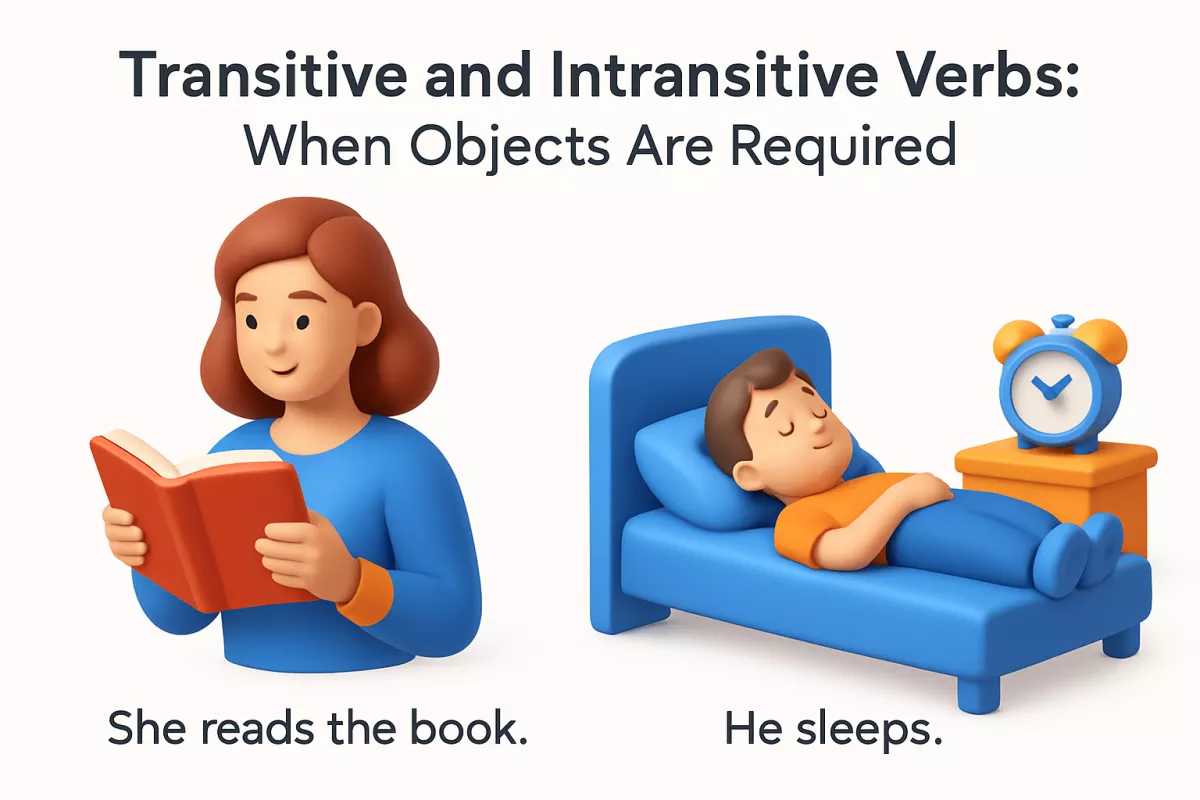
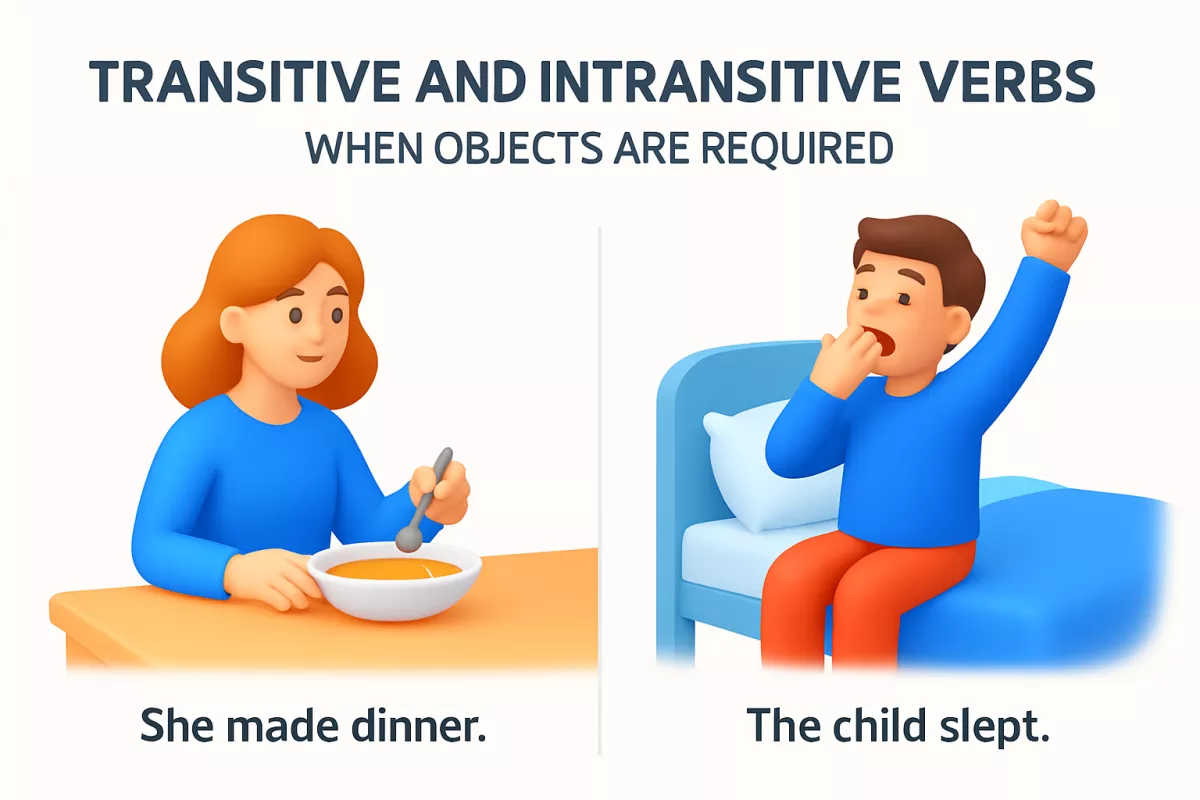
The distinction between transitive and intransitive verbs depends on how the verb connects to the rest of the sentence. A transitive verb must be followed by a direct object to complete its meaning. An intransitive verb does not need an object — the idea is already complete. A simple and reliable test is to ask “what?” or “whom?” immediately after the verb. If the question makes sense, the verb is transitive; if it does not, the verb is intransitive.
Transitive verbs: requiring objects
Transitive verbs describe actions that pass from the subject to something or someone else. If you remove the object, the sentence feels unfinished or unclear. These verbs are very common in everyday English, especially when describing actions that affect people, objects, or results.
- He kicked the ball. (What did he kick? The ball.)
- They built a house. (What did they build? A house.)
- I lost my keys. (What did I lose? My keys.)
- She answered the question. (What did she answer? The question.)
- The chef prepared dinner. (What did the chef prepare? Dinner.)
- We watched a movie. (What did we watch? A movie.)
- He opened the window. (What did he open? The window.)
Intransitive verbs: standing alone
Intransitive verbs do not transfer action to an object. The subject performs the action, but nothing directly receives it. These verbs often describe states, movements, or natural events. Adding a direct object after an intransitive verb usually sounds unnatural or incorrect.
- The baby cried.
- They arrived.
- She smiled.
- He runs every morning.
- The sun rises early in summer.
- The guests laughed loudly.
- Time passed quickly.
Quick comparison
| Transitive Verb | Intransitive Verb |
|---|---|
| Requires a direct object Example: She opened the door. |
Does not require a direct object Example: He sneezed. |
| The action affects something or someone She cleaned the room. |
The action stays with the subject She laughed. |
| You can ask “what?” or “whom?” after the verb He fixed the car. |
You cannot ask “what?” or “whom?” after the verb He slept. |
| Often answers the question “what happened to something?” They found the answer. |
Often describes a state, movement, or event The train arrived. |
It is important to remember that some English verbs can function as both transitive and intransitive, depending on context. For example, eat is transitive in “She eats lunch,” but intransitive in “She eats at noon.” Always focus on whether the verb needs a direct object in that specific sentence — this will guide you to the correct structure.
How to identify the direct object
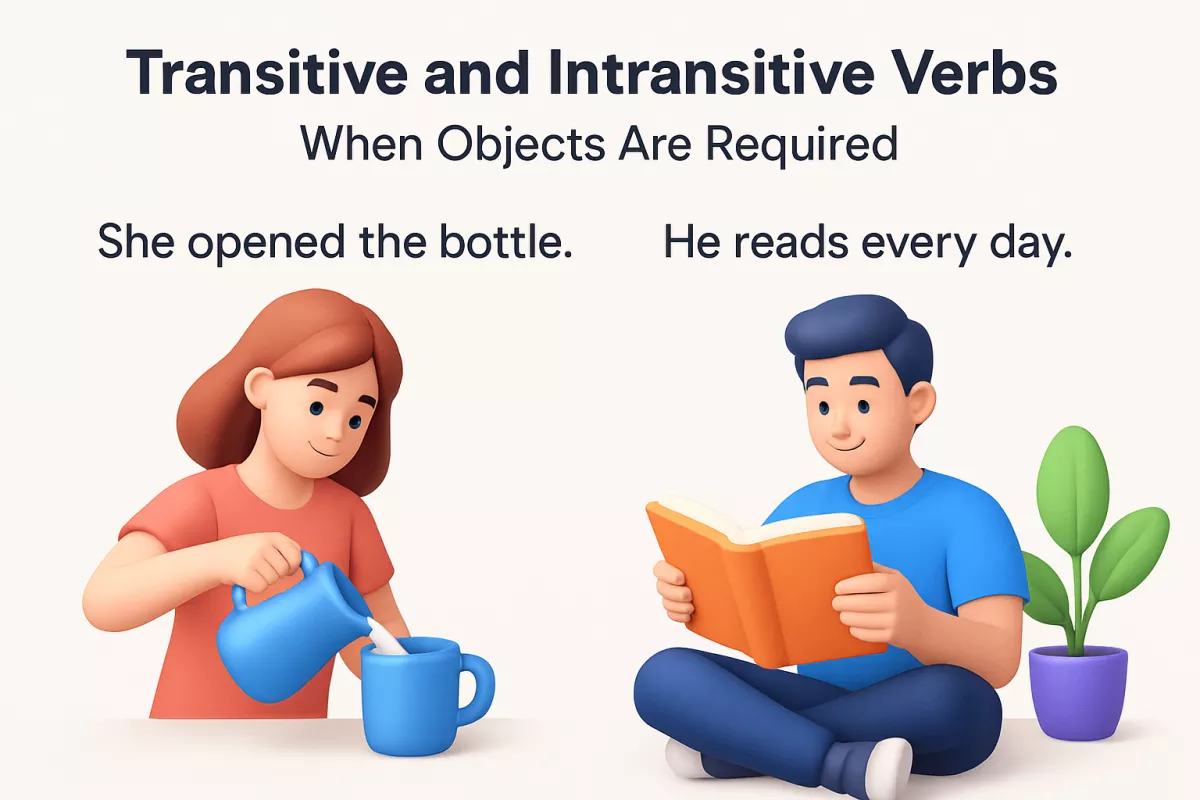
Determining the direct object in a sentence is an essential step for understanding how transitive verbs function. The direct object is the noun, pronoun, or noun phrase that receives the action of the verb directly—it's what or whom the subject acts upon. To spot it, start by finding the verb, then ask "what?" or "whom?" immediately after the verb. The answer is usually your direct object.
Steps to find the direct object
- Locate the verb: Identify the action word in the sentence.
- Ask the right question: After the verb, ask “what?” or “whom?”
- Find the answer: The word or phrase that answers the question is the direct object.
- Check for transitivity: If there’s no answer, the verb is likely intransitive and there’s no direct object present.
Common direct object patterns
Direct objects can take various forms:
- Nouns: She reads books.
- Pronouns: He called her.
- Noun phrases: They built a new bridge.
- Proper nouns: I visited Paris.
- Gerunds: We enjoy cooking.
- Infinitives: She wants to travel.
- Clauses: I know that he left early.
Examples for practice
Try identifying the direct object in these sentences:
- The dog chased the ball. → the ball
- Maria gave her friend a gift. → a gift
- We watched a movie last night. → a movie
- The teacher explained the lesson. → the lesson
- He forgot his keys. → his keys
- She admires her mentor. → her mentor
- They painted the fence. → the fence
- I completed the assignment. → the assignment
- We heard the news. → the news
- He invited me. → me
Comparing direct and indirect objects
Sometimes sentences include both a direct object and an indirect object. The direct object receives the action, while the indirect object tells to whom or for whom the action is done. Here’s a quick comparison:
| Sentence | Direct Object | Indirect Object | Question Test | Alternative Structure |
|---|---|---|---|---|
| She gave him a book. | a book | him | Gave what? — a book Gave to whom? — him |
She gave a book to him. |
| They sent their parents a letter. | a letter | their parents | Sent what? — a letter Sent to whom? — their parents |
They sent a letter to their parents. |
| We bought her flowers. | flowers | her | Bought what? — flowers Bought for whom? — her |
We bought flowers for her. |
| I told the class a story. | a story | the class | Told what? — a story Told to whom? — the class |
I told a story to the class. |
| He showed me his work. | his work | me | Showed what? — his work Showed to whom? — me |
He showed his work to me. |
| She taught us English. | English | us | Taught what? — English Taught to whom? — us |
She taught English to us. |
| The manager offered them a discount. | a discount | them | Offered what? — a discount Offered to whom? — them |
The manager offered a discount to them. |
| I wrote my friend an email. | an email | my friend | Wrote what? — an email Wrote to whom? — my friend |
I wrote an email to my friend. |
Quick tips
- If removing the object makes the sentence incomplete, it’s likely a direct object.
- Not all verbs take direct objects; only transitive verbs do.
- Practice by rewriting sentences and identifying what or whom is affected by the action.
Mastering the identification of direct objects helps clarify sentence structure and ensures correct verb usage, especially when distinguishing between transitive and intransitive verbs.
Common transitive verb patterns
Understanding how transitive verbs connect with their objects can help you construct clearer, more precise sentences. In English, these verbs typically require a direct object to complete their meaning. The object usually answers the question "what?" or "whom?" after the verb. However, there are several patterns and variations worth noting, especially when multiple objects or additional elements are involved.
Basic direct object structure
The simplest form involves a verb directly followed by its object. This object can be a noun, pronoun, or noun phrase. Here are some frequently seen examples:
- She reads books.
- They built a house.
- He loves music.
- We watched the movie.
- I need help.
- The company produced several reports.
- You found your keys.
- The chef prepared dinner.
- She answered the question.
- He broke the glass.
Double object constructions
Some verbs can take two objects: an indirect object (usually a person) and a direct object (usually a thing). This often happens with verbs related to giving, telling, or showing. In these patterns, the recipient usually comes before the thing given.
| Verb Pattern | Example Sentence |
|---|---|
| Verb + Indirect Object + Direct Object | She gave him a gift. |
| Verb + Direct Object + to/for + Indirect Object | She gave a gift to him. |
| Verb + Indirect Object + Direct Object | They taught us mathematics. |
| Verb + Direct Object + to/for + Indirect Object | They taught mathematics to us. |
Verb + object + complement
Certain verbs require not only an object, but also an object complement to complete the meaning. This complement can be a noun, adjective, or phrase that describes or renames the object.
- They elected her president.
- We consider this idea important.
- She painted the wall blue.
- He named his dog Max.
Summary of usage
The way a verb interacts with its object—or objects—can vary widely. Pay attention to whether a verb expects only a direct object, both a direct and indirect object, or an object plus a complement. Mastering these patterns will help you avoid incomplete sentences and express your ideas more accurately.
Common intransitive verb patterns
Understanding intransitive verbs means recognizing the sentence structures where these verbs naturally fit. These verbs do not require an object to complete their meaning, so the pattern often centers around the subject and verb, with optional modifiers to add detail. Below, you'll find typical ways intransitive verbs are used in sentences, along with examples to make things clearer.
Basic intransitive structures
The simplest pattern is just a subject followed by an intransitive verb. Sometimes, an adverb or prepositional phrase adds information, but there’s still no direct object.
- Subject + Verb: The baby cried.
- Subject + Verb + Adverb: She sang beautifully.
- Subject + Verb + Prepositional Phrase: The children played in the park.
Common intransitive verbs and their patterns
Some verbs almost always appear intransitively. Here are frequent examples and how they are naturally used:
- Arrive – He arrived late.
- Disappear – The sun disappeared quickly.
- Sleep – They slept soundly.
- Laugh – She laughed at the joke.
- Happen – What happened?
- Fall – Leaves fall in autumn.
- Die – The flowers died.
- Run – He ran quickly.
- Grow – The plant grew rapidly.
- Swim – We swam in the lake.
- Appear – She appeared calm.
- Arrive – The guests arrived on time.
- Work – He worked all night.
- Rise – The sun rises every morning.
- Wait – Please wait here.
- Sneeze – She sneezed loudly.
- Smile – He smiled shyly.
Comparing intransitive and transitive verb patterns
It’s useful to see how sentence structure changes when a verb is intransitive compared to when a verb is transitive. The table below shows the contrast between these two types:
| Pattern Type | Example |
|---|---|
| Intransitive | The dog slept. |
| Transitive | The dog chased the ball. |
| Intransitive + modifier | She laughed loudly. |
| Transitive + object | She read the book. |
Remember, intransitive verbs don’t take a direct object. Instead, they often stand alone or are followed by phrases that give extra information, such as time, place, or manner. Recognizing these patterns helps you spot intransitive verbs in context and avoid adding unnecessary objects.
Verbs that can be both: change in meaning
Some English verbs operate flexibly, acting as either transitive or intransitive depending on context. The meaning of these verbs often shifts based on whether they take a direct object. Sometimes, the change is subtle; in other cases, the verb’s sense can be quite different. Understanding these patterns helps you use verbs naturally and avoid confusion.
How context affects verb meaning
When a verb is used with an object, it may describe an action done to something or someone. Without an object, the verb might describe a state, a process, or simply an action that doesn’t transfer to anything. Here are some common verbs that change meaning depending on their use:
- Run – She runs every morning (no object, means 'to jog'). She runs a company (with object, means 'to manage').
- Break – The vase broke (no object, the vase shattered by itself). He broke the vase (with object, he caused it to shatter).
- Change – The weather changed (intransitive, it became different). She changed her clothes (transitive, she replaced them).
- Grow – Children grow quickly (intransitive, they become bigger). She grows tomatoes (transitive, she cultivates them).
- Open – The door opened suddenly (intransitive, it became open). He opened the door (transitive, he caused this).
- Boil – The water boiled (intransitive, it reached boiling point). She boiled the eggs (transitive, she cooked them).
- Move – We moved last year (intransitive, changed residence). He moved the table (transitive, changed its position).
- Sink – The ship sank (intransitive, went down in water). They sank the ship (transitive, made it go down).
- Drop – My grades dropped (intransitive, became lower). I dropped the keys (transitive, let them fall).
- Turn – The leaves turned yellow (intransitive, changed color). She turned the page (transitive, moved it).
- Start – The show started on time (intransitive, began itself). He started the car (transitive, caused it to begin).
- Stop – The music stopped (intransitive, ceased by itself). She stopped the car (transitive, caused it to cease).
- Increase – Prices increased (intransitive, rose by themselves). The company increased prices (transitive, made them higher).
- Close – The store closed at 8 (intransitive, ceased operating). They closed the store (transitive, shut it).
- Raise – The sun rose (intransitive, appeared in the sky). She raised her hand (transitive, lifted it).
- Drop – The temperature dropped (intransitive, became lower). He dropped his phone (transitive, let it fall).
Comparing transitive and intransitive uses
Some verbs have a very clear shift in meaning when an object is present. Here’s a side-by-side comparison of a few key verbs:
| Verb | Intransitive Example & Meaning | Transitive Example & Meaning |
|---|---|---|
| Run | He runs every day. (to move quickly, no object) |
She runs a shop. (to manage or operate) |
| Break | The glass broke. (became broken, no agent) |
He broke the glass. (caused to break) |
| Grow | The plant grows. (becomes bigger) |
They grow corn. (cultivate) |
| Open | The window opened. (became open) |
She opened the window. (caused to open) |
| Change | The weather changed. (became different) |
He changed his mind. (made different) |
Tips for learning these verbs
- Notice the presence or absence of a direct object: if there’s nothing receiving the action, the verb is acting intransitively.
- Pay attention to how the meaning shifts—sometimes it’s a matter of who or what is causing the action, other times the entire sense of the verb changes.
- Practice by making your own example sentences, switching between using an object and omitting it.
In short, many English verbs can act as both transitive and intransitive, but their meaning and usage will often shift depending on how they appear in a sentence. Recognizing these patterns can make your writing and speaking clearer and more precise.
Common learner errors with missing objects
Learners often confuse when a verb needs a direct object and when it doesn't, leading to sentences that sound incomplete or unclear. This mix-up typically comes from not recognizing whether a verb is transitive (needs an object) or intransitive (does not). The result can be sentences where the meaning is ambiguous or the grammatical structure is incorrect.
Typical patterns of omission
Some frequent mistakes involve dropping the object after verbs that require one. For example, saying "She brought" instead of "She brought her bag," or "I explained" when "I explained the rules" is needed. These errors can make communication less precise and sometimes confusing for listeners.
- Using transitive verbs without an object: "He built →" (should be "He built a house.")
- Assuming all verbs are intransitive: "They enjoy" (should be "They enjoy music.")
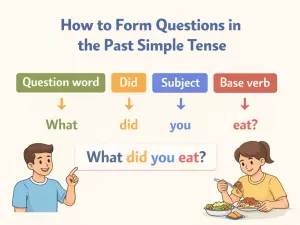
- Forgetting to add an object after certain verbs in questions: "What did you eat?" vs. "Did you eat?"
- Omitting objects with phrasal verbs: "She put on" (should be "She put on her jacket.")
- Leaving out objects in passive constructions: "The cake was eaten." (acceptable) vs. "Was eaten." (not clear who/what)
- Translating directly from a native language where objects are optional
- Using verbs like "find," "want," or "make" without specifying what is being found, wanted, or made
- Writing or saying "He needs" instead of "He needs help"
- Misusing verbs that can be both transitive and intransitive by omitting necessary objects in the transitive form
- Relying on context too heavily and skipping the object: "I fixed" when "I fixed the car" is expected
- Forgetting that some verbs change meaning depending on whether they take an object: "Run" (no object: to move quickly) vs. "Run a business" (object needed)
- Using "ask" without a direct object: "She asked" instead of "She asked a question"
- Leaving out objects with reporting verbs: "He told" vs. "He told the story"
Examples of confusing sentences
Below is a comparison of incorrect sentences missing necessary objects and their corrected forms. Notice how adding the object clarifies the meaning.
| Incorrect (Object Missing) | Correct (Object Included) |
|---|---|
| I finished. | I finished my homework. |
| She likes. | She likes chocolate. |
| We watched. | We watched the movie. |
| He answered. | He answered the question. |
| They lost. | They lost the keys. |
| She sent. | She sent an email. |
| You forgot. | You forgot your umbrella. |
| We read. | We read the article. |
Being aware of which verbs require an object and practicing with varied examples can help learners avoid these common pitfalls. Regular feedback and conscious review of sentence structure are effective ways to reduce these mistakes and improve clarity in writing and speaking.
How dictionaries label verb patterns
When you look up a verb in a dictionary, you’ll often notice shorthand labels or abbreviations right after the headword. These notations help readers quickly understand whether a verb needs an object (transitive), does not take an object (intransitive), or can function both ways. Dictionaries use a variety of symbols, abbreviations, and formatting conventions to make these distinctions clear.
Common abbreviations and symbols
Most dictionaries rely on a set of standard abbreviations to indicate verb patterns. Here are some you’ll frequently encounter:
- vt — verb transitive (requires an object)
- vi — verb intransitive (does not take an object)
- v — verb (pattern unspecified or can be both)
- [T] — transitive (sometimes in square brackets)
- [I] — intransitive
- vtr — transitive verb (used in some dictionaries)
- v.i. — verb intransitive (alternative style, especially in older works)
- v.t. — verb transitive
- vtr/vintr — sometimes both are listed if a verb can be used both ways
- v + obj — verb plus object (explicitly showing the requirement)
- v + prep — verb plus preposition (for phrasal verbs or prepositional patterns)
Label placement and formatting
These codes are usually placed immediately after the verb entry, before the definition. Some dictionaries use bold, italics, or brackets to make them stand out. In digital formats, you might also see hover-over explanations or links to grammar guides.
Comparing major dictionary conventions
Different publishers may have their own preferred styles. Here’s a comparison of how leading dictionaries typically present verb patterns:
| Dictionary | Transitive/Intransitive Label | Example Entry |
|---|---|---|
| Oxford Learner’s | [T], [I] | run [I] |
| Cambridge | [T], [I] | enjoy [T] |
| Collins COBUILD | transitive, intransitive | break transitive verb |
| Merriam-Webster | vt, vi | swim vi |
| Macmillan | [T], [I] | open [T] |
| Longman | [T], [I] | arrive [I] |
Why these patterns matter
Understanding these labels helps users know whether a verb must be followed by an object or not. For example, “eat” is listed as both transitive and intransitive, so you can say “She eats breakfast” (transitive) or “She eats quickly” (intransitive). In contrast, “give” is always transitive because it requires an object (“She gave a gift”).
Tips for interpreting dictionary codes
- If you see only [T] or vt, the verb always needs an object.
- If you see only [I] or vi, the verb cannot take an object.
- If both are listed, the verb is versatile and can be used either way depending on context.
- Some entries include example sentences showing both patterns for clarity.
- Phrasal verbs may use more complex labels, such as “v + prep + obj”.
In sum, these concise labels are a quick reference for learners and writers, helping avoid common mistakes with verb usage in English.
Homework: transitive vs intransitive practice
Ready to test your understanding of verbs that need objects versus those that don’t? The following exercises will help you spot the difference and use each type correctly in a sentence. Review the tasks below and try to complete them before checking the answers.
Task 1: Identify the verb type
For each sentence, decide if the main verb is transitive (T) or intransitive (I). Write T or I after each sentence.
- She baked a cake.
- The baby sleeps peacefully.
- We discussed the proposal.
- The sun rises in the east.
- He broke the window.
- The dog barked loudly.
- They built a sandcastle.
- The leaves fell from the tree.
- She forgot her keys.
- The crowd cheered.
Show answers
- 1. T
- 2. I
- 3. T
- 4. I
- 5. T
- 6. I
- 7. T
- 8. I
- 9. T
- 10. I
Task 2: Make your own sentences
Write one original sentence with a transitive verb and one with an intransitive verb. Underline or highlight the verb in each case.
Show answers
- Transitive example: She reads books every night.
- Intransitive example: The children laughed loudly.
Task 3: Spot the direct object
For each sentence below, underline the direct object if there is one. If there isn’t, write “none.”
- Tom answered the question.
- The bird sang.
- Maria opened the window.
- The baby cried.
- We watched a movie.
- She closed the door.
- The dog barked loudly.
- They built a house.
- The train arrived late.
- He wrote a letter.
Show answers
- the question
- none
- the window
- none
- a movie
- the door
- none
- a house
- none
- a letter
Common verbs: quick reference
Some verbs can only be transitive, some only intransitive, and some can be both. Here’s a handy chart to help you remember the difference:
| Transitive Only | Intransitive Only | Both (depends on use) |
|---|---|---|
| bring | arrive | run |
| borrow | sleep | change |
| enjoy | die | open |
| need | exist | start |
| send | disappear | move |
| build | wait | break |
| eat | happen | grow |
| find | go | stop |
| lose | arrive | close |
| fix | fall | play |
Practice identifying and using these verbs in different situations to strengthen your command of both types. If you’re unsure, try asking yourself whether the verb needs a direct object to make sense.