Verb Complements: Objects, Predicates, and Clauses

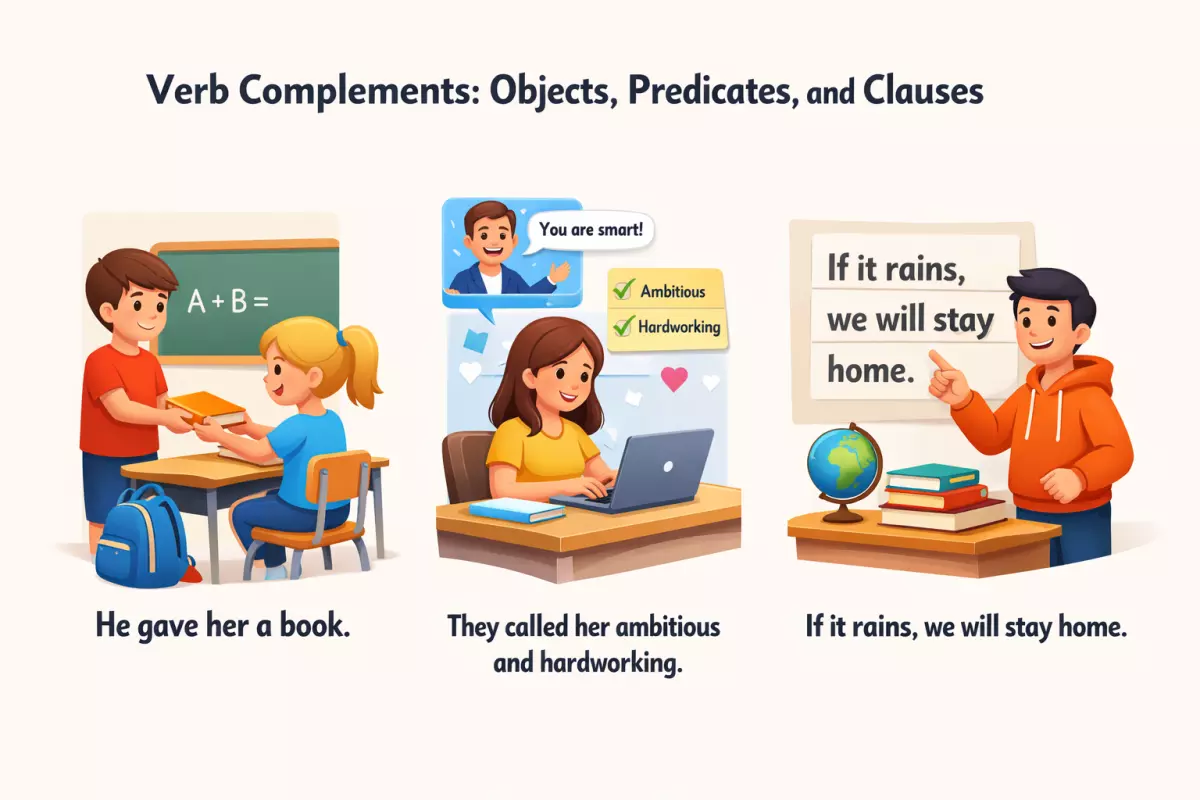 Covers what verb complements are, including direct and indirect objects, subject complements after linking verbs, and object complements in result structures. Also explains verb + that-clause and verb + wh-clause complements, common learner mistakes, and homework practice tasks.
In everyday English, verbs rarely stand alone; they often need extra words to complete the meaning, such as an object, a complement, or a full clause. These additions show who receives the action, what someone becomes, or what is being said or thought. When you learn to spot them, tricky sentences make more sense, and your speaking and writing become clearer and more precise.
What a verb complement is
A verb often needs extra information to complete its meaning. That extra information is the complement: a word, phrase, or clause that a verb requires (or strongly expects) to make a complete, grammatical idea. Without it, the sentence can sound unfinished, vague, or simply incorrect.
Complements are different from optional add-ons like many adverbs or prepositional phrases. An optional element can usually be removed without breaking the core grammar, while a required element is part of the verb’s pattern.
How to spot a required complement
- Remove the suspected complement and check whether the sentence still feels complete.
- ✅ She put the keys on the table. → She put the keys. (unfinished: where?)
- ✅ They depend on their coach. → They depend. (unfinished: on what/whom?)
- Ask what the verb “needs”: an object, a description, or an entire clause.
- Object needed: “eat something,” “build something.”
- Description needed: “be ready,” “seem tired.”
- Clause needed: “decide to leave,” “insist that we stay.”
- Notice fixed verb patterns that commonly take a specific form (to-infinitive, -ing form, that-clause, preposition + noun, etc.).
Common complement types (with patterns)
- Direct object (noun phrase): verb + NP
- She opened the window.
- We need more time.
- He answered the question.
- Indirect object + direct object: verb + NP + NP
- They gave her a map.
- I sent my friend a message.
- She taught the class a new method.
- Object complement (renames/describes the object): verb + object + complement
- They elected him president.
- The news made her angry.
- We consider the plan risky.
- Subject complement (follows a linking verb): linking verb + complement
- She is a pilot.
- The soup smells good.
- He became confident.
- Prepositional complement (verb + required preposition + noun/gerund): verb + prep + NP/-ing
- We belong to the same team.
- She apologized for being late.
- They rely on public transport.
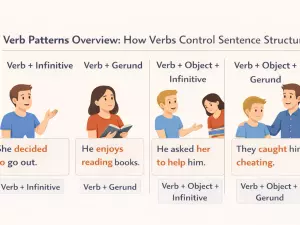
- To-infinitive clause: verb + to + base verb
- He decided to leave early.
- We hope to finish today.
- She refused to answer.
- -ing clause: verb + verb-ing
- They enjoy hiking.
- He avoided talking about it.
- She kept asking questions.
- That-clause: verb + that + clause (that often optional in speech)
- I think (that) it’s too late.
- She insisted (that) we stay.
- We realized (that) the door was locked.
- Wh-clause: verb + wh-word + clause
- Tell me what you saw.
- They explained why they left.
- We discussed how to proceed.
Complement vs. optional information
- Complements complete the verb’s pattern: “put” typically needs an object and a place; “depend” typically needs “on + noun/gerund.”
- Adjuncts add extra detail (time, manner, place) but are usually removable: “She opened the window quickly,” “We met after lunch.”
- Some elements are borderline: with certain verbs, a phrase may be optional in one meaning but required in another. Compare “He ate (already)” vs. “He ate three sandwiches” (more informative, but not always required).
Direct objects and indirect objects

Many verbs can take one noun phrase after the verb, and some can take two. The first pattern typically answers “what?” or “who?” after the verb, while the two-complement pattern often adds a recipient or beneficiary (“to/for whom?”) alongside the thing given, sent, offered, or taught.
How to identify each complement
- Direct object: the person or thing affected by the action; it answers “what?” or “whom?” after the verb. Example: “She opened the window.”
- Indirect object: the recipient/beneficiary; it answers “to whom?” “for whom?” “to what?” in a giving/communicating sense. Example: “She gave him a key.”
- Quick test: if you can add “to” or “for” before the recipient without changing the core meaning, that recipient is functioning as the indirect object. “She gave him a key” → “She gave a key to him.”
- Be careful with questions: “She asked him a question.” The thing asked is the direct object (“a question”); the person addressed is the indirect object (“him”).
Common word-order patterns
- Double-object pattern: Verb + Indirect Object + Direct Object
- “They sent me an email.”
- “The teacher taught us grammar.”
- “I bought her a notebook.”
- Prepositional pattern: Verb + Direct Object + to/for + recipient
- “They sent an email to me.”
- “The teacher taught grammar to us.”
- “I bought a notebook for her.”
- When the recipient is long or emphasized, the prepositional pattern is often smoother: “She explained the new policy to the staff members who joined last week.”
- When the direct object is a pronoun, the prepositional pattern is usually preferred: ✅ “Give it to me.” ❌ “Give me it.”
Verbs that commonly allow two objects
- Giving/transfer: give, send, offer, hand, pass, lend, loan, pay, sell, bring, deliver
- Communication: tell, show, teach, ask, read, write, email, text, promise
- Service/benefit: buy, make, cook, get, find, build, book, order
- Not every verb that involves a recipient allows the double-object pattern in standard usage. For example, “explain” typically needs a preposition: ✅ “Explain the rule to me.” ❌ “Explain me the rule.”
Pronouns, passives, and what becomes the subject
- In passive voice, either object can sometimes become the subject, depending on the verb and style:
- “They gave Maria a prize.” → “Maria was given a prize.”
- “They gave Maria a prize.” → “A prize was given to Maria.”
- With pronouns, keep case correct: “She gave him the keys,” not “She gave he the keys.”
- If both complements are pronouns, the “to/for” version is usually clearest: “Send it to her,” “Show them to us.”
Frequent learner issues to watch
- Choosing the wrong pattern for a verb: “describe,” “explain,” “suggest,” and “mention” generally require “to” + recipient rather than an indirect object without a preposition.
- Misidentifying the roles: in “She gave him a call,” “a call” is the direct object (the thing given), and “him” is the indirect object (the recipient).
- Overusing the double-object structure when the direct object is heavy: long direct objects often sound better before “to/for.”
- For “for” vs. “to”: use “to” for transfer/recipient (“send the file to Alex”), and “for” for benefit/service (“cook dinner for Alex”).
Subject complements after linking verbs
A linking verb connects the subject to information that identifies it or describes its state. The complement that follows does not receive the action (as an object would); instead, it completes the meaning of the subject by renaming it or giving it a quality.
What can function as a subject complement?
The most common patterns are a noun phrase (to identify) and an adjective phrase (to describe). Other structures also appear, especially in more formal or information-heavy sentences.
- Noun phrase (identity/class): “Maya is a pilot.” / “That building became a museum.”
- Adjective phrase (state/quality): “The soup smells delicious.” / “He seems tired.”
- Prepositional phrase (location/condition, common with be): “The keys are on the table.”
- Clause (often after be): “The problem is that we’re late.”
- Infinitive clause (definition/purpose): “Her goal is to finish early.”
- Gerund clause (activity as an identity): “His hobby is collecting stamps.”
- Adverb (fixed uses, especially with be): “The manager is in.” / “The lights are off.”
Common linking verbs and the patterns they prefer
Some verbs regularly take adjective complements (especially those about senses and appearance), while others often take noun phrases that rename the subject. Many can take either, depending on meaning.
- Be + noun/adjective/PP/clause: “She is a doctor.” / “She is calm.” / “She is at home.” / “The truth is that he knew.”
- Become / get / grow / turn + adjective or noun phrase: “It became clear.” / “He got angry.” / “She grew confident.” / “The caterpillar turned a butterfly.”
- Seem / appear + adjective (or to-infinitive): “They seem ready.” / “He appears to understand.”
- Look / sound / smell / taste / feel + adjective: “It sounds strange.” / “The cake tastes sweet.”
- Remain / stay / keep + adjective: “The door remained shut.” / “Please stay quiet.”
- Prove + adjective or noun phrase (often formal): “The method proved effective.” / “His claim proved a mistake.”
Usage checks: complement vs. object
A quick test is whether the word after the verb describes the subject (complement) or receives an action (object). Linking verbs do not take direct objects in these uses.
- ✅ “The idea sounds good.” (good describes the idea)
- ❌ “The idea sounds the plan.” (not an object pattern)
- ✅ “She became a leader.” (renames the subject)
- ✅ “She became confident.” (describes the subject)
- ✅ “They felt nervous.” (state of the subject)
- ❌ “They felt the nervous.” (noun doesn’t fit; would need an object verb like “felt the fabric”)
Case and agreement in subject complements
In careful or formal style, a pronoun complement after be can appear in the subject form, though everyday usage often prefers the object form.
- More formal: “It is I.” / “The winner was she.”
- More common in conversation: “It’s me.” / “The winner was her.”
Frequent patterns to practice
- be + adjective: “The room is quiet.”
- be + noun phrase: “His sister is an engineer.”
- be + prepositional phrase: “Our seats are near the front.”
- be + that-clause: “My worry is that we’ll miss the train.”
- be + to-infinitive: “The next step is to call support.”
- seem + adjective: “The explanation seems reasonable.”
- appear + to-infinitive: “She appears to agree.”
- become + adjective: “The sky became darker.”
- turn + adjective: “The leaves turned red.”
- remain + adjective: “The details remain unclear.”
- sense verb + adjective: “The coffee smells burnt.”
- feel + adjective: “I feel ready.”
Object complements and result structures
Some verbs take an object and then add a second element that says what the object becomes, how it is judged, or what state it ends up in. This extra element is not a separate object; it completes the meaning by describing the object’s identity, quality, or resulting condition.
What an object complement does
In patterns like V + object + complement, the complement refers back to the object (not the subject). It can name the object, describe it, or show a change caused by the verb.
- Object + noun phrase: identifies/renames the object (They elected her president.)
- Object + adjective phrase: describes the object (The news made him anxious.)
- Object + prepositional phrase: places the object in a resulting location/state (They put the books on the shelf.)
- Object + past participle: presents the object as affected/finished (We got the car fixed.)
- Object + bare infinitive: common after perception/causation (I saw her leave.)
- Object + -ing form: highlights an ongoing action (I heard them singing.)
Common verb patterns (with examples)
- make + object + adjective: The joke made the room quiet.
- make + object + noun: They made him team leader.
- consider + object + adjective: I consider her reliable.
- find + object + adjective: We found the lecture confusing.
- call + object + noun: Everyone calls the puppy Rocket.
- name + object + noun: They named the child Ava.
- elect + object + noun: The committee elected her chair.
- appoint + object + noun: They appointed him director.
- declare + object + adjective/noun: The judge declared the contract void.
- paint + object + adjective: She painted the door red.
- drive + object + adjective: The delays drove me crazy.
- keep + object + adjective: Keep the door closed.
- leave + object + adjective: Don’t leave the window open.
- get + object + past participle: I got my phone repaired.
- put + object + PP: Put your bag under the seat.
- send + object + PP: Send the files to my office.
Result phrases vs. simple description
A key usage difference is whether the second element describes an existing property or a new state caused by the verb. With many verbs, the complement implies a change (a “result”), not just a comment.
- ✅ She wiped the table clean. → the action caused the table to become clean (result).
- ✅ She wiped the clean table. → “clean” is just a modifier inside the noun phrase (description).
- ✅ They hammered the metal flat. → the metal ended up flat.
- ✅ We pushed the door open. → the door ended up open.
- ✅ The noise kept the baby awake. → the baby remained awake as a result.
Form choices that affect meaning
- Bare infinitive vs. -ing after perception verbs: ✅ I saw him cross the street (complete event) vs. ✅ I saw him crossing the street (in progress).
- Adjective vs. past participle: ✅ Keep the door closed (state) vs. ✅ Keep the door clean (quality).
- “Get” + past participle often implies arranging or achieving a result: ✅ She got the report finished (completed).
- “Make” + noun focuses on role/status: ✅ They made her captain (new position).
Frequent learner issues
- Using an adverb where an adjective is needed: ✅ The news made him angry. ❌ The news made him angrily.
- Adding “to be” unnecessarily: ✅ They elected her president. ❌ They elected her to be president. (Possible in some contexts, but often heavier and less natural.)
- Confusing object complements with extra objects: In “They called him a genius,” “a genius” describes “him”; it is not a second thing being called.
- Choosing a verb that doesn’t license this pattern: Some verbs need a clause instead (e.g., “say” typically takes a clause: “They said he was…” rather than “They said him…”).
Verb + that-clause complements
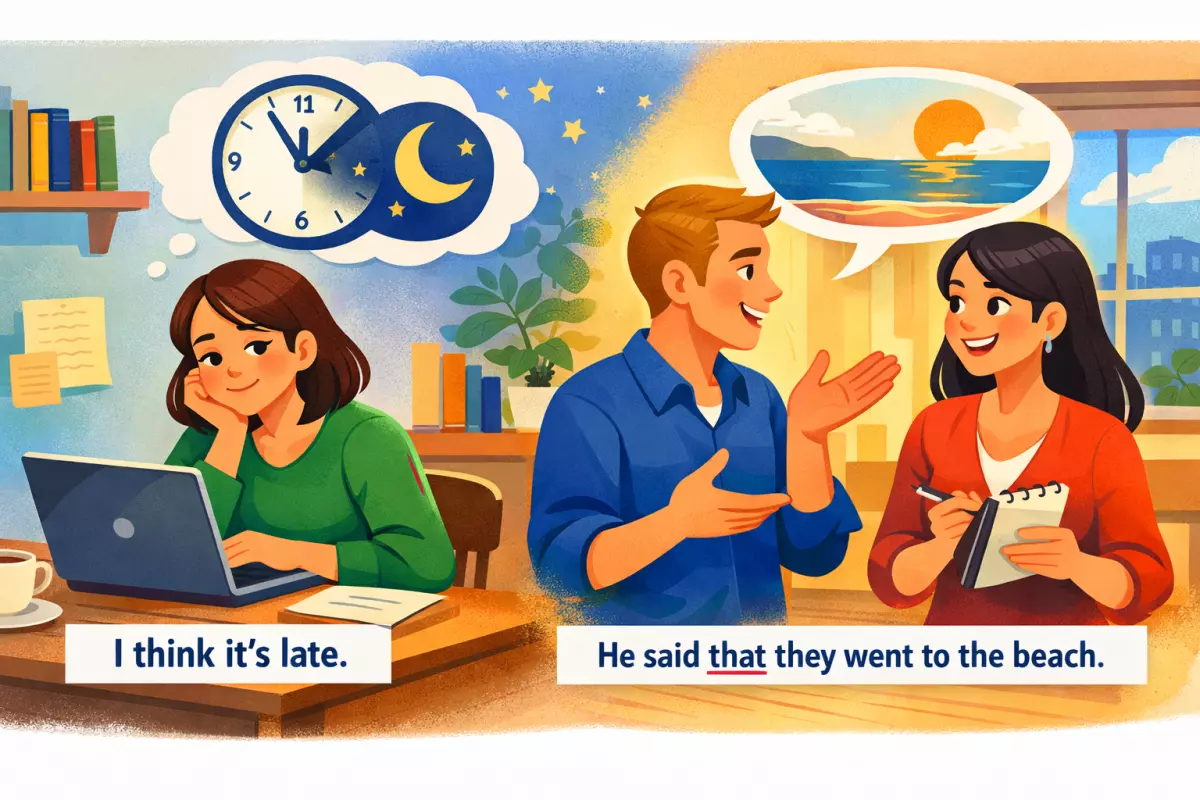
Many reporting, thinking, and feeling verbs can be followed by a full clause introduced by that. This structure lets you state a complete proposition (a “mini-sentence”) as the verb’s complement: the verb names the attitude or speech act, and the clause supplies the content.
Core pattern and punctuation
- Pattern: Subject + verb + (optional object) + (that) + clause.
- That is often optional in informal style: “I think (that) it’s late.” It is more common in careful writing and when clarity matters.
- Comma use: Generally no comma before the clause: “She said that she was ready.” (A comma may appear with parenthetical interruptions, but it is not the default.)
- Clause word order: Use statement order, not question order: ✅ “I wonder if it’s true.” ❌ “I wonder if is it true.”
Common verb groups that take a that-clause
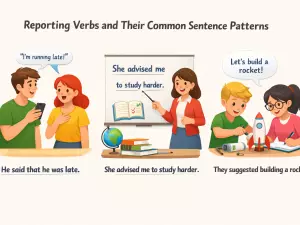
- Reporting verbs: say, tell (someone), admit, confess, announce, explain, reply, promise, insist, claim, report, mention.
- Belief/thought verbs: think, believe, assume, suppose, expect, suspect, guess, imagine, hope, doubt.
- Perception/realization verbs: notice, realize, discover, remember, forget, learn, understand.
- Emotion/attitude verbs: regret, fear, agree, decide, be glad, be surprised, be disappointed (these often appear as adjective + that-clause too).
When to keep or drop “that”
- Keep it to avoid ambiguity when the next word could be misread as an object: “She said that Monday was impossible.”
- Keep it after longer subjects or insertions to help the reader: “The manager, after reviewing the numbers, confirmed that the plan was viable.”
- Drop it in short, spoken-style sentences when the meaning stays clear: “I think you’re right.”
- Keep it in formal or academic writing where consistent clause marking improves readability.
Verb + object + that-clause (two complements)
Some verbs commonly take an indirect object (the person addressed) plus a content clause. The object is not the “topic” of the clause; it is the recipient of the message.
- ✅ “She told me that the meeting was cancelled.”
- ✅ “They assured us that everything was under control.”
- ✅ “He reminded her that the deadline was Friday.”
- ❌ “She explained me that…” → Use “explained to me that…” or “explained that…”
- ❌ “He suggested me that…” → Use “suggested that…” or “suggested to me that…” (less common).
Tense and meaning in the clause
- No automatic tense backshift: With present reporting, the clause tense matches the time: “I think that she is at work.”
- Backshift is common after past reporting: “She said that she was at work.” (especially when the time reference is still past or unspecified).
- Backshift is not required when the statement is still true or timeless: “The teacher said that water boils at 100°C.”
- Future meaning: “He promised that he would call.” / “He promised that he will call.” (the second can sound more immediate or still expected).
Expanded example set (usable patterns)
- “I believe (that) the results are reliable.”
- “We assume (that) everyone has finished.”
- “She suspects (that) the email is fake.”
- “He admitted that he made a mistake.”
- “They insisted that the door was locked.”
- “The guide explained that the trail was closed.”
- “I noticed that the lights were still on.”
- “She realized that she had the wrong address.”
- “Do you remember that we met before?”
- “I forgot that you don’t eat dairy.”
- “They confirmed that the payment went through.”
- “He warned us that the road gets icy at night.”
- “She reassured him that it wasn’t his fault.”
- “I hope that the weather improves.”
- “I doubt that this approach will work.”
- “We agreed that the proposal needed changes.”
As a complement type, the that-clause is especially useful when the verb’s meaning is incomplete without the content being reported, believed, or discovered. If the clause can be omitted without changing the core meaning, you may be dealing with a different structure (for example, a prepositional phrase or an adjunct) rather than a required complement.
Verb + wh-clause complements
Many verbs can take an embedded question as their complement. This complement is a full clause introduced by a wh-word (who, what, where, when, why, how, which, whose) and it functions like the verb’s object: it completes the verb’s meaning by supplying the information being asked about, discovered, explained, or decided.
Common patterns
- Verb + wh-clause: She explained why the meeting was cancelled.
- Verb + object + wh-clause: They told us where we should wait.
- Verb + wh-word + to-infinitive (when the subject is understood): He didn’t know what to say.
- Verb + wh-clause with statement word order (no inversion): ✅ I remember where she lives. ❌ I remember where does she live.
Verbs that commonly take embedded questions
- know: I don’t know what he wants.
- remember: Do you remember where we parked?
- forget: I forgot how I met her.
- understand: She understands why they’re upset.
- realize: He realized what had happened.
- discover: We discovered where the leak was coming from.
- find out: I’ll find out when the results are released.
- learn: They learned how the system works.
- decide: She decided which option was safest.
- choose: Pick which seat you want.
- figure out: Can you figure out why it keeps crashing?
- ask: He asked where I’d been.
- wonder: I wonder who left this here.
- explain: Please explain how you got that answer.
- show: Show me how you did it.
- tell: Tell us what you saw.
- check: I’ll check whether the door is locked.
- confirm: They confirmed when the flight would depart.
Word order and punctuation: embedded vs. direct questions
- Embedded questions use statement word order: ✅ I asked where she was. ❌ I asked where was she.
- They usually do not take a question mark unless the whole sentence is a question: ✅ I wonder what time it is. ✅ Do you know what time it is?
- Auxiliary do is not used in embedded questions: ✅ I don’t know what he said. ❌ I don’t know what did he say.
Wh-word + to-infinitive (reduced clause)
When the meaning is general or the subject is understood (often the same as the main clause subject), English often uses a wh-word followed by a to-infinitive. This is common after verbs of knowing, deciding, and learning.
- know: I don’t know what to do.
- learn: She learned how to pronounce the name.
- decide: We need to decide where to meet.
- remember: He couldn’t remember when to take the medication.
- show: Show me how to open the panel.
- choose: Choose which one to buy.
Whether/if as wh-type complements
Yes/no embedded questions are often introduced by whether or if. Many verbs accept both, but whether is preferred in more formal contexts and is common when alternatives are mentioned.
- ✅ I’m not sure whether it will rain.
- ✅ I’m not sure if it will rain.
- ✅ She asked whether we wanted tea or coffee.
Common learner mistakes with complements
Many errors come from mixing up which verbs take an object, which need a subject complement, and which patterns require a clause or a non-finite form (to-infinitive or -ing). Paying attention to the verb’s pattern helps you choose the right structure and avoid sentences that sound incomplete or ungrammatical.
Frequent pattern problems (with corrections)
- Using an object after a linking verb: Linking verbs (be, seem, become, feel, look, sound, remain) typically take a subject complement, not a direct object. ❌ “She became a doctor her.” ✅ “She became a doctor.”
- Forgetting the complement after a verb that requires one: Some verbs sound unfinished without a complement. ❌ “They considered.” ✅ “They considered the plan risky.” / “They considered changing the plan.”
- Confusing direct objects with object complements: In “They elected her president,” “president” describes “her” (object complement), not a second object. Learners sometimes add extra words: ❌ “They elected her as president” (often possible, but changes style and not always preferred).
- Using an adjective where an adverb is needed (or the reverse): After linking verbs, adjectives are typical. ✅ “He feels tired.” After action verbs, adverbs often fit. ✅ “He spoke clearly.”
- Mixing up “make/let/have” patterns: These causative verbs commonly use a bare infinitive. ❌ “She made me to apologize.” ✅ “She made me apologize.”
- Overusing “to” after perception verbs: With see/hear/feel/watch/notice, the bare infinitive or -ing is common. ❌ “I saw him to cross the street.” ✅ “I saw him cross the street.” / “I saw him crossing the street.”
- Choosing the wrong non-finite form (-ing vs to-infinitive): Some verbs strongly prefer one form. ❌ “I suggested to go.” ✅ “I suggested going.” ✅ “I suggested that we go.”
- Using an infinitive after “enjoy/avoid/finish”: These typically take -ing. ❌ “She enjoys to read.” ✅ “She enjoys reading.”
- Using -ing after “decide/hope/plan”: These typically take a to-infinitive. ❌ “We decided going.” ✅ “We decided to go.”
- Misplacing the “it” placeholder: With long clause complements, English often uses preparatory “it.” ❌ “To solve it quickly is difficult for me.” ✅ “It is difficult for me to solve it quickly.”
- Using “that” clauses where an object complement is needed: Some meanings require “object + complement” rather than a clause. ❌ “They named that he was captain.” ✅ “They named him captain.”
- Incorrect “want/need/expect” patterns: These commonly use “object + to-infinitive.” ❌ “I want that you come.” ✅ “I want you to come.” (Also possible: “I want you here.”)
- Confusing “say/tell” complements: “Tell” normally takes an object; “say” usually does not. ❌ “She said me that…” ✅ “She told me that…” / “She said that…”
- Adding a preposition where none is used: Some verbs take a direct object, not “to/for.” ❌ “She discussed about the problem.” ✅ “She discussed the problem.”
- Double-complement confusion with “explain/suggest/describe”: These do not take an indirect object the same way “tell” does. ❌ “He explained me the rules.” ✅ “He explained the rules to me.”
- Using object pronouns after “be” in formal writing: In careful style, subject pronouns are preferred after “be.” Informal: “It’s me.” More formal: “It is I.” (Most learners should recognize both, and choose based on context.)
Clause complement traps
- Omitting “that” when it creates ambiguity: “She said the manager resigned” can be unclear in fast reading; “She said that the manager resigned” is often clearer.
- Using question word order in an embedded clause: Embedded questions use statement order. ❌ “I don’t know where is he.” ✅ “I don’t know where he is.”
- Using “if” and “whether” incorrectly: “Whether” fits better with alternatives or after prepositions. ✅ “We discussed whether to postpone.” ✅ “It depends on whether it rains.”
- Mixing tense/backshift in reported complements: After a past reporting verb, many varieties use backshift. ✅ “She said (that) she was tired.” (But backshift is not always required if the meaning is still true.)
Quick checks before you write
- Ask: does the verb need a direct object, a subject complement, or a clause/non-finite complement?
- If you have “object + noun/adjective,” check whether the second element describes the object (object complement): “painted the door red,” “found the task easy.”
- If the complement is long, consider preparatory “it” to keep the sentence balanced.
- When choosing -ing vs to-infinitive, confirm the verb’s usual pattern (and remember that some verbs allow both with a meaning change, such as “remember/stop/try”).
Homework: verb complement practice tasks
Use these tasks to build control over common complement patterns: direct objects, indirect objects, subject complements (predicate nouns/adjectives), object complements, and clause complements (that-clauses, wh-clauses, to-infinitives, -ing clauses). Focus on what the verb requires and whether the complement describes the subject, the object, or the whole proposition.
1) Identify the complement type
For each sentence, name the complement after the verb (or after the object if there is an object complement). Use labels such as: DO (direct object), IO (indirect object), SC (subject complement), OC (object complement), that-clause, wh-clause, to-infinitive, -ing clause.
- Rina became a surgeon.
- The soup smells strange.
- The committee elected Maya chair.
- I sent the client an updated invoice.
- They consider the plan risky.
- We hope that the weather improves.
- He explained why the figures changed.
- She promised to call before noon.
- We enjoy working in small teams.
- The manager put the files on the shelf.
- I found the lecture fascinating.
- It seems that the key is missing.
Show answers
- SC (predicate noun: “a surgeon”)
- SC (predicate adjective: “strange”)
- DO + OC (“Maya” = DO; “chair” = OC)
- IO + DO (“the client” = IO; “an updated invoice” = DO)
- DO + OC (“the plan” = DO; “risky” = OC)
- that-clause
- wh-clause
- to-infinitive
- -ing clause
- DO + adverbial/PP complement of place (“the files” = DO; “on the shelf” completes “put”)
- DO + OC
- that-clause (with dummy “it”)
2) Choose the correct complement form
Select the best option (A or B). Use meaning and verb pattern, not just what “sounds right.”
- She suggested (A) to leave early (B) leaving early.
- They agreed (A) to postpone the meeting (B) postponing the meeting.
- I avoided (A) to mention the mistake (B) mentioning the mistake.
- We decided (A) to take the train (B) taking the train.
- He admitted (A) to break the rule (B) breaking the rule.
- Can you remind me (A) to email her (B) emailing her?
- The teacher encouraged us (A) to ask questions (B) asking questions.
- I look forward to (A) meet you (B) meeting you.
- She offered (A) to help (B) helping.
- They denied (A) to know him (B) knowing him.
Show answers
- B
- A
- B
- A
- B
- A
- A
- B
- A
- B
3) Rewrite to match a target complement pattern
Rewrite each sentence so it uses the pattern in parentheses. Keep the meaning as close as possible.
- They said, “The test is unfair.” (rewrite with a that-clause)
- “Where did she park?” I asked. (rewrite with a wh-clause complement)
- Sam is confident. (rewrite with a subject complement after a linking verb)
- I gave a tip to the driver. (rewrite with IO + DO)
- We think the rule is unnecessary. (rewrite with DO + OC)
- The news made her feel anxious. (rewrite with “made” + DO + adjective OC)
- He intends to study abroad. (rewrite with a noun phrase direct object)
- It is likely that prices will rise. (rewrite without dummy “it”)
Show answers
- They said that the test was unfair.
- I asked where she had parked.
- Sam seems confident. / Sam feels confident.
- I gave the driver a tip.
- We consider the rule unnecessary.
- The news made her anxious.
- He intends a period of study abroad. / He intends overseas study. (any clear NP object is acceptable)
- Prices are likely to rise.
4) Error correction: fix the complement
Each sentence contains a complement error (wrong form, missing element, or wrong pattern). Rewrite each one correctly.
- ❌ She explained me the procedure.
- ❌ I suggested him to apply.
- ❌ They made him to apologize.
- ❌ The film was seemed boring.
- ❌ I look forward to meet your team.
- ❌ We discussed about the budget.
- ❌ The boss told that we should leave.
- ❌ She let me to borrow her notes.
- ❌ He insisted me to stay.
- ❌ The report described the results to be significant.
Show answers
- ✅ She explained the procedure to me. / She explained the procedure.
- ✅ I suggested that he apply. / I suggested he apply. / I suggested applying.
- ✅ They made him apologize.
- ✅ The film seemed boring.
- ✅ I look forward to meeting your team.
- ✅ We discussed the budget.
- ✅ The boss told us that we should leave. / The boss said that we should leave.
- ✅ She let me borrow her notes.
- ✅ He insisted that I stay. / He insisted on my staying.
- ✅ The report described the results as significant.
5) Production task: build sentences from patterns
Write one original sentence for each pattern. Use your own topics (school, work, daily life). Aim for accurate structure and natural meaning.
- Verb + direct object (DO)
- Verb + indirect object + direct object (IO + DO)
- Linking verb + subject complement (SC)
- Verb + DO + object complement noun (OC noun)
- Verb + DO + object complement adjective (OC adjective)
- Verb + that-clause
- Verb + wh-clause
- Verb + to-infinitive
- Verb + -ing clause
- Verb + DO + prepositional complement required by meaning (e.g., put X on Y, keep X in Y)
Check your work by asking two questions: (1) Does the verb’s meaning require this complement type? (2) If you remove the complement, does the sentence become incomplete or change its core meaning?