Nouns After Prepositions: Core Grammar Patterns for Beginners

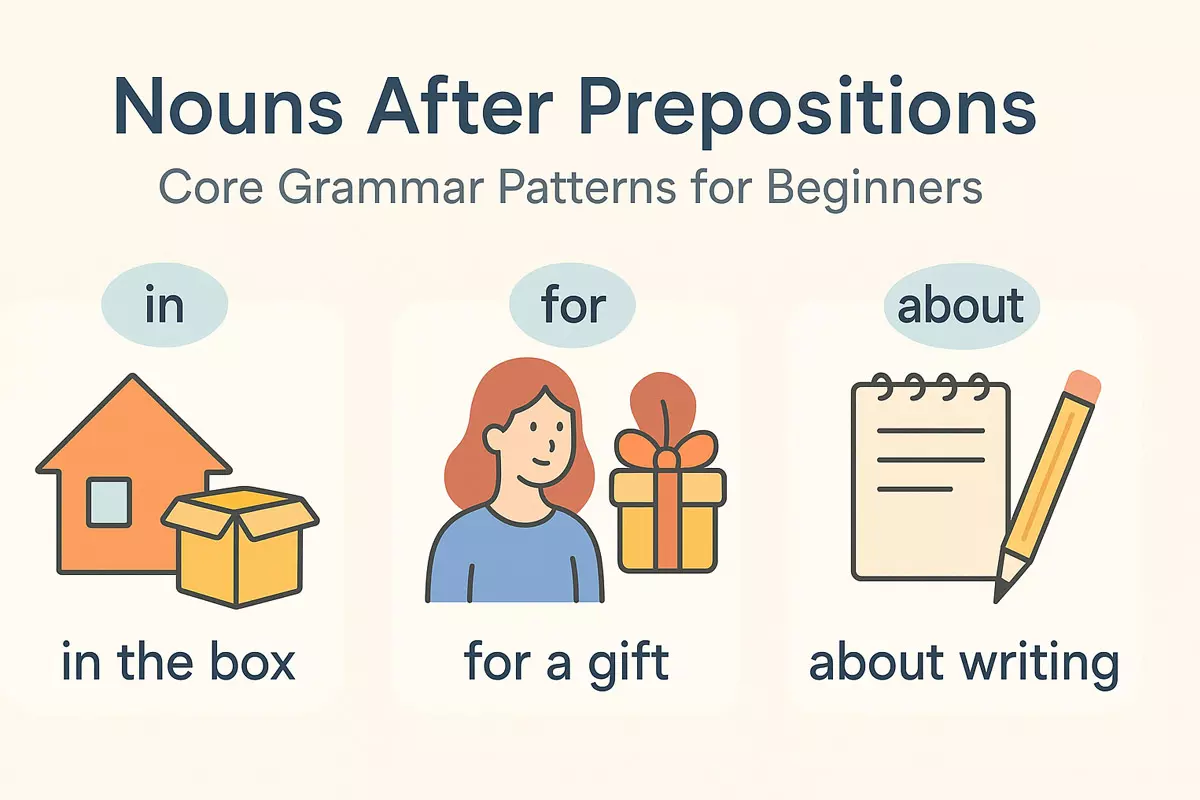 Here we how prepositions function in English sentences, how to form prepositional phrases with nouns, the difference between using nouns and pronouns after prepositions, typical mistakes, common phrase patterns, and offers practice activities.
- Role of prepositions in English sentences
- Forming basic prepositional phrases with nouns
- Nouns vs pronouns after common prepositions
- Time, place, and direction nouns after prepositions
- Preposition + noun patterns in everyday phrases
- Typical mistakes with noun forms after prepositions
- Practice: complete and expand prepositional phrases
Mastering the use of words that come after prepositions is an important part of learning English grammar, especially for beginners. By recognizing and practicing these common patterns, you can construct clearer and more accurate sentences, which in turn allows you to communicate your thoughts more effectively and confidently. As you become more familiar with these structures, your overall understanding of English will improve, making both writing and speaking smoother and more natural.
Role of prepositions in English sentences
Prepositions are words that show how nouns or pronouns relate to other words in a sentence. They help us express location, time, direction, cause, and many other relationships. Without them, sentences would be confusing or incomplete, especially when describing where something is or when an event happens.
How prepositions connect nouns to the rest of the sentence
Most often, a preposition is followed by a noun or noun phrase. This combination is called a prepositional phrase, and it acts like an extra piece of information—telling us more about the action, the subject, or the object. For example, in “The book is on the table,” the preposition “on” links the noun “table” to the rest of the idea, showing location.
Common ways prepositions are used
- Location: in the room, at the park, under the chair
- Direction: to the store, into the house, towards the station
- Time: before dinner, after school, during the meeting
- Reason: for health, because of rain, due to traffic
- Possession: of the city, with friends, belonging to John
- Method: by car, with a pen, through effort
- Comparison: like a tiger, as a leader, unlike others
- Agent: by the author, from the teacher
- Accompaniment: with my sister, along with the team
- Exception: except the dog, but her brother
Patterns to notice for beginners
Prepositions almost always require a noun or pronoun after them. This is a basic pattern:
- Preposition + noun (“in the box”)
- Preposition + pronoun (“for him”)
- Preposition + noun phrase (“on the big table”)
Avoid placing a verb directly after a preposition unless it is a gerund (the -ing form acting as a noun), as in “before eating.”
Examples of prepositional phrases in context
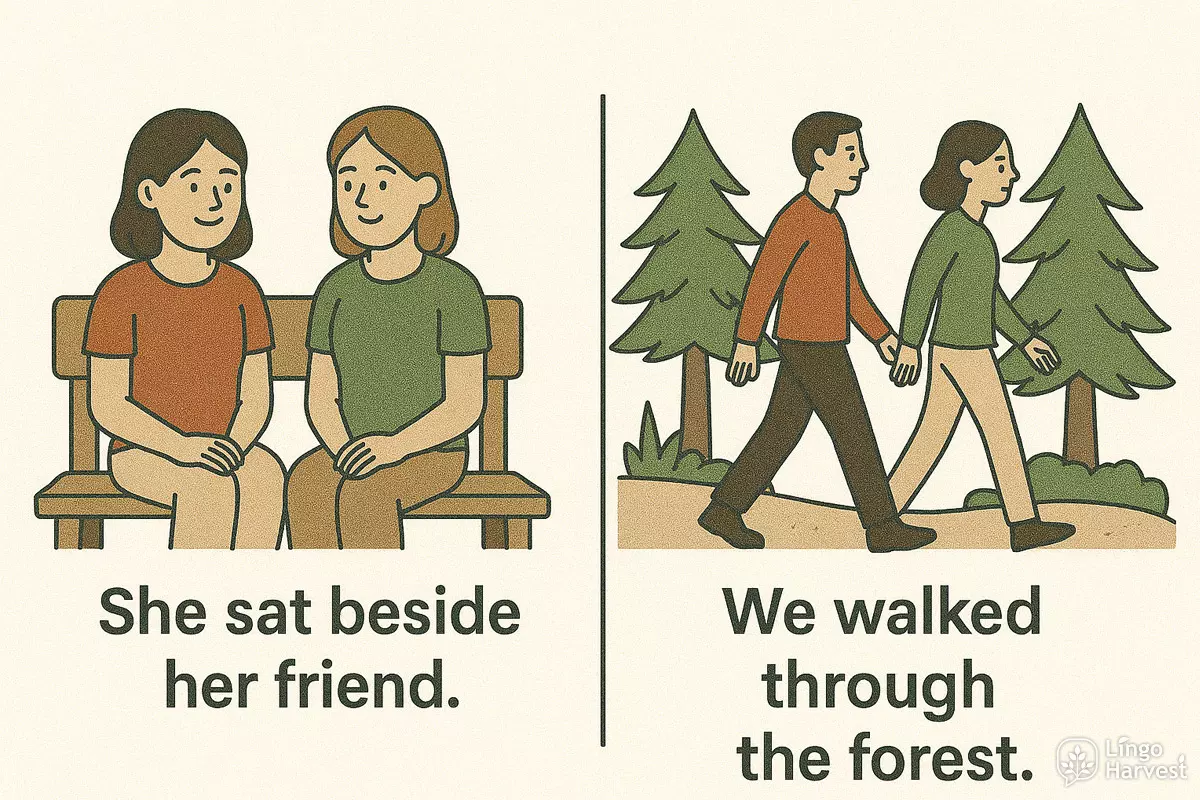
- She sat beside her friend.
- We walked through the forest.
- The keys are under the sofa.
- He arrived after lunch.
- The letter is from my cousin.
- I will see you at the station.
- The cat jumped onto the table.
- They live across the street.
- She spoke about her travels.
- The gift is for you.
- They met during the holidays.
- The picture is on the wall.
Prepositions and their typical noun partners
Some prepositions often pair with certain nouns. Recognizing these combinations can help you sound more natural in English.
| Preposition | Typical Noun Partners |
|---|---|
| in | the morning, the city, the car, a box |
| on | the table, the wall, Monday, the bus |
| at | home, the station, 5 o’clock, the door |
| for | breakfast, a reason, a friend, a walk |
| by | the window, car, chance, the author |
| with | my family, a pen, friends, sugar |
| to | the park, school, the store, bed |
| about | the problem, a story, the weather, life |
| from | the airport, my mother, a friend, school |
| under | the table, the bed, the tree, the bridge |
Learning how these connecting words function helps beginners build clear, natural sentences and avoid common mistakes. With practice, using prepositions with nouns becomes automatic and unlocks more expressive communication in English.
Forming basic prepositional phrases with nouns
Understanding how nouns work after prepositions is a core skill for beginners. In English, prepositions like "in," "on," "at," and "with" are almost always followed by a noun or a noun phrase. This creates a unit that gives more detail about time, place, direction, or relationships in a sentence.
How prepositions connect with nouns
A preposition is placed directly before a noun (or a group of words acting as a noun). The noun that follows is called the "object of the preposition." This pairing helps answer questions like "where?", "when?", or "with what/whom?".
- in the box (location: Where is it?)
- on the table (location)
- at midnight (time: When?)
- with friends (accompaniment: With whom?)
- under the bed (location)
- for the team (purpose/recipient: For whom?)
- about the movie (topic: About what?)
- by the window (location)
- between the chairs (location/relationship)
- without sugar (absence: Without what?)
- over the bridge (direction/location)
- before the meeting (time)
- after school (time)
- through the tunnel (direction)
- from the shop (origin: From where?)
- to the station (destination: To where?)
Basic structure of a prepositional phrase
The typical order is:
preposition + noun (or noun phrase)
The noun can be simple ("school") or include modifiers ("the old school on Main Street"). Articles (a, an, the) and adjectives often appear before the noun.
Examples in sentences
Seeing these combinations in context helps solidify the pattern. Here are some sample sentences:
- She sat on the chair.
- The keys are in the bag.
- We arrived at the station.
- He walked with his brother.
- I read about the accident.
Common prepositions and their noun partners
| Preposition | Example Noun | Sample Phrase |
|---|---|---|
| in | the room | in the room |
| on | the shelf | on the shelf |
| at | the door | at the door |
| with | a friend | with a friend |
| under | the table | under the table |
| for | the class | for the class |
| by | the river | by the river |
| about | the story | about the story |
Practicing these patterns helps you build clear, accurate sentences. As you grow more comfortable, try combining different prepositions and nouns to describe time, place, and relationships in your own writing and speech.
Nouns vs pronouns after common prepositions
Understanding when to use a noun or a pronoun after prepositions is a key step for English beginners. Prepositions like “in,” “on,” “to,” and “with” are almost always followed by a noun (a person, place, thing, or idea) or a pronoun (words like “him,” “her,” “us”). The choice depends on what you want to refer to: a specific object or a person/thing that’s already known.
How it works in sentences
After a preposition, you can place:
- Noun: I sat beside the window.
- Pronoun: I sat beside her.
Both are correct, but the noun gives new information, while the pronoun refers to something already mentioned or obvious.
Common prepositions with examples
Here are some examples showing both nouns and pronouns after frequently used prepositions:
- about the book / about it
- for my friend / for him
- with my parents / with them
- to the station / to her
- at the door / at us
- from school / from me
- by the river / by you
- under the table / under it
- after lunch / after them
- between the chairs / between us
- over the hill / over him
- behind the shop / behind her
- without money / without you
- near the park / near me
- before class / before him
Pronoun forms after prepositions
Personal pronouns change form after prepositions. For example, “he” becomes “him,” and “I” becomes “me.” Here’s a quick comparison:
| Subject Pronoun | After Preposition | Example |
|---|---|---|
| I | me | with me |
| he | him | for him |
| she | her | to her |
| we | us | between us |
| they | them | about them |
| you | you | for you |
| it | it | under it |
Tips for beginners
- Always use the “object” form of the pronoun after a preposition (me, him, her, us, them, you, it).
- Use a noun for clarity when introducing new information.
- Use a pronoun when the listener already knows who or what you mean.
- Check your sentences: “to I” and “with she” are incorrect (❌), but “to me” and “with her” are correct (✅).
With practice, using the right word after prepositions becomes natural. Focus on these simple patterns to build a strong grammar foundation.
Time, place, and direction nouns after prepositions
Understanding which nouns commonly follow prepositions can really help beginners form natural sentences. In particular, expressing moments, locations, and movement relies on using the right noun after a preposition. Let’s look at how these noun types fit into everyday phrases.
Prepositions with Time Nouns
Prepositions like at, in, and on are often used with words that tell us when something happens. These combinations are essential for talking about schedules, routines, and events. Here are some typical patterns:
- at night, at noon, at 5 o’clock
- in the morning, in December, in 2022
- on Monday, on my birthday, on the weekend
- before lunch, after class, during dinner
- until tomorrow, since last week
Notice how the choice of preposition changes with the type of time noun—days, months, points in time, and so on.
Prepositions with Place Nouns
To describe where something is, prepositions pair with nouns that name locations, buildings, and areas. This pattern is frequent in giving directions or describing places.
- in the park, in the city, in the office
- at home, at the station, at the door
- on the street, on the roof, on the bus
- near the library, opposite the bank
- between the shops, under the bridge
Using the correct preposition is key to clear, accurate descriptions of location.
Prepositions with Direction Nouns
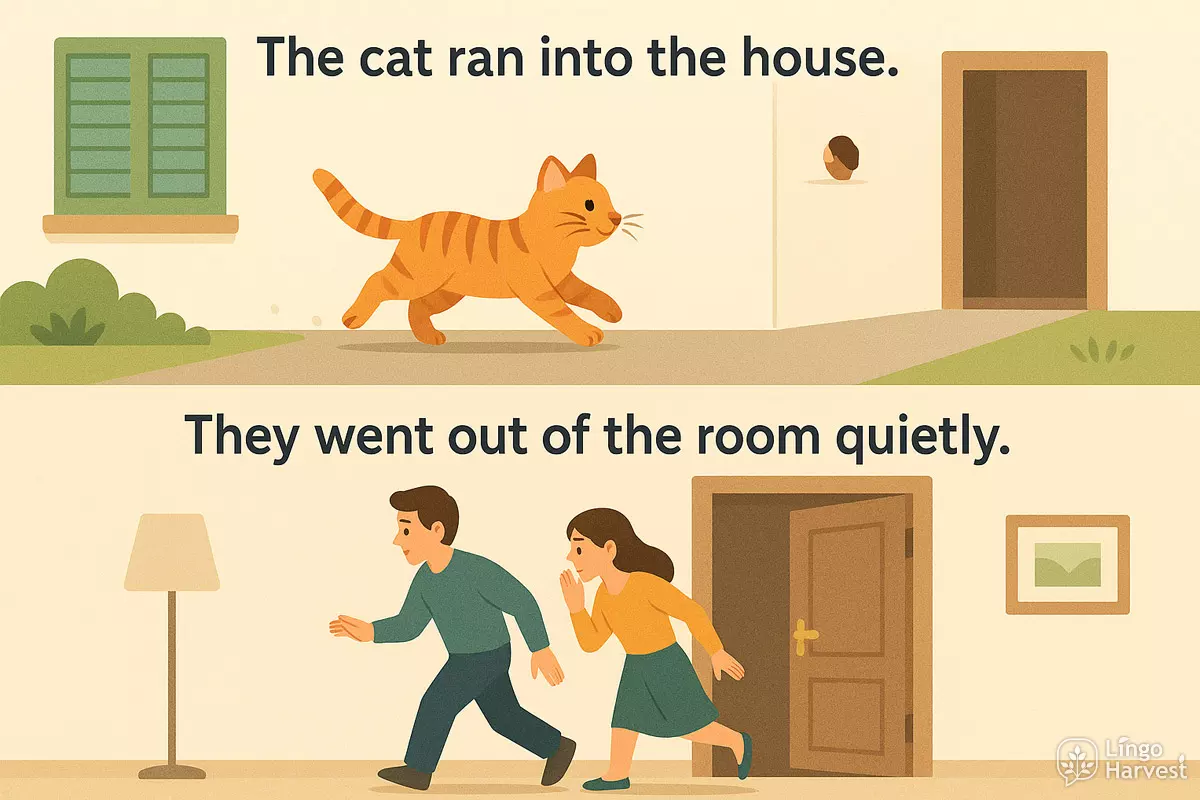
To talk about movement or direction, prepositions are followed by nouns indicating places or endpoints. This is common in travel and navigation.
| Preposition + Direction Noun | Example Usage |
|---|---|
| to school | He walks to school every morning. |
| from work | She comes from work at 6 PM. |
| into the house | The cat ran into the house. |
| out of the room | They went out of the room quietly. |
| towards the station | We are heading towards the station. |
| across the street | The shop is across the street. |
| along the river | They walked along the river. |
| past the museum | Go past the museum and turn left. |
Tips for Beginners
- Pay attention to which prepositions are used with specific time or place nouns; this often follows set patterns.
- Practice with real sentences — changing the noun after the preposition helps you see how the meaning changes.
- Some nouns can be used with more than one preposition, but the meaning may change (for example, in the car vs. on the bus).
- Noticing these patterns when listening or reading will make your English more natural and understandable.
- Practice by creating your own examples using different preposition–noun combinations.
Preposition + noun patterns in everyday phrases
Understanding how prepositions connect with nouns helps beginners form natural and useful sentences. These combinations are common in daily conversation, instructions, and descriptions. You’ll often find a preposition followed directly by a noun, creating set expressions that are easy to remember and use.
Common examples in daily speech
Many preposition-noun groups appear so frequently that they become familiar units of meaning. Here are some of the most widely used:
- at home → I stayed at home all evening.
- in bed → She was still in bed when I called.
- on time → The train arrived on time.
- under pressure → He works well under pressure.
- by car → We decided to travel by car.
- in trouble → He knew he was in trouble.
- on holiday → They are on holiday this week.
- at risk → The building is at risk of collapse.
- for sale → The house is for sale.
- in a hurry → I can’t talk now — I’m in a hurry.
- on the phone → She’s on the phone with a client.
- in the morning → I usually exercise in the morning.
- at work → He’s still at work.
- by mistake → I deleted the file by mistake.
- in pain → She was clearly in pain.
- on foot → We went there on foot.
- under control → The situation is under control.
- at the station → Let’s meet at the station.
- for example → Many fruits, for example apples, are rich in vitamins.
- in advance → Please let me know in advance.
How these patterns work
Preposition + noun pairs usually describe location, time, state, or manner. For example, "in bed" refers to a location, while "on time" relates to punctuality. Learning these patterns reduces hesitation and helps you sound more fluent.
Pattern comparison: different prepositions, different meanings
Some nouns combine with different prepositions to express varying ideas. Here’s a look at how changing the preposition changes the phrase’s meaning:
| Expression | Typical Meaning or Use |
|---|---|
| on time | Punctual; not late |
| in time | Before a deadline or before something happens |
| at work | Located at your workplace |
| in work | Employed; having a job |
| by chance | Accidentally; not planned |
| on purpose | Intentionally; deliberately |
| in trouble | Experiencing difficulty or problems |
| out of trouble | No longer in difficulty |
Tips for mastering these combinations
Focus on learning these groups as fixed expressions rather than translating word by word. Practice using them in simple sentences, and listen for them when watching or listening to English speakers. Over time, these patterns will become second nature.
Typical mistakes with noun forms after prepositions
Learners often struggle with noun patterns following prepositions, especially when it comes to choosing the correct form. A common challenge is remembering to use the correct case or singular/plural form, depending on the context and the language being studied. In English, for instance, prepositions are always followed by a noun or a pronoun in the objective case, but other languages may use different cases or endings.
Common areas where errors occur
- Using a verb instead of a noun after a preposition (e.g., "after eat" instead of "after eating")
- Forgetting to use the plural form after prepositions when required (e.g., "without book" instead of "without books")
- Incorrect use of possessive forms (e.g., "because of John's" instead of "because of John")
- Confusing countable and uncountable nouns (e.g., "with informations" instead of "with information")
- Leaving out necessary articles (e.g., "in hospital" when "in the hospital" is needed)
- Using a pronoun in the wrong case (e.g., "between you and I" instead of "between you and me")
- Mixing up gerunds and nouns (e.g., "before to go" instead of "before going")
- Adding unnecessary prepositions (e.g., "discuss about the problem" instead of "discuss the problem")
- Using a noun phrase when only a noun is needed (e.g., "during the my vacation" instead of "during my vacation")
- Omitting required prepositions (e.g., "interested this book" instead of "interested in this book")
Comparison of correct and incorrect patterns
| Incorrect Usage | Correct Usage |
|---|---|
| She is good in play piano | She is good at playing the piano |
| I am interested this book | I am interested in this book |
| He apologized about his mistake | He apologized for his mistake |
| They left without say goodbye | They left without saying goodbye |
| Between you and I, it's a secret | Between you and me, it's a secret |
| She is afraid from spiders | She is afraid of spiders |
| Thanks for your helps | Thanks for your help |
| I'm looking forward to meet you | I'm looking forward to meeting you |
| He is responsible of the project | He is responsible for the project |
| After to finish, call me | After finishing, call me |
To avoid these slip-ups, it helps to memorize common preposition + noun/gerund combinations and practice using them in context. Paying attention to word forms and double-checking your sentences can make a big difference in clarity and correctness. If you’re unsure, consult a reliable grammar resource or ask a teacher for guidance.
Practice: complete and expand prepositional phrases
Working with prepositional phrases is a practical way to boost your confidence in English grammar. The following tasks help you supply the correct noun after a preposition, expand simple patterns, and notice how meaning changes with different nouns. These exercises are ideal for beginners who want to move from single words to fuller, more natural sentences.
Task 1: Complete the Phrases
Fill in each blank with an appropriate noun. Try to use a different noun each time. Think about objects, people, places, or times.
- on the __________
- in the __________
- at the __________
- with a __________
- under the __________
- for my __________
- between the __________ and the __________
- without any __________
- after the __________
- before the __________
Show answers
- on the table
- in the box
- at the station
- with a pen
- under the bed
- for my friend
- between the chair and the window
- without any money
- after the lesson
- before the meeting
Task 2: Expand Simple Phrases
Take these short prepositional phrases and add details. For example, “in the bag” could become “in the black bag on the chair.” Try to add at least one extra detail to each phrase.
- on the floor
- in the car
- at home
- with my brother
- after class
- before dinner
- under the tree
- between the doors
- for your friend
- without a phone
Show answers
- on the floor near the window
- in the car with my sister
- at home in the kitchen
- with my brother at the park
- after class on Monday
- before dinner at 6 o’clock
- under the tree in the garden
- between the doors of the elevator
- for your friend in Canada
- without a phone in my pocket
Common Prepositions and Typical Nouns
Here’s a quick reference for some typical combinations. Notice how certain nouns often follow specific prepositions. This can help you sound more natural and understand common patterns.
| Preposition | Typical Nouns |
|---|---|
| on | table, floor, wall, bus, street |
| in | box, room, city, bag, morning |
| at | school, home, station, office, door |
| with | friend, dog, pen, family, smile |
| for | breakfast, you, holiday, reason, job |
| under | table, bed, tree, bridge, sun |
| between | chairs, houses, lines, people, doors |
| after | work, school, rain, lunch, meeting |
| before | dinner, class, sunrise, trip, show |
| without | money, phone, help, answer, key |
Tips for Expanding Your Phrases
- Use adjectives: “in the big house” or “with a new friend”.
- Add place or time details: “after lunch on Monday”.
- Combine more than one prepositional phrase: “on the table in the kitchen”.
- Think about who, where, and when to give your phrase more context.
With regular practice, filling and expanding prepositional phrases will become easier and help you build longer, clearer sentences in your English writing and speaking.