To vs Towards: Exact vs General Direction Explained for Learners

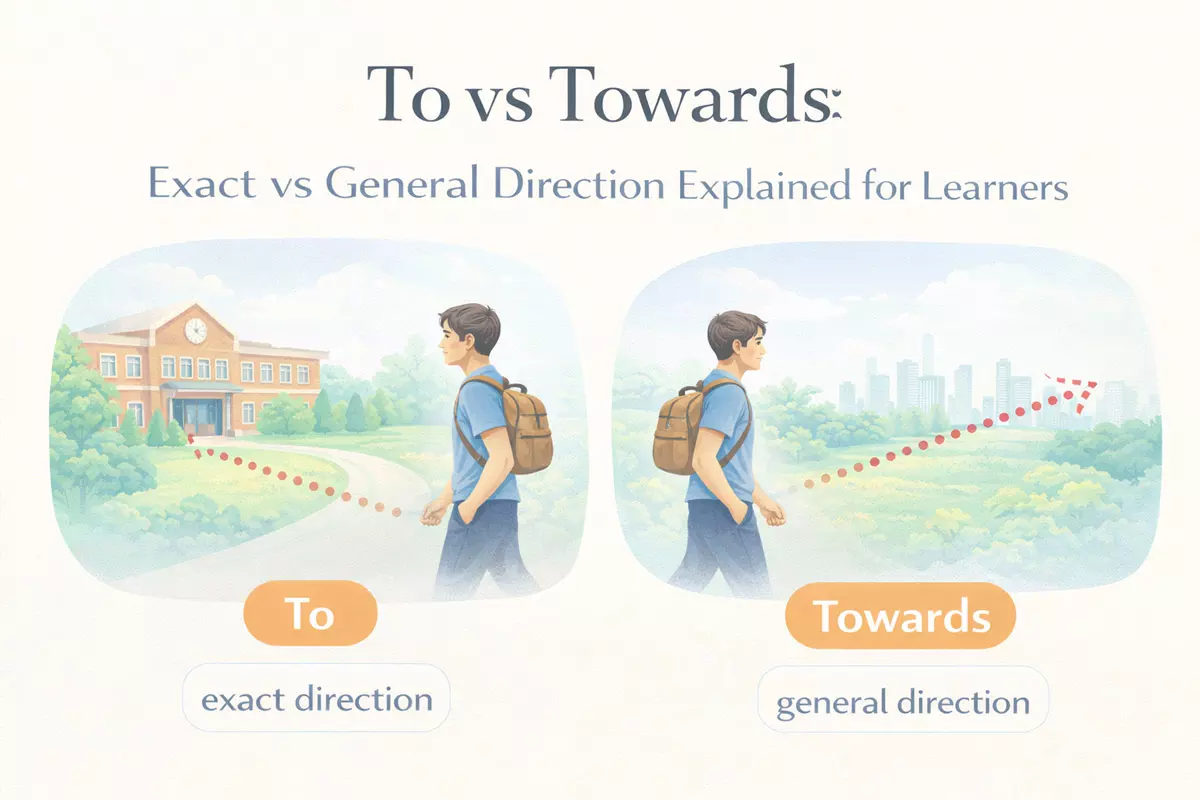 The article details how 'to' signals final destinations while 'towards' suggests movement in a general direction. It also covers metaphorical uses, British and American preferences, pronunciation influences, and practical guidance for descriptive writing.
- The Destination vs. Orientation principle: Finality (to) vs. progress in a direction (towards)
- Specific Targets: Using 'to' for arrival, endpoints, and fixed destinations
- Approximated Movement: 'Towards' for headings, trends, and vague spatial targets
- Metaphorical application: Attitudes 'towards' a subject vs. dedication 'to' a cause
- Regional variation: The British 'towards' vs. American 'toward' stylistic choice
- Phonetic and rhythmic factors: How sentence stress influences preposition selection in speech
- Practice: Mapping physical and abstract trajectories in descriptive and narrative writing
Navigating the subtle difference between expressing a specific destination and indicating a general path can be tricky for English learners, but mastering this distinction is essential for effective communication. Choosing the correct prepositions or phrases helps ensure your listener understands whether you are referring to an exact location, like a specific address or building, or a more general direction, such as heading toward a neighborhood or area. By practicing and noticing these nuances in everyday conversation, you can make your English sound clearer and more natural, ultimately boosting your confidence and helping you avoid misunderstandings.
The Destination vs. Orientation principle: Finality (to) vs. progress in a direction (towards)
When deciding between "to" and "towards," it’s helpful to focus on the sense of reaching a goal versus simply moving in its direction. "To" usually signals that an action ends at a specific place, person, or point in time—think of it as highlighting the endpoint. In contrast, "towards" describes movement or action oriented in a general direction, without necessarily arriving at the destination. This subtle difference is key for clear and precise communication.
Understanding Finality vs. Direction
Finality means the journey or process has a clear, definite end. Using "to" implies that the action is completed at that endpoint. Orientation, on the other hand, emphasizes the path or movement, not the completion. With "towards," the focus is on the ongoing progress, not the result.
- To: Indicates arrival or completion at a place or point (e.g., She went to the store).
- Towards: Suggests movement in a general direction, without confirming arrival (e.g., She walked towards the store).
Common Usage Patterns
Here are typical situations where the difference becomes important:
- Giving directions: "Go to the bank" (arrive there) vs. "Go towards the bank" (head in that direction, maybe not all the way).
- Goal setting: "Work to achieve your goals" (reach them) vs. "Work towards your goals" (make progress, possibly ongoing).
- Physical movement: "Run to the finish line" (complete the race) vs. "Run towards the finish line" (heading in that direction).
- Sending objects: "Send this to John" (he receives it) vs. "Throw the ball towards John" (in his direction, not necessarily caught).
- Time: "From 8 to 10 o’clock" (definite period) vs. "Towards 10 o’clock" (approximate, approaching the hour).
- Abstract progress: "Commit to a cause" (full involvement) vs. "Work towards a cause" (contribute, not completely there yet).
- Travel: "Drive to Paris" (arrive in Paris) vs. "Drive towards Paris" (on the way, perhaps stopping before arrival).
- Effort: "Apply to university" (submit application) vs. "Study towards university" (prepare for future application).
- Communication: "Speak to the manager" (direct interaction) vs. "Speak towards the manager" (addressing, but not necessarily directly).
- Change: "Move to a new house" (complete relocation) vs. "Move towards a new house" (in the process, not finished).
Summary Table: Key Contrasts
| "To" | "Towards" |
|---|---|
| Emphasizes arrival or completion | Focuses on movement/orientation without arrival |
| Used for specific destinations or results | Used for general directions or ongoing processes |
| Implies definite endpoint | Implies progress, not necessarily the end |
| "Go to school" | "Go towards school" (on the way, not yet there) → |
| "Send to Mary" (she receives it) | "Send towards Mary" (in her direction, may not arrive) |
Understanding this principle helps avoid confusion and makes your communication more precise, especially in contexts where the distinction between reaching a goal and making progress towards it matters.
Specific Targets: Using 'to' for arrival, endpoints, and fixed destinations
When you want to express movement toward a clear, defined place or a final point, "to" is the right preposition. It shows that someone or something is heading for a particular goal and usually indicates that the action ends at that location. This is why "to" is used for destinations, endpoints, or any situation where arrival is certain or implied.
How "to" Works in Sentences

"To" is used when the destination or endpoint is specific and known. Whether you are talking about travel, sending objects, or describing movement, "to" pinpoints the target of the action.
- She walked to the bus stop. (a specific place)
- They are flying to Paris. (a fixed city)
- Send the letter to my office. (a precise address)
- He went to sleep. (a defined state)
- The train goes to Berlin. (a set route)
- I handed the keys to the manager. (a particular person)
- Water flows to the sea. (a final destination)
- She returned to her hometown. (a unique location)
- Give it to me. (a specific recipient)
- We’ll drive to the mountains. (a clear endpoint)
- He moved to the front of the room. (an exact spot)
- The package was delivered to your house. (a concrete address)
- Go to page 10. (a fixed reference)
- The river leads to the lake. (an exact place)
- The cat jumped to the top shelf. (a definite location)
Comparing "to" with "towards"
"To" marks the point of arrival, while "towards" suggests movement in a general direction without confirming arrival. If you need to state that someone or something reaches its goal, "to" is the accurate choice.
| Example with "to" | Example with "towards" |
|---|---|
| She ran to the door. → (She arrived at the door) | She ran towards the door. → (She moved in that direction, but arrival isn’t certain) |
| He walked to the station. → (He reached the station) | He walked towards the station. → (He headed in that direction, but may not have arrived) |
| The letter went to her. → (She received it) | The letter moved towards her. → (In motion, not yet delivered) |
| We will travel to London. → (London is the destination) | We will travel towards London. → (London is the general direction) |
Summary
Use "to" whenever you mean that someone or something reaches a particular place, person, or state. It provides clarity about where the action ends—unlike "towards," which only points to a direction without a guaranteed finish. This helps your meaning stay clear and direct, especially when accuracy matters.
Approximated Movement: 'Towards' for headings, trends, and vague spatial targets
The preposition 'towards' is commonly used when the direction is not exact or when the destination is more general than specific. In English, it's the go-to choice for describing movement, goals, or changes that are approximate, evolving, or somewhat undefined. This makes it especially useful in headlines, when talking about progress, or referencing targets that aren't pinpointed on a map.
When to Use 'Towards' Instead of 'To'
Use 'towards' when the focus is on movement in a general direction, not a precise endpoint. This applies to both physical and abstract contexts. For example, if someone is walking in the direction of a building but not necessarily entering it, 'towards' is preferred. The same goes for trends or intentions that are developing or ongoing.
- Walking towards the park (approaching, but not necessarily arriving)
- Moving towards the exit (not yet at the exit)
- Steps towards improvement (progress, not completion)
- Trends towards sustainability (a shift, not a finished state)
- Efforts towards peace (ongoing process)
- Heading towards the mountains
- Leaning towards agreement (not fully agreed)
- Working towards a solution
- Progressing towards a goal
- Attitude towards change
- Shift towards online learning
- Contributing towards a cause
- Gravitating towards a decision
- Inclined towards optimism
- Advancing towards the finish line
- Turning towards the window
- Developments towards a new policy
- Moving towards midday (about time approaching, not exact)
Abstract and Headline Uses
Writers and speakers often choose 'towards' in news, research, or business headlines because it signals a movement or change that is in progress, without committing to a final result. It gives a sense of ongoing action, which is useful for discussing plans, intentions, or trends.
Comparing 'To' and 'Towards' for Vague Targets
| 'To' (Exact Destination) | 'Towards' (General Direction or Goal) |
|---|---|
| She walked to the station. (She arrived at the station.) |
She walked towards the station. (She moved in that direction, arrival unknown.) |
| He donated to the charity. (Money was given directly.) |
He contributed towards the charity. (Helped the cause, not always direct.) |
| She pointed to the answer. (Specific answer identified.) |
She worked towards the answer. (Effort in the general direction.) |
| They moved to the city. (They relocated there.) |
They are moving towards the city. (Approaching, not arrived yet.) |
In summary, 'towards' is ideal for scenarios where movement, effort, or change is approximate or incomplete. It's a versatile preposition for describing both physical direction and metaphorical progress, helping English learners express ideas without committing to an exact endpoint.
Metaphorical application: Attitudes 'towards' a subject vs. dedication 'to' a cause
When using “to” and “towards” in metaphorical contexts, their meanings shift from physical movement to describing emotions, intentions, and relationships. “Towards” often signals a general stance, opinion, or feeling in relation to something, while “to” expresses a more direct, committed, or goal-oriented connection.
Understanding 'towards' for attitudes and feelings
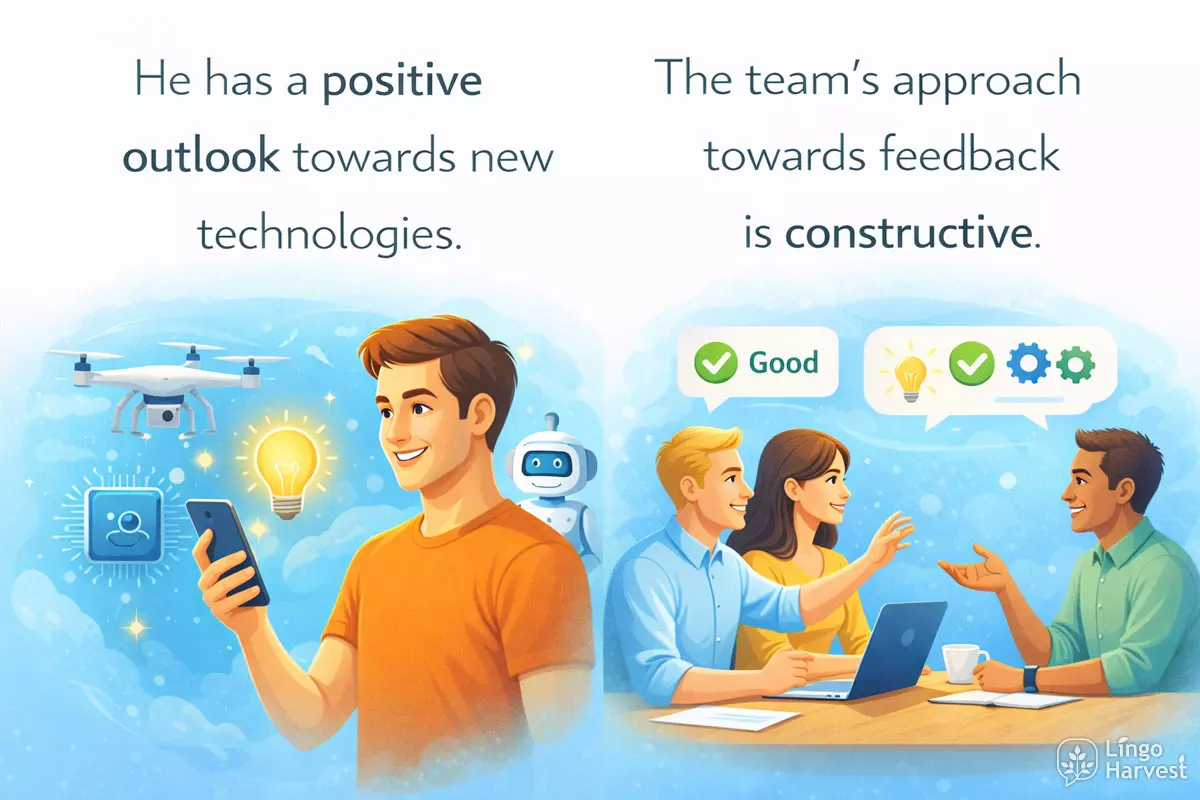
“Towards” is commonly used to convey a broad sense of orientation—how someone feels or thinks about a topic, person, or idea. It doesn’t indicate a completed action, but rather an ongoing or developing position. For example, “Her attitude towards change is open,” shows a general disposition, not a specific action.
- He has a positive outlook towards new technologies.
- The team’s approach towards feedback is constructive.
- My feelings towards classical music have changed over time.
- She’s always respectful towards her elders.
- There’s a growing interest towards sustainable living.
Dedication and commitment with 'to'
In contrast, “to” in expressions of dedication or commitment highlights a specific, often unwavering attachment. It suggests a strong, direct relationship or responsibility. For example, “dedicated to a cause” means someone is actively engaged and invested in achieving a goal.
- He’s devoted to his family.
- They are committed to improving education.
- She pledged loyalty to the organization.
- Our project is dedicated to community service.
- He made a promise to his mentor.
Comparing usage in metaphorical language
The difference between these prepositions becomes especially clear in common phrases. Here’s a side-by-side look at how each word shapes the meaning:
| Phrase with 'towards' | Phrase with 'to' |
|---|---|
| Her attitude towards risk is cautious | She is dedicated to reducing risk |
| Open-minded towards new ideas | Committed to a single vision |
| Sympathetic towards others’ struggles | Loyal to her friends |
| Critical towards certain policies | Obliged to follow the rules |
| Neutral towards the outcome | Responsible to the outcome |
| Supportive towards colleagues | Faithful to the team’s mission |
Summary of metaphorical usage
In summary, “towards” signals general orientation or attitude, reflecting openness or inclination without full commitment. “To” points to specific dedication or responsibility, indicating a direct and purposeful connection. Understanding these nuances helps you express both subtle and strong relationships in English.
Regional variation: The British 'towards' vs. American 'toward' stylistic choice
English speakers often notice that “towards” and “toward” seem to be interchangeable, but the form you choose can depend on where you are—or what style guide you follow. In the UK, “towards” is the standard term, while in the US, “toward” is overwhelmingly preferred. This difference is not about grammar or correctness, but rather about stylistic conventions rooted in regional preferences.
British and American Usage Patterns
Writers in Britain, Ireland, and Commonwealth countries generally use the -s ending, so you’ll read “towards the station” or “towards improvement” in British newspapers and books. In contrast, American publications—newspapers, academic writing, and even informal speech—favor the version without -s: “toward the station,” “toward improvement.”
Summary of Usage: ‘Toward’ vs. ‘Towards’
| Variant | Typical Regions | Example Sentence | Notes |
|---|---|---|---|
| Towards | UK, Ireland, Australia, NZ, South Africa | She walked towards the door. | More common in British and Commonwealth English |
| Toward | USA, Canada (mostly), some Caribbean | He moved toward the exit. | Preferred in American English; seen as slightly more formal in Canada |
| Both forms | International media, global organizations | The policy shifts toward/towards greater transparency. | Sometimes mixed in international or edited texts |
| Other -ward/-wards pairs | Varies | afterward/afterwards, forward/forwards | Similar regional patterns |
Key Points for Learners
- Neither “toward” nor “towards” is incorrect; choose based on your audience.
- Formal documents in the US expect “toward,” while UK institutions prefer “towards.”
- Mixing the forms in a single document is discouraged for consistency.
- This pattern extends to other words: “forward/forwards,” “backward/backwards,” “upward/upwards.”
- In spoken English, the difference is rarely noticed, but in writing it can stand out.
- Style guides (APA, Chicago, Oxford) may have specific recommendations.
- Using the regional standard can help your writing feel natural to readers in that area.
- When in doubt, follow your teacher’s or employer’s preferred style.
- Some international organizations accept both forms for inclusivity.
- “Towards” can sound more informal or conversational in American contexts.
These distinctions are stylistic rather than a matter of meaning. Whether you choose “toward” or “towards,” your intent and clarity are what matter most—just remember your audience and maintain consistency throughout your text.
Phonetic and rhythmic factors: How sentence stress influences preposition selection in speech
The way we choose between "to" and "towards" in natural speech is not only about meaning. Sound patterns, sentence rhythm, and stress placement play a surprisingly important role. When speaking quickly or informally, English speakers often favor prepositions that fit smoothly into the flow of a sentence. Shorter, less stressed words like "to" can be easier to blend with common verbs, while "towards" may be chosen for emphasis or when fitting the natural beat of a sentence.
Sound and rhythm in everyday speech
English has a strong tendency to reduce unstressed syllables. The word "to" is typically pronounced with a very weak vowel (/tə/ or even /tə/), especially in rapid speech. "Towards," on the other hand, carries more syllabic weight and often receives more stress, which can affect the rhythm and pacing of a sentence.
- To is often used in quick, direct phrases: "Go to bed," "Come to me," "Listen to this."
- Towards naturally slows the pace: "He walked towards the door," "She moved towards the light."
- In fast speech, "to" may almost disappear, making it easier for the listener to focus on the main action.
- "Towards" is chosen when the speaker wants to stress the direction or add clarity, especially in more formal or careful speech.
Preposition choice and sentence emphasis
Sometimes, the decision between these prepositions depends on which word in the sentence gets the main stress. If the direction is important and needs highlighting, "towards" is more likely to be stressed and used. But if the focus is on the action or the object, "to" fits more naturally into the background.
Common sentence patterns and stress placement
Here are some typical examples showing how rhythm and emphasis can affect preposition use:
- "She ran to the store." (action-focused, "to" is unstressed)
- "She ran towards the store." (direction-focused, "towards" may be stressed)
- "Hand it to me." ("to" blends into the verb)
- "Walk towards me." ("towards" stands out, clarifying movement)
- "Send this to your friend."
- "Move towards the exit."
- "Speak to your teacher."
- "Drive towards the mountains."
- "Go to sleep."
- "Head towards the finish line."
- "Give it to her."
- "Step towards the window."
- "Return to your seat."
- "Look towards the horizon."
Summary: Why rhythm matters in preposition selection
Native speakers unconsciously adapt their preposition choice to fit the musicality of English. When a sentence needs to be quick and smooth, "to" is favored. When more detail or emphasis is needed, "towards" fits better. These subtle sound choices help listeners understand both the action and its intent—sometimes even before the full meaning is clear.
Practice: Mapping physical and abstract trajectories in descriptive and narrative writing
Understanding how prepositions like "to" and "towards" operate in both literal and figurative contexts is key for descriptive and narrative writing. These words help writers chart movement—whether a character walks to the door or strives towards a personal goal. The exercises below will help you identify and use these prepositions to express direction and intent with precision.
Exploring Physical and Abstract Movement
Writers often describe movement in two ways: concrete (physical journeys) and abstract (progress or change). Consider how "to" usually indicates a specific endpoint, while "towards" suggests general motion or an evolving state. Try matching actions and intentions to the most natural preposition.
- She ran to the station. (specific destination)
- He moved towards the window. (approaching, but not reaching)
- They are working towards a solution. (abstract goal)
- The cat jumped to the table. (exact landing place)
- Her attitude shifted towards optimism. (change in state)
- We drove to Paris. (arrived at a location)
- The children drifted towards the playground. (moving in a general direction)
- He handed the letter to his teacher. (recipient as a target)
- The conversation moved towards more serious topics. (abstract shift)
- She pointed towards the mountains. (direction, not movement)
- They sailed to the island. (reached the island)
- The project is heading towards completion. (progress, not yet finished)
- He walked to his office. (destination)
- The team is pushing towards excellence. (aspirational goal)
- The wind blew towards the north. (direction)
- She traveled to Japan. (specific location)
Comparing Usage in Context
Notice how the choice between "to" and "towards" can subtly shift the meaning of a sentence. The table below contrasts common examples to help clarify their use in both physical and metaphorical situations.
| With "to" (exact endpoint) |
With "towards" (general direction/goal) |
|---|---|
| She walked to the exit. | She walked towards the exit. |
| He aspired to greatness. | He worked towards greatness. |
| They sent the package to London. | They sent the package towards London. (uncommon, but possible if not sure of arrival) |
| We moved to a new house. | We moved towards a new lifestyle. |
| She turned to him for help. | She turned towards him. |
| The boat sailed to the shore. | The boat sailed towards the shore. |
Try It Yourself: Fill in the Blanks
Choose the correct preposition ("to" or "towards") for each sentence below:
- He is working ___ his degree.
- The dog ran ___ the ball.
- They are moving ___ a more sustainable future.
- She gave the keys ___ her friend.
- The hikers walked ___ the mountain peak.
- Her thoughts drifted ___ home.
- He turned ___ the exit when he heard his name.
- Send the document ___ me when you finish.
- The boat moved slowly ___ the shore.
- She leaned closer ___ the microphone to speak clearly.
Show answers
- towards
- to
- towards
- to
- to
- towards
- towards
- to
- towards
- towards
Reflection: Applying the Concepts
As you write, consider whether you are describing a journey with a definite endpoint, or a process of moving in a direction or working on a goal. Using "to" and "towards" accurately will help you convey both physical movement and abstract progress with clarity and nuance.