Zero Plural Nouns Explained: Fish, Deer, Aircraft and More

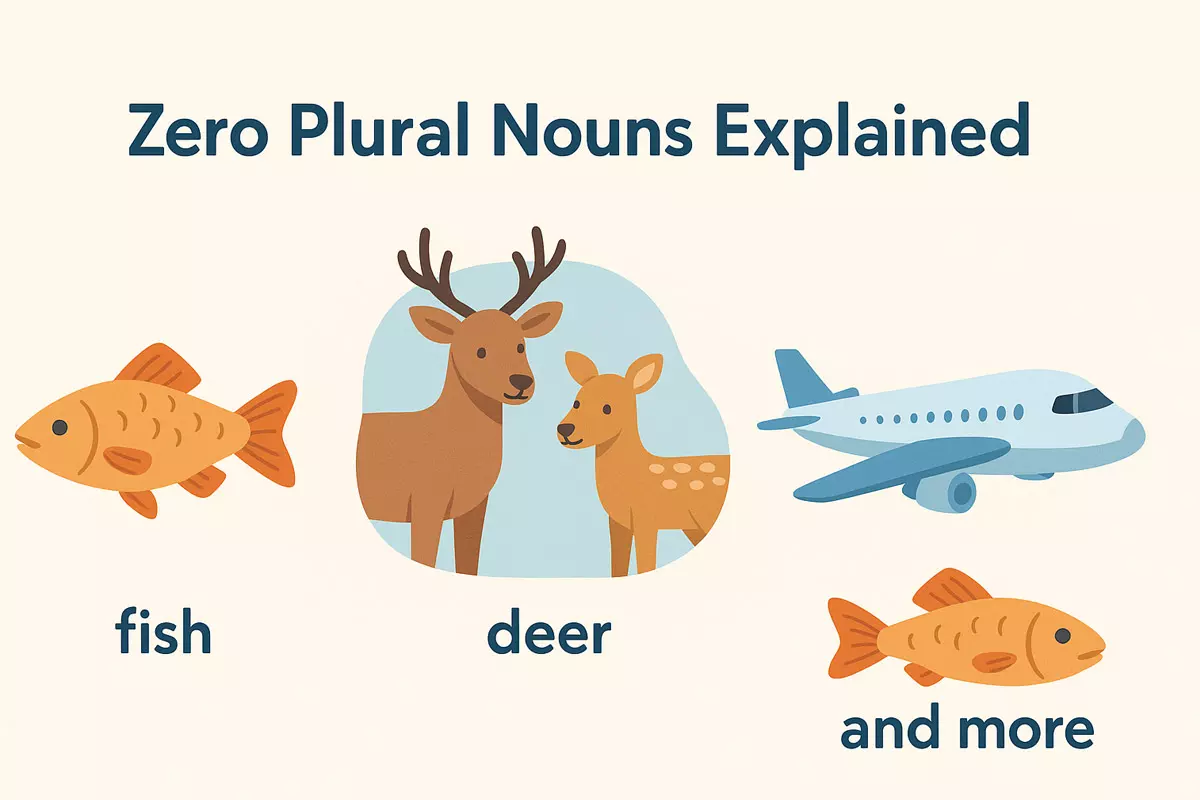 This article explains zero plural nouns in English, like fish, deer, and sheep. It covers how context shows if they are singular or plural, verb and determiner agreement, differences from other plurals, common mistakes, and practice exercises.
- What zero plural nouns are in English grammar
- Common zero plural nouns like fish, deer, and sheep
- Context deciding singular vs plural meaning
- Agreement of verbs and determiners with zero plurals
- Differences from regular and irregular plurals
- Typical mistakes learners make with zero plurals
- Practice: choose correct verb forms with zero plurals
Have you ever wondered why we say three fish instead of three fishes, or many deer instead of deers? In English, some nouns have the same form for both singular and plural, which can be confusing even for native speakers. This feature often applies to animals, like sheep and moose, and usually comes from older forms of English or borrowed words. Understanding these exceptions helps explain why the spelling stays the same, whether you are referring to just one or to many.
What zero plural nouns are in English grammar
Zero plural nouns are words that have the same form for both singular and plural. In English, most nouns form their plural by adding -s or -es, but some nouns don’t change at all when you’re talking about more than one. This feature can be confusing for learners, since there’s no visible marker for the plural. These “unchanging” plurals are found in a variety of categories, and they’re part of what makes English unique.
How zero plurals work
When you use a zero plural noun, the context and the words around it tell you whether it’s singular or plural. For example, “one sheep” and “ten sheep” use the same noun form, but the number before the noun clarifies the meaning. These nouns can refer to a single item or many, depending on the sentence.
Common examples of zero plural nouns
- fish (one fish, many fish) → We saw many fish in the lake.
- deer (a deer, several deer) → Several deer crossed the road.
- sheep (one sheep, two sheep) → Two sheep were grazing in the field.
- aircraft (an aircraft, many aircraft) → The aircraft landed safely.
- species (this species, two species) → This species is endangered.
- series (a series, three series) → This series is very popular.
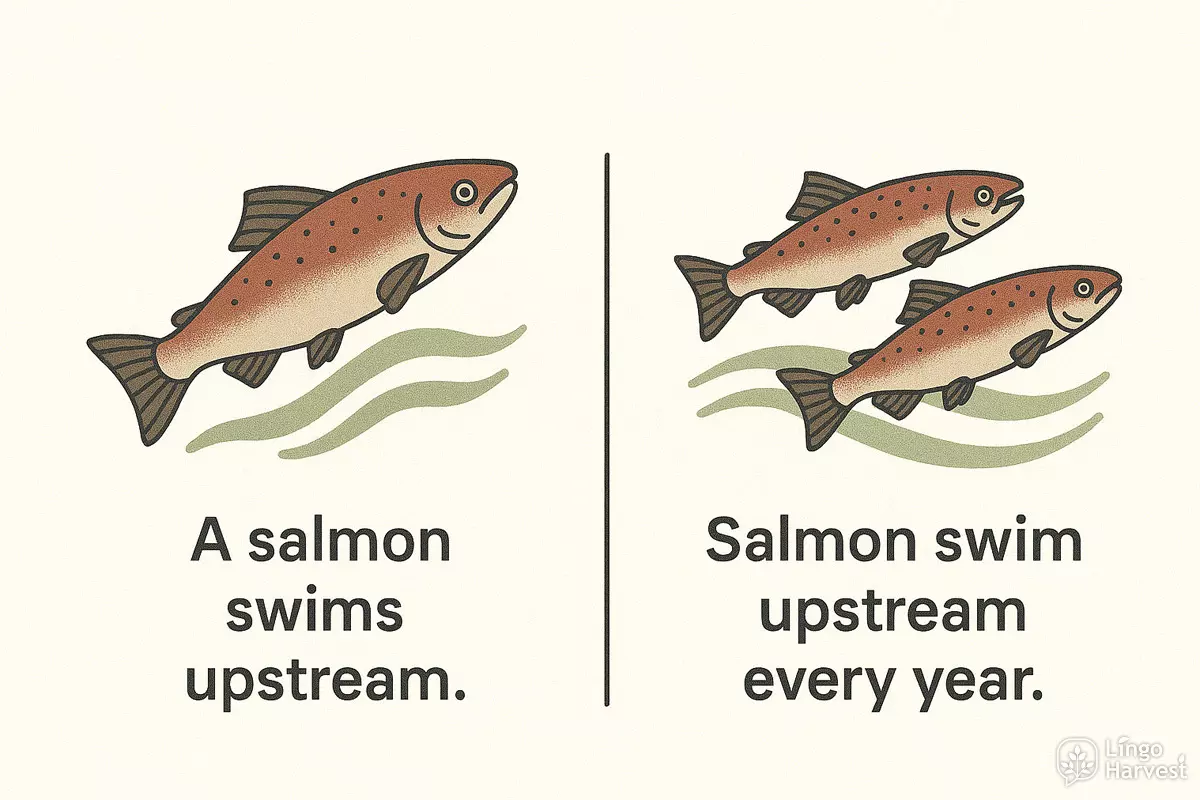
- salmon (a salmon, some salmon) → Salmon swim upstream every year.
- trout (one trout, many trout) → He caught several trout.
- moose (a moose, five moose) → A moose appeared near the forest.
- swine (a swine, several swine) → Swine are kept on the farm.
- cod (a cod, many cod) → Cod is often used in this dish.
- bison (a bison, herds of bison) → Bison live in large herds.
- elk (an elk, several elk) → We spotted an elk in the park.
- hovercraft (a hovercraft, multiple hovercraft) → The hovercraft crossed the river.
- offspring (an offspring, two offspring) → The offspring stayed close to the mother.
- means (a means, several means) → This is the only means of transport.
- headquarters (the headquarters, several headquarters) → The company’s headquarters is in London.
Patterns and usage
Most zero plural nouns in English refer to animals, especially those hunted or farmed, or to technical or collective terms. They often come from Old English or are borrowed from other languages. When using these nouns, remember that the verb agreement follows standard rules: “The deer are eating,” not “The deer is eating” (unless you mean a single deer).
Zero plurals compared to regular plurals
| Singular | Plural (Zero Plural) | Plural (Regular) |
|---|---|---|
| fish | fish | fishes (rare, for species) |
| deer | deer | deers ❌ (incorrect) |
| sheep | sheep | sheeps ❌ (incorrect) |
| aircraft | aircraft | aircrafts ❌ (incorrect) |
| species | species | species (same form) |
| moose | moose | mooses ❌ (incorrect) |
Knowing which English nouns don’t change in the plural helps you sound more natural and avoid common mistakes. If in doubt, check a dictionary, as most zero plural nouns are exceptions rather than the rule.
Common zero plural nouns like fish, deer, and sheep
Some English nouns have the same form for both their singular and plural, which can be confusing for learners. These words are often related to animals, but not exclusively. For example, “fish” can mean one fish or many fish, depending on context. The same goes for “deer” and “sheep”—whether you see one or a whole herd, the word doesn’t change.
How zero plurals work in sentences
Zero plural nouns do not add an -s or -es to form the plural. Instead, you tell whether the noun is singular or plural by looking at the verb or the rest of the sentence. For example:
- There is a sheep in the field. (singular)
- There are five sheep in the field. (plural)
- I caught three fish yesterday. (plural)
- A deer crossed the road. (singular)
- Several deer were grazing nearby. (plural)
List of common zero plural nouns
Here are some well-known examples of nouns that keep the same form for singular and plural:
- elk → Two elk were seen near the mountain trail.
- grouse → Grouse are difficult to spot in dense forests.
- carp → Carp thrive in warm freshwater lakes.
- plaice → Plaice are common in coastal waters.
- bream → Bream were caught early in the morning.
- spacecraft → Several spacecraft entered orbit successfully.
- barracks → The soldiers returned to the barracks.
- crossroads → We stopped at a crossroads to check the map.
- headquarters → The company’s headquarters are in Geneva.
- corps → Two medical corps were deployed to the area.
- Swiss → Three Swiss were interviewed by the reporter.
- Chinese → Many Chinese live abroad.
- means (as in “a means of transport”) → Several means were considered to reach the island.
- reindeer → Reindeer migrate across the tundra every winter.
- hovercraft → Hovercraft were used to cross the flooded area.
- bison → Bison grazed near the river at sunrise.
- shrimp (especially in UK English) → Shrimp were added to the pasta at the end.
- squid → Squid were visible near the surface at night.
- quail → Quail nested in the tall grass.
Comparing regular and zero plural nouns
Zero plural forms stand out when compared to regular English pluralization. Here’s a quick look at the difference:
| Singular | Plural (regular noun) | Plural (zero plural noun) |
|---|---|---|
| cat | cats | sheep |
| dog | dogs | fish |
| car | cars | deer |
| plane | planes | aircraft |
Usage tips and exceptions
Not all animal names behave this way—“horses” and “cows” are regular plurals. Also, “fishes” is sometimes used in scientific contexts to talk about multiple species of fish, but in everyday English, “fish” is almost always both singular and plural. Always check context and, when in doubt, consult a reputable dictionary.
Context deciding singular vs plural meaning
For nouns like "fish," "deer," and "aircraft," the same word can refer to one or many. The difference isn’t marked by spelling, so understanding whether these nouns are singular or plural depends on clues from the sentence. This is where context—such as surrounding words, verbs, and quantifiers—plays a critical role.
How to tell if a zero plural noun is singular or plural
Usually, you can decide if the noun is referring to one item or several by looking at:
- Articles and determiners: "A deer" (one), "some deer" (more than one), "the fish" (could be one or many)
- Numbers and quantifiers: "Three fish," "many aircraft," "one sheep"
- Verb agreement: "The sheep is grazing" vs. "The sheep are grazing"
Examples of context clues
You can spot whether the noun is singular or plural by paying attention to these patterns:
- “A fish swims in the tank.” → singular
- “Several fish swim in the tank.” → plural
- “That deer is very fast.” → singular
- “Those deer are eating.” → plural
- “One aircraft landed safely.” → singular
- “Many aircraft landed safely.” → plural
- “The trout was delicious.” → singular
- “The trout were swimming upstream.” → plural
- “A moose crossed the road.” → singular
- “Five moose crossed the road.” → plural
- “This series is interesting.” → singular
- “These series are different.” → plural
- “The species has distinctive markings.” → singular
- “Several species have been discovered.” → plural
- “That salmon looks fresh.” → singular
- “Some salmon migrate upstream.” → plural
- “A spacecraft is in orbit.” → singular
- “Two spacecraft are in orbit.” → plural
Common zero plural nouns and their usage
| Noun | Example (Singular / Plural) |
|---|---|
| Fish | The fish is colorful. → The fish are colorful. |
| Deer | A deer was spotted. → Many deer were spotted. |
| Aircraft | One aircraft is missing. → Several aircraft are missing. |
| Sheep | This sheep is lost. → These sheep are lost. |
| Moose | A moose is nearby. → Moose are common here. |
| Salmon | That salmon is huge. → The salmon are spawning. |
| Species | This species is rare. → Those species are extinct. |
| Series | The series has ended. → The series have ended. |
| Spacecraft | One spacecraft launched. → Two spacecraft launched. |
| Trout | A trout was caught. → Trout were caught. |
In summary, when dealing with zero plural nouns, always rely on the context—especially verbs, determiners, and numbers—to interpret whether the meaning is singular or plural. This is a natural part of English, and with practice, reading these signals becomes second nature.
Agreement of verbs and determiners with zero plurals
Many English nouns don’t change form in the plural—think of “fish,” “deer,” or “sheep.” These so-called zero plurals can cause confusion when choosing the right verb forms and determiners. The tricky part: although the noun looks singular, its meaning may be plural, so it takes plural agreement in most cases.
When using these nouns as subjects, always match the verb to the intended number. If you mean more than one, pair them with plural verbs. For example, “The fish are swimming,” not “The fish is swimming” (unless you mean a single fish).
Choosing the Right Verb Form
- Deer run quickly in the forest. ✅
- Two aircraft were spotted overhead. ✅
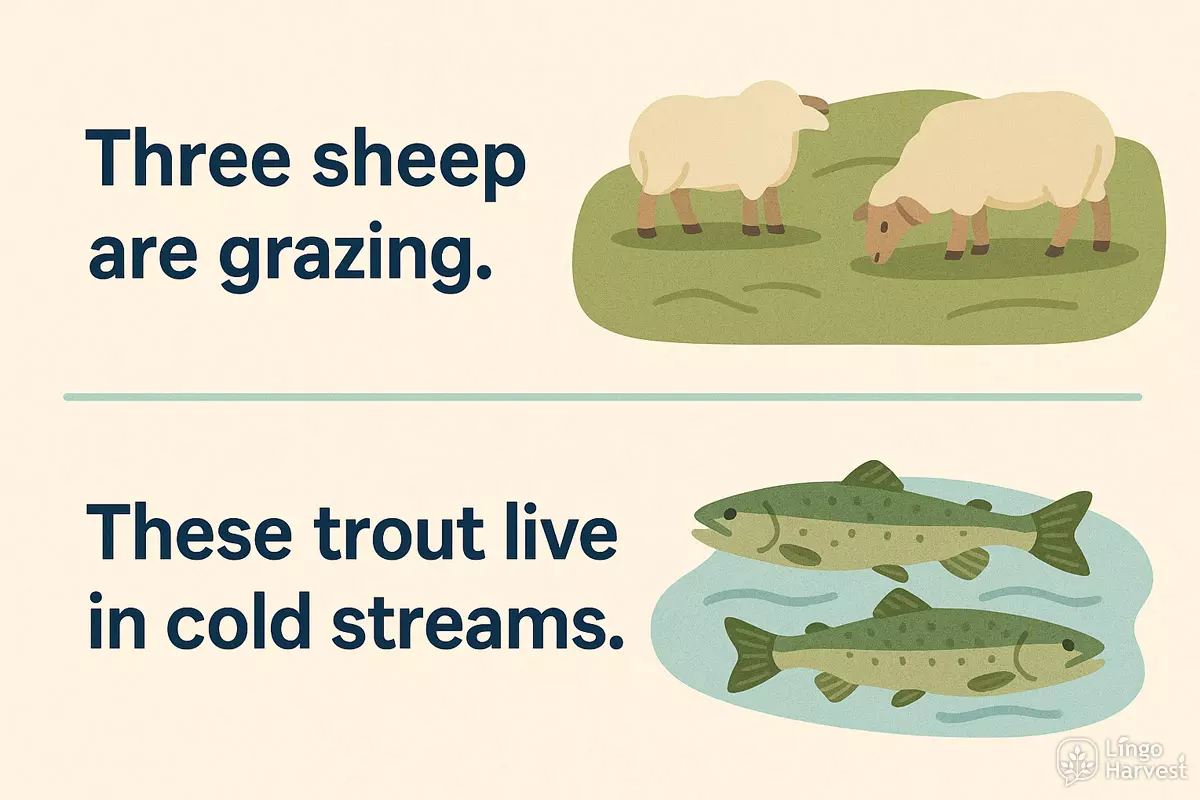
- Three sheep are grazing. ✅
- These trout live in cold streams. ✅
- The salmon migrate upstream every year. ✅
- Several moose have entered the clearing. ✅
- Many bison roam the plains. ✅
- The reindeer travel in herds. ✅
- Those pike look healthy. ✅
- The series are interesting. ❌ (Exception: "series" is both singular and plural, but typically takes a singular verb.)
Determiners and Quantifiers with Zero Plurals
Articles and quantifying words like “many,” “few,” or “some” must also correspond to the plural meaning, even if the noun’s spelling doesn’t change. The definite article “the” works for both singular and plural, but “a” or “an” is reserved for single instances.
- Many sheep were lost. ✅
- A sheep was found. ✅
- Some deer live here. ✅
- That fish is rare. ✅
- These fish are common. ✅
- Few aircraft remain. ✅
- Several trout were caught. ✅
- One moose appeared. ✅
- Those bison are protected. ✅
- No reindeer were seen. ✅
- All salmon spawn in autumn. ✅
- The pike is a predator. ✅
- The pike are active at dawn. ✅
Common Pitfalls and How to Avoid Them
Writers sometimes pair zero plural nouns with singular verbs by mistake, especially when the noun looks identical in both forms. To avoid this, always consider the intended meaning: if you’re talking about more than one, use plural agreement. Some quantifiers (“many,” “few,” “several”) are only used with plural reference, which helps signal the need for a plural verb.
| Zero Plural Noun | Correct Agreement Example |
|---|---|
| Fish | The fish are swimming near the shore. |
| Deer | Many deer gather at dusk. |
| Sheep | Some sheep have wandered off. |
| Aircraft | Several aircraft were delayed. |
| Bison | The bison roam freely. |
| Trout | These trout look healthy. |
| Moose | Three moose crossed the road. |
| Salmon | All salmon return to spawn. |
In summary, always let the intended number guide your choice of verbs and determiners with zero plural nouns. Paying attention to context and quantifiers will help you use these words naturally and accurately.
Differences from regular and irregular plurals
Zero plurals stand apart from both standard plural formations and the more unpredictable patterns of irregular nouns. Instead of adding endings or altering internal letters, these words retain the same form for both singular and plural uses. This trait can be confusing for learners, especially since most English nouns follow clear rules for plurality.
How regular and irregular plurals work
Most English nouns become plural by adding -s or -es (cats, boxes). Irregular forms, meanwhile, change spelling entirely or follow unique rules (man → men, mouse → mice). Zero plurals skip all these changes.
| Type | Singular Form | Plural Form | Example Sentence |
|---|---|---|---|
| Regular | cat | cats | There are three cats in the yard. |
| Irregular | child | children | The children are playing outside. |
| Zero plural | deer | deer | We saw five deer in the forest. |
| Zero plural | aircraft | aircraft | Several aircraft landed safely. |
Common zero plural nouns
Here are several nouns that do not change between singular and plural:
- fish → We saw many fish near the shore.
- deer → Several deer were crossing the road.
- sheep → Five sheep were grazing in the field.
- aircraft → Two aircraft are ready for takeoff.
- species → This species lives only in this region.
- series → The series is popular worldwide.
- salmon → Salmon migrate upstream every year.
- moose → A group of moose appeared near the forest.
- trout → They caught several trout in the river.
- swine → Swine are raised on this farm.
- cod → Cod is commonly used in this recipe.
- pike → Pike are found in freshwater lakes.
- offspring → The offspring stay close to their mother.
- means → This is the only means of transport here.
- head (of cattle) → The farmer owns fifty head of cattle.
- grouse → Grouse are difficult to spot in the wild.
- reindeer → Reindeer live in cold northern regions.
- hovercraft → The hovercraft crossed the river easily.
Key contrasts to remember
- Zero plurals: no change in spelling or pronunciation between singular and plural.
- Regular plurals: add -s or -es for pluralization.
- Irregular plurals: may change vowels, endings, or the entire word.
With zero plurals, context and verb agreement are the main clues to number. This feature is especially common with animal names and words for vehicles or groups, making it an exception worth memorizing.
Typical mistakes learners make with zero plurals
Understanding nouns that don’t change form for singular and plural can be tricky. English learners often assume all nouns add -s or -es in the plural, leading to errors. Zero plural nouns—like “fish,” “sheep,” and “aircraft”—break this rule, so it’s easy to make mistakes, especially in writing and exams.
Common confusion points
- Adding -s to words that should stay the same: “deers,” “sheeps,” “fishes”
- Forgetting that some nouns never change, even for large numbers: “two aircraft,” “many salmon”
- Mixing up zero plural nouns with regular ones: “one mouse, two mouse” (should be “mice”)
- Incorrect subject-verb agreement: saying “The sheep is in the field” when referring to several animals
- Confusion with context: not recognizing when a noun is being used as a plural
Examples of incorrect and correct forms
Let’s look at some frequent errors and their correct counterparts:
- ❌ “There are five deers in the park.”
✅ “There are five deer in the park.” - ❌ “Several fishes live in this pond.”
✅ “Several fish live in this pond.” - ❌ “Many sheeps were grazing.”
✅ “Many sheep were grazing.” - ❌ “The aircrafts took off.”
✅ “The aircraft took off.”
How zero plurals compare to regular plurals
| Regular Plural | Zero Plural |
|---|---|
| 1 cat / 2 cats | 1 sheep / 2 sheep |
| 1 car / 5 cars | 1 deer / 5 deer |
| 1 bird / 7 birds | 1 aircraft / 7 aircraft |
| 1 dog / 3 dogs | 1 salmon / 3 salmon |
| 1 apple / 10 apples | 1 trout / 10 trout |
Being aware of these patterns and practicing with real examples helps avoid common slip-ups. It’s useful to memorize the most frequent zero plural nouns and always double-check their forms in both speech and writing.
Practice: choose correct verb forms with zero plurals
Understanding how to match verbs with nouns that have zero plural forms is essential for accurate English usage. These nouns look the same in both singular and plural, but the verb must agree with the intended number. Let’s explore some typical examples and test your knowledge with practice exercises.
Verb agreement with zero plural nouns
When using these nouns, choose singular verbs for one item and plural verbs for more than one. Context usually reveals the number:
- One deer is standing in the field.
- Several deer are grazing nearby.
- This species lives in cold climates.
- Many species live in rainforests.
Practice: Choose the correct verb form
- The sheep ______ (is/are) in the barn.
- Two trout ______ (was/were) caught this morning.
- An aircraft ______ (lands/land) every hour.
- Five aircraft ______ (lands/land) every day.
- This series ______ (features/feature) famous detectives.
- Several series ______ (features/feature) new technology.
- The moose ______ (looks/look) huge.
- Many moose ______ (was/were) seen last winter.
- One salmon ______ (swims/swim) upstream.
- Hundreds of salmon ______ (swims/swim) every year.
- The offspring ______ (needs/need) care.
- Her offspring ______ (is/are) healthy.
Show answers
- are
- were
- lands
- land
- features
- feature
- looks
- were
- swims
- swim
- needs
- are
Quick reference: Singular vs. plural verb forms
| Example (Zero Plural Noun) | Correct Verb Form |
|---|---|
| One sheep | is |
| Many sheep | are |
| One aircraft | lands |
| Several aircraft | land |
| This species | lives |
| Many species | live |
| One trout | was |
| Two trout | were |