Plural-Only Nouns in English: Scissors, Pants, Clothes Usage

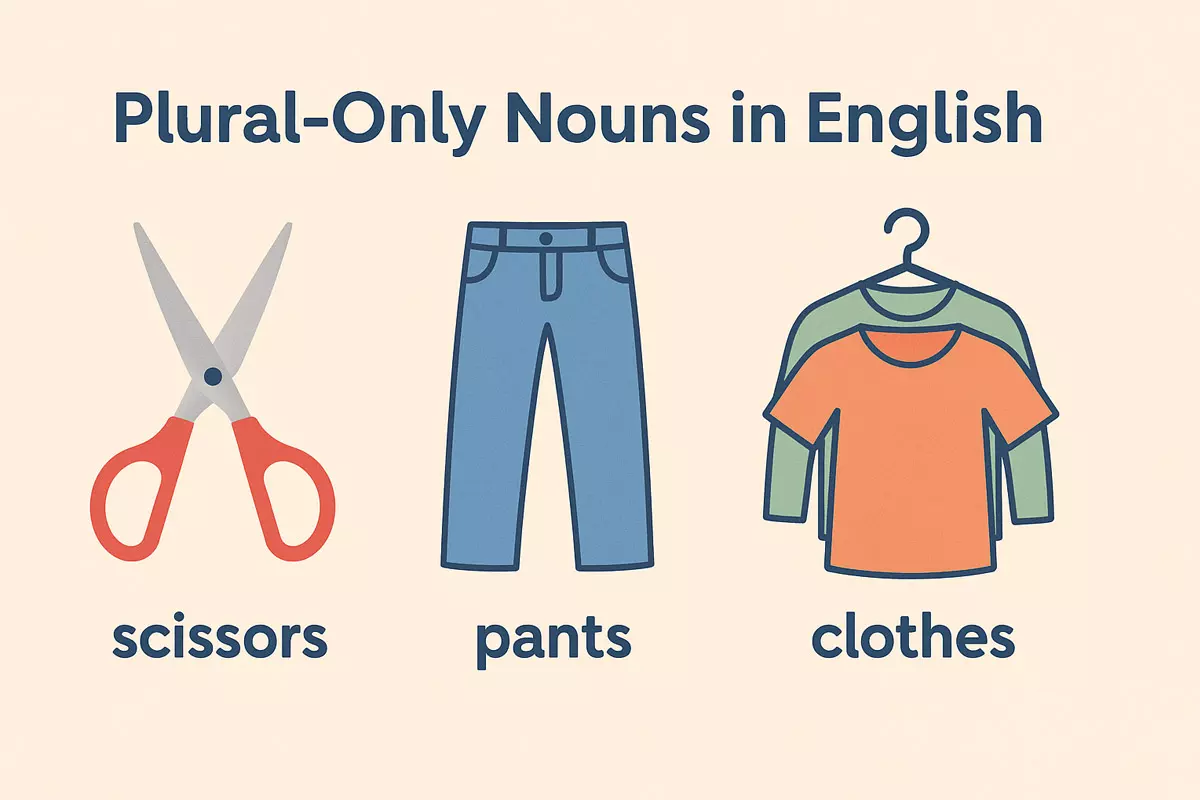 The article defines plural-only nouns, gives examples like scissors and pants, explains how to use quantifiers such as a pair of, covers verb agreement, discusses referencing one or more items, compares them to regular plurals, and offers practice sentences.
- Definition of plural-only or pluralia tantum nouns
- Common plural-only nouns like scissors and pants
- Using a pair of and other quantifiers with them
- Verb agreement with plural-only nouns in sentences
- Talking about one item vs several with plural-only nouns
- Comparing plural-only nouns to normal plural forms
- Practice: rewrite sentences using plural-only nouns
Have you ever noticed that we say these scissors or those pants instead of using a singular form? In English, certain words refer to objects that appear to be a single item, yet they are always treated as plural. This includes items like glasses, trousers, or binoculars. The reason is often historical or based on the object's structure, such as being made of two joined parts. These plural-only nouns shape the way we describe everyday things and highlight some unique quirks of the English language.
Definition of plural-only or pluralia tantum nouns
Many English nouns exist only in the plural form and do not have a standard singular counterpart. Linguists call these "pluralia tantum," which is Latin for "plural only." These words refer to objects, concepts, or substances that are typically thought of as pairs, sets, or collective items. When you use them, you always pair them with plural verbs and pronouns, even if you are referring to just one item.
How plural-only nouns behave in English
Pluralia tantum nouns don’t follow the usual singular-plural pattern. For example, we say "scissors are" instead of "scissors is," and "these pants" rather than "this pant." This is true even if you’re talking about a single pair of scissors or one pair of pants. The plural form is required for both meaning and grammar.
Common examples of pluralia tantum
You’ll encounter these special nouns across different contexts, especially for items that come in pairs or are made of two joined parts. Here are some typical examples:
- Scissors → These scissors are very sharp.
- Pants → His pants are too long.
- Clothes → Her clothes are drying outside.
- Glasses (for eyewear) → My glasses are on the table.
- Trousers → Those trousers look expensive.
- Jeans → My jeans were washed yesterday.
- Binoculars → The binoculars are useful for birdwatching.
- Shorts → His shorts are perfect for hot weather.
- Pliers → These pliers are used for gripping wires.
- Headphones → Her headphones are broken.
- Goggles → The goggles protect your eyes.
- Spectacles → His spectacles are new.
- Forceps → The forceps are kept in a sterile container.
- Shears → Garden shears are stored in the shed.
- Jitters → She had the jitters before the exam.
- Riches → Riches don’t guarantee happiness.
- Stairs → The stairs are very steep.
- Goods → The goods were delivered on time.
- Premises → Smoking is not allowed on these premises.
- Thanks → Thanks are due to everyone who helped.
Typical patterns and usage
Most plural-only nouns describe tools, clothing, or items in sets. They often require special phrases to indicate quantity. For instance, instead of "a scissors," we say "a pair of scissors." This "pair of" construction helps clarify that you mean one item, even though the noun itself is plural.
Grammatical implications
Because these nouns are always grammatically plural, they take plural verb forms:
- My trousers are in the wash. ✅
- The scissors have disappeared. ✅
- This jeans is new. ❌ (incorrect)
Summary
Pluralia tantum nouns are an interesting feature of English, reflecting how people conceptualize certain objects as inherently plural. Understanding which words belong to this category and how to use them correctly will help you sound more natural and avoid common mistakes.
Common plural-only nouns like scissors and pants
Many English nouns naturally appear only in their plural form, even when referring to a single object or concept. These are often called "pluralia tantum." They can refer to tools, clothes, instruments, or collective items. People sometimes find their usage confusing because, although they refer to a single object, they take plural verbs and pronouns.
Typical examples and their uses
You'll encounter these nouns frequently in everyday English. Here’s a list of some of the most common plural-only items and concepts:
- leggings → Her leggings are very comfortable.
- sweatpants → These sweatpants are perfect for workouts.
- underpants → He packed extra underpants for the trip.
- boxers → His boxers are made of cotton.
- briefs → The briefs are too small.
- stockings → She wore stockings with her dress.
- sunglasses → My sunglasses are in the car.
- earmuffs → The earmuffs kept his ears warm.
- handcuffs → The handcuffs were locked securely.
- pincers → These pincers are used in metalwork.
- nail clippers → The nail clippers are in the bathroom.
- hair straighteners → Her hair straighteners are overheating.
- curlers → The curlers were left in overnight.
- trunks (swimwear) → His trunks dried quickly.
- coveralls → The coveralls were covered in oil.
- pyjamas (UK spelling) → His pyjamas were freshly washed.
- headset → The headset is connected to the computer.
- braces (suspenders / dental) → He wore braces to hold up his trousers.
- ankle socks → Her ankle socks disappeared in the laundry.
- workwear → This workwear is designed for safety.
How to use these nouns correctly
These words always take plural verbs and pronouns, even if you’re only talking about one object. For example:
- Where are my scissors? ✅
- These pants are new. ✅
- The glasses are on the table. ✅
Saying "a scissor" or "a pant" is not standard usage in English. If you want to talk about an individual item, use "a pair of" before the noun:
- a pair of scissors
- a pair of pants
- a pair of glasses
Summary of usage patterns
| Plural-Only Noun | Correct Usage | Incorrect Usage |
|---|---|---|
| scissors | Where are the scissors? / a pair of scissors | Where is the scissor? / a scissor |
| pants | These pants are too big. / a pair of pants | This pant is too big. / a pant |
| glasses | My glasses are broken. / a pair of glasses | My glass is broken. / a glass (meaning eyewear) |
| tweezers | The tweezers are on the shelf. / a pair of tweezers | The tweezer is lost. / a tweezer |
Why are these nouns plural?
Many of these words describe items made up of two joined parts (like scissors or pants), which likely explains why English treats them as plural. Even so, when you need to refer to just one item, "a pair of" is the natural construction. Remember: although the object might be singular, the grammar stays plural.
Using a pair of and other quantifiers with them
When dealing with nouns like "scissors," "pants," and "clothes," English speakers often need to use special quantifiers because these items don’t take a simple singular form. Instead of saying "one scissor" or "one pant," people use expressions such as "a pair of scissors" or "a pair of pants." This helps indicate a single item, even though the noun itself is grammatically plural.
Common Quantifiers Used with Plural-Only Nouns
Some plural-only nouns require unique quantifiers or units, especially when you want to express a specific quantity. Here are the most frequent patterns:
- A pair of — Used for items that naturally come as two connected parts: a pair of glasses, a pair of pants, a pair of binoculars, a pair of jeans, a pair of tongs, a pair of pajamas, a pair of shorts, a pair of tweezers, a pair of pliers, a pair of scissors.
- Some — Used for non-count quantities: some clothes, some trousers, some spectacles, some goggles, some pliers, some shears.
- Several — For an unspecified, but countable, number: several clothes, several jeans, several shorts.
- Many — For larger, countable amounts: many pants, many scissors, many pajamas.
- A few — To indicate a small number: a few pants, a few clothes.
- Three pairs of — For precise counts: three pairs of socks, four pairs of glasses, five pairs of shorts.
- Lots of — For abundance: lots of clothes, lots of jeans.
- Plenty of — Also for abundance: plenty of pants, plenty of scissors.
- Dozens of — For large, countable groups: dozens of trousers, dozens of spectacles.
- Pieces of — Occasionally for items like "clothes" (e.g., three pieces of clothing), but not for "scissors" or "pants."
How Quantifiers Change the Meaning
The choice of quantifier can subtly shift the meaning. For example, "a pair of pants" is one item, but "pants" alone is vague and could mean several. "Some scissors" could refer to multiple pairs, while "a pair of scissors" is always just one.
| Plural-Only Noun | Correct Quantifier Example | Incorrect Example |
|---|---|---|
| Pants | a pair of pants ✅ | a pant ❌ |
| Scissors | a pair of scissors ✅ | a scissor ❌ |
| Clothes | some clothes ✅ | a cloth ❌ (note: "cloth" is a different word) |
| Jeans | two pairs of jeans ✅ | two jeans ❌ |
| Glasses | a pair of glasses ✅ | a glass ❌ (means something different) |
| Pajamas | a pair of pajamas ✅ | a pajama ❌ |
Tips for Everyday Usage
- Always use a pair of for a single item made of two joined or matching parts.
- For general or uncountable references, use some, a few, or many.
- Avoid using the singular form unless the noun has a different meaning (for example, pant in tailoring).
- Be careful: words like clothes and pants never take a directly before them.
- Understanding these patterns helps you sound more natural and avoid common mistakes with plural-only nouns.
Verb agreement with plural-only nouns in sentences
When working with nouns like "scissors," "pants," and "clothes," it's important to remember that they are always treated as plural in English, even though they may refer to a single item in real life. This means that you should use plural verbs and pronouns with these words, just as you would with any other plural noun.
How to match verbs with plural-only nouns
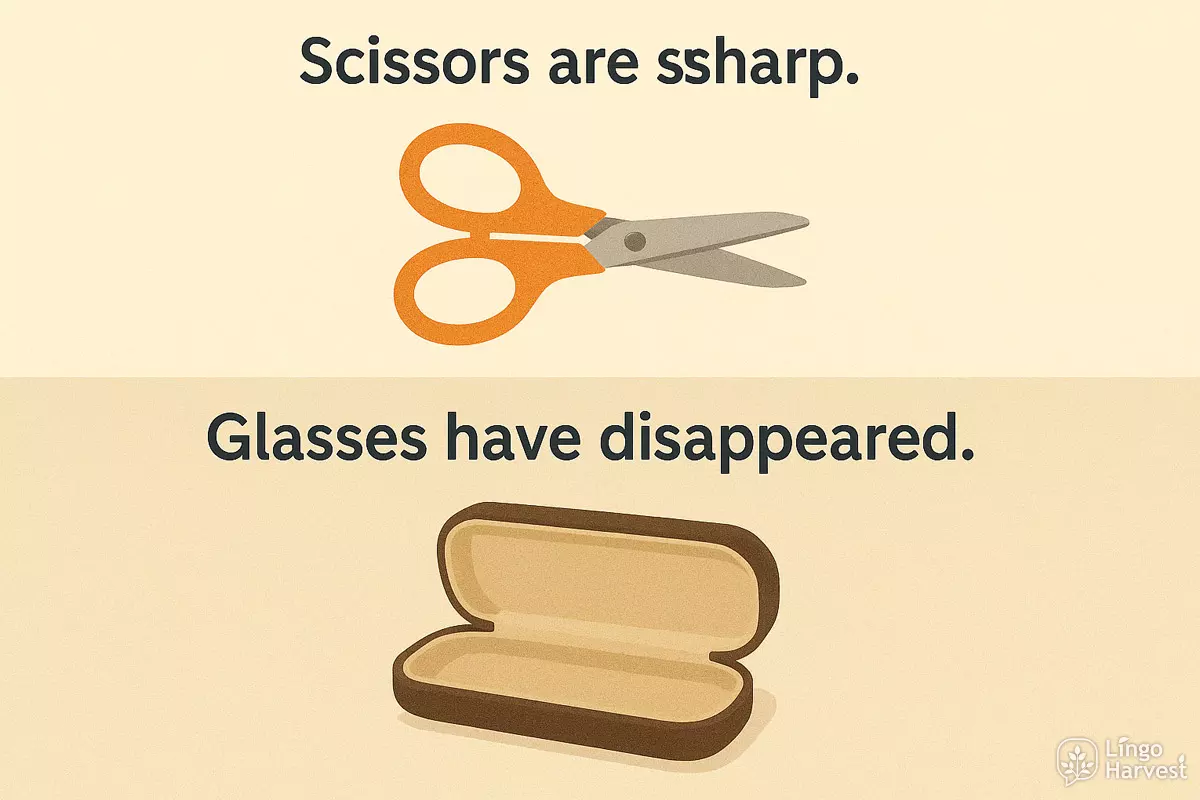
These words require plural verb forms. For example, you say "The scissors are on the table," not "The scissors is on the table." The same rule applies to other nouns that exist only in the plural form. Here are some common examples:
- Scissors are sharp.
- Pants were washed yesterday.
- Glasses have disappeared.
- Clothes need to be folded.
- Binoculars were expensive.
- Trousers are in the drawer.
- Headphones don’t work.
- Shorts were on sale.
- Pajamas are comfortable.
- Pliers belong to Sam.
- Sunglasses get lost easily.
- Jeans fit well.
- Shears need sharpening.
- Forceps are in the kit.
- Slacks have a stain.
Examples: Correct and incorrect verb forms
To make the pattern clear, let's look at some correct and incorrect uses:
- ✅ The pants are new. ❌ The pants is new.
- ✅ My glasses have scratches. ❌ My glasses has scratches.
- ✅ These scissors cut well. ❌ These scissors cuts well.
Comparing verb forms with plural-only and regular nouns
| Plural-Only Noun | Correct Verb Agreement | Singular Noun | Correct Verb Agreement |
|---|---|---|---|
| Pants | Pants are dirty. | Shirt | Shirt is dirty. |
| Scissors | Scissors have disappeared. | Knife | Knife has disappeared. |
| Glasses | Glasses were found. | Hat | Hat was found. |
| Clothes | Clothes need ironing. | Jacket | Jacket needs ironing. |
Key points to remember
- Always use plural verbs with these items, even if you mean a single object.
- Do not add "a" or "an" before plural-only nouns; say "a pair of scissors" if you want to specify one item.
- Pronouns should also be plural: "They are new," not "It is new."
This pattern helps make your English sound natural and accurate when talking about items that exist only in the plural form.
Talking about one item vs several with plural-only nouns
English has a quirky set of words—like "scissors," "pants," and "clothes"—that only appear in plural form, even when you mean just one item. These are called plural-only or pluralia tantum nouns. If you want to mention a single object, you can't just say "a scissor" or "a pant" in standard English. Instead, you need to use specific phrases or structures to clarify you mean one item instead of multiple.
How to specify a single item
To talk about just one object when the noun is always plural, English speakers usually add a counting word or a descriptive phrase. Some common patterns include:
- a pair of [noun] (e.g., a pair of scissors, a pair of pants)
- one item of [noun] (less common, more formal: one item of clothing)
- this/that [noun] (sometimes used, but context must make it clear you mean one)
If you want to refer to more than one, you can use "pairs" or just the plural noun, depending on context.
Examples: Singular vs. Plural Reference
Here are typical ways to express one or several items with these nouns:
- a pair of glasses → two pairs of glasses
- this pair of jeans → those jeans (implies multiple pairs or just the object in general)
- a pair of tweezers → several pairs of tweezers
- a pair of trousers → three pairs of trousers
- a pair of binoculars → four pairs of binoculars
- a pair of shorts → five pairs of shorts
- a pair of pliers → six pairs of pliers
- a pair of leggings → two pairs of leggings
- a pair of pajamas → multiple pairs of pajamas
- a pair of knickers → several pairs of knickers
- a pair of chopsticks → many pairs of chopsticks
- a pair of sunglasses → three pairs of sunglasses
- a pair of headphones → four pairs of headphones
Common Plural-Only Nouns and Their Usage
Some plural-only nouns are almost never used in the singular, and the "pair of" structure is the go-to choice. Here are a few of the most common examples:
- earrings → Her earrings were made of silver.
- handcuffs → The police removed the handcuffs.
- overalls → The mechanic’s overalls were covered in oil.
- pajama bottoms → The pajama bottoms were too loose.
- swim trunks → His swim trunks dried quickly.
- ski goggles → The ski goggles fogged up.
- reading glasses → My reading glasses are on the desk.
- kitchen tongs → The kitchen tongs are in the drawer.
- measuring scales → The measuring scales need calibration.
- fireworks → The fireworks lit up the sky.
- remains → The remains were found near the site.
- surroundings → The surroundings were quiet and peaceful.
- savings → Her savings are kept in a separate account.
- earnings → His earnings increased last year.
- outskirts → They live on the outskirts of the city.
Quick Comparison: Singular Reference Strategies
| Incorrect (Not Standard) | Correct (Standard English) |
|---|---|
| a scissor | a pair of scissors |
| a pant | a pair of pants |
| a clothe | an item of clothing |
| one binocular | a pair of binoculars |
| a tweezer | a pair of tweezers |
| a short | a pair of shorts |
| a glass (for eyeglasses) | a pair of glasses |
| a headphone | a pair of headphones |
When learning or using English, remember that for these plural-only nouns, you almost always need to use "a pair of" or a similar phrase to talk about just one item. This helps avoid confusion and keeps your language natural.
Comparing plural-only nouns to normal plural forms
English features a set of nouns that only appear in the plural form, even when they refer to a single object or concept. This stands in contrast to most nouns, which have clear singular and plural versions. Understanding the differences in usage, agreement, and meaning helps avoid common mistakes, especially with words like "scissors," "pants," and "clothes."
How plural-only nouns behave
Plural-only nouns, also known as pluralia tantum, don’t have a singular form that’s used in standard English for the item itself. For example, we say "these pants are new," not "this pant is new." This affects verb agreement (always plural) and the use of quantifiers or articles.
Standard plural nouns
Most English nouns can be singular or plural, simply by adding -s or -es. For instance, "book" becomes "books," and "cat" becomes "cats." These nouns can refer to one or more items, and the verb changes accordingly: "the book is on the table" vs. "the books are on the shelf."
Key differences in structure and use
- Verb agreement: Plural-only nouns always take plural verbs ("the scissors are"), while regular nouns shift ("the pencil is" vs. "the pencils are").
- Articles and determiners: You can't use "a" or "one" directly before plural-only nouns for a single object. Instead, use phrases like "a pair of scissors."
- Meaning: For plural-only nouns, the plural form is the default and often refers to a single item with two parts (like trousers) or a collective concept (like clothes).
Vocabulary: Plural-only vs. Regular Plural Nouns
| Plural-Only Nouns | Normal Plural Nouns |
|---|---|
| scissors | book/books |
| pants | apple/apples |
| trousers | car/cars |
| clothes | dog/dogs |
| glasses (eyewear) | student/students |
| binoculars | pen/pens |
| jeans | shoe/shoes |
| pliers | house/houses |
| shorts | cat/cats |
| tongs | tree/trees |
| pyjamas | child/children |
| spectacles | girl/girls |
Summary: When to use each type
When referring to objects with two joined parts or certain collective items, English requires the plural-only form. For most objects, standard pluralization rules apply. Remember: for items like "scissors" or "pants," use a plural verb and, if you need to specify one, say "a pair of..." instead of using a singular form. This distinction helps make your English sound more natural and accurate.
Practice: rewrite sentences using plural-only nouns
Understanding how to correctly use nouns that only have a plural form—such as "scissors," "pants," and "clothes"—is essential for clear English. These nouns do not have a singular version and always take plural verbs. Below, you'll find exercises to help you practice rewriting sentences by replacing singular nouns with their plural-only counterparts, ensuring grammatical accuracy.
Try changing the sentences below by substituting the underlined word with a plural-only noun. Pay attention to verb agreement and any needed changes in determiners or pronouns.
- I need a knife to cut this paper. → (Hint: a tool with two blades)
- She bought a new shirt for the party. → (Hint: general word for what you wear)
- The trouser is too long for me. → (Hint: plural-only clothing)
- He forgot his shoe at home. → (Hint: footwear, always plural)
- Can I borrow your glass to read this? → (Hint: something you wear to see)
- A binocular helps you see far away. → (Hint: optical device, plural form)
- The pyjama is comfortable. → (Hint: sleepwear, always plural)
- He put the spectacle on the table. → (Hint: formal word for glasses)
- I need a jean for the trip. → (Hint: denim clothing)
- She wore a short to the beach. → (Hint: summer clothing, plural)
Common Plural-Only Nouns: Usage Patterns
- Scissors are sharp. (Not "scissor is")
- Pants are on the chair. (Not "pant is")
- Clothes are clean. (Not "clothe is")
- Glasses help you see. (Not "glass helps")
- Binoculars are expensive. (Not "binocular is")
- Pyjamas are comfortable. (Not "pyjama is")
- Shorts are perfect for summer. (Not "short is")
- Trousers are formal. (Not "trouser is")
- Jeans are popular. (Not "jean is")
- Spectacles are on the desk. (Not "spectacle is")
- Pliers are in the toolbox. (Not "plier is")
- Headphones are broken. (Not "headphone is")
- Stairs are steep. (Not "stair is")
- Annals are historical records. (Not "annal is")
Show answers
- I need scissors to cut this paper.
- She bought new clothes for the party.
- The pants are too long for me.
- He forgot his shoes at home.
- Can I borrow your glasses to read this?
- Binoculars help you see far away.
- The pyjamas are comfortable.
- He put the spectacles on the table.
- I need jeans for the trip.
- She wore shorts to the beach.