Singular-Only Nouns in English: Information, Furniture, Advice

 The article defines singular-only or non-count nouns, gives key examples such as information and furniture, explains correct determiners and quantifiers, warns against incorrect plurals, lists common phrases, contrasts similar countable nouns, and provides practice.
- What singular-only or non-count nouns are
- Key examples: information, furniture, advice, luggage
- Correct determiners and quantifiers with singular-only nouns
- Avoiding wrong plurals like informations or furnitures
- Common phrases and collocations with these nouns
- Contrast with similar countable nouns learners confuse
- Practice: correct sentences with wrong plural endings
Have you ever wondered why we say pieces of advice or bits of furniture, but never advices or furnitures? In English, some nouns are uncountable, meaning they exist only in the singular form and don't follow the usual rule of adding an "s" for the plural. This peculiarity often confuses both learners and native speakers, as it defies regular grammar patterns. Words like advice, furniture, information, and luggage are examples of these uncountable nouns, requiring us to use phrases like pieces of advice or items of furniture instead.
What singular-only or non-count nouns are
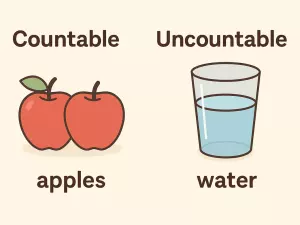
In English, some nouns do not have a plural form and are not used with the indefinite article (a or an). These are commonly called non-count nouns or mass nouns, and they refer to things that are seen as a whole, a mass, or a concept that cannot be separated into individual elements. For example, you can't say an information or furnitures; these words simply do not work in the plural or with “a/an.”
Non-count nouns cover a wide range of ideas, substances, and abstract concepts. They include things that are too small or too amorphous to count, as well as collective categories. This is why we say “some furniture” or “a piece of advice,” but not “furnitures” or “advices.”
Common Features of Non-Count Nouns
- They usually do not have a plural form (no “-s” ending).
- They cannot be used with the indefinite article (“a” or “an”).
- Quantifiers like “some,” “much,” or “a piece of” are often used instead.
- They often refer to abstract ideas, substances, or collective items.
Typical Examples
- advice → She gave me useful advice.
- furniture → The furniture in the apartment is new.
- information → This information is confidential.
- news → The news was unexpected.
- equipment → All the equipment is ready for use.
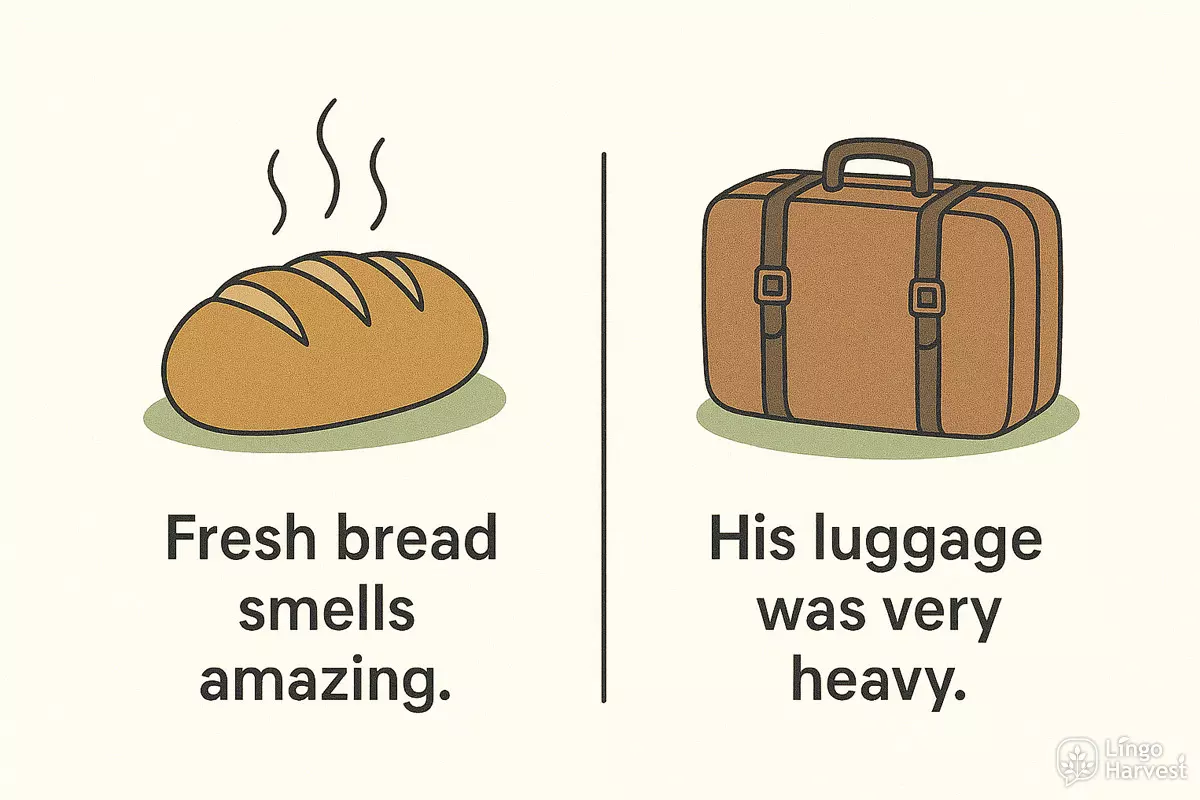
- bread → Fresh bread smells amazing.
- luggage → His luggage was very heavy.
- music → Music helps me relax after work.
- progress → She is making steady progress.
- research → The research takes several years.
- traffic → Traffic was terrible this morning.
- money → I don’t have enough money right now.
- water → Please drink more water.
- sand → The sand was hot under our feet.
- knowledge → Knowledge comes with experience.
- weather → The weather looks nice today.
- work → He has a lot of work to do.
- cheese → This cheese tastes great.
- homework → She finished her homework early.
- furniture → We bought new furniture for the office.
How to Refer to Specific Quantities
Because these nouns don’t have a plural, speakers use “containers” or “units” to specify amounts. For example:
- a piece of advice
- three pieces of furniture
- a bit of information
- two bottles of water
- a loaf of bread
Comparison with Count Nouns
| Count Nouns | Non-Count Nouns |
|---|---|
| Can be plural: books, chairs, apples |
No plural: information, furniture, advice |
| Used with “a/an”: a chair, an apple |
Not used with “a/an”: ❌ a furniture, ❌ an advice |
| Ask “How many?”: How many books? |
Ask “How much?”: How much information? |
| Quantified by numbers: three chairs |
Quantified by measures: a piece of furniture |
Understanding these special nouns helps avoid common mistakes and makes your English sound more natural. If you’re unsure, try rephrasing with “some,” “a piece of,” or another measure word.
Key examples: information, furniture, advice, luggage
Many English nouns refer to whole categories or collections and are used only in the singular. These words do not have a standard plural form and are not counted with numbers. Instead, they often require special phrases or quantifiers if you want to specify an amount. Let’s look at a few of the most common examples and see how they behave in sentences.
Common singular-only nouns
Some nouns are always singular because they represent abstract concepts, materials, or collective items. Here are several that English learners frequently encounter:
- Information → This information is very useful.
- Furniture → The furniture in the room is old.
- Advice → She gave me helpful advice.
- Luggage → His luggage was checked at the airport.
- Equipment → All the equipment is ready.
- News → The news was surprising.
- Baggage → Please collect your baggage at the carousel.
- Homework → He finished his homework on time.
- Progress → She is making good progress.
- Traffic → Traffic was heavy this morning.
- Knowledge → Knowledge grows with experience.
- Scenery → The scenery along the coast is beautiful.
- Research → The research focuses on climate change.
- Weather → The weather changed suddenly.
- Jewelry → Her jewelry was kept in a safe.
- Machinery → The machinery needs regular maintenance.
- Work (meaning employment or tasks) → He has a lot of work to do.
- Money → I don’t have enough money today.
- Music → Music helps people relax.
- Patience → Thank you for your patience.
How these nouns work in sentences
These words take singular verbs and do not use "a" or "an." For example, you say, "The information is useful," not "The informations are useful." When you want to talk about a specific amount, you need to use phrases like "a piece of," "an item of," or "some." For instance: "Can I give you a piece of advice?" or "He bought two pieces of furniture."
Comparing correct and incorrect usage
| Incorrect ❌ | Correct ✅ |
|---|---|
| She gave me many advices. | She gave me some advice. |
| There are a lot of informations. | There is a lot of information. |
| I bought three furnitures. | I bought three pieces of furniture. |
| Where are your luggages? | Where is your luggage? |
Choosing the right quantifier
When you need to count or specify an amount, use expressions such as:
- A piece of advice
- Two items of furniture
- Some information
- Several pieces of luggage
- A bit of news
- Much equipment
Getting used to these patterns will help you sound more natural and avoid common mistakes with singular-only nouns.
Correct determiners and quantifiers with singular-only nouns
When using nouns like information, furniture, or advice, it's important to remember that these words do not take plural forms and do not work with plural determiners or quantifiers. Instead, English uses specific words and phrases to talk about amount or quantity with these uncountable nouns.
Common quantifiers and determiners for uncountable nouns
Some determiners naturally fit with singular-only nouns, while others are incorrect. Here are typical options:
- some information / advice / furniture
- much information / advice / furniture
- a little advice / information
- any furniture / advice
- no information / advice / furniture
- a piece of advice / information / furniture
- a bit of information / advice
- a great deal of information / advice
- this information / advice / furniture
- that advice / information
- enough information / advice
- little advice / information
Incorrect quantifiers to avoid
Certain quantifiers and determiners are never used with these nouns. For example, you should not say many informations or these furnitures. Compare the correct and incorrect forms in the table below:
| ❌ Incorrect | ✅ Correct |
|---|---|
| many informations | much information |
| these advices | this advice |
| a furniture | a piece of furniture |
| few informations | little information |
Tips for natural usage
- Use a piece of, a bit of, or an item of (less common) to refer to single units.
- To express quantity, prefer much, little, or some rather than plural forms.
- Do not add -s to these nouns.
- Do not use many or few with these nouns.
- Choosing the right structure helps your English sound natural and precise, especially with nouns that always stay singular.
Avoiding wrong plurals like informations or furnitures
Many English learners are tempted to add an “-s” to certain words, thinking it will make them plural. However, some nouns—known as uncountable or mass nouns—do not have a plural form in English, even though their equivalents in other languages might. Using forms like “informations” or “furnitures” is incorrect. Native speakers will always use these words in the singular, regardless of quantity.
Common Uncountable Nouns That Don’t Take Plurals

Here are some nouns that are always singular in English, even when referring to more than one item or piece:
- information → This information is very important.
- furniture → The furniture in the office is modern.
- advice → She gave me useful advice.
- equipment → All the equipment is ready for use.
- luggage → His luggage was heavy.
- news → The news was shocking.
- bread → Fresh bread smells great.
- homework → He finished his homework early.
- clothing → Her clothing is suitable for cold weather.
- software → This software runs smoothly.
- traffic → Traffic was terrible this morning.
- work (as a task, not artwork) → I still have a lot of work to do.
- research → The research takes several years.
- progress → She is making steady progress.
- knowledge → Knowledge comes with experience.
- scenery → The scenery along the coast is beautiful.
- weather → The weather changed suddenly.
- music → Music helps me relax.
- evidence → The police found new evidence.
- money → I don’t have enough money right now.
Correct Usage Patterns
To express quantity with these nouns, use words like “some,” “a piece of,” “a bit of,” or other quantifiers. For example:
- Correct: I need some information. ✅
- Incorrect: I need informations. ❌
- Correct: She bought new furniture. ✅
- Incorrect: She bought furnitures. ❌
- Correct: He gave me good advice. ✅
- Incorrect: He gave me advices. ❌
Why These Mistakes Happen
Often, these errors come from direct translation. In many languages, words like “information” or “furniture” can take a plural form. Recognizing which English nouns don’t change is key to sounding natural.
Quick Reference: Singular-Only Nouns vs. Countable Nouns
| Singular-Only Noun (Uncountable) | Countable Equivalent or Correct Expression |
|---|---|
| information | a piece of information, details, facts |
| furniture | a chair, a table, pieces of furniture |
| advice | a tip, a suggestion, some advice |
| equipment | a tool, an instrument, items of equipment |
| luggage | a suitcase, a bag, pieces of luggage |
| news | a news story, a report, some news |
| research | a study, a paper, research projects |
| money | a coin, a bill, amounts of money |
| evidence | a clue, a proof, pieces of evidence |
| work | a task, a job, assignments |
Summary
Remember: if you’re unsure whether a noun can be pluralized, check a dictionary or reliable reference. Avoid adding “-s” to nouns like “information” and “furniture”—instead, use quantifiers or find a suitable countable expression. This habit will help your English sound more natural and accurate.
Common phrases and collocations with these nouns
Understanding how certain uncountable nouns are used in everyday English can help avoid common mistakes. Words like "information," "furniture," and "advice" rarely appear with "a" or in the plural, but they frequently combine with specific verbs, adjectives, and quantifiers to form natural-sounding phrases.
Typical ways to use "information"
The noun "information" often appears with verbs like "give," "provide," or "receive." It's also common with quantifiers (such as "some" or "a piece of") and adjectives to specify the kind or amount. Here are some frequent combinations:
- give information
- provide information
- seek information
- useful information
- a piece of information
- confidential information
- further information
- accurate information
- gather information
- request information
Common pairings with "furniture"
"Furniture" is another noun that doesn’t take a plural form or an indefinite article. It often combines with adjectives or quantifiers, and sometimes with verbs related to arrangement or purchase:
- buy furniture
- new furniture
- modern furniture
- office furniture
- a piece of furniture
- move furniture
- assemble furniture
- antique furniture
- heavy furniture
- arrange furniture
Useful expressions with "advice"
"Advice" is always singular and is usually paired with verbs like "give" or "offer," as well as adjectives that describe its quality. To talk about specific suggestions, use "a piece of advice":
- give advice
- ask for advice
- follow advice
- sound advice
- a piece of advice
- good advice
- seek advice
- offer advice
- ignore advice
- take advice
Comparing collocations: "information," "furniture," and "advice"
The table below shows how each noun pairs with quantifiers and the phrase "a piece of," which is often used to refer to one item or unit of these uncountable nouns.
| Noun | With Quantifiers | With "a piece of" |
|---|---|---|
| information | some information, much information, a lot of information | a piece of information |
| furniture | some furniture, much furniture, a lot of furniture | a piece of furniture |
| advice | some advice, much advice, a lot of advice | a piece of advice |
These patterns help English learners avoid errors like using "informations" or "furnitures." Instead, stick to the structures above for natural, fluent expression.
Contrast with similar countable nouns learners confuse
Learners often mix up singular-only nouns like information, furniture, and advice with similar words that can be counted. This confusion leads to mistakes such as using informations or saying an advice. Understanding the difference between these mass nouns and their countable counterparts helps avoid common errors in English.
Countable vs. Uncountable: Common Mix-Ups
Some nouns that look or sound similar have different grammar rules. Here are examples of confusing pairs:
- Information (uncountable) vs. Fact (countable)
- Advice (uncountable) vs. Tip, Suggestion (countable)
- Furniture (uncountable) vs. Chair, Table, Sofa (countable)
- Equipment (uncountable) vs. Tool, Device (countable)
- Luggage (uncountable) vs. Bag, Suitcase (countable)
- News (uncountable) vs. Report, Story (countable)
- Work (uncountable) vs. Job, Task (countable)
- Homework (uncountable) vs. Assignment (countable)
- Clothing (uncountable) vs. Shirt, Skirt (countable)
- Money (uncountable) vs. Coin, Dollar (countable)
Comparing Correct and Incorrect Usage
| Uncountable Noun (Singular-Only) | Countable Alternative | Correct Example | Incorrect Example |
|---|---|---|---|
| Information | Fact | I need some information. / I found three facts. | ❌ I need an information. / ❌ I found three informations. |
| Advice | Tip, Suggestion | She gave me good advice. / She gave me two tips. | ❌ She gave me an advice. / ❌ She gave me two advices. |
| Furniture | Chair, Table | We bought new furniture. / We bought three chairs. | ❌ We bought a furniture. / ❌ We bought three furnitures. |
| Equipment | Tool | The equipment is expensive. / The tools are expensive. | ❌ The equipments are expensive. |
Tips to Remember
- Uncountable nouns like information don’t use “a/an” or plural “-s”.
- To count, use a phrase: a piece of advice, a bit of information, an item of furniture.
- If you want to specify number, switch to a countable synonym: two facts, three tips, five chairs.
Getting familiar with which nouns are always singular and which can be counted will help you sound more natural and accurate in English conversations and writing.
Practice: correct sentences with wrong plural endings
Understanding which English nouns do not take a plural form is essential for clear and correct communication. Many learners mistakenly add –s or –es to words like "information" or "advice," even though these nouns are singular only. Below, you'll find practice sentences and explanations to help you spot and fix these common errors.
Spot the Mistake: Which Word Should Not Be Plural?
Read each sentence below. One word in each sentence is incorrectly pluralized. Identify the mistake and rewrite the sentence using the correct form.
- She gave me many helpful advices before my exam.
- We bought some new furnitures for the office last week.
- Do you have any informations about the schedule?
- He offered several useful advices during the meeting.
- The teacher provided important informations for the project.
- They moved the furnitures into the new apartment.
- I need more advices on how to improve my writing.
- There are too many informations to remember all at once.
- All the furnitures in this room are antique.
- Can you give me some advices about traveling in England?
Show answers
- She gave me much helpful advice before my exam.
- We bought some new furniture for the office last week.
- Do you have any information about the schedule?
- He offered several useful pieces of advice during the meeting.
- The teacher provided important information for the project.
- They moved the furniture into the new apartment.
- I need more advice on how to improve my writing.
- There is too much information to remember all at once.
- All the furniture in this room is antique.
- Can you give me some advice about traveling in England?
How to Express Quantity with Singular-Only Nouns
Words like "information," "furniture," and "advice" do not take regular plural endings. To talk about more than one piece, use expressions like "some," "much," or "a piece of." Here are common patterns:
- a piece of advice
- some information
- much furniture
- two pieces of furniture
- a bit of advice
- several pieces of information
- lots of advice
- a little information
- no furniture
- plenty of advice
Comparison Table: Wrong vs. Correct Forms
| Incorrect Plural | Correct Usage |
|---|---|
| advices | advice / pieces of advice |
| furnitures | furniture / pieces of furniture |
| informations | information / pieces of information |
Quick Correction Challenge
Rewrite the following sentences using the correct singular-only forms:
- He found three informations on the website.
- We received many advices from our mentor.
- The movers carried the furnitures upstairs.
- She gave me two advices before the interview.
- I read several informations about the course.
- They bought new equipments for the studio.
- The police gave us some informations about the case.
- Our luggages were too heavy to lift.
- He shared many feedbacks after the presentation.
- Can you send me those researches by email?
Show answers
- He found three pieces of information on the website.
- We received much advice from our mentor.
- The movers carried the furniture upstairs.
- She gave me two pieces of advice before the interview.
- I read some information about the course.
- They bought new equipment for the studio.
- The police gave us some information about the case.
- Our luggage was too heavy to lift.
- He shared some feedback after the presentation.
- Can you send me that research by email?
Remember, not every English noun can be made plural with –s or –es. Use these patterns and corrections to sound more natural and accurate when speaking or writing.