Countability Errors in Global English and How to Avoid Them

 The article reviews countable and uncountable nouns, highlights tricky differences and nouns with changing meanings, explains words like some and many, discusses global English influences, and gives strategies and practice for using correct forms in context.
- Review of countable vs uncountable noun categories
- Typical countability differences that confuse learners
- Nouns that change meaning when countable or uncountable
- Correct use of some, any, many, much, and a piece of
- Global English influences on countability choices
- Strategies for learning tricky countable and mass nouns
- Practice: choose correct forms in real-life mini dialogues
Many English learners, as well as fluent speakers, often struggle with the challenge of using count and noncount nouns correctly, which frequently results in communication mistakes. Mastering the distinction between these two types of nouns is essential for conveying ideas accurately and avoiding confusion in both spoken and written English. By learning and practicing the rules surrounding count and noncount nouns, you can improve your clarity and confidence when interacting with people from diverse backgrounds, making your communication more effective overall.
Review of countable vs uncountable noun categories
Understanding the distinction between nouns that can be counted and those that cannot is essential for accuracy in English grammar. Countable nouns refer to items that can be separated and counted individually, while uncountable nouns refer to substances or concepts that are not easily divided into discrete units.
What are countable nouns?
Countable nouns describe things that can be counted as individual elements. They have both singular and plural forms and can be used with numbers and articles like "a" or "an."
- apple / apples → She bought apples for the pie.
- idea / ideas → We discussed several ideas during the meeting.
- book / books → The books are on the shelf.
- child / children → The children are playing outside.
- car / cars → Many cars were parked near the mall.
- dog / dogs → Dogs need daily exercise.
- country / countries → She has visited five countries.
- student / students → The students listened carefully.
- table / tables → The café placed extra tables outside.
- coin / coins → He collected old coins.
What are uncountable nouns?
Uncountable nouns refer to materials, substances, concepts, or qualities that cannot be counted individually. They do not typically have a plural form and are not used with "a" or "an."
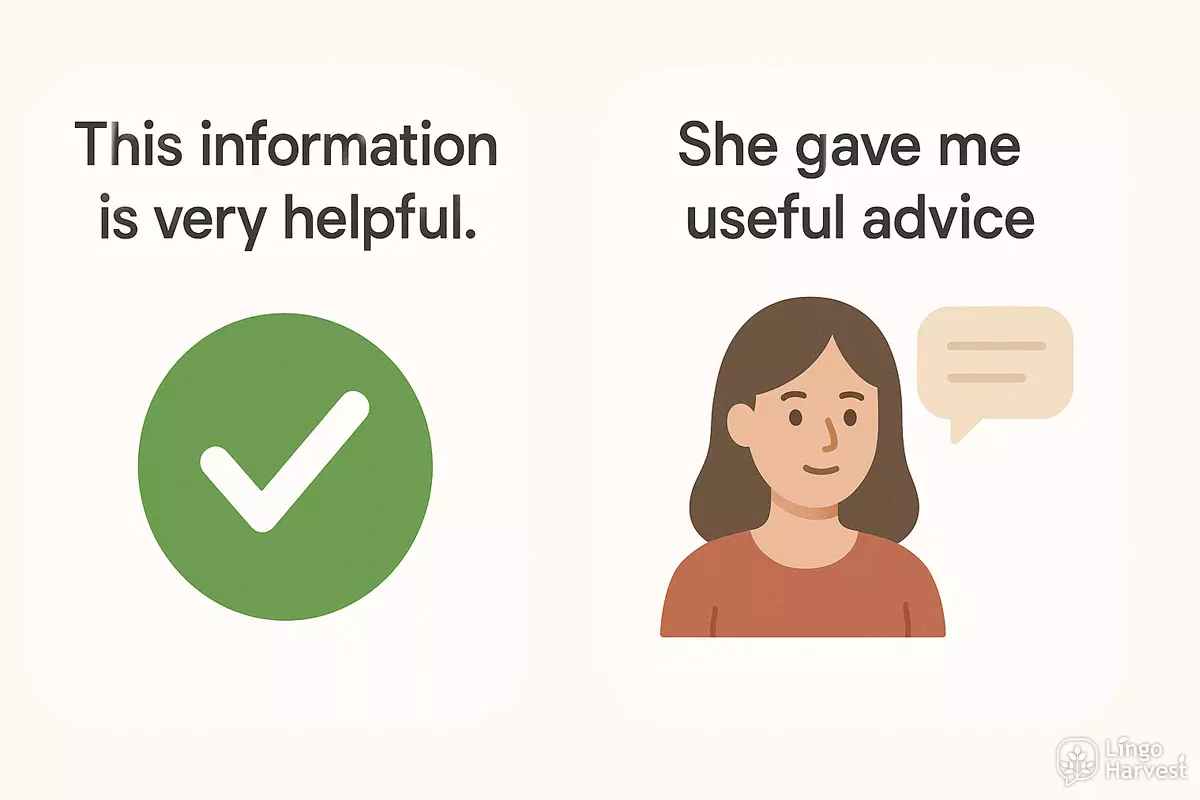
- information → This information is very helpful.
- advice → She gave me useful advice.
- money → I don’t have enough money today.
- furniture → The furniture in this room is new.
- water → Please drink more water.
- rice → Rice is a staple food in many countries.
- music → Music helps me relax.
- happiness → Happiness comes from simple things.
- bread → Fresh bread smells amazing.
- equipment → All the equipment is ready.
- luggage → Her luggage was very heavy.
- traffic → Traffic was terrible this morning.
- research → The research takes several years.
- news → The news was surprising.
- sand → The sand was hot under our feet.
- air → The air feels clean here.
Main differences at a glance
| Countable Nouns | Uncountable Nouns |
|---|---|
| Can use numbers: three chairs | Cannot use numbers directly: ❌ three bread |
| Take plural form: books | No plural form: furniture |
| Use "a"/"an": a cat | Do not use "a"/"an": ❌ a milk |
| Can use "many," "few": many cars, few ideas | Can use "much," "little": much time, little traffic |
Common mistakes and how to avoid them
Learners often confuse these categories, especially with nouns that have different countability in other languages. Some errors include using plural forms with uncountable nouns or using "a" before an uncountable noun. To avoid these, remember:
- Use quantifiers like some, a piece of, a bit of for uncountable nouns (e.g., a piece of advice).
- Do not add an "s" to uncountable nouns (e.g., informations ❌).
- For countable nouns, use numbers and plural forms as needed (e.g., five apples).
- Check if a noun changes meaning with countability (e.g., chicken as an animal is countable, as food is uncountable).
Practice: Identify the noun type
Decide whether each noun is countable or uncountable:
- Advice
- Table
- News
- Student
- Water
- Information
- Chair
- Money
- Book
- Furniture
Show answers
- Advice – Uncountable
- Table – Countable
- News – Uncountable
- Student – Countable
- Water – Uncountable
- Information – Uncountable
- Chair – Countable
- Money – Uncountable
- Book – Countable
- Furniture – Uncountable
Typical countability differences that confuse learners
English learners often stumble over which nouns are countable and which are uncountable, especially when their native language treats these categories differently. Some nouns that can be counted in one language are “mass nouns” in English, while others that seem “uncountable” elsewhere take plurals in English. This mismatch causes frequent mistakes in articles, quantifiers, and verb agreement.
Common uncountable nouns that learners try to count
Many everyday words in English are “uncountable,” meaning they don’t usually take an “-s” ending or pair with numbers directly. Learners may try to say “informations” or “furnitures,” but these forms are incorrect. Here are some typical uncountable nouns that often cause confusion:
- advice → She gave me useful advice.
- bread → Fresh bread smells wonderful.
- furniture → The furniture in the office is modern.
- homework → He finished his homework early.
- information → This information is very important.
- luggage → Her luggage was heavy.
- money → I don’t have enough money today.
- news → The news was unexpected.
- progress → She is making good progress.
- traffic → Traffic was heavy this morning.
- weather → The weather looks nice today.
- work → He has a lot of work to do.
To specify quantities, English uses phrases like “a piece of advice,” “two loaves of bread,” or “three pieces of furniture,” rather than pluralizing the noun itself.
Nouns that change countability in context
Some nouns can be either countable or uncountable, depending on meaning. For instance, “chicken” (the meat, uncountable) vs. “a chicken” (the animal, countable). This flexibility can be tricky for learners to master.
| Noun | Uncountable (Mass/Abstract) | Countable (Specific/Individual) |
|---|---|---|
| Chicken | I ate chicken for lunch. | There are three chickens in the yard. |
| Paper | I need some paper to write on. | She submitted two papers to the conference. |
| Glass | The table is made of glass. | He drank two glasses of water. |
| Experience | She has a lot of experience. | He told three interesting experiences. |
False friends and native language interference
Some errors come from “false friends,” where a noun is countable in one language but not in English, or vice versa. For example, “advice” is countable in French (“un conseil”), but not in English. Learners may also transfer habits from their own language when using quantifiers like “much,” “many,” “few,” or “little,” leading to sentences like “so much advices” or “few informations.”
Tricky quantifiers and determiners
Choosing the right quantifier is another hurdle. Use “much” or “little” for uncountable nouns (e.g., “much information”), and “many” or “few” for countable nouns (e.g., “many books”). This distinction often requires practice, as even advanced learners occasionally mix them up.
- Correct: much homework ✅
- Incorrect: many homework ❌
- Correct: many problems ✅
- Incorrect: much problems ❌
Mastering these differences helps learners sound more natural and avoids misunderstandings. Being aware of such countability patterns, and checking a reliable dictionary when in doubt, can make a big difference in accuracy.
Nouns that change meaning when countable or uncountable
Many English nouns can be both countable and uncountable, but their meaning may shift depending on how they are used. This subtlety often leads to confusion, especially for learners from languages without this distinction. Understanding these differences can help avoid misunderstandings and improve clarity in communication.
How meaning shifts with countability
When a noun is countable, it often refers to separate, individual items. When uncountable, it may refer to a general idea, a mass, or an abstract concept. These changes can be significant, sometimes altering the entire sense of a sentence.
- Paper: "a paper" means a newspaper or academic article; "paper" (uncountable) refers to the material.
- Light: "a light" is a lamp or source of illumination; "light" (uncountable) means brightness or daylight in general.
- Chicken: "a chicken" refers to the animal; "chicken" (uncountable) is the meat.
- Glass: "a glass" is a drinking vessel; "glass" (uncountable) is the material.
- Iron: "an iron" is a tool for pressing clothes; "iron" (uncountable) is the metal.
- Experience: "an experience" is a specific event; "experience" (uncountable) refers to knowledge or skill gained over time.
- Room: "a room" is a part of a building; "room" (uncountable) means space.
- Work: "a work" is a creation (like a painting); "work" (uncountable) means employment or labour.
- Hair: "a hair" is one strand; "hair" (uncountable) is all the hair collectively.
- Time: "a time" refers to an occasion or event; "time" (uncountable) is the general concept of time passing.
- Wood: "a wood" is a small forest; "wood" (uncountable) is the material.
- Chocolate: "a chocolate" is a single piece; "chocolate" (uncountable) is the substance or flavour.
- Business: "a business" is a company; "business" (uncountable) is commercial activity in general.
- Toast: "a toast" is a speech; "toast" (uncountable) is the food (toasted bread).
- Damage: "damages" (countable, usually plural) means compensation; "damage" (uncountable) is harm or injury.
- Order: "an order" is a request or command; "order" (uncountable) means organization or tidiness.
- Fruit: "a fruit" is a kind or piece; "fruit" (uncountable) is the category in general.
- Noise: "a noise" is a specific sound; "noise" (uncountable) is sound in general, often unpleasant.
- Success: "a success" is a particular achievement; "success" (uncountable) is the state of achieving goals.
Side-by-side comparison of key examples
| Noun | Countable Usage | Uncountable Usage |
|---|---|---|
| Paper | He wrote a paper on economics. ✅ | We need paper for the printer. ✅ |
| Experience | That was an experience I'll never forget. ✅ | She has a lot of experience in teaching. ✅ |
| Glass | Could I have a glass of water? ✅ | The window is made of glass. ✅ |
| Chicken | There is a chicken in the yard. ✅ | We had chicken for dinner. ✅ |
| Hair | There is a hair in my soup. ✅ | She has long, beautiful hair. ✅ |
| Light | Turn on a light please. ✅ | There is not enough light in this room. ✅ |
Mastering these distinctions can prevent common countability mistakes and help you sound more natural in English. If you are unsure, consider the context and whether you mean a specific item or a general concept. Over time, noticing these patterns will make your English clearer and more precise.
Correct use of some, any, many, much, and a piece of
Understanding when to use words like some, any, many, much, and a piece of can help you avoid common mistakes with countable and uncountable nouns. Each of these quantifiers has its own context and rules, and using them accurately improves clarity in both spoken and written English.
When to use "some" and "any"
Both some and any are used with plural countable nouns and uncountable nouns, but they appear in different types of sentences:
- Some is typically used in positive statements: We need some eggs.
- Any is common in questions and negatives: Do you have any bread?, There isn’t any water left.
- In polite offers or requests, some can also be used: Would you like some coffee?
How to choose between "many" and "much"
The choice between many and much depends on whether the noun is countable or uncountable:
| Quantifier | Used with | Example |
|---|---|---|
| many | Countable nouns (plural) | How many apples are there? |
| much | Uncountable nouns | How much money do you need? |
Using "a piece of" with uncountable nouns
Some nouns don’t have a plural form and can’t be counted directly (for example, information, advice, furniture). To talk about a single unit, use a piece of:
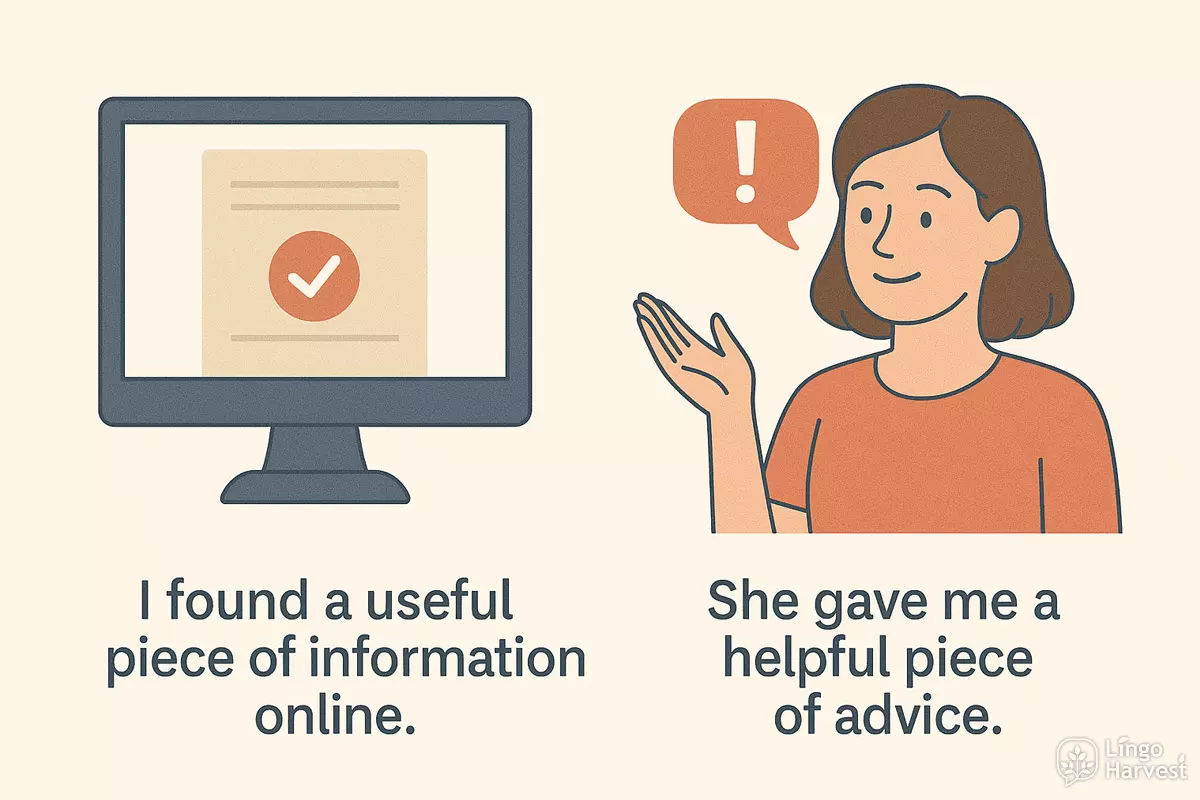
- a piece of information → I found a useful piece of information online.
- a piece of advice → She gave me a helpful piece of advice.
- a piece of furniture → We bought a new piece of furniture for the living room.
- a piece of cake → He offered me a piece of cake after dinner.
- a piece of news → I have an interesting piece of news to share.
- a piece of luggage → She checked one piece of luggage at the airport.
- a piece of music → This piece of music is very relaxing.
- a piece of evidence → The police found a crucial piece of evidence.
- a piece of paper → Please sign this piece of paper.
- a piece of equipment → Each piece of equipment was tested carefully.
Quick reference tips
- Use some for positive statements and polite offers/requests.
- Use any in negatives and questions.
- Many goes with things you can count (books, cars, ideas).
- Much is for things you can’t count (water, time, sugar).
- For uncountable nouns, use a piece of to refer to a single item or portion.
Becoming familiar with these patterns will help you communicate more naturally and avoid typical mistakes with quantifiers in English.
Global English influences on countability choices
Variations in English around the world often lead to confusion about which nouns are countable and which are not. Learners frequently encounter differences in usage due to contact with local languages, education systems, and exposure to different varieties of English. This means that what is considered correct in one context may sound odd or even incorrect in another.
How different Englishes affect count noun decisions
Speakers of various English dialects, such as Indian, Nigerian, Singaporean, and Filipino English, may treat certain nouns differently from how they are used in American or British English. For instance, some global varieties use "furnitures" or "equipments" as plural count nouns, while standard English treats "furniture" and "equipment" as uncountable.
Common influences from other languages
Mother tongues often shape how English users view nouns. If someone's first language marks more nouns as countable, they may carry this habit into English. Additionally, direct translations can lead to phrases like "informations," "advices," or "sceneries," which are ungrammatical in standard varieties but widespread in international contexts.
Typical countability shifts in global contexts
- Using "feedbacks" instead of "feedback" (uncountable in standard English)
- Referring to "softwares" or "hardwares"
- Saying "luggages" instead of "luggage"
- Using "staffs" to mean multiple employees
- Talking about "researches" (when referring to academic work in general)
- Pluralizing "evidence" as "evidences"
- "Informations" for multiple pieces of information
- "Baggages" instead of "baggage"
- "Furnitures" for items of furniture
- "Equipments" for different items of equipment
- Using "homeworks" for assignments
- Referring to "works" for tasks or jobs (rather than "work" as an uncountable noun)
- "Advices" instead of the uncountable "advice"
- Talking about "sceneries" for different views
- Using "newses" when referring to multiple reports
- "Meats" for types of meat
- Referring to "waters" when talking about different kinds of water
- "Poetries" for poems or poetic works
Comparison of noun usage in different English varieties
| Noun | Standard English | Global English Variants |
|---|---|---|
| Equipment | Uncountable ("new equipment") | Often pluralized ("equipments") |
| Advice | Uncountable ("some advice") | Often pluralized ("advices") |
| Staff | Uncountable or collective ("the staff are...") | Pluralized for individuals ("staffs") |
| Information | Uncountable ("much information") | Pluralized ("informations") |
| Furniture | Uncountable ("some furniture") | Pluralized ("furnitures") |
| Research | Uncountable ("recent research") | Pluralized ("researches") |
Why these patterns matter
Understanding these global influences is crucial for anyone working or communicating in international settings. While these forms may be widely accepted locally, they can lead to misunderstandings or be marked as errors in academic or professional contexts. Recognizing the roots of these patterns helps learners and teachers prioritize which forms to adopt or avoid, depending on their goals and audiences.
Strategies for learning tricky countable and mass nouns
Understanding which nouns are countable or uncountable can be challenging, especially when direct translations from other languages don’t match English usage. The best way to master these nuances is to combine memorization with practical exposure and pattern recognition.
Notice Common Patterns and Exceptions
Many mass nouns refer to substances, qualities, or abstract ideas (like "water," "advice," or "information"), while countable nouns usually name individual objects or people. However, there are many exceptions, so it’s helpful to focus on patterns but stay alert for outliers.
- Countable: apple, chair, idea, mistake, suggestion, suitcase, opportunity, dog, friend, car
- Uncountable: rice, furniture, news, knowledge, equipment, luggage, advice, bread, traffic, money
Use Memory Tricks and Visual Cues
Associating nouns with images or sample phrases can help. For instance, visualize a pile of "furniture" (not "furnitures") or a single "piece of advice" (not "an advice"). Create flashcards with example sentences or group nouns by categories, like "food," "abstract concepts," or "materials."
Practice with Real Sentences
Exposure to authentic English is essential. Pay attention to how native speakers use quantifiers such as "much," "many," "few," "a little," and "a lot of." Notice which nouns appear with "a/an" or plural endings. Reading and listening regularly will reinforce the correct forms.
Learn with Structured Comparisons
Some nouns change meaning depending on countability. Here’s a table illustrating common examples:
| Noun | Countable Usage | Uncountable Usage |
|---|---|---|
| Paper | A newspaper, an essay (e.g., "three papers") | Material for writing/printing (e.g., "some paper") |
| Chicken | A bird/animal (e.g., "two chickens") | Meat/food (e.g., "some chicken") |
| Light | Lamps or sources (e.g., "two lights") | Brightness (e.g., "some light") |
| Experience | Specific events (e.g., "two experiences") | General knowledge/skill (e.g., "much experience") |
| Time | Occasions (e.g., "three times") | General duration (e.g., "not much time") |
Build a List of Tricky Words
Some English nouns are especially confusing for learners. Keeping a personal list of these can help you avoid classic mistakes. Here are a few worth memorizing:
- Information (never "informations")
- Advice (never "advices")
- News (always singular, uncountable)
- Accommodation (uncountable in British English)
- Progress (never "progresses")
- Homework (uncountable)
- Furniture (uncountable)
- Equipment (uncountable)
- Scenery (uncountable)
- Baggage/luggage (uncountable)
- Traffic (uncountable)
- Work (uncountable for employment/labor)
- Toast (uncountable for the food; "a toast" for a speech)
- Damage (uncountable)
- Research (uncountable)
- Weather (uncountable)
Check Yourself with Quantifiers
A practical way to test if a noun is uncountable is to try using it with "many" or "a few." If it sounds odd ("many advice" ❌), it’s probably uncountable. Use "much" or "a little" for these nouns.
Final Tips
Regularly review your notes, ask teachers or native speakers when unsure, and don’t be afraid to make mistakes. Over time, with enough exposure and practice, distinguishing between countable and mass nouns will become more intuitive.
Practice: choose correct forms in real-life mini dialogues
Mastering when to use countable or uncountable nouns can be tricky, especially in everyday exchanges. Below, you'll find mini-dialogues modeled on real-life situations where choosing the right form is essential for clarity and correctness. Read each scenario, then select the most appropriate option from the choices provided.
Choose the correct word or form in each dialogue
-
At a café:
A: Would you like some coffee / a coffee?
B: Yes, I'd love some / a. -
In the office:
A: I have informations / some information about the meeting.
B: Great! Is it important / an important? -
Shopping:
A: How many luggages / pieces of luggage do you have?
B: Just one / a. -
At home:
A: Can you give me an advice / some advice about this recipe?
B: Sure! Add less / fewer salt next time. -
In a classroom:
A: I need a paper / some paper to take notes.
B: Here’s one / some. -
Travel:
A: Do you have any news / any new about the flight?
B: Yes, there is a delay / some delay. -
Cooking:
A: We need an equipment / some equipment for baking.
B: I have some / a mixer we can use. -
At the store:
A: Are there much apples / many apples left?
B: Only a few / a little. -
Chatting:
A: Do you have some time / a time to talk?
B: Yes, I have a few / a little minutes. -
On the phone:
A: Can I ask you a question / a questions?
B: Of course! Go ahead.
Common countability confusion: quick checks
- Advice: uncountable (never "an advice")
- Information: uncountable (not "informations")
- Luggage: uncountable (use "pieces of luggage" for quantity)
- News: uncountable (never "a news")
- Equipment: uncountable (not "equipments")
- Paper: uncountable for material, countable for individual documents ("a paper")
- Time: uncountable for duration, countable for events ("a time" = an occasion)
- Money: uncountable (not "monies" in everyday English)
- Furniture: uncountable (not "furnitures")
- Travel: uncountable when referring to general activity, countable for individual trips ("a travel" is incorrect)
Show answers
- some coffee / some
- some information / important
- pieces of luggage / one
- some advice / less
- some paper / some
- any news / a delay
- some equipment / a
- many apples / a few
- some time / a few
- a question