Noun Stress Patterns in English Pronunciation for Beginners

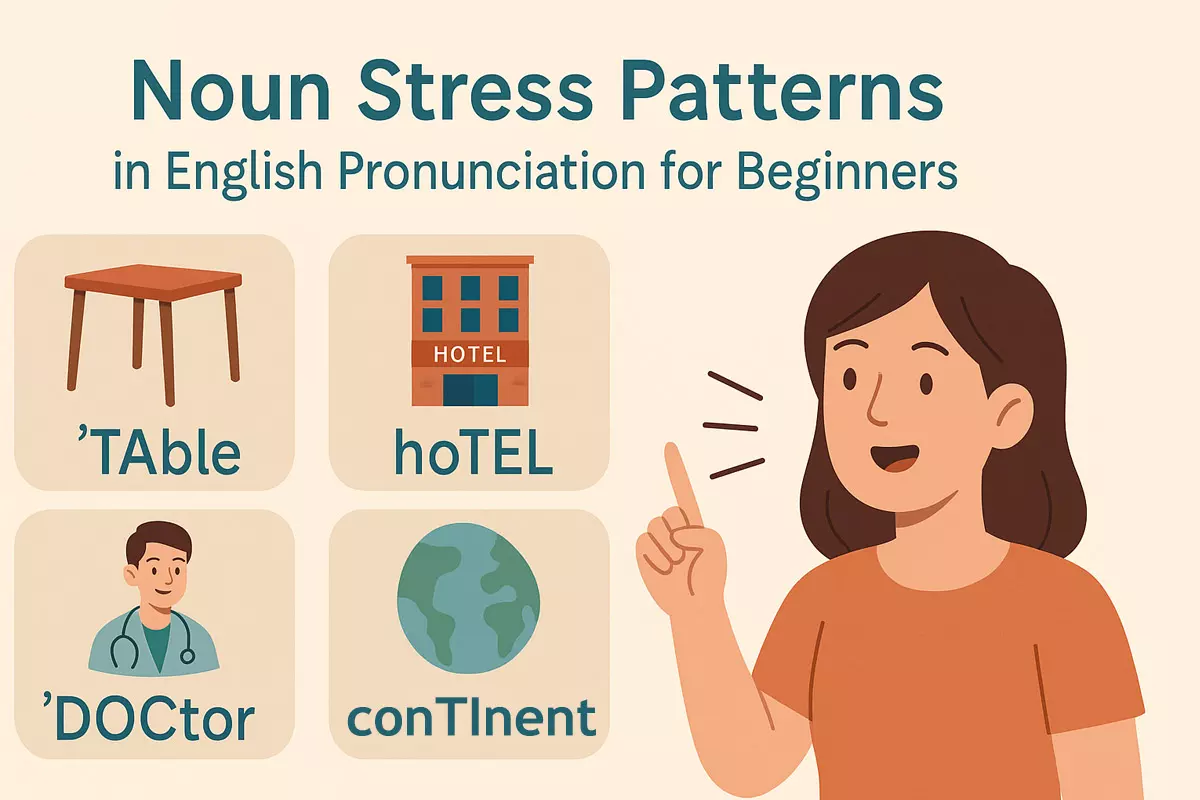 The article explains the importance of word stress for clear English pronunciation, reviews stress patterns in nouns (including noun–verb pairs and multi-syllable words), discusses how stress affects comprehension, and offers practice to avoid common mistakes.
- Why word stress matters for clear English pronunciation
- Basic stress patterns in one-syllable and two-syllable nouns
- Common noun–verb stress pairs like record and present
- Multi-syllable noun stress patterns with examples
- How stress patterns affect listening and comprehension
- Typical pronunciation mistakes with noun stress
- Practice: listen, repeat, and mark stress in common nouns
Learning to place emphasis on the correct syllables in simple English words helps your speech become clearer and more natural. If you are a beginner, focusing on how to stress nouns correctly is a practical way to improve your pronunciation and boost your confidence when speaking. With regular practice and attention to syllable stress patterns, you will find it easier to communicate and be understood in everyday conversations.
Why word stress matters for clear English pronunciation
Getting word stress right is essential for being understood when speaking English. Native speakers rely on stress patterns to quickly recognize words and their meanings. When stress is misplaced, a word can sound confusing or even like a different word altogether. For example, the noun record (RE-cord) and the verb record (re-CORD) change meaning entirely based on where the stress falls.
How stress influences understanding
Incorrect stress can make your speech sound unnatural and may cause listeners to misunderstand or miss your message. English listeners expect certain syllables to be emphasized, so if you stress the wrong part of a word, even a familiar term might not be recognized.
- Clarity: Correct stress highlights the important part of the word, making your speech clearer.
- Comprehension: Listeners process stressed syllables faster, so proper emphasis helps them follow your meaning.
- Fluency: Using natural stress patterns makes your English sound more fluent and confident.
Common issues from incorrect stress
Misplacing stress often leads to misunderstandings, especially with words that change meaning depending on stress or with longer nouns. Here are some typical problems:
- Listeners confuse the word with a similar-sounding one.
- Speech sounds awkward or “foreign.”
- Important information is missed in conversation.
- Communication breakdowns during phone calls or presentations.
Examples: Noun stress in everyday words
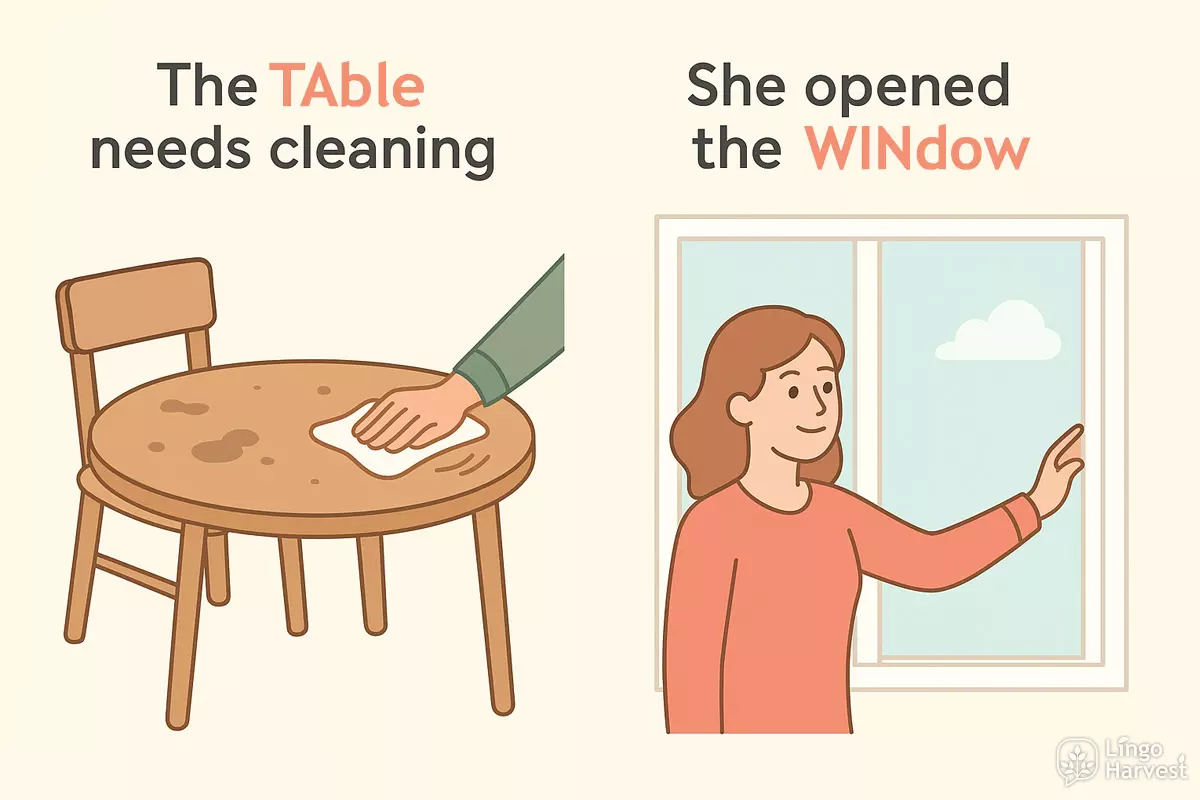
In English, many nouns have stress on the first syllable. Practicing these can help you develop a natural speaking rhythm. Here are some common examples:
- TAble – The table needs cleaning.
- WINdow – She opened the window.
- DOCtor – The doctor arrived quickly.
- MOney – He saved some money.
- PROduct – This product sells well.
- PAper – I lost the paper.
- STUdent – The student asked a question.
- PIcture – I took a picture.
- REcord (noun) – She broke the record.
- PREsent (noun) – I bought a present.
- ANimal – The animal ran away.
- MOment – Wait a moment, please.
- POcket – The keys are in my pocket.
- MARket – We walked to the market.
- COLor – Blue is my favorite color.
- PROblem – We solved the problem.
- LESson – Today’s lesson was easy.
- PARent – Each parent signed the form.
Stress and meaning: Nouns vs. verbs
Some English words change from noun to verb by shifting the stress. Here’s how this works with common pairs:
| Word | Noun Stress | Verb Stress |
|---|---|---|
| record | RE-cord | re-CORD |
| present | PRE-sent | pre-SENT |
| object | OB-ject | ob-JECT |
| contract | CON-tract | con-TRACT |
| increase | IN-crease | in-CREASE |
Paying attention to which syllable is stressed will help you avoid misunderstandings and speak with greater confidence. By listening to native speakers and practicing these patterns, you’ll find your English becomes much clearer and easier for others to understand.
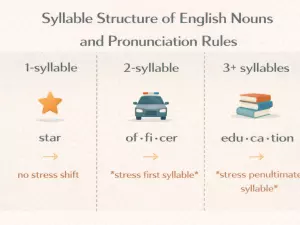
Basic stress patterns in one-syllable and two-syllable nouns
Understanding where to place stress in English nouns is a key part of clear pronunciation. For beginners, it helps to start with the simplest cases: words with one or two syllables. The rules for these are straightforward, but learning them lays a strong foundation for more complex patterns later.
One-syllable nouns: easy stress placement
With single-syllable nouns, stress is never an issue—there’s only one syllable, so it always gets the emphasis. Here are some common examples:
- cat – The cat slept on the sofa.
- book – I bought a new book yesterday.
- dog – The dog barked loudly.
- chair – She sat on the wooden chair.
- fish – The fish swam near the surface.
- cup – He broke his favorite cup.
- pen – I can’t find my pen.
- clock – The clock stopped working.
- shoe – Her shoe was too small.
- star – A bright star appeared in the sky.
The entire word is pronounced with natural emphasis, so there’s no need to worry about which syllable to stress.
Two-syllable noun stress: the first syllable rule
For most two-syllable nouns in English, the stress usually falls on the first syllable. This pattern helps listeners quickly recognize the word as a noun. Here are some frequently used examples:
- TAble – The table was covered with books.
- MUsic – The music was too loud.
- WINdow – She cleaned the window this morning.
- APple – He ate a fresh apple.
- DOCtor – The doctor checked his temperature.
- GARden – They worked in the garden all day.
- PAper – I wrote my name on the paper.
- TIger – The tiger moved quietly through the grass.
- MONey – She saved money for a new phone.
- LAmp – The lamp lit up the whole room.
The main stress, shown in uppercase, is almost always at the start of the word. This makes pronunciation predictable for most two-syllable nouns.
Exceptions and tips
While the first-syllable stress is common, there are a few exceptions—often with words borrowed from other languages, or when the noun is also a verb. For example:
- hoTEL
- machine
To master these patterns, listen to native speakers and repeat words aloud. Marking the stressed syllable can help you remember. If in doubt, check a dictionary for the correct pronunciation.
At a glance: stress in single and double syllable nouns
| Word | Where is the stress? |
|---|---|
| cat | Only syllable stressed (CAT) |
| table | First syllable stressed (TA-ble) |
| garden | First syllable stressed (GAR-den) |
| hotel | Second syllable stressed (ho-TEL) |
| music | First syllable stressed (MU-sic) |
Knowing these basic patterns will make it easier to pronounce new vocabulary and communicate clearly in English. Practice by saying words aloud and noticing where your voice naturally emphasizes a syllable.
Common noun–verb stress pairs like record and present
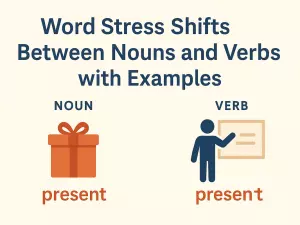
Many English words change their pronunciation depending on whether they are used as nouns or verbs. The difference usually comes down to syllable stress: nouns typically have the stress on the first syllable, while verbs shift the stress to the second syllable. This pattern can be confusing for beginners, but understanding it will help you sound more natural and avoid misunderstandings in conversation.
How stress changes meaning
When the same word is pronounced with the stress on a different syllable, its function in the sentence changes. For example, record as a noun (RE-cord) refers to a physical item or data, while as a verb (re-CORD) it means to save audio or video. This stress pattern is common with two-syllable words in English.
Examples of noun–verb stress pairs
Here are some frequently used words that follow this stress pattern. Notice how the meaning and grammatical role change with the stress:
- REcord (noun) → reCORD (verb)
- PResent (noun) → preSENT (verb)
- CONtract (noun) → conTRACT (verb)
- OBject (noun) → obJECT (verb)
- INcrease (noun) → inCREASE (verb)
- DEcrease (noun) → deCREASE (verb)
- IMport (noun) → imPORT (verb)
- EXport (noun) → exPORT (verb)
- PERmit (noun) → perMIT (verb)
- PROduce (noun) → proDUCE (verb)
- PROtest (noun) → proTEST (verb)
- REject (noun) → reJECT (verb)
- SUBject (noun) → subJECT (verb)
- SURvey (noun) → surVEY (verb)
- TORment (noun) → torMENT (verb)
- UPset (noun) → upSET (verb)
- CONvert (noun) → conVERT (verb)
- CONtest (noun) → conTEST (verb)
Quick reference: Stress shift overview
| Noun (1st syllable stress) | Verb (2nd syllable stress) |
|---|---|
| REcord (music album) | reCORD (to save sound) |
| PResent (a gift) | preSENT (to show or give) |
| OBject (a thing) | obJECT (to disagree) |
| CONtract (legal document) | conTRACT (to shrink) |
| PERmit (official paper) | perMIT (to allow) |
| PROduce (fruits/vegetables) | proDUCE (to make) |
| IMport (goods from abroad) | imPORT (to bring in) |
| EXport (products sent abroad) | exPORT (to send out) |
Practicing these stress changes will make your English sound clearer and help listeners easily understand whether you mean the noun or the verb. Listening to native speakers and repeating these pairs aloud can be very effective for mastering this aspect of pronunciation.
Multi-syllable noun stress patterns with examples
Understanding how to pronounce multi-syllable nouns accurately is key to being understood in English. These words often have one syllable that is pronounced more strongly than the others, and the position of this stress can change the sound and sometimes even the meaning of the word. For beginners, it's helpful to learn some typical stress rules and see them in action with common vocabulary.
Common stress patterns in longer nouns
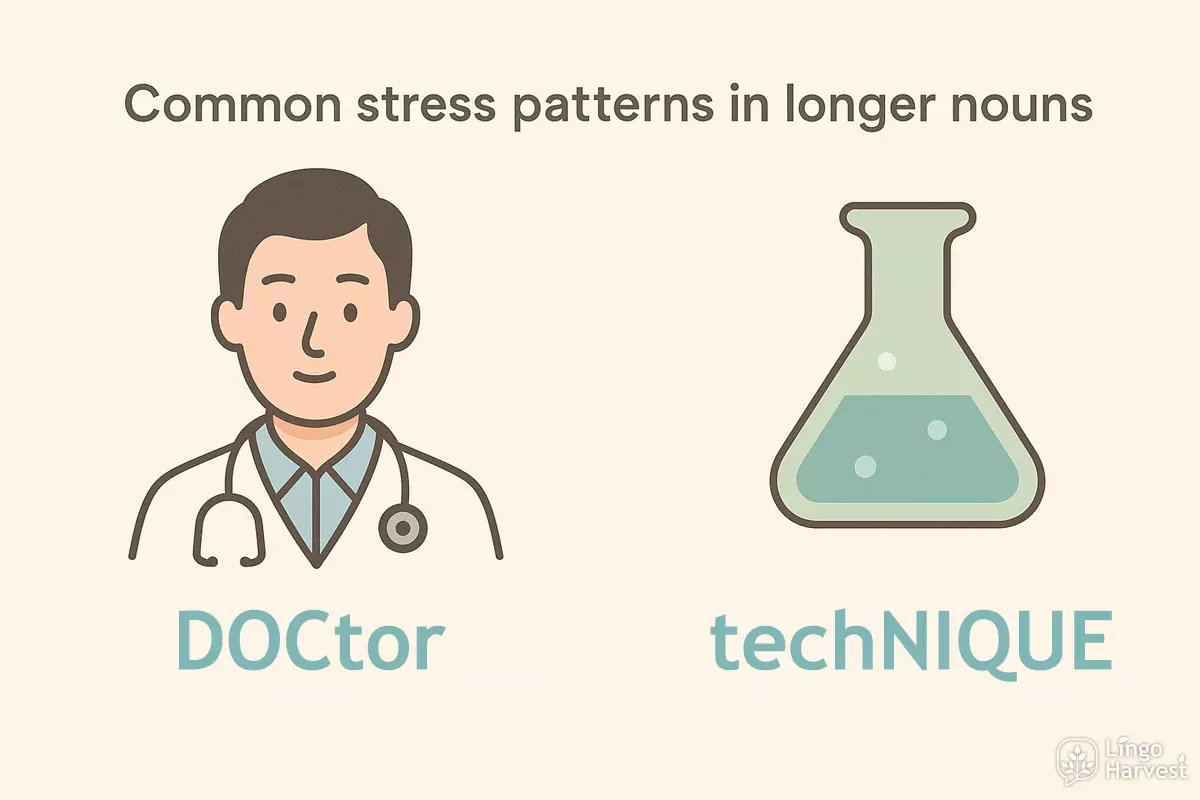
Most multi-syllable nouns in English place the stress on the first syllable. However, there are exceptions, especially with words borrowed from other languages or those ending with specific suffixes. Here are some useful guidelines:
- First syllable stress: This is the most frequent pattern. Examples: TAble, DOCtor, CHIna, MOney, REcord (as a noun), PROduce (as a noun).
- Second syllable stress: Many words ending in "-tion", "-sion", "-ic", and "-ity" are stressed on the penultimate (second-to-last) syllable. Examples: poTAto, hoTEL, comPUter, reLAXation, eLECtric, acTIVity.
- Suffix-driven stress: Some endings, like "-eer", "-ese", "-ique", shift the stress to the last syllable. Examples: engiNEER, Japanese, techNIQUE.
Examples of multi-syllable nouns and their stress patterns
Below is a table showing a variety of common multi-syllable nouns, with the stressed syllable indicated in uppercase. Practice saying these words aloud, emphasizing the marked syllable.
| Word | Stressed Syllable |
|---|---|
| TAble | First |
| DOCtor | First |
| CHIna | First |
| poTAto | Second |
| comPUter | Second |
| eLECtric | Second |
| engiNEER | Last |
| techNIQUE | Last |
| acTIVity | Second |
| MOney | First |
| Japanese | Last |
| REcord (noun) | First |
| reLAXation | Second |
| INdustry | First |
| proDUCtion | Second |
Tips for learning stress patterns
- Listen to native speakers and focus on which syllable sounds stronger.
- Practice repeating words out loud, clapping or tapping on the stressed syllable.
- Use a dictionary that shows word stress if you’re unsure.
- Remember that some words change stress when used as verbs or nouns (for example, REcord vs. reCORD).
By becoming familiar with these patterns and examples, learners can improve both their pronunciation and listening skills.
How stress patterns affect listening and comprehension
Understanding which syllable receives stress in English nouns can make a big difference when listening to spoken English. Native speakers rely on stress cues to distinguish between words, especially when they sound similar or have multiple syllables. For example, recognizing that the stress falls on the first syllable in "TAble" but on the second in "hoTEL" helps listeners quickly identify the word being said, even if the audio is unclear or fast.
Why stress matters for beginners
Learners often miss key information because they expect all syllables to be spoken with equal emphasis. In reality, English speakers reduce or even swallow unstressed syllables, which can make words hard to recognize for beginners. Paying attention to which syllable is stressed helps listeners "catch" the important part of the word and fill in the rest, improving overall comprehension.
Common challenges caused by incorrect stress
- Misunderstanding similar words (e.g., 'REcord' [noun] vs. 'reCORD' [verb])
- Difficulty following fast speech
- Missing important details in instructions or conversations
- Confusing unfamiliar vocabulary with known words
- Feeling lost in group discussions or when listening to news
Examples: How stress changes meaning
- 'PREsent' (noun: a gift) → 'preSENT' (verb: to show or give something)
- 'CONtract' (noun: agreement) → 'conTRACT' (verb: to shrink or tighten)
- 'INcrease' (noun: growth) → 'inCREASE' (verb: to become greater)
- 'PERmit' (noun: license) → 'perMIT' (verb: to allow)
- 'REbel' (noun: a person who resists) → 'reBEL' (verb: to resist)
- 'OBject' (noun: thing) → 'obJECT' (verb: to oppose)
- 'IMport' (noun: goods brought in) → 'imPORT' (verb: to bring in goods)
- 'EXport' (noun: goods sent out) → 'exPORT' (verb: to send out goods)
- 'CONvert' (noun: someone who changes beliefs) → 'conVERT' (verb: to change)
- 'CONtest' (noun: competition) → 'conTEST' (verb: to compete or challenge)
How stress guides listening
When you train your ear to notice strong syllables, you can:
- Predict word boundaries in connected speech
- Differentiate between nouns and verbs that look the same in writing
- Follow the rhythm of natural English more easily
- Improve your own pronunciation, making your speech clearer to others
Comparison: Clear vs. unclear stress
| With Correct Stress | With Incorrect or Missing Stress |
|---|---|
| Listeners identify the word quickly | Listeners may not understand or confuse the word |
| Speech sounds natural and fluent | Speech may sound robotic or hard to follow |
| Confidence in conversations increases | Miscommunication and frustration are more likely |
| Listeners can guess unknown words from context | Context clues are less helpful if stress is wrong |
By focusing on stress patterns as you listen and speak, you’ll find it much easier to understand English in real-life situations, from classroom lessons to movies and everyday conversations.
Typical pronunciation mistakes with noun stress
Learners often face challenges with the correct placement of stress in English nouns. Getting the stress wrong can make a word sound unnatural or even cause misunderstandings. Many beginners transfer stress patterns from their native language, which may not match English stress rules.
Common errors when stressing nouns
One frequent issue is stressing the wrong syllable. For example, saying "adVICE" instead of "ADvice" or "hoTEL" instead of "HOtel." Misplaced stress can confuse listeners, as it sometimes turns a noun into a verb or vice versa.
- Placing stress on the last syllable: "hoTEL" ❌ instead of "HOtel" ✅
- Using even stress on all syllables: "TAble" becomes "taBLE" (incorrect)
- Applying verb stress patterns to nouns: "reCORD" (verb) vs. "REcord" (noun)
- Ignoring reduced vowels in unstressed syllables, making the word sound odd
- Overemphasizing every syllable: "inFORmaTION" instead of "inforMAtion"
- Saying compound nouns as two separate words: "BLACK board" instead of "BLACKboard"
- Stress shifting due to spelling similarities: "PREsent" (noun) vs. "preSENT" (verb)
- Not recognizing multi-syllable nouns often have stress on the first syllable
- Confusing noun-verb pairs: "OBject" (noun) vs. "obJECT" (verb)
- Pronouncing foreign loanwords with native language stress patterns
Commonly mispronounced nouns: Stress placement
| Incorrect Stress | Correct Stress |
|---|---|
| hoTEL | HOtel |
| adVICE | ADvice |
| inforMAtion | inforMAtion |
| proDUCE (noun) | PROduce (noun) |
| obJECT (noun) | OBject (noun) |
| reCORD (noun) | REcord (noun) |
| maCHINE | maCHINE |
| address (first syllable) | ADdress (noun) |
Tips for improving noun stress
To make your pronunciation clearer, listen carefully to native speakers and repeat noun examples, focusing on which syllable they emphasize. Break words into syllables and mark the stressed part. Practice with minimal pairs (like "REcord" vs. "reCORD") to hear the difference. Over time, you’ll develop a natural feel for where the stress should fall in English nouns.
Practice: listen, repeat, and mark stress in common nouns
Understanding which syllable to stress in English nouns can greatly improve your pronunciation clarity. Let's work through some practical exercises to help you identify and practice word stress in everyday vocabulary.
How to Mark Word Stress
Start by saying the word slowly and listening for the strongest, loudest part. In English dictionaries, stressed syllables are often marked with an apostrophe before the syllable (for example: TAble is pronounced /ˈteɪ.bəl/). When practicing, you can underline, bold, or capitalize the stressed part to help you remember.
Common Nouns for Stress Practice
Below is a list of frequently used English nouns. Say each word aloud, and try to feel which syllable is stressed. Mark the stressed syllable as you practice:
- TAble → The table is made of wood.
- WINdow → She opened the window for fresh air.
- DOCtor → The doctor arrived quickly.
- COMputer → His computer is very fast.
- baNAna → I ate a banana for breakfast.
- poTAto → She cooked a potato soup.
- EXport → The company plans to export more goods.
- adVICE → He gave me useful advice.
- PROduct → This product sells very well.
- hoTEL → They stayed at a large hotel.
- reCORD → He set a new world record.
- MOney → She saved money for a trip.
- reLAtion → Their relation improved over time.
- INternet → The internet connection is slow today.
- picTURE → She drew a picture of a tree.
- stuDENT → The student answered correctly.
- poLIce → The police arrived at the scene.
- faMILy → My family visited last weekend.
- reSEARCH → Their research was groundbreaking.
- inVITation → I received an invitation to the event.
Listening and Repetition Tips
Focus on how native speakers say these words. Listen to audio samples if possible, then repeat each word, exaggerating the stressed syllable at first. This helps your mouth and ear get used to the rhythm of English words.
Identifying Stress Patterns in Two- and Three-Syllable Nouns
Many two-syllable nouns in English have the stress on the first syllable (e.g., TAble, WINdow). Three-syllable nouns often have stress on the first or second syllable, depending on their origin and structure.
| Word | Stressed Syllable | Example Pronunciation |
|---|---|---|
| TAble | First | TA-ble |
| COMputer | Second | com-PU-ter |
| baNAna | Second | ba-NA-na |
| reCORD | Second | re-Cord |
| PROduct | First | PRO-duct |
| hoTEL | Second | ho-TEL |
| INternet | First | IN-ter-net |
| adVICE | Second | ad-VICE |
Task: Mark the Stress
Read the following words and decide which syllable is stressed. Say each word out loud and try to emphasize the correct syllable. Then, check your answers below.
- family
- potato
- picture
- relation
- student
- invitation
- banana
- computer
- address
- idea
Show answers
- FAM-i-ly (first syllable)
- po-TA-to (second syllable)
- PIC-ture (first syllable)
- re-LA-tion (second syllable)
- STU-dent (first syllable)
- in-vi-TA-tion (third syllable)
- ba-NA-na (second syllable)
- com-PU-ter (second syllable)
- ad-DRESS (second syllable)
- i-DE-a (second syllable)
Next Steps
Continue practicing by listening to spoken English and marking the stress in new nouns you encounter. Over time, you'll develop an intuition for natural word rhythm.