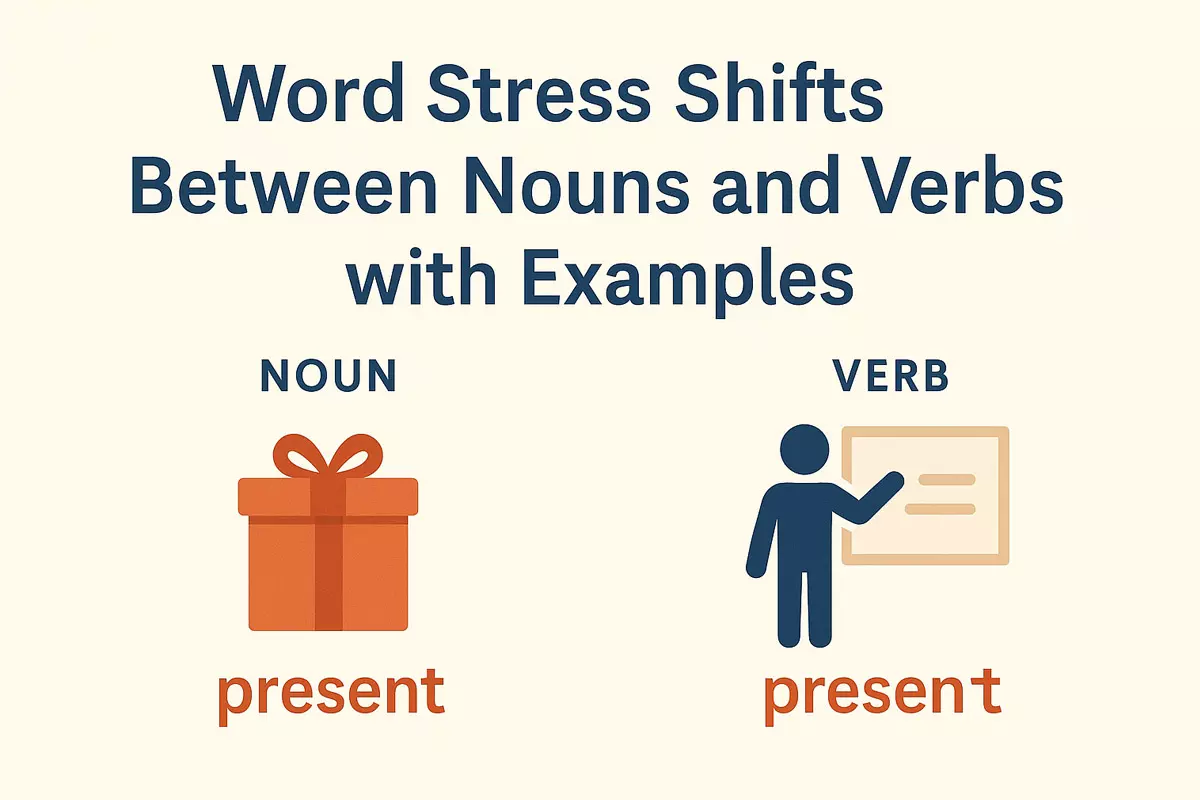
Word Stress Shifts Between Nouns and Verbs with Examples

 Here we why stress shifts between nouns and verbs are important, lists common two-syllable pairs, explains how stress changes meaning, gives pronunciation and listening tips, discusses typical learner mistakes, and provides practice with sample words.
- Why stress shifts between nouns and verbs matter
- Common two-syllable noun–verb pairs like record and present
- How stress position changes meaning and word class
- Pronunciation tips for stressed and unstressed syllables
- Listening strategies to notice stress shifts in speech
- Typical learner errors with stress in noun–verb pairs
- Practice: mark and pronounce stress in sample word lists
Have you ever noticed how the same word can sound different depending on whether it names something or describes an action? In English, many words change which syllable is stressed based on their function as a noun or a verb. For example, the word "record" is pronounced with the stress on the first syllable when used as a noun, as in "She set a new record," but with the stress on the second syllable when used as a verb, as in "Please record your message." This pattern appears in several word pairs and highlights the flexibility and nuance of English pronunciation.
Why stress shifts between nouns and verbs matter
Understanding how word stress changes between related nouns and verbs is crucial for clear, accurate communication in English. Native speakers rely on these subtle shifts to distinguish meaning, and incorrect stress can lead to confusion or make speech sound unnatural. For learners, mastering these patterns is not just about pronunciation—it's about being understood and following the rhythm of the language.
How stress affects meaning and clarity
In English, the position of stress in a word can change its function and meaning. For example, record as a noun has the stress on the first syllable (REcord), while the verb form is stressed on the second syllable (reCORD). Misplacing the stress may cause listeners to misunderstand which part of speech is intended, especially in spoken contexts.
- Present (noun: PRESent / verb: preSENT)
- Object (noun: OBject / verb: obJECT)
- Increase (noun: INcrease / verb: inCREASE)
- Export (noun: EXport / verb: exPORT)
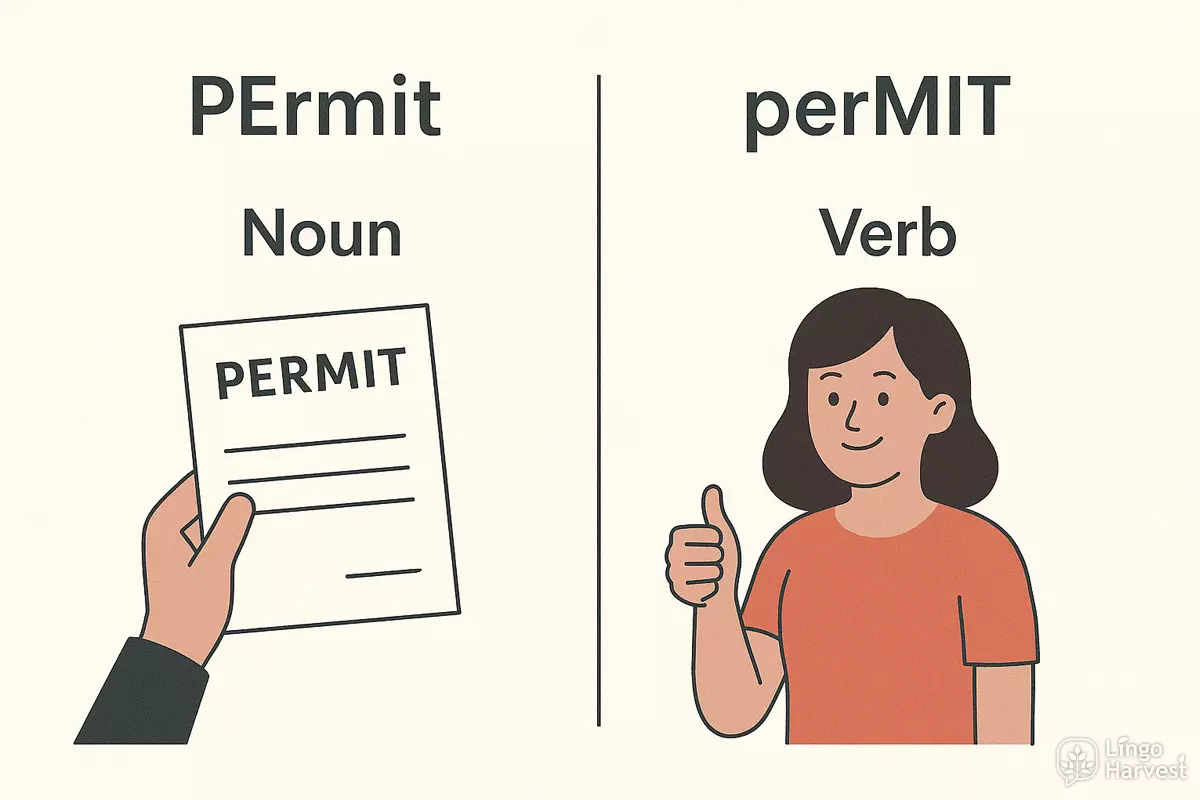
- Permit (noun: PERmit / verb: perMIT)
- Conflict (noun: CONflict / verb: conFLICT)
- Refuse (noun: REfuse / verb: reFUSE)
- Suspect (noun: SUSpect / verb: susPECT)
- Increase (noun: INcrease / verb: inCREASE)
- Contract (noun: CONtract / verb: conTRACT)
- Import (noun: IMport / verb: imPORT)
- Contest (noun: CONtest / verb: conTEST)
- Convert (noun: CONvert / verb: conVERT)
- Record (noun: REcord / verb: reCORD)
- Address (noun: ADdress / verb: adDRESS)
- Progress (noun: PROgress / verb: proGRESS)
- Reject (noun: REject / verb: reJECT)
- Subject (noun: SUBject / verb: subJECT)
- Project (noun: PROject / verb: proJECT)
- Insult (noun: INsult / verb: inSULT)
Why English learners should pay attention
Getting the stress right is especially important for non-native speakers, as it helps avoid misunderstandings and shows a deeper grasp of how English works. Stress patterns often follow predictable rules, but there are exceptions, so attentive listening and practice are essential. By recognizing these shifts, learners can improve both their pronunciation and listening skills, making conversations smoother and more natural.
Common two-syllable noun–verb pairs like record and present
English features several two-syllable words that change their word stress depending on whether they are used as nouns or verbs. Typically, the stress falls on the first syllable for the noun form, while the verb form places emphasis on the second syllable. This shift can impact both pronunciation and meaning, which is why it's important for learners to recognize these patterns.
Pattern of Stress Shift
The general rule is straightforward: with these word pairs, nouns have the stress on the first syllable, and verbs on the second. This helps listeners distinguish between the function of the word in a sentence, even when the spelling remains the same.
Examples of Two-Syllable Noun–Verb Word Pairs
Here are some common examples where word stress changes depending on the grammatical role:
- conduct (NOUN: CON-duct, VERB: con-DUCT)
- rebel (NOUN: RE-bel, VERB: re-BEL)
- survey (NOUN: SUR-vey, VERB: sur-VEY)
- escort (NOUN: ES-cort, VERB: es-CORT)
- transfer (NOUN: TRANS-fer, VERB: trans-FER)
- extract (NOUN: EX-tract, VERB: ex-TRACT)
- impact (NOUN: IM-pact, VERB: im-PACT)
- update (NOUN: UP-date, VERB: up-DATE)
- discount (NOUN: DIS-count, VERB: dis-COUNT)
- contrast (NOUN: CON-trast, VERB: con-TRAST)
- compound (NOUN: COM-pound, VERB: com-POUND)
- compress (NOUN: COM-press, VERB: com-PRESS)
- digest (NOUN: DI-gest, VERB: di-GEST)
- perfect (NOUN: PER-fect, VERB: per-FECT)
- increase (NOUN: IN-crease, VERB: in-CREASE)
- decrease (NOUN: DE-crease, VERB: de-CREASE)
- overlap (NOUN: O-verlap, VERB: o-ver-LAP)
- upgrade (NOUN: UP-grade, VERB: up-GRADE)
- outline (NOUN: OUT-line, VERB: out-LINE)
- forecast (NOUN: FORE-cast, VERB: fore-CAST)
How to Recognize and Practice These Words
Paying attention to context can often help you determine the correct stress. In sentences, nouns often follow articles or adjectives, while verbs follow subjects. Practicing these pairs aloud will build confidence and improve your listening skills.
How stress position changes meaning and word class
English has many words where shifting the stress changes both the meaning and the grammatical category. Most commonly, this happens with pairs where one form is a noun and the other is a verb. In these cases, the noun usually has the stress on the first syllable, while the verb form shifts the stress to the second syllable. This subtle shift can completely alter the function of the word in a sentence.
Why stress matters
Changing the stress doesn’t just affect pronunciation—it can also signal whether a word is being used as a thing (noun) or an action (verb). For example, “record” as a noun (“a music record”) has the stress on the first syllable, but as a verb (“to record a video”), the stress moves to the second syllable. Listeners rely on this cue to instantly understand meaning in spoken English.
Common noun-verb stress shift examples
Here are some frequent pairs where the position of the stress distinguishes nouns from verbs:
- transfer: TRANSfer (noun) → transFER (verb)
- discount: DIScount (noun) → disCOUNT (verb)
- extract: EXtract (noun) → exTRACT (verb)
- contrast: CONtrast (noun) → conTRAST (verb)
- compound: COMpound (noun) → comPOUND (verb)
- digest: DIgest (noun) → diGEST (verb)
- perfect: PERfect (noun/adjective) → perFECT (verb)
- overlap: Ovelap (noun) → overLAP (verb)
- upgrade: UPgrade (noun) → upGRADE (verb)
- forecast: FOREcast (noun) → foreCAST (verb)
Stress patterns and sentence clarity
Correctly placing the stress is crucial for clear communication. A misplaced stress can lead to misunderstandings, especially in spoken English. For learners, practicing these pairs helps build both listening skills and accurate pronunciation.
Pronunciation tips for stressed and unstressed syllables
Mastering the difference between emphasized and less prominent syllables is a key skill for clear English speech. In words that change stress depending on their grammatical role—like some nouns and verbs—recognizing which syllable to highlight can help listeners understand your meaning immediately.
How to identify the strong syllable
To spot the syllable that gets the main emphasis:
- Say the word slowly and listen for the part you say louder and with a slightly higher pitch.
- The stressed syllable is often longer and clearer, while unstressed syllables sound quicker and use a weaker vowel sound, often a schwa /ə/.
- For two-syllable words that switch category (noun/verb), the first syllable is usually stressed for nouns, and the second for verbs.
Tips for practicing clear word stress
- Listen to native speakers and repeat after them, focusing on which syllable is strongest.
- Record yourself saying noun-verb pairs and compare your stress patterns.
- Use hand claps or tap your desk to mark the main syllable as you say the word.
- Practice minimal pairs in sentences: "The REcord is old." vs. "Please reCord the song."
- Remember, incorrect stress can make a word sound unfamiliar, even if pronunciation is otherwise perfect.
Common vowel sound changes in unstressed syllables
Unstressed syllables often use a reduced vowel, usually the schwa /ə/. For example, in "permit" as a noun (PERmit), the second syllable is unstressed and reduced. This reduction makes speech smoother and more natural.
Listening strategies to notice stress shifts in speech
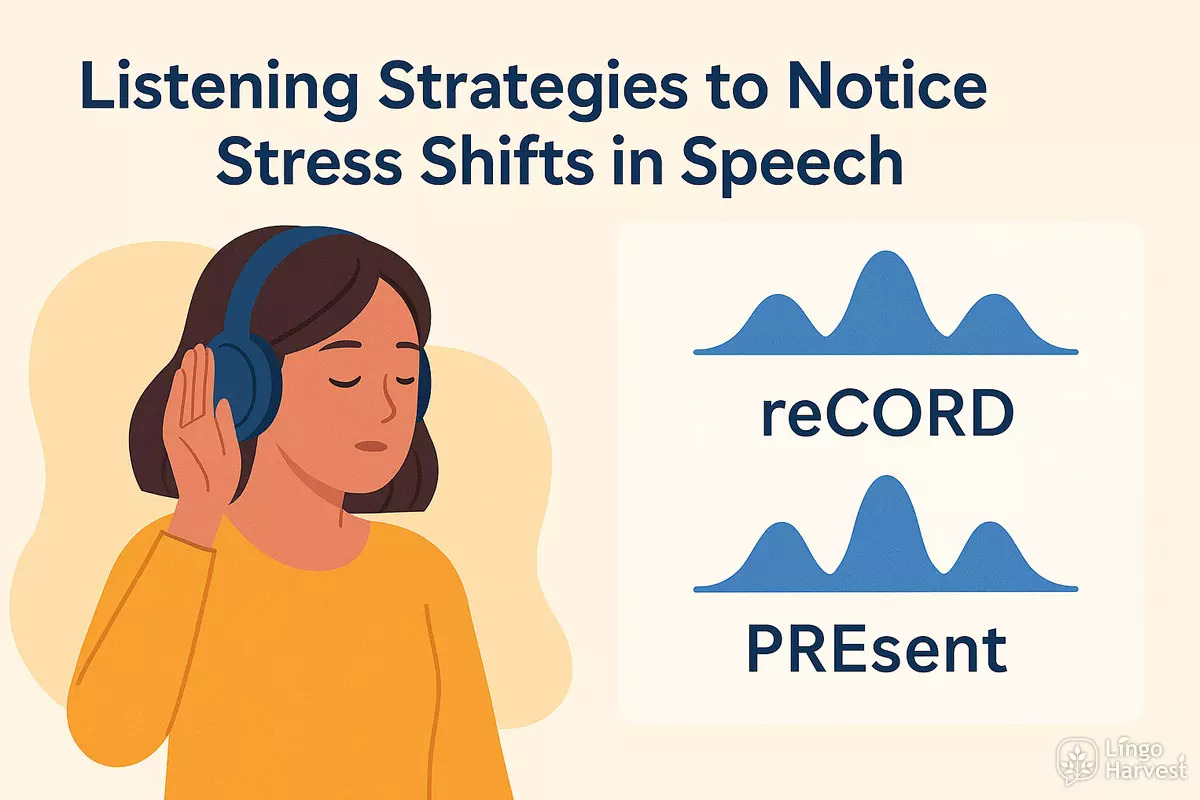
Understanding how to hear the difference between noun and verb stress patterns can make spoken English much clearer. Many words change their meaning depending on which syllable is stressed, and these changes can be subtle. Here are some practical ways to develop your ear for these shifts and improve both your listening and speaking skills.
Focus on syllable emphasis in context
When listening to native speakers, pay attention to which syllable is pronounced more strongly in words that can be both nouns and verbs—like “record” or “present.” The stressed syllable is usually louder, longer, and sometimes at a slightly higher pitch than the others. Noticing these clues will help you distinguish between the noun and verb forms during conversations or in media.
Compare stress patterns visually and aurally
A helpful exercise is to listen to recordings and mark which syllable is stressed. You can also use transcripts to underline or color-code stressed syllables. Over time, you’ll start to predict which syllable will be emphasized based on whether the word is a noun or a verb.
Tips for active listening
- Repeat after native speakers, mimicking their stress patterns.
- Use slow playback features to catch subtle stress changes.
- Listen for sentence context—nouns and verbs often appear in predictable spots.
- Record yourself and compare your stress with model examples.
Paying close attention to syllable emphasis will boost your comprehension and help you avoid misunderstandings, especially with words that change their function based on stress. With consistent practice, picking out these shifts becomes second nature.
Typical learner errors with stress in noun–verb pairs
Learners often struggle with correctly placing word stress in English, especially with words that change their stress pattern depending on whether they are used as nouns or verbs. This can lead to misunderstandings, as the meaning of the word may shift with the stress. Non-native speakers frequently apply the same stress pattern to both forms, or overgeneralize from one example to others that do not follow the same rule.
Common stress placement mistakes
Many English words that serve as both nouns and verbs shift their primary stress from the first syllable (noun) to the second syllable (verb). For example, the noun 'record' is stressed on the first syllable ('RE-cord'), while the verb 'record' shifts stress to the second ('re-CORD'). Learners might incorrectly say 're-CORD' when they mean the object, or 'RE-cord' when they mean the action, which can confuse listeners.
- Using verb stress for the noun: saying 'in-CREASE' instead of 'IN-crease' for a price rise
- Using noun stress for the verb: saying 'CON-tract' instead of 'con-TRACT' for the action
- Applying the pattern to words that do not shift stress, such as 'visit' (which stays on the first syllable)
- Ignoring the stress change when reading aloud, especially in academic or formal contexts
- Overcorrecting and stressing both syllables equally, which can sound unnatural
Tips to avoid stress-related pronunciation errors
- Listen carefully to native speakers and note how they stress these pairs in context.
- Practice both forms aloud, paying attention to the syllable that receives the strongest emphasis.
- Remember that for most such pairs, the noun is stressed on the first syllable, and the verb on the second.
- Check dictionaries with pronunciation guides to confirm the correct stress pattern.
- Use minimal pair exercises to train your ear and voice to differentiate between noun and verb forms.
Misplacing stress can make spoken English harder to understand. By becoming familiar with these patterns and practicing regularly, learners can improve both their pronunciation and their overall communication skills.
Practice: mark and pronounce stress in sample word lists
To make stress patterns automatic, you need focused practice with fresh examples. In this section, you will work with new noun–verb pairs, mark the stressed syllable, and practice pronouncing each form aloud. Pay attention to how stress placement signals the grammatical role of the word.
Identify and mark the stressed syllable
Each pair below follows the typical noun–verb stress shift: the noun is stressed on the first syllable, and the verb on the second. Read each pair slowly, exaggerate the stress, and then repeat it at a natural speaking speed.
- collapse (noun: COL-lapse), collapse (verb: col-LAPSE)
- protest (noun: PRO-test), protest (verb: pro-TEST)
- exploit (noun: EX-ploit), exploit (verb: ex-PLOIT)
- overthrow (noun: O-verthrow), overthrow (verb: o-ver-THROW)
- overflow (noun: O-verflow), overflow (verb: o-ver-FLOW)
- recall (noun: RE-call), recall (verb: re-CALL)
- refund (noun: RE-fund), refund (verb: re-FUND)
- download (noun: DOWN-load), download (verb: down-LOAD)
- upload (noun: UP-load), upload (verb: up-LOAD)
- misprint (noun: MIS-print), misprint (verb: mis-PRINT)
Practice task: say, compare, and use
Work through the list step by step:
- Say the noun form and verb form aloud for each pair.
- Notice how the stressed syllable moves when the word changes function.
- Choose any four pairs and create one sentence with the noun and one with the verb.
Show sample answers
- In all pairs above, the noun is stressed on the first syllable, and the verb on the second.
- Changing stress helps listeners immediately recognize whether the word names something or describes an action.
- Example sentences:
- collapse (noun): The COLlapse of the bridge shocked the city. / collapse (verb): The bridge may colLAPSE soon.
- protest (noun): A PROtest formed outside the building. / protest (verb): They proTEST the decision.
- refund (noun): I requested a REfund. / refund (verb): They reFUNDed my ticket.
- download (noun): The DOWNload was fast. / download (verb): Please downLOAD the file.
Regular practice with new word sets like this helps build instinctive control over stress patterns. Focus on hearing and producing the stressed syllable clearly, and your pronunciation will sound more natural and confident over time.