Nouns Used as Adjectives in English Grammar with Examples

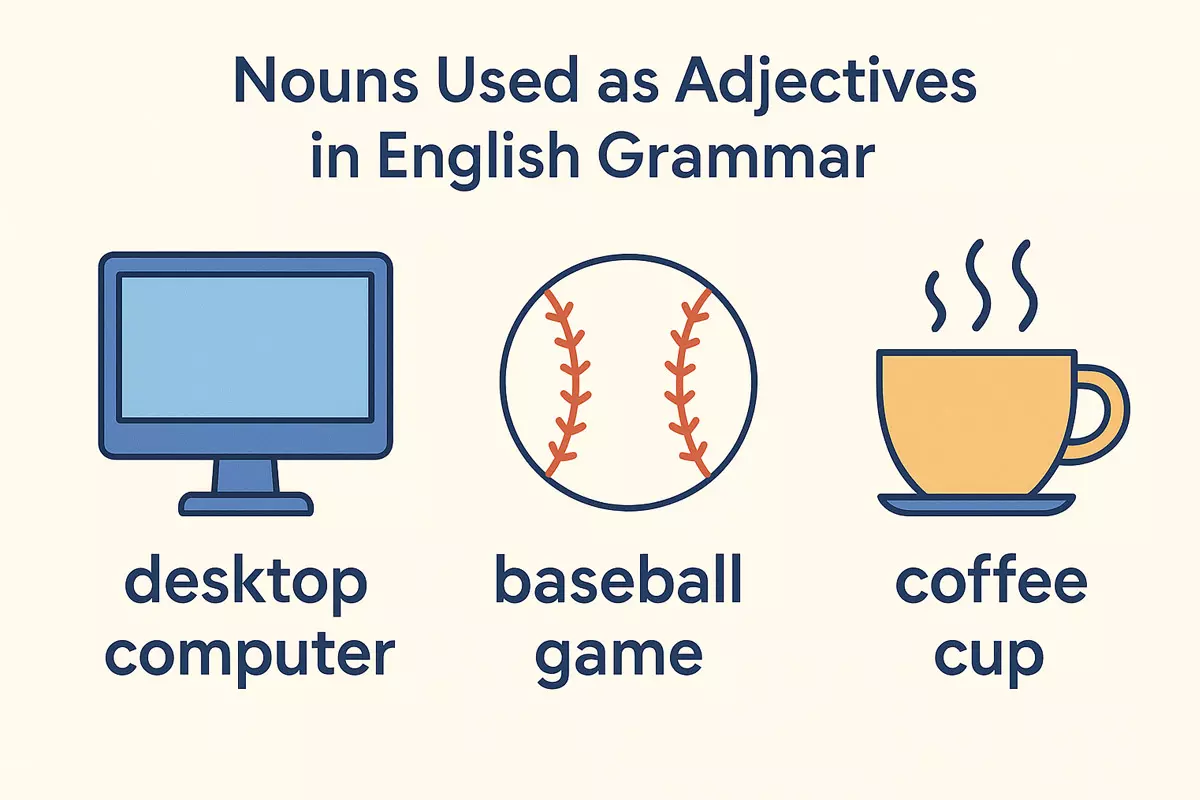 This article explains noun modifiers in English grammar, including basic patterns like car door and coffee cup, how meanings change, spelling and hyphenation rules, formal versus informal usage, common mistakes, and practice creating clear noun modifiers.
- What noun modifiers are in English grammar
- Basic noun + noun patterns like car door and coffee cup
- Meaning changes when a noun is used before another noun
- Spelling and hyphenation with noun modifiers
- Formal vs informal uses of noun modifiers in writing
- Common mistakes with plural and possessive forms
- Practice: build clear noun modifiers from simple phrases
Have you ever noticed how words such as chicken in chicken soup or car in car keys help make the meaning clearer? In English, nouns can often act as descriptive words, providing extra detail or specifying what kind of thing is being discussed. By placing one noun before another, we can create phrases that are more precise and informative, making it easier to understand exactly what is meant. This way of using nouns to describe other nouns is a common feature of English and helps us communicate more effectively.
What noun modifiers are in English grammar
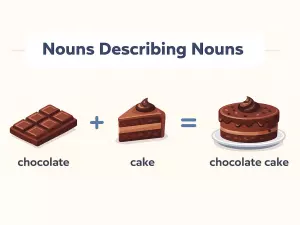
Noun modifiers, also known as attributive nouns or noun adjuncts, are nouns that directly describe or qualify another noun. In English, it’s common for one noun to function like an adjective, providing extra detail about the main noun that follows. For example, in the phrase “chicken soup,” the word “chicken” tells us what kind of soup it is. The first noun modifies the second, giving more specific meaning.
How noun modifiers work
Usually, the modifier noun comes directly before the noun it describes, with no joining words. This structure helps clarify what type, category, or purpose the main noun has. Most often, noun modifiers are singular—even when the meaning is plural, such as “shoe store” (not “shoes store”).
Common patterns for noun modifiers
Here are some typical ways nouns act as modifiers:
- Material: “gold ring,” “paper bag”
- Purpose: “coffee cup,” “sleeping bag”
- Origin: “French wine,” “silk scarf”
- Time: “summer holiday,” “morning exercise”
- Type or Category: “car engine,” “mountain bike”
- Location: “kitchen table,” “garden chair”
- Content: “data analysis,” “news report”
- Quantity/Measurement: “tennis ball,” “liter bottle”
- Owner (sometimes): “child care,” “student card”
- Shape/Size: “cube steak,” “pocket knife”
Examples of noun modifiers in context
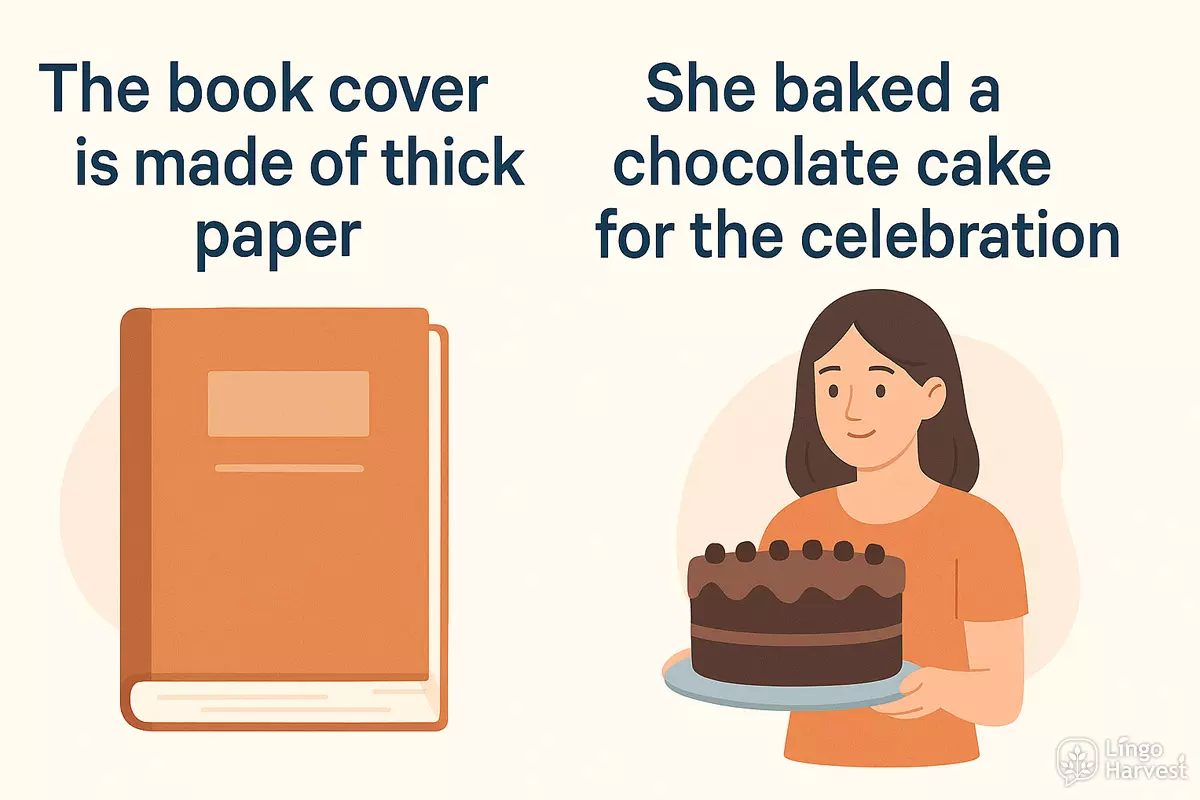
Noun modifiers appear in countless everyday phrases. Here are some more examples:
- Book cover → The book cover is made of thick paper.
- Chocolate cake → She baked a chocolate cake for the celebration.
- History teacher → My history teacher explains events clearly.
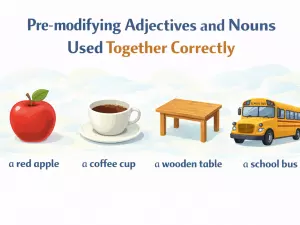
- School bus → The school bus arrives at 8 a.m.
- Water bottle → I always carry a water bottle to the gym.
- Office chair → This office chair is very comfortable.
- Birthday party → We planned a birthday party for Saturday.
- Garden hose → The garden hose is long enough to reach the flowers.
- Computer screen → The computer screen is too bright.
- Science project → Her science project won first prize.
- Football match → We watched the football match together.
- Movie theater → The movie theater was full.
- Window cleaner → He used a window cleaner to remove the stains.
- Apple pie → Grandma makes the best apple pie.
- Music lesson → I have a music lesson every Friday.
- Language school → She studies English at a language school.
- Police officer → A police officer helped us find the address.
- Train station → Let’s meet at the train station.
- Hair dryer → I need a hair dryer after swimming.
- Rain jacket → Take a rain jacket in case it rains.
Key points to remember
- Noun modifiers almost always come before the noun they describe.
- The modifier noun is usually singular (“race car,” not “races car”).
- Sometimes, the meaning changes if the modifier is plural or possessive (compare “teachers’ lounge” vs. “teacher lounge”).
- This construction is a simple way to add detail or specify the kind of noun you mean.
Noun modifiers make English more precise and flexible, allowing speakers to combine ideas in compact phrases. They’re an essential part of everyday language, especially in descriptions and naming things.
Basic noun + noun patterns like car door and coffee cup
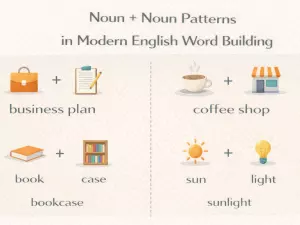
Many English phrases use two nouns together, where the first noun describes the type or purpose of the second. This is a common way to create compound nouns or noun phrases. In this structure, the first noun acts like an adjective, giving more information about the second noun. For example, in “car door,” the word “car” tells us what kind of door we’re talking about. These combinations are everywhere in everyday English. They help us be specific and avoid long explanations. Instead of saying “a door that belongs to a car,” we simply say “car door.” The first noun usually answers the question “what kind?” or “what purpose?” about the second noun.
Common Patterns and Examples
You’ll often see this structure in names of objects, places, or roles. Here are some typical examples:
- coffee cup
- chicken soup
- bus stop
- book cover
- computer screen
- apple pie
- office chair
- school bag
- garden hose
- kitchen table
- birthday card
- tennis shoes
- water bottle
- city map
- mountain bike
- window frame
- train ticket
- phone charger
How the First Noun Works
In these phrases, the first noun doesn’t change its form, and there’s no need for “’s” or “of.” It’s simply placed before the main noun, acting like a descriptive word. This makes English concise and efficient.
| First Noun (Describes) | Main Noun (What it is) |
|---|---|
| car | door (a door on a car) |
| coffee | cup (a cup for coffee) |
| bus | stop (a place where buses stop) |
| apple | pie (a pie made with apples) |
| office | chair (a chair for office use) |
| school | bag (a bag for school) |
| garden | hose (a hose for the garden) |
This pattern is flexible and can be used for a wide range of objects and concepts. The meaning is usually clear from context, and these phrases are a key part of natural English communication.
Meaning changes when a noun is used before another noun
When a noun is placed in front of another noun, it often acts as an adjective, creating a new phrase with a specific meaning. This new meaning is usually different from what you would get by simply combining the two nouns in a literal way. The first noun describes or limits the second noun, and together, they form a compound noun or a noun phrase. For example, "chicken soup" isn’t just any soup and any chicken; it specifically refers to soup made with chicken. Likewise, "apple juice" is not just any juice and any apple, but specifically juice made from apples. The meaning shifts from two unrelated things to a single, more precise concept.
How the meaning shifts
The combination of two nouns can sometimes be confusing for learners because the result is not always predictable from the individual words. The first noun often answers the question "What kind?" or "What type?" about the second noun, acting as a descriptor. Here are some common patterns:
- Material: silver spoon (a spoon made of silver, not a spoon and some silver)
- Purpose: coffee cup (a cup for coffee, not a cup and coffee)
- Origin: French bread (bread from France, not bread and France)
- Content: history book (a book about history, not a book and history)
- Time: summer vacation (a vacation during summer)
- Location: kitchen table (a table kept in the kitchen)
- Measurement: tennis ball (a ball for tennis)
- Container: water bottle (a bottle for water)
- Ingredient: tomato salad (a salad made with tomatoes)
- Function: alarm clock (a clock that acts as an alarm)
Examples that show different meanings
Sometimes, switching the order of the nouns can change the meaning completely, or the phrase might not make sense at all. Compare these pairs:
| Phrase | Meaning |
|---|---|
| chicken soup | Soup made from chicken |
| soup chicken | A chicken intended for making soup (rarely used) |
| race car | A car designed for racing |
| car race | A competition where cars race |
| toy store | A shop that sells toys |
| store toy | A toy representing or related to a store (unusual) |
| garden hose | A hose used in the garden |
| hose garden | A garden made of hoses (does not make sense) |
As you can see, the order and function of the nouns are important for the intended meaning. The first noun modifies the second, and together they produce a fixed or commonly understood phrase. This is why understanding the way nouns are used as adjectives is essential for clear and natural English.
Spelling and hyphenation with noun modifiers
When a noun is used to modify another noun, spelling and punctuation can sometimes cause confusion. Most of the time, English keeps the modifying noun in its singular form, even if the meaning is plural. For example, we say shoe store (not shoes store) and car engine (not cars engine). This pattern is consistent, but there are exceptions, especially with irregular plurals or established expressions. Hyphenation is another area where writers often have questions. In general, noun modifiers are not hyphenated when they directly precede the noun they modify. For instance, we write chicken soup and computer program without a hyphen. However, hyphens are commonly used if the noun modifier is part of a compound adjective that could be misread, or when clarity is needed.
Plural and Singular Forms
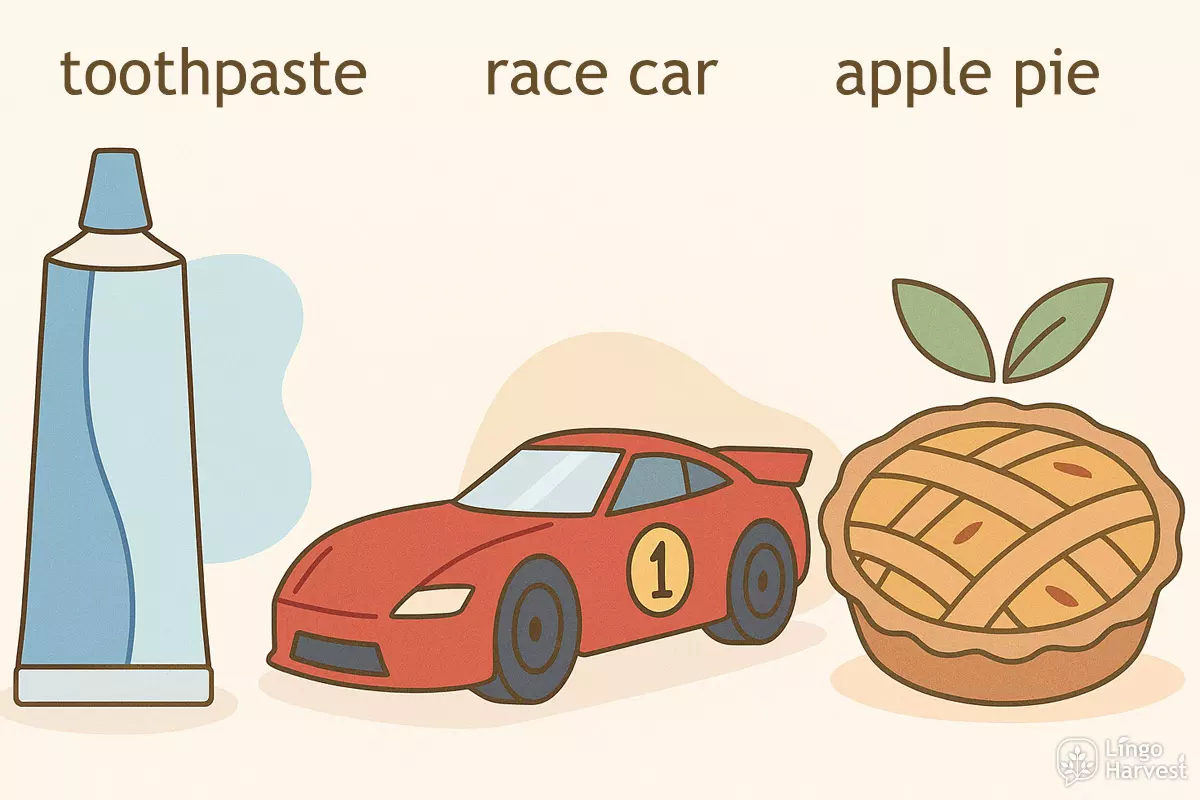
The noun that comes first (the modifier) is usually singular, even when the meaning is plural. Here are some common examples:
- toothpaste (not teethpaste) → I bought a new toothpaste at the pharmacy.
- race car (not races car) → The race car reached incredible speed.
- apple pie (not apples pie) → She baked an apple pie for dessert.
- shoe store (not shoes store) → There’s a shoe store near the mall.
- book cover (not books cover) → The book cover is damaged.
- child care (not children care) → Child care services are expensive.
- mouse trap (not mice trap) → He set a mouse trap in the garage.
- computer screen (not computers screen) → The computer screen is cracked.
- coffee cup (not coffees cup) → My coffee cup is still hot.
- dog food (not dogs food) → This dog food is grain-free.
- flower pot (not flowers pot) → The flower pot fell over.
- kitchen table (not kitchens table) → We eat at the kitchen table.
- garden hose (not gardens hose) → The garden hose is leaking.
- birthday card (not birthdays card) → I wrote a birthday card for her.
- water bottle (not waters bottle) → Take a water bottle with you.
- office chair (not offices chair) → This office chair hurts my back.
- chicken soup (not chickens soup) → Chicken soup helps when you’re sick.
- car engine (not cars engine) → The car engine won’t start.
- desk lamp (not desks lamp) → Turn on the desk lamp.
- school bus (not schools bus) → The school bus arrived early.
Irregular plurals sometimes retain their plural form: sports car (from "sports"), arms race (from "arms"), or sales tax. These are exceptions and usually set by usage over time.
Choose the correct compound noun (A/B)
- A. toothpaste
B. teethpaste - A. apple pie
B. apples pie - A. shoe store
B. shoes store - A. book cover
B. books cover - A. child care
B. children care - A. mouse trap
B. mice trap - A. coffee cup
B. coffees cup - A. dog food
B. dogs food - A. office chair
B. offices chair - A. school bus
B. schools bus
Show answers
- A. toothpaste
- A. apple pie
- A. shoe store
- A. book cover
- A. child care
- A. mouse trap
- A. coffee cup
- A. dog food
- A. office chair
- A. school bus
When to Use Hyphens
Hyphens are not typically used between noun modifiers and the main noun. Still, there are cases where they help prevent ambiguity, especially when the modifier itself is a compound or when the meaning would otherwise be unclear. Compare:
- chocolate chip cookies (no hyphen needed)
- high-school student (hyphen clarifies that the student is from high school, not just a "high student")
- small-animal clinic (the clinic is for small animals, not a small clinic for animals)
- post-office box (hyphenated because "post office" acts as a single unit)
Hyphens are more common when the modifier is more than one word or could be misinterpreted. Generally, if the noun modifier is a standard, single word, no hyphen is needed.
Comparison Table: Hyphenation in Noun Modifiers
| Without Hyphen | With Hyphen |
|---|---|
| car park | high-speed train |
| coffee mug | state-of-the-art device |
| garden hose | well-known author |
| office building | old-fashioned recipe |
| kitchen sink | long-term plan |
In summary, most noun modifiers are written in the singular and do not need a hyphen. Hyphens only appear when clarity demands it or when the modifier is a multi-word phrase. If you’re unsure, check a dictionary or style guide for established usage.
Formal vs informal uses of noun modifiers in writing
How you use nouns as modifiers can shift depending on whether your writing is formal or informal. In formal contexts—such as academic papers, business correspondence, or official reports—noun modifiers are typically used with precision and clarity. The combinations are often well-established and avoid ambiguity. In contrast, more casual writing, like emails to friends or text messages, tends to be playful and flexible with noun modifiers, sometimes inventing new combinations or using shortened forms.
Patterns in formal writing
Writers in formal settings usually rely on standard noun + noun constructions that are widely recognized. These modifiers help keep the language concise and professional. Examples include:
- government policy → The government policy aims to reduce emissions.
- research project → She is leading a research project on climate change.
- company strategy → The company strategy focuses on long-term growth.
- health risks → Smoking increases serious health risks.
- data analysis → Data analysis revealed several key trends.
- investment plan → They approved a new investment plan.
- training session → The training session starts at 9 a.m.
- production process → The production process was optimized last year.
- team leader → The team leader coordinated the tasks.
- education system → The education system needs reform.
In these cases, the first noun modifies the second by specifying the type or category of the second noun, and the combination is clear to most readers.
Informal and creative uses
In informal writing, noun modifiers are often more experimental. People might string together two (or even more) nouns in ways that aren’t standard, or use slang and abbreviations. This can add humor, personality, or brevity, but may also create confusion if the meaning isn’t obvious.
- movie night → We’re having a movie night at my place.
- coffee run → I’m doing a quick coffee run before the meeting.
- cat video → That cat video went viral.
- pizza party → The kids had a pizza party after the game.
- phone charger → I forgot my phone charger at home.
- game night → Let’s organize a game night this weekend.
- road trip → They planned a road trip across the country.
- laundry day → Sunday is usually laundry day for me.
- dog park → We take our dog to the dog park every evening.
- fridge magnet → She collects fridge magnets from her travels.
These patterns are common in everyday conversation, social media, and informal messages, where flexibility and creativity are valued over strict correctness.
Comparing formal and informal usage
| Formal Example | Informal Example |
|---|---|
| employee handbook | work buddy |
| financial statement | money talk |
| training program | gym time |
| project deadline | crunch time |
| meeting agenda | catch-up call |
| customer feedback | user rant |
| policy update | rule change |
| performance review | check-in chat |
Tips for choosing the right style
- Consider your audience: Use more conventional noun modifiers in professional or academic writing.
- Be clear: Avoid creative or ambiguous combinations if clarity is essential.
- Embrace variety: In casual settings, feel free to invent new noun modifiers to add personality.
- Check for established patterns: Some combinations are widely accepted in both formal and informal English.
Overall, the context and your goals as a writer will guide how you use nouns as modifiers—whether you opt for established patterns or experiment with new ones.
Common mistakes with plural and possessive forms
Learners often confuse how to use plural and possessive endings when nouns function as modifiers. English grammar has specific rules for when to add -s or -’s to a noun used as an adjective, but these rules can be tricky in practice. The most common error is adding a plural or possessive ending where it isn’t needed, or omitting it where it is.
Plural nouns as adjectives: no -s
When a noun is used before another noun to describe it (as an attributive noun), it usually stays in its singular form—even if it refers to more than one thing. For example, we say “shoe store” (not shoes store) and “car door” (not cars door). This rule helps keep phrases concise and clear.
- Book club (not books club)
- Dog park (not dogs park)
- Apple pie (not apples pie)
- Child seat (not children seat)
- Race car (not races car)
- Tree house (not trees house)
- Computer lab (not computers lab)
- Summer camp (not summers camp)
- Student desk (not students desk)
- Phone case (not phones case)
Possessive forms: when to use -’s
Another mix-up is using possessive forms as modifiers when they’re not needed. In most cases, the noun used as an adjective is not possessive. For example, we say “teacher meeting” instead of “teacher’s meeting,” unless the meeting truly belongs to the teacher. However, some set phrases do use the possessive, like “children’s books.”
| Incorrect Form ❌ | Correct Form ✅ |
|---|---|
| books shelf | book shelf |
| students desk | student desk |
| teachers meeting | teacher meeting |
| childrens toys | children’s toys |
| dogs park | dog park |
| workers room | worker’s room (if it belongs to a worker) / worker room (if it’s for workers in general) |
| cars door | car door |
| mothers group | mothers’ group (for a group of mothers) |
Irregular plurals and set phrases
Some nouns have irregular plural forms or established possessive phrases. For example, “women’s restroom” (not woman restroom or womens restroom) and “men’s clothing” (not man clothing). These exceptions are often set phrases in English and must be memorized.
- Children’s playground
- Men’s room
- Women’s shelter
- People’s choice
- Firemen’s hall
To avoid confusion, remember: nouns used as adjectives are usually singular and non-possessive, except for certain idiomatic expressions or when true possession is meant. Double-check set phrases and irregular forms, as these often break the usual pattern.
Practice: build clear noun modifiers from simple phrases
Turning simple phrases into effective noun modifiers is an important skill in English grammar. This involves using one noun to describe or modify another, creating clear, concise expressions. For example, instead of saying “a bag for laptops,” we say “laptop bag.” Practicing this structure helps you sound more natural and precise in both writing and conversation.
Transforming Phrases into Noun + Noun Modifiers
Below are several everyday phrases. Try to rewrite each one as a noun modifier (noun + noun) combination. This exercise will help you recognize common patterns and build confidence using nouns as adjectives.
- A bottle for water
- A machine that makes coffee
- A cake made for birthdays
- An app for messaging
- A table used for dining
- A room for meetings
- A store that sells books
- A watch for sports
- Glasses for reading
- A chair for the office
- Food for cats
- A bag for travel
- A lamp for the desk
- A ticket for the train
- A test for driving
- A bottle for milk
- A class for yoga
- A phone for work
- A camera for action
- A box for jewelry
Show answers
- Water bottle
- Coffee machine
- Birthday cake
- Messaging app
- Dining table
- Meeting room
- Bookstore
- Sports watch
- Reading glasses
- Office chair
- Cat food
- Travel bag
- Desk lamp
- Train ticket
- Driving test
- Milk bottle
- Yoga class
- Work phone
- Action camera
- Jewelry box
Compare: Full Phrase vs. Noun Modifier
Notice how the meaning stays the same, but the expression becomes shorter and clearer. Here’s a comparison to help you see the pattern:
| Long Phrase | Noun Modifier |
|---|---|
| A bottle for water | Water bottle |
| A class for yoga | Yoga class |
| Food for cats | Cat food |
| A room for meetings | Meeting room |
| A chair for the office | Office chair |
| A machine that makes coffee | Coffee machine |
| A bag for travel | Travel bag |
| A lamp for the desk | Desk lamp |
Tips for Building Noun Modifiers
- Usually, the first noun describes the type, purpose, or material (e.g., plastic bottle, coffee cup).
- Most noun modifiers are singular, even if they refer to more than one item (e.g., shoe store not shoes store).
- Sometimes the modifier is plural if that’s the standard form (e.g., sports car, clothes shop).
- Keep the order: modifier noun + main noun.
- Check if the combination is commonly used in English; not all combinations sound natural.
Practicing these transformations will help you express ideas more efficiently and understand authentic English usage in daily life. Try creating more noun modifier combinations from phrases you hear or read!