Words That Act as Both Nouns and Adjectives in English Usage

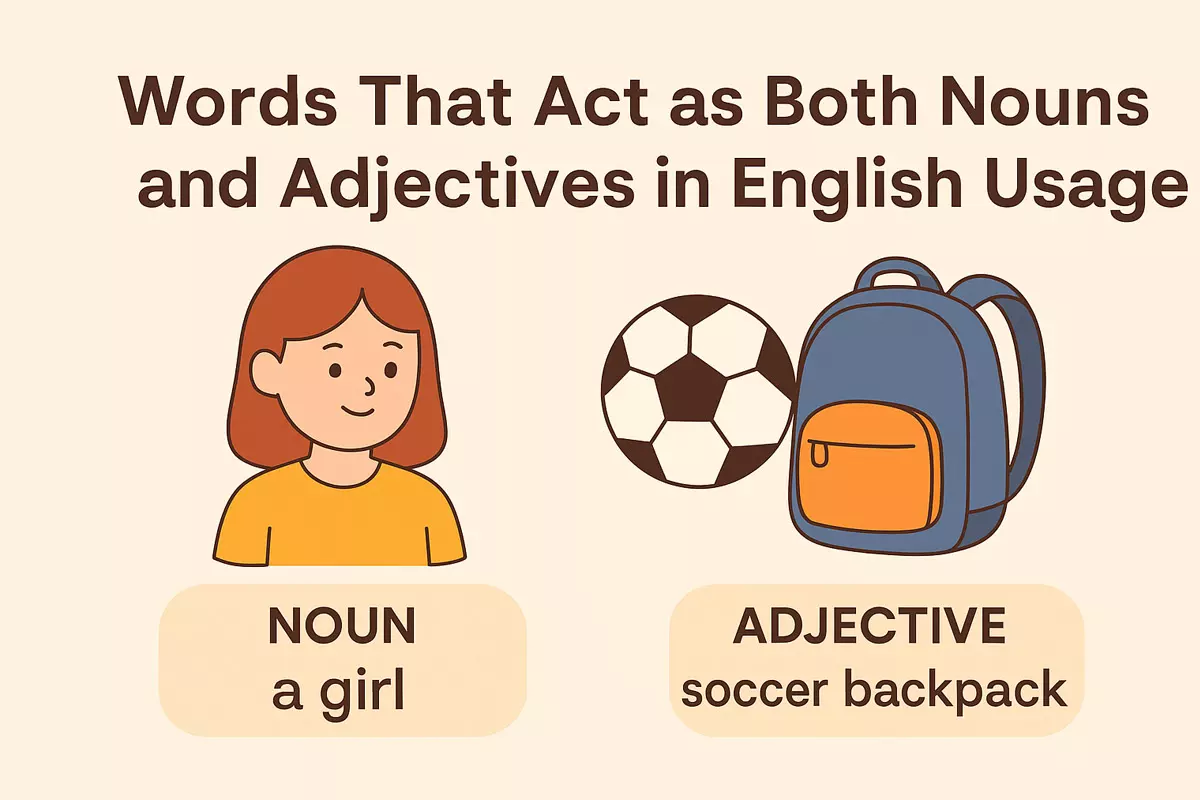 This article explains how words like plastic, gold, and online function as both nouns and adjectives in English. It covers meaning shifts based on word position, usage differences, common learner errors, and includes practice with sentence rewriting.
- Overview of noun–adjective dual-use words
- Common examples like plastic, gold, and online
- Position changes and meaning shifts in sentences
- Differences between modifier use and naming use
- Register differences in noun vs adjective function
- Typical learner mistakes with form and position
- Practice: rewrite sentences using correct word function
English contains many words that can serve dual roles, sometimes acting as descriptors and other times as names for things. This versatility highlights the language’s flexibility, allowing words to adapt to different contexts depending on how they are used. By examining how certain terms function both as naming elements and as descriptive modifiers, we can better appreciate the dynamic nature of English and the creative ways speakers use the language to express nuanced meanings in various situations.
Overview of noun–adjective dual-use words
Many English words can serve as both nouns and adjectives, depending on their position and function within a sentence. This flexibility is common in everyday language and is especially noticeable in phrases where one word describes or modifies another. Often, these dual-use terms appear before a main noun, acting as modifiers, but they retain their core identity as objects, concepts, or materials.
How Dual-Use Works in English Sentences
Words like “chicken,” “silver,” and “summer” naturally shift between roles. For example, in “chicken soup,” “chicken” describes the type of soup, functioning adjectivally. When used in “The chicken is in the yard,” it’s a noun. This adaptability streamlines communication and allows for concise descriptions without the need for additional words or suffixes.
Common Examples of Nouns Used as Adjectives
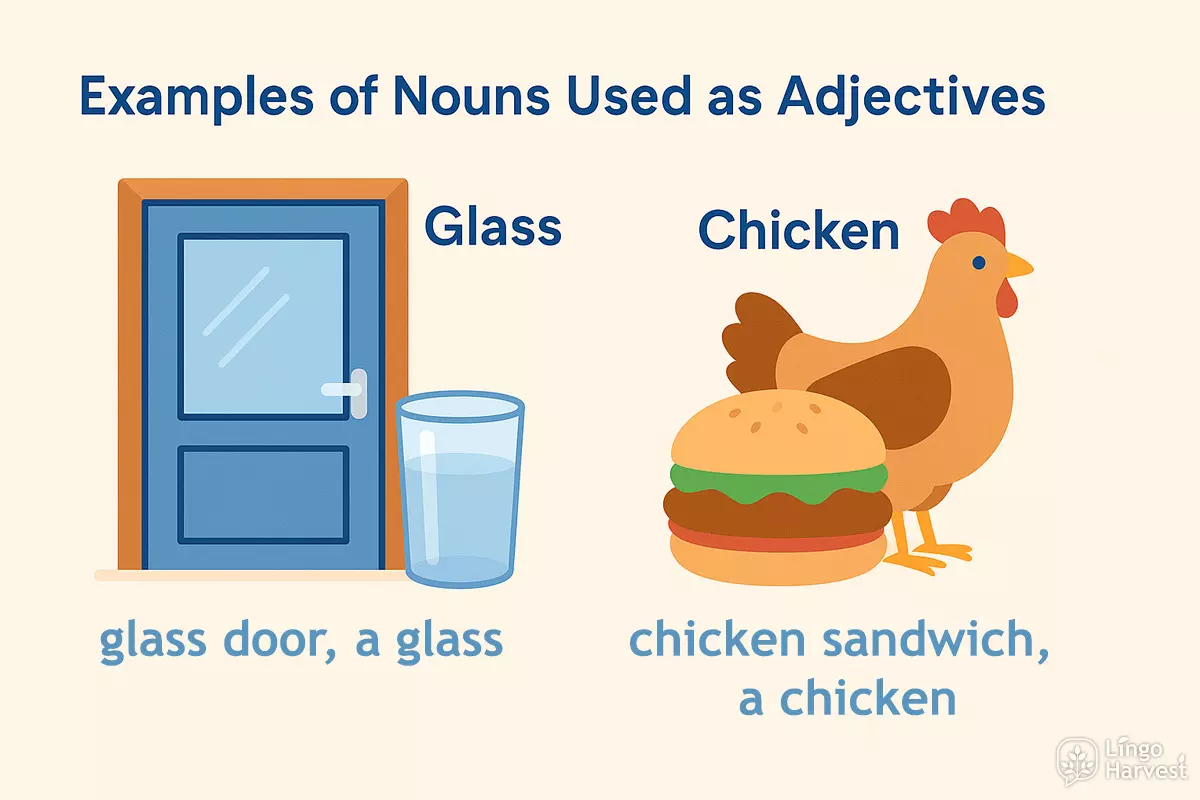
The following words frequently appear in both capacities, modifying other nouns or standing alone as subjects or objects:
- Stone (stone wall, a stone)
- Wood (wood floor, a wood)
- Glass (glass door, a glass)
- Chicken (chicken sandwich, a chicken)
- Gold (gold ring, gold is valuable)
- Summer (summer vacation, summer is hot)
- Computer (computer science, a computer)
- Garden (garden tools, a garden)
- School (school bus, a school)
- Chocolate (chocolate cake, chocolate melts)
- Paper (paper bag, a paper)
- Office (office chair, an office)
- Family (family business, a family)
- History (history lesson, history repeats)
- Water (water bottle, water is essential)
- Football (football match, a football)
- Metal (metal detector, metal conducts electricity)
- Science (science project, science is fascinating)
- Travel (travel guide, travel is fun)
- Fashion (fashion show, fashion changes)
Patterns and Usage Notes
Dual-use words usually precede the main noun when functioning as modifiers. This is typical in compound nouns or descriptive phrases. The context of the sentence determines the function; word order plays a crucial role.
| Word | As a Noun | As an Adjective |
|---|---|---|
| Glass | I drank a glass of water. | She opened the glass door. |
| Summer | Summer is my favorite season. | We took a summer holiday. |
| Chocolate | He ate a chocolate. | They made a chocolate cake. |
| School | The school is across the street. | We rode the school bus. |
| Paper | She wrote on the paper. | He brought a paper bag. |
| Metal | Metal is a good conductor. | They found a metal pipe. |
Why This Duality Matters
Understanding these flexible words helps speakers and writers create clear, natural-sounding phrases. Recognizing when a word is modifying another or standing alone avoids confusion and improves communication. This aspect of English also enriches vocabulary and supports creative expression.
Common examples like plastic, gold, and online
Many English words can shift between roles, serving as both nouns and adjectives depending on context. This flexibility allows us to be concise and clear, but it can also cause confusion for learners. Let's explore how this works with some familiar terms.
How certain words change function
Some words start life as nouns, describing objects or concepts, but are often used before other nouns to specify type or quality—functioning as adjectives. For example, in "plastic bag," "plastic" is not just a material but a descriptor for the kind of bag.
- Plastic: As a noun, it refers to the synthetic material ("This bottle is made of plastic"). As an adjective, it describes something made from that material ("plastic container").
- Gold: Used as a noun for the precious metal ("Gold is valuable"), or as an adjective meaning 'made of gold' or 'gold-colored' ("gold ring").
- Online: Functions as a noun in "the online" (rare but possible, e.g., "the online is down"), and more commonly as an adjective in "online course" or "online store."
Other versatile words in English
Many other everyday words can act in this dual capacity. Here are more examples:
- Silver
- Wood
- Stone
- Glass
- Paper
- Chicken
- School
- Garden
- Office
- Kitchen
- Summer
- Winter
- Business
- Sports
- City
- Country
- Internet
- Fashion
Usage patterns: noun vs. adjective
Often, the position of the word in a sentence signals its role. If it comes before another noun and describes it, it's acting adjectivally. If it stands alone or is the subject/object, it's a noun.
| Word | As a Noun | As an Adjective |
|---|---|---|
| Plastic | This toy is made of plastic. | She bought a plastic bottle. |
| Gold | Gold is a precious metal. | He wore a gold watch. |
| Online | The online has changed shopping. (rare) | They offer online classes. |
| Chicken | We had chicken for dinner. | They run a chicken farm. |
| School | The school is closed today. | She took the school bus. |
| Summer | Summer is my favorite season. | I bought summer clothes. |
Understanding how these terms shift between functions helps with both writing and comprehension. The context and word order usually reveal whether a word is being used as a noun or serving as an adjective, clarifying meaning for both native speakers and learners alike.
Position changes and meaning shifts in sentences
When a word serves as both a noun and an adjective, its placement in a sentence often determines its function and can subtly alter the meaning. Typically, these words appear before a noun when acting as adjectives, describing or qualifying another word. When used as nouns, they stand alone as the subject, object, or complement of a clause.
How placement determines function
Many terms in English can shift roles depending on where they appear. For example, “chicken” in “chicken soup” describes the type of soup, but in “The chicken crossed the road,” it clearly refers to the animal itself. These shifts are not just syntactic; they can influence how a sentence is understood.
Common examples of dual-role words
- Light: “light bulb” (adjective) vs. “Turn on the light” (noun)
- Paper: “paper plane” (adjective) vs. “Read the paper” (noun)
- Stone: “stone wall” (adjective) vs. “Throw a stone” (noun)
- Glass: “glass door” (adjective) vs. “Drink a glass of water” (noun)
- Wood: “wood table” (adjective) vs. “Chop some wood” (noun)
- Silver: “silver ring” (adjective) vs. “He collected silver” (noun)
- Milk: “milk bottle” (adjective) vs. “Drink your milk” (noun)
- Garden: “garden tools” (adjective) vs. “Water the garden” (noun)
- School: “school bus” (adjective) vs. “He walked to school” (noun)
- Water: “water bottle” (adjective) vs. “Pour the water” (noun)
- Iron: “iron gate” (adjective) vs. “Use the iron” (noun)
- Gold: “gold medal” (adjective) vs. “He bought gold” (noun)
- Chicken: “chicken sandwich” (adjective) vs. “Feed the chicken” (noun)
- Plastic: “plastic bag” (adjective) vs. “Recycle plastic” (noun)
- Car: “car keys” (adjective) vs. “Drive the car” (noun)
- Coffee: “coffee cup” (adjective) vs. “Brew some coffee” (noun)
- Fruit: “fruit salad” (adjective) vs. “Eat fruit” (noun)
- Room: “room temperature” (adjective) vs. “Clean the room” (noun)
- Dance: “dance class” (adjective) vs. “Join the dance” (noun)
- Time: “time zone” (adjective) vs. “Check the time” (noun)
Comparing shifts in meaning
Sometimes, the function of a word within a sentence can lead to subtle changes in interpretation. For learners, distinguishing these uses is key to clarity.
| Word as Adjective (before noun) | Word as Noun (subject/object) |
|---|---|
| glass window (type of window) | I cleaned the glass. (material itself) |
| paper cup (type of cup) | He wrote on the paper. (the sheet) |
| chicken sandwich (type of sandwich) | The chicken is tasty. (the meat or animal) |
| school book (type of book) | She went to school. (the institution) |
| fruit basket (basket for fruit) | Fruit is healthy. (food group) |
| water bottle (bottle for water) | Pour the water. (the liquid) |
| iron fence (type of fence) | He bought iron. (the element) |
| gold chain (type of chain) | The gold is pure. (the metal) |
| dance floor (type of floor) | The dance was fun. (the event) |
| car engine (engine of a car) | He repaired the car. (the vehicle) |
Why these shifts matter
Recognizing the dual nature of these words can help avoid confusion and enhance both written and spoken communication. Understanding how word order and sentence structure affect meaning is essential for mastering English, especially for those learning it as a second language.
Differences between modifier use and naming use
When a word can function as both a noun and an adjective, its grammatical role depends on how it's used in a sentence. As a modifier, the word describes or qualifies another noun, while in its naming role, it stands alone as the subject or object. This distinction affects sentence structure and meaning.
Modifier (Adjective) Use
In the modifier role, the word appears directly before another noun, providing extra detail. It tells us what kind, which one, or how many. For example, in "chicken soup," the word "chicken" modifies "soup" and specifies the type of soup.
Naming (Noun) Use
When serving as a noun, the same word represents a person, place, thing, or idea on its own. For instance, "chicken" in "The chicken is cooked" is the main subject. Here, it doesn't describe another noun, but is the thing being talked about.
Key Characteristics
- Modifier use: Usually comes before the main noun it describes.
- Naming use: Acts as the main noun in the clause or sentence.
- Modifiers cannot take plural forms or articles (e.g., sports car, not sports cars car).
- Naming forms can be singular or plural and may use articles or determiners (e.g., a chicken, the chickens).
Comparison Table
| Modifier (Adjective) Use | Naming (Noun) Use |
|---|---|
| Used before another noun e.g., "apple pie" |
Acts as subject/object e.g., "I ate an apple" |
| Describes type or category e.g., "history teacher" |
Refers to the thing itself e.g., "History is fascinating" |
| No plural or article e.g., "car engine" (not "cars engine") |
Can be plural or take an article e.g., "cars", "the engine" |
| Answers "What kind?" e.g., "school bus" |
Answers "What is it?" e.g., "The bus arrived" |
Common Examples of Dual-Role Words
Here are several words that often serve both as a noun (naming use) and as a descriptive modifier:
- Chicken (chicken soup / the chicken)
- Glass (glass bottle / a glass)
- Stone (stone wall / a stone)
- Paper (paper bag / the paper)
- Water (water bottle / the water)
- Chocolate (chocolate cake / the chocolate)
- School (school bus / the school)
- Car (car keys / the car)
- Garden (garden hose / the garden)
- History (history book / history fascinates me)
- Sports (sports equipment / sports are fun)
- Office (office chair / the office)
- Science (science project / science is hard)
- Music (music teacher / music calms me)
- Computer (computer screen / my computer)
- Family (family reunion / my family)
- Summer (summer vacation / summer is hot)
- Plastic (plastic bag / plastic is everywhere)
This dual function enriches English, but it’s important to recognize the intended meaning based on sentence position and use. Modifier forms typically never stand alone, while naming forms do. Understanding these patterns helps avoid confusion and ensures clear communication.
Register differences in noun vs adjective function
Understanding how a word's role shifts between noun and adjective forms is essential for precise English communication. The context and register—whether formal, informal, technical, or conversational—often influence which function is preferred or even possible. For instance, some terms are used as modifiers (adjectives) more often in specialized or academic settings, while in everyday speech, their noun forms are favored.
How context shapes word function
Certain words naturally fit one role depending on their environment. Take "stone" in "stone wall" (adjective function, modifying "wall") versus "a stone" (noun). In scientific writing, "protein" often precedes another noun ("protein structure"), acting adjectivally, but it can stand alone as a noun in general discussion ("Proteins are essential nutrients").
Formality and register considerations
The choice between using a word as a noun or an adjective can subtly alter the tone. For example:
- Government policy (adjective function, formal)
- The government (noun, neutral or informal)
- Chocolate cake (adjective, everyday)
- A chocolate (noun, casual)
In legal or bureaucratic language, noun modifiers are common: "contract terms," "court order." In contrast, spoken English might default to the base noun.
Common words with dual roles
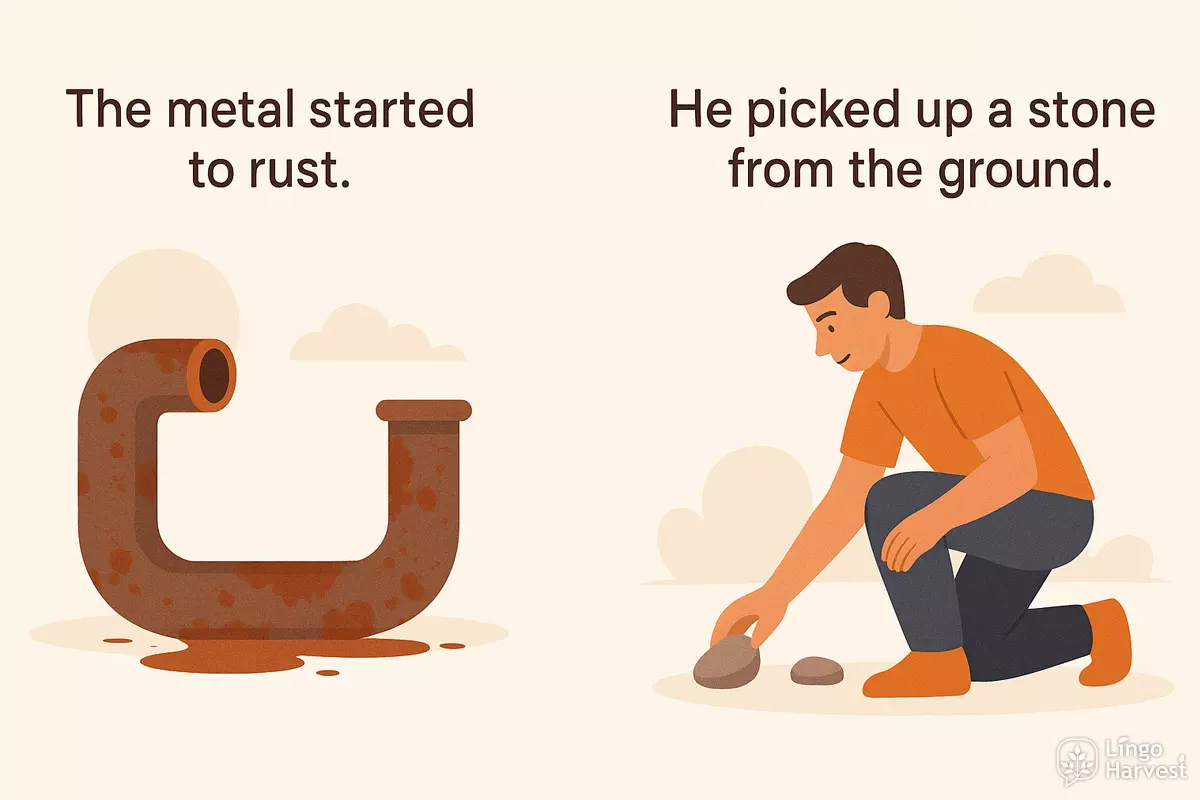
Here's a selection of terms that often change function based on register and syntactic position:
- Metal (metal frame / the metal) → The metal started to rust.
- Stone (stone bridge / a stone) → He picked up a stone from the ground.
- Fabric (fabric pattern / some fabric) → She bought some fabric for sewing.
- Wood (wood carving / the wood) → The wood smelled fresh after cutting.
- Iron (iron gate / the iron) → The iron was too hot to touch.
- Oil (oil lamp / some oil) → The machine needs some oil.
- Air (air pressure / the air) → The air felt cold this morning.
- Light (light source / the light) → The light was too bright.
- Fire (fire safety / the fire) → The fire spread quickly.
- Rain (rain clouds / the rain) → The rain stopped suddenly.
- Sound (sound waves / the sound) → The sound was very clear.
- Heat (heat wave / the heat) → The heat was unbearable yesterday.
- Energy (energy level / the energy) → The energy in the room was amazing.
- Traffic (traffic jam / the traffic) → The traffic was terrible today.
- Market (market price / the market) → The market opened early.
- Language (language skills / a language) → She speaks a language I don’t know.
- Team (team meeting / the team) → The team worked together well.
- Room (room temperature / a room) → We booked a room for two nights.
- Project (project manager / the project) → The project is almost finished.
- Planet (planet surface / a planet) → They discovered a planet similar to Earth.
Comparing noun and adjective uses in different registers
| Word | As Noun (Typical Register) | As Adjective (Typical Register) |
|---|---|---|
| Silver | The silver was tarnished. (neutral, descriptive) |
Silver jewelry is popular. (commercial, descriptive) |
| School | She's at school. (neutral, everyday) |
School supplies are on sale. (retail, formal) |
| Paper | He wrote a paper. (academic, neutral) |
Paper towels are useful. (practical, descriptive) |
| Office | She left the office early. (business, neutral) |
Office chair prices vary. (commercial, catalog) |
| Family | The family is large. (personal, social) |
Family dinner is important. (cultural, communal) |
Register awareness helps speakers and writers choose the most effective word form for their audience and purpose. Recognizing these distinctions is key to sounding natural and clear in both formal and informal contexts.
Typical learner mistakes with form and position
Learners often confuse when and how to use words that can function as both nouns and adjectives. This confusion usually centers around sentence structure, word order, and the subtle changes in meaning that arise depending on a word’s role.
Common misplacement issues
It’s easy to put these dual-purpose words in the wrong spot within a phrase. For example, “chicken soup” (adjective + noun) is correct, but “soup chicken” (noun + noun) is not what native speakers say unless talking about a type of chicken. Placing the noun before the adjective form can result in unnatural or incorrect English.
Form confusion
Mistaking when a word is acting as a noun versus an adjective can lead to grammatical errors. Take “glass” in “glass bottle” (adjective use) versus “a glass” (noun use). Learners sometimes try to add plural or possessive endings incorrectly, like “glasses bottle” or “bottle’s glass,” which changes the meaning or creates ungrammatical phrases.
Frequent errors with noun-adjective combinations
- Adding plurals to adjectives: Saying “shoes boxes” instead of “shoe boxes.”
- Wrong position: “Table coffee” instead of “coffee table.”
- Redundant articles: “The gold the ring” instead of “the gold ring.”
- Missing the base form: “Sports car” (correct), not “sport car.”
- Incorrect order: “Rain heavy” instead of “heavy rain.”
- Mistaking adjective for noun: Using “wood” instead of “wooden” where only an adjective is possible (“wood chair” vs. “wooden chair”).
- Unnecessary possessive: “Children’s book” (correct), but “children book” (incorrect for the possessive meaning).
- Misunderstood meaning: “Paper bag” vs. “bag paper.”
- Using plural for the modifier: “Tooth brushes” instead of “toothbrushes.”
- Overgeneralizing patterns: Applying the same structure to all words (e.g., “milk bottle” is correct, but “bottle milk” is not a standard collocation).
Comparing correct and incorrect structures
| Incorrect Example | Correct Example |
|---|---|
| shoes boxes | shoe boxes |
| bottle water | bottled water / water bottle |
| sugars packets | sugar packets |
| glass bottleses | glass bottles |
| book children | children’s book |
| chocolate cake | chocolate cake |
| table coffee | coffee table |
| bottle milk | milk bottle |
Tips for avoiding mistakes
- Remember: modifier (adjective form) almost always comes before the main noun.
- Use the singular form of the modifier unless it’s a set phrase (e.g., “sports car”).
- Check if the combination is a common collocation in English.
- Be careful with possessives—sometimes you need them, sometimes not.
By being mindful of these pitfalls, learners can produce more natural and accurate English when using words that can switch between noun and adjective roles.
Practice: rewrite sentences using correct word function
Understanding how a word changes its role in a sentence is crucial for mastering English usage. In this section, you'll get hands-on experience by identifying and revising sentences where common words act as both nouns and adjectives. This will help you internalize the shift in function and improve your grammatical flexibility.
Instructions
Below are sentences containing words that can function as both nouns and adjectives. Your task is to rewrite each sentence so that the word clearly serves the opposite function from what is presented. Pay attention to context clues and sentence structure to ensure grammatical accuracy.
Exercise: Rewrite the Sentences
- The chicken soup is delicious.
Rewrite so "chicken" is a noun, not an adjective. - We visited the history museum.
Rewrite so "history" is a noun, not an adjective. - He wore a leather jacket.
Rewrite so "leather" is a noun, not an adjective. - She has a gold ring.
Rewrite so "gold" is a noun, not an adjective. - I enjoy summer evenings.
Rewrite so "summer" is a noun, not an adjective. - The garden tools are in the shed.
Rewrite so "garden" is a noun, not an adjective. - We bought paper plates.
Rewrite so "paper" is a noun, not an adjective. - There is a stone wall at the end of the yard.
Rewrite so "stone" is a noun, not an adjective. - He collects coin albums.
Rewrite so "coin" is a noun, not an adjective. - The school bus is late.
Rewrite so "school" is a noun, not an adjective.
Word Function Comparison
See how words shift between noun and adjective roles in different sentences:
| Word | As a Noun | As an Adjective |
|---|---|---|
| Chicken | I ate chicken for dinner. | I made chicken soup. |
| Paper | She wrote on paper. | We used paper plates. |
| Leather | This bag is made of leather. | He wore a leather jacket. |
| Gold | The ring is made of gold. | She has a gold ring. |
| Garden | The garden is full of flowers. | The garden tools are new. |
| Stone | He threw a stone. | The stone wall is old. |
| School | School starts at 8 am. | The school bus is yellow. |
| Coin | He found a coin. | She bought a coin collection. |
| History | History is my favorite subject. | The history museum is interesting. |
| Summer | Summer is hot here. | Summer evenings are beautiful. |
Show answers
- The soup contains chicken. / I ate chicken.
- The museum displays history. / I love history.
- The jacket is made of leather. / He bought leather.
- The ring is made of gold. / She bought gold.
- Summer is my favorite season. / I love summer.
- The tools are for the garden. / I worked in the garden.
- The plates are made of paper. / I need paper.
- The wall is made of stone. / He threw a stone.
- The albums are for coins. / He found a coin.
- The bus is for the school. / She is at school.