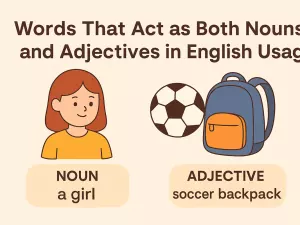
Noun Modifiers: Nouns Describing Nouns

 The article explains noun modifiers, including basic noun plus noun structures, meaning relationships, stress patterns, and how they differ from adjectives. It also highlights common combinations, possible ambiguities, and provides practice with noun phrases.
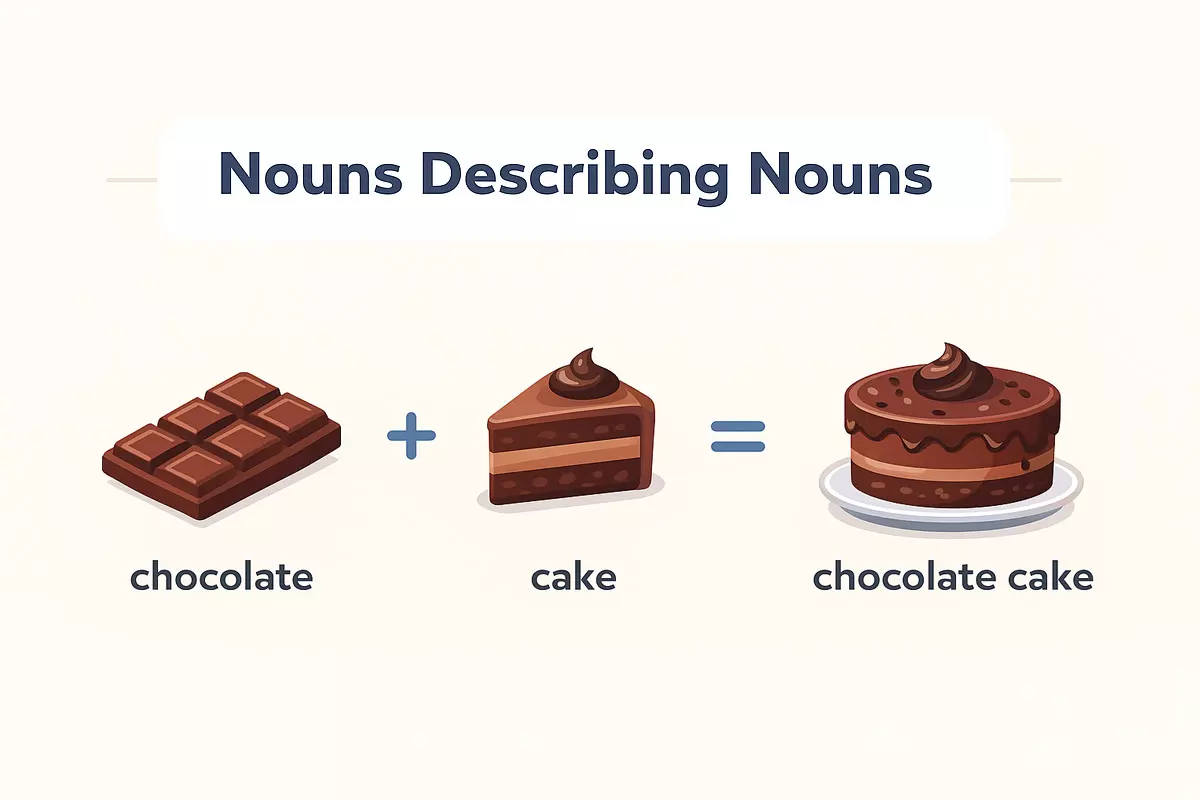
Have you ever noticed how combining two nouns can create more precise and vivid descriptions in language? When one noun is used to modify another, it allows us to convey specific meanings and add depth to our communication. This technique, often called a compound noun or noun adjunct, enriches our vocabulary by enabling us to describe objects, places, or ideas in a more detailed and nuanced way. For example, phrases like "chocolate cake" or "school bus" immediately paint a clear picture, demonstrating how two simple naming words, when joined, can make our language more expressive and efficient.
What Is a Noun Modifier?
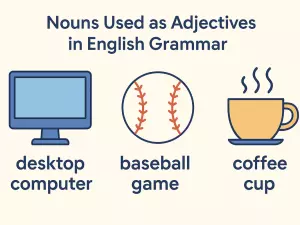
A noun modifier is a noun that functions like an adjective, describing or specifying another noun directly in front of it. Instead of using separate descriptive words, English often places one noun before another to narrow down or clarify meaning. For example, in the phrase “chicken soup,” the word “chicken” modifies “soup” to show what kind of soup is meant.
How Noun Modifiers Work
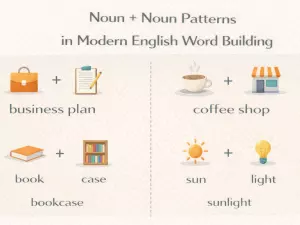
The structure is simple: the first noun acts as a descriptor, and the second noun is the main subject. These combinations are especially common in English, where two nouns are placed side by side with no linking words in between. The first noun doesn’t change form and is almost always singular, even if it describes something plural.
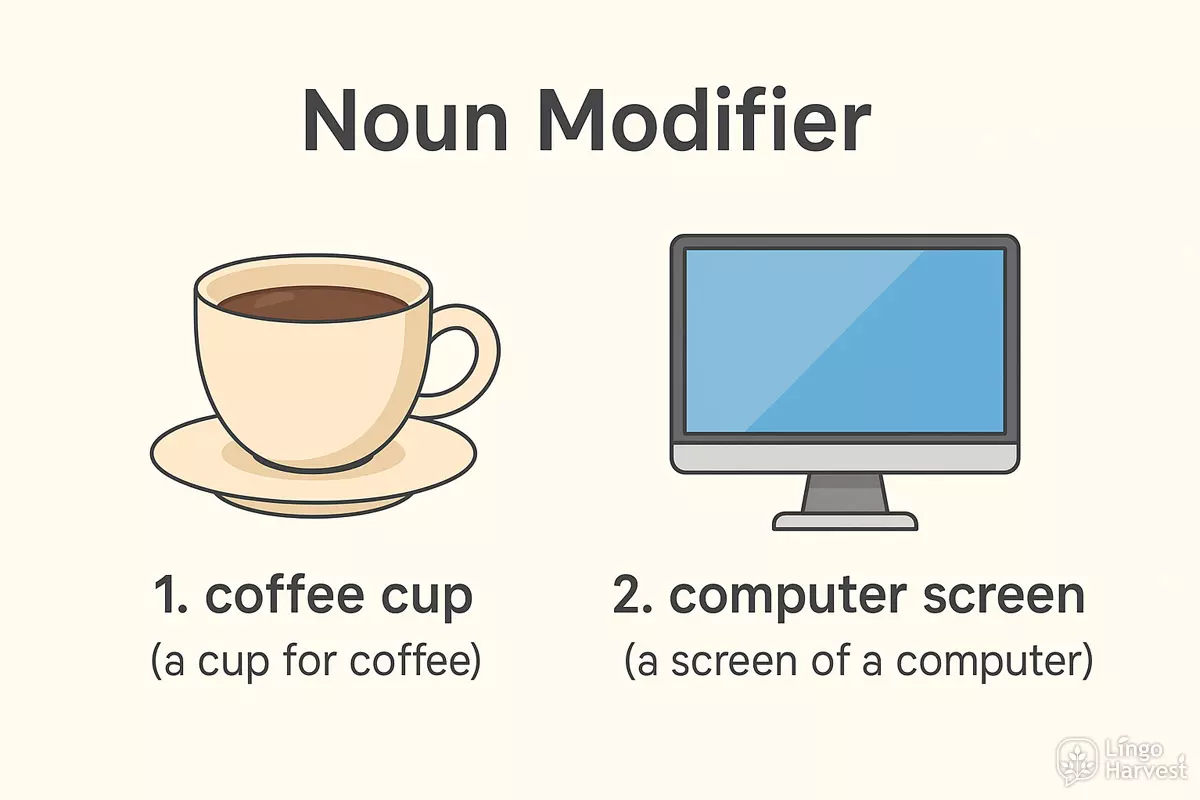
- coffee cup (a cup for coffee)
- computer screen (a screen of a computer)
- school bus (a bus for school use)
- race car (a car designed for racing)
- kitchen table (a table kept in the kitchen)
- garden hose (a hose used in the garden)
- toothbrush holder (a holder for a toothbrush)
- book cover (the cover of a book)
- snow boots (boots for snow)
- dog park (a park for dogs)
- office chair (a chair for office use)
- water bottle (a bottle for water)
- fruit salad (salad made of fruit)
- window cleaner (a cleaner for windows)
- baby clothes (clothes for babies)
- car keys (keys for a car)
- music teacher (a teacher of music)
- bus stop (a stop for buses)
- sports equipment (equipment for sports)
Why Use Nouns as Modifiers?
This construction helps make language more concise and precise. By placing a noun modifier before another noun, you avoid lengthy explanations. Instead of saying “a bottle that is used for water,” you simply say “water bottle.” This makes communication faster and clearer.
Common Patterns and Rules
- The first noun almost never takes a plural form (e.g., “shoe store,” not “shoes store”).
- The meaning can often be guessed by reversing the phrase and adding “of” or “for” (e.g., “table lamp” → “lamp for the table”).
- Some combinations are so common that they function almost as single words (e.g., “football,” “toothpaste”).
Comparison: Noun Modifier vs. Adjective
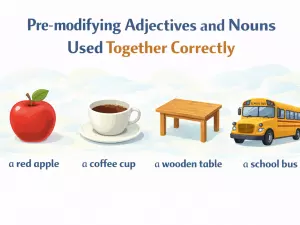
While adjectives describe qualities (like “red” in “red apple”), noun modifiers specify type or purpose (like “apple” in “apple pie”). This difference is important for understanding how English builds meaning.
| Adjective + Noun | Noun Modifier + Noun |
|---|---|
| red car | race car |
| big house | family house |
| clean water | water bottle |
| old book | book cover |
| round table | kitchen table |
Noun modifiers are an efficient way to convey specific information about objects, people, or places. They are a fundamental part of English sentence structure, and mastering their use can make your communication more natural and precise.
Basic Noun + Noun Structures
Nouns often describe other nouns in English, creating compact phrases that convey specific meanings. This type of modifier structure is common in everyday language, especially when you want to clarify what kind of thing, person, or concept you mean. The first noun acts as an adjective, giving more information about the second noun. For example, in "chicken soup," "chicken" tells us what kind of soup it is. These combinations are usually written as two separate words, with the first noun modifying the second.
How Noun Modifiers Work
The first noun, or modifier, typically answers the question "What kind?" or "Which one?" about the main noun. Most of these constructions are singular even if they refer to more than one thing (for instance, "shoe store" and not "shoes store"). This pattern helps keep descriptions short and clear.
- coffee cup
- car door
- school bus
- book cover
- apple pie
- computer desk
- kitchen table
- garden hose
- office chair
- chicken soup
- race car
- city park
- birthday card
- summer vacation
- mountain bike
- water bottle
- window frame
- bus stop
- language school
- music festival
Usage Patterns and Rules
Not all noun combinations are possible; the first noun must clearly describe or limit the meaning of the second. Generally, the modifier noun is singular, even for plural meanings (e.g., "shoe store" not "shoes store"), unless it is a material or already a plural form by convention ("sports car").
Common Mistakes and Tips
- ❌ Avoid using plural forms as modifiers unless it's standard (e.g., "sports equipment," not "sports equipments").
- ✅ Place the descriptive noun first: "toothpaste tube" (not "paste tooth tube").
- ✅ For clarity, use a hyphen only if the meaning is unclear without it, which is rare in these structures.
Comparison: Noun Modifier vs. Adjective Modifier
| With Noun Modifier | With Adjective Modifier |
|---|---|
| chicken soup | spicy soup |
| glass door | heavy door |
| language school | international school |
| computer desk | large desk |
This structure helps you build precise, natural-sounding English phrases. Knowing how to use nouns as modifiers is a practical skill for both writing and conversation.
Meaning Relationships Between the Nouns
When one noun describes another, the connection between them reveals a specific meaning or relationship. These pairings are not random; the first noun (the modifier) typically narrows or clarifies the second noun (the head noun), providing context such as purpose, material, location, or type. Recognizing these patterns helps with both comprehension and natural usage.
Common Types of Noun-Noun Relationships
Several distinct patterns emerge when nouns are used to modify other nouns. Here are some of the most frequent types:
- Material: What something is made of (e.g., glass bottle, cotton shirt)
- Purpose/Function: What something is used for (e.g., coffee cup, swimming pool)
- Location: Where something is found or used (e.g., kitchen table, garden gate)
- Time: When something occurs (e.g., summer vacation, morning routine)
- Type/Category: What kind or category (e.g., sports car, chicken soup)
- Content: What something contains (e.g., water bottle, chocolate cake)
- Origin: Where something comes from (e.g., Italian bread, London office)
- Owner/User: Who owns or uses it (e.g., children’s book, teacher desk)
- Part/Whole: A part of something larger (e.g., engine part, company policy)
- Measurement/Quantity: How much or how many (e.g., liter bottle, six-pack can)
Examples of Noun Modifiers in Context
Below are varied examples illustrating different relationships found in noun modifiers. Notice how the first noun shapes the meaning of the phrase:
- Apple pie → type of pie (apple is the main ingredient)
- Office chair → chair for use in an office
- Winter coat → coat for winter
- Birthday card → card for a birthday
- Stone wall → wall made of stone
- Library book → book belonging to a library
- Car door → door that is part of a car
- Kitchen window → window in a kitchen
- History teacher → teacher of history
- Baby food → food intended for babies
- Mountain bike → bike designed for mountains
- Plastic bag → bag made of plastic
- Travel guide → guide for travel
- Dog house → house for a dog
Comparing Relationship Types
Sometimes, the exact meaning can depend on context or convention. Here’s a comparison of several relationships found in noun modifier structures:
| Relationship Type | Example & Explanation |
|---|---|
| Material | Wooden chair (a chair made of wood) |
| Purpose | Coffee grinder (a grinder for coffee) |
| Content | Milk bottle (a bottle containing milk) |
| Location | Office window (a window in an office) |
| Type/Category | Sports car (a car designed for sports performance) |
Why Understanding These Patterns Matters
Knowing how nouns relate within a phrase helps you interpret and create clear, concise expressions. These structures allow English speakers to communicate complex ideas efficiently, often packing a lot of meaning into just two words. Recognizing these patterns also helps you avoid ambiguity and choose the most natural-sounding combinations.
Stress Patterns in Noun Modifiers
When two nouns are combined, the way we pronounce them often changes. In English, these combinations—known as noun modifiers or noun-noun compounds—typically place the main stress on the first word. This shift in emphasis can change the meaning and clarity of the phrase. Recognizing where the stress falls helps listeners distinguish between a true compound (like coffee table) and a phrase that simply links two nouns (such as coffee mug).
Primary Stress Placement
In most noun modifier phrases, the first noun receives the strongest emphasis. This pattern signals that the first noun is describing or modifying the second, rather than simply listing two objects. For example, in garden hose, the word garden is stressed, showing that the hose belongs to or is used in a garden.
- TOY store → a shop selling toys
- BUS stop → a place where buses stop
- KITCHEN chair → a chair for the kitchen
- APPLE pie → a pie made with apples
- BOOK shelf → a shelf for books
- CHICKEN soup → soup made from chicken
- OFFICE manager → manager of an office
- COMPUTER screen → a screen for a computer
- SUMMER dress → a dress for summer
- FOOTBALL match → a match involving football
- WATER bottle → a bottle for water
- DINNER plate → a plate for dinner
- STUDENT loan → a loan for students
- RAIN jacket → a jacket for rain
- NEWSPAPER article → an article from a newspaper
- FIRE alarm → an alarm for fire
- TEA cup → a cup for tea
- POLICE car → a car used by police
Exceptions and Special Cases
While initial stress is the most common pattern, there are exceptions. Some phrases, especially those that are not set compounds but rather noun + noun phrases (like French wine), tend to have the second word stressed instead. In these cases, the first word acts more like an adjective.
- French WINE → wine from France
- Plastic BAG → a bag made of plastic
- City COUNCIL → the council for a city
Why Stress Matters
Getting the stress right helps avoid confusion. For example, greenhouse (a glass building for growing plants) is pronounced with the stress on GREEN, while green house (a house painted green) stresses both words equally. Misplacing the stress can lead to misunderstandings, especially for learners or in fast conversation.
Difference from Adjective Use
Noun modifiers and adjectives both describe or specify nouns, but they function differently in sentences. Adjectives are dedicated descriptive words like “red,” “happy,” or “large,” and they typically answer questions about qualities or states. In contrast, noun modifiers use another noun in front of a main noun (“chicken soup,” “summer vacation,” “car engine”) to indicate type, purpose, material, or relationship, rather than a descriptive attribute.
How Noun Modifiers and Adjectives Work
Adjectives usually come before the noun and directly describe it: “blue sky,” “old book.” Noun modifiers, however, provide context or specify a category: “sky blue,” “book cover.” Notice how a noun modifier often narrows meaning, while an adjective comments on a feature.
Key Differences Summarized
- Adjectives describe qualities or states (e.g., “green,” “fast,” “delicious”).
- Noun modifiers show type, purpose, or material (e.g., “chocolate cake,” “race car”).
- Adjectives can be comparative/superlative (“bigger,” “fastest”); noun modifiers do not change form.
- Noun modifiers are always singular, even if the meaning is plural (“shoe store,” not “shoes store”).
- Adjectives can stand alone with linking verbs (“The sky is blue”); noun modifiers cannot (“The cake is chocolate” does not mean the same as “chocolate cake”).
Common Patterns
Many English phrases use both forms, but the choice changes the meaning:
- “plastic bag” (bag made of plastic) vs. “plastic” (adjective, not commonly used alone for bags)
- “history teacher” (teacher of history) vs. “historical teacher” (not natural; would mean a teacher from history)
- “chicken soup” (type of soup) vs. “chicken” (adjective, not used this way)
- “wooden table” (adjective: made of wood) vs. “wood table” (noun modifier: also means made of wood, but less common in some varieties of English)
Comparison Table: Adjectives vs. Noun Modifiers
| Adjective Use | Noun Modifier Use |
|---|---|
| blue car (describes color) |
police car (shows type) |
| old house (describes age) |
brick house (shows material) |
| big dog (describes size) |
guard dog (shows purpose) |
| delicious cake (describes taste) |
birthday cake (shows occasion) |
| fast train (describes speed) |
freight train (shows function) |
Summary
Understanding when to use a noun as a modifier instead of an adjective helps you be more precise in English. Noun modifiers often clarify category, function, or material, while adjectives focus on qualities. Mixing them up can lead to confusion or unnatural phrasing, so recognizing their unique roles is key to clear communication.
Typical Combinations in Everyday English
When one noun is used to describe another, it creates a compact and clear meaning that’s easy to spot in daily language. These pairings are everywhere, from conversations to news headlines. Often, the first noun acts like an adjective, giving extra detail about the second noun. The result is a streamlined phrase that’s usually shorter and more direct than a full descriptive sentence.
Common Patterns and Examples
Some pairings have become so familiar that they feel like single words. Here are several widely used combinations where the first noun modifies the second:
- coffee cup
- office chair
- bus stop
- car keys
- chicken soup
- garden hose
- school bag
- birthday card
- computer screen
- water bottle
- kitchen table
- book shelf
- rain jacket
- cell phone
- shoe box
- sports team
- music lesson
- holiday plans
- apple pie
- road map
How These Combinations Work
The first noun usually answers the question “What kind?” or “What type?” about the second noun. For example, a coffee cup is a cup for coffee, while a garden hose is a hose for the garden. These phrases are efficient, avoiding extra words and making communication faster.
Structured Overview: Noun Modifier Examples
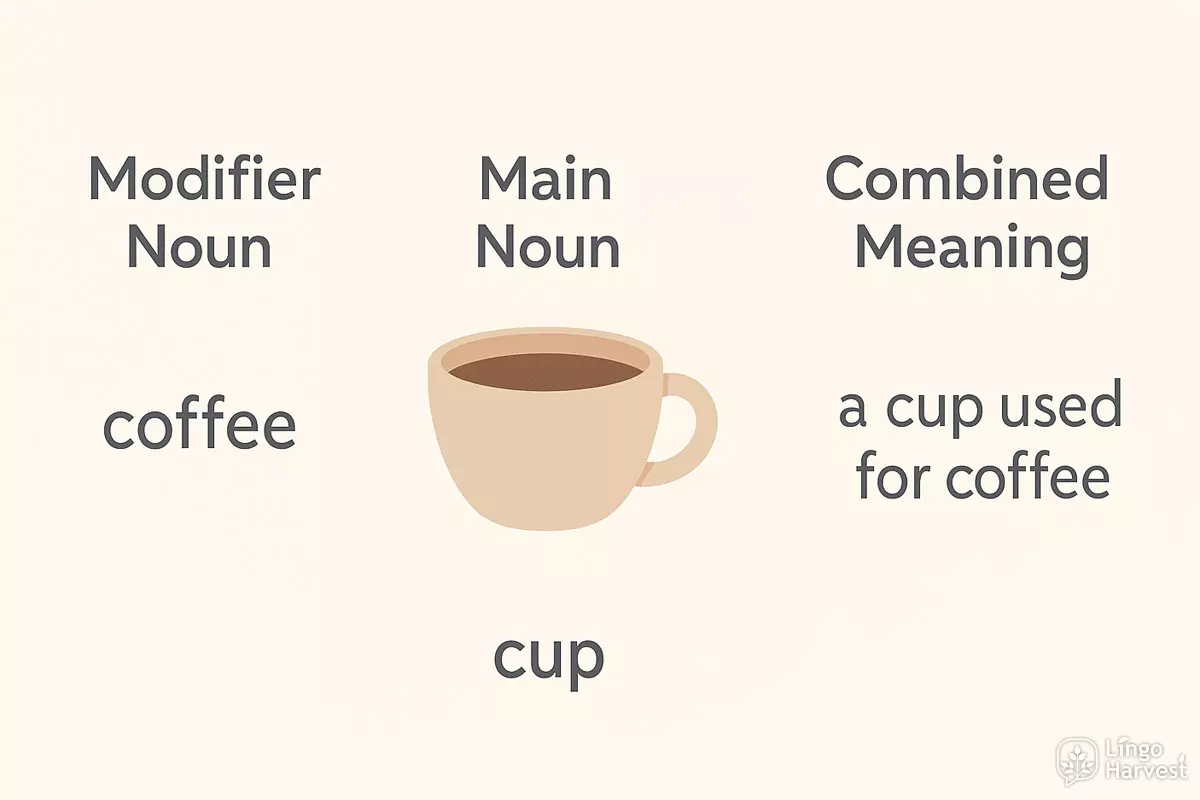
| Modifier Noun | Main Noun | Combined Meaning |
|---|---|---|
| coffee | cup | a cup used for coffee |
| office | chair | a chair used in an office |
| bus | stop | a place where buses stop |
| car | keys | keys for a car |
| school | bag | a bag used for school |
| water | bottle | a bottle for water |
Everyday Use and Flexibility
These structures are flexible and can be adapted to new situations. For example, as technology evolves, new pairings appear, such as smartphone case or video call. This adaptability makes noun modifiers a practical and essential part of English communication.
Ambiguous or Confusing Noun Chains
When multiple nouns are stacked together to modify another noun, the intended meaning can quickly become unclear. These strings, often called noun strings or noun stacks, are common in technical writing, business documents, and academic texts. However, without clear connections or context, readers may struggle to interpret them correctly.
Why Noun Stacks Cause Problems
Long chains of nouns can be ambiguous because English relies on word order and context, not inflection, to indicate relationships. Without connecting words, it’s hard to know which noun modifies which, or what the overall relationship is. For example, "employee performance evaluation criteria" could mean criteria for evaluating employee performance, or criteria for evaluating something called "employee performance evaluation."
Common Examples of Unclear Noun Strings
Here are some typical multi-noun constructions that may puzzle readers:
- Data analysis results report
- Customer service response time policy
- Product warranty claim process
- Software development project manager responsibilities
- Sales forecast accuracy improvement plan
- Human resources compliance training schedule
- Market research survey results summary
- Security system access code update
- Quality control inspection report
- Inventory management software update notice
- Supplier contract review procedure
- Employee health benefit enrollment period
- Network security breach incident report
- Budget approval process documentation
- Customer feedback analysis method
Clarifying Noun Stacks: Strategies
To make these phrases easier to understand, consider:
- Adding prepositions (e.g., "report on data analysis results")
- Rephrasing with possessives or relative clauses ("criteria for employee performance evaluation")
- Breaking the chain into shorter, simpler phrases
How Ambiguity Arises: Comparison Table
| Original Noun Chain | Possible Interpretations |
|---|---|
| Child safety seat inspection program |
|
| Employee performance review form deadline |
|
| Annual budget planning meeting schedule |
|
| Customer account update request form |
|
Overly dense noun clusters can confuse even experienced readers. Clearer phrasing, logical structure, and sometimes adding small connecting words can help prevent misunderstanding and ensure your meaning is unmistakable.
Practice: Interpret Noun + Noun Phrases
Understanding how one noun modifies another is essential for grasping English meaning and structure. In noun + noun combinations, the first noun usually describes the type, purpose, material, or other quality of the second noun. Let’s explore how these noun modifiers shape meaning and practice interpreting them.
Common Patterns and Their Interpretations
The first noun often answers “what kind?”, “what purpose?”, or “what material?”. Here are some typical types:
- Purpose: coffee cup (a cup for coffee), shoe box (a box for shoes)
- Material: glass bottle (a bottle made of glass), paper bag (a bag made of paper)
- Type/Category: sports car (a car for sports), chicken soup (soup made with chicken)
- Location: kitchen table (a table for the kitchen or in the kitchen), garden gate (a gate for the garden)
- Content: water bottle (a bottle that holds water), milk carton (a carton containing milk)
Exercise: What Do These Noun + Noun Phrases Mean?
Read the following phrases. For each, explain what the first noun tells us about the second noun.
- chicken sandwich
- office chair
- toothpaste tube
- book cover
- car door
- garden hose
- bus stop
- rain jacket
- computer screen
- coffee table
- plastic bag
- tea pot
- bedroom window
- school bus
- apple pie
Show answers
- A sandwich made with chicken.
- A chair for use in an office.
- A tube that holds toothpaste.
- The cover of a book.
- The door of a car.
- A hose for watering the garden.
- A place where a bus stops.
- A jacket for wearing in the rain.
- The screen of a computer.
- A table often used for coffee or in a living room.
- A bag made of plastic.
- A pot used for making or serving tea.
- The window in a bedroom.
- A bus used for taking students to school.
- A pie made with apples.
Compare: Literal vs. Idiomatic Meanings
Some noun + noun phrases are straightforward, while others have more idiomatic meanings. Compare these:
| Phrase | Typical Meaning |
|---|---|
| chicken soup | Soup made with chicken |
| baby oil | Oil for babies (not made of babies!) |
| apple juice | Juice made from apples |
| news paper | Paper containing news |
| race car | Car designed for racing |
| dog food | Food for dogs |
| silver ring | Ring made of silver |
| mountain bike | Bike for riding on mountains/trails |
| fire drill | Practice for a fire emergency (not a drill made of fire) |
| water bottle | Bottle for holding water |
Try Interpreting Unfamiliar Combinations
Sometimes, you’ll meet unusual noun modifiers. Try to guess the meaning from context. For example: “moon cheese,” “history teacher,” “butter knife,” “window seat.” What do you think each means?
Show answers
- moon cheese: Cheese that is dry and crunchy (brand name), or cheese from/suitable for the moon (imaginative).
- history teacher: A teacher who teaches history.
- butter knife: A knife for spreading butter.
- window seat: A seat next to a window (on a bus, plane, etc.).
By regularly analyzing how nouns modify other nouns, you will become more comfortable interpreting these combinations in real-life English.