Generic Nouns in Explanations, Rules, and General Statements

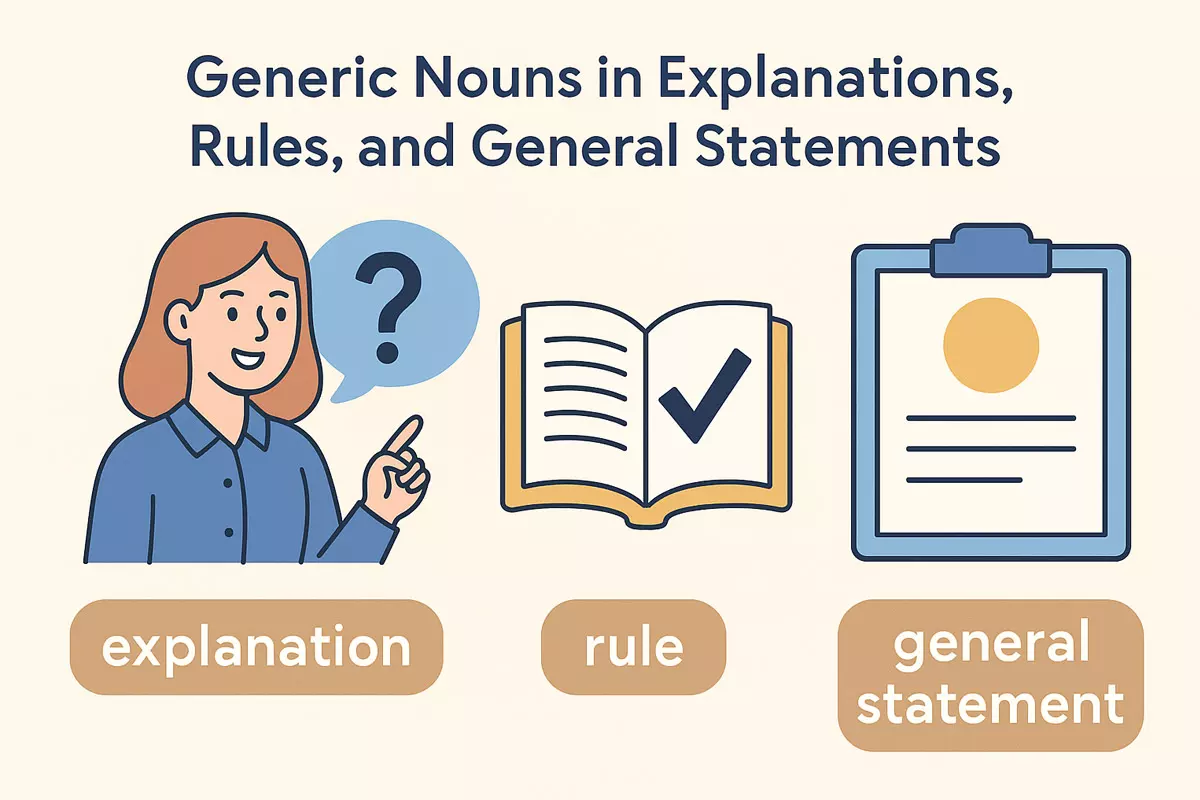 Here we what generic nouns are in English grammar, how to use their singular, plural, and zero article forms, their role in rules and definitions, differences from specific examples, common mistakes, and practice turning specifics into generics.
- What generic nouns are in English grammar
- Forms used for generic meaning: singular, plural, and zero article
- Generic nouns in definitions, rules, and instructions
- Choosing the right form for neutral generic statements
- Differences between generic and specific examples
- Common mistakes with generic people and group nouns
- Practice: turn specific sentences into generic statements
When we explain how things work, set out guidelines, or make broad claims about the world, we often use words that refer to entire categories rather than individual examples. These general terms, known as generalizations, help us communicate complex ideas more efficiently, but they can also cause misunderstandings if not used carefully. Recognizing and understanding how these general terms function can make our communication clearer and help prevent confusion, especially when discussing abstract or wide-ranging topics.
What generic nouns are in English grammar
Generic nouns are words that refer to an entire class, group, or category of people or things, rather than to a specific individual or item. In English, these nouns are commonly used when making general statements, explaining rules, or describing universal truths. Instead of pointing to one unique example, a generic noun represents a typical member or the whole set, such as in “A cat makes a good pet,” where “cat” means any cat, not a specific one.
How generic nouns are used
Writers and speakers use these nouns to express broad truths or to give instructions that apply widely. For example, in rules like “A child must be accompanied by an adult,” the term “child” is not about a particular individual; it applies to all children.
- To state facts: “Water boils at 100°C.”
- To explain habits: “The lion hunts at night.”
- In instructions: “A driver should always wear a seatbelt.”
- For proverbs: “An apple a day keeps the doctor away.”
- To describe types: “A smartphone can perform many functions.”
- For scientific laws: “A gas expands when heated.”
- To give advice: “A student should review notes regularly.”
- In generalizations: “Dogs are loyal animals.”
- With universal truths: “Light travels faster than sound.”
- In comparisons: “A rose smells sweeter than a daisy.”
Forms of generic nouns
There are several ways to construct generic references in English. The choice depends on the context, the noun’s countability, and whether the group is being described collectively or as a typical example.
| Form | Example & Usage |
|---|---|
| Singular with indefinite article | “A doctor must have patience.” — Refers to any doctor in general. |
| Plural noun | “Doctors must have patience.” — Refers to the whole group. |
| Uncountable noun | “Sugar is sweet.” — Applies to the substance as a whole. |
| Singular with the definite article | “The tiger is a dangerous animal.” — The species as a type. |
Understanding these patterns helps in writing explanations, setting rules, and making generalizations that are clear and universally understood. Whether you use the singular, plural, or uncountable form, the key is that the noun stands for a whole category, not just one example.
Forms used for generic meaning: singular, plural, and zero article
Understanding how English expresses general truths or broad categories often involves recognizing the use of singular, plural, and bare noun forms. These grammatical patterns help us make statements about whole classes of things, not just individual cases. Here’s how each form works to convey general meaning:
Singular with the Definite Article ("the")
When we use "the" plus a singular countable noun, it can refer to an entire species, class, or type. This is common in scientific, technical, or formal writing.
- The tiger is an endangered species. (means "all tigers")
- The computer has changed the world. (means "computers in general")
Singular with the Indefinite Article ("a/an")
"A" or "an" with a singular noun can also express a generalization about any member of a group.
- A dog makes a good pet. (any dog, dogs in general)
- A smartphone can be addictive. (any smartphone, smartphones in general)
Plural Nouns
Plural forms without articles are often used to make general statements about all members of a category.
- Dogs are loyal animals.
- Smartphones have changed communication.
- Books provide knowledge.
- Cats dislike water.
Zero Article with Uncountable and Plural Nouns
Sometimes, no article is used before uncountable nouns or plural countable nouns for generic reference.
- Water boils at 100°C.
- Information is valuable.
- Children need love.
- Teachers shape minds.
Comparing Generic Forms
To see how these patterns differ and overlap, here are common ways to express a general idea using different noun forms:
| Form | Example |
|---|---|
| Singular with "the" | The elephant lives in Africa and Asia. |
| Singular with "a/an" | A doctor should be compassionate. |
| Plural (no article) | Doctors help people every day. |
| Zero article, uncountable | Education is important for society. |
Key Points to Remember
- Choose singular or plural forms based on how broad your statement should be.
- Zero article is standard for uncountable and most plural generic nouns.
- Both "the" and "a/an" with singular nouns can generalize, but "the" often suggests a type or species, while "a/an" means any representative.
- These patterns are especially common in explanations, rules, and statements about habits or facts.
Generic nouns in definitions, rules, and instructions
When crafting definitions, outlining rules, or giving instructions, English often relies on generic nouns to describe categories or types rather than specific individuals or items. This approach allows statements to be both broadly applicable and clear, avoiding ambiguity about whether a statement is meant for one person or thing, or for an entire group.
How generic nouns function in these contexts
Generic nouns usually appear in the singular without an article (e.g., “Water boils at 100°C”), with the definite article (“The lion is a dangerous animal”), or in the plural (“Dogs are loyal animals”). Each pattern subtly shifts the nuance of the statement, but all serve to generalize rather than specify.
- Singular without article: “Sugar dissolves in water.”
- Singular with ‘the’: “The customer is always right.”
- Plural: “Cats dislike water.”
Common uses in definitions, rules, and instructions
These noun forms are especially valuable in academic writing, technical documentation, and everyday guidelines. Here are some typical patterns:
- “A triangle has three sides.”
- “Students must submit assignments on time.”
- “The teacher explains the lesson.”
- “Drivers should obey traffic signals.”
- “A verb expresses an action or state.”
- “Dogs need regular exercise.”
- “The applicant must provide identification.”
- “Plants require sunlight to grow.”
- “A password should contain at least eight characters.”
- “Children under 12 are not permitted.”
- “The user clicks the button to continue.”
- “Employees must wear badges at all times.”
- “A sentence starts with a capital letter.”
- “Books are kept on shelves.”
- “A computer processes information.”
- “Visitors must sign in at reception.”
Comparing generic noun patterns
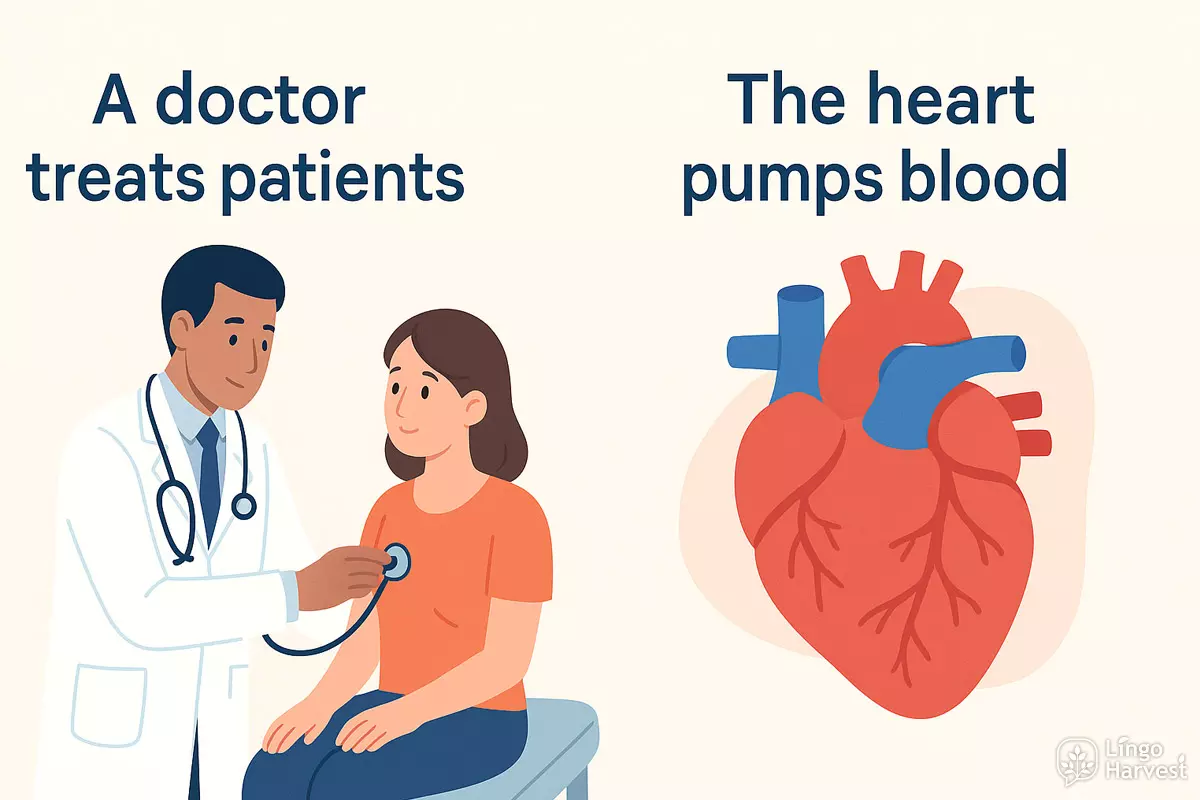
The choice of structure can affect the tone or focus of a rule or definition. Here’s a comparison of typical generic forms:
| Pattern | Example |
|---|---|
| Singular, indefinite article (“a”/“an”) | A doctor treats patients. |
| Singular, definite article (“the”) | The heart pumps blood. |
| Plural, no article | Doctors treat patients. |
| Uncountable, no article | Information is valuable. |
Practical tips
When writing rules or instructions, choose the most natural generic noun form for clarity and generality. Consider your audience and the context: technical manuals may favor “the user,” while safety notices might use the plural (“Employees must...”). Consistency in style helps ensure the message is understood by everyone.
Choosing the right form for neutral generic statements
Selecting the most appropriate noun form is essential when making statements that apply broadly, such as when explaining how things work, giving rules, or describing general truths. The choice depends on factors like countability, specificity, and whether the noun refers to a whole class or individuals within it. Understanding these distinctions helps avoid ambiguity and ensures your statements are clear and inclusive.
Common structures for expressing generalizations
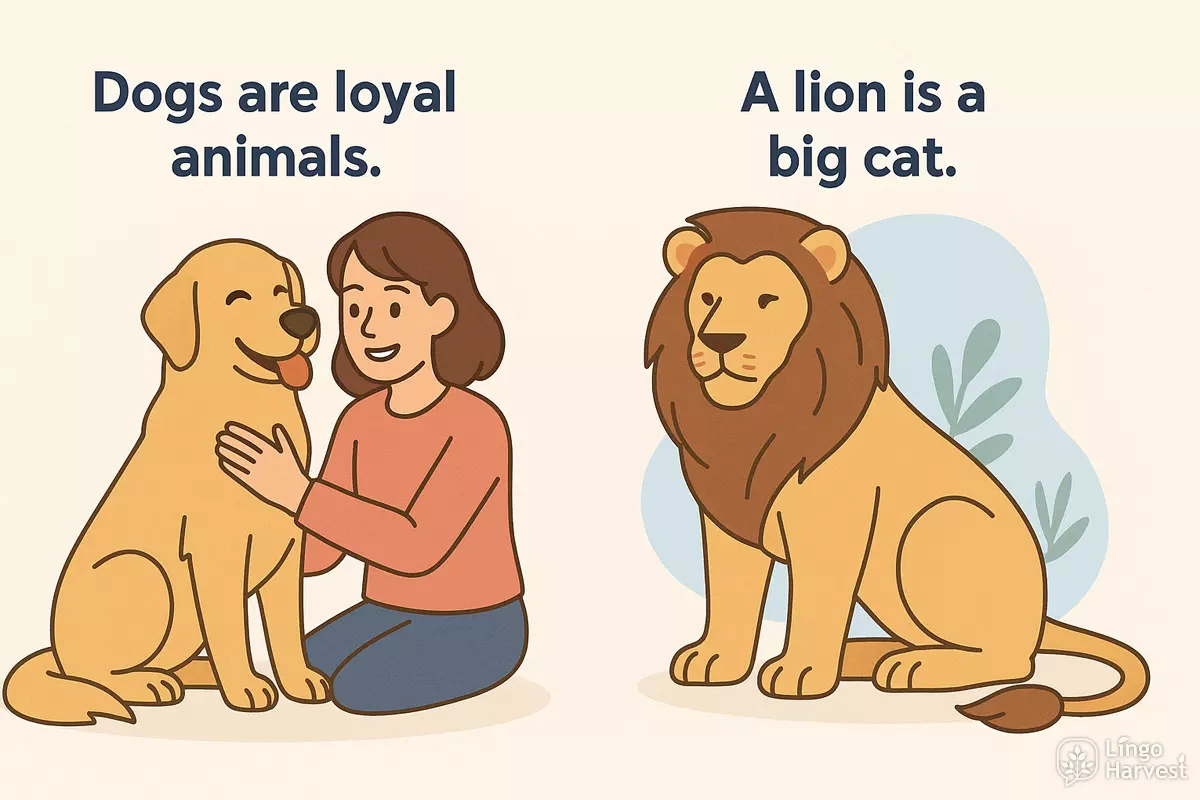
- Plural countable nouns (no article): Used for broad categories. Example: "Dogs are loyal animals."
- Singular countable noun with 'a/an': Indicates any member of a class. Example: "A lion is a big cat."
- Uncountable nouns: Used for substances and abstract concepts. Example: "Water boils at 100°C."
- Zero article with plural/uncountable: For general rules. Example: "Children learn quickly."
- ‘The’ + singular noun: Less common for generics, but sometimes used in scientific or formal writing. Example: "The elephant is the largest land animal."
Comparing forms: When to use each
The table below summarizes the main options for neutral, generic noun statements, with examples and notes on usage.
| Form | Example | Usage Notes |
|---|---|---|
| Plural noun (no article) | Cats like to sleep. | Most common for generalizations about a group. |
| Singular noun with ‘a/an’ | A cat makes a good pet. | Highlights a typical representative of the group. |
| Uncountable noun | Milk contains calcium. | Used for substances or abstract ideas. |
| ‘The’ + singular noun | The whale is a mammal. | Less common, often in scientific or encyclopedic contexts. |
Tips for neutral and inclusive statements
- Use plural nouns to avoid gender or number bias: "Doctors treat patients."
- Prefer uncountable forms for materials or concepts: "Honesty is valued."
- Be careful with singular ‘he’ or ‘she’—use ‘they’ or plural forms for neutrality.
- For professions, avoid unnecessary articles: "Teachers inspire learning" (not "The teacher inspires learning" for all teachers).
- When using ‘a/an’, remember it refers to any single member, not a specific one.
By choosing the noun form thoughtfully, you ensure your explanations and generalizations are clear, accurate, and free from unintended bias. This attention to form is especially important in educational, scientific, and policy-related writing.
Differences between generic and specific examples
Understanding how generic nouns function in explanations and rules often means distinguishing them from specific references. Generic expressions refer to a whole class or category, suggesting a general truth, while specific statements point to an individual or a particular instance. This distinction is crucial for accurate communication, especially in educational, scientific, or instructional contexts.
Generic Examples: Broad and Timeless
Generic nouns are used when discussing habits, universal truths, or rules that apply broadly. They do not refer to one particular person or thing, but rather to all members of a group. For example:
- The tiger is a solitary animal. (all tigers in general)
- Water boils at 100°C. (true for all water under standard conditions)
- Children like to play.
- A dog makes a good pet.
- Honesty is the best policy.
- Birds lay eggs.
- Plastic can be recycled.
- An apple a day keeps the doctor away.
- Lions live in prides.
- Music soothes the soul.
Specific Examples: Unique and Context-Dependent
In contrast, specific examples refer to a particular object, person, or event. These are often used when describing a single case, giving a personal story, or referencing a unique situation. For instance:
- The tiger in the zoo is sleeping.
- This water is too hot to touch.
- My child likes to play outside.
- That dog barked all night.
- Her honesty impressed everyone.
- The bird in the garden laid eggs yesterday.
- This plastic bottle was recycled last week.
- An apple from your tree fell on the ground.
- The lions at the reserve are being studied.
- His music was featured in the movie.
Key Contrasts in Usage
Generic statements are common in rules, scientific facts, and generalizations, while specific ones are typical in anecdotes, observations, or instructions focused on a single item. The choice between these forms shapes the scope and tone of any explanation.
| Generic Example | Specific Example |
|---|---|
| Cats are curious animals. | The cat on my porch is curious. |
| A computer can process information quickly. | My computer crashed yesterday. |
| Students need to study regularly. | These students finished their project early. |
| Ice melts at 0°C. | The ice in my glass melted. |
| Doctors help people stay healthy. | Dr. Lee helped me recover from the flu. |
Practical Applications
Choosing the right form helps clarify whether you are making a statement about all cases or just one. In writing instructions, rules, or definitions, generic nouns keep your message broad and widely applicable. For storytelling or detailed descriptions, specific nouns bring focus and detail to your point.
Common mistakes with generic people and group nouns
Writers often stumble when using nouns that refer to people or groups in a general sense. These errors usually involve agreement issues, unclear reference, or awkward phrasing. Understanding how to use these terms correctly can make explanations and general statements much clearer.
Confusing Singular and Plural Forms
A typical mistake is mixing up singular and plural forms when talking about people in general. For example, using "a student should do their homework" is common, but some prefer "students should do their homework" to keep subject and pronoun agreement straightforward.
- Incorrect: Every employee must wear their badge. ❌
- More standard: All employees must wear their badges. ✅
- Traditional: Every employee must wear his or her badge. ✅
Ambiguous Group References
Sometimes, it's unclear whether a noun refers to individuals or a collective group. This is especially true with words like "team," "family," or "audience," which are singular in form but can imply a group of people.
- The team is winning. (The group as a single unit)
- The team are arguing among themselves. (The individuals within the group)
Using "People" vs. "Persons" and Other Collective Nouns
Choosing between "people" and "persons" can be tricky. "People" is usually used for general groups, while "persons" is more formal or legalistic. The same confusion can happen with other collective terms.
- Many people enjoy hiking. (General statement)
- Three persons were found. (Formal/legal context)
- The committee has made its decision. (Singular collective noun)
- The committee are divided in their opinions. (Emphasizing individuals)
Incorrect Use of Articles with Generic Nouns
Articles ("a," "an," "the") can change the meaning of a generic noun phrase. Using the wrong article can make a sentence sound odd or alter its intent.
- A teacher should be patient. (Any teacher in general)
- The teacher should be patient. (A specific teacher or the role in context)
- Teachers should be patient. (All teachers in general)
Comparison Table: Singular vs. Plural & Collective Nouns
| Generic Noun | Typical Usage & Notes |
|---|---|
| Student / Students | "A student should..." (singular, generic); "Students should..." (plural, generic) |
| Person / People | "A person must..." (singular, formal); "People must..." (plural, common) |
| Team | "The team is..." (group as unit); "The team are..." (members as individuals, chiefly British English) |
| Family | "My family has..." (singular, group); "My family are..." (individuals, mainly UK) |
| Committee | "The committee decides..." (as a whole); "The committee are..." (members individually) |
Quick Tips to Avoid Common Pitfalls
- Check pronoun agreement: match singular with singular, plural with plural.
- Be clear whether you mean a group as one unit or as individuals.
- Choose articles carefully to convey the right level of generality.
- Use "people" for most general references, "persons" for formal/legal contexts.
- Reword for clarity if a sentence feels awkward or ambiguous.
Practice: turn specific sentences into generic statements
Understanding how to express general truths or rules is essential for clear explanations. Often, we start with a specific example and need to convert it into a statement that applies more broadly. This helps make rules, scientific facts, and generalizations easier to understand and remember.
Task: Rewrite Specific Sentences as Generic Noun Statements
Try rephrasing the following specific sentences to create general statements using generic nouns. This may involve removing names, dates, or unique details, and focusing on the core principle or pattern.
- Lisa always drinks coffee before work.
- The cheetah in the zoo runs very fast.
- My teacher gives homework every Monday.
- John’s cat sleeps all day.
- That new phone breaks easily if dropped.
- Our neighbor’s dog barks at strangers.
- Sarah’s computer overheats when used for gaming.
- Daniel’s bakery opens at 7 a.m.
- The sandwich at this cafe costs $5.
- Emily’s bike has a flat tire.
- My cousin’s children like ice cream.
- This printer uses a lot of ink.
- Our office manager schedules meetings on Fridays.
- The plant in my room grows quickly.
- Mark’s car needs repairs often.
- The river near our house floods in spring.
- My brother’s phone battery dies fast.
- The coffee shop on Main Street serves pastries.
- Anna’s shoes wear out after a few months.
- My friend’s apartment gets cold in winter.
Show answers
- People often drink coffee before work.
- Cheetahs run very fast.
- Teachers give homework every Monday.
- Cats sleep all day.
- New phones break easily if dropped.
- Dogs bark at strangers.
- Computers overheat when used for gaming.
- Bakeries open at 7 a.m.
- Sandwiches at cafes cost $5.
- Bikes can get flat tires.
- Children like ice cream.
- Printers use a lot of ink.
- Office managers schedule meetings on Fridays.
- Plants grow quickly.
- Some cars need repairs often.
- Rivers flood in spring.
- Phone batteries die fast.
- Coffee shops serve pastries.
- Shoes wear out after a few months.
- Apartments get cold in winter.
Patterns to Notice
- Remove unique names or places to make the sentence apply generally.
- Use plural nouns when referring to a class or type (e.g., "Cheetahs," "Teachers").
- Use the singular form with "a" or "an" for representative examples (e.g., "A bakery opens early.").
- Omit time or location details unless they are part of the general rule.
- Sometimes, verbs change to reflect frequency or possibility (e.g., "can," "often").
Common Structures for Generic Statements
| Specific Sentence | Generic Statement |
|---|---|
| Lucy’s dog loves to play fetch. | Dogs love to play fetch. |
| The apple on my desk is red. | Apples are red. |
| My neighbor’s garden has many flowers. | Gardens have many flowers. |
| This brand’s laptops are expensive. | Laptops are expensive. |
| Her grandfather reads the newspaper every morning. | People read the newspaper every morning. |
Tips for Creating Generic Noun Statements
- Think about what group or category the specific example belongs to.
- Use plural nouns or indefinite articles ("a," "an") to make the statement general.
- Focus on the action or quality that applies to the whole group, not just one example.
- If the sentence is about habits or routines, use simple present tense.