Metaphorical Uses of Nouns in Modern English Expression

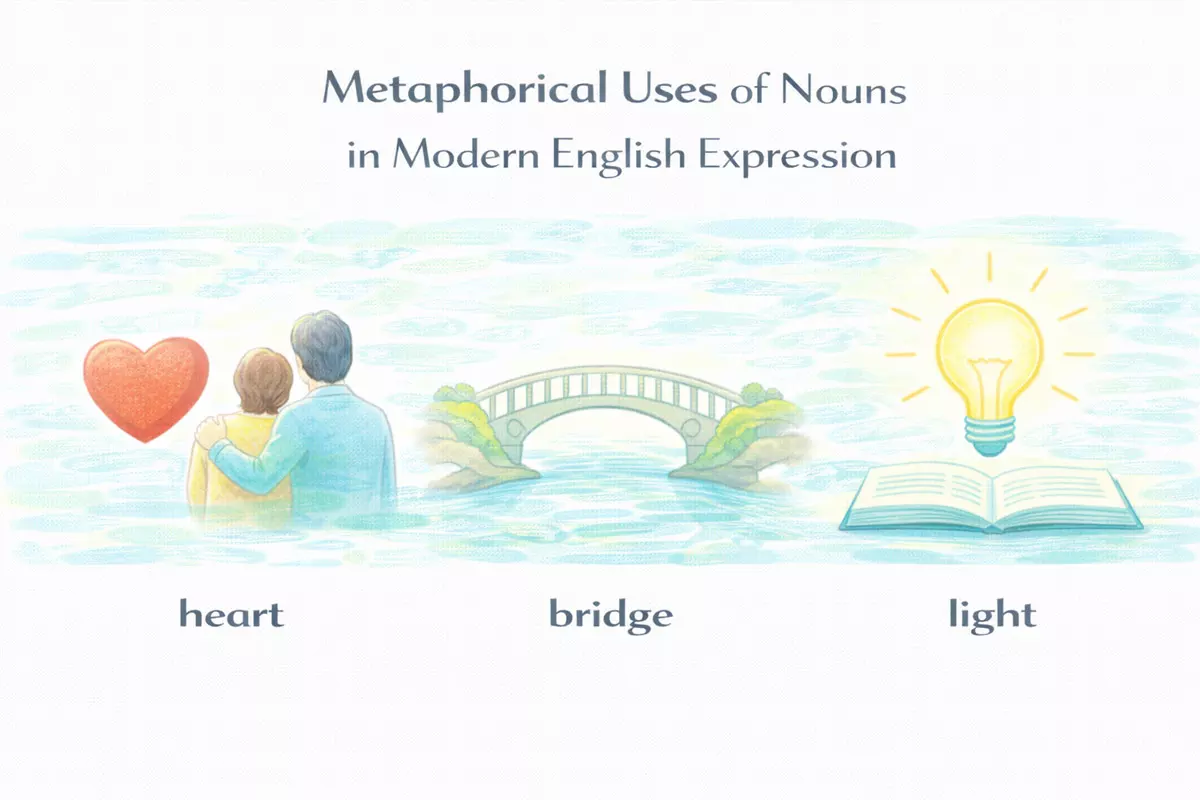 Here we metaphorical nouns in communication, highlighting common patterns, how they create abstract meaning, differences from literal usage, stylistic effects, frequent learner misunderstandings, and provides practice in identifying them.
- What metaphorical noun usage means in communication
- Common metaphorical noun patterns in modern English
- How metaphorical nouns shape abstract meaning
- Differences between literal and metaphorical noun use
- Register and stylistic impact of metaphorical nouns
- Typical learner misinterpretation of metaphorical nouns
- Practice: identify and interpret metaphorical noun usage
Everyday language is filled with creativity, as familiar objects and concepts are often given imaginative new meanings. In modern English, people frequently transform simple nouns into vivid symbols or analogies, which helps them express ideas with originality and energy. This playful use of language not only keeps conversations engaging but also allows speakers to connect with others in unique ways. By reimagining ordinary words, individuals can convey subtle emotions, clever observations, or complex ideas in a manner that feels both fresh and relatable.
What metaphorical noun usage means in communication
Metaphorical nouns play a significant role in how we convey abstract ideas and emotions. By borrowing concrete nouns and applying them to new, often intangible contexts, speakers and writers create vivid imagery and add nuance to their language. This technique helps listeners and readers relate unfamiliar concepts to familiar experiences, making communication more engaging and accessible.
How Metaphorical Nouns Shape Understanding
Using nouns metaphorically can clarify complex topics or express subtle shades of meaning. For instance, calling someone a "rock" highlights their stability and reliability, while referring to a project as a "journey" suggests growth and progression over time. These expressions do more than decorate language—they frame the way we interpret information and interact with others.
Common Functions of Metaphorical Nouns
- Illustrating character traits: "He’s a shark in business."
- Describing roles or statuses: "She’s the backbone of the team."
- Conveying emotional states: "He’s in a bubble of happiness."
- Explaining relationships: "They’re the glue that holds us together."
- Emphasizing challenges: "We hit a wall in the negotiations."
- Highlighting opportunities: "This is a golden ticket."
- Signaling danger or caution: "It’s a minefield out there."
- Representing processes: "Let’s build a bridge between departments."
- Expressing transformation: "She’s a chameleon in the workplace."
- Summarizing outcomes: "It was a home run for the company."
- Framing time: "We’re at a crossroads."
- Describing support: "He’s my anchor."
- Labeling obstacles: "That’s a stumbling block."
- Characterizing innovation: "She’s a trailblazer."
- Referring to secrecy: "He keeps everything in a vault."
Why Do Speakers Use Metaphorical Nouns?
People turn to metaphorical language for several reasons. It can simplify complex topics, evoke emotions, or create shared cultural references that foster connection. In professional and casual contexts alike, these figurative expressions make language more memorable and persuasive. Sometimes, they even become idiomatic, losing their literal imagery but retaining their communicative power.
Comparing Literal and Metaphorical Noun Usage
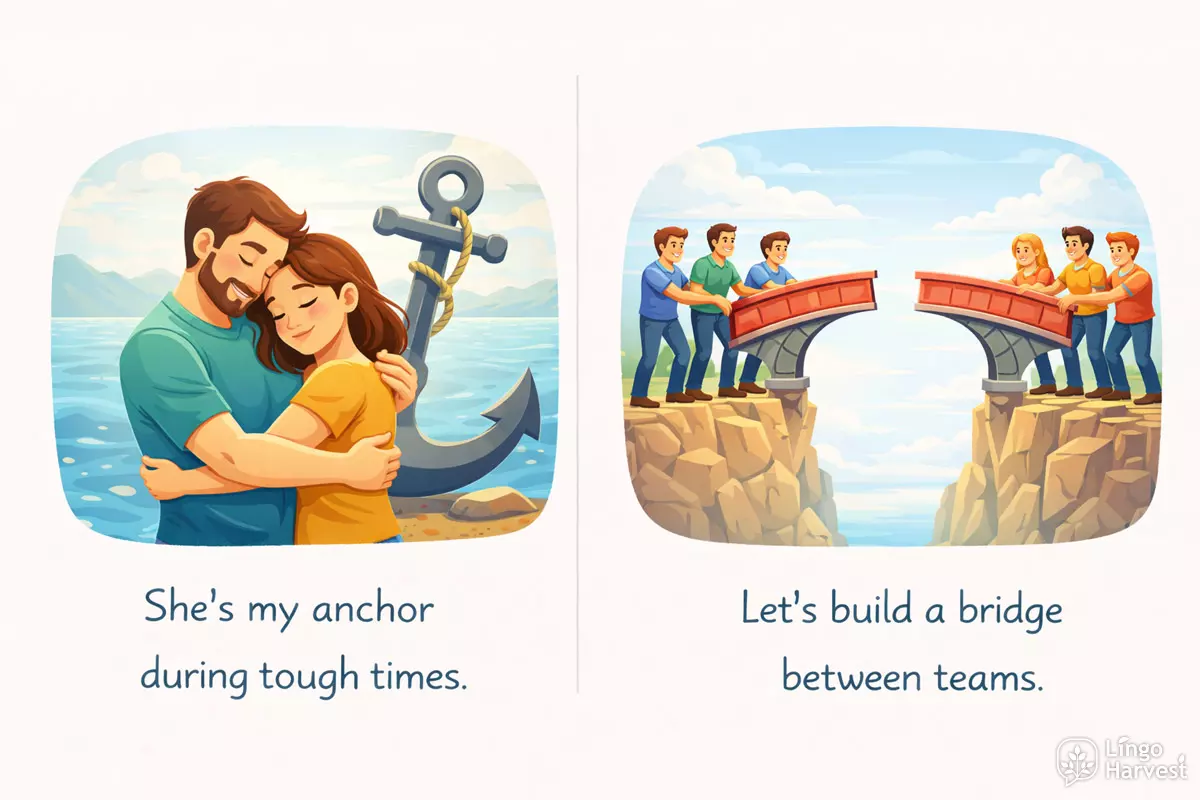
| Literal Noun Usage | Metaphorical Noun Usage |
|---|---|
| The wall needs painting. | We hit a wall in our project. ❌ (obstacle, not an actual wall) |
| The anchor holds the ship in place. | She’s my anchor during tough times. ✅ (provides support, not a literal anchor) |
| The bridge crosses the river. | Let’s build a bridge between teams. → (connection, not a physical bridge) |
| The chameleon changes color. | He’s a chameleon in new situations. (adapts easily) |
Ultimately, these figurative noun uses enrich communication by encouraging imagination, fostering empathy, and making ideas stick. They are essential tools for anyone who wants to express themselves with clarity and creativity.
Common metaphorical noun patterns in modern English
Metaphorical nouns add vividness and clarity to both spoken and written language. Instead of using literal descriptions, English speakers often choose nouns that evoke imagery or associations from other domains. These figurative patterns are deeply embedded in everyday conversation, journalism, literature, and even technical writing.
Typical Patterns and Examples
Writers and speakers frequently draw from physical objects, natural phenomena, and human anatomy to create memorable metaphors. Here are some common patterns where a noun is used metaphorically:
- Journey for progress or experience ("career path," "road to recovery")
- Bridge for connection ("bridge the gap," "a bridge between cultures")
- Heart for emotion or core ("heart of the matter," "change of heart")
- Window for opportunity or perspective ("window of opportunity," "a window into history")
- Storm for difficulty or turmoil ("weather the storm," "a storm of protest")
- Light for understanding ("shed light on," "light at the end of the tunnel")
- Seed for origin or beginning ("seed of doubt," "plant a seed of hope")
- Wall for barrier or obstacle ("hit a wall," "break down barriers")
- Mirror for reflection or similarity ("mirror society," "mirror image")
- Wave for movement or trend ("a wave of change," "a new wave of technology")
- Footprint for impact ("carbon footprint," "digital footprint")
- Roots for origin or foundation ("roots in tradition," "put down roots")
- Chain for connection or restriction ("a chain of events," "break the chains")
- Fire for passion or destruction ("spark a fire," "under fire")
- Beacon for guidance ("a beacon of hope," "beacon for change")
- Shadow for presence or threat ("cast a shadow," "in the shadow of")
- Flood for abundance or overwhelm ("a flood of information," "flooded with calls")
- Anchor for stability or support ("anchor of the team," "anchor yourself")
- Web for complexity or connection ("web of lies," "the World Wide Web")
- Pillar for support or strength ("pillar of the community," "a pillar of support")
Paradigms in Metaphorical Noun Usage
Some metaphorical nouns cluster around similar ideas, allowing for flexible expression. For instance, both "bridge" and "gateway" can refer to means of access, while "storm" and "wave" suggest forces of change. Recognizing these patterns can help learners and writers vary their language and avoid repetition.
| Metaphorical Noun | Typical Figurative Meaning |
|---|---|
| Bridge | Connection or transition between people, ideas, or places |
| Seed | Origin or starting point for growth, ideas, or problems |
| Anchor | Stability, support, or something that holds a situation steady |
| Wave | Movement, trend, or sudden increase in activity |
| Wall | Barrier, obstacle, or something that divides or blocks progress |
| Light | Understanding, hope, or revelation |
| Fire | Intense emotion, passion, or destruction |
| Footprint | Evidence of impact, presence, or legacy |
These figurative patterns not only enrich expression but also help speakers convey complex ideas efficiently. By understanding and applying these common metaphorical noun structures, both native and non-native users of English can enhance clarity and creativity in their communication.
How metaphorical nouns shape abstract meaning
Metaphorical nouns play a central role in the way English speakers express complex or intangible concepts. By borrowing familiar, concrete terms and applying them to abstract ideas, language users make the unfamiliar more relatable and vivid. This process not only enriches communication but also influences how people conceptualize emotions, relationships, and even societal structures.
Turning the tangible into the conceptual
Concrete nouns such as “bridge,” “window,” or “foundation” often serve as metaphors for processes or qualities that can’t be directly observed. For example, calling a solution a “bridge” between problems, or labeling a person’s motivation as the “engine” behind their actions, invokes a physical object to clarify an abstract idea. This allows speakers to frame difficult topics in more digestible terms.
Common patterns in metaphorical noun use
- Journey: “Path to success,” “roadblock,” “milestone”
- Construction: “Foundation of trust,” “building relationships,” “framework of ideas”
- Nature: “Seed of doubt,” “branch of government,” “storm of emotions”
- Container: “Boxed into a role,” “pool of resources,” “well of knowledge”
- Light and vision: “Shed light on an issue,” “window of opportunity,” “blinded by love”
- War and conflict: “Battleground of ideas,” “weapon of words,” “armor of confidence”
- Economics: “Market crash,” “budget freeze,” “resource drain”
- Technology: “Firewall against threats,” “network of friends,” “platform for debate”
- Body parts: “Backbone of the team,” “heart of the matter,” “eye of the storm”
- Food: “Recipe for disaster,” “slice of life,” “bitter pill to swallow”
Comparing literal and metaphorical uses
| Literal Noun | Metaphorical Meaning |
|---|---|
| Bridge | Connection between concepts or people |
| Seed | Origin or beginning of an idea or feeling |
| Window | Opportunity or perspective |
| Foundation | Basic underlying principle or support |
| Storm | Intense period of emotion or activity |
These patterns reveal how metaphorical nouns make it easier to communicate abstract notions by grounding them in everyday experience. Through recurring metaphors, speakers can draw on shared cultural imagery, allowing for more nuanced and memorable conversations. Over time, many such nouns become so common in figurative use that their metaphorical meanings are understood almost instantly, shaping the way we think about abstract concepts in English.
Differences between literal and metaphorical noun use
Understanding how nouns function in both their straightforward and figurative senses is crucial for interpreting modern English. Literal nouns refer directly to tangible objects or specific concepts, while metaphorical nouns convey meaning through imaginative comparison or symbolism. Recognizing this distinction can greatly influence how we interpret statements and uncover subtle nuances in communication.
Literal Noun Usage: Direct Reference
Literal use of nouns occurs when a word points to its primary, concrete meaning. For instance, in the phrase "the apple is red," 'apple' clearly denotes the familiar fruit. Such usage is straightforward and easy to identify, as it deals with real-world objects or widely recognized entities.
Metaphorical Noun Usage: Figurative Meaning
Metaphorical use, on the other hand, relies on analogy or association. Here, a noun stands in for something it does not literally represent, often to create vivid imagery or express abstract ideas. For example, calling someone "a rock" in the sentence "She is my rock" uses 'rock' metaphorically to suggest strength or stability.
Key Contrasts in Use
The following table outlines some of the most important contrasts between literal and metaphorical noun usage in English:
| Aspect | Literal Noun Use | Metaphorical Noun Use |
|---|---|---|
| Meaning | Direct, concrete reference | Implied, abstract or symbolic reference |
| Example | "Bridge" = a physical structure over water | "Bridge" = a connection between ideas |
| Context Dependence | Usually clear without extra explanation | Often needs surrounding context to interpret |
| Function | Describes reality or facts | Conveys emotion, attitude, or analogy |
| Interpretation | Fixed and literal meaning | Flexible, open to interpretation |
Common Patterns and Examples
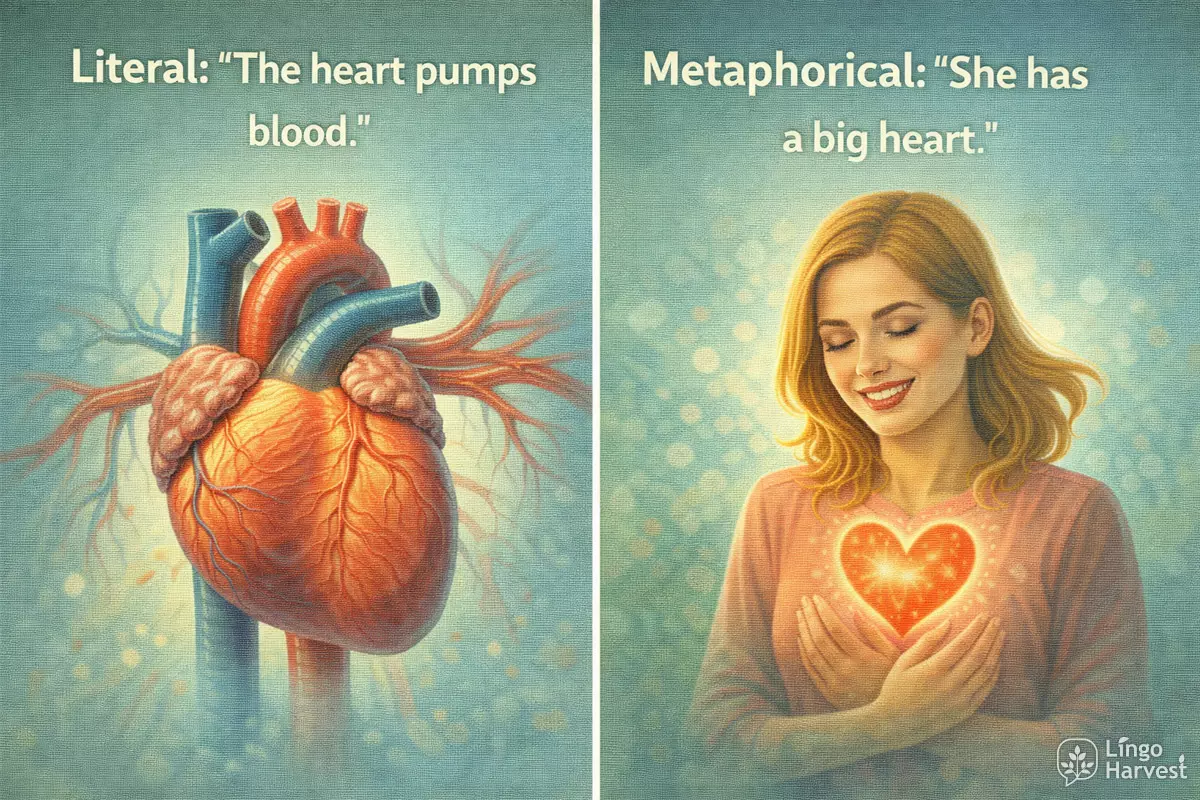
To clarify how these uses appear in everyday language, here are several examples where a noun can shift from literal to metaphorical meaning:
- Wall – Literal: "The wall needs painting." → Metaphorical: "He hit a wall in his career."
- Heart – Literal: "The heart pumps blood." → Metaphorical: "She has a big heart."
- Light – Literal: "Turn off the light." → Metaphorical: "He was a light in the darkness."
- Root – Literal: "The root of the tree is deep." → Metaphorical: "Find the root of the problem."
- Window – Literal: "Close the window." → Metaphorical: "A window of opportunity."
- Voice – Literal: "Her voice is soft." → Metaphorical: "Give people a voice."
- Bridge – Literal: "Cross the bridge." → Metaphorical: "Bridge the gap."
- Chain – Literal: "A chain holds the gate." → Metaphorical: "A chain of events."
- Seed – Literal: "Plant a seed." → Metaphorical: "The seed of doubt."
- Mirror – Literal: "Look in the mirror." → Metaphorical: "Art mirrors life."
- Shadow – Literal: "A shadow on the wall." → Metaphorical: "A shadow of doubt."
- Anchor – Literal: "Drop the anchor." → Metaphorical: "He is her anchor."
- Fire – Literal: "Start a fire." → Metaphorical: "A fire in her eyes."
- Wave – Literal: "The wave crashed." → Metaphorical: "A wave of relief."
- Thread – Literal: "Sew with thread." → Metaphorical: "A common thread in stories."
Interpreting Figurative Language
When encountering a noun used outside its standard sense, look for clues in the sentence or surrounding text. Metaphorical usage often adds emotional weight, humor, or deeper meaning, while literal usage tends to inform or describe. Appreciating these differences can enhance both comprehension and expressive ability in English.
Register and stylistic impact of metaphorical nouns
Metaphorical nouns often shape the tone and level of formality in English expression. The choice to use a metaphorical noun—like “pillar” for a key member of a group or “bridge” for a means of connection—immediately signals a shift from literal to imaginative language. This can add color and vividness to communication, but it also affects how the message is received, depending on the context and audience.
Influence on Register
Writers and speakers adjust their use of figurative nouns according to the situation. Informal contexts, such as everyday conversation or creative writing, tend to welcome more playful or inventive metaphors. In contrast, academic or professional settings may require restraint, opting for clarity and precision over poetic imagery. However, even in formal registers, carefully chosen metaphorical nouns can clarify complex concepts or lend persuasive force.
- “Backbone” – suggests essential support (e.g., "She is the backbone of the team").
- “Anchor” – implies stability or grounding.
- “Engine” – connotes driving force or motivation.
- “Mirror” – indicates reflection or representation.
- “Crutch” – refers to support, sometimes with a hint of dependency.
- “Window” – offers a view or opportunity (e.g., "a window into history").
- “Heart” – symbolizes the core or most important part.
- “Shield” – stands for protection or defense.
- “Bridge” – represents connection or transition.
- “Pillar” – denotes fundamental support or strength.
- “Fountain” – conveys a source or origin (e.g., "a fountain of knowledge").
- “Key” – signifies something crucial or enabling access.
- “Seed” – suggests beginnings or potential for growth.
- “Light” – represents guidance or inspiration.
- “Virus” – used metaphorically for harmful influence (e.g., "a virus of misinformation").
- “Web” – implies complexity or interconnectedness.
- “Sword” – can symbolize aggression or authority.
- “Lens” – denotes perspective or way of seeing.
- “Map” – suggests guidance or planning.
- “Thread” – indicates connection or continuity.
Stylistic Functions and Effects
Metaphorical nouns can elevate style, making descriptions more memorable or persuasive. They may introduce subtle connotations—positive or negative—depending on the metaphor. For example, calling an idea “a seed” evokes growth and potential, while “a crutch” might imply weakness or overdependence. The impact also depends on the novelty of the metaphor: fresh imagery often catches attention, while overused metaphors may feel clichéd or lose their force.
Comparing Levels of Formality
The same metaphorical noun can shift in perceived formality based on context and collocation. Consider the following structured overview:
| Metaphorical Noun | Informal Example | Formal Example |
|---|---|---|
| Anchor | He’s my anchor when things get rough. | The policy serves as an anchor for organizational stability. |
| Engine | She’s the engine of our group project. | Innovation functions as the engine of economic growth. |
| Bridge | Let’s build a bridge between our teams. | This initiative acts as a bridge between research and application. |
| Backbone | He’s the backbone of the band. | Robust infrastructure is the backbone of national development. |
| Crutch | Don’t use that as a crutch. | Such measures can become a crutch for unsustainable practices. |
Summary
In sum, the stylistic and register choices surrounding metaphorical nouns contribute significantly to the nuance and effectiveness of modern English expression. Their flexible use allows speakers and writers to adapt tone, clarify meaning, and engage audiences across a spectrum of communicative settings.
Typical learner misinterpretation of metaphorical nouns
Learners of English often struggle when a noun is used in a non-literal, metaphorical way. Instead of recognizing the figurative meaning, they might interpret the word based on its most basic definition, leading to misunderstanding in both reading and conversation. This issue is especially pronounced with common nouns that have taken on metaphorical senses in modern usage.
Common pitfalls in understanding figurative nouns
A frequent source of confusion comes from nouns that have a clear, concrete meaning but are frequently used metaphorically. For example, when someone is described as a "rock," a learner may imagine an actual stone rather than understanding the intended idea of reliability or strength. Such misunderstandings can make figurative language sound puzzling or even nonsensical.
- Bridge – mistaking a "bridge" in "building bridges" for a physical structure, not a relationship or connection.
- Head – interpreting "the head of the company" as a literal body part instead of a leader.
- Heart – reading "the heart of the matter" as a physical heart, missing the idea of the main point.
- Root – taking "the root of the problem" as a plant root, not the fundamental cause.
- Window – misunderstanding "a window of opportunity" as an actual window, not a chance or period.
- Chain – hearing "a chain of events" and imagining physical chains instead of a sequence.
- Foot – thinking "at the foot of the mountain" refers to a body part, not the base.
- Table – confusing "to table a discussion" with a piece of furniture, not the act of postponing or starting (context dependent).
- Eye – misreading "the eye of the storm" as a literal eye, not the calm center.
- Wall – interpreting "hitting a wall" as encountering a real wall, not a metaphor for difficulty.
- Light – misunderstanding "to shed light on" as using a lamp, not clarifying something.
- Mirror – taking "mirror someone’s behavior" literally, not understanding imitation.
- Shell – reading "come out of your shell" as a physical shell, missing the idea of becoming more open.
- Key – thinking "the key to success" is a physical key, not a crucial factor.
- Seed – misunderstanding "plant the seed of doubt" as gardening, not initiating doubt.
- Voice – interpreting "give someone a voice" as about speaking, not empowerment.
- Frame – confusing "frame of mind" with a picture frame, not a mental state.
- Wave – thinking "a wave of emotion" refers to water, not a surge of feeling.
- Cloud – misreading "under a cloud" as a weather condition, not suspicion or trouble.
- Thread – interpreting "lose the thread" as losing actual string, not the main point.
Why metaphoric nouns cause confusion
Many metaphorical expressions have become so common that native speakers use them without considering their original, literal meanings. However, learners may not have encountered these shifts in meaning, especially if their first language uses different metaphors or none at all. The lack of direct translation often leads to incorrect assumptions, especially in academic or professional settings.
Illustrative comparison: literal vs. metaphorical meanings
| Literal Meaning | Metaphorical Use |
|---|---|
| A physical bridge over water | Building connections between people or groups |
| A key that opens a lock | An essential solution or factor (e.g., key to success) |
| The heart as an organ in the body | The central or most important part (e.g., heart of the matter) |
| A chain made of metal links | A linked sequence (e.g., chain of events) |
| The root of a plant | The fundamental cause or origin |
Tips for recognizing figurative nouns
To avoid confusion, learners should look for context clues, familiarize themselves with common idioms, and practice recognizing when a word doesn’t fit its literal sense. Exposure to authentic language and regular use of dictionaries that include idiomatic meanings can help develop this skill over time.
Practice: identify and interpret metaphorical noun usage
Exploring metaphorical nouns in context helps solidify understanding of how English speakers use concrete terms to express abstract ideas. Below, you'll find activities and examples that invite you to recognize and analyze figurative uses of nouns. Reflect on each sentence and consider what the noun represents beyond its literal meaning.
Spot the Metaphor: Identify the Figurative Noun
Read the following sentences. For each, pick out the noun used metaphorically and briefly describe what abstract idea it conveys.
- After the scandal, his reputation was in ruins.
- She has a heart of stone when it comes to negotiations.
- The city is a melting pot of cultures.
- This project is a double-edged sword.
- He finally broke the ice at the party.
- The announcement sparked a wave of excitement.
- They hit a wall in their research.
- The rumor spread like wildfire through the office.
- She’s the backbone of the organization.
- The plan is still on the drawing board.
Show answers
- Ruins — represents a destroyed reputation, not actual buildings.
- Heart of stone — indicates emotional coldness, not a literal stone heart.
- Melting pot — describes cultural diversity, not a cooking vessel.
- Double-edged sword — means something with both positive and negative consequences.
- Ice — symbolizes social awkwardness or distance.
- Wave — refers to a surge of excitement, not water.
- Wall — signifies an obstacle, not a physical barrier.
- Wildfire — describes rapid spread, not an actual fire.
- Backbone — means essential support, not a literal spine.
- Drawing board — suggests the planning phase, not a real board.
Common Metaphorical Nouns in Modern English
Below is a list of metaphorical nouns frequently found in contemporary English, along with brief hints about their figurative meanings. Consider how these words shift from their concrete senses to more abstract uses.
- Bridge — connection or transition
- Storm — turmoil or conflict
- Light — understanding or hope
- Shadow — doubt or secrecy
- Seed — beginning or potential
- Mirror — reflection or imitation
- Anchor — stability or support
- Path — direction or choice
- Fire — passion or destruction
- Jungle — chaos or complexity
- Web — network or entanglement
- Gate — opportunity or barrier
- Footprint — impact or trace
- Springboard — starting point or launchpad
- Window — opportunity or perspective
- Shell — protection or outward appearance
- Chain — connection or restriction
- Mask — disguise or concealment
- Fuel — motivation or energy
- Thread — continuity or theme
Interpret Metaphorical Nouns in Context
For each sentence below, explain the figurative meaning of the highlighted noun.
- His words were a bridge between two opposing viewpoints.
- After months of uncertainty, a light appeared at the end of the tunnel.
- The new policy served as a springboard for innovation.
- Rumors cast a shadow over the celebration.
- She became the anchor during turbulent times.
- The speech was a spark that ignited public interest.
- The project became a puzzle too complex to solve quickly.
- The agreement built a foundation for long-term collaboration.
- The company reached a crossroads in its development.
- The failure acted as a wake-up call for the entire industry.
Show answers
- Bridge — his words helped connect two groups or perspectives.
- Light — hope or a sign of improvement after difficulty.
- Springboard — something that gives impetus or a starting point for new ideas.
- Shadow — a sense of doubt or negativity affecting the event.
- Anchor — a source of stability and reassurance.
- Spark — a trigger for excitement, interest, or action.
- Puzzle — something difficult or confusing to work out.
- Foundation — the basis on which future progress depends.
- Crossroads — a point requiring an important decision.
- Wake-up call — something that forces people to recognise a problem.
Comparing Literal and Metaphorical Noun Usage
Understanding the shift between literal and figurative meanings is essential. The table below contrasts some nouns in both contexts to illustrate how metaphor works in modern English.
| Literal Usage | Metaphorical Usage |
|---|---|
| The bridge crosses the river. | Her friendship was a bridge between rivals. |
| The storm damaged the coastline. | He went through an emotional storm after the breakup. |
| Light filled the window. | The internship was a window into the industry. |
| The seed grew into a tree. | The idea planted the seed of change. |