Fixed Noun Phrases in Natural Spoken English Conversations

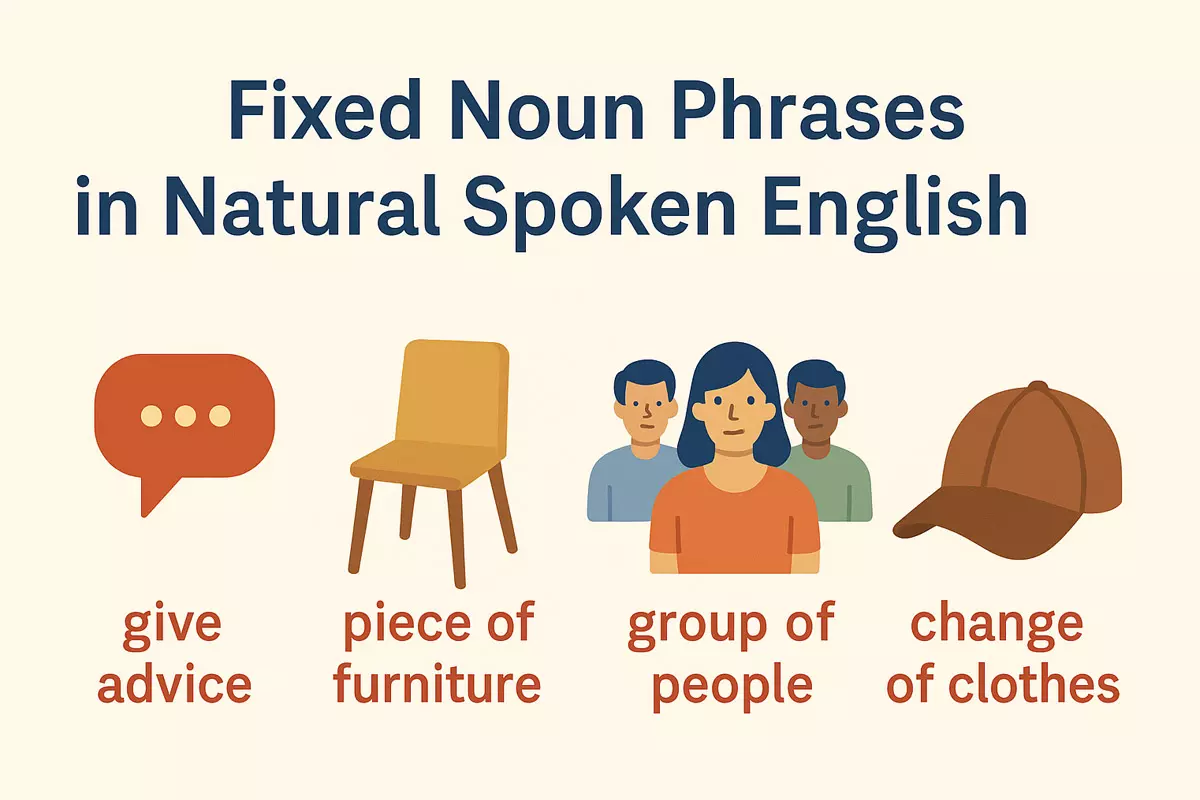 The article explains fixed noun phrases in spoken English, gives everyday examples, shows how they help with fluency and reactions, discusses informal and neutral usage, warns against overuse, and includes dialogue practice with these phrases.
- What fixed noun phrases are in spoken English
- Everyday chunks like a good idea or the whole thing
- How fixed phrases support fluency and natural rhythm
- Using fixed noun phrases to agree, disagree, and react
- Register: informal vs neutral fixed noun expressions
- Avoiding overuse and keeping language natural
- Practice: complete dialogues with fixed noun phrases
Everyday speech is filled with familiar word clusters that we use almost automatically, shaping the way we connect and communicate with others. By examining these set expressions in natural conversations, we can uncover subtle patterns that make our interactions smoother and more effective. Understanding how these phrases function not only helps us express our thoughts more clearly but also allows us to engage in conversations with greater confidence and ease.
What fixed noun phrases are in spoken English
In everyday conversation, speakers often rely on set noun expressions that come up repeatedly and function as ready-made building blocks. These are combinations like “a cup of tea,” “the other day,” or “a bunch of people” that are used so frequently, their structure and meaning become familiar to listeners. These expressions, sometimes called lexical bundles or formulaic sequences, make communication faster and help people sound more natural and fluent.
Common types and examples
Some fixed noun groups are idiomatic, while others are simply frequent collocations. Here are examples that native speakers use without thinking much about their internal grammar:
- a couple of minutes → I’ll be ready in a couple of minutes.
- the end of the day → At the end of the day, results matter.
- a lot of people → A lot of people attended the event.
- the bottom line → The bottom line is that we need more time.
- this kind of thing → I don’t usually worry about this kind of thing.
- my point of view → From my point of view, the plan makes sense.
- a piece of cake → The test was a piece of cake.
- the same thing → We were talking about the same thing.
- the whole time → She was smiling the whole time.
- a bunch of friends → A bunch of friends came over last night.
- the right time → This isn’t the right time to decide.
- the fact that → The fact that he apologized matters.
- a sense of humor → He has a great sense of humor.
- a matter of time → It’s only a matter of time before it works.
- the first time → I remember the first time we met.
- the next day → We continued the discussion the next day.
- the last minute → He finished the task at the last minute.
- a state of mind → Confidence is a state of mind.
- a big deal → It’s not a big deal.
- the real world → School doesn’t always prepare you for the real world.
Why speakers use fixed noun phrases
These pre-fabricated chunks allow smoother interaction and reduce the effort of constructing sentences from scratch. They help listeners process speech faster, since the patterns are predictable. In spontaneous talk, using these expressions also signals social belonging and can make speech less formal and more relatable.
Features of fixed noun chunks
- Often include prepositions (e.g., “of,” “in,” “at”)
- Rarely change form (e.g., “a piece of cake” stays the same, even if the context changes)
- Sometimes have idiomatic, non-literal meanings
- Can serve as subjects, objects, or complements in a sentence
- Are learned and recalled as a whole, not word by word
Functions in conversation
Set noun phrases are used for various purposes: describing time (“the other day”), giving opinions (“my point of view”), or referring to shared experiences (“the whole time”). Native speakers rely on these for clarity and efficiency, and learners benefit from recognizing and practicing them.
Everyday chunks like a good idea or the whole thing
Fixed noun phrases are a major building block of natural spoken English. These pre-assembled chunks—such as “a good idea” or “the whole thing”—streamline conversation, let speakers process language quickly, and help listeners follow along with ease. Rather than composing each sentence from scratch, fluent speakers often rely on these ready-made expressions to convey thoughts efficiently.
Why these set phrases matter in conversation
In daily speech, certain noun phrases are so common that they function almost like single words. They often appear in similar situations and carry familiar meanings, making them easy to recognize and use. This predictability supports smooth interaction, reduces misunderstandings, and saves cognitive effort for both speakers and listeners.
Common fixed noun chunks you’ll hear all the time

Here are some examples of everyday noun phrases that regularly appear in casual conversation:
- a good idea → That sounds like a good idea.
- the whole thing → I didn’t understand the whole thing.
- a long time → We haven’t seen each other for a long time.
- the right time → Now is the right time to talk.
- the same way → He solved the problem the same way.
- a big deal → Don’t worry, it’s not a big deal.
- a hard time → She’s having a hard time at work.
- the other day → I met him the other day.
- the next step → The next step is to review the plan.
- a bit much → That price is a bit much for me.
- a great job → You did a great job on the presentation.
- the main reason → The main reason is lack of time.
- a different story → That’s a different story altogether.
- a tough call → It was a tough call to make.
- the first time → This is my first time here.
- the last minute → He changed his mind at the last minute.
- a bad idea → Skipping the meeting was a bad idea.
- the best part → The best part was meeting new people.
- the same thing → We were thinking about the same thing.
- a good question → That’s a good question.
How these chunks fit into real speech
Speakers often use these fixed groups of words to express opinions, summarize events, or react quickly. For example, saying “That’s a good question” buys time to think, while “the whole thing” can refer to a complex situation without listing details. These noun phrases are especially useful for keeping conversation flowing and making responses sound natural.
Patterns and flexibility
While these expressions are usually fixed, some allow for minor variation (for example, “a really good idea” or “the very last minute”). However, their core structure stays the same, which is why they’re recognized as set chunks in spontaneous talk.
Summary
Being aware of frequent noun phrase chunks helps with both understanding and producing natural English. Listening for these patterns in conversation can make it easier to follow the gist and join in smoothly.
How fixed phrases support fluency and natural rhythm
Fixed noun phrases—such as “a cup of tea” or “the end of the day”—play an essential role in making speech flow smoothly. When speakers use these ready-made chunks, they don’t have to assemble each element from scratch. This reduces cognitive load, allowing them to focus on their message and interact more naturally.
Streamlining Conversation
Using familiar set phrases helps speakers maintain a steady pace. These pre-assembled expressions are often pronounced as a single unit, leading to more natural intonation and rhythm. For example, in casual dialogue, saying “a piece of cake” is quicker and easier than constructing a new phrase with the same meaning.
Examples of Common Fixed Noun Phrases in Everyday Speech
- a matter of time → It’s only a matter of time before things improve.
- the bottom line → The bottom line is that we need more resources.
- the point of view → From my point of view, the plan will work.
- a state of mind → Confidence is a state of mind.
- the end of the day → At the end of the day, honesty matters.
- a sense of humor → He has a great sense of humor.
- a piece of advice → Let me give you a piece of advice.
- the middle of nowhere → They live in the middle of nowhere.
- a breath of fresh air → Her idea was a breath of fresh air.
- the last straw → That comment was the last straw.
- the back of my mind → It was always in the back of my mind.
- a change of heart → He had a change of heart at the last minute.
- the tip of the iceberg → This issue is just the tip of the iceberg.
- a cup of tea → Let’s sit down and have a cup of tea.
- the right track → You’re on the right track.
- a matter of fact → As a matter of fact, I agree with you.
- the spur of the moment → She decided to leave on the spur of the moment.
- the heat of the moment → He said it in the heat of the moment.
- the bottom of my heart → I thank you from the bottom of my heart.
- the drop of a hat → He’s ready to help at the drop of a hat.
Supporting Spontaneous Interaction
Because these expressions are stored as whole units in memory, they can be recalled rapidly. This quick access is especially valuable in fast-paced exchanges, where hesitation can disrupt the flow. By relying on fixed noun groups, speakers avoid awkward pauses and keep conversations moving.
Comparison: Constructed vs. Fixed Phrases
Below is a comparison showing how fixed noun phrases differ from phrases constructed on the spot, highlighting their impact on ease and rhythm of speech.
| Constructed Phrase | Fixed Noun Phrase |
|---|---|
| It’s not difficult at all. | a piece of cake |
| At the last possible moment | the eleventh hour |
| Very rarely | once in a blue moon |
| To summarize | the bottom line |
Rhythm and Intonation
Fixed expressions often have a predictable stress pattern, which supports the musicality of spoken English. This helps listeners follow the speaker’s meaning and makes the exchange feel more natural. In summary, making use of set noun groups allows speakers to sound more fluent and confident, and helps listeners process information more efficiently.
Using fixed noun phrases to agree, disagree, and react
Fixed noun phrases play a key role in shaping responses during everyday spoken exchanges. Instead of full sentences, speakers often rely on set noun-based expressions to show agreement, express doubt, or react to what’s been said. These chunks add nuance and can make interactions sound more natural and fluent.
Common types of fixed noun phrases for responses
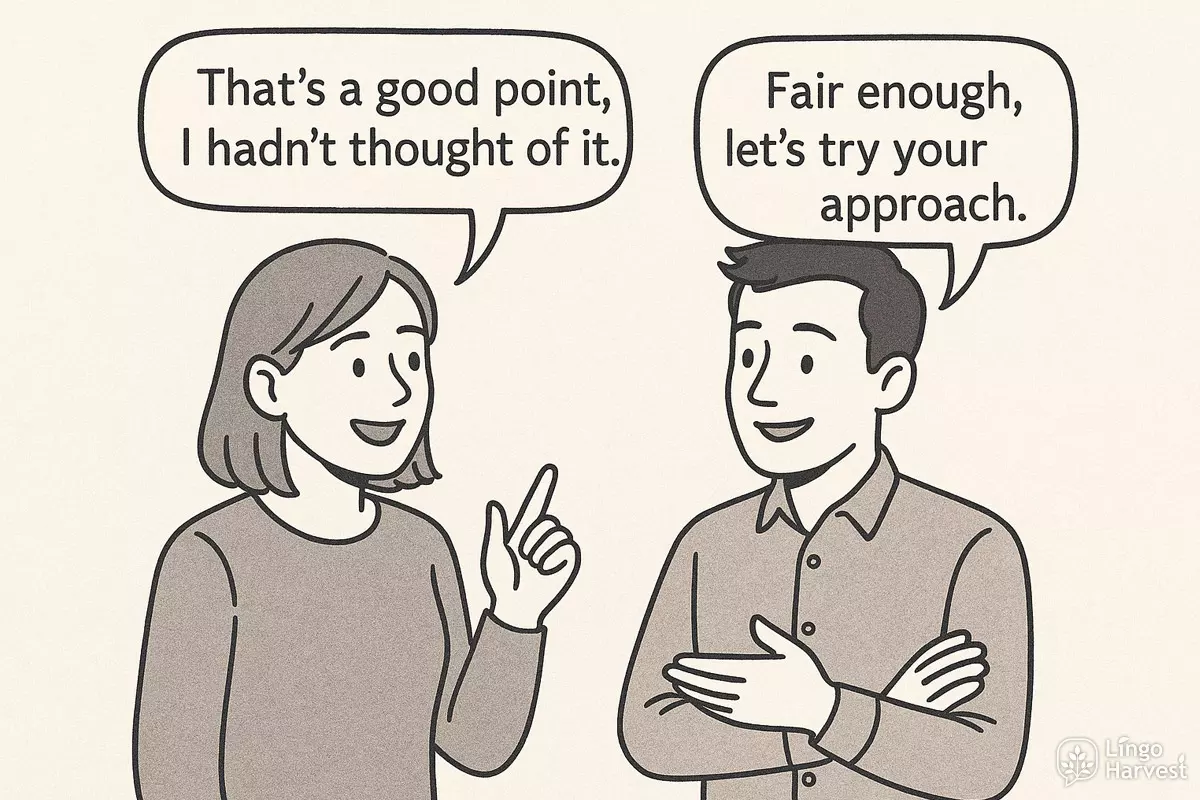
People use a range of ready-made noun phrases in conversation to signal their stance quickly and efficiently. Here are some frequent patterns:
- Good point → That’s a good point; I hadn’t thought of it.
- Fair enough → Fair enough, let’s try your approach.
- No doubt → No doubt this will take more time.
- Nice try → Nice try, but the answer is still incorrect.
- Wishful thinking → Believing it will fix itself is wishful thinking.
- Not my thing → Camping is not my thing.
- Nice idea → That’s a nice idea for the presentation.
- Bold move → Quitting his job was a bold move.
- Valid concern → That’s a valid concern we should address.
- Common sense → Wearing a helmet is just common sense.
- Good call → Choosing that option was a good call.
- Big mistake → Ignoring the warning was a big mistake.
- Classic example → This case is a classic example of poor planning.
- Same here → I’m tired too — same here.
- Point taken → Point taken, I’ll be more careful.
- Lucky guess → I didn’t know the answer; it was a lucky guess.
- Harsh truth → The harsh truth is that we’re out of time.
- Personal opinion → In my personal opinion, this works better.
- Strong argument → She made a strong argument for change.
- Wrong assumption → That was a wrong assumption from the start.
Functions in conversation
Such expressions can do more than simply agree or disagree. They help speakers to:
- Show quick alignment or opposition without lengthy explanations (e.g., Fair enough ✅, Big mistake ❌).
- Soften disagreement or criticism by using indirect phrasing (e.g., Wishful thinking instead of “That’s wrong”).
- Express emotion or evaluation, making reactions more vivid (Bold move, Harsh truth).
- Signal empathy or shared experience (Same here, Point taken).
Comparing agreement and disagreement phrases
Some fixed noun phrases are typically used to agree, others to disagree, and some can be neutral or context-dependent. The table below summarizes common examples:
| Agreement | Disagreement | Neutral/Reaction |
|---|---|---|
| Good point | Wishful thinking | Classic example |
| Fair enough | Wrong assumption | Nice try |
| Point taken | Big mistake | Harsh truth |
| Good call | Not my thing | Lucky guess |
Tips for natural use
To sound more fluent, try using these set noun phrases in everyday talk. They help you react quickly and sound engaged, without always needing full sentences. Pay attention to tone and context—some options can be blunt or sarcastic, while others are supportive or neutral. Over time, these expressions become second nature in spontaneous conversation.
Register: informal vs neutral fixed noun expressions
Understanding how fixed noun phrases shift between informal and neutral registers is key in analyzing natural spoken English. Some expressions are tightly linked to casual speech, while others fit comfortably in both everyday and more neutral, context-independent conversation. Recognizing these differences helps speakers and learners choose language appropriate to social context and conversational tone.
Characteristics of Informal and Neutral Fixed Noun Phrases
Informal fixed noun phrases often rely on idiomaticity, ellipsis, or colloquial reference. They may be shortened, playful, or carry social meaning beyond their literal sense. In contrast, neutral expressions are less marked; they serve clear communicative functions without drawing attention to register or group identity.
- Informal: "a bunch of guys", "a load of nonsense", "my two cents", "a pain in the neck", "the whole shebang"
- Neutral: "a group of people", "a piece of information", "a matter of concern", "a set of rules", "a point of view"
Comparing Informal and Neutral Examples
The table below contrasts common fixed noun phrases in informal and neutral registers, highlighting how similar meanings are expressed differently depending on the situation.
| Informal Expression | Neutral Equivalent |
|---|---|
| a bunch of stuff | a number of items |
| a piece of cake | an easy task |
| the whole nine yards | everything possible |
| a big deal | an important matter |
| a pain in the neck | a troublesome issue |
| a load of rubbish | false information |
| my two cents | my opinion |
| the whole shebang | the entire thing |
| no biggie | not a major problem |
| an old hand | an experienced person |
Choosing the Right Register in Conversation
Selecting between informal or more neutral fixed noun phrases depends on audience, setting, and intent. Informal options foster closeness, humor, or shared identity, while neutral choices maintain clarity and politeness in unfamiliar or mixed-company situations. Being aware of these patterns allows for more effective and sensitive communication in varied conversational contexts.
Avoiding overuse and keeping language natural
Fixed noun phrases can make spoken English sound fluent and efficient, but relying on them too heavily may cause speech to become monotonous or formulaic. In everyday conversation, speakers balance set expressions with spontaneous language to keep exchanges lively and authentic. Over-dependence on prefabricated chunks can reduce listener engagement and even obscure intended meaning if context is ignored.
Finding the Right Balance
Natural-sounding speech often involves mixing fixed expressions with more flexible, creative forms. While phrases like “by the way” or “the fact is” help structure discourse, too many in a row can make conversation sound rehearsed. Instead, integrate these chunks where they fit the flow, and be ready to adapt or expand based on the topic and your listener’s responses.
Common Pitfalls to Watch For
- Using the same phrase repeatedly within a short span
- Inserting set expressions where a simpler word or pause would work
- Ignoring the context, leading to awkward or unclear contributions
- Forgetting to personalize fixed phrases to the current topic
Strategies for More Natural Speech
- Vary the way you introduce ideas: alternate between set phrases and direct statements.
- Listen for how others use fixed expressions in context, and note variations.
- Practice paraphrasing common noun phrases to suit different situations.
- Leave space for spontaneous reactions or clarifications.
- Balance formulaic language with individualized comments or questions.
Examples: Overused vs. Natural Integration
- Overused: “At the end of the day, at the end of the day, we have to decide.”
- Natural: “We have to decide eventually. At the end of the day, that’s what matters.”
- Overused: “The bottom line is, the bottom line is, we’re late.”
- Natural: “We’re late. The bottom line is, we need to hurry.”
Useful Alternatives to Fixed Noun Phrases
- In my opinion → In my opinion, this solution is the most practical.
- To be honest → To be honest, I didn’t expect that result.
- What I mean is → What I mean is, we need more time.
- The main thing is → The main thing is to stay focused.
- One thing to remember → One thing to remember is that deadlines matter.
- For example → For example, this method saves time.
- Let’s say → Let’s say we start the project next week.
- Speaking of which → Speaking of which, have you seen the report?
- As far as I know → As far as I know, the meeting is still scheduled.
- To sum up → To sum up, we agree on the main points.
- That reminds me → That reminds me, I need to send an email.
- From my perspective → From my perspective, the risk is manageable.
- Just so you know → Just so you know, the deadline has changed.
- As a matter of fact → As a matter of fact, she already approved it.
- For what it’s worth → For what it’s worth, I think you did well.
- The real issue is → The real issue is the lack of resources.
- By comparison → By comparison, the second option is cheaper.
- By all means → By all means, ask any questions you have.
- In any case → In any case, we should move forward.
- On the whole → On the whole, the project was a success.
Staying aware of how and when you use fixed noun phrases ensures your speech remains engaging and easy to follow. By blending set expressions with fresh language, you can sound both fluent and genuinely involved in the conversation.
Practice: complete dialogues with fixed noun phrases
Working with set noun combinations helps learners sound more natural in everyday speech. Below, you'll find interactive exercises designed to improve your ability to recognize and use these chunks in typical conversational exchanges. Each activity focuses on inserting the most appropriate phrase to complete short dialogues. Read each dialogue and choose or supply the best fixed noun group.
Task 1: Fill in the missing phrase
Insert the most suitable fixed noun phrase from the list into each gap.
- keep in mind → Keep in mind that the deadline is tomorrow.
- piece of advice → Let me give you a piece of advice.
- point of view → From her point of view, the decision was fair.
- matter of time → It’s only a matter of time before he succeeds.
- state of mind → Confidence is a positive state of mind.
- frame of reference → Experience shapes your frame of reference.
- course of action → We need to decide on the best course of action.
- chain of events → One mistake started a chain of events.
- rule of thumb → As a rule of thumb, save ten percent of your income.
- turning point → That moment was a turning point in her career.
- train of thought → I lost my train of thought during the speech.
- slip of the tongue → Calling him by the wrong name was a slip of the tongue.
- line of work → She changed her line of work last year.
- center of attention → He became the center of attention.
- leap of faith → Starting the business was a leap of faith.
- sign of the times → Online meetings are a sign of the times.
- matter of opinion → Taste in music is a matter of opinion.
- state of emergency → The city declared a state of emergency.
- force of habit → He wakes up early by force of habit.
- piece of cake → The exam was a piece of cake.
- Could you give me a ______ before I talk to my boss?
- Don’t worry, fixing that will be a ______.
- From my ______, that’s not the best solution.
- Sorry, that was just a ______. I meant something else.
- It’s only a ______ before she finds out.
- Keep this in mind as your main ______.
- We need to decide on a clear ______.
- One mistake started a whole ______.
- Changing careers felt like a real ______.
- I lost my ______ halfway through the explanation.
Show answers
- piece of advice
- piece of cake
- point of view
- slip of the tongue
- matter of time
- frame of reference
- course of action
- chain of events
- leap of faith
- train of thought
Task 2: Complete the dialogue with the right set phrase
Read each short exchange and fill in the blank with a suitable fixed noun combination from the list above.
- I lost my ______ — what were we talking about?
- It was a real ______ in my life; everything changed after that.
- That’s just my ______; you might see it differently.
- By ______, I always check my emails first thing.
- He took a big risk — made a real ______.
- Looking back, it was a clear ______ of bigger problems.
- She spoke from her own ______, not from facts.
- We followed the same ______ as before.
- One small mistake caused a whole ______.
- Staying calm is a useful ______ in stressful situations.
Show answers
- train of thought
- turning point
- matter of opinion
- force of habit
- leap of faith
- sign of the times
- point of view
- course of action
- chain of events
- rule of thumb
Task 3: Compare and contrast in context
Some fixed noun phrases can feel similar but are used differently. See the comparison below:
| Phrase | Typical Use in Conversation |
|---|---|
| rule of thumb | A general principle or guideline in informal advice. “As a rule of thumb, double-check your work before submitting.” |
| piece of advice | A specific suggestion or tip. “Let me give you one piece of advice: always back up your files.” |
| frame of reference | The set of ideas or experiences that shapes someone’s viewpoint. “We come from different frames of reference.” |
| chain of events | A sequence of connected happenings. “That mistake started a whole chain of events.” |
Understanding and practicing these common noun combinations improves fluency and helps conversations flow more naturally. Try incorporating them into your daily exchanges to become more comfortable with their use.