Common Learner Errors with English Nouns and How to Fix Them

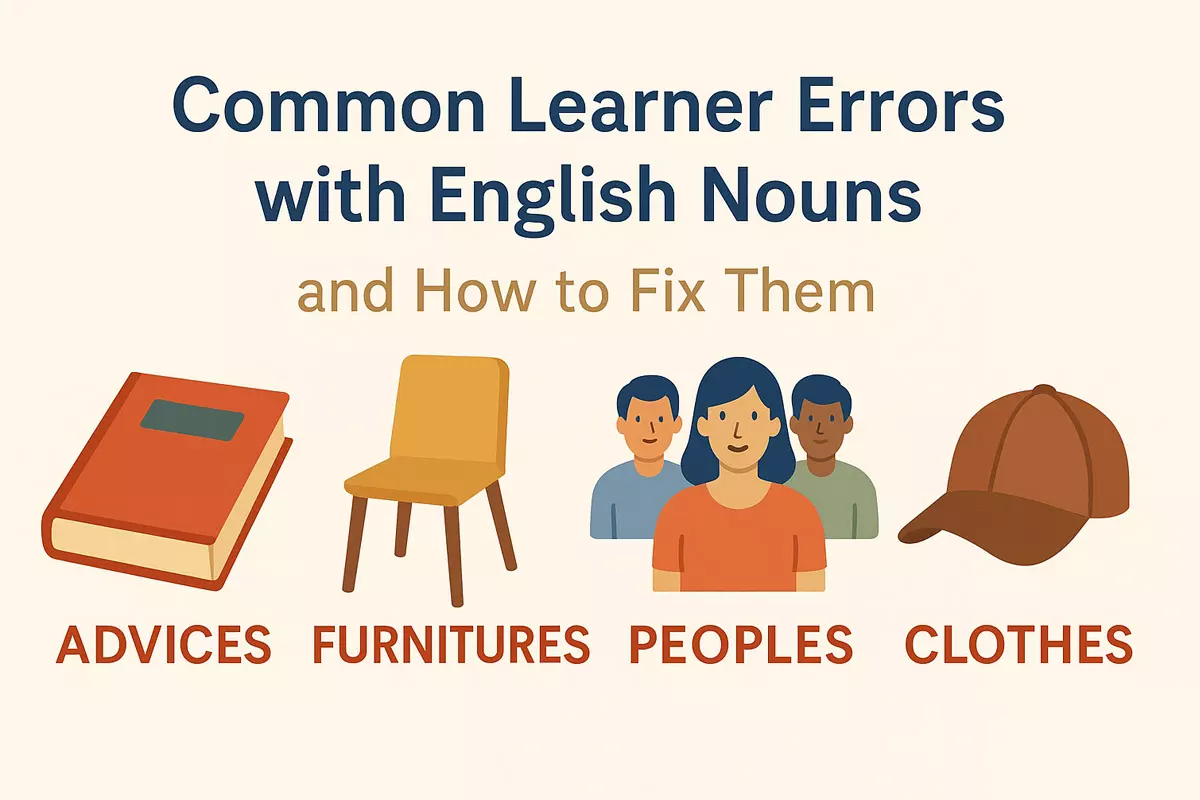 This article reviews common noun issues for English learners, such as mistakes with singular and plural forms, countable and uncountable nouns, article usage, and awkward collocations. It also offers strategies and editing practice to fix these errors.
- Overview of frequent noun problems for learners
- Errors with singular and plural noun forms
- Mistakes in countable vs uncountable noun usage
- Article problems with a, an, and the before nouns
- Wrong collocations and unnatural noun combinations
- Strategies for checking and correcting noun usage
- Practice: edit short texts to repair noun mistakes
Mastering English nouns can be challenging, as even advanced learners sometimes make common mistakes. Confusion often arises between countable and uncountable nouns, leading to errors such as using incorrect articles or plural forms. For example, words like advice or information are uncountable and should not be pluralized, while regular countable nouns like book or apple can take plural forms. Being aware of these typical pitfalls helps learners communicate more accurately and confidently in English.
Overview of frequent noun problems for learners
Many English learners face recurring difficulties with nouns, especially when it comes to countability, plural forms, and article usage. These challenges often lead to mistakes that can make speech or writing sound unnatural or confusing. Understanding the root causes of these issues is the first step to improving accuracy and confidence.
Common types of noun-related mistakes
Errors with nouns often stem from differences between English and a learner’s native language. The following problem areas frequently cause confusion:
- Using singular and plural forms incorrectly (e.g., informations instead of information)
- Mixing up countable and uncountable nouns (e.g., saying a furniture)
- Forgetting or misusing articles with nouns (I have cat vs. I have a cat)
- Applying the wrong plural endings (childs instead of children)
- Confusing collective nouns (the people is instead of the people are)
- Transferring noun patterns directly from their first language
- Using general nouns without specifying quantity (She gave advice vs. She gave some advice)
- Incorrect possessive forms (the book of John instead of John’s book)
- Problems with abstract nouns (an information, a progress)
- Overusing or omitting “the” unnecessarily
Countable vs. uncountable nouns: a frequent source of error
One of the main stumbling blocks is knowing whether a noun is countable or uncountable. This affects article usage, verb agreement, and pluralization. Below is a summary of common countable and uncountable nouns to illustrate the contrast:
| Countable Nouns | Uncountable Nouns |
|---|---|
| apple | water |
| book | information |
| idea | advice |
| car | furniture |
| friend | money |
| city | news |
| dog | equipment |
| question | bread |
Irregular plural forms and article confusion
Another frequent difficulty is remembering irregular plurals, such as children, men, women, and teeth. Learners might also use articles incorrectly, adding “a” or “an” where it doesn’t belong, or omitting “the” with specific nouns. This is especially common with abstract and mass nouns.
Summary of typical errors
- Adding “s” to uncountable nouns (advices, informations)
- Using “many” with uncountable nouns (many money instead of much money)
- Incorrect use of “a” or “an” with uncountable nouns (an equipment)
- Forming regular plurals from irregular nouns (childs, womans)
- Confusing group and individual nouns in agreement (The team are playing vs. The team is playing)
By recognizing these patterns, learners can focus their studies on the most troublesome areas, making steady progress toward more natural and accurate English usage.
Errors with singular and plural noun forms
Many English learners struggle with knowing when to use singular or plural forms, especially since English has irregular patterns and exceptions. Mistakes often happen with countable and uncountable nouns, irregular plurals, and nouns that look plural but are actually singular. Understanding the common pitfalls can help you communicate more clearly and avoid confusion.
Common mistakes with regular plurals
- Forgetting to add -s or -es for most plural nouns: book → books, box → boxes
- Adding an incorrect ending: childs ❌ instead of children ✅
- Using a plural with uncountable nouns: informations ❌ instead of information ✅
Irregular plural forms
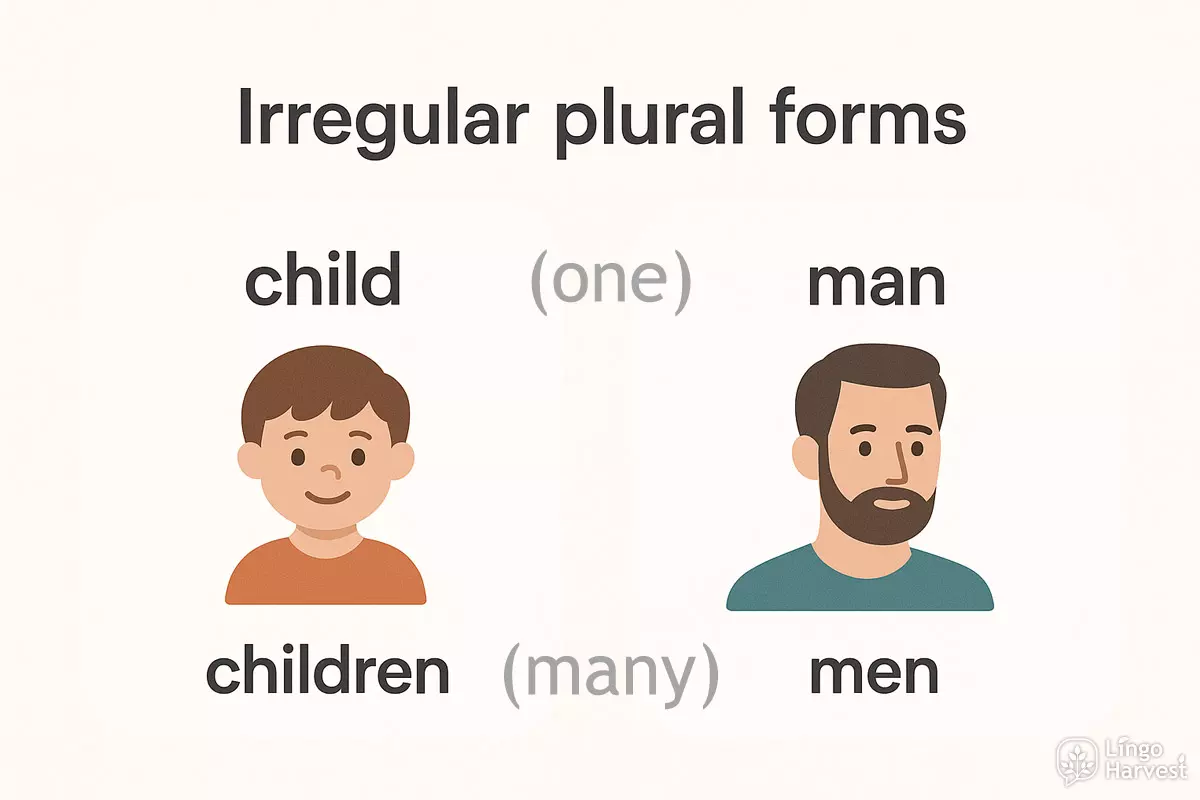
Some nouns change completely in the plural, or do not change at all. Here are some examples:
| Singular | Plural | Common Error |
|---|---|---|
| child | children | childs ❌ |
| man | men | mans ❌ |
| person | people | persons ❌ |
| sheep | sheep | sheeps ❌ |
| mouse | mice | mouses ❌ |
| foot | feet | foots ❌ |
| tooth | teeth | tooths ❌ |
| cactus | cacti | cactuses ❌ (cactuses is accepted in modern English, but cacti is more traditional) |
| fish | fish | fishes ❌ (sometimes correct, but usually “fish” is both singular and plural) |
| analysis | analyses | analysises ❌ |
Tricky nouns and exceptions
- Some nouns only have a plural form: scissors, trousers, glasses. Example: “Where are my glasses?”
- Words that end with -s but are singular: news, mathematics, physics. Example: “The news is interesting.”
- Certain nouns are always uncountable in English: advice, furniture, luggage, bread. Don’t use a plural form with these.
Tips to avoid mistakes
- Check if the noun is countable or uncountable before using a plural.
- Learn and memorize irregular plural forms—they often don’t follow the “add -s” rule.
- Pay attention to context: Some nouns can be both countable and uncountable, but their meaning changes (e.g., “chicken” as food vs. animal).
- When in doubt, look up the noun in a dictionary for correct singular and plural usage.
Mistakes in countable vs uncountable noun usage
Many English learners struggle with knowing which nouns can be counted and which cannot. This confusion often leads to errors with articles, quantifiers, and verb agreement. For example, it’s common to hear sentences like “I have many informations” or “She gave me an advice,” which sound unnatural to native speakers.
Common Errors with Countable and Uncountable Nouns
Problems typically fall into these categories:
- Adding -s to uncountable nouns (e.g., “furnitures” instead of “furniture”)
- Using a/an with uncountable nouns (e.g., “an equipment”)
- Using plural verbs with uncountable nouns (e.g., “The news are good”)
- Choosing the wrong quantifier (e.g., “many money” instead of “much money”)
Key Differences and Examples
Countable nouns refer to items you can count individually (one apple, two apples), while uncountable nouns refer to substances, concepts, or masses that you cannot separate easily (water, advice). Some words can be both, depending on meaning.
| Countable Nouns | Uncountable Nouns |
|---|---|
| book → books | information (never “informations”) |
| apple → apples | advice (never “advices”) |
| idea → ideas | furniture (never “furnitures”) |
| mistake → mistakes | equipment (never “equipments”) |
| car → cars | news (always singular: “The news is…”) |
| child → children | music (never “musics”) |
| question → questions | luggage (never “luggages”) |
| job → jobs | bread (never “breads” unless talking about types) |
| dog → dogs | water (never “waters” unless talking about sources) |
| coin → coins | money (never “moneys” in general usage) |
Tips for Avoiding Common Pitfalls
- Learn which nouns are always uncountable in English, even if they are countable in your native language.
- Use quantifiers like some, much, a little for uncountable nouns, and many, a few, several for countable nouns.
- Remember that words like advice and information are uncountable, so say “some advice” or “a piece of information.”
- Practice with real examples and listen for correct usage in native speech.
Being aware of these differences and practicing them can help you sound more natural and avoid common mistakes related to noun types in English.
Article problems with a, an, and the before nouns
Misusing articles such as a, an, and the is a frequent challenge for English learners. Articles signal whether a noun is specific or general, but in many languages, articles are used differently—or not at all. This often leads to confusion or omission when constructing English sentences.
Common mistakes with articles
Learners might leave out articles, use the wrong one, or add them where they are not needed. Here are some typical errors:
- Saying “I have cat” instead of “I have a cat.”
- Using “an university” instead of “a university.”
- Writing “She went to the school yesterday” when meaning any school, not a specific one.
- Omitting the in “I closed door” instead of “I closed the door.”
- Using “the water is important for life” when referring to water in general (should be just “Water is important for life”).
When to use a, an, and the
Choosing the correct article depends on whether the noun is countable, singular or plural, and if it is specific or general. Here’s a summary of some typical article usage patterns:
| Article | When to Use |
|---|---|
| a / an | Before singular, countable nouns when talking about something for the first time or something non-specific. Examples: a car, an apple, a teacher |
| the | Before singular or plural nouns when the listener knows which one you mean (something specific or already mentioned). Examples: the car we bought, the apples on the table |
| No article | Before most plural and uncountable nouns when speaking in general. Examples: Dogs are friendly. Water is essential. |
Examples of correct and incorrect usage
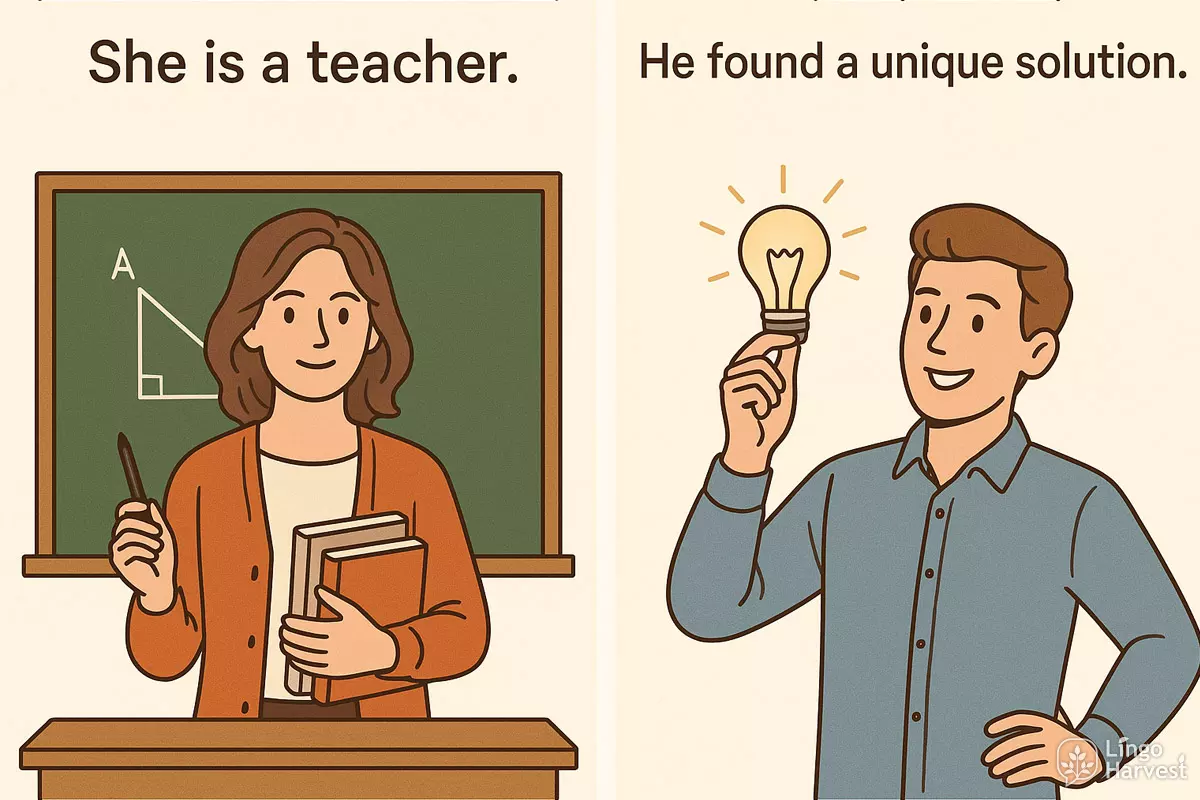
- ❌ “She is teacher.” → ✅ “She is a teacher.”
- ❌ “He found an unique solution.” → ✅ “He found a unique solution.”
- ❌ “The life is short.” (when speaking generally) → ✅ “Life is short.”
- ❌ “I read book yesterday.” → ✅ “I read a book yesterday.”
- ❌ “I have the headache.” (not a specific headache) → ✅ “I have a headache.”
- ❌ “She is an honest person.” (correct, because ‘honest’ starts with a vowel sound)
- ❌ “She is a honest person.” (incorrect, because ‘honest’ starts with a vowel sound)
- ❌ “We need a information.” → ✅ “We need information.”
- ❌ “He went to the bed.” (unless referring to a specific bed) → ✅ “He went to bed.”
- ❌ “The children like the chocolate.” (in general) → ✅ “Children like chocolate.”
Tips for mastering articles
- Remember: use a or an for something non-specific or mentioned for the first time.
- Use the for something specific or already discussed.
- Omit articles when talking about things in general (especially with plural or uncountable nouns).
- Pay attention to the sound that follows the article, not just the spelling (e.g., “an hour,” “a university”).
With consistent practice and attention to context, article errors can be reduced. Focus on whether the noun is specific or general, and whether it’s countable, to guide your choice.
Wrong collocations and unnatural noun combinations
Many learners struggle with choosing the right noun and noun-adjective or noun-verb pairings in English. This often leads to combinations that, while understandable, sound odd or unnatural to native speakers. Errors can happen because of direct translation from a learner’s first language, or simply from not being familiar with common English patterns.
Why word pairings matter
Native speakers expect certain nouns to appear together with specific verbs, adjectives, or other nouns. These “collocations” make speech and writing sound smooth and natural. When learners use combinations that are rare or incorrect, even if the vocabulary is right, the result can be confusing or awkward.
Common mismatched noun combinations
Here are examples of unnatural or incorrect pairings, along with more natural alternatives:
| ❌ Incorrect | ✅ Correct |
|---|---|
| Make a photo | Take a photo |
| Strong rain | Heavy rain |
| Big news | Important news / Breaking news |
| High temperature (for a fever) | A fever / Running a fever |
| Do a mistake | Make a mistake |
| Give an exam (meaning “take an exam”) | Take an exam (student) / Give an exam (teacher) |
| Lose the bus | Miss the bus |
| Open the light | Turn on the light |
| Close the TV | Turn off the TV |
| Hard traffic | Heavy traffic |
| Pay attention on | Pay attention to |
| Do sport | Play sports / Do exercise |
| Say me | Tell me |
| Discuss about | Discuss (no “about”) |
| Advice (as a verb) | Advise (verb) / Advice (noun) |
| Do a party | Have a party / Throw a party |
| Take a decision | Make a decision |
| Win a salary | Earn a salary |
| Make a homework | Do homework |
| Do a shower | Take a shower |
Tips for learning natural collocations
To sound more fluent, focus on learning common noun combinations as “chunks” rather than translating word by word. Reading and listening to native materials helps you notice which words are used together. Practice using these combinations in your own sentences, and when in doubt, check a reliable dictionary or ask a native speaker.
Strategies for checking and correcting noun usage
Improving accuracy with English nouns starts by developing habits for careful review and self-correction. Many learners struggle with singular and plural forms, uncountable nouns, or article usage, but there are practical ways to spot and fix these errors.
Reviewing Your Writing for Common Noun Mistakes
- Read sentences aloud to catch awkward or incorrect noun forms.
- Underline all nouns in a paragraph and check if they match the intended meaning and number.
- Pay special attention to words that often cause confusion, such as "information" (uncountable) or irregular plurals like "children."
- Check subject-verb agreement to ensure the noun form is correct.
- Look for missing articles ("a," "an," "the") before singular countable nouns.
- Use grammar checkers to identify possible mistakes, but verify suggestions yourself.
Comparing Countable and Uncountable Nouns
One frequent challenge is distinguishing between nouns that can be counted and those that cannot. The table below offers examples and helps clarify usage patterns:
| Countable Nouns | Uncountable Nouns | Correct Usage Example | Incorrect Usage Example |
|---|---|---|---|
| apple | advice | I ate an apple. | I ate an advice. ❌ |
| car | furniture | She owns three cars. | She owns three furnitures. ❌ |
| book | information | He read many books. | He read many informations. ❌ |
| dog | homework | Two dogs barked. | Two homeworks. ❌ |
| idea | bread | She had an idea. | She had an bread. ❌ |
Tips for Self-Correction
- Memorize lists of common uncountable nouns and their correct usage.
- Keep a personal error log to track recurring mistakes with noun forms.
- Practice rewriting incorrect sentences until correct usage feels natural.
- Ask a peer or teacher to review your work and point out noun errors.
- Focus on problematic nouns (e.g., "news," "equipment," "luggage") and review their usage regularly.
Useful Patterns and Examples to Watch For
- Irregular plurals: child → children, person → people, foot → feet
- Mass nouns: water, air, rice, advice, furniture
- Nouns with the same singular and plural: sheep, deer, fish
- Always plural nouns: scissors, trousers, glasses
- Abstract nouns (usually uncountable): happiness, knowledge, information
- Collective nouns: team, group, audience
- Nouns with confusing endings: analysis (singular), analyses (plural); criterion/criteria
- Common article mistakes: "a news" ❌ vs. "some news" ✅
- Overgeneralized plurals: "advices" ❌, "informations" ❌
- Words ending in -s but singular: mathematics, physics, news
By building awareness of these patterns and regularly checking your work, you can steadily reduce errors with nouns and communicate more clearly in English.
Practice: edit short texts to repair noun mistakes
Editing short texts is a practical way to improve your understanding of English noun usage. Common errors include missing plural forms, incorrect use of countable and uncountable nouns, and confusion between possessives and plurals. Below, you will find several exercises where you can spot and correct these typical mistakes found in learner writing.
Task 1: Find and Correct Noun Errors
Read each short text and identify the mistakes related to nouns. Rewrite the sentences with the correct forms.
-
My friend have three cat and one dog. The cat is very playfuls and like to sleep on chair.
-
She gave me many advices about my homework. I need more informations to finish the project.
-
The childrens in the park was playing with ball. Their mothers was sitting on benchs.
-
This is my parents’s house. Its walls are blue colors. There is a lot of furnitures in living room.
-
There are too much cars on the street today. I saw a lot of peoples walking with bags.
-
He don’t have any moneys to buy new clothes.
-
I received a good news from my teachers yesterday.
-
The luggages was very heavy, so we needed helps.
-
She has many homeworks to do after schools.
-
There is few furnitures in the rooms.
Show answers
- My friend has three cats and one dog. The cats are very playful and like to sleep on chairs.
- She gave me much advice about my homework. I need more information to finish the project.
- The children in the park were playing with balls. Their mothers were sitting on benches.
- This is my parents’ house. Its walls are blue. There is a lot of furniture in the living room.
- There are too many cars on the street today. I saw a lot of people walking with bags.
- He doesn’t have any money to buy new clothes.
- I received good news from my teacher yesterday.
- The luggage was very heavy, so we needed help.
- She has a lot of homework to do after school.
- There is little furniture in the room.
Common Noun Errors: Quick Reference
Here are some typical noun mistakes and corrections to watch for:
- Incorrect plural forms (childs → children, mans → men)
- Adding -s to uncountable nouns (informations → information)
- Confusing possessive and plural forms (parent’s → parents’)
- Using “much” vs. “many” with countable/uncountable nouns
- Omitting articles before singular countable nouns (I have cat → I have a cat)
- Using “peoples” instead of “people”
- Incorrect irregular plurals (foot → feet, tooth → teeth)
- Forgetting to pluralize after numbers (two book → two books)
- Wrong noun form after quantifiers (a piece of advice, not an advice)
- Using “furnitures” instead of “furniture”
- Confusing collective nouns (team is/are, family is/are)
- Incorrect use of “a/an” with uncountable nouns (an information → some information)
- Mixing singular and plural verb agreement (children is → children are)
Spot the Correct Form: Mini-Quiz
Choose the correct option in each sentence.
- There are many (child / children) in the playground.
- I have a lot of (homework / homeworks) tonight.
- Can you give me some (advices / advice)?
- My (parent’s / parents’) car is blue.
- She bought two (bag / bags) yesterday.
- We need more (information / informations) to continue.
- The (news / newses) was surprising.
- There isn’t much (money / moneys) left.
- How many (person / people) were there?
- He drank two (glass / glasses) of water.
Show answers
- children
- homework
- advice
- parents’
- bags
- information
- news
- money
- people
- glasses
Countable and Uncountable Nouns: Examples
Some nouns are countable, while others are not. Here’s a comparison to help you remember:
| Countable Nouns | Uncountable Nouns |
|---|---|
| book / books | information |
| apple / apples | advice |
| car / cars | furniture |
| child / children | homework |
| idea / ideas | water |
Review these examples as you practice editing. Recognizing patterns will help you avoid frequent mistakes with English nouns.