Typical Noun Agreement Mistakes Made by English Learners

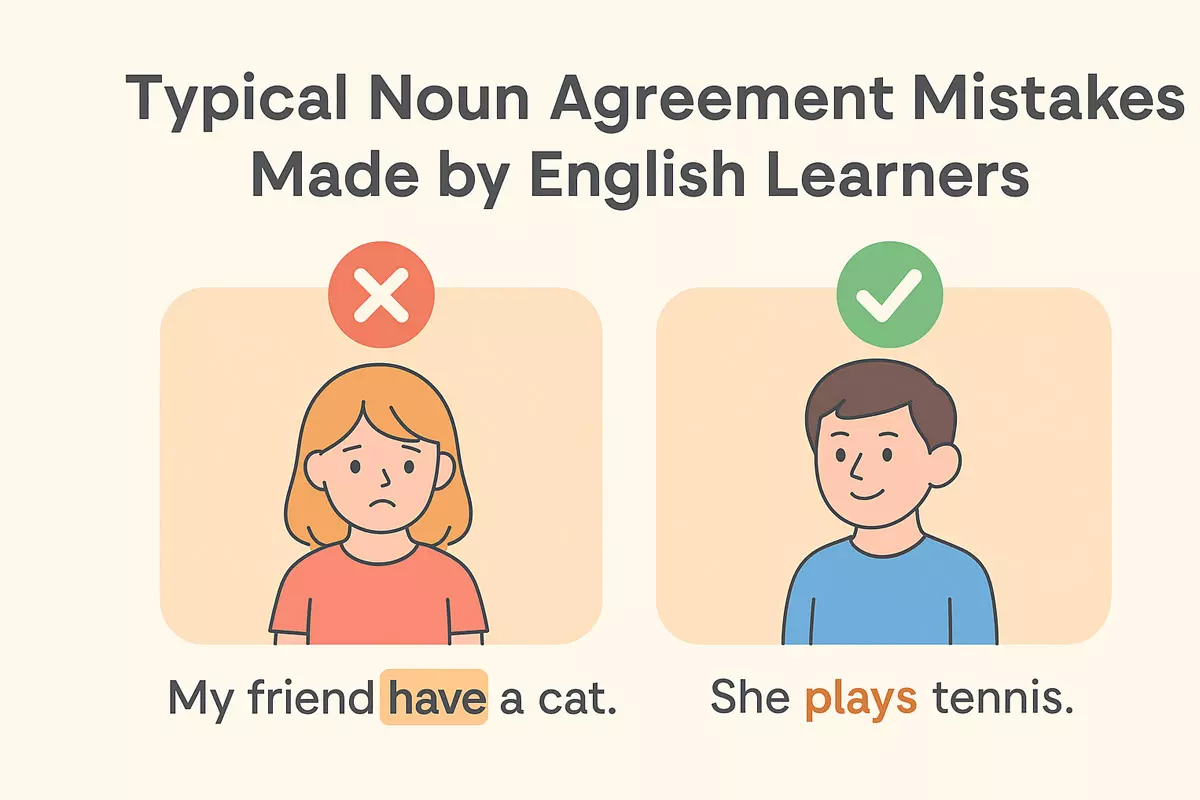 Here we noun agreement in English grammar, including subject–verb and pronoun agreement, rules for collective nouns, common mistakes with long noun phrases, tips for checking agreement, and practice correcting errors in example sentences.
- What noun agreement means in English grammar
- Subject–verb agreement with singular and plural nouns
- Agreement with collective and group nouns in sentences
- Pronoun agreement with singular and plural noun phrases
- Common errors with agreement after long noun phrases
- Tips for checking agreement in your own writing
- Practice: correct agreement errors in example sentences
Many English learners often find it challenging to correctly match nouns with their corresponding partners in a sentence, which can result in mistakes that make communication unclear or confusing. These errors frequently occur with subject-verb agreement, pluralization, and the use of articles, all of which are essential for conveying precise meaning. By paying close attention to these areas and practicing regularly, learners can significantly enhance their accuracy and confidence in both writing and speaking English.
What noun agreement means in English grammar
Understanding noun agreement is essential for constructing accurate English sentences. In simple terms, noun agreement refers to matching nouns with other sentence elements, mainly verbs and determiners, in number (singular or plural). This means you need to ensure that if your noun is singular, the verb and any accompanying words also reflect that singularity; the same goes for plural forms.
Key Aspects of Noun Agreement
- Subject-verb alignment: The verb form changes depending on whether the subject noun is singular or plural. For example: "The cat runs" vs. "The cats run."
- Determiner-noun consistency: Articles and quantifiers must fit the noun’s number. "A dog" (singular), "some dogs" (plural).
- Pronoun-noun connection: Pronouns must agree in number with their nouns, such as "it" for singular and "they" for plural.
Common Patterns and Examples
English learners often make mistakes with irregular plural forms, collective nouns, and words that appear plural but are singular (and vice versa). Here are some typical scenarios that require attention:
- Irregular plurals: "child" → "children", "mouse" → "mice"
- Uncountable nouns: "information" (never "informations")
- Collective nouns: "The team is winning" (team = one group)
- Words ending in -s: "Mathematics is difficult" (singular subject)
- Compound subjects: "My friend and colleague are here"
- Titles or names: "The United States is" (treated as singular)
- Each/every: "Each student has a book" (singular verb)
- Both/few/many/several: "Both children are ready" (plural verb)
- None/some/all: Agreement depends on context: "None of the water is cold" vs. "None of the cookies are left"
- Indefinite pronouns: "Everyone is invited" (singular)
Typical Agreement Forms
Below is a comparison of how noun agreement affects verb and determiner choices in typical English sentences:
| Noun Type | Correct Verb Form | Correct Determiner/Article |
|---|---|---|
| Singular (regular) | runs, is | a, the, this |
| Plural (regular) | run, are | some, these, the |
| Irregular plural | go, have | many, several, those |
| Uncountable | is, seems | much, some, the |
Why Noun Agreement Matters
Getting agreement right helps your sentences sound natural and clear. Mistakes can make your meaning confusing or even change what you intended to say. Paying attention to these patterns—and practicing with lots of examples—is the best way to master this aspect of English grammar.
Subject–verb agreement with singular and plural nouns
Understanding how verbs change to match singular and plural forms is a common challenge for English learners. The most frequent mistake occurs when the verb does not properly reflect whether the subject is one thing or more than one. In English, singular subjects usually take verbs ending in -s (like "runs" or "eats"), while plural subjects do not (such as "run" or "eat").
How agreement works in simple present tense
The simple present tense is where agreement errors often appear. Here, the verb form depends directly on whether the noun subject is singular or plural.
- He walks to school. ✅
- They walk to school. ✅
- She eat breakfast. ❌ (should be "eats")
- The children plays outside. ❌ (should be "play")
Common patterns that cause confusion
Learners often get confused when:
- The subject is a collective noun (e.g., "team," "family")
- There are words between the subject and the verb
- Indefinite pronouns are used (e.g., "everyone," "nobody")
- The sentence begins with "there is/are"
Examples of correct and incorrect verb forms
Below is a comparison of common mistakes and their correct forms:
| Incorrect | Correct |
|---|---|
| My friend go to the market. | My friend goes to the market. |
| The dogs barks loudly. | The dogs bark loudly. |
| Everybody know the answer. | Everybody knows the answer. |
| There is many students in the class. | There are many students in the class. |
| His family live in Canada. (AmE) | His family lives in Canada. (AmE) |
| The group are ready. (AmE) | The group is ready. (AmE) |
Tips for getting agreement right
- Identify the real subject of the sentence—even if there are extra phrases in between.
- Remember that words like "everyone," "someone," and "nobody" always take a singular verb.
- Collective nouns usually take a singular verb in American English.
- Be careful with "there is/are"—match the verb to the noun that follows.
- Practice listening for agreement in everyday conversation to build intuition.
By focusing on these patterns and reviewing common errors, learners can avoid some of the most typical mistakes in matching verbs to their noun subjects.
Agreement with collective and group nouns in sentences
Understanding how to match verbs and pronouns with collective and group nouns is a common stumbling block for English learners. These nouns—like "team," "family," or "government"—refer to groups of people or things but are often treated as singular in grammar. However, there are cases when plural agreement is possible or even required, depending on whether the group acts as a single unit or as individuals.
Common Collective Nouns That Cause Confusion

- Team – Our team won the final match.
- Family – Her family visited last weekend.
- Group – The group met outside the building.
- Audience – The audience applauded loudly.
- Committee – The committee approved the proposal.
- Class – Our class starts at nine.
- Staff – The staff helped organize the event.
- Police – The police arrived quickly.
- Government – The government announced new rules.
- Crew – The crew prepared the plane for takeoff.
- Company – The company expanded to new markets.
- Band – The band performed three songs.
- Choir – The choir practiced every afternoon.
- Jury – The jury reached a decision.
- Club – She joined a book club.
- Board – The board voted unanimously.
- Public – The public reacted positively.
- Army – The army protected the border.
- Couple – The couple moved into a new home.
- Faculty – The faculty discussed new courses.
How Agreement Works with Collective Nouns
When a collective noun acts as a single unit, use a singular verb and pronoun. When you are focusing on individual members within the group, a plural verb and pronoun may be appropriate. This can depend on the context and sometimes even the variety of English (British vs. American).
| Example Sentence | Correct Agreement |
|---|---|
| The team is winning. | Singular verb: the team is considered one unit. ✅ |
| The team are arguing among themselves. | Plural verb: focusing on individuals within the team (especially in British English). ✅ |
| My family has decided to move. | Singular verb: family acts as one entity. ✅ |
| The staff are preparing their reports. | Plural verb: individual staff members are doing separate actions. ✅ |
| The committee was formed last year. | Singular verb: committee as a single group. ✅ |
| The committee have disagreed on the issue. | Plural verb: committee members are acting individually. ✅ |
Typical Mistakes and How to Avoid Them
Mixing up singular and plural forms with these group nouns can make sentences sound odd or incorrect. Here are some tips to help:
- Ask yourself: Is the group acting as one, or are you thinking about the individuals?
- In American English, singular verbs and pronouns are more common with collective nouns.
- In British English, plural agreement is often used when the focus is on members acting separately.
- Be careful with pronouns: "The jury gave its verdict" (singular), "The jury can't agree among themselves" (plural).
- Some words—like "police" or "people"—are always plural and take plural verbs: "The police are investigating."
Quick Reference for Group Noun Agreement
- Singular agreement: The class is ready. The company has announced its results.
- Plural agreement: The crew are cleaning their cabins. The couple have invited us.
Remember, paying attention to the meaning and context will help you choose the correct form and avoid common errors with group and collective nouns.
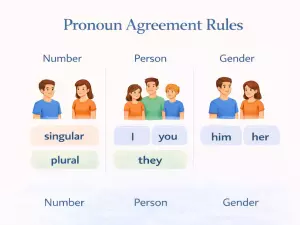
Pronoun agreement with singular and plural noun phrases
Ensuring that pronouns correctly match the number of the nouns they refer to is a frequent stumbling block for English learners. This issue often arises when the subject and the pronoun are separated by other words, or when collective nouns and indefinite pronouns are involved. Misunderstandings about which pronoun to use—singular or plural—can lead to sentences that sound awkward or are grammatically incorrect.
Common areas of confusion
- Replacing a singular noun with a plural pronoun, or vice versa
- Handling collective nouns (e.g., "team," "family")
- Using "they/their" for singular generic references
- Misaligning pronouns with compound subjects
- Indefinite pronouns such as "everyone," "each," "someone"
Typical mistakes and correct forms
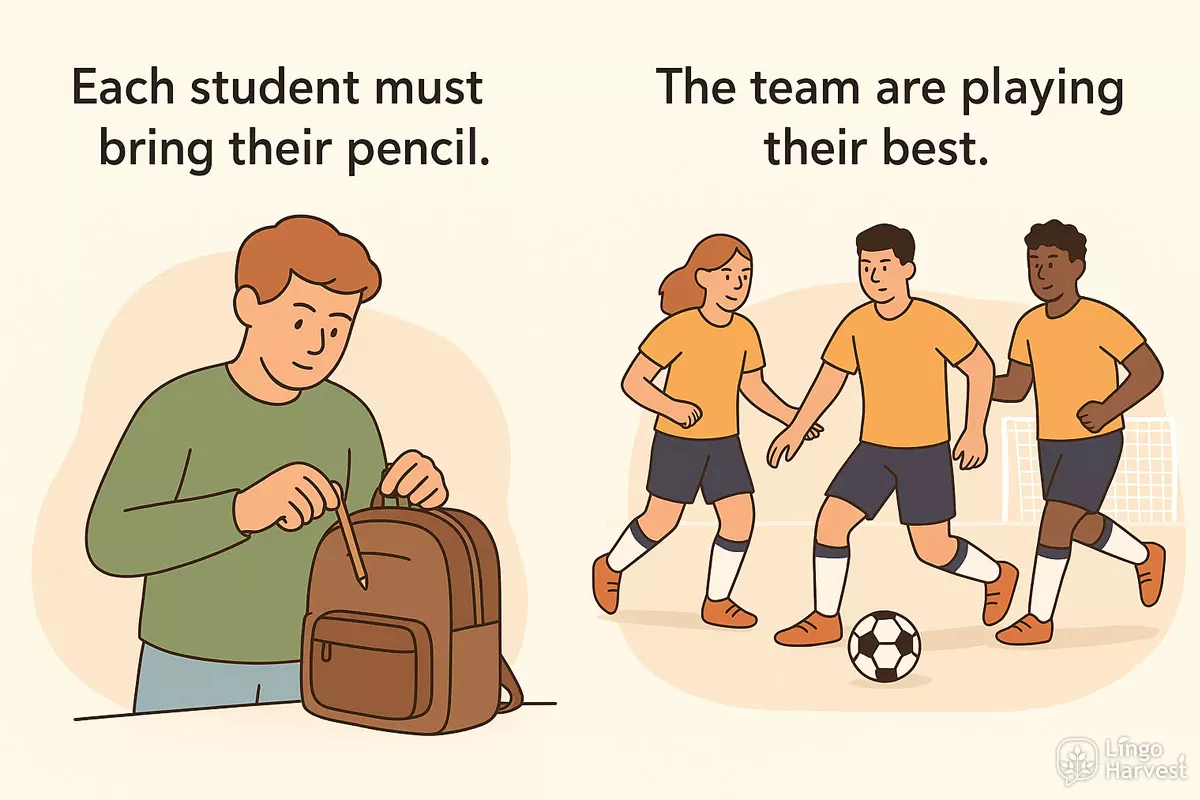
| Incorrect Example | Correct Example |
|---|---|
| Each student must bring their pencil. | Each student must bring his or her pencil. OR (in informal English): Each student must bring their pencil. |
| The team are playing their best. | The team is playing its best. OR (in British English, sometimes): The team are playing their best. |
| My family is going to their vacation home. | My family is going to its vacation home. |
| Neither of the boys have finished their homework. | Neither of the boys has finished his homework. |
| Someone left their bag here. | Someone left his or her bag here. OR (informal): Someone left their bag here. |
| John and Mary forgot his book. | John and Mary forgot their books. |
| If a person wants to succeed, they must work hard. | If a person wants to succeed, he or she must work hard. OR (informal): If a person wants to succeed, they must work hard. |
| Every student should submit their assignments on time. | Every student should submit his or her assignment on time. OR (informal): Every student should submit their assignment on time. |
| The committee have made their decision. | The committee has made its decision. |
| My dog loves their new toy. | My dog loves its new toy. |
Helpful tips for correct usage
- Match singular nouns with singular pronouns: "The child lost his toy."
- Use plural pronouns for plural nouns: "The students finished their exams."
- Be careful with indefinite pronouns: "Everyone should do his or her best." (or "their best" in informal speech)
- Collective nouns: In American English, treat as singular ("The team won its game."); in British English, sometimes plural ("The team won their game.")
- Compound subjects: Use plural pronouns ("Jack and Jill took their pails.")
- Gender-neutral language: "They/their" is increasingly accepted for singular, but formal writing may prefer "he or she."
Being attentive to the relationship between nouns and the pronouns that refer to them helps avoid confusion and ensures clarity in communication. Practice and awareness of context—especially with tricky cases like collective and indefinite nouns—can greatly reduce these common errors.
Common errors with agreement after long noun phrases
Learners of English often struggle with subject-verb agreement when the subject is a long or complex noun phrase. The main challenge is that the noun closest to the verb is not always the head noun that determines agreement. This leads to mistakes, especially when additional descriptive clauses or prepositional phrases come between the main noun and the verb.
Why do these mistakes happen?
When a noun phrase is interrupted by modifiers, relative clauses, or prepositional phrases, it becomes easy to lose track of the real subject. Many learners mistakenly match the verb to the nearest noun, not the main one. This is called “proximity error.”
Typical patterns that cause confusion
- Phrases with "of": The list of items is long (not are long).
- Relative clauses: The boy who likes apples runs fast.
- Adjective phrases: The cake covered with strawberries looks delicious.
- Appositive phrases: My friend, a talented musician, lives in London.
- Prepositional phrases: The group of students is ready.
- Subjects with numbers: A series of tests was performed.
- Collective nouns: A pack of wolves was spotted.
- Compound subjects: The teacher and her assistant are here.
- Subjects with “as well as”: The manager, as well as his team, is present.
- Subjects with “together with”: The athlete, together with her coaches, runs daily.
- Subjects with “along with”: The CEO, along with the board, supports the plan.
- Parenthetical interruptions: The result, in my opinion, is clear.
- Subjects with “including”: The package, including the accessories, arrives tomorrow.
- Uncountable nouns with modifiers: The amount of water is sufficient.
- Subjects starting with “there”: There is a book and a pen on the table.
Common wrong vs. correct patterns
| Incorrect ❌ | Correct ✅ |
|---|---|
| The list of books are on the table | The list of books is on the table |
| A group of friends have arrived | A group of friends has arrived |
| The bouquet of flowers smell nice | The bouquet of flowers smells nice |
| The number of students are increasing | The number of students is increasing |
| The president, together with his advisors, are attending | The president, together with his advisors, is attending |
| The cake with strawberries look tasty | The cake with strawberries looks tasty |
Tips to avoid mistakes
- Identify the main noun in the subject phrase – ignore modifiers and extra phrases.
- Ask yourself: “What is the real subject?”
- Practice with sentences that have inserted phrases or clauses.
- Check if the head noun is singular or plural before choosing the verb form.
By focusing on the true subject and being cautious with lengthy noun phrases, learners can significantly reduce agreement errors in their writing and speech.
Tips for checking agreement in your own writing
When reviewing your own sentences, it’s easy to overlook mismatches between nouns and verbs or pronouns. To catch common mistakes, try reading your work aloud and pausing at each noun to check what it connects with. Many writers find that errors become more noticeable when they slow down and focus specifically on agreement.
Step-by-step strategies
- Identify the subject: Determine if it is singular or plural.
- Match the verb: Ensure the verb form corresponds with the subject’s number (e.g., "She runs", "They run").
- Check pronouns: Pronouns must agree in number and gender with the nouns they replace.
- Watch for tricky phrases: Phrases like "a number of" or "each of" can be misleading—focus on the true subject.
- Look out for collective nouns: Words like "team" or "family" may take singular or plural verbs depending on context.
Common agreement pitfalls
Writers often stumble over certain patterns. Here’s a quick reference table with frequent errors and their corrections:
| Incorrect | Correct |
|---|---|
| The informations are useful. | The information is useful. |
| Each of the students have a book. | Each of the students has a book. |
| My family are going on vacation. | My family is going on vacation. |
| These news is surprising. | This news is surprising. |
| She don't like apples. | She doesn't like apples. |
Quick self-check questions
- Is the verb form correct for the subject?
- Do pronouns refer clearly to the right nouns?
- Are collective nouns used consistently?
- Have you double-checked irregular plurals (e.g., "children," "men")?
Useful reminders
- Some nouns look plural but are singular (e.g., "mathematics," "news").
- Be cautious with phrases between subject and verb—they don’t change the subject’s number.
- Compound subjects joined by "and" are usually plural, but "bread and butter" (as a single idea) is singular.
- With "either/or" and "neither/nor," the verb agrees with the closest subject.
- Practice by underlining subjects and verbs in your writing to visually spot mismatches.
Taking time to review agreement not only corrects mistakes but also strengthens clarity for your readers. By applying these checks regularly, you’ll notice patterns and avoid the most frequent errors English learners make.
Practice: correct agreement errors in example sentences
Mistakes with noun agreement are common for English learners. To improve, it’s important to recognize patterns and actively correct errors. Below, you’ll find a set of sentences that include typical agreement issues. Your task is to spot and fix the mistakes, focusing on matching nouns with the correct verbs and determiners.
Common Error Types to Watch For
- Singular/plural mismatch (e.g., "The dogs runs" instead of "The dogs run")
- Incorrect use of articles or quantifiers with countable and uncountable nouns
- Irregular plural forms (e.g., "childs" vs. "children")
- Unnecessary "s" with uncountable nouns (e.g., "informations")
- Pronoun agreement errors (e.g., "Everyone have their own opinion")
Correct the Agreement Errors
- The informations you gave me was very helpful.
- Each students has their own locker.
- Those kind of books is interesting.
- My friend and his sister goes to the same school.
- She have two childs.
- There is many cars in the parking lot.
- The news are not true.
- Much people enjoys this movie.
- All of the milk are in the fridge.
- Neither of the boys have finished their homework.
- Both of my parent is doctors.
- Some of the equipments are broken.
- That woman want to speak with you.
- Every students need to submit their work.
- Several informations were missing from the report.
Show answers
- The information you gave me was very helpful.
- Each student has their own locker.
- Those kinds of books are interesting.
- My friend and his sister go to the same school.
- She has two children.
- There are many cars in the parking lot.
- The news is not true.
- Many people enjoy this movie.
- All of the milk is in the fridge.
- Neither of the boys has finished their homework.
- Both of my parents are doctors.
- Some of the equipment is broken.
- That woman wants to speak with you.
- Every student needs to submit their work.
- Several pieces of information were missing from the report.
Quick Reference: Common Noun Agreement Corrections
| Incorrect Form | Correct Form |
|---|---|
| Childs | Children |
| Informations | Information |
| Equipments | Equipment |
| News are | News is |
| Both parent is | Both parents are |
| Those kind | Those kinds |
Practicing with real examples helps build confidence in using the correct forms. Pay attention to number, irregular plurals, and uncountable nouns in your writing and speaking.