Nouns in Requests, Complaints, and Apologies in Real Dialogues

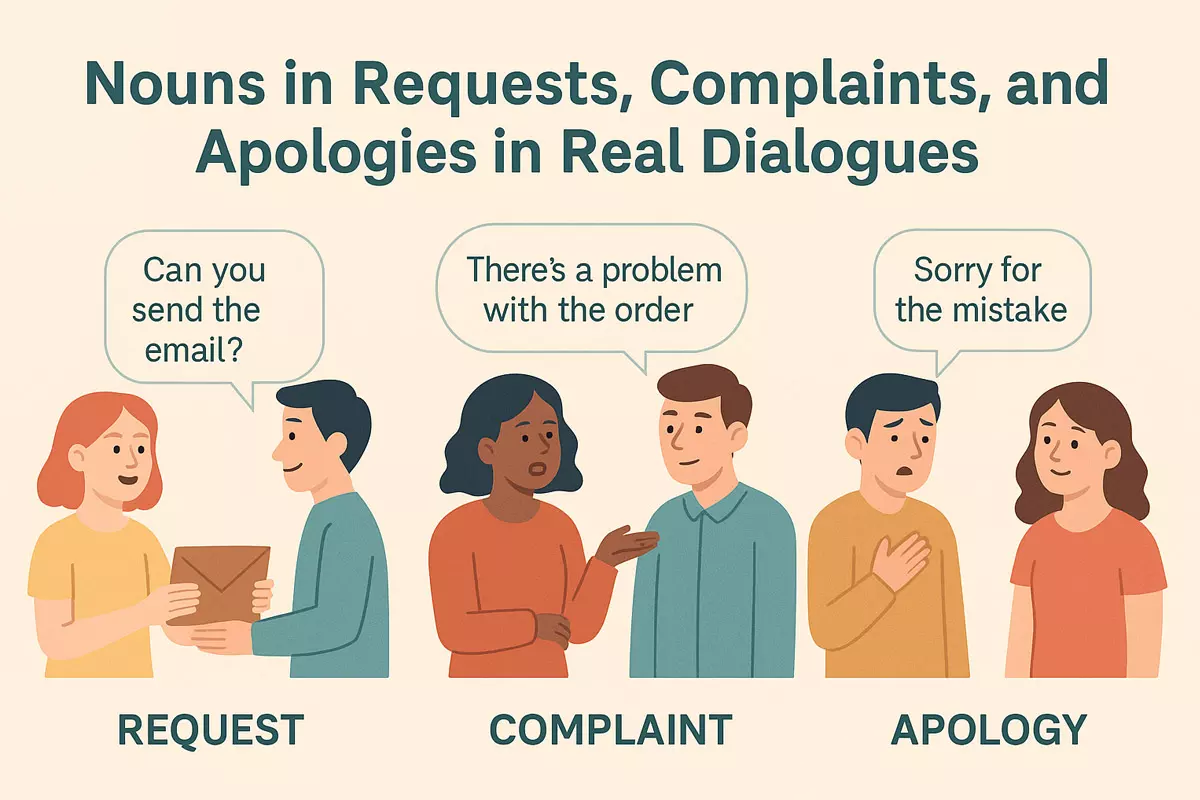 This article explains how using specific nouns in English, such as favor, issue, or inconvenience, affects the tone of polite requests, complaints, and apologies. It covers common errors and provides practice with improved noun-based expressions.
- Role of nouns in polite requests and complaints
- Common request nouns like favor, help, and time
- Complaint nouns such as problem, issue, and delay
- Apology-related nouns like mistake and inconvenience
- Tone control through noun choice in sensitive situations
- Typical errors in polite noun-based expressions
- Practice: rewrite dialogues with polite noun structures
In daily conversations, the way we use names of people and things plays a crucial role, particularly when seeking assistance, expressing dissatisfaction, or showing regret. By examining how these words function in real-life interactions, we can uncover subtle patterns that influence how we relate to others and navigate social situations. Understanding these nuances not only sheds light on communication strategies but also helps us become more effective and empathetic communicators in various contexts.
Role of nouns in polite requests and complaints
Nouns are essential in shaping how requests and complaints are perceived in real-life conversations. The choice of noun can make an expression sound more formal, indirect, or even soften the impact of a negative statement. By focusing on the object or issue rather than the person, speakers often achieve a more tactful tone.
How noun choices influence politeness
Using abstract or general nouns can distance the speaker from the problem, making complaints and requests feel less personal. For example, referring to "the noise" instead of "your loud music" shifts attention to the issue rather than blaming the listener. Similarly, polite requests often incorporate nouns to specify the desired action or object, which can help avoid direct commands.
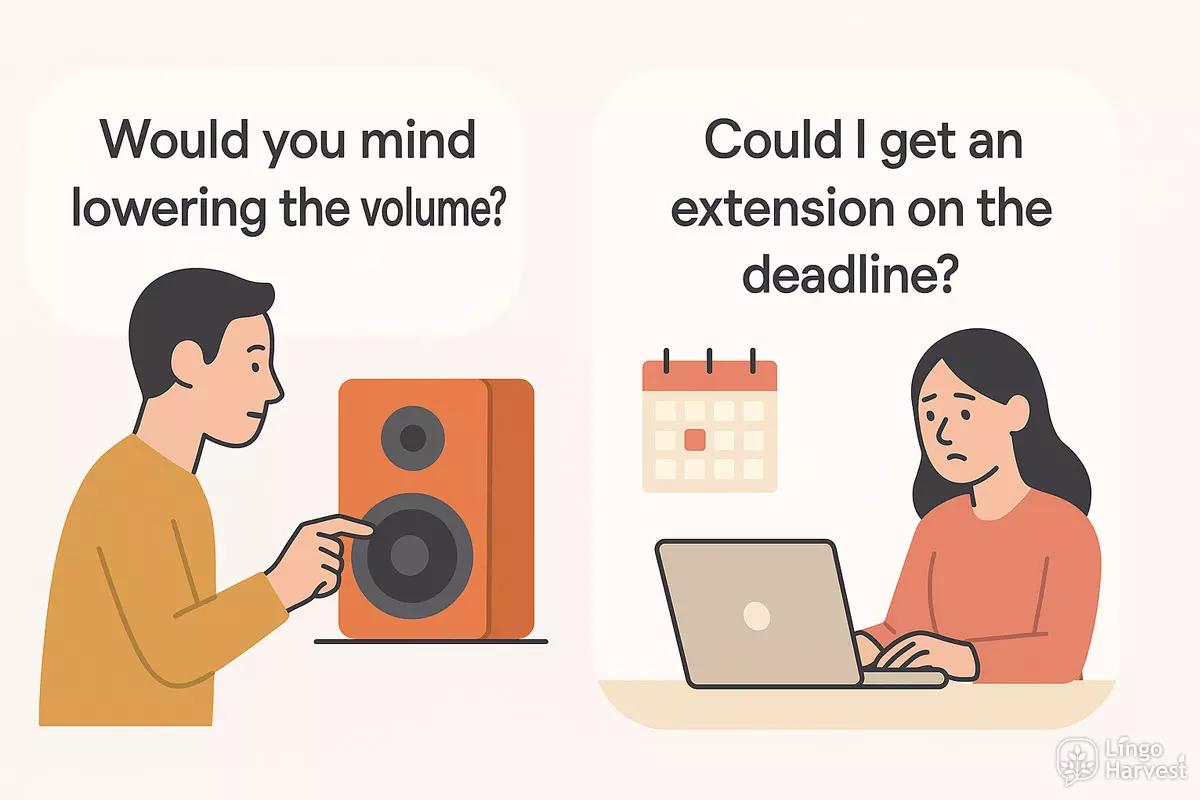
- Would you mind lowering the volume?
- Could I get an extension on the deadline?
- There seems to be a misunderstanding.
- Is it possible to have some assistance?
- I have a concern about the schedule.
- May I request your attention to this matter?
- I noticed a delay in the delivery.
- Could you send the report today?
- I’d like to discuss the issue with billing.
- There was a problem with my order.
- Would you please check the temperature in the room?
- Is there a chance for rescheduling?
- May I have your feedback on this?
- Can I get some clarification?
- I’m experiencing difficulty with logging in.
- Could you provide an update?
- I would appreciate your cooperation.
- Is parking available?
- I have a request regarding my appointment.
- Would it be possible to change the meeting time?
Directness vs. indirectness in noun usage
Selecting more neutral nouns tends to make the interaction less confrontational. For instance, saying "There is an issue with the payment" is softer than "You made a mistake with the payment." This subtle shift can help maintain positive relationships, especially in sensitive situations.
Common noun patterns in requests and complaints
Speakers often use certain structures to frame requests or voice dissatisfaction with tact. Some typical patterns include:
- I have a/an [noun]… (e.g., I have a question)
- There is/was [noun]… (e.g., There was a misunderstanding)
- Could you provide [noun]… (e.g., Could you provide assistance?)
- Would it be possible to [verb] noun… (e.g., change the schedule)
Polite communication in requests and complaints often relies on the careful selection and placement of nouns, allowing speakers to address concerns or needs with clarity and respect. This approach minimizes friction and promotes constructive dialogue.
Common request nouns like favor, help, and time
In everyday conversations, certain nouns frequently appear when people want to ask for something politely or indirectly. Words such as favor, help, and time are often chosen because they soften the impact of the request and make it feel less demanding. These nouns serve as a buffer, allowing speakers to frame their needs in a way that considers the other person's willingness or availability.
How request nouns function in dialogue
Request nouns are typically paired with polite expressions or modal verbs to form indirect questions or appeals. For instance, saying "Could you do me a favor?" or "Can I ask for your help?" shifts the focus from the specific action to the general idea of assistance, making the interaction smoother. Using these nouns also helps maintain positive relationships, as they show respect for the listener's autonomy and time.
Examples of common nouns used in requests
- favor → Could you do me a favor and check this file?
- help → I need your help with this task.
- time → Do you have a moment of your time?
- advice → She asked for advice before making a decision.
- permission → We need permission to access that area.
- support → Thank you for your support during the project.
- assistance → He requested assistance with the installation.
- guidance → I appreciate your guidance on this issue.
- recommendation → She gave a strong recommendation for the candidate.
- suggestion → His suggestion improved the final design.
- information → We need more information to proceed.
- feedback → Please share your feedback after testing the feature.
- patience → Thank you for your patience while we resolve the issue.
- understanding → We appreciate your understanding during the delay.
- opinion → What’s your opinion on this proposal?
- clarification → I need clarification on the last point.
- resources → We don’t have enough resources to finish today.
- access → You will get access after approval.
- consideration → Thank you for your consideration.
- opportunity → This opportunity could change your career.
Request patterns with these nouns
Polite requests often follow certain patterns. Here are some typical ways these nouns appear in real dialogue:
- Could I ask a favor?
- Would you mind giving me some help with this?
- Do you have time to talk?
- Can I get your advice on something?
- I’d appreciate your feedback.
Comparing common request nouns
| Noun | Typical Context in Requests |
|---|---|
| favor | Used to ask for a personal or special action, often informal ("Can you do me a favor?") |
| help | Requests for practical assistance or support ("Could you help me with this box?") |
| time | Polite way to request someone’s availability ("Do you have time to meet?") |
| advice | Seeking someone’s opinion or guidance ("May I ask your advice?") |
| permission | Formal or institutional requests for approval ("May I have permission to leave early?") |
Choosing the right noun when making a request can make your communication more effective and considerate. Understanding these patterns helps speakers navigate social interactions with greater ease.
Complaint nouns such as problem, issue, and delay
In real dialogues, certain nouns are frequently used to express dissatisfaction or to highlight things that have gone wrong. Words like "problem," "issue," and "delay" allow speakers to identify what is wrong without assigning direct blame, making them useful in both formal and informal complaints. These nouns often serve as the focal point of the complaint and can be modified by adjectives to convey urgency or seriousness ("serious issue," "unexpected delay," "minor problem").
Common nouns for expressing complaints
People tend to rely on a core set of nouns when voicing concerns in conversations, especially in customer service, workplace, or everyday situations. Here are some widely used options:
- Problem → We need to fix a problem with the new update.
- Issue → There is an issue with the login system.
- Delay → The delivery faced a short delay.
- Error → An error occurred during processing.
- Fault → It wasn’t your fault; the device malfunctioned.
- Complication → A small complication slowed the installation.
- Difficulty → He had difficulty completing the task.
- Disruption → The storm caused disruption to the service.
- Obstacle → We must overcome this obstacle to proceed.
- Malfunction → A system malfunction shut everything down.
- Setback → The team experienced a minor setback.
- Breakdown → A breakdown in communication caused confusion.
- Defect → The product had a manufacturing defect.
- Shortcoming → The software has a security shortcoming.
- Mistake → She made a mistake in the report.
- Glitch → A small glitch interrupted the video call.
- Failure → The engine failure delayed the project.
- Incident → The incident was resolved quickly.
- Inconvenience → We apologize for the inconvenience.
- Oversight → The missing file was just an oversight.
How complaint nouns function in dialogue
Complaint-related nouns often appear in specific patterns, especially when speakers want to remain polite or indirect. For example, "There seems to be a delay with my order," or "We encountered a problem with the software." This structure lets the speaker point out an issue while softening the tone.
Nuances and register
Choosing between nouns like "issue" and "problem" can affect the perceived severity or politeness of a complaint. "Issue" is often chosen for its neutral tone, while "problem" can sound more direct. Other terms like "complication" or "inconvenience" may downplay the seriousness, which is useful when the situation is minor or the relationship is delicate.
Typical patterns and modifiers
Complaint nouns are frequently paired with certain adjectives to specify the nature or gravity of the concern. Common modifiers include:
- Major/minor → We had a minor delay, but a major issue was avoided.
- Technical → The team is working on a technical problem.
- Unexpected → The outage was caused by an unexpected error.
- Ongoing → There is an ongoing investigation into the issue.
- Temporary → The service interruption is only temporary.
- Serious → This is a serious malfunction that needs attention.
- Small → It’s just a small glitch and will be fixed soon.
- Current → Our current problem is the slow server speed.
- Repeated → A repeated failure suggests a deeper defect.
- Significant → The update caused a significant disruption.
Examples in real dialogue
- “I’m having trouble with the login process.”
- “There’s a delay in the shipment.”
- “We noticed an error on the invoice.”
- “This setback has caused us to reschedule.”
- “I’d like to report a malfunction in the device.”
By using these nouns, speakers can clearly identify what is wrong, invite solutions, and maintain a constructive tone. The choice of noun and modifiers shapes both the clarity and the emotional impact of the complaint.
Apology-related nouns like mistake and inconvenience
When people apologize in real-life conversations, they often use specific nouns to identify the problem or issue at hand. These nouns help clarify exactly what went wrong and give the apology more weight and specificity. Using the right noun can make an apology sound more sincere and appropriate to the situation.
Common nouns used in apologies
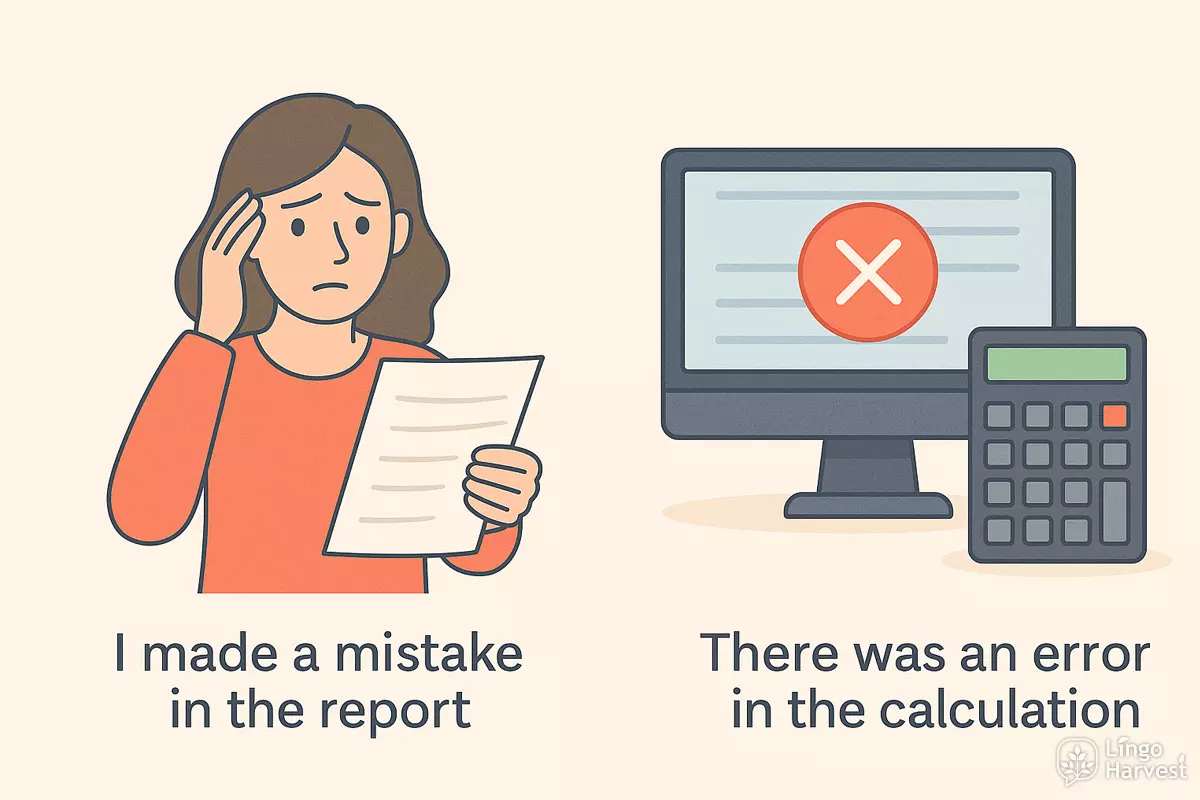
Some nouns frequently appear in spoken and written apologies. They refer to errors, problems, or the negative impact of an action. Here are several examples often heard in dialogues:
- mistake → I made a mistake in the report.
- error → There was an error in the calculation.
- fault → It wasn’t your fault; the system crashed.
- oversight → The missing signature was an oversight.
- inconvenience → Sorry for the inconvenience caused.
- delay → The flight experienced a two-hour delay.
- trouble → He had trouble logging into the system.
- confusion → The schedule change created confusion.
- misunderstanding → It was just a misunderstanding between colleagues.
- disturbance → We apologize for the disturbance during the event.
- issue → There is an issue with the printer.
- problem → We found a problem in the design.
- disruption → The storm caused major disruption to traffic.
- accident → He broke his arm in a car accident.
- setback → The project faced a minor setback.
- complication → A complication occurred during installation.
- interruption → The meeting was interrupted by a phone call.
- shortcoming → The system has a major shortcoming in security.
- negligence → The damage happened due to negligence.
- failure → The engine failure stopped the entire process.
How these nouns function in apologies
These terms typically appear after phrases like “I apologize for…”, “We’re sorry about…”, or “Please forgive the…”. By naming the specific issue, speakers demonstrate awareness and responsibility. For instance, saying “Sorry for the inconvenience” acknowledges the effect on another person, while “I apologize for my mistake” takes ownership of a specific action.
Sample apology patterns
You might encounter these common structures in real dialogues:
- I apologize for the oversight.
- We’re sorry about the delay.
- Please excuse my mistake.
- I regret the confusion caused.
- Our apologies for the disruption.
Comparing apology nouns in context
Different nouns can subtly change the tone or focus of an apology. For example, “inconvenience” is polite and somewhat formal, while “mistake” is more direct. Here’s a quick comparison of several typical nouns and how they might be used:
| Noun | Typical Context or Example |
|---|---|
| mistake | “I’m sorry for my mistake in the report.” |
| inconvenience | “We apologize for any inconvenience this may have caused.” |
| delay | “Sorry for the delay in responding.” |
| confusion | “Please excuse the confusion regarding your reservation.” |
| trouble | “Sorry for the trouble we’ve caused.” |
| issue | “I apologize for the issue with your order.” |
| fault | “It was my fault, and I’m truly sorry.” |
| error | “Our error led to this situation. We apologize.” |
Using the right noun in an apology not only clarifies the nature of the problem but also shows thoughtfulness and respect for the other person’s feelings. In both personal and professional contexts, these nouns are essential tools for effective communication and relationship repair.
Tone control through noun choice in sensitive situations
Choosing the right nouns can significantly soften or intensify the impact of requests, complaints, and apologies in everyday dialogue. In sensitive interactions, speakers often adjust noun selection to manage emotional reactions, protect relationships, and clarify intentions. For example, opting for a neutral or abstract noun instead of a direct, personal one often reduces confrontation.
Strategies for Sensitive Noun Selection
Speakers use a variety of tactics to keep conversations constructive and avoid escalation. Some of the most effective approaches include:
- Choosing impersonal nouns: “There was a misunderstanding” instead of “You made a mistake.”
- Employing collective nouns: “The team’s oversight” rather than “Your error.”
- Using event nouns: “The delay” instead of “Your lateness.”
- Selecting abstract nouns: “The issue” rather than “Your behavior.”
- Generalizing with plural forms: “Requests” instead of “Your request.”
- Referring to objects/processes: “The paperwork” instead of “Your report.”
- Minimizing with diminutives: “A small concern” rather than “A major problem.”
- Emphasizing shared experience: “Our problem” vs. “My problem.”
- Highlighting expectations: “Standard procedures” instead of “Your way.”
- Softening with positive nouns: “Opportunity” over “Obstacle.”
- Neutralizing with time nouns: “This moment” instead of “Your action.”
- Depersonalizing with location nouns: “At the meeting” instead of “When you spoke.”
- Using process nouns: “The transition” instead of “Your decision.”
- Referring to intentions: “The intention” instead of “Your plan.”
- Highlighting context: “Given the circumstances” instead of “Given your mistake.”
Effects of Different Noun Choices
The nouns used in emotionally charged situations can signal blame, distance, empathy, or shared responsibility. Consider the following contrasts:
- “Your complaint” → “The feedback received”
- “My fault” → “An unfortunate result”
- “Your absence” → “The lack of presence”
- “My request” → “A suggestion”
Comparing Direct and Indirect Noun Use
When a conversation requires delicacy, indirect nouns often help maintain goodwill. The table below illustrates how direct nouns can be softened to influence tone and emotional response:
| Direct Noun (More Confrontational) | Indirect/Neutral Noun (Softer) |
|---|---|
| Your mistake | The oversight |
| My complaint | Some feedback |
| Your delay | The timing issue |
| My apology | Regret for the situation |
| Your responsibility | The matter at hand |
| My disappointment | Unmet expectations |
Summary
Careful noun selection helps speakers avoid unnecessary confrontation and fosters an atmosphere of respect, especially in delicate exchanges. By choosing words that depersonalize or generalize, communicators can express their needs or concerns while maintaining a positive relationship.
Typical errors in polite noun-based expressions
Missteps in using nouns for politeness in real-life requests, complaints, and apologies often lead to misunderstandings or unintended rudeness. Learners may overuse certain formulaic nouns, choose the wrong level of formality, or confuse countable and uncountable forms. This can affect how their intended message is received, sometimes making it sound abrupt or insincere.
Common mistakes with noun-based politeness
- Using “favor” in the wrong context, e.g., “Can I make a favor?” instead of “Can I ask a favor?”
- Mixing up “apology” and “apologies”: “I want to make an apology” vs. “My apologies for the delay”
- Incorrect articles: “I have complaint” instead of “I have a complaint”
- Forgetting plural forms: “Many thanks” vs. “Many thank”
- Overusing “request” where a verb would be more natural
- Using “regret” as a noun inappropriately, e.g., “I have a regret to inform you”
- Misplacing possessives: “Your inconvenience is regretted” instead of “We regret the inconvenience”
- Directness that sounds impolite: “I want information” without softening nouns or modifiers
- Confusing “excuse” (as a noun) and “excuse me” (as a phrase)
- Using “problem” too bluntly: “You are the problem” instead of “There seems to be a problem”
- Translating directly from another language, resulting in unnatural noun phrases
- Misusing “appreciation”: “I want your appreciation” instead of “I would appreciate your help”
- Inappropriate formality: “I humbly submit a request” in a casual context
- Using “issue” instead of “concern” or “matter” when the situation is minor
- Incorrect noun collocations: “Give me a suggestion” instead of “Could you make a suggestion?”
- Omitting hedging nouns: “This is a complaint” instead of “I have a small complaint”
Table: Problematic vs. Polite Noun-based Expressions
| Direct or Incorrect Expression | Polite, Natural Alternative |
|---|---|
| I want information. | Could I request some information? |
| I have complaint. | I have a complaint to make. |
| Give me a suggestion. | Could you offer a suggestion? |
| I make apology. | Please accept my apologies. |
| What’s your problem? | Is there an issue I can help with? |
| I want your appreciation. | I would appreciate your help. |
| Excuse for mistake. | Please excuse the mistake. |
| I regret to inform your inconvenience. | We regret any inconvenience caused. |
How to avoid these pitfalls
Being aware of context and the relationships between speakers helps in choosing appropriate noun-based forms. Practice with real dialogues, pay attention to native speaker usage, and don’t rely only on textbook phrases. Small adjustments—like adding “some,” “a little,” or softeners such as “a bit of”—can make expressions sound more natural and respectful.
Practice: rewrite dialogues with polite noun structures
Polite noun structures can transform direct or blunt statements into more considerate and diplomatic language in everyday conversations. This practice section helps you recognize and apply such structures in requests, complaints, and apologies. You’ll see how simple changes can make your speech softer and more effective in real-life dialogues.
Common Polite Noun Structures
- Would you mind + noun phrase (e.g., "Would you mind a quick response?")
- I would appreciate + noun phrase (e.g., "I would appreciate your assistance.")
- May I request + noun phrase (e.g., "May I request a little more time?")
- There seems to be + noun phrase (e.g., "There seems to be a misunderstanding.")
- I apologize for + noun phrase (e.g., "I apologize for the inconvenience.")
- Could you provide + noun phrase (e.g., "Could you provide an update?")
- Would it be possible to have + noun phrase (e.g., "Would it be possible to have an extension?")
- I have a concern about + noun phrase (e.g., "I have a concern about the timeline.")
- Thank you for + noun phrase (e.g., "Thank you for your patience.")
- Is it possible to receive + noun phrase (e.g., "Is it possible to receive clarification?")
- I regret any + noun phrase (e.g., "I regret any confusion caused.")
- Would you be able to offer + noun phrase (e.g., "Would you be able to offer assistance?")
Rewrite the Dialogues
Below are some everyday exchanges. Your task is to rewrite each one using more polite noun-based expressions.
- Direct: "Give me the report by tomorrow."
Rewrite with a polite noun structure. - Direct: "You made a mistake."
Rewrite to soften the complaint. - Direct: "Sorry I was late."
Rewrite using a noun structure for the apology. - Direct: "Can you fix this now?"
Rewrite as a polite request. - Direct: "Wait until I finish."
Rewrite using a noun phrase to make it more polite. - Direct: "You didn't send the document."
Rewrite to express the issue more diplomatically. - Direct: "I need help."
Rewrite as a more formal request. - Direct: "That's wrong."
Rewrite with a polite noun phrase. - Direct: "Call me back soon."
Rewrite using a noun-based request. - Direct: "You forgot my order."
Rewrite as a polite complaint.
Show answers
- "I would appreciate the report by tomorrow."
- "There seems to be an error."
- "I apologize for my lateness."
- "Would it be possible to have this fixed now?"
- "May I request a moment until I finish?"
- "There appears to be a missing document."
- "I would appreciate your assistance."
- "There seems to be a mistake."
- "Could you provide a return call soon?"
- "I have a concern about my order being missed."
Tips for Using Polite Noun Structures
- Replace direct commands with requests using nouns (e.g., "assistance," "support," "clarification").
- Express complaints as observations or concerns, not accusations.
- Apologize for the effect, not just the action, using noun phrases (e.g., "the delay," "the inconvenience").
- Thank others using noun-based compliments ("your understanding," "your time," "your efforts").
Practicing these transformations will help you sound more professional and considerate in both spoken and written interactions.