Nouns for Feelings and Emotions: Vocabulary and Usage

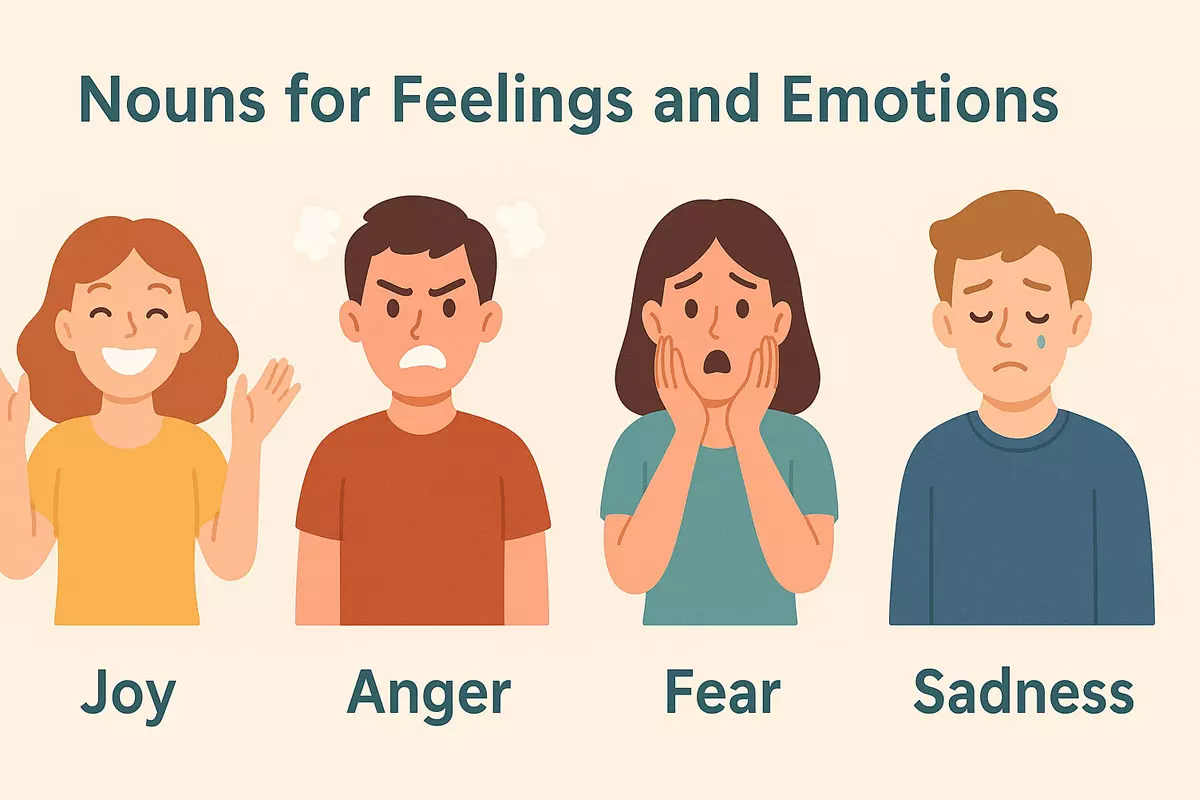 Here we key emotion nouns, explains positive and negative types, highlights common collocations and prepositions, discusses expressing intensity, provides everyday sentence models, and ends with practice on choosing the right emotion noun.
Exploring words that capture our inner states can open new ways to express ourselves and understand others. By expanding your emotional vocabulary, you gain tools to articulate complex feelings and experiences more precisely, which can lead to deeper connections and improved communication. This article delves into terms that describe various emotions and moods, helping you convey your sentiments with greater clarity and nuance, whether in conversations, writing, or self-reflection.
Core Emotion Nouns
Understanding the vocabulary for feelings and emotions helps express complex internal states more precisely. Many everyday conversations, literature, and even professional contexts require words that directly label what people are experiencing inside. Here, you’ll find some of the most frequently used nouns that denote basic emotions and feelings.
Common Words for Emotions
English contains a rich set of terms describing emotional states. These nouns allow for clear communication about mood, reactions, and interpersonal dynamics. Some of the most widely used include:
- Joy
- Anger
- Fear
- Sadness
- Disgust
- Surprise
- Love
- Hate
- Hope
- Despair
- Envy
- Pride
- Shame
- Guilt
- Relief
- Anxiety
- Contentment
- Gratitude
- Regret
- Excitement
Comparing Similar Feelings
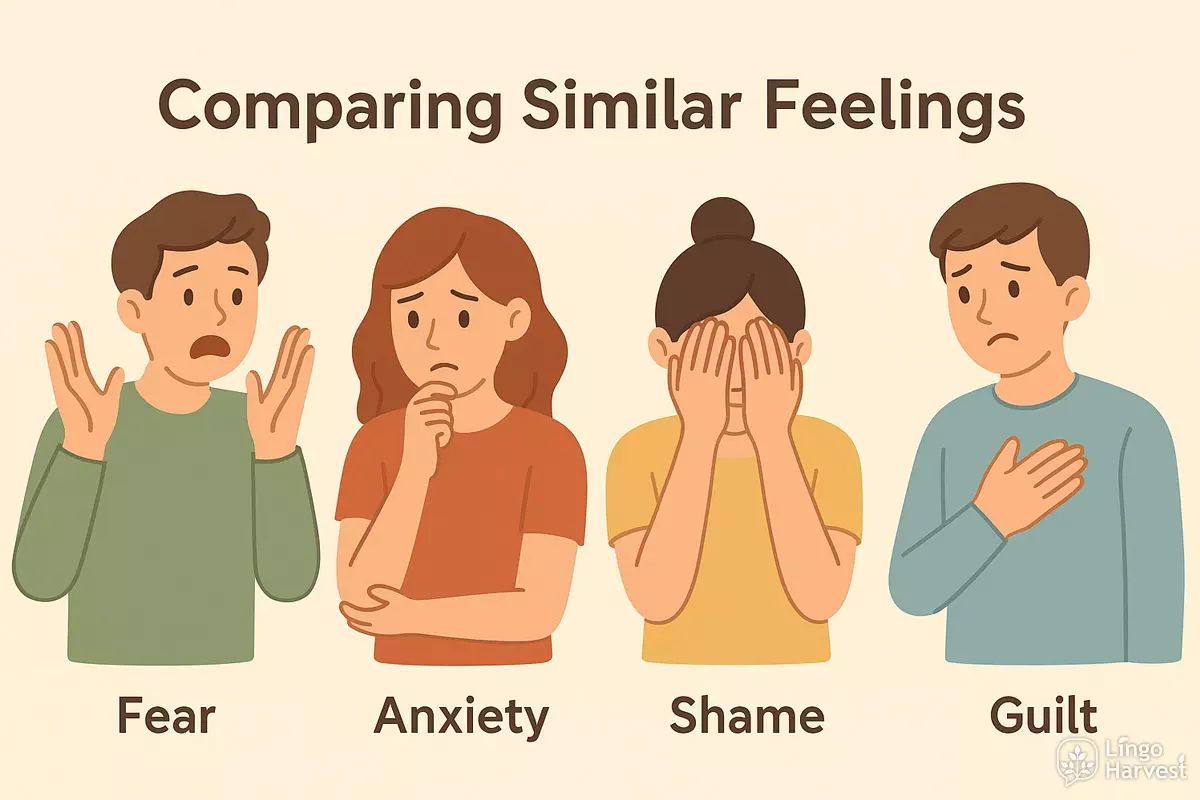
Sometimes, it’s useful to distinguish between closely related emotions. For instance, words like “fear” and “anxiety” both refer to negative feelings but have different nuances. The following table highlights a few such comparisons:
| Emotion Noun | Typical Context or Nuance |
|---|---|
| Fear | A response to a specific, immediate threat or danger |
| Anxiety | A general sense of unease, often without a clear cause |
| Shame | Feeling bad about oneself, often related to social judgment |
| Guilt | Feeling responsible for a specific wrong action |
| Joy | A strong feeling of happiness, often sudden or intense |
| Contentment | A calm, steady sense of satisfaction |
Usage in Sentences
Using these nouns in context can clarify one’s state of mind. For example:
- She felt overwhelming gratitude after receiving help.
- His anger was evident in his tone.
- After the exam, a wave of relief washed over them.
- The news filled them with hope for the future.
These vocabulary choices help you communicate feelings with accuracy and empathy, making conversations more meaningful and nuanced.
Positive vs Negative Sets
Understanding how nouns for feelings and emotions are grouped helps learners communicate with nuance. English vocabulary often organizes these terms into two broad categories: words that describe pleasant or desirable states, and those that convey discomfort or distress. Recognizing the distinction improves both comprehension and expression, especially when discussing mood, reactions, or personal experiences.
Common Nouns for Pleasant Emotions
Terms that refer to uplifting or agreeable states are useful for expressing satisfaction and optimism. Here are some frequently used nouns denoting positive emotions:
- Joy
- Contentment
- Gratitude
- Hope
- Affection
- Pride
- Relief
- Admiration
- Excitement
- Serenity
- Amusement
- Trust
Common Nouns for Unpleasant Emotions
Words describing negative or difficult feelings help express vulnerability or challenges. These are common nouns for less pleasant emotional states:
- Anger
- Fear
- Sadness
- Disgust
- Shame
- Envy
- Guilt
- Frustration
- Anxiety
- Loneliness
- Regret
- Disappointment
| Positive Emotion Nouns ✅ | Negative Emotion Nouns ❌ |
|---|---|
| Joy | Sadness |
| Gratitude | Anger |
| Hope | Fear |
| Relief | Frustration |
| Serenity | Anxiety |
| Trust | Guilt |
| Admiration | Envy |
| Excitement | Disappointment |
Usage Tips
When choosing a noun to describe a feeling, consider the context and intensity. For example, “contentment” is milder than “joy,” while “anxiety” suggests a different nuance than “fear.” Mixing these nouns in conversation allows for more accurate and empathetic communication. Additionally, some words can be neutral or context-dependent, so always pay attention to how they are used in sentences.
Common Collocations
When discussing feelings and emotions, certain nouns often appear together with specific verbs, adjectives, or prepositions. These typical word combinations help your English sound more natural and fluent. Understanding which words commonly go with terms like "anger," "joy," or "fear" can make your speech and writing much clearer.
Typical Verb + Noun Combinations
Some verbs are frequently used with nouns that describe emotional states. Here are some examples:
- Express gratitude
- Feel anxiety
- Overcome fear
- Harbor resentment
- Show affection
- Suppress anger
- Experience joy
- Share happiness
- Hide disappointment
- Cause frustration
- Relieve stress
- Admit guilt
Adjective + Noun Patterns
Adjectives often help specify or intensify the emotional noun. Some frequent pairings include:
- Sheer delight
- Deep sorrow
- Intense fear
- Sudden shock
- Bitter disappointment
- Overwhelming relief
- Quiet pride
- Rising excitement
- Acute embarrassment
- Lingering regret
Prepositional Phrases with Emotional Nouns
Certain nouns for feelings tend to be followed by specific prepositions, forming fixed phrases that are easy to remember:
- In a state of panic
- With a sense of dread
- Out of curiosity
- Under pressure
- For pleasure
- From anger
- With pride
- In fear of
Comparison Table: Emotional Nouns and Common Collocations
| Emotion Noun | Frequent Collocations |
|---|---|
| Anger | Express anger, suppress anger, anger at someone |
| Happiness | Feel happiness, share happiness, happiness at news |
| Fear | Overcome fear, in fear of, fear for safety |
| Guilt | Admit guilt, feel guilt, guilt about something |
| Pride | Take pride in, with pride, pride of achievement |
| Relief | Feel relief, sigh of relief, overwhelming relief |
| Frustration | Cause frustration, frustration with, vent frustration |
| Regret | Express regret, deep regret, regret about decision |
Mastering these typical combinations will help you communicate about emotional states more naturally. Noticing how words fit together in authentic speech and writing is a useful step in expanding your vocabulary related to moods and feelings.
Prepositions with Feeling Nouns
Understanding which prepositions naturally combine with nouns related to emotions is essential for fluent and accurate English. Certain nouns expressing feelings often require specific prepositions to convey the intended meaning. For example, “fear of spiders” is correct, while “fear from spiders” sounds unnatural. Using the right combination helps your speech and writing sound more natural and precise.
Common Prepositions Used with Emotion Nouns
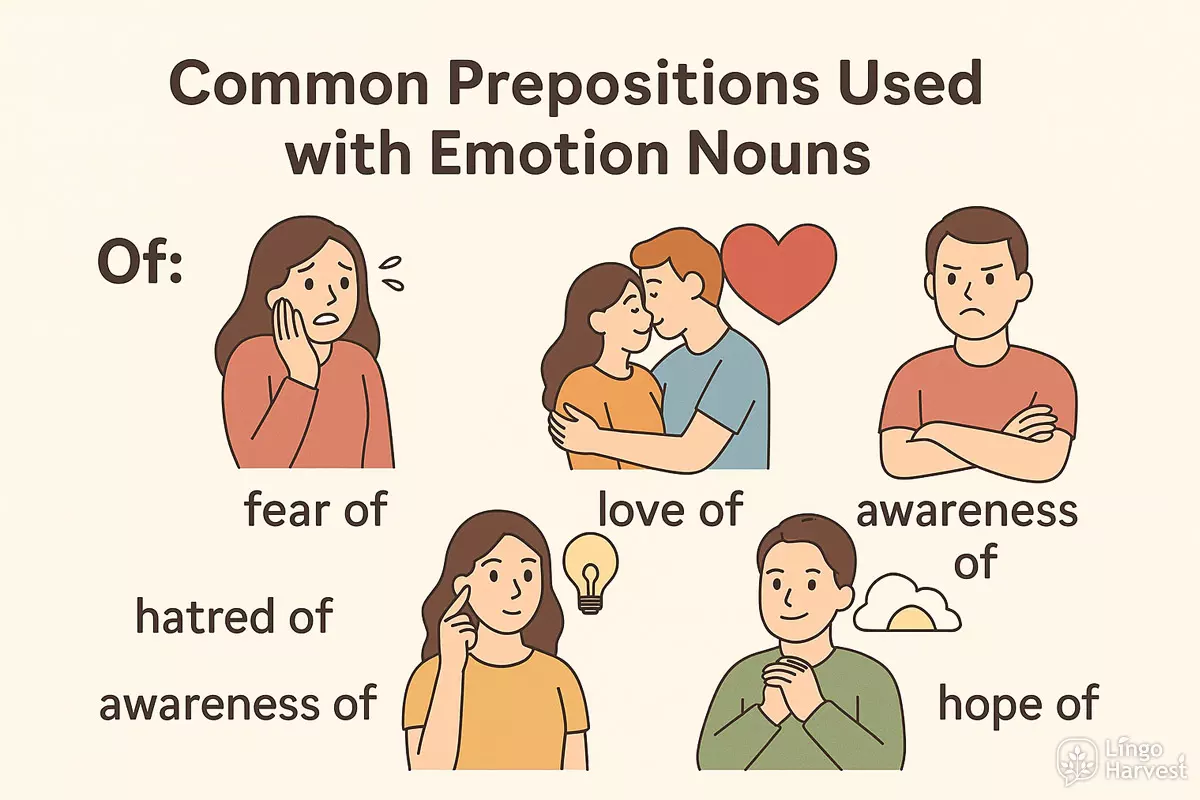
Some prepositions frequently appear with nouns describing emotional states. These patterns are important to remember because they often can’t be changed without altering the meaning or making the phrase incorrect.
- Of: fear of, love of, hatred of, awareness of, hope of
- For: sympathy for, gratitude for, respect for, admiration for, affection for
- аbout: anxiety about, concern about, excitement about, worry about, confusion about
- At: surprise at, anger at, delight at, amazement at, annoyance at
- With: satisfaction with, frustration with, disappointment with, patience with, pleasure with
- To: devotion to, loyalty to, indifference to, sensitivity to, openness to
Patterns and Meaning
The preposition can subtly change the nuance of the emotion noun. For example, "anger at" often points to a specific target (“anger at the decision”), while "anger with" usually refers to a person (“anger with my friend”). Observing these small differences can help you express your feelings more precisely.
Examples of Emotion Noun + Preposition Combinations
Below is a table showing some of the most common collocations of emotion nouns with their usual prepositions. These pairings are widely used in both spoken and written English.
| Feeling Noun | Typical Preposition |
|---|---|
| Fear | of |
| Excitement | about |
| Respect | for |
| Anger | at / with |
| Confusion | about |
| Gratitude | for |
| Surprise | at |
| Affection | for |
| Disappointment | with / in |
| Awareness | of |
Tips for Mastering Collocations
Pay close attention to how native speakers use prepositions with nouns that express feelings. Reading widely and listening to authentic conversations can help you notice these patterns. When in doubt, consult a reliable dictionary or language resource, as direct translation from your native language may not always work. Over time, these combinations will start to feel more natural.
Talking About Intensity
When describing feelings and emotions, it’s common to express how strong or weak they are. English uses a variety of nouns and modifiers to capture these differences, allowing speakers to communicate subtle shifts from mild discomfort to overwhelming joy. Choosing the right noun or adding intensity words can help you be more precise.
Common Nouns for Varying Strengths of Emotions
Some nouns signal a lower level of emotion, while others suggest something much more powerful. Here are several examples showing this range:
- Interest → Fascination
- Worry → Anxiety → Panic
- Dislike → Aversion → Loathing
- Surprise → Astonishment → Shock
- Happiness → Joy → Ecstasy
- Sadness → Grief → Despair
- Anger → Rage → Fury
- Fear → Dread → Terror
- Affection → Love → Adoration
- Disappointment → Frustration → Devastation
- Confusion → Bewilderment → Disorientation
- Calm → Contentment → Serenity
Modifiers That Change Intensity
To fine-tune meaning, modifiers like “slight,” “overwhelming,” or “sheer” often appear before nouns. These words help indicate the degree of the emotion:
- slight annoyance
- deep sadness
- overwhelming relief
- sheer joy
- mild irritation
- intense curiosity
- total despair
- profound gratitude
- extreme fear
- lasting affection
Comparing Intensity: Sample Noun Groups
The table below shows how nouns for feelings and emotions can be grouped by their relative strength, helping you select the best word:
| Mild | Strong |
|---|---|
| Concern | Alarm |
| Discomfort | Agony |
| Admiration | Worship |
| Displeasure | Outrage |
| Enthusiasm | Elation |
| Embarrassment | Humiliation |
Tips for Expressing Degrees of Emotion
- Pick nouns that match the situation: “annoyance” for minor irritation, “rage” for extreme anger. - Use modifiers to clarify: “slight happiness” is less intense than “intense happiness.” - Notice context: Some words (like “terror” or “ecstasy”) are rarely used for everyday feelings. - Listen for natural collocations—some modifiers fit better with certain nouns (e.g., “deep sorrow,” “sheer delight”). Understanding and using the right nouns and modifiers makes your communication clearer and more expressive when discussing emotions.
Everyday Sentence Models
Clear, natural sentences help learners express emotions and feelings in daily conversations. By practicing common patterns, you can confidently talk about happiness, frustration, excitement, or disappointment. Below, you’ll find typical ways to use nouns related to emotional states, covering a range of positive and negative experiences.
Common Sentence Patterns
- I feel joy when I see my friends.
- There was a sense of relief after the exam.
- Her anger was obvious during the meeting.
- He expressed his gratitude to the team.
- She couldn’t hide her disappointment.
- My curiosity led me to ask more questions.
- We share a deep affection for music.
- His fear of heights kept him from climbing.
- They showed great enthusiasm for the project.
- Everyone felt a wave of sadness at the news.
- I have a lot of respect for her honesty.
- He tried to control his jealousy.
- There was genuine admiration in her voice.
- We felt pride in our achievements.
- Her anxiety increased before the interview.
- My trust in him has grown over time.
- The surprise on his face was clear.
- She radiated confidence during her speech.
- He spoke with regret about the mistake.
- The news brought a sense of hope.
Comparing Positive and Negative Emotions
| Positive Emotion | Negative Emotion |
|---|---|
| Happiness | Anger |
| Gratitude | Jealousy |
| Pride | Fear |
| Affection | Sadness |
| Hope | Regret |
Using nouns for emotional states helps you describe both your own feelings and those of others. These sentence models give you a foundation for real-life conversations, whether you’re sharing your admiration for someone or talking about anxiety before a big event. Try adapting these patterns to your own experiences for more authentic communication.
Practice: Choose the Right Noun
Selecting the most accurate word for a specific emotional state can make your communication clearer and more expressive. This section offers practical exercises to help you identify and use appropriate nouns related to feelings and emotions in various contexts.
Fill in the Blank
Read each sentence and pick the noun that best fits the meaning. Choose from the list: joy, anger, fear, disappointment, pride, relief, envy, excitement, sadness, gratitude.
- After hearing the good news, a sense of _______ spread through the room.
- He felt deep _______ when he saw his friend succeed where he had failed.
- She couldn’t hide her _______ when her hard work was finally recognized.
- When the project failed, the team’s _______ was obvious.
- The sudden loud noise filled her with _______.
Show answers
- 1. joy
- 2. envy
- 3. pride
- 4. disappointment
- 5. fear
Matching Emotions to Situations
Match each scenario on the left with the most suitable noun for the emotion on the right.
| Situation | Emotion (Noun) |
|---|---|
| Winning a difficult competition |
|
| Receiving help during a crisis |
|
| Missing out on an opportunity |
|
| Watching fireworks on New Year’s Eve |
|
Show answers
- Winning a difficult competition → pride
- Receiving help during a crisis → gratitude
- Missing out on an opportunity → sadness
- Watching fireworks on New Year’s Eve → excitement
Common Nouns for Emotions: Expanded Examples
Here are more nouns that describe different emotional states. Consider the subtle differences between them:
- anxiety
- contentment
- frustration
- affection
- admiration
- regret
- shame
- delight
- loneliness
- compassion
- resentment
- astonishment
- hope
- despair
- sympathy
- trust
- confusion
- curiosity
Practice using these words in sentences to develop a richer emotional vocabulary and improve your ability to express nuanced feelings in English.