How Words Change Class: Conversion in English

 This article explains conversion in English, showing how words change roles, like nouns to verbs or adjectives to nouns. It covers common patterns, examples, typical mistakes, daily usage, and offers practice with word conversion.
Have you ever noticed how a noun can unexpectedly become a verb or how an adjective might take on the role of a noun in English? This fascinating linguistic phenomenon, known as conversion or zero derivation, enables words to shift their grammatical categories without changing their form. Such flexibility not only enriches the language but also encourages creativity in communication, allowing speakers to express ideas more vividly and efficiently by adapting familiar words to new roles as needed.
What Is Conversion?
In English, conversion refers to the process where a word changes its grammatical class—like from a noun to a verb—without any alteration in its form. This means the spelling and pronunciation stay the same, but the role the word plays in a sentence shifts. For example, the noun “email” can become the verb “to email” simply by using it differently in context. No prefixes, suffixes, or modifications are needed; the transformation is immediate and seamless.
How Conversion Works in English
This linguistic phenomenon is especially common in English, thanks to its flexible structure. Speakers can turn nouns into verbs, verbs into nouns, adjectives into nouns, and so on. The context and sentence structure reveal the new grammatical function. Here are some frequent types of shifts:
- Noun → Verb: “Google” (noun) becomes “to Google” (verb)
- Verb → Noun: “run” (verb) becomes “a run” (noun)
- Adjective → Noun: “poor” (adj.) becomes “the poor” (noun)
- Adjective → Verb: “empty” (adj.) becomes “to empty” (verb)
Examples of Conversion in Everyday English
This process makes vocabulary more versatile. Here are some common instances:
- Text (noun) → to text (verb)
- Access (noun) → to access (verb)
- Impact (noun) → to impact (verb)
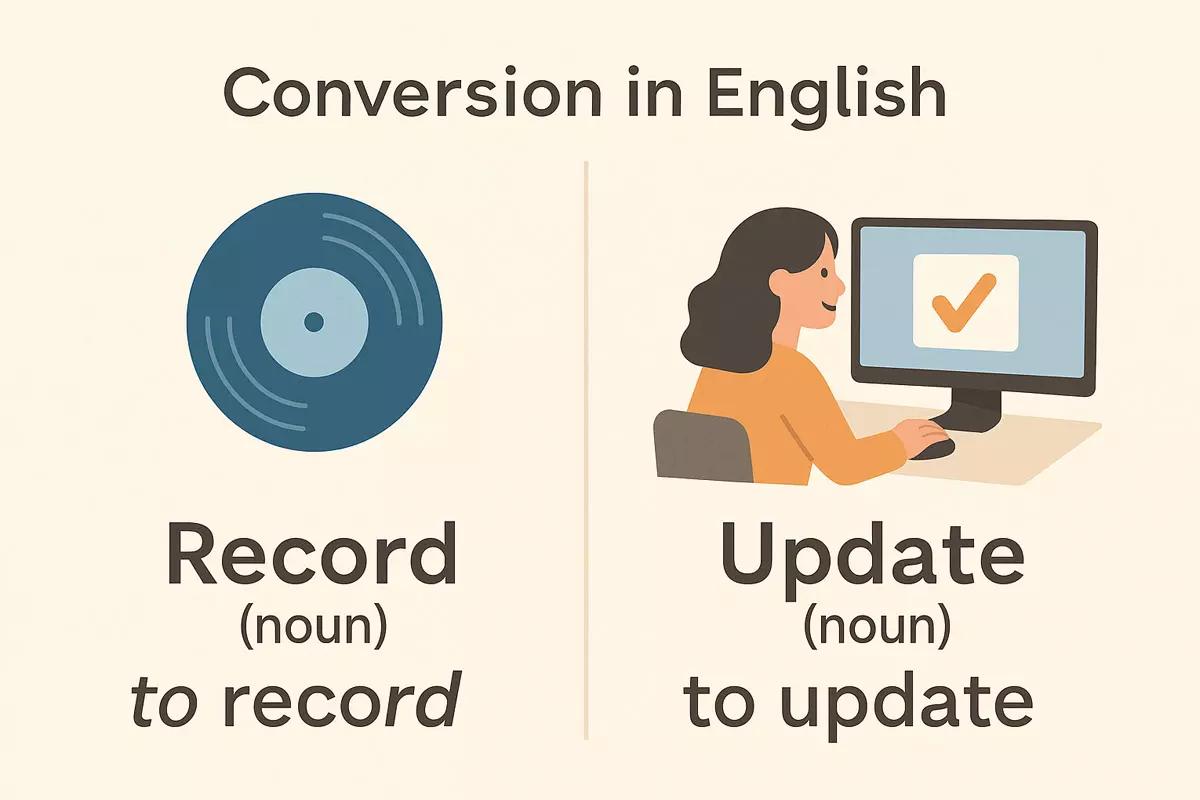
- Record (noun) → to record (verb)
- Update (noun) → to update (verb)
- View (noun) → to view (verb)
- Cook (verb) → a cook (noun)
- Hope (verb) → hope (noun)
- Clean (verb) → clean (adjective)
- Light (noun) → to light (verb)
- Judge (noun) → to judge (verb)
- Order (verb) → order (noun)
- Call (verb) → a call (noun)
- Use (verb) → use (noun)
- Hopeful (adjective) → a hopeful (noun)
- Empty (adjective) → to empty (verb)
- Deep (adjective) → to deep (verb, rare/poetic)
- Green (adjective) → a green (noun, e.g., in golf)
Why Is Conversion Important?
This feature allows English to adopt new words and adapt existing ones efficiently. Instead of inventing entirely new terms, speakers can repurpose familiar words, making the language more dynamic and expressive. It also helps English speakers communicate more precisely by using words flexibly according to context.
Comparing Conversion with Other Word Formation
Unlike affixation (adding prefixes or suffixes), conversion involves no visible change in the word’s form. Here’s a comparison:
| Process | Example | Form Change? |
|---|---|---|
| Conversion | “Email” (noun) → “to email” (verb) | No |
| Affixation | “Friend” → “friendly” | Yes |
| Compounding | “Tooth” + “brush” = “toothbrush” | Yes |
| Clipping | “Advertisement” → “ad” | Yes |
Understanding this process helps explain why English is so adaptable and why new uses for words often appear quickly in speech and writing.
Common Conversion Patterns
Transforming words from one part of speech to another is a hallmark of English flexibility. This process, known as conversion or zero derivation, allows speakers to use familiar words in new grammatical contexts. Let's explore the most frequent ways this shift occurs, along with typical examples.
Noun → Verb Shifts
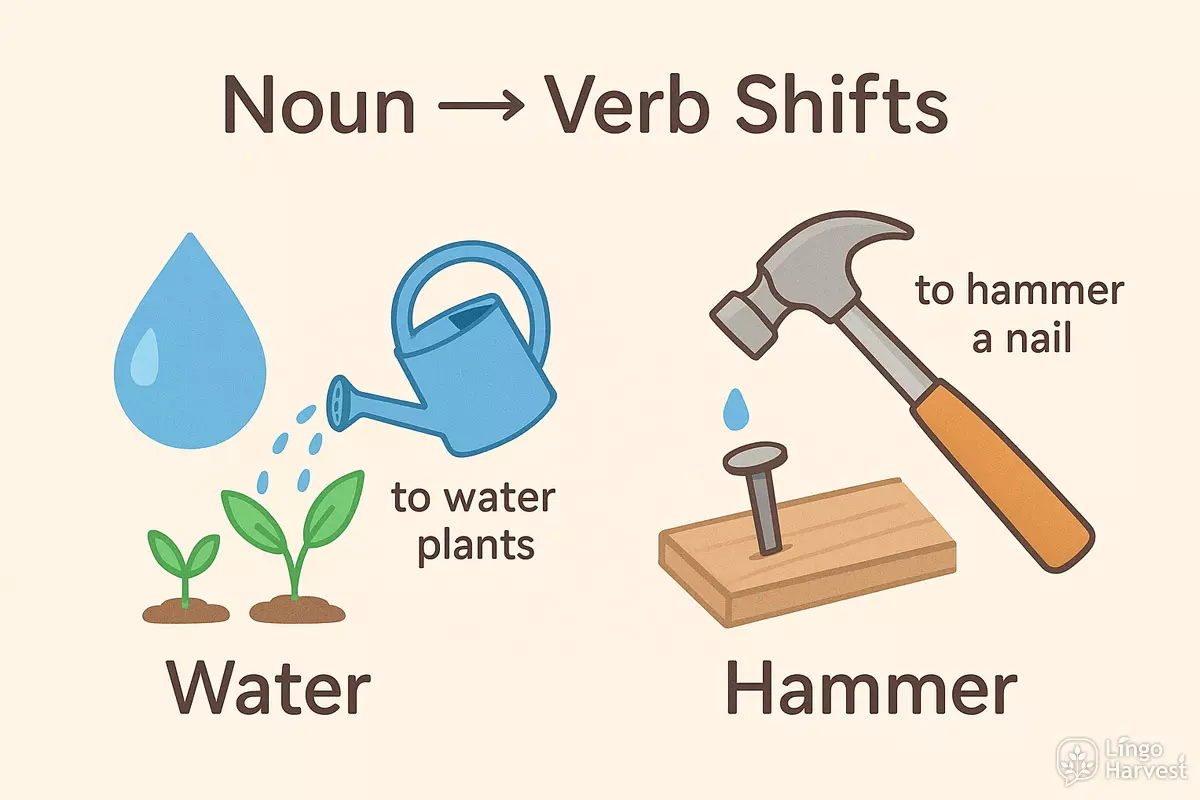
Many everyday words originally used as nouns have taken on roles as verbs. This pattern is especially productive in modern English and often involves no change in spelling or pronunciation.
- Google (to google something)
- Email (to email a document)
- Chair (to chair a meeting)
- Host (to host a party)
- Water (to water plants)
- Hammer (to hammer a nail)
- Friend (to friend someone online)
- Text (to text a message)
- Ship (to ship a package)
- Season (to season food)
Verb → Noun Transformations
Verbs become nouns frequently, often to name the action or the result. These converted forms are sometimes called "deverbal" nouns.
- Run (go for a run)
- Drive (take a drive)
- Call (receive a call)
- Guess (make a guess)
- Walk (enjoy a walk)
- Try (give it a try)
- Visit (have a visit)
- Return (expect a return)
- Move (make a move)
- Reply (write a reply)
Adjective → Noun and Verb Conversions
Adjectives sometimes shift into nouns (often to label people or qualities) or even verbs (though less commonly).
- Poor (the poor, a group noun)
- Daily (read the daily, i.e., newspaper)
- Empty (an empty, as a noun; to empty, as a verb)
- Clean (a clean, as a noun; to clean, as a verb)
- Regular (a regular, as in a frequent customer)
- Open (to open, as a verb)
- Dry (a dry, as in a dry period or to dry clothes)
Summary Table: Typical Conversion Directions and Examples
| Source Word Class | Target Word Class | Example |
|---|---|---|
| Noun | Verb | Google → to google |
| Verb | Noun | Run → a run |
| Adjective | Noun | Poor → the poor |
| Adjective | Verb | Clean → to clean |
By recognizing these pathways, you can better understand and anticipate how English words adapt to new uses. This adaptive feature is one of the reasons English keeps expanding its expressive range.
Noun-to-Verb Conversion
In English, it's common for a word that usually names a thing or concept to start functioning as an action. This process, often called "verbing," is a natural way the language adapts and expands its vocabulary. Sometimes, the meaning is literal—using "hammer" as in "to hammer a nail"—and sometimes more figurative, like "to chair a meeting."
How It Happens
Turning a noun into a verb usually doesn't require changing the form of the word. Speakers simply begin to use it in a new syntactic role. Context helps listeners understand the intended meaning. Over time, many of these new verbs become standard.
Everyday Examples
You might not notice how often this happens in daily conversation. Here's a list of common nouns that have been adopted as verbs, along with example uses:
- Email – "I'll email you the details."
- Google – "Can you google that for me?"
- Host – "They will host the event."
- Text – "She texted me last night."
- Chair – "Who will chair the committee?"
- Access – "I can't access the file."
- Butter – "Could you butter the bread?"
- Ship – "We will ship your order tomorrow."
- Hand – "Please hand me the pen."
- Bookmark – "Bookmark this page for later."
- Message – "Message me when you arrive."
- Mirror – "Their actions mirror our own."
- Friend – "Did you friend her online?"
- Season – "Season the soup to taste."
- Bottle – "They bottle their own juice."
- Screen – "We need to screen the candidates."
- Park – "Where can I park my car?"
- Table – "Let's table that discussion."
- Voice – "She voiced her concerns."
- Map – "We need to map the route."
Patterns and Productivity
Certain semantic patterns make this shift more likely. Objects, tools, or roles are frequent sources: "hammer," "host," and "coach" are all nouns that became verbs by describing the typical action associated with them. New technologies and trends also accelerate this process, as seen with "google" or "text."
Comparing Noun and Verb Uses
The same word can look identical as a noun or a verb, but context reveals its function. Consider the following structured examples:
| Noun Use | Verb Use |
|---|---|
| Send me a text. | Can you text me later? |
| The chair is comfortable. | Who will chair the meeting? |
| He left a bookmark. | Bookmark this site. |
| This is a new bottle. | Bottle the lemonade, please. |
| Let’s see the map. | We’ll map our journey. |
Why It Matters
This kind of flexibility keeps English dynamic and responsive to change. Speakers can quickly express new ideas by adapting existing words, rather than inventing entirely new ones. The process also reflects creativity and efficiency in communication.
Verb-to-Noun Conversion
Turning verbs into nouns is a common process in English, allowing speakers to create new words without changing the form. This phenomenon, sometimes called "zero-derivation" or "conversion," lets a word shift from one grammatical function to another. In this case, an action word becomes a thing or concept, often without any visible change in spelling. This shift is productive because English does not always require a special ending or affix for the new noun. The meaning typically shifts from an action or process to the result, product, or instance of that action. For example, the verb "to run" can also refer to "a run" in sports or "a run" in stockings.
Common Patterns and Examples
Here are some frequent instances where action words serve as nouns in everyday language:
- run → a morning run
- drive → a test drive
- call → a phone call
- walk → a short walk
- visit → a quick visit
- cook → a good cook
- play → a stage play
- drink → a cold drink
- jump → a high jump
- move → a clever move
- drive → a long drive
- swim → a swim in the lake
- look → a strange look
- help → a little help
- catch → a lucky catch
- laugh → a loud laugh
- try → a second try
- show → a TV show
- answer → a correct answer
- report → a news report
Meaning Shifts and Flexibility
The new noun often keeps a close connection to the verb, but sometimes takes on specialized meanings. For instance, "run" as a noun can mean a continuous period of operation ("a run of good luck") or a journey. Context usually makes the intended meaning clear.
Comparison: Verb and Noun Use
Below is a table comparing how the same word can function as both a verb and a noun in different sentences:
| Verb Use | Noun Use |
|---|---|
| They run every morning. | She went for a run. |
| Can you call me later? | I missed your call. |
| We play chess on Sundays. | The play was entertaining. |
| He drinks coffee every day. | Would you like a drink? |
| Let’s walk to the park. | That was a pleasant walk. |
Why Does This Happen?
English speakers value efficiency and flexibility, so reusing words in new grammatical roles is natural. This type of word class shift, especially from action words to objects or events, enriches the language and simplifies communication without the need for additional word endings.
Adjective Conversions
Shifting an adjective into a new grammatical role is a common and fascinating process in English. This change, often called zero-derivation, allows a descriptive word to function as a noun or a verb without any alteration in form. When this shift happens, the meaning and role of the word in a sentence can change dramatically, adding flexibility to the language.
Turning Descriptors into Nouns
English speakers frequently use adjectives as nouns, especially to refer to groups or abstract concepts. For instance, "the rich" means wealthy people as a group, and "the unknown" refers to things that are unfamiliar or mysterious. These transformations are especially common with collective or abstract ideas.
- the blind (people who cannot see)
- the poor (those lacking money)
- the elderly (older adults)
- the accused (people accused of a crime)
- the brave (courageous individuals)
- the young (young people collectively)
- the deceased (those who have died)
- the guilty (people found guilty)
- the oppressed (those suffering injustice)
- the living (those who are alive)
- the unemployed (people without jobs)
- the sick (people who are ill)
- the unknown (what is not known)
- the wise (wise people)
- the innocent (those not guilty)
From Qualities to Actions
Although less common, certain adjectives can become verbs through conversion. In these cases, the meaning typically relates to making something possess the quality described by the adjective.
- empty (to remove contents: "Please empty the bin.")
- clean (to make clean: "She cleaned the room.")
- dry (to make dry: "Dry the dishes.")
- open (to make open: "Open the window.")
- calm (to make calm: "He tried to calm the crowd.")
- clear (to make clear: "Clear the table.")
- empty (as in "Empty your pockets.")
- narrow (to make more narrow: "They narrowed the road.")
Patterns and Productivity
Some patterns are especially productive, such as using "the + adjective" to refer to a group, or employing an adjective as a verb to denote causing a state or change. However, not every adjective can undergo this process naturally; usage depends on convention and context.
| Adjective | Converted Form | Example Sentence |
|---|---|---|
| rich | the rich (noun) | The rich often invest in art. |
| clean | clean (verb) | We need to clean the kitchen. |
| poor | the poor (noun) | Charities help the poor. |
| empty | empty (verb) | She emptied her cup. |
| blind | the blind (noun) | Accessibility is vital for the blind. |
| dry | dry (verb) | Hang the clothes to dry them. |
This kind of word class change demonstrates the fluidity and resourcefulness of English. Whether describing people, concepts, or actions, the ability of adjectives to shift roles enriches both spoken and written communication.
Conversion in Daily English
In everyday conversations, English speakers often switch a word’s grammatical category without changing its form—a process called conversion. This kind of word flexibility keeps language dynamic and efficient. For instance, it’s common to turn a noun into a verb (“to Google”) or an adjective into a noun (“the poor”). This process happens naturally, and native speakers may not even realize they’re doing it.
Common Ways Words Shift Roles
Some patterns of conversion are especially frequent in spoken and informal contexts. Here are some typical examples where the same word serves different purposes:
- Noun → Verb: email (Send me an email. / I’ll email you.)
- Verb → Noun: run (Let’s run. / I went for a run.)
- Adjective → Noun: final (The final answer. / He’s in the finals.)
- Noun → Adjective: chocolate (Chocolate is delicious. / Chocolate cake.)
- Adjective → Verb: clean (The room is clean. / I’ll clean the room.)
- Verb → Adjective: tired (I’m tired. / The tired runner.)
- Interjection → Verb: Google (Google it!)
- Noun → Verb: host (She’s a great host. / She will host the party.)
- Noun → Verb: text (Send me a text. / Text me later.)
- Adjective → Noun: regular (He’s a regular customer.)
- Adjective → Verb: empty (The glass is empty. / Can you empty the trash?)
- Verb → Noun: drive (Let’s drive. / It was a long drive.)
- Noun → Verb: chair (Sit in the chair. / Who will chair the meeting?)
- Noun → Verb: friend (She’s my friend. / I’ll friend you online.)
Conversion in Context: Everyday Sentences
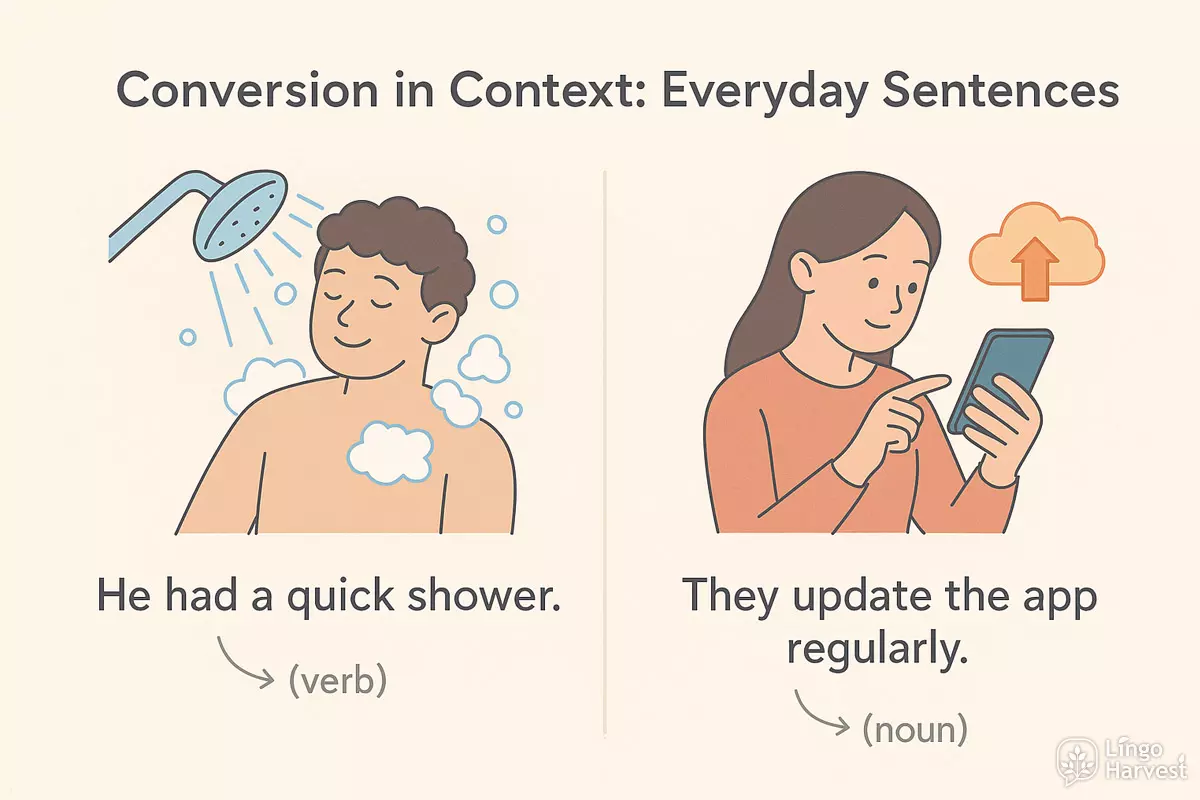
To see how this process works, here are some sample sentences:
- “Let’s table the topic.” (noun → verb)
- “He had a quick shower.” (verb → noun)
- “They update the app regularly.” (noun → verb)
- “She gave me a good look.” (verb → noun)
Patterns and Productivity
This grammatical flexibility is especially productive in English, making it easy to create new expressions on the fly. Media, technology, and slang often accelerate the adoption of new uses. For instance, “Google” became a verb almost as soon as the search engine became popular. In conversation, speakers take advantage of this by recycling familiar words in fresh ways, streamlining communication.
Summary Table: Typical Conversion Types
| Base Word | Original Role | New Role via Conversion |
|---|---|---|
| Noun (“a Google search”) | Verb (“to Google something”) | |
| Chair | Noun (“a chair”) | Verb (“to chair a meeting”) |
| Clean | Adjective (“clean clothes”) | Verb (“to clean the house”) |
| Run | Verb (“to run”) | Noun (“a quick run”) |
| Text | Noun (“a text message”) | Verb (“to text a friend”) |
In summary, the ability to shift words between grammatical categories is a hallmark of English, especially in informal and spoken contexts. This adaptability helps speakers express ideas efficiently and creatively, making the language responsive to new situations and technologies.
Typical Mistakes
When learning how English words shift from one grammatical category to another, it’s easy to stumble over certain patterns. Many learners assume that any noun can be used as a verb or vice versa, but that’s not always the case. Misunderstanding the rules of conversion can lead to awkward, unclear, or incorrect sentences.
Overgeneralizing Word Class Changes
Assuming that all nouns can become verbs, or all adjectives can turn into nouns, often results in unnatural language. For example, while "to bottle" (from "bottle") is accepted, "to table" means something specific in parliamentary language and cannot be used for all meanings of "table." Not every word can shift categories without sounding odd or being incorrect.
Confusing Meaning After Conversion
Sometimes, the meaning of a word changes subtly (or dramatically) when it moves to a new class. Learners may use the converted form expecting it to retain the original sense. For instance, "to dust" (as a verb) means to remove dust, but "to pepper" (as a verb) means to sprinkle with pepper, not to remove it.
Incorrect Forms or Collocations
Using the wrong preposition or combining a converted word with incompatible structures is another common pitfall. Some forms are fixed, and inventing new ones can lead to mistakes.
- Using "to chair" (to lead a meeting) correctly, but mistakenly saying "to desk" for working at a desk ❌
- Trying "to friend" someone (now accepted in social media), versus "to cousin" (not used)
- Saying "a run" (noun from verb) is normal, but "a swim" is only correct in specific contexts
- Confusing "to text" (send a message) with "to message" (broader use)
- Attempting "to blue" (not standard) instead of "to color blue"
- Using "a laugh" (noun from verb) properly, but inventing "a think" (not idiomatic)
- Assuming "to room" (to share a room) is the same as "to house" (to provide shelter)
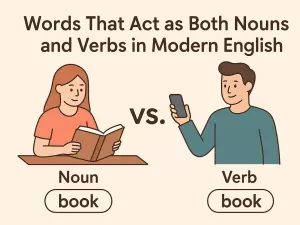
- Misapplying "to book" (to reserve) to mean "to write a book"
- Using "to ship" (send goods) versus "to car" (not used for driving)
- Saying "to Google" is now common, but "to Yahoo" is not standard
- Expecting "to bottle" (put in a bottle) and "to glass" (not used for putting into glass) to work the same way
- Forming plurals from converted nouns incorrectly ("two sleeps" for "two nights" is rare and context-dependent)
Comparison: Acceptable vs. Unacceptable Conversions
| Accepted Conversion | Unnatural/Not Used |
|---|---|
| to email (send an email) ✅ | to envelope (not used) ❌ |
| a call (noun from verb) ✅ | a cook (for the event of cooking) ❌ |
| to host (be the host) ✅ | to guest (not standard) ❌ |
| to hand (give by hand) ✅ | to foot (not used for walking) ❌ |
Summary Tips
To avoid these common traps, pay attention to established usage in authentic English contexts, check dictionaries for verb/noun forms, and remember that not every word can freely switch categories. Practice with real examples, and when in doubt, use more standard expressions.
Practice: Convert the Words
Understanding how English words shift between grammatical categories is essential for mastering flexible usage. Let’s apply your knowledge by transforming words from one part of speech to another. This will help you recognize patterns and build vocabulary.
Task 1: Noun → Verb
Try turning these nouns into verbs. Sometimes the spelling stays the same, and sometimes it changes slightly.
- hammer
- host
- paint
- shoulder
- text
- mirror
- water
Show answers
- email → to email (e.g., "I will email you")
- hammer → to hammer (e.g., "He hammered the nail")
- host → to host (e.g., "She will host the event")
- paint → to paint (e.g., "They painted the wall")
- shoulder → to shoulder (e.g., "He shouldered the responsibility")
- pocket → to pocket (e.g., "She pocketed the money")
- text → to text (e.g., "He texted his friend")
- mirror → to mirror (e.g., "Their actions mirrored ours")
- google → to google (e.g., "I googled the answer")
- water → to water (e.g., "Please water the plants")
Task 2: Verb → Noun
Convert these verbs into their noun forms. Some are identical, while others require a change.
- run
- drive
- walk
- call
- love
- jump
- plan
- visit
- reply
- move
Show answers
- run → a run (e.g., "He went for a run")
- drive → a drive (e.g., "Let's go for a drive")
- walk → a walk (e.g., "Take a walk")
- call → a call (e.g., "I received a call")
- love → love (e.g., "Love is important")
- jump → a jump (e.g., "That was a big jump")
- plan → a plan (e.g., "What's the plan?")
- visit → a visit (e.g., "His visit was short")
- reply → a reply (e.g., "She gave a quick reply")
- move → a move (e.g., "A smart move")
Task 3: Adjective → Noun
Change these adjectives into nouns that represent the quality, state, or person.
- strong
- happy
- dark
- poor
- rich
- young
- sad
- wise
- honest
- brave
Show answers
- strong → strength
- happy → happiness
- dark → darkness
- poor → poverty
- rich → richness (or "the rich" for people)
- young → youth (or "the young")
- sad → sadness
- wise → wisdom
- honest → honesty
- brave → bravery
Comparison Table: Conversion Examples
Here’s a structured look at how words can shift between categories without changing their form:
| Base Form | As a Noun | As a Verb |
|---|---|---|
| text | Send me a text. | I will text you later. |
| shoulder | He hurt his shoulder. | She shouldered the blame. |
| plan | That is a good plan. | Let's plan the trip. |
| mirror | A mirror on the wall. | Their actions mirror ours. |
| call | I missed your call. | Please call me. |
Reflect and Expand
Notice how conversion lets English speakers create new uses from familiar words. Try applying this process to new vocabulary you encounter: can you use it in a different grammatical role? This flexibility is a hallmark of English’s evolving character.