Noun Functions in a Sentence: Subject, Object, and Complement

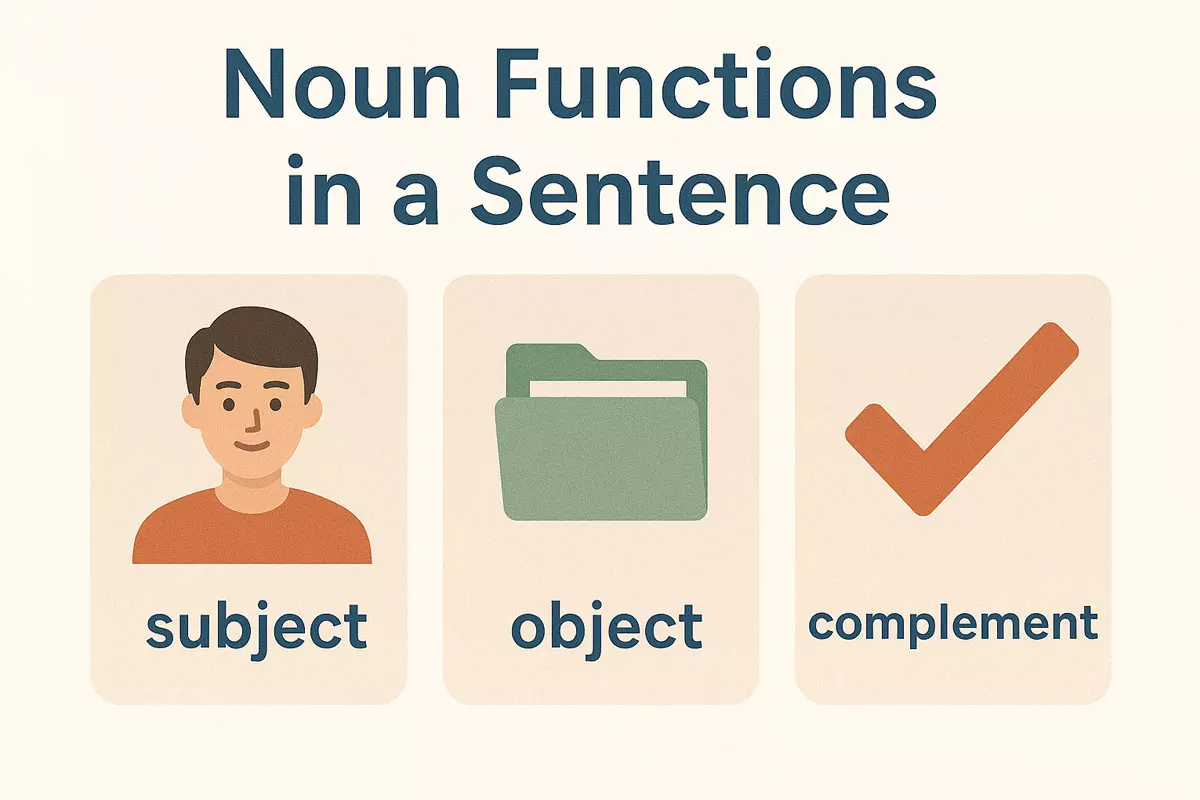 Here we the main grammatical functions of nouns, showing how they act as subjects in simple and complex clauses, serve as direct or indirect objects, and function as complements. It also discusses noun positions, common learner errors, and provides practice.
- Main grammatical functions of nouns in sentences
- How nouns work as subjects in simple and complex clauses
- Direct and indirect object roles of nouns
- What noun complements are and how they differ from objects
- Position of each noun function in common sentence patterns
- Typical learner errors with identifying noun functions
- Practice: identify and label noun functions in sentences
Have you ever considered how words that name people, places, or things serve different purposes within a sentence? These naming words, known as nouns, can act as the subject leading the action, the object receiving it, or even as complements that add essential details to complete an idea. By recognizing how nouns shift roles depending on their placement and function, you can enhance your writing skills and communicate your ideas more clearly and effectively in any context.
Main grammatical functions of nouns in sentences
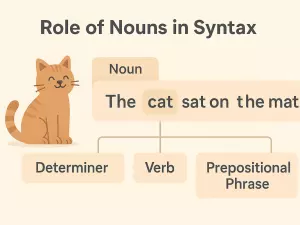
Nouns serve a range of essential roles within sentence structures, allowing us to communicate clearly about people, places, things, and ideas. Understanding how nouns function makes it easier to construct sentences that are both grammatically correct and expressive.
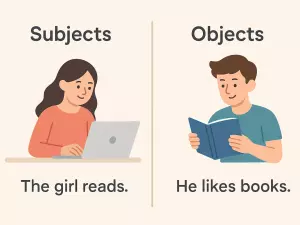
Subject: Who or what the sentence is about
The subject is typically the “doer” of the action or the main focus of the statement. In most English sentences, the subject appears before the verb.
- The cat sleeps on the sofa.
- Water boils at 100°C.
- Children love stories.
Object: Receiving the action

Objects are nouns that receive the action of the verb. They can be direct or indirect.
- Direct object: She read the book.
- Indirect object: I gave my friend a gift.
- Compound object: They saw lions and tigers.
Complement: Completing the meaning
Nouns also act as complements, providing additional information about the subject or object. There are two main types:
- Subject complement: My brother is a doctor.
- Object complement: They elected her president.
Other noun roles in sentences
Beyond subject, object, and complement, nouns can fill a variety of other grammatical positions:
- Appositive: My friend, Anna, is visiting.
- Possessive: James’s car is new.
- Object of a preposition: She sat on the chair.
- Vocative: Students, please listen.
- Adjective modifier (noun adjunct): Chicken soup is healthy.
- Gerund phrase (noun as verbal): Swimming is fun.
- Infinitive phrase (noun as verbal): To travel is my dream.
- Predicate nominative (subject complement): The winner is John.
- Predicate accusative (object complement): They named the puppy Max.
- Direct address: Mom, can you help me?
Comparison of key noun functions
| Function | Example in a sentence |
|---|---|
| Subject | Dogs bark loudly. |
| Direct Object | She painted a picture. |
| Indirect Object | He sent his mother a letter. |
| Subject Complement | The winner is a teacher. |
| Object Complement | They named him captain. |
Nouns are versatile elements in English, and their position and relationship to the verb determine their grammatical function. By recognizing these patterns, you can improve both your sentence construction and comprehension.
How nouns work as subjects in simple and complex clauses
Nouns often take center stage in sentences by serving as the main agents performing an action or being described. In both basic statements and more intricate sentence structures, the subject is almost always a noun or a noun phrase. This grammatical role is essential, as it determines what or who the sentence is about, and it directs the action of the verb.
Subjects in Simple Clauses
In a basic sentence, the subject is usually a single noun or a noun phrase that appears before the verb. These structures are direct and easy to spot:
- The train stopped.
- My neighbor laughed.
- Fresh bread smells amazing.
- Two students asked a question.
- The tall building looks impressive.
These examples show how a noun or a group of words built around a noun (noun phrase) functions as the core of a statement.
Subjects in Complex Clauses
As sentences become more elaborate, the subject can still be a noun, but it might be embedded within larger structures. For example, the subject might include modifiers, relative clauses, or even take the form of a gerund phrase. Here are some ways nouns act as subjects in complex sentences:
- The girl who won the prize is my sister.
- Finding a solution took hours.
- Whatever you decide is fine with me.
- The noise from the construction site kept us awake.
- That she passed the exam surprised everyone.
In these cases, the subject still revolves around a noun or noun-like structure but may incorporate additional descriptive or explanatory information.
Comparing Simple and Complex Subjects
| Type of Subject | Example |
|---|---|
| Single noun | Dogs bark. |
| Noun phrase | The tall man left early. |
| Gerund phrase | Swimming in cold water is challenging. |
| Clause as subject | What she said was surprising. |
| Noun with modifiers | The car parked outside belongs to Sam. |
Key Points to Remember
- The subject is often the first major noun or noun phrase in a sentence.
- Modifiers and clauses can make subjects longer, but the core remains a noun.
- Even when the subject contains verbs (as in gerunds or clauses), it still functions as a noun in the sentence structure.
- Subjects control verb agreement; a plural subject requires a plural verb, and vice versa.
Whether the sentence is simple or layered, nouns as subjects provide the anchor for meaning and clarity in communication.
Direct and indirect object roles of nouns
Nouns can serve as both direct and indirect objects within a sentence, giving structure and meaning to actions and relationships. A direct object is the receiver of the action performed by the subject, while an indirect object tells us to whom or for whom the action is done. Understanding the distinction between these two roles helps in constructing clear, effective sentences.
Direct Object: The Immediate Receiver
A noun acting as a direct object answers the question "what?" or "whom?" after the verb. It receives the action directly, as in "She found the keys." Here, "the keys" is what was found. The direct object typically comes right after the verb, unless there's an indirect object present.
- He painted the fence.
- They watched a movie.
- We lost our tickets.
- She loves chocolate.
- I met your friend yesterday.
Indirect Object: The Beneficiary or Recipient
An indirect object represents the person or thing that benefits from or receives the direct object. It answers "to whom?" or "for whom?" the action is performed. In "She gave her friend a gift," "her friend" is the indirect object—receiving the gift, which is the direct object.
- He sent his mother a letter.
- They showed us their project.
- I bought my brother a toy.
- We offered the team our support.
- She made me a sandwich.
Comparing Direct and Indirect Objects
Sometimes, both a direct and an indirect object appear together. The order can change, especially if you use a preposition (to/for), but the roles remain clear. The following table compares their typical positions and the questions they answer:
| Role | Function and Example |
|---|---|
| Direct Object | Receives the action directly She read the book. |
| Indirect Object | Receives the direct object or benefits from the action She gave her sister a book. |
| Position | Direct object comes after the verb; indirect object usually precedes the direct object (without preposition) or follows it (with preposition) He sent me a postcard. He sent a postcard to me. |
| Questions Answered | Direct: What? Whom? Indirect: To whom? For whom? |
Key Patterns to Remember
- Subject + Verb + Direct Object
The cat caught the mouse. - Subject + Verb + Indirect Object + Direct Object
Jane wrote her boss a message. - Subject + Verb + Direct Object + Preposition + Indirect Object
Jane wrote a message to her boss.
Recognizing how nouns operate in these object positions is crucial for mastering sentence structure and conveying precise meaning in writing and speech.
What noun complements are and how they differ from objects
Noun complements and objects both follow verbs or linking verbs in sentences, but their roles are distinct. Noun complements provide necessary information to complete the meaning of a subject or object, often identifying or describing it in more detail. Objects, on the other hand, receive the action of the verb directly, without necessarily describing or renaming the subject.
Understanding noun complements
A noun complement, sometimes called a subject or object complement, is a noun or noun phrase that completes the meaning of another noun. Subject complements follow linking verbs (like "be," "seem," or "become") and rename or describe the subject. For example, in "She is a doctor," the noun "doctor" is a complement that tells us what "she" is.
How objects function
Objects typically follow action verbs and answer the questions "what?" or "whom?" For instance, in "He reads books," the noun "books" is the direct object, because it receives the action of reading.
Key differences at a glance
To help clarify, here are the main contrasts:
- Noun complements follow linking verbs and provide more information about the subject or object.
- Objects follow action verbs and receive the action directly.
- Complements can rename or classify; objects do not rename, but are acted upon.
- Complements are essential for the sentence to make sense after certain verbs; objects are only necessary with transitive verbs.
Examples of noun complements vs. objects
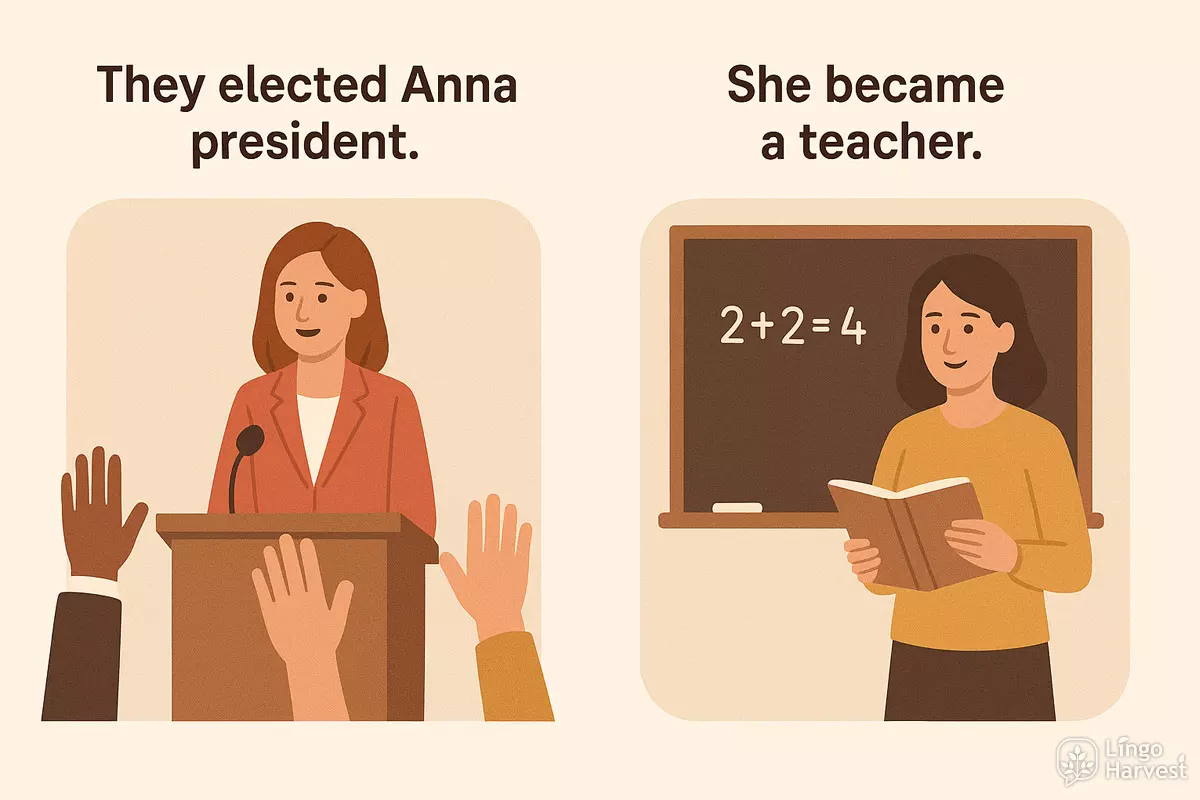
- The winner is John. (complement)
- They elected Anna president. (complement)
- She became a teacher. (complement)
- He kicked the ball. (object)
- We saw the movie. (object)
- You called me. (object)
- My favorite food is pizza. (complement)
- The class made Emily leader. (complement)
- They built a house. (object)
- He considers her a genius. (complement)
- She wrote a letter. (object)
- The sky became darkness. (complement)
Comparison: Noun Complements vs. Objects
| Feature | Noun Complement | Object |
|---|---|---|
| Typical verb type | Linking (become, seem, be) | Action (read, write, eat) |
| Function | Renames/describes subject or object | Receives action |
| Sentence necessity | Essential for meaning with linking verbs | Essential with transitive verbs |
| Example | She is a leader. | She admires her friend. |
By distinguishing between these two roles, you can write clearer sentences and better understand the structure of English grammar. Recognizing whether a noun is renaming, describing, or receiving the action will help you identify its function accurately.
Position of each noun function in common sentence patterns
Understanding where different noun roles appear within sentences is key to analyzing English structure. Nouns can act as subjects, objects (direct or indirect), or complements, and their placement often signals their function. Let's break down where these noun roles are typically found.
Subjects: The Starting Point
Subjects usually come at the very beginning of a sentence, before the verb. They perform the action or are described by the rest of the sentence. For example:
- The cat slept on the sofa.
- John is a teacher.
- Reading helps improve vocabulary.
Objects: After the Action
Objects generally follow the verb. Direct objects receive the action, while indirect objects indicate to whom or for whom the action is performed. Their position often depends on sentence structure:
- Direct object: She found the keys.
- Indirect object (before direct object): He gave Mary a gift.
- Indirect object (after direct object, with "to" or "for"): He gave a gift to Mary.
Complements: Completing the Meaning
Noun complements provide additional information about the subject or object. Subject complements follow linking verbs and refer back to the subject, while object complements follow and modify the object.
- Subject complement: My brother is a doctor.
- Object complement: They elected her president.
Common Sentence Patterns for Noun Functions
The table below summarizes where each type of noun function typically appears in familiar English sentence structures.
| Sentence Pattern | Typical Noun Function Positions |
|---|---|
| Subject + Verb (S + V) | Subject noun at the beginning Example: Birds fly. |
| Subject + Verb + Object (S + V + O) | Subject noun at the start; direct object noun after verb Example: She reads books. |
| S + V + Indirect Object + Direct Object (S + V + IO + DO) | Subject noun first, indirect object noun before direct object Example: He sent his friend a letter. |
| S + Linking Verb + Subject Complement (S + LV + SC) | Subject noun first, subject complement noun after linking verb Example: Anna became a doctor. |
| S + V + Object + Object Complement (S + V + O + OC) | Subject noun, then direct object noun, then object complement noun Example: They named the baby Oliver. |
Quick Reference: Typical Placements
- Subjects: always before the main verb
- Direct objects: directly after action verbs
- Indirect objects: before or after direct objects (with or without a preposition)
- Subject complements: after linking verbs (is, become, seem, etc.)
- Object complements: after direct objects, especially with verbs like “name,” “make,” “consider”
Recognizing these positions helps you identify the role each noun plays, making sentence analysis and construction much easier.
Typical learner errors with identifying noun functions
Many English learners run into trouble when trying to recognize how nouns work in a sentence. Problems often arise from confusing similar sentence elements or misunderstanding word order, especially in longer or more complex sentences. Below, we’ll look at some frequent pitfalls and misconceptions, along with practical examples to clarify the distinctions.
Mixing up subject and object
A common mistake is swapping the subject and object, particularly when both are nouns. Learners may assign the wrong function based on position or misunderstanding the verb’s direction.
- Incorrect: The ball kicked the boy. (Instead of: The boy kicked the ball.)
- Incorrect: She was given by the present. (Instead of: She was given the present.)
Misidentifying complements
Identifying noun complements can be tricky, especially with linking verbs like be, seem, or become. Learners sometimes confuse complements with objects, or assume every noun after a verb is an object.
- After linking verbs, the noun is a complement, not an object: She is a teacher.
- After action verbs, the noun is usually an object: She reads a book.
Confusing direct and indirect objects
Some students have trouble telling apart direct and indirect objects, especially in sentences with both. The order of objects or the use of prepositions like to and for can cause confusion.
| Sentence | Direct Object / Indirect Object |
|---|---|
| He gave her a book. | Direct: a book / Indirect: her |
| She sent the company an email. | Direct: an email / Indirect: the company |
| They made me a cake. | Direct: a cake / Indirect: me |
| We showed them the way. | Direct: the way / Indirect: them |
Other frequent errors and misconceptions
- Assuming any noun after a verb is automatically the object.
- Overlooking noun phrases or gerunds as subjects or objects.
- Forgetting that questions can invert the noun’s position: What did she buy?
- Mistaking prepositional objects (after prepositions) for direct objects: He listened to music.
- Missing compound nouns as a single unit: My English teacher is kind.
- Ignoring appositive nouns, which rename or explain another noun: My friend, Alex, loves chess.
- Confusing possessive nouns with objects: John’s car is red.
- Not recognizing implied subjects in commands: (You) Sit down.
- Believing every noun is essential to the sentence’s meaning (overlooking optional or parenthetical nouns).
- Failing to spot when a noun functions as both subject and object in reflexive constructions: He hurt himself.
Awareness of these typical stumbling blocks helps learners analyze sentences more confidently and accurately. Practice with diverse sentence structures, and pay attention to the role each noun plays—this is key to mastering sentence analysis.
Practice: identify and label noun functions in sentences
Understanding how nouns work in a sentence is easier with hands-on exercises. Below, you'll find a variety of examples and short activities to help you recognize when a noun acts as a subject, object, or complement. Try to spot the noun and its function in each sentence before checking the answers.
Task 1: Find the Noun and Its Role
Read each sentence and decide which word is the noun. Then, determine if it serves as the subject, object, or a complement.
- The dog barked loudly.
- She gave her friend a present.
- My favorite food is pizza.
- We visited the museum yesterday.
- The winner was John.
- They built a bridge over the river.
- Her dream is to become a doctor.
- The book on the table belongs to me.
- He considers Mary his best friend.
- The children played in the park.
Show answers
- dog – subject
- friend – indirect object
- pizza – subject complement
- museum – direct object
- John – subject complement
- bridge – direct object
- doctor – subject complement
- book – subject
- best friend – object complement
- children – subject
Common Patterns and Clues
Here are some typical structures you’ll encounter when analyzing noun roles:
- Subject: Usually comes before the verb. Example: Cats sleep a lot.
- Direct Object: Follows an action verb. Example: She reads a book.
- Indirect Object: Comes before the direct object, usually receiving something. Example: He gave his teacher a note.
- Subject Complement: Comes after linking verbs (is, are, was, etc.), renaming or describing the subject. Example: My brother is a student.
- Object Complement: Follows and modifies the object. Example: They elected her president.
Quick Practice: Identify Noun Functions
Match each noun to its function in the following sentences:
- The cake tastes delicious.
- I met an old friend at the market.
- Our team made Emily the captain.
- The movie was exciting.
- Please hand the keys to your father.
- The weather changed suddenly.
- She bought a new jacket yesterday.
- They elected Mark the leader.
- The lesson seemed easy.
- He placed the book on the shelf.
Show answers
- cake – subject
- friend – direct object
- captain – object complement
- movie – subject
- keys – direct object
- weather – subject
- jacket – direct object
- leader – object complement
- lesson – subject
- book – direct object
Summary Table: Noun Functions and Examples
| Function | Example Sentence |
|---|---|
| Subject | The cat sleeps on the sofa. |
| Direct Object | She opened the window. |
| Indirect Object | He sent his mother a letter. |
| Subject Complement | Her favorite color is blue. |
| Object Complement | They named the puppy Max. |
When analyzing sentences, focus on the position of the noun and the verbs it interacts with. This approach will help you accurately label each noun’s role, leading to a clearer understanding of sentence structure.