Nouns as Subjects and Objects

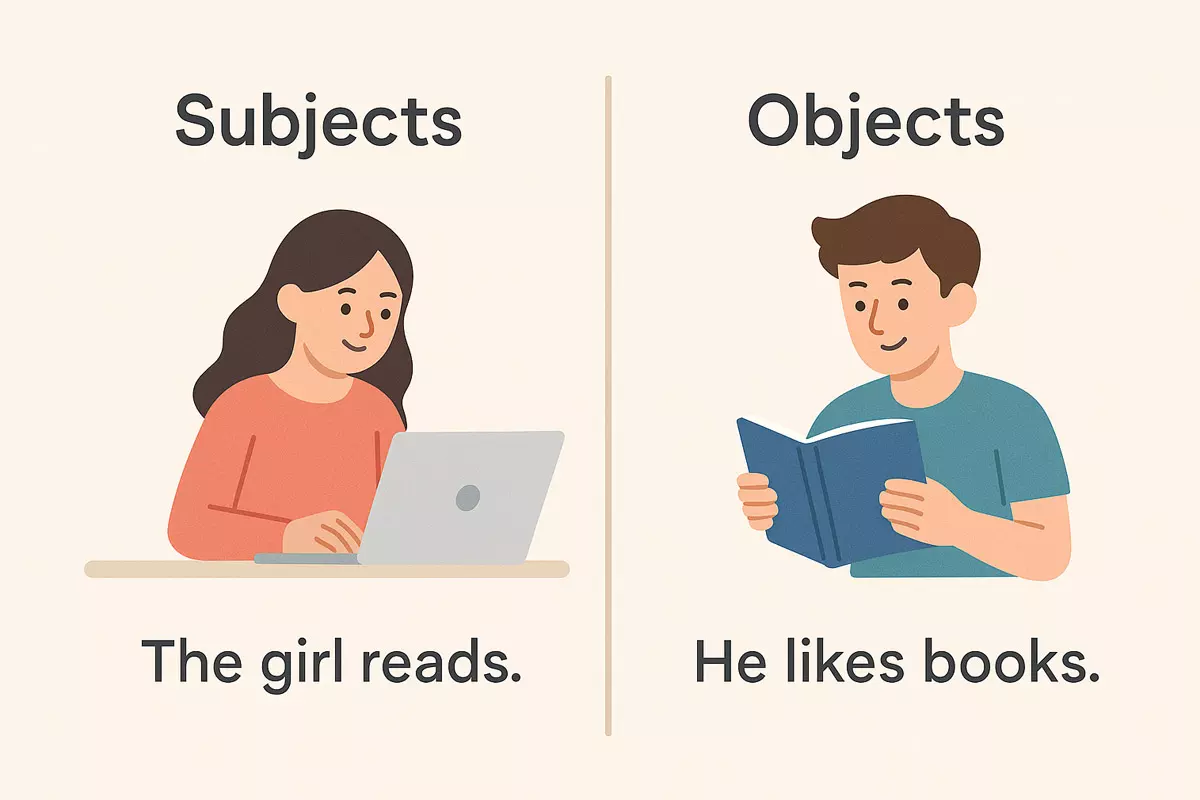 Here we how nouns function as subjects and both direct and indirect objects in sentences, explains noun phrases and word order, highlights common learner mistakes, and provides practice identifying subjects and objects in everyday English.
Every sentence requires a subject or object to perform or receive an action, and this is where nouns, or naming words, play a vital role. By recognizing how nouns function in various positions within a sentence, you can enhance both the clarity and engagement of your writing. Mastering the use of these essential parts of speech helps you construct more effective sentences, ensuring that your ideas are communicated precisely and your writing remains interesting for your readers.
Sentence Parts: Subject and Object
Understanding how nouns function in sentences is essential for building clear and grammatically correct statements. In English, nouns often act as either the subject (the doer of the action) or the object (the receiver of the action). Recognizing these roles helps you identify who is performing an action and who or what is affected by it.
What Is a Subject?
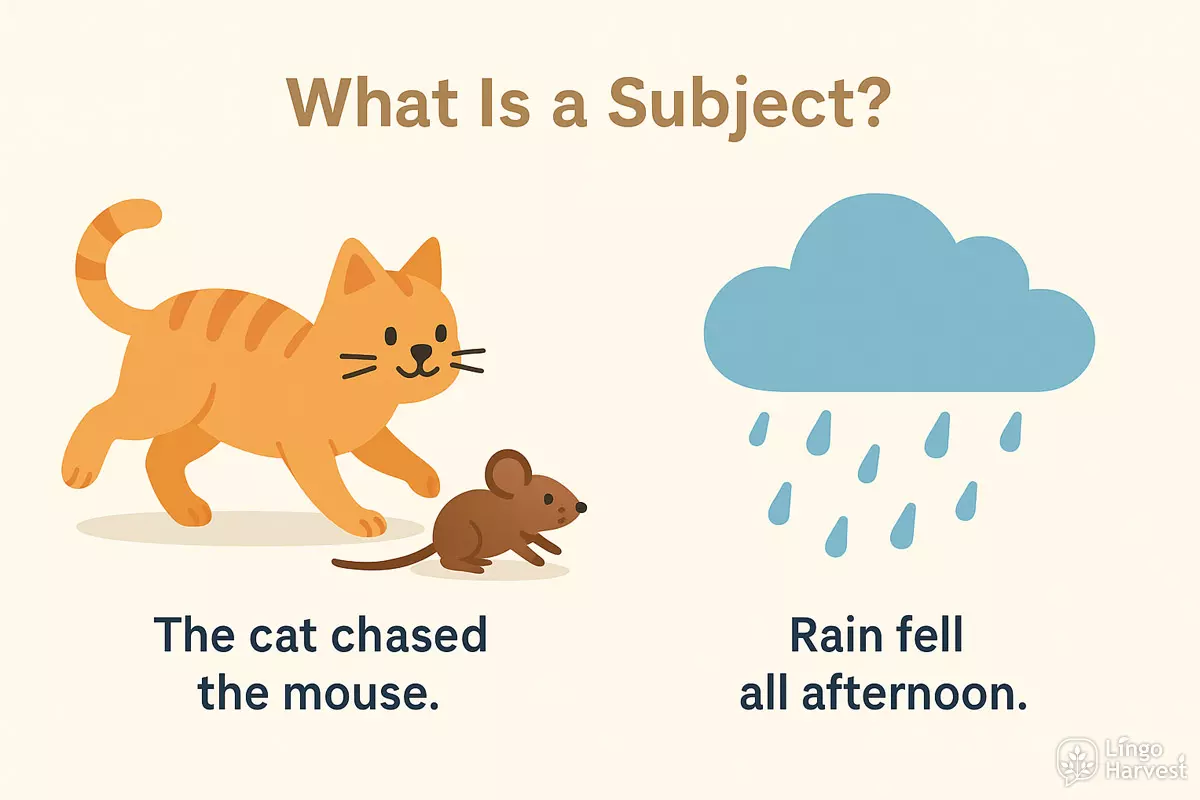
The subject is typically the noun or pronoun that performs the action in a sentence. It usually appears at the beginning and answers the question, "Who or what is doing something?" For example:
- The cat chased the mouse.
- Lisa reads books every night.
- Rain fell all afternoon.
What Is an Object?
Objects receive the action of the verb. There are two main types: direct objects (which answer "what?" or "whom?") and indirect objects (which answer "to whom?" or "for whom?"). For example:
- The cat chased the mouse. (direct object)
- Lisa gave her friend a gift. (her friend is the indirect object, a gift is the direct object)
- He built a sandcastle.
Comparing Subjects and Objects
To see how nouns switch roles between doing and receiving actions, compare these examples:
| Subject (Doer) | Object (Receiver) |
|---|---|
| Children play games. | The teacher praised the children. |
| Wind shakes trees. | We admire the trees. |
| Doctors help patients. | The hospital employs many doctors. |
| Books inspire readers. | She donated books to the library. |
| Lights brighten rooms. | We cleaned all the rooms. |
Quick Tips for Identifying Subjects and Objects
- Ask "Who/what is doing the action?" to find the subject.
- Ask "Who/what is affected by the action?" to find the object.
- Nouns can serve as either, depending on sentence structure.
- Subjects usually come before the verb; objects follow it.
- Some sentences have both direct and indirect objects.
Grasping the roles of nouns in these positions makes it easier to construct sentences and spot errors. By practicing with a variety of examples, you’ll gain confidence in recognizing and using subjects and objects correctly.
How Nouns Function as Subjects
Nouns play a crucial role in sentence structure by acting as the main actors or "doers" of actions. In English, a noun or noun phrase typically appears at the beginning of a sentence, identifying what or who is performing the verb. This position is called the subject position, and it helps readers or listeners quickly understand the focus of the statement.
Subject Position in Sentences
The subject usually comes before the main verb. For example, in "Cats sleep on the sofa," the noun "cats" takes the subject position and tells us who is sleeping. Both concrete nouns (like "dog," "tree," "car") and abstract nouns (like "freedom," "happiness," "information") can fill this role.
Types of Nouns Used as Subjects
Almost any noun can be used as a subject, including:
- Common nouns: Students study every day.
- Proper nouns: Maria travels often.
- Collective nouns: The team celebrates together.
- Abstract nouns: Patience is a virtue.
- Compound nouns: Toothpaste is in the drawer.
- Gerunds (noun forms of verbs): Swimming relaxes me.
- Infinitives used as nouns: To read is to grow.
- Noun phrases: The tall man in the hat waved.
- Pronouns (as noun substitutes): They arrived early.
- Mass nouns: Water boils at 100°C.
Examples of Subjects in Context
To illustrate how different nouns can serve as the subject, here are several examples:
- The sun rises in the east.
- Friendship lasts a lifetime.
- Books open new worlds.
- My neighbor's dog barks at night.
- Ice cream melts quickly.
- They finished the project.
- Hiking keeps you fit.
- The committee meets monthly.
- Music soothes the soul.
- Honesty builds trust.
- John and Lisa are planning a trip.
- That old bridge needs repairs.
Key Points to Remember
- A noun in the subject role is usually the "who" or "what" of the sentence.
- Subjects must agree with their verbs in number (singular/plural).
- Subject nouns can be singular ("The student learns") or plural ("The students learn").
- Complex noun phrases can also act as the subject, not just single words.
Comparing Subject Nouns and Objects
| Role in Sentence | Example |
|---|---|
| Subject Noun | The dog barked. |
| Object Noun | She fed the dog. |
| Compound Subject | John and Mary laughed. |
| Subject Pronoun | They arrived early. |
Understanding how nouns operate as the central focus of a clause helps build clear and effective sentences. Recognizing the subject role is essential for mastering sentence structure and ensuring agreement between nouns and verbs.
How Nouns Function as Direct Objects
Nouns frequently appear as the receivers of an action, filling the grammatical role known as the direct object. In a sentence, a direct object answers the question "what?" or "whom?" after an action verb. This role is essential for providing detail and clarity about what the subject is affecting or interacting with. Take the sentence, "The cat chased the mouse." Here, "the mouse" is the noun directly impacted by the verb "chased."
Identifying Direct Objects in Sentences
To spot a direct object, look for a noun or noun phrase that follows an action verb and completes its meaning. The process involves:
- Locating the action verb
- Asking "what?" or "whom?" after the verb
- Finding the noun that answers this question
Common Patterns and Examples
Direct objects can be single words, phrases, or even clauses. Here are some typical structures and examples:
- She reads books.
- We built a sandcastle.
- They invited their friends.
- He found the answer.
- The teacher explained the lesson.
- Maria painted a landscape.
- Children collected shells.
- The chef prepared the meal.
- I lost my keys.
- You finished your homework.
- She remembered the story.
- We watched a movie.
- He adopted a puppy.
- They bought groceries.
- The dog fetched the ball.
- My friend solved the puzzle.
- The artist sketched a portrait.
- Workers repaired the road.
- She wrote a letter.
- He ate an apple.
Direct Objects vs. Other Sentence Elements
It’s important to distinguish direct objects from indirect objects and complements. The direct object is always the primary receiver of the verb’s action, while indirect objects (if present) benefit from or are affected by the action. For example, in "She gave her friend a gift," "a gift" is the direct object, and "her friend" is the indirect object.
| Sentence | Direct Object (Noun) |
|---|---|
| The dog chased the ball. | the ball |
| Lisa baked a cake. | a cake |
| They visited the museum. | the museum |
| John opened the window. | the window |
| We heard music. | music |
| She bought flowers. | flowers |
| The team won the match. | the match |
| I remembered the answer. | the answer |
Understanding the function of nouns in this grammatical slot helps clarify sentence meaning and structure. Mastering this concept allows you to write and interpret sentences with greater precision.
Indirect Objects and Noun Phrases
In English sentences, the indirect object often refers to the recipient or beneficiary of an action. Unlike direct objects, which receive the verb’s action directly, indirect objects tell us to whom or for whom something is done. This role is commonly filled by a noun or noun phrase, and understanding how these function within different sentence patterns is key to parsing and constructing clear statements.
How Indirect Objects Work
Indirect objects usually appear before the direct object when no preposition is used, and after the direct object when introduced by “to” or “for.” For example: “She gave her friend a gift” (no preposition), versus “She gave a gift to her friend.” Both sentences convey the same meaning, but the position and structure of the noun phrase shifts.
- He sent his parents a letter.
- He sent a letter to his parents.
- The teacher showed the students a video.
- The teacher showed a video to the students.
- We baked Grandma a cake.
- We baked a cake for Grandma.
- She bought her brother a ticket.
- She bought a ticket for her brother.
- They offered the guests some tea.
- They offered some tea to the guests.
Noun Phrase Structure in Indirect Objects
A noun phrase acting as an indirect object can be as simple as a single noun (“children”) or more complex, including determiners, adjectives, and modifiers (“the excited young children from next door”). The flexibility of noun phrases allows for precise and vivid communication about who is affected by the action.
| Sentence Pattern | Indirect Object Example | Direct Object Example | With Preposition? |
|---|---|---|---|
| Subject + Verb + IO + DO | the manager | an answer | ❌ |
| Subject + Verb + DO + to IO | to the manager | an answer | ✅ |
| Subject + Verb + IO + DO | our neighbors | an invitation | ❌ |
| Subject + Verb + DO + for IO | for our neighbors | an invitation | ✅ |
Choosing between prepositional and non-prepositional forms often depends on clarity, emphasis, or style. Both forms are grammatically correct, but some verbs only allow one structure. Recognizing these patterns helps in both writing and comprehension.
Word Order and Noun Position
In English sentences, the arrangement of nouns as subjects and objects is crucial for conveying clear meaning. Typically, the subject comes before the verb, while the object follows the verb. This standard sequence helps listeners and readers immediately identify who is performing the action and who or what receives it.
Basic Patterns
The most common pattern is Subject–Verb–Object (SVO). For example:
- The cat (subject) chased (verb) the mouse (object).
- Children (subject) love (verb) stories (object).
This arrangement is especially important in English, where word order often determines grammatical roles, unlike languages that use case endings.
Variations and Emphasis
Sometimes, writers or speakers may change the usual noun arrangement for emphasis or style. For example:
- Stories the children love. (Object fronted for emphasis)
- Rarely do students forget their homework. (Subject follows verb in questions or for emphasis)
Passive voice also alters noun position: the object of an active sentence becomes the subject in the passive form.
| Active Voice | Passive Voice |
|---|---|
| The chef cooked the meal. | The meal was cooked by the chef. |
| The dog bit the man. | The man was bitten by the dog. |
| Scientists discovered the cure. | The cure was discovered by scientists. |
| She reads the book. | The book is read by her. |
Examples of Noun Placement
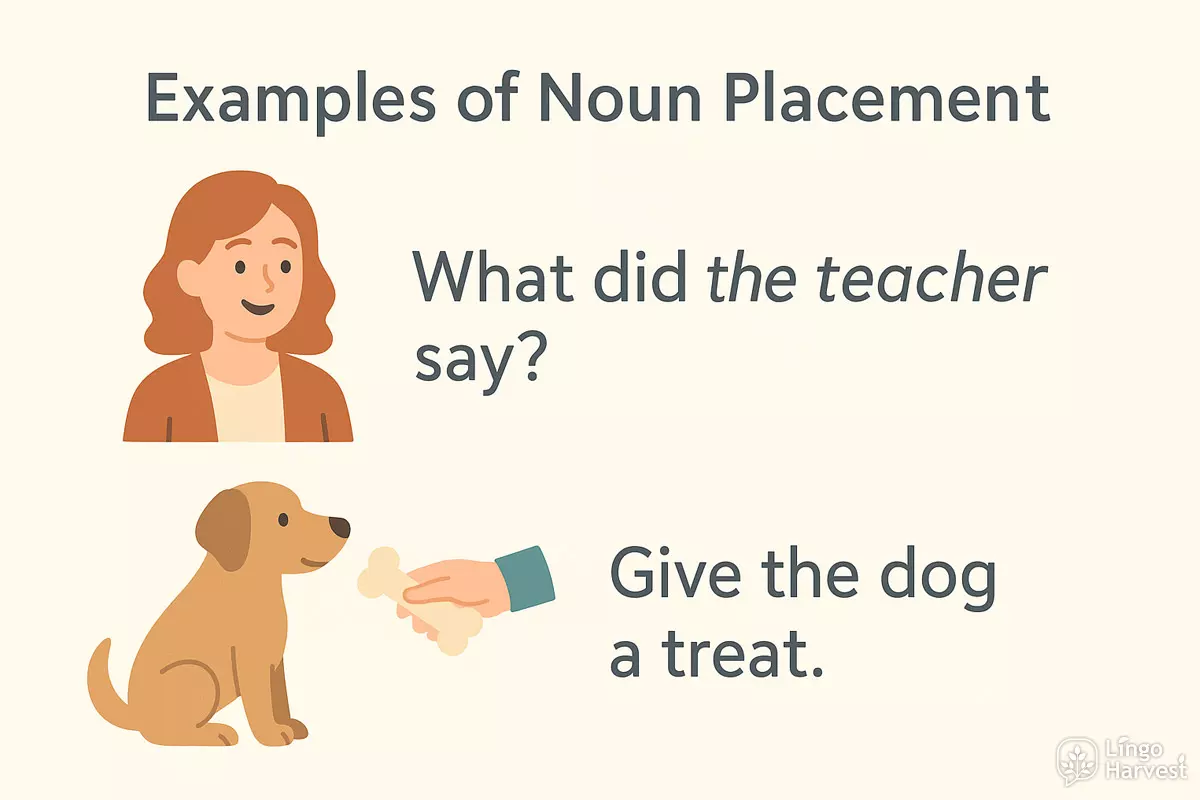
Placement can also shift in questions, commands, and exclamations. Here are additional ways nouns appear:
- What did the teacher say? (Subject after auxiliary)
- Give the dog a treat. (Object after verb in imperative)
- How quickly the team won!
- There is an apple on the table. ("There is" construction)
- Under the bed slept a cat. (Inversion for style)
- It was John who broke the vase. (Cleft sentence for focus)
- Never have they seen such a storm.
- On the wall hangs a picture.
- Who did she meet?
- Tell me the truth.
Understanding how subjects and objects are arranged enhances both comprehension and expression in English. Noticing these patterns will help you construct clearer, more effective sentences.
Examples from Everyday English
Every day, we see nouns playing different roles in sentences: sometimes they’re the focus of the action, and other times they receive the action. Let’s look at how this works in practical situations.
Common Sentences with Nouns as Main Actors
Nouns often act as the “doers” in our sentences. Here are some clear instances where a noun is the subject:
- The dog barked loudly.
- Children play in the park.
- My friend called me yesterday.
- Rain fell all night.
- The students finished the project.
When Nouns Take the Action: Object Examples
Nouns also frequently receive the action. Here are sample sentences where a noun is the object:
- She read a book.
- The teacher praised the class.
- We saw fireworks.
- He bought groceries this morning.
- They invited their neighbors.
Comparing Subjects and Objects in Sentences
Sometimes, the same noun can be a subject in one sentence and an object in another. Here’s a structured comparison to clarify how their positions change:
| Noun as Subject | Noun as Object |
|---|---|
| The cat chased the mouse. (“The cat” is the subject) |
The dog chased the cat. (“The cat” is the object) |
| John loves music. (“John” is the subject) |
Everyone admires John. (“John” is the object) |
| Cars pollute the air. (“Cars” is the subject) |
We washed the cars. (“Cars” is the object) |
| Birds sing every morning. (“Birds” is the subject) |
She feeds the birds. (“Birds” is the object) |
Quick Tips for Identifying Subjects and Objects
- Ask “Who or what does the action?” to find the subject.
- Ask “Who or what receives the action?” to spot the object.
- Subjects usually come before the verb; objects come after.
- Not every sentence has an object, but every complete sentence has a subject.
By observing these patterns in daily conversations and written texts, you’ll get a better sense of how nouns shift roles depending on sentence structure.
Frequent Learner Problems
Understanding how nouns function as subjects and objects can be tricky for language learners, especially when moving between languages with different sentence structures. Many struggle to clearly identify which noun is doing the action and which is receiving it, particularly when word order changes or pronouns are involved.
Common Mistakes and Confusions
- Mixing up subject and object position: Swapping the order of nouns, especially in questions or passive constructions.
- Incorrect pronoun usage: Using subject forms (e.g., “he”) where object forms (e.g., “him”) are needed, and vice versa.
- Omitting the subject: Leaving out the noun that should perform the action, especially in informal speech.
- Using the wrong case: In languages with case markings, choosing the wrong noun form for subject or object roles.
- Confusing direct and indirect objects: Not distinguishing between the recipient and the thing being acted upon.
- Misidentifying the verb’s target: Attaching the action to the wrong noun, leading to sentences that don’t make sense.
- Word order errors: Placing the subject or object out of the expected position, making the sentence unclear.
- Overusing passive voice: Avoiding active constructions, which can obscure who is doing what.
- Misinterpreting context clues: Failing to use surrounding words or sentence logic to figure out noun roles.
- Problems with complex sentences: Getting lost in sentences with multiple clauses or embedded structures.
Examples: Subject vs. Object Confusion
Here are some sentence pairs that highlight frequent mix-ups. Understanding who is acting and who is affected is key:
- She loves him → He loves her (subject and object swap)
- The dog chased the cat → The cat chased the dog
- John gave Mary a book (John = subject, Mary = indirect object, book = direct object)
- The teacher helped the students (teacher = subject, students = object)
- I saw her (I = subject, her = object)
- They invited us (they = subject, us = object)
- The ball hit me (ball = subject, me = object)
- My friend called me (friend = subject, me = object)
- We heard the music (we = subject, music = object)
- The movie surprised them (movie = subject, them = object)
Subject and Object Pronouns: Quick Reference
| Subject Pronoun | Object Pronoun |
|---|---|
| I | me |
| you | you |
| he | him |
| she | her |
| it | it |
| we | us |
| they | them |
Paying attention to these patterns, and double-checking which noun is performing the action, will help avoid common errors. Practice with varied sentence structures is the best way to build confidence and accuracy.
Practice: Identify Subjects and Objects
Understanding how nouns function within a sentence is essential for mastering grammar. Below, you’ll find exercises that focus on spotting which nouns act as the "doers" (subjects) and which receive the action (objects). This will help reinforce your ability to break down sentences and see their structure more clearly.
Task 1: Find the Subject and Object in Each Sentence
Read each sentence carefully. Decide which noun is the subject (the noun performing the action) and which is the object (the noun receiving the action). Write your answers as: Subject – Object.
- The cat chased the mouse.
- Maria reads books every night.
- Teachers help students learn.
- The storm damaged the roof.
- My friend sent me a postcard.
Show answers
- Subject: cat – Object: mouse
- Subject: Maria – Object: books
- Subject: Teachers – Object: students
- Subject: storm – Object: roof
- Subject: friend – Object: postcard
Task 2: Multiple Nouns—Who Does What?
Some sentences include more than two nouns. Identify all the subjects and objects. If there is an indirect object (who receives the object), include it as well.
- The chef cooked the guests a delicious meal.
- Emma gave her brother a gift.
- Our neighbors offered us fresh apples.
- The librarian handed the child a book.
- David told his friends a funny story.
Show answers
- Subject: chef – Indirect Object: guests – Direct Object: meal
- Subject: Emma – Indirect Object: brother – Direct Object: gift
- Subject: neighbors – Indirect Object: us – Direct Object: apples
- Subject: librarian – Indirect Object: child – Direct Object: book
- Subject: David – Indirect Object: friends – Direct Object: story
Common Subject and Object Nouns: Examples in Context
Here is a list of sentences demonstrating various nouns as subjects and objects. Use these for extra practice or inspiration for writing your own.
- The dog fetched the ball.
- Anna painted a picture.
- The wind shook the trees.
- Children love ice cream.
- My uncle built a house.
- The artist drew a portrait.
- Birds eat worms.
- Lisa mailed a letter.
- Tom kicked the football.
- The machine prints documents.
- The doctor examined the patient.
- People watch movies.
- The sun warms the earth.
- Grandma baked cookies.
- Students solve problems.
- We visited the museum.
Summary Table: Subjects and Objects in Sample Sentences
| Sentence | Subject | Object |
|---|---|---|
| The teacher explains the lesson. | teacher | lesson |
| Sarah waters the plants. | Sarah | plants |
| The dog found a bone. | dog | bone |
| John repaired the car. | John | car |
| The computer displays images. | computer | images |
By practicing with these varied examples and exercises, you will become more confident in identifying the roles nouns play in different sentence structures.