Predicate Nouns with Linking Verbs Explained with Examples

 Here we what predicate nouns are in English grammar, how they work with linking verbs, which linking verbs are common, how they differ from direct objects, rules for agreement, typical learner mistakes, and practice with sentences.
- What predicate nouns are in English grammar
- Role of linking verbs with predicate nouns
- Common linking verbs used with predicate nouns
- Difference between predicate nouns and direct objects
- Agreement between subject and predicate noun
- Frequent learner mistakes with linking verb structures
- Practice: complete sentences using predicate nouns correctly
Have you ever wondered how certain words in a sentence help identify or rename the subject? When nouns follow linking verbs, they act as subject complements, offering additional details about the subject. Understanding how to use these complements can make your sentences clearer and more expressive by adding important information. This article explains how subject complements work, why they matter, and provides examples to help you improve your writing skills and communicate more effectively.
What predicate nouns are in English grammar
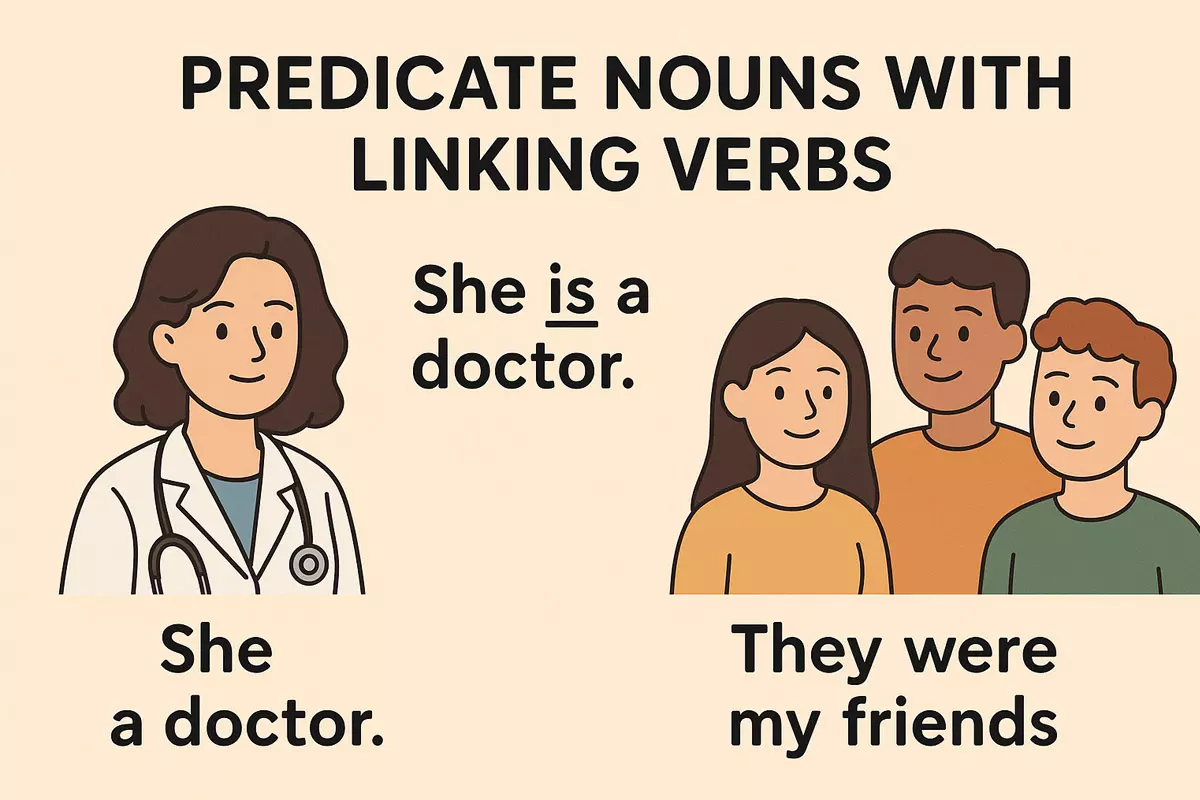
A predicate noun, sometimes called a predicate nominative, is a noun or pronoun that follows a linking verb and identifies, renames, or explains the subject of the sentence. Instead of showing action, it gives more information about who or what the subject is. The most common linking verb used with these nouns is be (am, is, are, was, were), but others like become and seem can also appear.
The role of a predicate noun is to provide a second name or label for the subject, not just to describe it (which is what predicate adjectives do). For example, in the sentence “My brother is a doctor,” the word doctor is a predicate noun because it tells us what “my brother” is.
How predicate nouns function in a sentence
Predicate nouns always follow linking verbs, not action verbs. They are essential for equating the subject with another noun or pronoun. Here are some characteristics:
- They come after linking verbs, such as is, are, was, were, become, seem.
- They answer questions like “Who is the subject?” or “What is the subject?”
- They never follow an action verb.
- They can be singular or plural, depending on the subject.
- They rename or identify the subject, not describe it.
Common examples of predicate nouns

Here are some typical cases where predicate nouns appear in everyday English:
- Sarah is a teacher.
- The winner was John.
- His dream became reality.
- The capital of France is Paris.
- You are my friend.
- This animal is a mammal.
- He became a leader.
- That building is a museum.
- She will be the manager.
- The best option seems the train.
- Our neighbors are artists.
- The answer was a surprise.
Predicate nouns vs. predicate adjectives
It’s easy to confuse predicate nouns with predicate adjectives. While both follow linking verbs, they serve different purposes. Predicate nouns rename or identify the subject, whereas predicate adjectives describe it.
| Predicate Noun | Predicate Adjective |
|---|---|
| She is a scientist. | She is curious. |
| That animal became a pet. | That animal became friendly. |
| This book was a bestseller. | This book was popular. |
| He will be the president. | He will be responsible. |
Recognizing predicate nouns helps clarify sentence structure and meaning, especially when distinguishing between naming and describing the subject. This understanding is key to mastering sentences with linking verbs in English.
Role of linking verbs with predicate nouns
Linking verbs act as bridges in sentences, connecting the subject to a noun that provides more information about it. Instead of showing action, these verbs help describe or identify the subject by joining it to a predicate noun, also known as a predicate nominative. This structure is common when you want to state what someone or something is, rather than what they do.
How linking verbs function with predicate nouns
When a linking verb appears before a predicate noun, it signals that the noun is renaming or classifying the subject. This setup is essential for making statements of identity, profession, category, or status. For example, in "Sarah is a teacher," the verb "is" links "Sarah" to "teacher," identifying her occupation.
Common linking verbs used with predicate nouns
- am → I am tired after work.
- is → She is very confident.
- are → They are ready to leave.
- was → He was nervous before the exam.
- were → We were happy with the results.
- be → Try to be honest with yourself.
- being → She is being very polite today.
- been → I have been busy all morning.
- become → He became a doctor last year.
- seem → This task seems difficult.
- appear → She appears calm despite the stress.
- remain → The door remained closed.
- turn → The sky turned dark suddenly.
- grow (linking) → He grew impatient while waiting.
- stay → Please stay quiet during the movie.
- feel (linking) → I feel confident about the test.
Patterns and examples
Linking verbs always come between the subject and the noun that completes the meaning. Here are some patterns you might encounter:
- Subject + linking verb + predicate noun
- John is a student.
- The winner was Maria.
- My dream became reality.
- This seems a mistake.
- Their idea remains a mystery.
- He turned a hero overnight.
- The leader grew a legend in his community.
- That stays a secret.
Comparison of linking verbs and action verbs
It's important to distinguish between verbs that connect and those that show action. Linking verbs do not describe an action performed by the subject; instead, they connect the subject to more information. Some verbs can serve as both, depending on context.
| Verb | Linking Example | Action Example |
|---|---|---|
| is | She is a doctor. | ❌ (never action) |
| grow | He grew a leader. | She grew tomatoes. |
| turn | The sky turned a vivid orange. | He turned the page. |
| feel | It feels a challenge. | I feel the fabric. |
Understanding this connection helps clarify why certain nouns follow linking verbs and how they serve to identify or describe the subject in more detail. This structure is fundamental in English for expressing definitions, categories, and states of being.
Common linking verbs used with predicate nouns
Linking verbs are essential for connecting the subject of a sentence to a word or phrase that describes or renames it, often called a predicate noun. These verbs do not show action; instead, they serve as bridges between the subject and additional information about the subject.
Typical linking verbs in English
Some verbs are frequently used to link subjects to predicate nouns. The most common is "to be" in its various forms, but several others can also serve this purpose. Here’s a list of verbs that commonly function as connectors in such sentences:
- prove → The plan proved successful.
- sound → That idea sounds reasonable.
- feel → I feel ready for the test.
- look → She looks confident today.
- taste → The soup tastes salty.
- smell → The room smells fresh.
- stay → Please stay calm.
- keep → He kept silent during the meeting.
- become → The weather became colder.
- end up → They ended up friends.
- turn out → The story turned out true.
- come across → He came across nervous.
- fall → She fell ill last week.
- get → He got angry quickly.
- go → The milk went sour.
Examples in sentences
To illustrate how these verbs work, look at the following sentences. The linking verb is in bold, and the predicate noun is italicized:
- She is a doctor.
- They became friends.
- This seems the solution.
- He remained president for two terms.
- The winner was Sam.
- The flower grew a tree.
Comparing forms of "to be" as linking verbs
The verb "to be" is by far the most versatile and frequently used linking verb. It changes form depending on tense and subject. Here’s a summary of its main forms:
| Form | Example with Predicate Noun |
|---|---|
| am | I am a teacher. |
| is | She is the leader. |
| are | They are students. |
| was | He was a pilot. |
| were | We were champions. |
| be | Let this be a lesson. |
Key points to remember
- Linking verbs do not show action; they connect the subject to a noun or adjective.
- The verb "to be" in all its forms is the most frequent bridge between subjects and predicate nouns.
- Other verbs like "become," "seem," and "remain" can also link subjects to predicate nouns, but are less common.
Understanding which verbs can serve as connectors helps you construct clear, grammatically correct sentences that provide more information about the subject.
Difference between predicate nouns and direct objects
Understanding how predicate nouns and direct objects function helps clarify sentence structure. Both are nouns, but their roles differ based on the verb and the relationship to the subject.
A predicate noun (also called a predicate nominative) follows a linking verb and renames or identifies the subject. In contrast, a direct object receives the action of an action verb. The main distinction lies in the type of verb used and the noun’s connection to the subject.
How to tell them apart
- Predicate nouns follow linking verbs like is, are, was, were, become, seem.
- Direct objects follow action verbs such as eat, write, play, see.
- Predicate nouns describe or rename the subject; direct objects answer "what?" or "whom?" after the verb.
Examples for comparison
- She is a teacher. (teacher = predicate noun; describes "she")
- She teaches students. (students = direct object; receives the action "teaches")
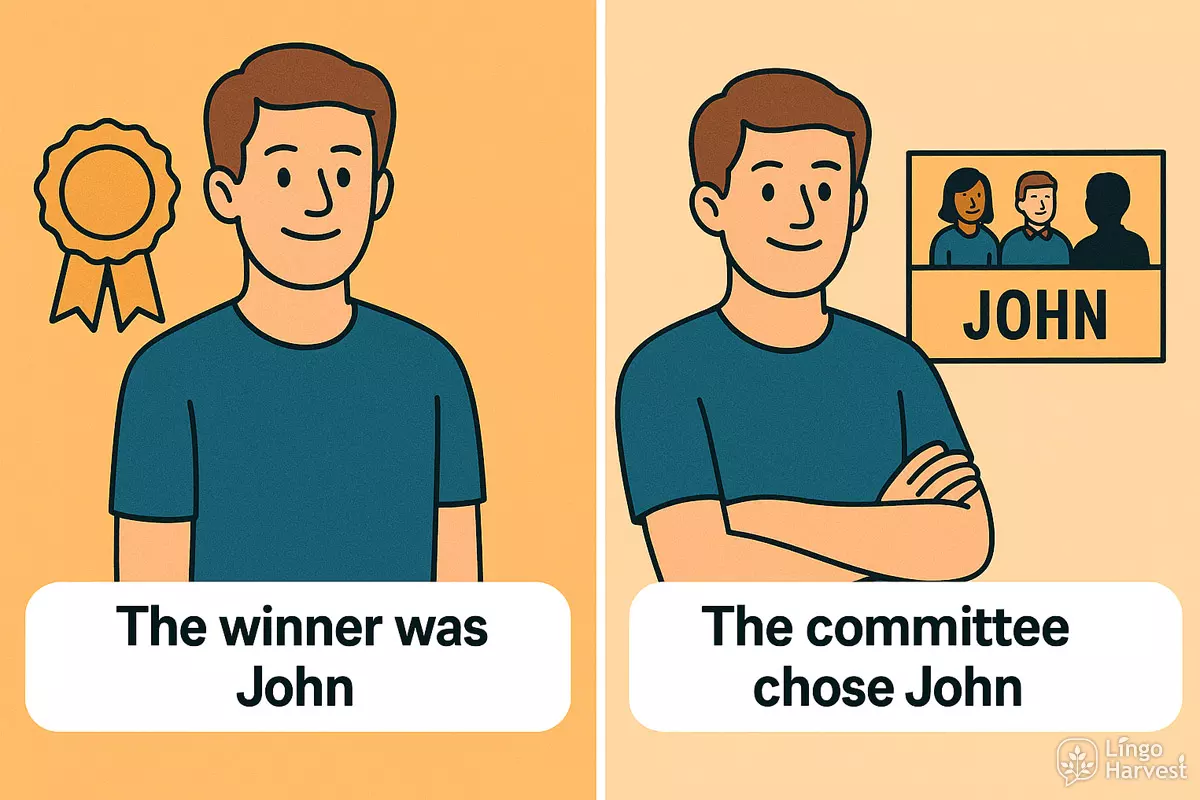
- The winner was John. (John = predicate noun; identifies "winner")
- The committee chose John. (John = direct object; receives the action "chose")
- My favorite fruit is mango. (mango = predicate noun)
- I like mango. (mango = direct object)
- Her dream became reality. (reality = predicate noun)
- She pursued her dream. (dream = direct object)
- This seems a problem. (problem = predicate noun)
- We solved a problem. (problem = direct object)
Quick comparison
| Predicate Noun | Direct Object |
|---|---|
| Follows a linking verb | Follows an action verb |
| Renames or identifies the subject | Receives the action of the verb |
| Example: She is a doctor. | Example: She called a doctor. |
| Answers: Who/what is the subject? | Answers: What/whom does the subject verb? |
In summary, the core difference is that predicate nouns give more information about the subject through a linking verb, while direct objects complete the meaning of an action verb by receiving its action.
Agreement between subject and predicate noun
When a linking verb connects a subject to a predicate noun, the two nouns must match in certain ways. The most important rule is that both should agree in number—singular with singular, plural with plural. This helps sentences remain clear and grammatically correct.
Number Agreement
If the subject is singular, the predicate noun should also be singular. For example, “My brother is a doctor.” If the subject is plural, the complement should be plural as well: “My friends are musicians.” This consistency avoids confusion and keeps the meaning precise.
- The girl is a student. ✅
- The girls are students. ✅
- The children are a joy. ❌ (should be “The children are joys.” or rewrite for clarity)
- This animal is a mammal. ✅
- Those people are tourists. ✅
- The committee is a group. ✅
- The teams are winners. ✅
- My aunt is a teacher. ✅
- The men are players. ✅
- The book is a novel. ✅
Person Agreement
While number is key, person (first, second, third) rarely causes issues because predicate nouns usually reflect the subject’s identity. For example, “You are a student,” “I am a teacher,” “They are leaders.” The verb form changes, but the noun agreement remains straightforward.
Special Cases: Collective and Abstract Nouns
Some subjects, like collective nouns (“team,” “family”), can be singular or plural depending on context. In American English, these are usually treated as singular: “The team is a winner.” Abstract nouns generally take singular complements: “Honesty is a virtue.”
Summary Table: Matching Subject and Predicate Noun
| Subject | Predicate Noun |
|---|---|
| The cat | a pet |
| The cats | pets |
| My parents | teachers |
| The idea | a solution |
| Those men | artists |
| The country | a democracy |
| These books | novels |
| Our house | a home |
In summary, always ensure that the complement matches the subject in number (and, when relevant, person). This helps your sentences sound natural and grammatically correct when using predicate nouns with linking verbs.
Frequent learner mistakes with linking verb structures
Understanding how linking verbs work with predicate nouns can be challenging for many English learners. These errors often arise from confusion about which verbs are considered linking verbs, how to match the subject with the correct predicate noun, or even from direct translation habits.
Common pitfalls when using linking verbs
Many students accidentally use action verbs instead of linking verbs, or vice versa. Sometimes, they try to use an adjective where a noun is required, or forget to keep the noun and verb in agreement. Here are some typical mistakes:
- Using an object pronoun instead of a subject pronoun after a linking verb (e.g., It was her instead of It was she in formal writing).
- Replacing a predicate noun with an adjective, or the other way around.
- Choosing "become" or "seem" incorrectly, especially in more complex sentences.
- Forgetting that some verbs (like feel, appear, grow) can be linking verbs in some contexts but not all.
- Using a linking verb with a direct object rather than a predicate noun (e.g., She became a doctor → correct; She became doctor ❌ incorrect).
- Attempting to use non-linking verbs (like run or eat) in these structures.
- Mixing up singular and plural forms in the predicate noun (e.g., They are a teacher instead of They are teachers).
- Adding unnecessary articles or omitting them (e.g., He is engineer instead of He is an engineer).
- Translating directly from the learner's native language, which may use different patterns.
- Placing adverbs between the linking verb and the predicate noun (e.g., She is quickly a leader ❌).
Comparison: Correct vs. Incorrect linking verb usage
Some errors are best understood by comparing correct and incorrect forms side by side. The table below highlights typical mistakes and their proper usage:
| Incorrect | Correct |
|---|---|
| He became angry. | He became a leader. |
| This tastes deliciously. | This tastes delicious. |
| They are a students. | They are students. |
| She is quickly a manager. | She is a manager. |
| I am engineer. | I am an engineer. |
| It was him. | It was he. (formal) |
| We became to doctors. | We became doctors. |
| He looks an artist. | He looks like an artist. |
| She feels herself happy. | She feels happy. |
| My friend seem a teacher. | My friend seems a teacher. |
How to avoid these mistakes
To improve accuracy with predicate nouns and linking verbs, focus on these tips:
- Memorize the most common linking verbs: be, become, seem, appear, feel, grow, look, remain, stay, sound, taste, turn.
- After a linking verb, check if a noun, pronoun, or adjective is appropriate for the meaning you want.
- Double-check subject-verb and subject-noun agreement.
- Be careful with word order—predicate nouns come directly after the verb, with no adverbs between.
- Read aloud to hear if the sentence sounds natural in English.
A clear understanding of these structures will help you avoid the most frequent errors and communicate more precisely.
Practice: complete sentences using predicate nouns correctly
Understanding how to use predicate nouns with linking verbs helps make your writing clearer and more precise. Predicate nouns, sometimes called predicate nominatives, rename or identify the subject following a linking verb (such as "is," "are," "was," "become," and "seem"). Practicing with real examples will help reinforce this concept.
Fill in the blanks with appropriate predicate nouns
Complete the following sentences by choosing a suitable predicate noun. Think about what the subject is being identified as or renamed:
- My father is a ________.
- That animal was a ________.
- Julia became a ________ after graduation.
- This city is the ________ of our state.
- His idea was a real ________.
- The winner is ________.
- Her favorite subject is ________.
- Dr. Smith is our family ________.
- Those books are valuable ________.
- Michael will become a ________ next year.
Show answers
- teacher (or other profession)
- tiger (or other animal)
- doctor (or other career)
- capital
- success
- Sarah (or another name)
- math (or another school subject)
- doctor (or another medical role)
- resources (or another noun)
- senior (or another role)
Choose the correct linking verb for each predicate noun
Decide which linking verb best completes each sentence:
- The sky ___ a beautiful shade of blue. (is / are)
- These apples ___ a good snack. (is / are)
- He ___ the new captain. (is / are)
- The puppies ___ a delight. (is / are)
- My favorite subject ___ history. (is / are)
- Those shoes ___ very comfortable. (is / are)
- Her idea ___ interesting. (is / are)
- The results ___ surprising. (is / are)
- This information ___ useful. (is / are)
- The students ___ ready for the test. (is / are)
Show answers
- is
- are
- is
- are
- is
- are
- is
- are
- is
- are
Examples of predicate nouns in sentences
Here are several more examples to help you recognize predicate nouns in context. Notice how each noun after the linking verb names or identifies the subject:
- Mary is a talented artist.
- My friends are excellent musicians.
- This building became a museum in 2001.
- The chef was a famous television personality.
- His dream is a career in medicine.
- Those children are our neighbors.
- Winter is a challenging season for many animals.
- That book is a bestseller.
- The solution was an easy one.
- Our guide will be a local resident.
Practice forming your own sentences using different linking verbs and predicate nouns. This will help you master the pattern and use it confidently in both writing and speaking.