Nouns in Comparison Structures Used in Everyday English

 The article explains how nouns function in comparative statements, including using more, less, and equal forms, and comparing count and mass nouns. It also covers equative structures, common errors, and differences between noun and adjective comparisons.
- How nouns function in comparative statements
- Nouns with more, less, and equal comparison
- Quantity comparison with count and mass nouns
- Equative structures using noun phrases
- Common errors in noun-based comparisons
- Difference between adjective and noun comparison
- Practice: write everyday comparisons using nouns correctly
In everyday conversations, we frequently compare people, places, or things, and knowing how to use nouns correctly in these comparisons helps your English sound more fluent and natural. By practicing the placement and form of naming words in comparative and superlative sentences, you can express similarities and differences more clearly. This not only improves your communication skills but also boosts your confidence when speaking or writing in English, making your language use more precise and engaging.
How nouns function in comparative statements
Nouns play a critical role when we compare people, objects, or ideas in English. While adjectives often show differences in qualities (like “smarter” or “taller”), nouns are essential for expressing contrasts in quantity, category, or identity. Common patterns use “more,” “less,” “as…as,” or “fewer” with nouns to clarify what’s being compared.
Patterns for Comparing Quantities and Types
English offers several ways to set nouns side by side for comparison. Some of the most useful patterns include:
- More + noun + than: “She has more books than her brother.”
- Fewer + countable noun + than: “There are fewer cars on the street today.”
- Less + uncountable noun + than: “We have less time than we thought.”
- As much/many + noun + as: “He doesn’t have as many friends as before.”
- The same + noun + as: “They have the same problem as last year.”
- Different + noun + from: “This is a different approach from ours.”
- Comparison with possessive structures: “My team’s performance was better than theirs.”
- Comparing groups: “Cats are better pets than dogs for some people.”
- Superlative context: “She has the most experience in our department.”
- Using numbers for precision: “We received three times more applications this year.”
Examples of Noun-Based Comparative Structures
Nouns in these constructions highlight the subject of the comparison, not the quality. This difference is important for clarity and accuracy in communication. Below are common comparative structures using nouns:
| Structure | Example Sentence |
|---|---|
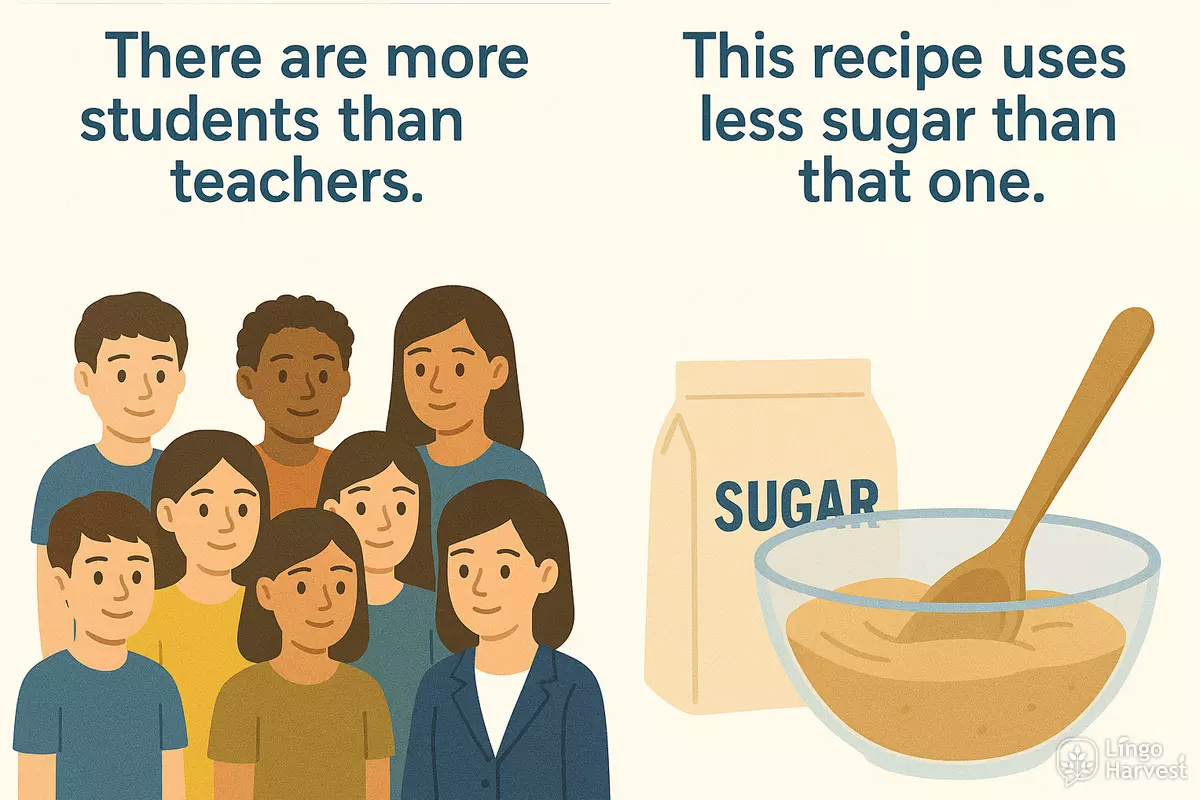
| more + [countable noun] + than | There are more students than teachers. |
| less + [uncountable noun] + than | This recipe uses less sugar than that one. |
| fewer + [countable noun] + than | We had fewer interruptions than yesterday. |
| as much/many + [noun] + as | He drank as much water as his friend. |
| the same + [noun] + as | She has the same job as her sister. |
| a different + [noun] + from | They chose a different route from us. |
| [number] times as many/much + [noun] + as | This store sells twice as many shoes as that one. |
| more/less/fewer + [noun] + than expected | We had less rain than expected. |
| [noun] + compared to/with + [noun] | Attendance this year compared to last year was higher. |
| [noun] + is/are + comparative adjective + than + [noun] | Dogs are friendlier pets than snakes. |
Usage Tips
When constructing these comparisons, keep in mind the type of noun:
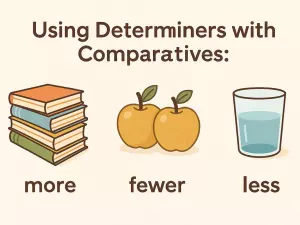
- Use “fewer” with countable nouns (apples, cars, people).
- Use “less” with uncountable nouns (water, time, money).
- Choose “as many” for countable nouns and “as much” for uncountable nouns.
These patterns help speakers and writers draw clear, accurate parallels or contrasts in everyday conversation and writing. Proper noun use in comparison structures makes statements more precise and easier to understand.
Nouns with more, less, and equal comparison
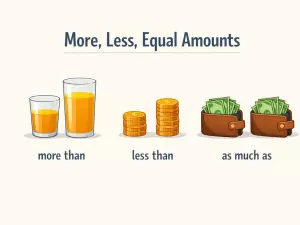
When talking about quantities or amounts in English, it's common to compare nouns by expressing if there is a greater, smaller, or equal number of things. These comparison structures are straightforward but have specific patterns, especially when using "more," "less," and "as...as" with countable and uncountable nouns.
Using "more" and "fewer/less" with nouns
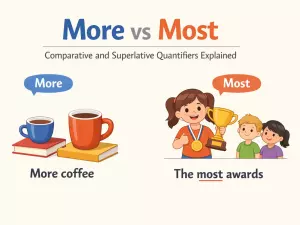
To show that one group or thing has a higher or lower quantity than another, use "more" and "fewer" for countable nouns, and "more" and "less" for uncountable nouns. The structure is:
- more + plural countable noun (e.g., more books, more ideas)
- fewer + plural countable noun (e.g., fewer cars, fewer options)
- more + uncountable noun (e.g., more water, more time)
- less + uncountable noun (e.g., less money, less information)
Expressing equality with nouns
To indicate two things or groups have the same amount, use the structure "as much/many ... as." "As many" is used with plural countable nouns, and "as much" with uncountable nouns.
- as many apples as → I bought as many apples as I could carry.
- as many questions as → Ask as many questions as you need.
- as much energy as → She didn’t have as much energy as she expected.
- as much patience as → You need as much patience as possible for this job.
- Common comparison patterns
Here are some practical ways these patterns appear in everyday conversation:
- She has more friends than I do.
- We need fewer meetings this week.
- There is less sugar in this recipe.
- He has as much experience as her.
- They brought more snacks than we expected.
- Do you have as many tickets as we need?
- We should use less paper to save resources.
- Are there more options available?
- She spent less money this month.
- He received as many compliments as his colleague.
- We have more information now.
- There are fewer cars on the road today.
- This solution uses as much time as the other one.
- They have fewer responsibilities than before.
- You need more practice to improve.
Structured comparison examples
Below is a table summarizing how these comparative forms are constructed with nouns in English:
| Comparison Type | Example Structure |
|---|---|
| Greater quantity (countable) | more + plural noun (e.g., more chairs) |
| Smaller quantity (countable) | fewer + plural noun (e.g., fewer students) |
| Greater quantity (uncountable) | more + uncountable noun (e.g., more rice) |
| Smaller quantity (uncountable) | less + uncountable noun (e.g., less noise) |
| Equal quantity (countable) | as many + plural noun + as (e.g., as many emails as) |
| Equal quantity (uncountable) | as much + uncountable noun + as (e.g., as much advice as) |
Understanding these structures helps you express comparative ideas naturally, whether you’re talking about objects, time, or abstract concepts. With practice, these patterns will become a regular part of your English communication.
Quantity comparison with count and mass nouns
In everyday English, different words and structures are used when comparing amounts involving countable and uncountable nouns. Understanding which expressions pair with each type is important for clear and natural communication.
Comparing countable nouns
Count nouns (like apples, books, cars) refer to items you can count individually. When comparing these, use terms such as more, fewer, or as many as. Here are common patterns:
- She has more books than I do.
- There are fewer chairs in this room.
- Do you have as many pens as Tom?
- No one brought so many gifts last year.
- We need a few more volunteers for the event.
Comparing mass (uncountable) nouns
Mass nouns (such as water, information, rice) describe substances or concepts that cannot be counted individually. For these, use words like more, less, or as much as. Typical examples include:
- I drank more water today.
- This recipe uses less sugar.
- Do you have as much patience as your sister?
- He offered so much advice at the meeting.
- Could I have a little more coffee?
Side-by-side comparison of forms
The table below summarizes key structures for comparing amounts with count and mass nouns, highlighting the typical choice of words and example phrases.
| Expression | Example with Count Noun / Mass Noun |
|---|---|
| more | more chairs / more milk |
| fewer / less | fewer apples / less money |
| as many as / as much as | as many friends as you / as much time as possible |
| so many / so much | so many emails / so much noise |
| a few more / a little more | a few more questions / a little more salt |
Key points to remember
- Countable nouns pair with many, few, fewer, as many.
- Uncountable nouns take much, little, less, as much.
- More works for both types.
- Incorrect combinations (like less apples or many water) are common mistakes.
Mastering these patterns helps you sound natural and precise when discussing quantities, whether you’re talking about things you can count or substances you can’t.
Equative structures using noun phrases
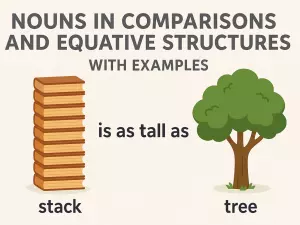
Making comparisons in English often involves showing that two things or people are equal in some way. When nouns are used for this purpose, certain patterns help express the idea of equivalence. These constructions are common in both spoken and written language, especially in everyday situations where we want to highlight similarities.
Standard patterns for showing equality
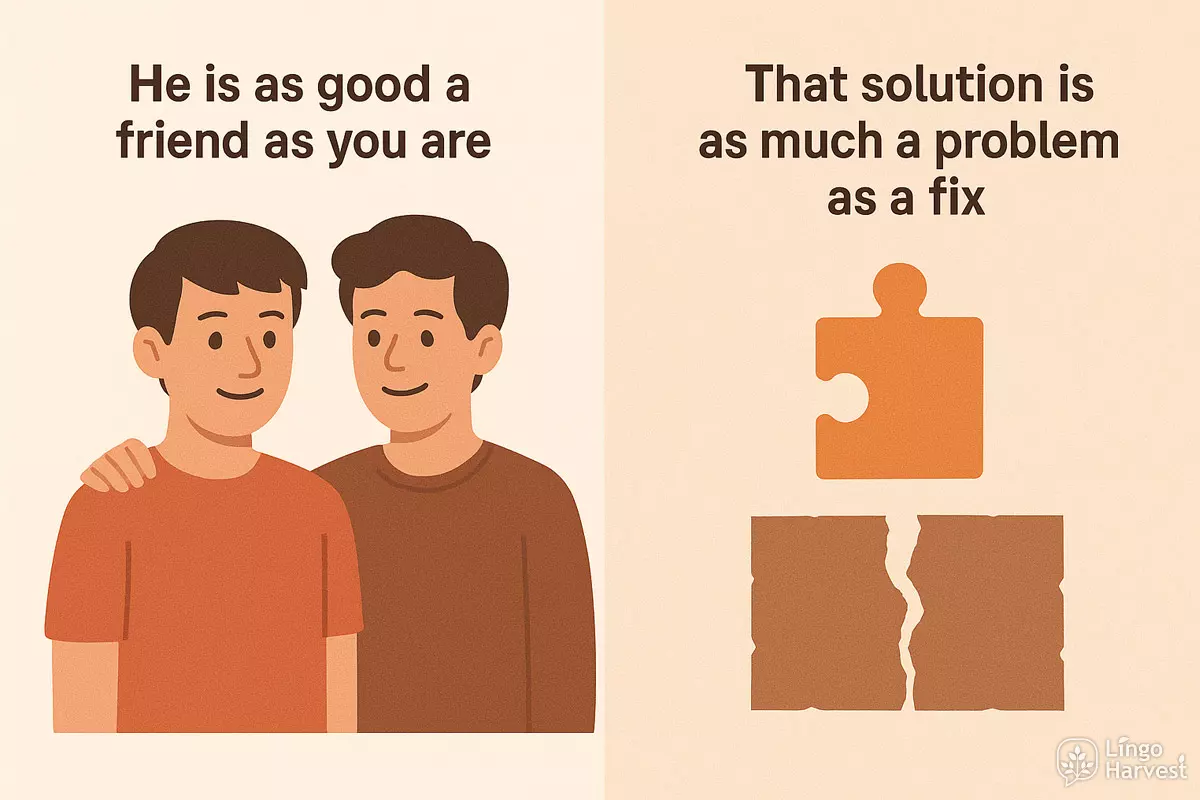
The most common way to indicate that two nouns are on the same level is by using the phrase as + noun + as. This pattern is straightforward and allows speakers to compare attributes, roles, or identities. Here are some examples:
- He is as good a friend as you are.
- That solution is as much a problem as a fix.
- This phone is as much a camera as a communication tool.
- She is as talented a musician as her brother.
- It’s as big an opportunity as a challenge.
Alternative structures
There are several other ways to convey equality with noun phrases. Some structures use expressions like “the same…as” or “no less…than.” These forms are slightly more formal but still frequent in everyday speech:
- He is the same age as his cousin.
- This is the same problem as before.
- She has no less experience than her colleague.
- They have an equal chance of winning.
- It’s the same story as last time.
Comparison of equative patterns
Below is a table that summarizes several common ways to express equality between nouns, highlighting the structure and a sample sentence for each. These patterns are useful for everyday descriptions and comparisons.
| Pattern | Example |
|---|---|
| as + noun + as | She is as skilled a chef as her mentor. |
| the same + noun + as | We have the same goal as our partners. |
| no less + noun + than | This is no less a victory than last time. |
| as much/many + noun + as | He has as many ideas as anyone here. |
| equal + noun + to | Her performance is equal quality to the best in the field. |
Usage notes and variations
It’s important to match the noun and context when choosing which structure to use. For countable nouns, “as many…as” is preferred, while “as much…as” fits uncountable nouns. In formal writing, “no less…than” adds emphasis, while “the same…as” is neutral. These patterns are flexible and allow speakers to compare people, objects, qualities, and more.
In summary, these structures provide a clear and natural way to indicate equality between things or people in daily English. Mastering them helps express nuanced comparisons with precision and clarity.
Common errors in noun-based comparisons
Missteps with comparing nouns often stem from confusion about structure, missing words, or unclear references. It’s easy to mix up the correct forms, especially when switching between English and other languages with different comparison patterns. Let’s look at typical pitfalls and how to avoid them.
Omitting Necessary Words
Leaving out essential words like “than” or “as” can make sentences confusing or grammatically incorrect. For example:
- Incorrect: “My book is thicker your book.”
- Correct: “My book is thicker than your book.”
Unclear Reference Points
Sometimes, it’s unclear what is being compared. Always specify both items:
- Unclear: “The price of apples is higher.”
- Clear: “The price of apples is higher than the price of oranges.”
Mixing Singular and Plural Nouns
Comparing a singular noun to a plural noun can confuse the reader:
- Incorrect: “A cat is friendlier than dogs.”
- Correct: “A cat is friendlier than a dog.”
- Or: “Cats are friendlier than dogs.”
Redundant or Missing Articles
Articles (“a,” “an,” “the”) should match on both sides of the comparison when appropriate.
Comparing Incompatible Nouns
Make sure the nouns are logically comparable. For instance, comparing a “car” to “speed” doesn’t work; compare “car” to “bicycle” or “speed of a car” to “speed of a bike.”
Common Mistakes and Corrections
| Incorrect Example | Corrected Version |
|---|---|
| My dog is bigger my cat. | My dog is bigger than my cat. |
| The population of Tokyo is more than New York. | The population of Tokyo is greater than that of New York. |
| This recipe needs less eggs than that one. | This recipe needs fewer eggs than that one. |
| She has as much books as I do. | She has as many books as I do. |
| Her bag is heavier as mine. | Her bag is heavier than mine. |
| There are more cars in London than Paris. | There are more cars in London than in Paris. |
| My phone’s battery lasts longer than John. | My phone’s battery lasts longer than John’s (battery). |
| This chair is more comfortable the other one. | This chair is more comfortable than the other one. |
| I have less pencils than you. | I have fewer pencils than you. |
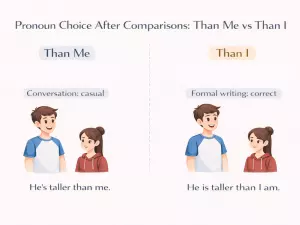
| My brother is as tall as me. | My brother is as tall as I am. |
Tips to Avoid Tricky Errors
- Always check if “than” or “as” is needed.
- Match articles and number (singular/plural) on both sides.
- Make sure you’re comparing similar things (apples to apples).
- Use “fewer” for countable nouns and “less” for uncountable nouns.
- Repeat the noun or use a possessive when the reference isn’t clear.
Getting comfortable with these patterns will help you express comparisons clearly and naturally in everyday English.
Difference between adjective and noun comparison
When comparing things in English, we often use both adjectives and nouns, but the structure and meaning of these comparisons can be quite different. Understanding how these two forms function in everyday sentences helps you express ideas more clearly and naturally.
How adjective-based comparisons work
Adjectives describe qualities (like big, fast, expensive). To compare using adjectives, we usually use patterns such as:
- Comparative adjectives: "This car is faster than that one."
- Superlative adjectives: "She is the smartest student in the class."
- As...as structure: "He is as tall as his brother."
These forms focus on the degree or intensity of a specific characteristic.
Noun-based comparisons in English
Comparing nouns shifts the focus to quantity or the type of thing being discussed. Structures often include:
- More/less/fewer + noun: "She has more books than me."
- As many/much/few/little + noun + as: "I have as many friends as you."
- No more/no fewer + noun + than: "They have no more options than we do."
Here, the comparison is about the amount or number, not the quality.
Key differences at a glance
Below is a structured comparison of how adjective and noun-based comparisons differ in everyday English:
| Feature | Adjective Comparison | Noun Comparison |
|---|---|---|
| What is compared? | Qualities or characteristics | Quantities or types of things |
| Common patterns | -er/-est, more/most, as...as | more/less/fewer + noun, as many/much/few/little + noun + as |
| Example | "Tom is taller than Jim." | "Tom has more books than Jim." |
| Focus | Degree of a trait | Number or amount |
Common comparison phrases in everyday English
Here are some useful expressions illustrating both comparison types:
- My bag is lighter than yours. (adjective)
- I have less money than last week. (noun)
- His jokes are funnier than mine. (adjective)
- There are fewer cars on the road today. (noun)
- This test is as difficult as the last one. (adjective)
- She drinks as much coffee as I do. (noun)
- That movie was more exciting than I expected. (adjective)
- We have as few problems as possible. (noun)
- He’s the oldest player on the team. (adjective)
- She has the most experience in the group. (noun)
Knowing whether to use an adjective or a noun in your comparison can help you be both more precise and more natural in conversation.
Practice: write everyday comparisons using nouns correctly
When talking about similarities and differences in daily life, English speakers often use nouns in comparison structures. Getting comfortable with these patterns helps make your speech more natural and clear. Below, you'll find examples, hands-on tasks, and a structured overview to deepen your understanding of using nouns in comparisons.
Common Patterns for Comparing Nouns
English offers several ways to compare things using nouns. Here are some typical structures:
- as + noun + as
- more + noun + than
- fewer/less + noun + than
- the same + noun + as
- different + noun + from
- twice/half + as much/many + noun + as
- a greater/lesser number of + plural noun
- no + noun + as + adjective + as
- as much/many + noun + as
- not as much/many + noun + as
- similar + noun + to
- another + noun + like
Examples of Everyday Noun Comparisons
| Comparison Structure | Example Sentence |
|---|---|
| as + noun + as | He has as much patience as his mother. |
| more + noun + than | This store has more options than the other one. |
| fewer + noun + than | We have fewer apples than oranges. |
| the same + noun + as | She bought the same dress as her friend. |
| twice as many + noun + as | There are twice as many students in this class as in the last one. |
| less + noun + than | I have less time than you today. |
| different + noun + from | This recipe uses a different ingredient from yours. |
| similar + noun + to | This phone has a similar design to the previous model. |
| not as much/many + noun + as | They don’t have as many choices as we do. |
| another + noun + like | I’d like another coffee like the last one. |
Practice: Complete the Sentences
Fill in the blanks with the correct comparison structure using the nouns given in parentheses.
- My new laptop has __________ (features) than my old one.
- He doesn’t have as __________ (energy) as he used to.
- We ordered the same __________ (meal) as our friends.
- This bag is made of a different __________ (material) from yours.
- There are twice as __________ (chairs) in this room as in the other.
Show answers
- more features
- much energy
- meal
- material
- many chairs
Try Making Your Own Comparisons
Choose two things from your daily life (for example: two phones, two cities, two meals) and write three comparison sentences using different noun-based structures from the table above.
Show answers
- This city has more parks than my hometown.
- There are fewer buses here than in the city center.
- My new phone has the same features as my friend’s.
By practicing these comparison structures, you’ll find it easier to express similarities and differences clearly in everyday English conversations.