Adjective Order: Theoretical Framework

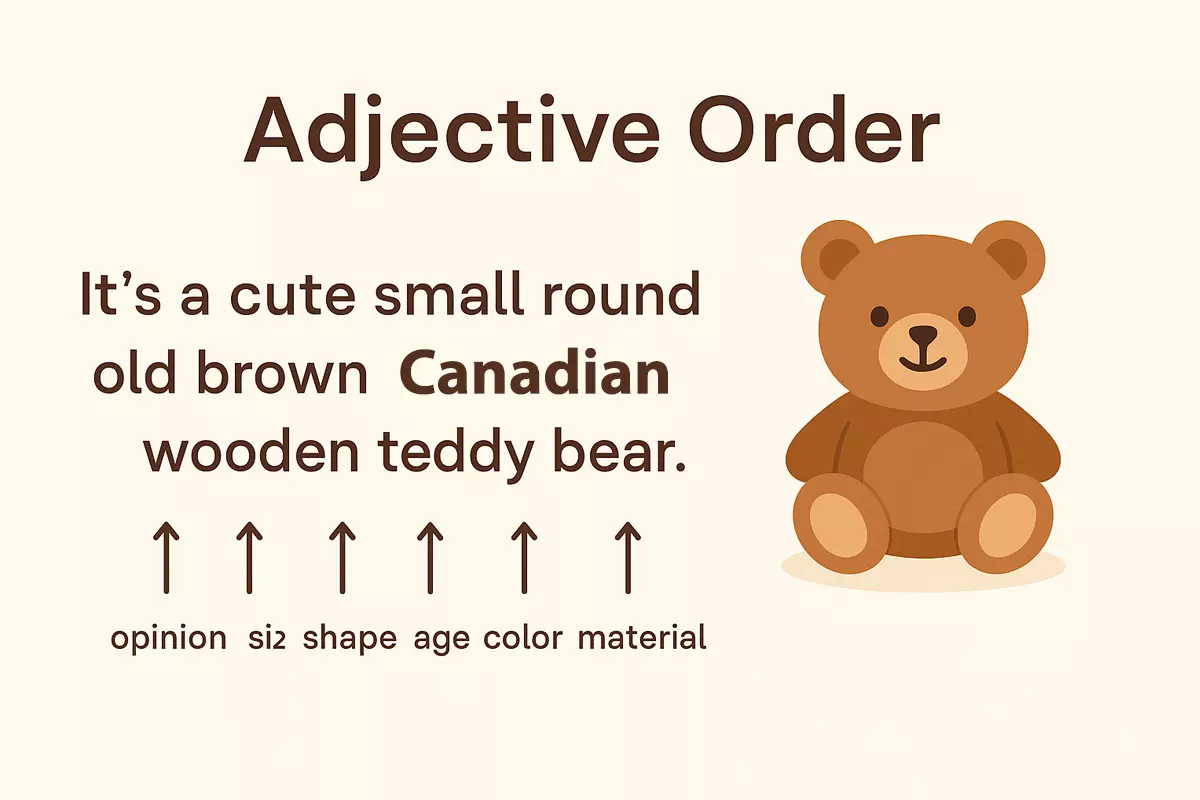 This article explains how English speakers order adjectives before nouns, covering the typical sequence: opinion, size, shape, age, color, origin, and material. It includes a full model and short practice to help you master the pattern.
We naturally say "a big red ball" instead of "a red big ball" because English follows a specific order for adjectives, typically placing size before color. This instinctive arrangement is not random; it reflects subtle grammatical conventions that native speakers apply without thinking. Understanding these patterns sheds light on the logical structure underlying English and illustrates how our brains intuitively process and organize language, making communication clearer and more effective for both speakers and listeners.
Why Order Matters
The arrangement of adjectives in a sentence isn’t just a matter of convention—it directly influences clarity and meaning. In English and many other languages, listeners expect descriptive words to follow a particular hierarchy. When this expectation is met, the resulting phrase feels natural and is processed quickly. When the sequence is disrupted, the phrase can sound awkward or even change its meaning entirely.
Clarity and Comprehension
Native speakers intuitively sense when adjectives are out of order. For example, “a red big balloon” feels jarring compared to “a big red balloon.” That’s because adjectives are subconsciously sorted by categories such as quantity, quality, size, age, shape, color, origin, and material. This underlying structure helps listeners immediately grasp which attributes are most central to the noun.
Ambiguity and Misunderstanding
Altered adjective sequence can introduce ambiguity. Consider these two examples:
- “an old French painting” (a painting from France that is old)
- “a French old painting” (less natural, but could be interpreted as an old painting in the French style)
Such shifts can subtly or even dramatically change what is being described, affecting communication in both casual and formal contexts.
Naturalness and Native-Like Fluency
Adhering to established order fosters fluency. Non-native speakers often stand out when they use unusual adjective patterns, even if the individual words are correct. Mastery of this order is a hallmark of advanced proficiency.
Common Adjective Categories and Their Usual Sequence
To illustrate the typical arrangement, here’s a list of common types of adjectives and their recommended order before a noun:
- Quantity (e.g., three, several)
- Opinion (e.g., lovely, awful)
- Size (e.g., small, huge)
- Age (e.g., young, ancient)
- Shape (e.g., round, flat)
- Color (e.g., blue, golden)
- Origin (e.g., Italian, Arctic)
- Material (e.g., wooden, silk)
- Purpose/Qualifier (e.g., running [shoes], cooking [pot])
Comparing Acceptable and Unacceptable Sequences
| Natural Sequence | Unnatural Sequence |
|---|---|
| a lovely small old round blue Italian wooden dining table | a Italian blue old wooden lovely dining small round table |
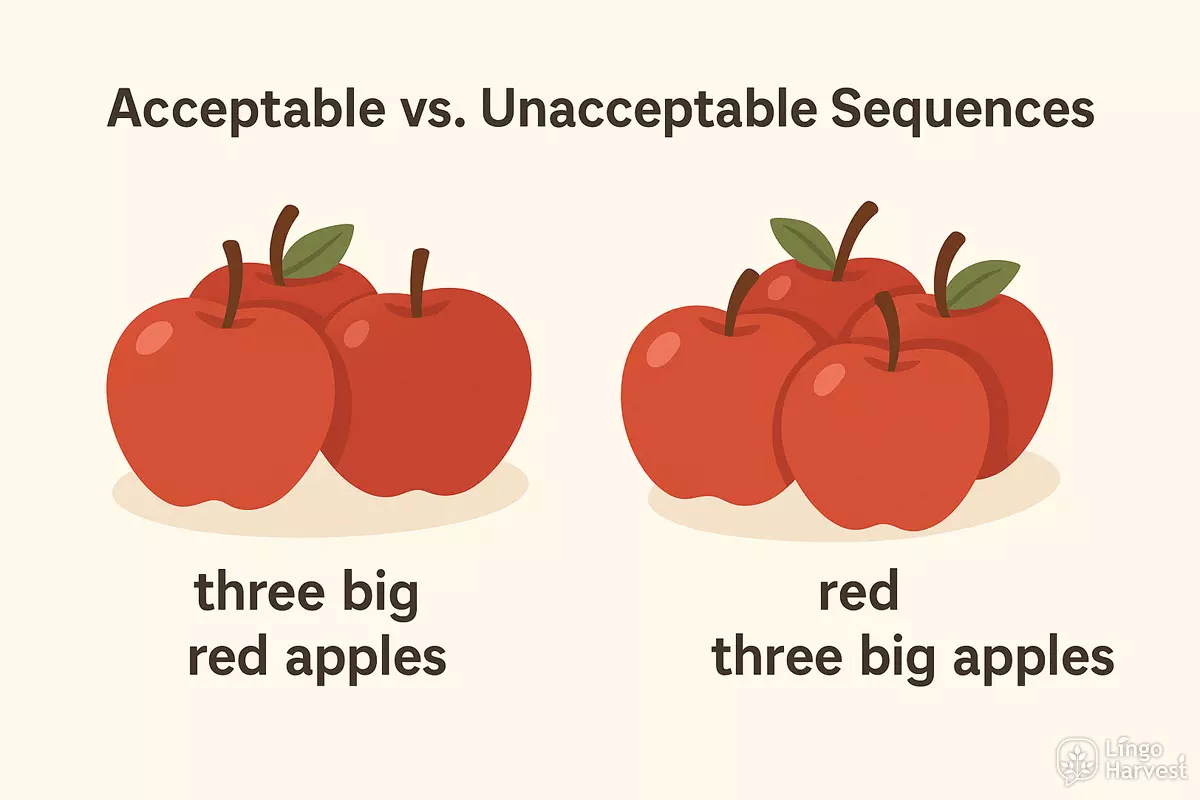
| three big red apples | red three big apples |
| an elegant modern glass vase | glass elegant modern vase |
| some large square white pillows | square white large some pillows |
Understanding the logic behind adjective placement not only improves accuracy, but also ensures that descriptions are vivid, precise, and easily understood. This order is not arbitrary—it reflects cognitive patterns that support efficient communication.
Opinion Before Fact
Many discussions about the order of adjectives in English begin with personal impressions or intuitions. Native speakers often have a strong sense of what “sounds right,” even if they cannot articulate the rules behind their preferences. Linguists, too, have long debated whether the typical sequence of adjectives reflects innate patterns, learned conventions, or mere habit. Before turning to empirical studies or formal models, it’s helpful to recognize the role of subjective judgment in shaping our understanding of how descriptive words are arranged.
Common Intuitive Judgments
- “A big red ball” feels more natural than “a red big ball.”
- People rarely question why “old wooden chair” flows better than “wooden old chair.”
- Adjective order often goes unnoticed until a “wrong” sequence causes a jolt.
- Some speakers prefer shorter, familiar patterns without knowing the underlying logic.
- Children mimic adult speech patterns before learning explicit rules.
These opinions guide everyday language use, but they aren't always consistent or universal. What seems obvious to one speaker may sound odd to another, especially across dialects or languages. This subjective layer creates a fascinating challenge for theorists: how to move from personal impressions to objective analysis.
From Intuition to Evidence
Early attempts to explain adjective sequence relied heavily on anecdotal examples and classroom observations. Over time, researchers began to look for patterns that could be tested and verified. However, even today, debates sometimes hinge on what “feels” correct, rather than definitive data.
| Intuitive Preference | Empirical Observation |
|---|---|
| “Beautiful old house” sounds right | Corpus studies confirm this order is most common |
| “Big blue box” over “blue big box” | Language learners often make the reverse error |
| Order changes with emphasis (e.g., “the old lovely car”) | Prosody and context can override default patterns |
| Native speakers “just know” the sequence | Explicit rules are taught to non-native learners |
Understanding the gap between subjective feel and objective fact is central to building a robust theoretical framework. While personal instincts provide a useful starting point, systematic analysis is needed to uncover the principles governing adjective arrangement.
Size and Shape
In linguistic theory, descriptive adjectives relating to magnitude and form occupy a distinct position within the overall hierarchy of adjective order. These terms typically follow opinion adjectives and precede age or color modifiers. Their placement is not arbitrary; rather, it reflects both syntactic conventions and cognitive patterns that influence natural language use.
Role in Adjective Sequences
Adjectives denoting extent or contour—such as "tiny," "enormous," "round," or "flat"—help to specify and visualize the noun more precisely. In English, such words are usually positioned before other descriptive categories like color or material, but after subjective judgments. For example, "a lovely small round table" is preferred over "a round lovely small table."
Common Lexical Items
Writers and speakers rely on a broad set of adjectives to convey physical dimensions and contours. Some frequently encountered terms include:
- big
- small
- tall
- short
- long
- wide
- narrow
- tiny
- huge
- gigantic
- massive
- slender
- fat
- round
- square
- flat
- curved
- pointed
- rectangular
- bulky
These modifiers serve to clarify both the scale and the outline of the referent, allowing for more vivid and precise communication.
Comparative Placement of Size and Shape Adjectives
The theoretical framework for adjective order suggests a predictable sequence. When combining size and form descriptors, the term indicating magnitude precedes the one indicating contour:
- big round bowl
- small square window
- tall slender vase
- short flat stone
This sequence aligns with the broader cross-linguistic patterns observed in many languages.
Semantic Constraints and Exceptions
While the general preference is clear, exceptions do exist. Idiomatic expressions, poetic usage, or the need for emphasis may lead to variations, but these are marked and less frequent. In most formal or neutral contexts, maintaining the established order enhances clarity and naturalness.
Summary Table: Typical Adjective Order Involving Magnitude and Form
| Order Position | Example Sequence |
|---|---|
| Opinion → Magnitude → Form | beautiful small round vase |
| Opinion → Magnitude → Form → Age | lovely large rectangular old mirror |
| Magnitude → Form → Color | tiny square red box |
| Magnitude → Form → Material | huge flat stone table |
Understanding the theoretical underpinnings of adjective order, especially for terms describing extent and outline, provides valuable insight into both the structure and intuitive logic of English noun phrases.
Age and Color
In English adjective sequences, terms relating to how old something is and its hue belong to distinct categories. Linguists consistently observe that expressions describing the object's time-related qualities (like "new," "ancient," or "modern") typically come before those indicating appearance or pigmentation (such as "blue," "striped," or "golden"). This ordering is not arbitrary; it reflects deeper principles about how speakers conceptualize physical attributes relative to more enduring or abstract qualities.
Relative Position in Adjective Strings
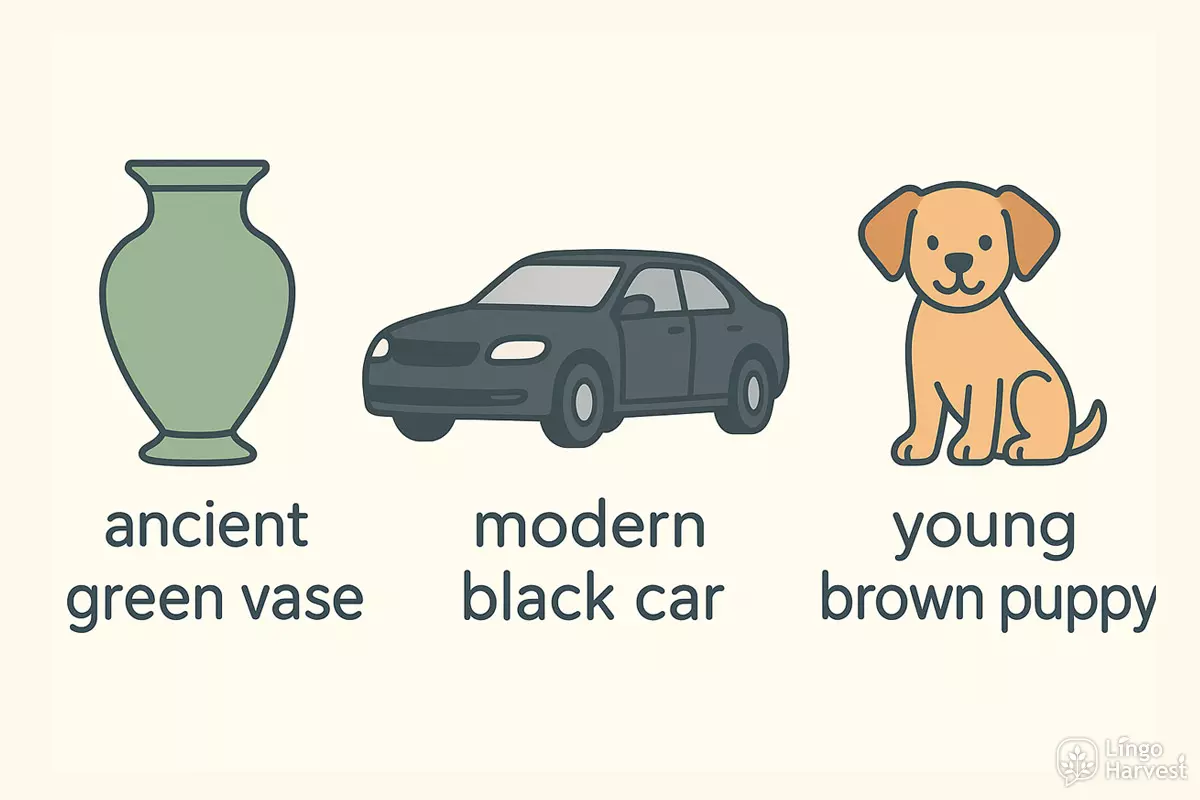
When multiple descriptive words are used, age adjectives generally precede those for coloration. For example, we say "an old red book" rather than "a red old book." This order is so deeply ingrained that reversing it can sound unnatural to native speakers.
- ancient green vase
- modern black car
- young brown puppy
- new silver laptop
- old white house
- recent purple painting
- antique gold watch
- fresh blue shirt
- vintage orange dress
- recently-built gray bridge
- historic pink mansion
- brand-new yellow bicycle
Why This Order?
The accepted sequence aligns with semantic hierarchy theories. Age adjectives often signal more inherent or contextually relevant information about the noun, while color is considered a surface-level descriptor. This distinction is not just a quirk of English; many languages show a similar pattern, suggesting a cognitive basis for the hierarchy.
Common Age and Color Adjectives
To illustrate the range of vocabulary used, here is a sample of frequently encountered adjectives in each category:
- Age: ancient, antique, old, young, modern, new, historic, recent, vintage, brand-new, prehistoric, medieval
- Color: red, blue, green, yellow, black, white, pink, orange, brown, purple, gray, gold, silver
Examples in Context
The following phrases show how these descriptors combine, always placing the temporal adjective before the chromatic one:
- old blue jeans
- modern white sneakers
- ancient golden statue
- new red umbrella
- historic gray castle
This ordering helps listeners or readers process information efficiently: first, they learn about the object’s timeframe, then its visual traits. Such patterns underpin the broader theoretical frameworks that govern adjective order and reflect how language maps onto human perception.
Origin and Material
When exploring why adjectives appear in a certain sequence, linguists often examine both the historical development of adjective order and the conceptual categories that shape how we group descriptive words. The roots of adjective ordering can be traced to patterns observed across languages, where speakers tend to arrange modifiers in a way that reflects cognitive priorities or cultural conventions.
Historical Perspectives
Early grammarians noticed that speakers intuitively follow particular patterns when stringing adjectives together. For instance, in English, it feels more natural to say "a big red ball" rather than "a red big ball." These preferences are not arbitrary; they have evolved alongside the language itself, influenced by usage trends, language contact, and internal grammaticalization processes.
Semantic Categories and Cognitive Basis
Researchers have identified several major types of meaning that adjectives can convey. These include qualities such as size, shape, color, age, and material. The order in which these categories appear is often linked to how easily we can conceptualize or perceive the properties being described. For example, permanent characteristics like material tend to follow more subjective descriptors like opinion or size.
- Opinion (e.g., lovely, horrible)
- Size (e.g., huge, tiny)
- Age (e.g., ancient, modern)
- Shape (e.g., round, square)
- Color (e.g., blue, golden)
- Origin (e.g., French, Arctic)
- Material (e.g., wooden, silk, metal)
- Purpose (e.g., sleeping [as in "sleeping bag"])
Cross-Linguistic Variation
Not all languages order descriptive words in the same way. Some languages permit greater flexibility, while others have strict rules. For instance, Romance and Germanic languages show both similarities and differences in how they arrange modifiers, which has intrigued typologists for decades.
| Language | Typical Adjective Order Example | Notes |
|---|---|---|
| English | a beautiful small old Italian wooden chair | Opinion → Size → Age → Origin → Material |
| Spanish | una silla italiana vieja pequeña de madera bonita | Order may vary; adjectives often follow the noun |
| French | une belle petite vieille chaise italienne en bois | Some adjectives precede, others follow the noun |
| German | ein schöner kleiner alter italienischer Holzstuhl | Adjectives precede the noun; similar order to English |
Material as a Category
The label "material" refers to what something is made of—such as metal, glass, or cotton. In English and many other languages, this type of descriptor typically comes near the end of the sequence, just before the noun itself. This reflects a tendency to move from subjective or abstract qualities toward more concrete, inherent properties. Understanding these patterns sheds light on the interplay between linguistic tradition, cognitive processing, and communicative efficiency. By dissecting both the historical roots and the semantic building blocks, researchers gain insight into why adjective sequences tend to feel "right" or "wrong" to native speakers.
Full Order Model
The established sequence of adjectives in English is not arbitrary. Linguists have observed that when multiple descriptive words appear before a noun, they tend to follow a preferred arrangement. This organization is influenced by semantic categories such as quantity, opinion, size, age, shape, color, origin, material, and purpose. Understanding these categories helps explain why phrases like "big old red barn" sound natural, while "red old big barn" does not.
Semantic Categories and Typical Sequence
Most analyses agree on a general order, which can be summarized as follows:
- Quantity (e.g., two, several, many)
- Opinion or Quality (e.g., lovely, boring, excellent)
- Size (e.g., large, tiny, enormous)
- Age (e.g., new, ancient, young)
- Shape (e.g., round, square, flat)
- Color (e.g., blue, green, black)
- Origin (e.g., French, medieval, Martian)
- Material (e.g., wooden, plastic, silk)
- Purpose or Qualifier (e.g., sleeping [as in sleeping bag], racing [as in racing car])
Illustrative Examples
To show how these categories interact, here are several multi-adjective noun phrases that follow the standard sequence:
- three beautiful large old round white Italian marble statues
- several delicious small fresh red Spanish tomatoes
- many interesting modern rectangular blue Japanese glass vases
- a few ugly tiny ancient brown wooden boxes
- some amazing huge new black German sports cars
- numerous boring little old green plastic toys
- several elegant tall young pale Russian dancers
- ten delightful wide antique gold picture frames
- five ordinary short modern silver candlesticks
- various charming thin vintage yellow cotton dresses
- countless plain massive old stone garden ornaments
- a couple of impressive large new white ceramic plates
Comparison of Adjective Orders
When the arrangement is altered, the result often feels unnatural or confusing to native speakers. The table below contrasts preferred and non-preferred adjective orders, highlighting the natural flow of information:
| Natural Order | Unnatural Order |
|---|---|
| a beautiful old Italian lamp | an Italian old beautiful lamp |
| three large blue ceramic bowls | ceramic blue large three bowls |
| many small round wooden tables | wooden round small many tables |
| an elegant new silver bracelet | silver elegant new bracelet |
| some delicious fresh French bread | French fresh delicious bread |
Key Insights
The rationale for this structure is partly cognitive: the most subjective or general information (like quantity or opinion) is positioned first, while more intrinsic or specific details (such as material or purpose) come last. Native speakers rarely need to consciously recall these rules, as the ordering is deeply embedded through exposure and usage. However, for learners and analysts, understanding this systematic approach reveals much about how meaning, clarity, and convention interact in language.
Short Practice
Understanding how to arrange descriptive words before nouns is essential for fluent English. Below you'll find targeted exercises and examples designed to reinforce the principles of adjective sequencing discussed in the theoretical overview.
Task 1: Arrange the Adjectives
Rewrite each phrase below, placing the adjectives in their natural English order:
- car / red / old / sports
- dress / silk / beautiful / long
- dog / little / brown / friendly
- building / modern / tall / office
- table / wooden / round / small
Show answers
- old red sports car
- beautiful long silk dress
- friendly little brown dog
- tall modern office building
- small round wooden table
Task 2: Identify the Incorrect Order
For each group, one phrase has the adjectives in the wrong sequence. Select the incorrect one.
- a) lovely little blue box
- b) blue lovely little box
- c) little lovely blue box
- a) big Italian leather bag
- b) Italian big leather bag
- c) big leather Italian bag
Show answers
- First group: b) blue lovely little box
- Second group: b) Italian big leather bag
Common Adjective Types and Order
Here's a reference list of common categories, from closest to the noun (right) to farthest (left):
- Opinion (beautiful, ugly, lovely)
- Size (small, big, gigantic)
- Age (old, young, ancient)
- Shape (round, square, flat)
- Color (red, blue, green)
- Origin (Italian, French, Asian)
- Material (wooden, plastic, silk)
- Purpose (sleeping, racing, cooking)
Task 3: Build Your Own Noun Phrases
Using at least three adjectives from different categories above, create noun phrases for the following nouns:
- bag
- house
- shirt
- book
Show answers
- bag: lovely small Italian leather bag
- house: big old red brick house
- shirt: stylish new blue cotton shirt
- book: fascinating thick ancient history book
Quick Reference Table: Adjective Order Example
| Adjective Type | Example Phrase |
|---|---|
| Opinion + Size + Noun | beautiful large garden |
| Age + Shape + Noun | old round clock |
| Color + Origin + Material + Noun | green Japanese ceramic vase |
| Size + Age + Color + Noun | small new white car |
| Opinion + Size + Age + Origin + Material + Noun | lovely big old French wooden table |
Practicing with real examples helps internalize the logic behind adjective placement, making your English sound more natural and precise. Try mixing categories and reviewing the chart to build confidence.