Nouns Followed by To-Infinitives in Modern English Grammar

 The article explains why some nouns are followed by to-infinitives, reviews common patterns like ability to and chance to, discusses meaning and grammar differences from verb patterns, and provides guidance on usage, mistakes, and practice exercises.
- Why some nouns are followed by to-infinitives
- Common noun + to-infinitive patterns like ability to and chance to
- Meaning relationships between the noun and the infinitive
- Difference between noun + to-infinitive and verb patterns
- Using noun + to-infinitive in formal and neutral writing
- Typical learner mistakes with incorrect verb forms
- Practice: complete noun + to-infinitive sentence patterns
Many naming words, or nouns, naturally combine with to-infinitives in modern English, creating phrases like "decision to leave" or "opportunity to learn." Understanding how these combinations work can help learners construct more precise and natural sentences. By studying which nouns are typically followed by to-infinitives and recognizing the subtle changes in meaning they bring, language users can enhance both their fluency and clarity, making their communication more effective and nuanced in everyday situations.
Why some nouns are followed by to-infinitives
Certain nouns in English are naturally linked to actions or possibilities, which leads them to be followed by a to-infinitive structure. This pattern allows speakers to specify purpose, intention, or potential actions related to the noun. For example, in "a decision to leave," the noun "decision" is directly connected to the action "to leave," clarifying what the decision involves.
Expressing Purpose, Need, or Ability

Nouns that refer to plans, opportunities, needs, or abilities often use a to-infinitive to clarify what is involved or required. This construction makes sentences more precise and efficient. For instance, "opportunity to travel" conveys what the opportunity actually is, rather than leaving it vague.
- Ability: the ability to swim → She has the ability to swim long distances.
- Chance: a chance to speak → He finally got a chance to speak.
- Decision: a decision to move → They made a decision to move abroad.
- Desire: a desire to learn → She has a strong desire to learn new skills.
- Effort: an effort to improve → He made an effort to improve his writing.
- Failure: a failure to respond → His failure to respond caused confusion.
- Intention: the intention to help → She showed the intention to help others.
- Need: the need to act → There is a need to act quickly.
- Offer: an offer to assist → They accepted his offer to assist.
- Plan: a plan to expand → The company has a plan to expand overseas.
- Promise: a promise to return → He made a promise to return soon.
- Proposal: a proposal to merge → They reviewed a proposal to merge the companies.
- Refusal: a refusal to comment → His refusal to comment surprised reporters.
- Request: a request to speak → She submitted a request to speak at the event.
- Tendency: a tendency to forget → He has a tendency to forget names.
- Wish: a wish to succeed → She expressed a wish to succeed in her career.
Why This Structure Is Preferred
Using a to-infinitive after certain nouns makes English more concise and avoids awkward relative clauses. Instead of saying "the need that we act," we simply say "the need to act." This structure is especially common in formal and academic English.
Comparison with Other Patterns
Some nouns are followed by gerunds (-ing forms) instead, while others can take either pattern with a change in meaning or nuance. Below is a comparison:
| Noun | + to-infinitive | + gerund (-ing) |
|---|---|---|
| decision | decision to leave | ❌ (not used) |
| chance | chance to meet | ❌ (not used) |
| interest | ❌ (not used) | interest in learning |
| plan | plan to travel | ❌ (not used) |
| way | way to solve | way of solving |
| intention | intention to help | ❌ (not used) |
Summary
Nouns that are followed by to-infinitives usually express something that can be acted upon or realized. This pattern not only clarifies meaning but also streamlines communication, especially when describing plans, needs, and intentions. Understanding which nouns fit this structure is a key part of mastering modern English grammar.
Common noun + to-infinitive patterns like ability to and chance to
In English, certain nouns are frequently paired with a to-infinitive verb to express potential, opportunity, need, or other abstract ideas. This structure is especially common with nouns that refer to qualities, possibilities, or necessities. Using a to-infinitive after these nouns often clarifies what action, event, or state is being discussed.
How these patterns work
The noun acts as a “container” for the action described by the infinitive. For example: “She has the ability to solve problems.” Here, “ability” is explained or specified by the infinitive “to solve.” This pattern is productive and flexible, making it useful for both formal and informal contexts.
Common nouns used before to-infinitives
Here are some of the most frequent nouns that naturally precede a to-infinitive, each with a brief example for clarity:
- Ability – She has the ability to adapt quickly.
- Chance – He got the chance to travel abroad.
- Decision – It was his decision to leave early.
- Desire – She expressed a desire to learn Korean.
- Effort – Their effort to improve was impressive.
- Failure – There was a failure to communicate.
- Intention – My intention to help remains unchanged.
- Need – There’s a need to update the software.
- Offer – The offer to assist was appreciated.
- Opportunity – I had the opportunity to meet her.
- Permission – He gave me permission to enter.
- Plan – Our plan to expand is underway.
- Promise – She made a promise to return.
- Proposal – The proposal to merge was discussed.
- Refusal – His refusal to cooperate surprised us.
- Request – They made a request to postpone.
- Tendency – He has a tendency to forget names.
- Wish – Her wish to visit Paris is strong.
Usage notes and variations
Not all nouns can be followed by a to-infinitive. The construction usually works with abstract nouns that refer to actions, intentions, or possibilities. Some nouns may change their meaning slightly depending on whether they are followed by an infinitive or a gerund.
Comparing noun + to-infinitive meanings
Below is a table showing how the meaning can change depending on the noun used before the infinitive. Notice how the nuance shifts from ability or possibility, to obligation, or to intention:
| Noun + to-infinitive Pattern | Typical Meaning |
|---|---|
| Ability to do | Describes skill or capacity for an action e.g., “He has the ability to lead.” |
| Chance to do | Expresses opportunity or possibility e.g., “They had a chance to win.” |
| Need to do | Indicates necessity or requirement e.g., “There’s a need to act now.” |
| Decision to do | Refers to a choice or conclusion e.g., “Her decision to stay was final.” |
| Promise to do | Shows commitment or intention e.g., “He made a promise to help.” |
Summary
Pairing abstract nouns with to-infinitives adds clarity and specificity to your statements. This structure is especially helpful for expressing abilities, opportunities, intentions, and necessities in a concise way. When learning new vocabulary, notice which nouns can be naturally linked to infinitives for more fluent and precise English.
Meaning relationships between the noun and the infinitive
When a noun is followed by a to-infinitive, there is often a specific semantic link between them. The infinitive can clarify why the noun exists, what it is for, or what action is expected or possible. Understanding these patterns helps learners interpret and produce natural sentences in English.
Common types of relationships
The connection between the noun and the infinitive can take several forms, depending on context and meaning. Here are some of the most frequent types:
- Purpose or intention: The infinitive shows what the noun is intended for.
She has a plan to travel the world. - Ability or capacity: The noun refers to someone or something able to perform the action.
He has the ability to solve complex problems. - Decision or willingness: The noun expresses a choice or readiness.
They made a promise to help us. - Necessity or requirement: The infinitive describes what is needed.
There is a need to improve safety. - Opportunity or chance: The noun signals a possible action.
This is a great opportunity to learn. - Permission or right: The noun refers to what is allowed.
You have permission to leave early. - Request or demand: The noun expresses something asked for.
He made a request to speak. - Effort or attempt: The noun shows action is being tried.
She made an effort to understand. - Time or moment: The noun indicates when something happens.
It was the right time to act. - Reason or motive: The noun gives a rationale.
He had a reason to leave.
Examples of noun + to-infinitive patterns
To see these relationships in action, consider the following examples. Each pair demonstrates how the infinitive complements or specifies the noun:
- desire to succeed → She has a strong desire to succeed.
- chance to win → He still has a chance to win the match.
- decision to resign → She announced her decision to resign.
- failure to appear → His failure to appear caused a delay.
- invitation to join → We received an invitation to join the event.
- permission to enter → They got permission to enter the area.
- request to speak → She made a request to speak at the ceremony.
- attempt to escape → The attempt to escape was unsuccessful.
- plan to expand → The company has a plan to expand next year.
- offer to help → He accepted her offer to help.
- right to vote → Every adult has the right to vote.
- opportunity to meet → The trip gave us an opportunity to meet new people.
- order to evacuate → They followed the order to evacuate immediately.
- promise to return → He kept his promise to return on time.
- refusal to cooperate → Their refusal to cooperate caused issues.
- ability to adapt → Her ability to adapt impressed the team.
- need to improve → There is a need to improve our system.
- tendency to exaggerate → He has a tendency to exaggerate stories.
- wish to learn → She expressed a wish to learn more.
- time to relax → I finally have time to relax.
Comparing relationship types
| Type of Relationship | Example (noun + to-infinitive) |
|---|---|
| Purpose/Intention | She has a plan to improve the process. |
| Ability/Capacity | He has the ability to lead a team. |
| Opportunity/Chance | This is your chance to shine. |
| Request/Demand | They made a request to attend the meeting. |
| Decision/Choice | Her decision to move surprised everyone. |
| Permission/Right | Do you have permission to leave? |
| Necessity/Requirement | There is a need to act quickly. |
| Effort/Attempt | He made an attempt to contact her. |
Recognizing these patterns not only aids comprehension but also helps learners construct more precise and idiomatic sentences in both spoken and written English.
Difference between noun + to-infinitive and verb patterns
When learning English, it’s easy to confuse how to use to-infinitives after nouns versus verbs, but these patterns serve different functions and appear in distinct structures. Understanding these differences helps avoid mistakes and makes your sentences clearer.
Noun + to-infinitive: Expressing Purpose, Possibility, or Necessity

After certain nouns, a to-infinitive often explains purpose, intention, or the potential for something to happen. This pattern is common with abstract nouns or those that relate to plans, needs, or opportunities. For example:
- chance to win → She has a chance to win the competition.
- decision to leave → They made a decision to leave early.
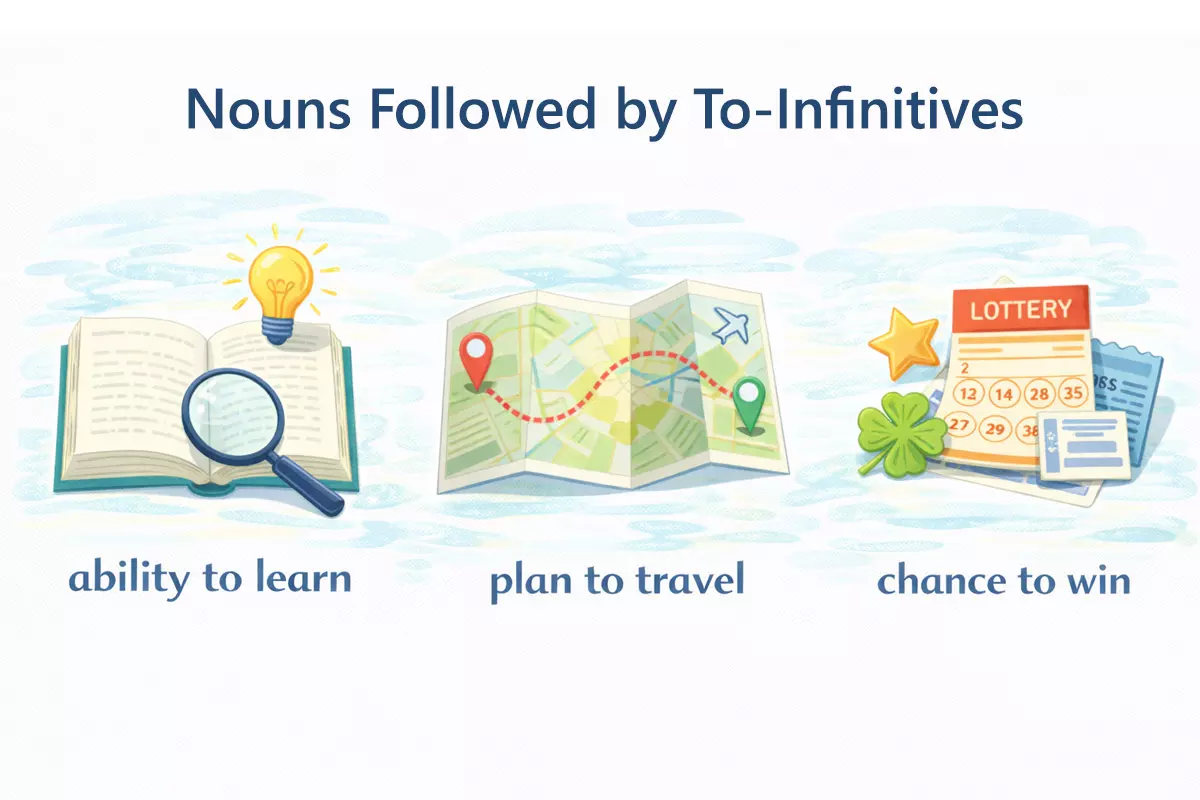
- ability to swim → He has the ability to swim very fast.
- request to speak → She sent a request to speak at the event.
- plan to travel → We have a plan to travel next month.
- permission to enter → They received permission to enter the building.
- desire to improve → He shows a desire to improve every day.
- failure to reply → His failure to reply caused problems.
- attempt to escape → The attempt to escape was unsuccessful.
- offer to help → She accepted his offer to help.
- refusal to cooperate → Their refusal to cooperate slowed progress.
- promise to return → He made a promise to return soon.
- motivation to succeed → She has strong motivation to succeed.
- opportunity to learn → This course gives students an opportunity to learn.
- intention to stay → They expressed an intention to stay longer.
- right to vote → Every citizen has the right to vote.
- order to leave → They received an order to leave immediately.
- effort to solve → His effort to solve the problem paid off.
In these examples, the to-infinitive often answers “what for?” or “which kind?” about the noun.
Verb + to-infinitive: Expressing Actions or Intentions
With verbs, the to-infinitive usually describes a following action, intention, or plan. The verbs that take this pattern include:
- agree to go → They agree to go on holiday together.
- decide to start → She decided to start a new project.
- hope to win → He hopes to win the race.
- plan to visit → We plan to visit Rome this summer.
- promise to help → She promised to help later.
- refuse to answer → He refused to answer the question.
- fail to notice → They failed to notice the mistake.
- offer to drive → She offered to drive us home.
- learn to swim → He is learning to swim this year.
- forget to call → I forgot to call my aunt.
- need to finish → We need to finish the report today.
- want to leave → They want to leave early.
- manage to complete → She managed to complete the task.
- prepare to move → They are preparing to move house.
- attempt to explain → He attempted to explain the idea.
- choose to stay → We chose to stay at home.
- afford to buy → She can’t afford to buy a new car.
- threaten to quit → He threatened to quit the team.
Here, the to-infinitive is closely linked to the subject’s action or intention.
Comparing the Patterns
The main contrast is that nouns followed by to-infinitives often describe a quality, possibility, or requirement, while verbs with to-infinitives point to the action a person will do or tries to do.
| Noun + to-infinitive | Verb + to-infinitive |
|---|---|
| He had a chance to win. | He hoped to win. |
| She made a decision to leave. | She decided to leave. |
| They received permission to enter. | They were allowed to enter. |
| We made an attempt to escape. | We tried to escape. |
| He had a desire to improve. | He wanted to improve. |
Summary of Usage
- Use noun + to-infinitive to specify the purpose or nature of the noun.
- Use verb + to-infinitive to express what the subject intends, hopes, or manages to do.
- The noun pattern is often more formal or abstract.
- The verb pattern is more direct and action-focused.
- Choosing the correct pattern makes your English sound natural and precise.
Using noun + to-infinitive in formal and neutral writing
In academic and professional English, pairing nouns with to-infinitive forms is a common way to express aims, intentions, or requirements concisely. This construction helps clarify what needs to be done, expected, or considered, often making statements more precise and less ambiguous.
Common contexts for noun + to-infinitive patterns
Writers frequently use these structures to describe plans, opportunities, or obligations without lengthy explanations. Some typical scenarios include:
- Stating objectives: the decision to expand
- Describing opportunities: a chance to participate
- Expressing needs: the need to improve
- Referring to requests: a request to review
- Outlining requirements: a requirement to submit
- Indicating intentions: an intention to collaborate
- Highlighting offers: an offer to assist
- Identifying abilities: the ability to adapt
- Signaling motivation: motivation to learn
- Marking permission: permission to proceed
- Signifying failure or success: failure to comply, success to achieve
- Conveying promises: a promise to deliver
- Stating ambition: an ambition to lead
- Expressing willingness: willingness to participate
- Showing reluctance: reluctance to change
Formal vs. informal alternatives
While noun + to-infinitive combinations are prevalent in formal documents, they may sound overly stiff in everyday conversation. For instance, "the decision to postpone" is more suited to reports, whereas "we decided to postpone" is typical in casual speech.
Structural variations and clarity
This pattern is especially useful for avoiding wordiness. Instead of writing "the fact that it is necessary to submit the form," you can simply say "the requirement to submit the form." Such constructions are favored in policies, guidelines, and academic prose for their clarity and brevity.
| Noun | Example with to-infinitive |
|---|---|
| Ability | Her ability to solve problems impressed the committee. |
| Chance | The chance to study abroad is a unique opportunity. |
| Decision | The decision to merge was unanimous. |
| Need | There is a need to update the policy regularly. |
| Plan | The plan to expand operations was well received. |
| Promise | He made a promise to support the project. |
| Request | We received a request to provide more details. |
| Requirement | One requirement to apply is fluency in English. |
| Offer | The offer to assist was appreciated. |
| Tendency | There is a tendency to overlook minor errors. |
Tips for effective use
When integrating noun + to-infinitive structures, ensure the noun naturally supports an action or state. Avoid forced constructions, and prefer this form when summarizing requirements, intentions, or options. This approach not only streamlines your writing but also enhances its formality and precision.
Typical learner mistakes with incorrect verb forms
Learners often face confusion when combining nouns and to-infinitives, especially regarding which verb form to use. This confusion can lead to sentences that sound unnatural or are grammatically incorrect. One widespread issue is using the base form or gerund where the to-infinitive is needed, or vice versa. Misunderstanding the structure can also result in tense or agreement errors.
Common errors when forming to-infinitives after nouns
- Using the gerund instead of the to-infinitive: The decision of going instead of The decision to go.
- Inserting an unnecessary subject: The plan for us to study (sometimes correct, but often misused).
- Omitting "to": The chance win instead of The chance to win.
- Using the past tense: The need to went instead of The need to go.
- Confusing modal verbs with noun + to-infinitive patterns: The ability can swim instead of The ability to swim.
- Pluralizing the noun incorrectly: Opportunities to learns instead of Opportunities to learn.
- Placing the infinitive before the noun: To eat the desire instead of The desire to eat.
- Redundant infinitives: The request to to leave.
- Using the bare infinitive: The offer help instead of The offer to help.
- Misapplying the pattern to nouns that don't take infinitives: The knowledge to speak (should be knowledge of speaking or how to speak).
- Adding unnecessary prepositions: The proposal of to meet.
- Incorrect word order: To win the chance instead of The chance to win.
- Using "for" incorrectly: The opportunity for to travel instead of The opportunity to travel.
- Double marking tense: The intention to went instead of The intention to go.
- Using a finite clause: The suggestion that he goes where The suggestion to go is needed.
- Applying the infinitive where a gerund is required: The enjoyment to swim instead of The enjoyment of swimming.
- Using passive incorrectly: The right to be invited (sometimes correct, but often misapplied).
- Misplacing adverbs: The chance quickly to finish instead of The chance to finish quickly.
Comparing correct and incorrect forms
| Incorrect Example | Correct Form |
|---|---|
| The decision of going | The decision to go |
| The chance win | The chance to win |
| Opportunities to learns | Opportunities to learn |
| The offer help | The offer to help |
| The proposal of to meet | The proposal to meet |
| The enjoyment to swim | The enjoyment of swimming |
| The ability can swim | The ability to swim |
| The need to went | The need to go |
When learning these structures, it helps to memorize which nouns are typically followed by to-infinitives and to practice with authentic examples. Reviewing common pitfalls and comparing them to correct forms can increase accuracy and confidence in using modern English grammar.
Practice: complete noun + to-infinitive sentence patterns
Understanding how certain nouns combine with to-infinitives is essential for constructing clear and idiomatic sentences in modern English. This section offers targeted activities to help you recognize and correctly use these patterns, whether in writing or speech.
Common nouns often followed by to-infinitives
Some nouns naturally take a to-infinitive to express purpose, intention, or potential. Review this selection of common examples:
- decision to (e.g., decision to leave)
- ability to (e.g., ability to solve problems)
- chance to (e.g., chance to win)
- effort to (e.g., effort to improve)
- offer to (e.g., offer to help)
- plan to (e.g., plan to travel)
- refusal to (e.g., refusal to cooperate)
- request to (e.g., request to join)
- opportunity to (e.g., opportunity to study)
- promise to (e.g., promise to return)
- failure to (e.g., failure to comply)
- need to (e.g., need to adapt)
- permission to (e.g., permission to enter)
- desire to (e.g., desire to learn)
- wish to (e.g., wish to participate)
- attempt to (e.g., attempt to escape)
- intention to (e.g., intention to resign)
- right to (e.g., right to vote)
- motivation to (e.g., motivation to succeed)
- request to (e.g., request to speak)
Complete the sentences
Fill in the blanks with an appropriate noun + to-infinitive pattern from the list above. Adjust the form if necessary.
- She finally made the ____________ move abroad.
- He was given ____________ access the documents.
- The company has no ____________ expand this year.
- We welcomed his ____________ help with the project.
- They expressed a strong ____________ learn more.
- There was little ____________ repair the damage.
- Her ____________ participate surprised everyone.
- Their ____________ comply led to consequences.
Show answers
- decision to
- permission to
- plan to
- offer to
- desire to
- opportunity to
- wish to
- failure to
Identify the correct pattern
Choose the correct noun + to-infinitive combination for each sentence.
- I had no ____________ (need/opportunity) to attend the meeting.
- His ____________ (refusal/attempt) to cooperate was unexpected.
- Do you have the ____________ (right/effort) to access this data?
- Their ____________ (plan/promise) to leave was clear.
- She made an ____________ (offer/request) to speak at the event.
- He showed a strong ____________ (desire/failure) to succeed.
- The company announced a ____________ (decision/chance) to expand.
- We received ____________ (permission/ability) to enter the area.
- They made an ____________ (effort/refusal) to solve the problem.
- I finally had ____________ (time/tendency) to relax.
Show answers
- opportunity to
- refusal to
- right to
- plan to
- request to
- desire to
- decision to
- permission to
- effort to
- time to
Quick reference: Patterns and sample sentences
Below is a structured overview of representative nouns and their to-infinitive combinations with example sentences.
| Noun | Example Sentence |
|---|---|
| decision to | Her decision to change careers surprised everyone. |
| ability to | He has the ability to solve complex problems. |
| promise to | She made a promise to return soon. |
| attempt to | Their attempt to escape was unsuccessful. |
| offer to | They received an offer to join the team. |
| refusal to | His refusal to participate was disappointing. |
| opportunity to | We had an opportunity to learn from experts. |
| plan to | Our plan to visit Paris was postponed. |
Exploring and practicing these patterns will help you use noun + to-infinitive structures more naturally in both formal and informal English.