Nouns Followed by -ing Forms in Spoken and Written English

 The article details which nouns are typically followed by -ing forms, how these differ from direct objects, and explores meaning relationships. It also compares noun plus -ing to noun plus to-infinitive, discusses register, common mistakes, and provides practice.
- Which nouns are commonly followed by -ing forms
- Difference between -ing complements and direct objects
- Meaning relationships in noun + -ing patterns
- Comparing noun + -ing with noun + to-infinitive forms
- Register differences in spoken and written usage
- Common errors with -ing after nouns
- Practice: choose correct -ing forms after given nouns
Have you ever noticed that some English nouns are commonly followed by verbs ending in -ing? This pattern, seen in phrases like "have difficulty understanding" or "spend time working," highlights the way certain nouns and gerunds naturally fit together in both spoken and written language. Understanding these pairings can help learners sound more fluent and recognize subtle differences between everyday conversation and more formal contexts, making communication clearer and more effective.
Which nouns are commonly followed by -ing forms
Many nouns in English are naturally linked to -ing forms (gerunds) when they describe actions, habits, or activities. This pattern is especially frequent in both spoken and written language, helping to express ideas clearly and concisely. The -ing form often acts as the object of the noun, indicating what the action or process is about.
Frequent nouns used with -ing forms
Some nouns are much more likely to be followed by an -ing word. These tend to refer to processes, feelings, plans, or experiences. Here’s a list of nouns that commonly appear before an -ing form:
- chance → She has a chance of winning the match.
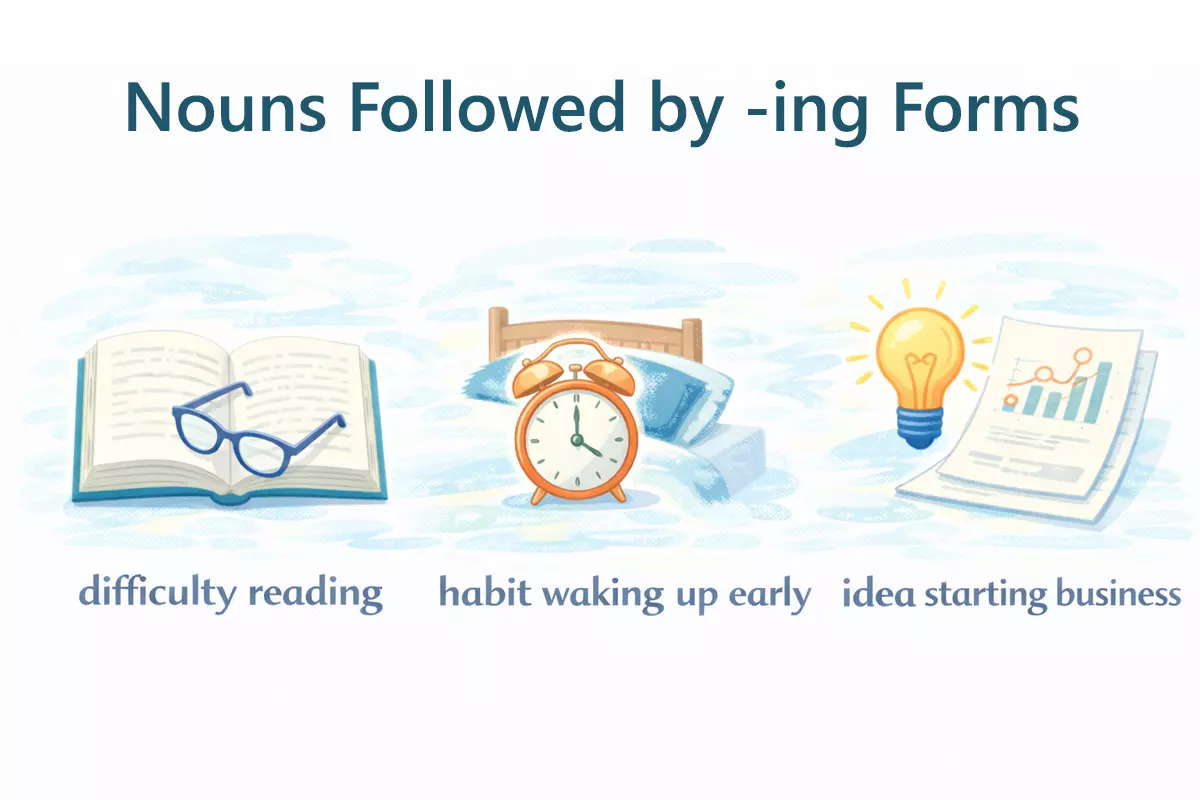
- difficulty → He had difficulty in understanding the lesson.
- experience → She has experience in managing projects.
- habit → He has a habit of smoking too much.
- idea → I like the idea of starting a business.
- interest → They showed interest in learning English.
- method → We used a method of solving the puzzle.
- possibility → There is a possibility of meeting tomorrow.
- problem → We faced a problem of finding volunteers.
- reason → What is the reason for leaving early?
- risk → She took a risk of falling during the race.
- trouble → He had trouble in getting up so early.
- way → This is a way of improving your writing.
- advantage → One advantage of being tall is better reach.
- disadvantage → A disadvantage of living alone is loneliness.
- fear → She has a fear of missing important news.
- process → The process of learning takes time.
- opportunity → We had an opportunity of working abroad.
- task → They finished the task of organizing the files.
- responsibility → Parents have responsibility for making decisions.
Patterns and prepositions
The connection between these nouns and -ing forms often relies on certain prepositions, such as of, in, or for. For example, "method of solving," "interest in learning," or "reason for leaving." The choice of preposition depends on the noun and is important to use naturally.
Examples in context

Seeing these noun + -ing combinations in real sentences can clarify their usage:
- She has a habit of checking her phone every hour.
- They discussed the possibility of moving abroad.
- He struggled with the problem of getting accurate data.
- I have some experience in teaching English.
Comparison of noun + -ing patterns
| Noun | Typical -ing Form Example |
|---|---|
| difficulty | difficulty in understanding instructions |
| interest | interest in learning new languages |
| method | method of solving problems |
| risk | risk of losing money |
| reason | reason for leaving early |
| way | way of improving skills |
These patterns are widely used in both formal and informal English. Recognizing common nouns that take -ing forms can make your language more natural and precise, especially when describing actions, experiences, or processes.
Difference between -ing complements and direct objects
Understanding how -ing forms function after nouns is key for both clarity and accuracy in English. Sometimes, a noun is closely followed by an -ing word (like “reading” or “swimming”), but the relationship between the noun and the -ing form can be quite different depending on the structure and meaning.
-ing complements typically occur when the noun refers to an activity, habit, or process, and the -ing form provides essential information to complete the meaning. In these cases, the -ing word is not an object of the noun, but rather a complement that clarifies or specifies what the noun is about. For example, “His addiction to gambling” or “Her interest in painting.” The -ing form isn’t something the noun “does” or “receives,” but rather describes the content or focus.
In contrast, a direct object after a noun is rare and typically only possible when the noun is derived from a verb that can take an object. Even so, in English, it’s more common for the direct object to follow the verb, not the noun. For example, in “the observation of birds,” “birds” is the object of “observation,” but if you use an -ing form (“the observation of birdwatching”), it changes the meaning: now, “birdwatching” is an activity being observed, not the direct object of “observation.”
Key distinctions
- Complement: The -ing form completes the idea started by the noun. Example: “His fear of flying.”
- Direct object: The noun (if derived from a verb) might take an object, but this is usually a noun or pronoun, not an -ing form. Example: “The proposal of changes.”
Common nouns followed by -ing complements
- advantage of doing → One advantage of doing homework early is having free time later.
- chance of winning → She has a good chance of winning the competition.
- choice between staying and leaving → He faced a difficult choice between staying and leaving.
- danger of slipping → There is a danger of slipping on the ice.
- difficulty in understanding → He had difficulty in understanding the instructions.
- experience in managing → She has experience in managing large teams.
- habit of smoking → He has the habit of smoking after dinner.
- idea of starting → I like the idea of starting my own business.
- interest in learning → She showed great interest in learning French.
- method of solving → We are looking for a better method of solving this problem.
- opportunity of meeting → The event gave us the opportunity of meeting new people.
- possibility of finding → There is a possibility of finding a solution.
- problem of getting → We faced the problem of getting enough volunteers.
- reason for leaving → He gave a clear reason for leaving the job.
- risk of falling → She took the risk of falling from the ladder.
- trouble in hearing → He has trouble in hearing quietly spoken words.
- way of improving → This book offers a good way of improving vocabulary.
Comparison: -ing complements vs. direct objects
| -ing Complement Example | Direct Object Example |
|---|---|
| She has a fear of flying. | She made a proposal of changes. |
| They discussed the idea of moving. | They announced the cancellation of classes. |
| He explained the method of solving the puzzle. | He described the solution to the problem. |
| We talked about the risk of losing money. | We evaluated the impact of the policy. |
In summary, -ing complements are used to complete or specify the meaning of a noun, while direct objects act as the receiver of the noun’s action (when the noun is derived from a verb). Recognizing this distinction is important for natural, accurate English in both speech and writing.
Meaning relationships in noun + -ing patterns
When a noun is followed by an -ing form, the connection between the two words is rarely random. In most cases, the -ing form expresses a specific relationship to the noun it follows. Understanding these relationships helps learners interpret and produce natural English in both speech and writing.
Common Types of Relationships
The -ing form after a noun can describe a range of meanings. Sometimes, it shows what the noun does; other times, it reveals what is done to the noun, or it may express purpose, result, or context. Here are some of the most frequent relationships:
- Subject: The noun performs the action. Example: student reading (the student reads)
- Object: The noun receives the action. Example: book signing (someone signs the book)
- Purpose: The -ing form explains why the noun exists. Example: washing machine (a machine for washing)
- Result: The -ing form shows what results from the noun. Example: building collapse (a collapse caused by a building)
- Context or time: The -ing form describes when or in what situation the noun is relevant. Example: meeting room (a room used during meetings)
Examples of Noun + -ing Combinations
The following table highlights a variety of noun + -ing form pairings and their typical interpretations:
| Noun + -ing Form | Relationship/Interpretation |
|---|---|
| traffic jam | Result (a jam caused by traffic) |
| training session | Purpose (a session for training) |
| reading material | Purpose (material for reading) |
| shopping center | Purpose (a center for shopping) |
| smoking area | Purpose (area designated for smoking) |
| cooking class | Purpose (a class for cooking) |
| sleeping bag | Purpose (a bag for sleeping in) |
| hearing aid | Purpose (aid for hearing) |
| walking tour | Type/Method (a tour done by walking) |
| parking lot | Purpose (a lot for parking) |
| meeting point | Context (a point for meeting) |
| driving test | Purpose (a test of driving ability) |
| fishing boat | Purpose (a boat used for fishing) |
| gardening tools | Purpose (tools for gardening) |
| broadcasting company | Activity (a company that broadcasts) |
| training manual | Purpose (manual for training) |
| swimming pool | Purpose (pool for swimming) |
| teaching method | Purpose/Activity (method for teaching) |
| building permit | Object (permit to build) |
| running shoes | Purpose (shoes for running) |
Why These Relationships Matter
Recognizing the link between the noun and the -ing form clarifies meaning and avoids confusion. For English learners, being aware of these typical patterns helps with vocabulary building and more accurate language production. It’s also important for interpreting new combinations you encounter in real-world communication.
Comparing noun + -ing with noun + to-infinitive forms
Choosing between a noun followed by an -ing form or a to-infinitive often depends on the noun itself and the meaning intended. Some nouns naturally take one pattern, while others can accept both, sometimes with a subtle difference in meaning. In spoken and written English, these patterns can signal preferences, intentions, or even completed versus potential actions.
Common Patterns and Preferences

Certain nouns are almost always followed by an -ing form, such as "chance of," "interest in," or "difficulty in." Others, like "decision to" or "ability to," typically pair with a to-infinitive. However, some nouns allow both structures, with slight changes in nuance or usage.
- Advantage of doing – There's an advantage of using recycled materials.
- Chance to do – She had a chance to present her research.
- Preference for doing – He has a preference for working alone.
- Decision to do – The decision to relocate was unanimous.
- Hope of doing – They had little hope of recovering the data.
- Ability to do – Her ability to adapt impressed everyone.
- Reason for doing – What's your reason for leaving early?
- Plan to do – Our plan to expand was approved.
- Excuse for doing – There’s no excuse for breaking the rules.
- Request to do – The request to postpone was granted.
- Method of doing – This is the most efficient method of solving the issue.
- Promise to do – He made a promise to return soon.
- Opportunity to do – Don’t miss the opportunity to learn new skills.
- Intention of doing – She had no intention of quitting.
- Failure to do – Failure to follow instructions can be costly.
Subtle Differences in Meaning
Sometimes, the choice between -ing and to-infinitive changes the nuance. While both forms may be grammatically correct, one may emphasize the process or activity itself, and the other may focus on the possibility or intention.
| Noun + -ing | Noun + to-infinitive |
|---|---|
| chance of winning | chance to win |
| opportunity of meeting | opportunity to meet |
| intention of leaving | intention to leave |
| plan for building | plan to build |
| method of achieving | method to achieve |
| reason for staying | reason to stay |
Notes on Usage
- Noun + -ing often refers to the action in general or as a process (e.g., "method of solving"). - Noun + to-infinitive usually points to a specific action, intention, or future possibility (e.g., "plan to solve"). - Some nouns, like "decision," almost always take a to-infinitive, while others, such as "interest," prefer the -ing form. Understanding these subtle distinctions can help make your spoken and written English more precise and natural.
Register differences in spoken and written usage
Patterns involving nouns followed by -ing forms show notable contrasts between everyday conversation and formal writing. In speech, speakers often use shorter, less formal noun + -ing combinations, sometimes with incomplete or loosely connected phrases. Written texts, especially academic or technical ones, favor more precise, structured patterns and a broader range of nouns before -ing forms.
Common patterns in conversation
In informal spoken English, certain nouns are frequently paired with -ing forms to express activities, routines, or ongoing processes. These combinations tend to be direct and context-driven. Some typical examples include:
- Have trouble finding
- Spend time doing
- Get used to working
- See someone leaving
- Hear people talking
- Catch someone cheating
- Have fun playing
- Waste time arguing
- Notice someone crying
- Find yourself thinking
Speakers often rely on these collocations for efficiency and clarity, sometimes omitting explicit subjects or objects if the meaning is clear from context.
Written English: expanded range and complexity
In contrast, written registers—such as academic articles, reports, and essays—tend to use a wider variety of head nouns before -ing forms. Writers often choose nouns that convey abstract ideas, processes, or systematic actions. The noun + -ing construction is also more likely to be embedded in longer, more complex sentences. Examples of noun + -ing patterns found more often in writing include:
- The process of developing
- The importance of understanding
- The possibility of achieving
- The risk of missing
- The effect of increasing
- The task of organizing
- The challenge of balancing
- The difficulty of explaining
- The benefit of exercising
- The impact of reducing
- The practice of recycling
- The issue of funding
- The method of calculating
- The aim of improving
- The danger of ignoring
Such structures are valued for their precision and ability to express nuanced relationships between concepts.
Comparing spoken and written usage
To illustrate the contrast, the table below shows typical noun + -ing combinations found in informal speech versus those prevalent in formal writing:
| Spoken English | Written English |
|---|---|
| Have trouble sleeping | The issue of sleeping disorders |
| Spend time studying | The importance of studying techniques |
| Get used to driving | The process of learning to drive |
| Waste time waiting | The problem of waiting times |
| Have fun dancing | The benefits of dancing |
| Notice people talking | The effect of talking in class |
Summary of register differences
Overall, the choice of noun + -ing forms reflects the level of formality and communicative goals. Conversation favors brevity and immediacy, while academic or formal writing requires more carefully constructed, context-rich phrases. Recognizing these patterns helps learners adjust their language use for different contexts and audiences.
Common errors with -ing after nouns
Many English learners struggle with the correct use of -ing forms following nouns, especially since spoken and written English sometimes differ in flexibility. These mistakes often stem from confusion between gerunds, infinitives, and other noun modifiers, or from translating directly from a first language. Understanding the most frequent slip-ups can help you become more accurate and natural in your usage.
Mixing up gerunds and infinitives
One of the most common issues is choosing the wrong form after certain nouns. Some nouns are typically followed by -ing forms, while others require an infinitive. For example, learners might say "a chance meeting him" instead of "a chance to meet him". This can make sentences sound awkward or unclear.
Omitting necessary prepositions
After some nouns, a preposition is required before the -ing form, but it’s easy to leave it out. For example, "interest reading" should be "interest in reading". Missing the preposition leads to ungrammatical phrases.
Confusing participles with gerunds
Occasionally, an -ing form after a noun may be misused as a present participle, changing the meaning of the sentence. For instance, "the problem solving" (meaning the act of solving) is different from "the problem, solving it" (where "solving" describes an action related to "the problem").
Frequent error patterns
- Saying "the possibility to win" instead of "the possibility of winning"
- Using "the idea to travel" instead of "the idea of traveling"
- Writing "the reason leaving" instead of "the reason for leaving"
- Incorrect: "advantage using" → Correct: "advantage of using"
- Incorrect: "difficulty to understand" → Correct: "difficulty understanding" or "difficulty in understanding"
- Omitting prepositions: "fear flying" → "fear of flying"
- Confusing patterns: "plan going" instead of "plan to go"
- Redundant prepositions: "opportunity for to work" instead of "opportunity to work"
- Literal translations: "the habit do" instead of "the habit of doing"
- Using infinitives where -ing is needed: "interest to learn" instead of "interest in learning"
- Switching noun + -ing for noun + relative clause: "the suggestion working late" vs. "the suggestion that we work late"
- Unnecessary articles: "a advice giving" instead of "giving advice"
- Improper word order: "the chance winning the prize" instead of "the chance of winning the prize"
- Incorrect gerund formation: "the risk to fail" instead of "the risk of failing"
- Using -ing after nouns that do not allow it: "the request going" instead of "the request to go"
Comparison of correct and incorrect patterns
| Incorrect Example | Correct Form |
|---|---|
| the possibility to win | the possibility of winning |
| interest reading | interest in reading |
| plan going | plan to go |
| habit do | habit of doing |
| request going | request to go |
| reason leaving | reason for leaving |
| advantage using | advantage of using |
| difficulty to understand | difficulty understanding |
To avoid these pitfalls, pay close attention to which nouns typically collocate with -ing forms, and always check if a preposition or a different structure is needed. Listening to natural spoken English and reading authentic texts can help reinforce the correct patterns.
Practice: choose correct -ing forms after given nouns
Understanding which nouns are commonly followed by -ing forms is essential for fluent English. Below, you’ll find exercises and examples to help you recognize and use these patterns, especially in conversation and writing. Review the tasks and try to select the right -ing form for each noun.
Task 1: Select the correct -ing form
For each sentence, choose the correct -ing form that naturally follows the noun.
- He has no interest in (swim / swimming) early in the morning.
- She made a habit of (read / reading) before bed.
- We have difficulty (understand / understanding) his accent.
- There is a chance of (rain / raining) later today.
- He took pride in (finish / finishing) the project on time.
Show answers
- swimming
- reading
- understanding
- raining
- finishing
Common Nouns That Take -ing Forms
Here’s a list of nouns that are frequently followed by an -ing form. Note how these patterns appear in both spoken and written English:
- interest in (e.g., interest in learning)
- reason for (e.g., reason for leaving)
- chance of (e.g., chance of winning)
- difficulty in (e.g., difficulty in finding)
- habit of (e.g., habit of smoking)
- problem with (e.g., problem with parking)
- experience in (e.g., experience in managing)
- responsibility for (e.g., responsibility for organizing)
- opportunity of (e.g., opportunity of meeting)
- method of (e.g., method of solving)
- excuse for (e.g., excuse for being late)
- way of (e.g., way of thinking)
- possibility of (e.g., possibility of failing)
- advantage of (e.g., advantage of exercising)
- risk of (e.g., risk of falling)
- fear of (e.g., fear of flying)
- process of (e.g., process of learning)
- hope of (e.g., hope of finding)
- plan for (e.g., plan for expanding)
- idea of (e.g., idea of starting)
Task 2: Match the noun to a suitable -ing form
Connect each noun to an appropriate -ing form from the list below:
- 1. method of
- 2. excuse for
- 3. difficulty in
- 4. fear of
- 5. chance of
- a) missing the bus
- b) solving the puzzle
- c) being late
- d) learning English
- e) flying
Show answers
- 1 – b) solving the puzzle
- 2 – c) being late
- 3 – d) learning English
- 4 – e) flying
- 5 – a) missing the bus
Quick Reference: Noun + -ing Patterns
Here is a reference for combining nouns with -ing forms in everyday English:
- She has a habit of snacking at night.
- There’s no reason for worrying about it.
- He has experience in teaching.
- They saw the advantage of arriving early.