Personal Nouns and Social Roles in Everyday English Usage

 The article defines personal nouns in English, lists common nouns for identity and roles, examines their use in family, work, and society, compares formal and informal options, addresses cultural sensitivity, notes learner errors, and offers practice using them.
- What personal nouns represent in English usage
- Common personal nouns for identity and roles
- Social role nouns in family, work, and society
- Formal vs informal personal noun choices
- Cultural sensitivity in using personal and role nouns
- Typical learner errors with role-based nouns
- Practice: describe people using accurate personal nouns
Everyday conversations are rich with words that reflect our identities and relationships, subtly shaping how we interact and perceive one another. The language we use to describe people and their roles in society reveals underlying cultural values and social structures. By examining the terms and expressions we choose, we gain insight into how language both mirrors and influences our understanding of community, belonging, and individual roles. This exploration highlights the powerful connection between language and the way we navigate our social world.
What personal nouns represent in English usage
Personal nouns play a crucial role in how English speakers identify, classify, and relate to people in daily communication. These nouns refer to individuals or groups based on characteristics like role, relationship, profession, or even personality traits. Instead of simply naming a person, they often signal social context, status, or expectations.
Types of personal nouns and their social functions
English uses a wide range of words to label people according to their roles or relationships. This includes family terms, job titles, and more abstract labels for personality or group identity. The choice of noun can reflect formality, respect, affection, or even bias.
- Family roles: mother, uncle, cousin, grandmother, sibling
- Occupational titles: teacher, nurse, engineer, chef, artist
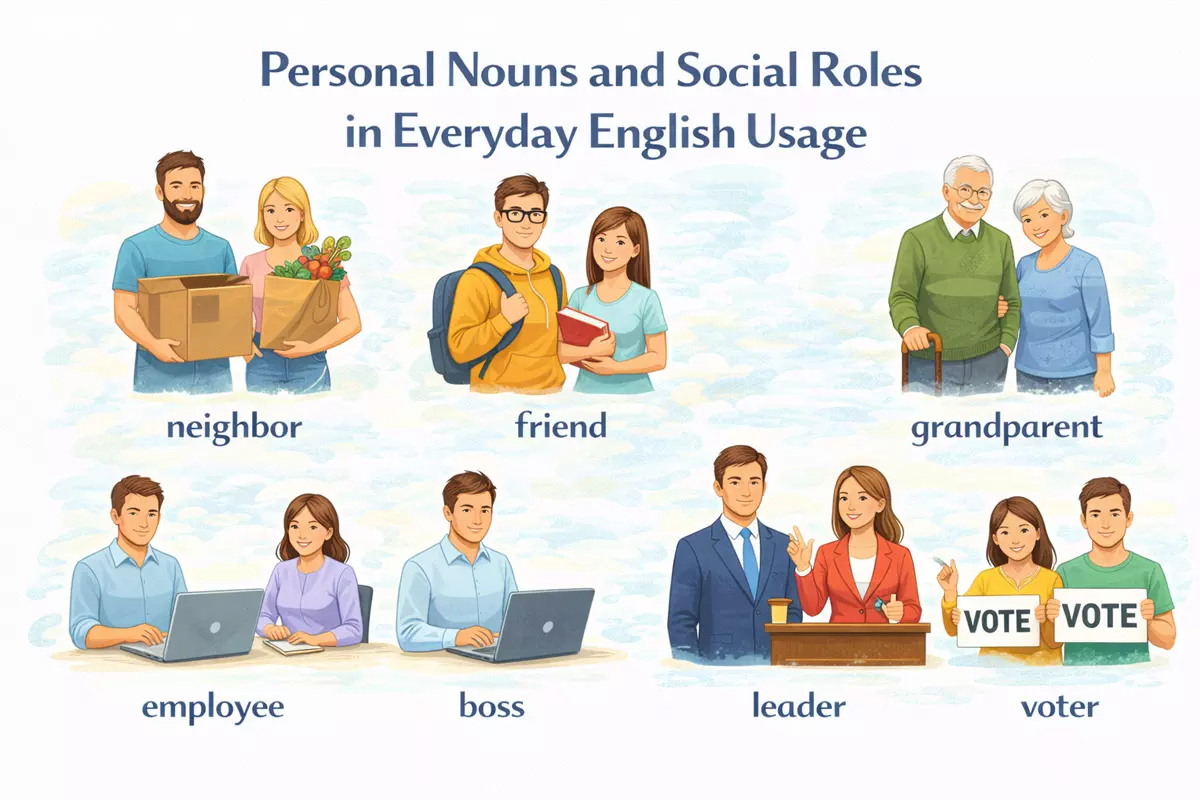
- Social relationships: friend, neighbor, colleague, classmate
- Group identities: citizen, member, participant, leader
- General descriptors: individual, person, stranger, guest
- Pronoun-based nouns: he, she, they (when used as stand-ins for people)
- Personality descriptors: optimist, introvert, skeptic, visionary
- Authority figures: judge, president, captain, principal
- Honorifics and titles: Mr., Ms., Dr., Sir, Madam
- Age-related terms: child, teenager, adult, elder
- Relationship status: spouse, partner, widow, fiancé
- Nationality or origin: American, Briton, Canadian, Spaniard
How context shapes the meaning of personal nouns
The social nuances of these nouns become clear in conversation. For example, addressing someone as “doctor” versus “Mr.” may convey respect or acknowledge expertise. Using informal terms like “buddy” or “pal” suggests familiarity, while titles like “manager” or “officer” indicate hierarchy or responsibility.
Comparing personal nouns by function
Some personal nouns overlap in meaning but differ in connotation, register, or specificity. Here’s a structured look at how various forms compare in English:
| Type of Personal Noun | Example Usage |
|---|---|
| Relational | “My cousin lives abroad.” |
| Professional | “The engineer fixed the issue.” |
| Descriptive | “She’s a real optimist.” |
| Honorific/Title | “Dr. Lee will see you now.” |
| Group/Collective | “Every citizen has rights.” |
| General | “A person should be honest.” |
Why personal nouns matter in social interaction
Using the right noun helps speakers navigate politeness, authority, and emotional distance. For example, calling someone by their first name versus their title can change the tone of a conversation. In summary, these nouns are more than labels—they’re tools for building relationships, expressing attitudes, and defining social roles in everyday English.
Common personal nouns for identity and roles
Everyday English is full of words that describe who people are and the part they play in society. These personal nouns help us talk about professions, relationships, and individual identities. Understanding their usage is essential for effective communication, whether you’re describing yourself, others, or talking about broader groups.
Personal nouns by occupation and role
Many terms refer to what someone does for a living or their specific function in a group. Here are some frequently used examples:
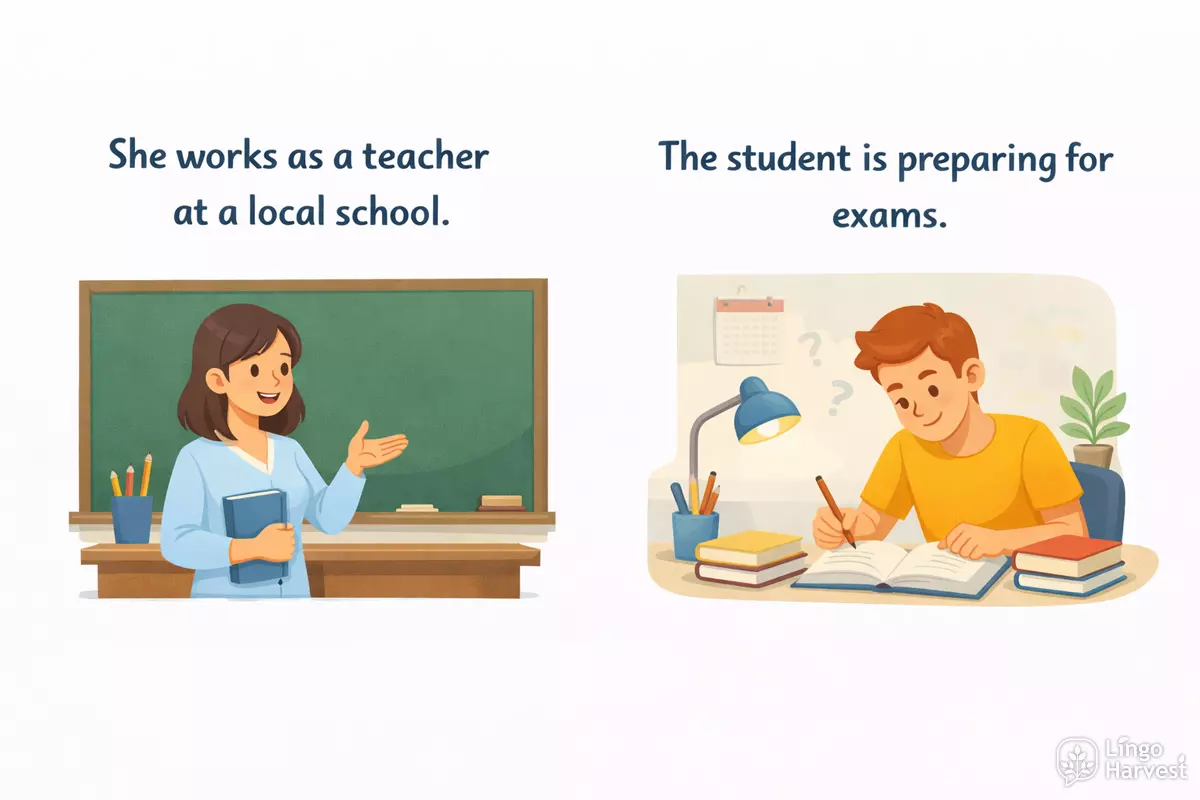
- teacher → She works as a teacher at a local school.
- student → The student is preparing for exams.
- doctor → He visited the doctor for a check-up.
- nurse → The nurse helped the patient.
- engineer → She is an engineer in a tech company.
- artist → The artist exhibited his work.
- driver → The driver stopped the bus.
- manager → The manager led the meeting.
- chef → The chef prepared a special dish.
- scientist → The scientist conducted an experiment.
- athlete → The athlete trained every day.
- musician → The musician played the piano.
- writer → The writer published a new book.
- mechanic → The mechanic fixed the car.
- farmer → The farmer grows vegetables.
Identity nouns in family and social contexts
Words for family members and social connections also play a major role in daily conversation. These nouns often carry emotional weight and help define relationships:
- mother → My mother works from home.
- father → His father taught him to drive.
- sister → My sister lives in another city.
- brother → Her brother plays football.
- friend → I met a friend after work.
- neighbor → Our neighbor moved in last week.
- colleague → I discussed the project with a colleague.
- partner → She runs the business with her partner.
- child → The child was playing in the yard.
- parent → Every parent wants the best for their child.
Comparing gendered and neutral forms
Some English nouns have both gender-specific and gender-neutral versions. This is important in modern contexts where inclusive language is valued. Here’s a comparison of several common pairs:
| Gendered Form | Gender-Neutral Form |
|---|---|
| actor / actress | actor |
| waiter / waitress | server |
| policeman / policewoman | police officer |
| steward / stewardess | flight attendant |
| chairman / chairwoman | chairperson / chair |
Other forms that signal roles or group membership
Beyond jobs and relationships, English includes nouns that emphasize belonging or status. These can refer to age, experience, or participation:
- leader → The leader explained the plan to the team.
- member → She is a member of the local club.
- citizen → Every citizen has the right to vote.
- resident → The resident reported a noise issue.
- guest → We welcomed a guest from abroad.
- visitor → The museum attracts many visitors.
- volunteer → He works as a volunteer on weekends.
- expert → Ask an expert for professional advice.
- novice → As a novice, she is still learning the basics.
- student → The student submitted the assignment on time.
Choosing the right term not only clarifies meaning but also shows respect and awareness of social context. As language evolves, so do these words, reflecting changes in society and attitudes toward identity.
Social role nouns in family, work, and society
Everyday English relies on a wide range of words to describe people’s positions in the home, the workplace, and the broader community. These nouns identify how individuals relate to others, what responsibilities they hold, and the expectations society has for them. Understanding these terms helps clarify relationships and social structures.
Family roles: Words for relatives and home life
Family vocabulary is among the first personal nouns people learn. These terms can reflect biological relationships, legal ties, or emotional connections. For example:
- daughter → Their daughter starts school this year.
- son → His son loves playing football.
- aunt → My aunt lives in Canada.
- uncle → Her uncle taught her how to drive.
- cousin → I’m meeting my cousin this weekend.
- grandparent → The child visits a grandparent every summer.
- niece → His niece just turned five.
- nephew → She bought a gift for her nephew.
- stepfather → Her stepfather supports the family.
- stepmother → He gets along well with his stepmother.
- guardian → The guardian signed the school documents.
- sibling → She has one sibling.
- spouse → He discussed the decision with his spouse.
- in-law → They invited their in-laws for dinner.
- relative → A distant relative attended the wedding.
- household member → Every household member helps with chores.
These labels shape how people interact with each other and often come with specific roles or duties.
Workplace titles: Professional and organizational nouns
At work, nouns for social positions reflect hierarchy, expertise, and function. Some are gender-neutral, while others have changed over time to become more inclusive. Common examples include:
- Manager → The manager approved the new schedule.
- Employee → Every employee must follow the company rules.
- Colleague → I discussed the issue with a colleague.
- Supervisor → The supervisor checked our work.
- Intern → The intern starts work on Monday.
- Director → The director announced the new strategy.
- Assistant → The assistant prepared the documents.
- Boss → My boss called a meeting.
- Partner → She runs the business with her partner.
- Consultant → They hired a consultant for advice.
- Technician → The technician repaired the equipment.
- Worker → The worker finished the task early.
- Executive → The executive joined the board meeting.
- Owner → The owner sold the company.
- Leader → The leader motivated the team.
These nouns not only describe status but also hint at the responsibilities and relationships within a company.
Community and societal roles
Beyond family and work, English includes a range of nouns for roles in the community, government, and social groups. These can be formal or informal:
- Citizen → Every citizen has the right to vote.
- Neighbor → Our neighbor helped us move.
- Voter → Each voter received a ballot.
- Volunteer → She works as a volunteer on weekends.
- Official → The official signed the document.
- Member → He is a member of the committee.
- Resident → The resident reported the issue.
- Chairperson → The chairperson opened the meeting.
- Representative → The representative spoke for the group.
- Participant → Every participant received a certificate.
- Leader → The leader explained the plan.
- Advocate → She is an advocate for equal rights.
- Supporter → The supporter donated money.
- Opponent → His opponent challenged the decision.
- Judge → The judge announced the verdict.
These words help define how people interact in groups and institutions, and can signal authority, participation, or affiliation.
Comparing role nouns: Gender, formality, and modern usage
Some personal nouns have gendered forms or levels of formality, while others have shifted toward more neutral language. The table below highlights a few contrasts:
| Traditional Form | Modern/Neutral Form |
|---|---|
| Chairman | Chairperson / Chair |
| Policeman / Policewoman | Police officer |
| Stewardess | Flight attendant |
| Actor / Actress | Actor (all genders) |
| Fireman | Firefighter |
Social role nouns continue to evolve with society’s values, reflecting changes in gender equality, workplace culture, and social norms. Recognizing these words and their modern equivalents helps speakers communicate respectfully and precisely.
Formal vs informal personal noun choices
Choosing between formal and informal personal nouns can shape how speakers are perceived in different social settings. The language we use to refer to ourselves and others—words like “man,” “woman,” “guy,” “lady,” “gentleman,” or “kid”—often signals our relationship to the audience, the context, and the level of respect or familiarity we wish to convey.
Factors influencing noun choice
The selection of personal nouns depends on several factors:
- Audience: Professional or unfamiliar listeners usually receive more formal terms.
- Setting: Workplace, ceremonies, or academic contexts call for formality; casual gatherings favor relaxed nouns.
- Intent: To show respect, distance, or camaraderie.
- Regional variation: Some nouns are formal or informal only in certain dialects or cultures.
Common examples: contrasting pairs
Many English personal nouns have both formal and informal variants. Here are some common contrasts:
- man → guy, dude, fella
- woman → lady, gal, chick
- child → kid
- father → dad, pops
- mother → mom, mum, ma
- friend → buddy, mate, pal
- teacher → prof, coach
- colleague → coworker, workmate
- police officer → cop, bobby
- doctor → doc, medic
- gentleman → guy, bloke
- lady → woman, gal
- child (neutral) → kiddo, youngster
- parent → folks, old man/lady
- boss → chief, head honcho
- senior citizen → old-timer, geezer
- assistant → helper, sidekick
- partner (business) → associate, buddy
Implications of noun selection
Using a formal noun can signal respect, maintain a professional boundary, or show deference. In contrast, informal nouns often express friendliness, solidarity, or a relaxed atmosphere. However, using an overly casual term in a formal setting may seem disrespectful or unprofessional, while too much formality among friends can sound distant or odd.
Summary comparison
Below is a quick reference showing typical differences between formal and informal personal nouns in English:
| Formal Noun | Informal Noun |
|---|---|
| Gentleman | Guy |
| Woman | Gal |
| Child | Kid |
| Father | Dad |
| Mother | Mom |
| Colleague | Workmate |
| Police officer | Cop |
| Doctor | Doc |
| Senior citizen | Old-timer |
| Assistant | Sidekick |
Choosing the right noun is a subtle but important part of effective communication, reflecting both social awareness and linguistic flexibility.
Cultural sensitivity in using personal and role nouns
Choosing the right words to describe people and their roles requires an understanding of cultural backgrounds, expectations, and evolving norms. What may seem neutral or polite in one context could be inappropriate or outdated in another. Awareness of these nuances helps avoid misunderstandings and makes communication more inclusive.
Factors influencing language choices
- Historical usage: Some terms carry historical baggage or have shifted in connotation over time.
- Individual preferences: People may prefer particular forms of address or identity labels.
- Social context: Formality, hierarchy, and setting (workplace, family, public) often affect word choice.
- Gender and inclusivity: Language is moving toward more gender-neutral and inclusive expressions.
- Regional variation: Terms common in one country or area might be rare or misunderstood elsewhere.
Examples of sensitive vs. insensitive usage
It’s helpful to compare different ways of referring to individuals and roles, noting which are considered modern, respectful, or outdated.
| Term | Notes |
|---|---|
| Firefighter | Preferred over "fireman" for gender neutrality |
| Chairperson / Chair | Inclusive alternative to "chairman" or "chairwoman" |
| Flight attendant | Replaces "stewardess" or "steward" (now considered dated) |
| Server / Waitstaff | Modern, less gendered than "waiter" or "waitress" |
| Person with a disability | Person-first language, preferred over "disabled person" |
| Police officer | Neutral; avoids gender-specific "policeman" or "policewoman" |
| They (singular) | Used for gender-neutral reference; widely accepted |
| Partner (relationship) | Inclusive of all relationship types; avoids assumptions |
| Senior / Older adult | More respectful than "elderly" or "old person" |
| Indigenous peoples | Preferred over outdated or colonial terms |
Tips for respectful communication
- Listen to how people refer to themselves and mirror that language when appropriate.
- If unsure, politely ask for a person’s preferred title or pronoun.
- Stay updated on changes in terminology, especially in professional and public contexts.
- Avoid assumptions based on appearance, name, or role; check before using specific terms.
- Recognize that language evolves—what’s acceptable today may shift in the future.
In sum, using names and titles with care reflects not just linguistic skill, but also respect for the diversity and dignity of those we address.
Typical learner errors with role-based nouns
Learners often encounter confusion when using nouns that refer to social positions or functions, especially when these words have specific grammatical or cultural requirements. Many of these mistakes arise from first-language interference, overgeneralization of rules, or unfamiliarity with English conventions.
Mixing Countable and Uncountable Forms
One frequent issue is treating certain role-based words as countable when they are not, or vice versa. For instance, "staff" is collective and typically uncountable, but beginners may say "a staff" instead of "a staff member" or "the staff are helpful."
Incorrect Gender or Neutral Forms
Another challenge is the use of gendered terms in situations where modern English prefers neutral language. For example, using "policeman" for any officer, rather than the neutral "police officer," or saying "chairman" instead of "chairperson" or "chair."
Errors with Articles and Plurals
Role nouns often require definite or indefinite articles, or may be used without them in general statements. Learners sometimes omit articles ("She is teacher" instead of "She is a teacher") or incorrectly pluralize titles ("two doctors" is correct, but "two doctor" is not).
Common Confusions and Overlaps
Some English words for social roles look similar but have distinct meanings. Mixing them up can cause misunderstandings.
- Using "actor" for both men and women, when "actress" may be expected in some contexts.
- Confusing "principal" (school head) and "principle" (moral rule).
- Calling a "chef" anyone who cooks, instead of specifically a professional cook.
- Misusing "manager" and "boss" as exact synonyms.
- Referring to a "customer" as a "client," or vice versa, without recognizing the context.
- Using "worker" for specialized roles, e.g., "office worker" instead of "clerk" or "assistant."
- Mixing up "guest" and "visitor" in hospitality and social settings.
- Saying "doctor" for any medical professional, ignoring "nurse," "surgeon," or "physician."
- Using "pupil" and "student" interchangeably, though "pupil" is mainly for young learners in British English.
- Calling a "waiter" a "server" or vice versa, not realizing regional preferences.
Patterns and Examples

Learners may also struggle with fixed expressions, titles, or roles that change meaning in different contexts. Consider the following examples and their correct usage:
- He is an engineer (not "He is engineer").
- She has been elected president (no article after "elected").
- My boss gave me a day off (not "My chief gave me...," unless referring to a specific role).
- They are staff members (not "stuffs").
- We met the mayor (not "We met mayor" without "the").
- She works as a nurse (not "as nurse").
- He is the director of the company (article required).
- Our teacher is kind (article optional when used as a general noun in some cases).
- My friend is a student (indefinite article needed).
- She is a scientist (not "She is scientist").
Comparison of Role-Based Noun Pairs
Some pairs of nouns are easily confused because they refer to similar but not identical roles. The table below highlights frequent mix-ups and their distinctions.
| Frequently Confused Noun | Correct Context/Meaning |
|---|---|
| Client → Customer | Client: professional services (lawyer, designer). Customer: general buyer (shop, store). |
| Chef → Cook | Chef: professional head of a kitchen. Cook: anyone who prepares food. |
| Boss → Manager | Boss: informal, any supervisor. Manager: official title, specific responsibility. |
| Principal → Principle | Principal: head of a school. Principle: a basic rule or law. |
| Waiter → Server | Waiter: traditional term for restaurant staff. Server: gender-neutral alternative, US English. |
Summary
Awareness of these common pitfalls, from article use to distinctions among similar terms, helps learners sound more natural in daily English. Paying attention to context, countability, and social expectations will minimize confusion and promote clearer communication.
Practice: describe people using accurate personal nouns
Describing individuals precisely in English often means choosing the most suitable personal noun for their role, identity, or relationship to others. This practice not only improves clarity but also demonstrates respect and awareness of social contexts. Below, we explore how to select the right term, offer practical exercises, and provide useful vocabulary for common scenarios.
Choosing Between Similar Nouns
Some terms may appear similar but carry different nuances. Understanding these distinctions helps avoid confusion and improves communication. Here is a comparison of commonly confused personal nouns:
| Noun | When to Use |
|---|---|
| colleague | Someone you work with, especially in a professional setting. |
| coworker | Any person who works at the same company or organization, regardless of department. |
| client | A person or organization using the services of a professional (lawyer, designer, etc.). |
| customer | Someone who purchases goods or services, usually in retail or hospitality. |
| mentor | A more experienced person who gives guidance or advice. |
| supervisor | Someone who oversees or manages others in a workplace. |
Exercises: Identify and Use Accurate Nouns
Try the following tasks to practice selecting the most fitting nouns for different social roles or relationships. Answers are provided below each exercise.
- Which noun best describes a person who is learning from an experienced professional?
- a) mentor
- b) apprentice
- c) supervisor
- What would you call a person who lives next door to you?
- Choose the correct noun: “My ________ helped me with my first project at work.”
- a) manager
- b) colleague
- c) client
- Identify the term for someone who purchases your product in a store.
- Which noun refers to a person who gives professional advice for a fee?
- Choose the correct word: “The ________ is responsible for leading the team.”
- a) leader
- b) member
- c) intern
- What do you call a person who works without pay to help others?
- Identify the noun for someone officially chosen to speak for a group.
- Choose the correct noun: “The ________ inspected the work and gave feedback.”
- a) supervisor
- b) customer
- c) neighbor
- What is the noun for a person who votes in an election?
Show answers
- b) apprentice
- neighbor
- b) colleague
- customer
- consultant
- a) leader
- volunteer
- representative
- a) supervisor
- voter
Tips for Describing People Clearly
- Think about context: is the relationship professional, personal, or social?
- Use specific nouns over general ones when possible (e.g., "supervisor" instead of "worker").
- Be aware of changes in preferred terminology, especially regarding gender or identity.
- When in doubt, ask the person how they prefer to be described.
By practicing these distinctions and using accurate nouns, you can communicate more effectively and respectfully in everyday English.