Collective Measurement Nouns in Quantities and Amounts

 Here we what collective measurement nouns are in English, such as group, set, series, and pair. It explains their usage with countable items, verb agreement rules, differences from plural nouns, common learner mistakes, and offers practice.
- What collective measurement nouns are in English
- Common examples like group, set, series, and pair
- Using collective measurement nouns with countable items
- Verb agreement with collective measurement nouns
- Differences between collective and simple plural nouns
- Typical learner mistakes with quantity expressions
- Practice: describe quantities using collective measurement nouns
When we talk about quantities, we often use group words to clearly indicate how much or how many items or substances we mean. These terms, such as handful, pair, dozen, or batch, help us bundle things together and convey information about volume, mass, or number more precisely. By choosing the right group word, our communication becomes not only more accurate but also easier for others to understand. This use of specific terms makes our descriptions of portions or totals both vivid and effective in everyday conversation.
What collective measurement nouns are in English
In English, collective measurement nouns are words used to describe groups or quantities of items, substances, or units as a single entity. These nouns help speakers and writers refer to a defined amount without listing every individual element. They serve as efficient tools for quantifying masses, liquids, collections, and even abstract concepts.
Common Types and Examples
Some of these terms are specific to certain materials, while others are more general. For example, "dozen" refers to a group of twelve, while "pair" refers to two items. Here are some everyday collective measurement words:
- bunch (as in a bunch of grapes)
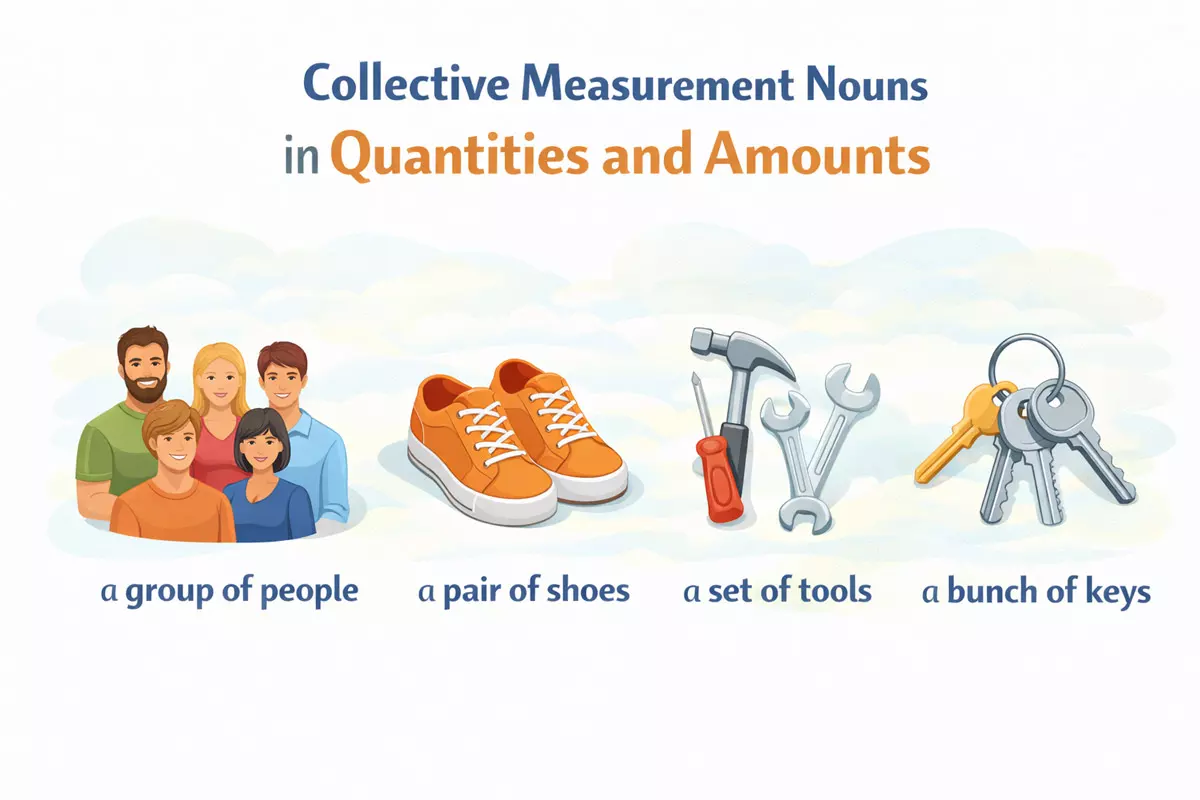
- pair (two things, like a pair of shoes)
- dozen (twelve items, such as a dozen eggs)
- score (twenty units)
- set (a group that belongs together, like a set of tools)
- fleet (a group of ships or vehicles)
- herd (a group of animals, such as cows)
- pack (a group of items or animals, e.g., a pack of wolves or cards)
- stack (items placed on top of one another, like a stack of books)
- bundle (things fastened together, like a bundle of sticks)
- cluster (usually for things close together, like a cluster of stars)
- team (a group of people working together)
- batch (a group produced at the same time, like a batch of cookies)
- heap (a pile, such as a heap of clothes)
- crowd (a large group of people)
- swarm (a large group of insects, like a swarm of bees)
- flock (a group of birds or sheep)
- gaggle (a group of geese)
- suite (a set of rooms or related items, like a suite of furniture)
- row (a line of things, such as a row of houses)
Measurement Nouns for Uncountable Quantities

Some collective terms help measure substances that aren’t easily counted, such as liquids or powders. Here are several that are commonly used:
| Word | Description | Example sentence |
|---|---|---|
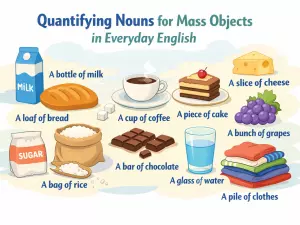
| liter | a metric unit used to measure liquids | She bought a liter of milk. |
| gallon | a large unit for measuring liquids | The car uses a gallon of fuel per trip. |
| pint | a smaller liquid measure, common for drinks | He ordered a pint of beer. |
| cup | a measure for liquid or dry ingredients | Add one cup of flour. |
| pinch | a very small amount, often used for spices | Add a pinch of salt. |
| dash | a small quantity, usually of liquid or powder | Add a dash of vinegar. |
| scoop | a portion taken with a scoop | I want a scoop of ice cream. |
| slice | a thin piece cut from a whole | She ate a slice of pizza. |
| loaf | a shaped mass, especially of bread | He bought a loaf of bread. |
| bar | a solid rectangular block | She ate a bar of chocolate. |
| grain | a tiny amount, such as sand or rice | A grain of sand was stuck to my shoe. |
Comparison of Common Collective Measurement Nouns
| Noun | Typical Usage | Approximate Amount |
|---|---|---|
| bunch | Fruits, flowers, keys | Varies (usually several) |
| dozen | Eggs, donuts, roses | 12 |
| pair | Shoes, socks, gloves | 2 |
| batch | Cookies, bread, documents | Produced at once |
| fleet | Vehicles, ships | Several |
| pack | Cards, wolves, gum | Varies (usually 5+) |
| liter | Milk, water, juice | 1 liter (1000ml) |
| slice | Bread, cake, cheese | Thin piece |
Using these collective nouns makes communication about quantities and groupings precise and efficient. They’re essential for both everyday language and specialized contexts like cooking, science, and commerce.
Common examples like group, set, series, and pair
Many English nouns help express collective quantities or amounts, making it easier to refer to multiple items as a single unit. Words such as “group,” “set,” “series,” and “pair” are commonly used for this purpose, but they each have specific nuances and contexts where they are most appropriate.
Nuances of Collective Measurement Nouns
Some of these terms are broad and flexible, while others are quite specific. For instance, "group" can refer to almost any collection, whether of people, objects, or abstract items. In contrast, "pair" is strictly limited to two items, usually ones that function together (like shoes or gloves).
- Group – a general term for several items, people, or animals considered together.
- Set – a collection of related things, often forming a complete unit (such as a set of tools or a set of dishes).
- Series – a sequence of things, typically arranged in a particular order (like a television series or a series of experiments).
- Pair – exactly two items that are matched or used together (a pair of socks, a pair of earrings).
- Batch – a quantity produced or collected at one time (a batch of cookies).
- Bundle – several items fastened or wrapped together (a bundle of newspapers).
- Pack – a collection, often of animals or cards (a pack of wolves, a pack of playing cards).
- Cluster – items grouped closely together, often naturally (a cluster of grapes).
- Fleet – a group of vehicles, especially ships or trucks (a fleet of taxis).
- Stack – items placed in a neat pile (a stack of books).
- Swarm – a large number of insects or animals moving together (a swarm of bees).
- Flock – a group of birds or sheep (a flock of geese).
- Collection – an accumulation of items, often curated (a collection of stamps).
- Suite – a set of related things, often rooms or musical pieces (a hotel suite, a suite of software tools).
- Array – an impressive or orderly arrangement (an array of options).
- Deck – a complete set of playing cards (a deck of cards).
- Team – a group of people working together toward a common goal (a team of researchers).
- Choir – an organized group of singers.
- Panel – a group of experts or judges (a panel of judges).
- Bunch – several items, often loosely grouped (a bunch of keys, a bunch of flowers).
Different Contexts and Functions
While many of these words are used for physical objects, others apply to people, animals, or even abstract concepts. For example, “series” often refers to events, episodes, or processes, while “fleet” and “team” are typically reserved for vehicles and people, respectively.
| Noun | Typical Usage & Meaning |
|---|---|
| Group | General term for any number of items, people, or animals considered as a unit |
| Set | Items that belong together or complete a unit (e.g., set of tools, set of cups) |
| Series | Ordered or sequential items or events (e.g., series of lectures, series of numbers) |
| Pair | Exactly two items, usually matching or used together (e.g., pair of shoes) |
| Batch | Group produced or gathered at one time (e.g., batch of bread) |
| Bundle | Several items packaged or tied together (e.g., bundle of sticks) |
| Pack | Collection, especially animals or cards (e.g., pack of dogs, pack of cards) |
| Cluster | Things grouped closely, often naturally (e.g., cluster of stars) |
| Fleet | Group of vehicles, especially ships or trucks |
| Stack | Items arranged in a pile (e.g., stack of papers) |
Understanding these terms improves clarity and precision in communication, especially when describing quantities or arrangements in both everyday and technical contexts. Choosing the right collective noun depends on what is being grouped, the number involved, and the relationship among the items.
Using collective measurement nouns with countable items
When talking about groups or quantities of individual items, English often relies on collective measurement nouns. These words help us describe a specific number or collection of countables, making our language more precise and natural. Instead of saying the exact number every time, we use terms like "dozen" or "pair" to convey meaning efficiently.
Common collective measurement nouns for countable objects
Here are some frequently used collective measurement nouns that refer to countable things. Each term typically matches a particular quantity or grouping:
- a dozen (12 items)
- a pair (2 items, usually matching or related)
- a trio (3 people or things)
- a quartet (4, often musicians or singers)
- a set (a group, often with a fixed number, e.g., a set of six glasses)
- a bunch (a cluster, e.g., a bunch of keys or bananas)
- a stack (a neat pile, e.g., a stack of books)
- a pack (commonly for cards, animals, or grouped products)
- a flock (usually birds or sheep)
- a team (group of people collaborating, e.g., a team of doctors)
- a group (general term for several items or people)
- a bundle (items tied or wrapped together, e.g., a bundle of newspapers)
- a cluster (close grouping, e.g., a cluster of grapes)
- a row (linear arrangement, e.g., a row of chairs)
- a string (often for things on a line, e.g., a string of pearls)
- a fleet (group of vehicles, e.g., a fleet of ships)
- a batch (items produced or collected at one time, e.g., a batch of cookies)
- a panel (group of experts or judges)
- a cast (group of actors in a play or film)
Patterns and usage notes
Most of these nouns are followed by "of" plus the plural noun of the item, such as "a bunch of grapes" or "a stack of papers." Some, like "dozen" or "pair," can be used directly ("three dozen eggs," "a pair of socks"). The choice often depends on tradition or the type of objects described.
It's important to remember that these terms can change the verb agreement. For example, "A team of scientists is working on the problem," since "team" is treated as a singular entity. However, context and regional usage may affect whether the verb is singular or plural, especially in British English.
Comparison of common collective measurement nouns
| Collective Noun | Typical Use or Example |
|---|---|
| Dozen | Eggs, roses, cupcakes (e.g., a dozen eggs = 12 eggs) |
| Pair | Socks, shoes, gloves (e.g., a pair of shoes = 2 shoes) |
| Bunch | Bananas, grapes, keys (e.g., a bunch of bananas) |
| Pack | Cards, wolves, gum (e.g., a pack of cards) |
| Set | Dishes, tools, stamps (e.g., a set of plates) |
| Stack | Books, papers, plates (e.g., a stack of books) |
| Cluster | Grapes, stars, islands (e.g., a cluster of islands) |
| Trio | Musicians, singers, friends (e.g., a trio of musicians) |
Choosing the right collective noun adds clarity and nuance to your descriptions. Familiarity with these terms helps speakers and writers convey quantity and grouping more naturally in English.
Verb agreement with collective measurement nouns
Understanding how verbs interact with collective measurement nouns can be tricky, especially since agreement often depends on whether the noun is seen as a unit or as individual components. These nouns—such as "a group of liters," "a set of measurements," or "a pile of sand"—frequently function as singular units, but context sometimes calls for plural agreement. When the focus is on the total quantity as a single entity, a singular verb is generally used. For example, "A gallon of milk sits on the table." Here, the entire quantity acts as one unit. However, if the individual elements within the measurement are emphasized, a plural verb can be appropriate: "A number of liters were spilled during the experiment." This subtlety can shift the meaning and clarity of a sentence.
Common patterns in verb selection
- Singular verb: Used when the measurement noun is treated as a whole or single unit.
- Plural verb: Used when the individual elements or parts within the measurement are highlighted.
- Context and emphasis influence which form feels most natural or precise.
Examples of collective measurement nouns in context

- A cup of beans is enough for the recipe.
- A couple of liters were left over after the test.
- A series of tests has confirmed the results.
- A handful of coins was found under the sofa.
- A pile of leaves is blocking the drain.
- A batch of cookies was baked this morning.
- A set of scales is required for the lab.
- A number of samples have been contaminated.
- A group of milliliters was measured.
- A stack of plates is wobbling dangerously.
- A range of values is possible in this experiment.
- A collection of data points has been analyzed.
- A series of measurements was taken every hour.
- A mass of evidence suggests a different conclusion.
- A fleet of trucks was dispatched.
- A row of bottles is lined up on the shelf.
- A quantity of sugar was spilled.
- A cluster of readings was inconsistent.
Agreement decision guide
| Type of meaning | Verb form example |
|---|---|
| Unit/Total quantity focus | "A bag of flour is on the counter." |
| Individual elements emphasized | "A couple of kilograms were missing." |
| Expression is idiomatic or fixed | "A number of samples have failed." |
| Measurement noun is plural in form | "A series of experiments has concluded." |
Practical tips
- Check if your sentence emphasizes the whole or the parts—this often determines verb agreement.
- Some expressions, like "a number of," almost always take a plural verb.
- If in doubt, try rephrasing the sentence to clarify the intended meaning.
Mastering verb use with measurement collectives improves clarity and precision, helping your writing sound both natural and accurate.
Differences between collective and simple plural nouns
When discussing nouns that refer to quantities or amounts, it’s important to recognize how collective measurement words differ from straightforward plurals. Collective nouns like “a flock of birds” or “a pile of books” group multiple items into a single unit, whereas simple plurals such as “birds” or “books” refer to individual members without suggesting a unified whole.
How collective measurement nouns function
Collective measurement terms encapsulate a group as a single entity. They are often used to simplify or quantify groups in conversation and writing. For example, “a cup of rice” treats all grains as one measured portion, not as individual grains.
Key distinctions
- Collective measurement nouns usually take a singular verb when the group acts as one: “A bunch of grapes is on the table.”
- Simple plurals always refer to multiple separate items and take plural verbs: “Grapes are on the table.”
- Collective terms can specify quantity, while regular plurals do not: compare “a dozen eggs” (specific count) with “eggs” (unspecified number).
- Measurement collectives often use “of” to link the noun: “a liter of milk,” “a slice of bread.”
Comparison of collective measurement and simple plural forms
| Collective Measurement Noun | Simple Plural Noun |
|---|---|
| a cup of rice | cups of rice |
| a herd of cattle | cows |
| a fleet of ships | ships |
| a stack of books | books |
| a cluster of stars | stars |
| a pack of wolves | wolves |
| a pile of clothes | clothes |
| a row of chairs | chairs |
| a bunch of keys | keys |
| a box of chocolates | chocolates |
Summary of usage
Collective measurement expressions help speakers and writers convey precise amounts or organize items into meaningful groups, while basic plurals simply indicate more than one. The choice between these forms often depends on whether the focus is on the collection as a whole or on the individual members. Recognizing this distinction is essential for accurate and nuanced communication about quantities and amounts.
Typical learner mistakes with quantity expressions
Many language learners face challenges when using collective measurement nouns and other quantity-related terms. These problems often arise from confusion about countable and uncountable nouns, direct translation from their native language, or unfamiliarity with idiomatic patterns. Understanding where these mistakes commonly occur helps build more accurate and natural-sounding English.
Confusing countable and uncountable nouns
A frequent issue is pairing the wrong quantifier with a noun. For example, learners may say "many bread" instead of the correct "much bread" or "a loaf of bread." This confusion stems from not recognizing which nouns can be counted individually and which refer to a substance or mass.
- Incorrect: many water ❌ Correct: much water or a bottle of water ✅
- Incorrect: a few milk ❌ Correct: a little milk or a carton of milk ✅
- Incorrect: two breads ❌ Correct: two loaves of bread ✅
Misusing collective measurement nouns
Learners sometimes select the wrong collective noun, or use a standard plural instead of a collective form. This often leads to awkward or incorrect expressions:
- Incorrect: a piece of informations ❌ Correct: a piece of information ✅
- Incorrect: a glass of juices ❌ Correct: a glass of juice ✅
- Incorrect: three cups of coffee (if talking about the substance, not servings) ❌ Correct: some coffee (when referring to the drink in general) ✅
Direct translation errors
Literal translation from a learner’s first language can cause trouble. Some languages use quantity expressions differently, leading to errors like:
- Incorrect: How much persons are there? ❌ Correct: How many people are there? ✅
- Incorrect: A spoon of sugars ❌ Correct: A spoonful of sugar ✅
- Incorrect: Three luggages ❌ Correct: Three pieces of luggage ✅
Common problematic quantity expressions
Here’s a comparison of some typical collective measurement terms and their correct usage, which can help clarify frequent sources of error:
| Incorrect Expression | Correct Form |
|---|---|
| a furniture | a piece of furniture |
| two advices | two pieces of advice |
| an equipment | a piece of equipment |
| three breads | three loaves of bread |
| four informations | four pieces of information |
| five luggages | five pieces of luggage |
| six coffees (meaning cups) | six cups of coffee |
Other pitfalls to watch for
- Using "less" with countable nouns (should be "fewer")
- Forgetting to use "of" after collective measurement nouns (e.g., "a bottle of water")
- Adding plural "-s" to uncountable nouns ("informations," "equipments")
- Mixing up "amount" (uncountable) and "number" (countable)
- Stacking quantifiers incorrectly ("many much," "a lot of much")
Mastering these patterns and recognizing which nouns require collective measurement terms is essential for clear, idiomatic communication. Careful attention to these details will help learners avoid common errors and express quantities more naturally.
Practice: describe quantities using collective measurement nouns
Understanding how to express quantities using collective measurement words helps make descriptions more natural and precise. Let’s explore how to apply these terms in context, and practice recognizing or choosing the right ones for different groups or amounts.
Common collective measurement nouns
- a flock of birds → A flock of birds flew over the field.
- a herd of cattle → A herd of cattle was grazing nearby.
- a pack of wolves → We heard a pack of wolves at night.
- a bunch of grapes → She bought a bunch of grapes.
- a stack of books → There is a stack of books on the desk.
- a pile of leaves → He raked a pile of leaves in the garden.
- a swarm of bees → A swarm of bees surrounded the tree.
- a cluster of stars → A cluster of stars lit up the sky.
- a heap of clothes → There was a heap of clothes on the chair.
- a set of tools → He keeps a set of tools in the garage.
- a row of houses → A row of houses lines the street.
- a team of players → A team of players entered the field.
- a fleet of ships → A fleet of ships sailed into the harbor.
- a string of pearls → She wore a string of pearls.
- a group of friends → A group of friends met for dinner.
- a bar of chocolate → He ate a bar of chocolate.
- a loaf of bread → She bought a loaf of bread.
- a slice of pizza → I ordered a slice of pizza.
- a cup of tea → He made a cup of tea.
- a sheet of paper → Write your name on a sheet of paper.
Choosing the right collective noun: mini-quiz
- Which collective noun best fits? A _______ of sheep grazed on the hillside.
- Select the correct term: She bought a _______ of bananas at the market.
- What is the collective noun for a group of keys?
- Fill in the blank: He handed me a _______ of cards.
- Choose the right word: A _______ of birds flew across the lake.
- Complete the sentence: There was a _______ of books on the table.
- What do we call a group of bees?
- Fill in the blank: She wore a _______ of pearls.
- Select the correct noun: A _______ of players entered the stadium.
- What is the collective noun for ships sailing together?
Show answers
- flock
- bunch
- a set (or bunch) of keys
- deck
- flock
- stack
- swarm
- string
- team
- fleet
Comparing collective measurement nouns
Some groups or amounts can be described with more than one collective noun, depending on context or nuance. Here’s a comparison:
| Noun | Common measurement words |
|---|---|
| Fish | school, shoal, batch |
| Paper | sheet, ream, stack, pile |
| Apples | bushel, basket, bag |
| Flowers | bunch, bouquet, arrangement |
| Logs | pile, stack, cord |
| Sugar | bag, lump, spoonful |
Task: create your own examples
Try making sentences using collective measurement nouns. For example:
- A herd of elephants crossed the river.
- She poured a cup of coffee.
- They admired a bouquet of roses.
Write three sentences of your own using different collective measurement words.
Show answers
- Possible answers:
- I need a sheet of paper for my notes.
- The chef used a pinch of salt.
- We watched a parade of floats pass by.
Practicing with these expressions will make your language richer and more precise when talking about groups or amounts. Try noticing collective measurement nouns in your reading or conversations and experiment with new ones in your own writing.