Partitive Nouns in English: A Piece of, A Bit of, A Slice of

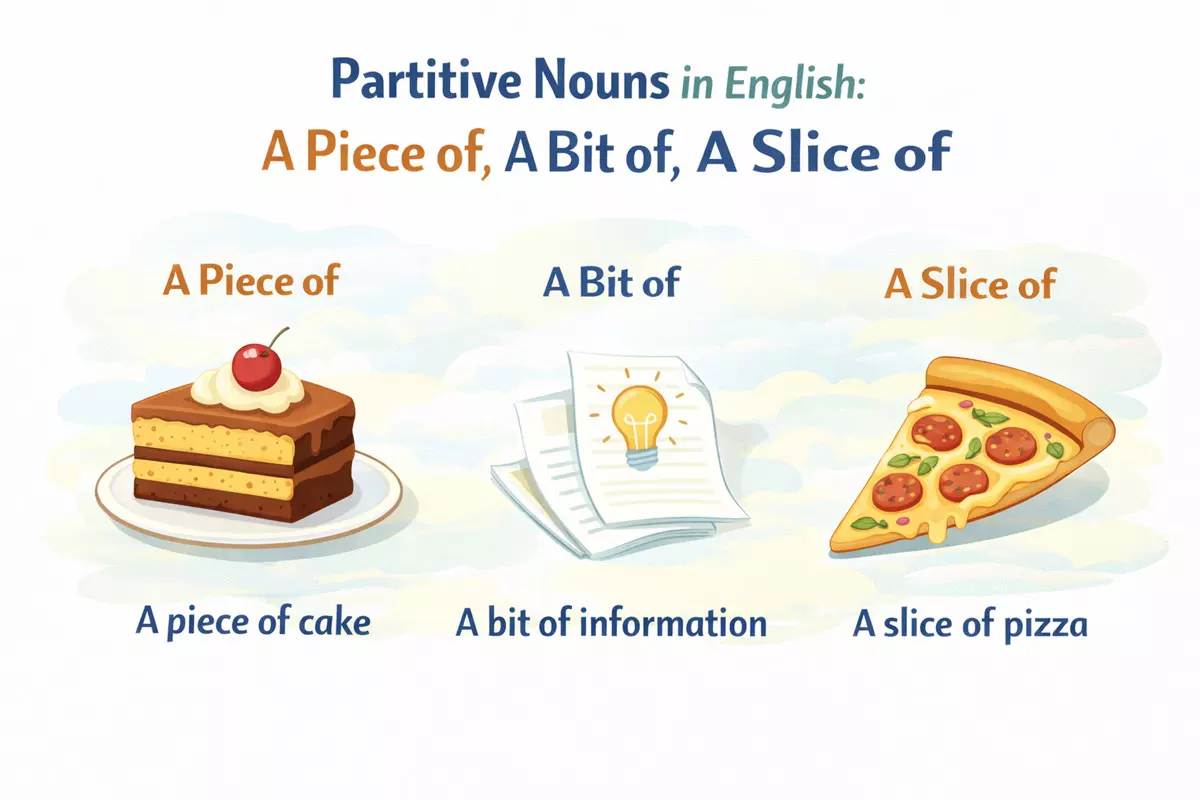 The article defines partitive nouns, lists common examples, and explains their use with uncountable nouns. It also covers how to choose the right partitives for food and materials, distinguishes them from measurement nouns, and includes practice exercises.
- What partitive nouns are in English grammar
- Common partitives like piece, bit, slice, and item
- Using partitives with uncountable nouns
- Choosing correct partitives for food and materials
- Differences between partitives and measurement nouns
- Common learner errors with partitive structures
- Practice: complete sentences using correct partitive forms
Have you ever wondered how to describe small amounts, like a sliver of cake or a drop of water, in English? Knowing the right expressions for dividing things into portions is more common than you might think, and mastering these terms can help your language sound much more natural and precise. Phrases such as a pinch of salt, a splash of milk, or a slice of bread are just a few examples. Using these expressions allows you to communicate quantities clearly and effectively, making your English both accurate and engaging in everyday conversation.
What partitive nouns are in English grammar
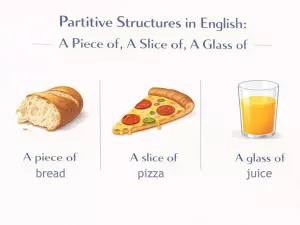
Partitive nouns help us describe a portion or segment of something that is usually seen as a whole or uncountable. In English, these expressions are commonly used when we talk about mass nouns (like "water," "bread," or "information") or collections, making it easier to specify the amount or piece being referred to. Instead of saying "some bread," we might say "a slice of bread" to indicate a specific part.
How partitive nouns function
When we use a partitive noun, it typically comes before the main noun and is often combined with "of." The structure looks like this: partitive noun + of + main noun. This pattern allows speakers to be more precise about quantity, especially with items that can’t be easily counted on their own. For example, we wouldn’t say “one bread” but rather “a loaf of bread” or “a piece of bread.”
Common examples of partitive nouns
Here are some of the most frequently used expressions to indicate parts or portions in English:
- a piece of cake → She ate a piece of cake after dinner.
- a slice of pizza → He ordered a slice of pizza.
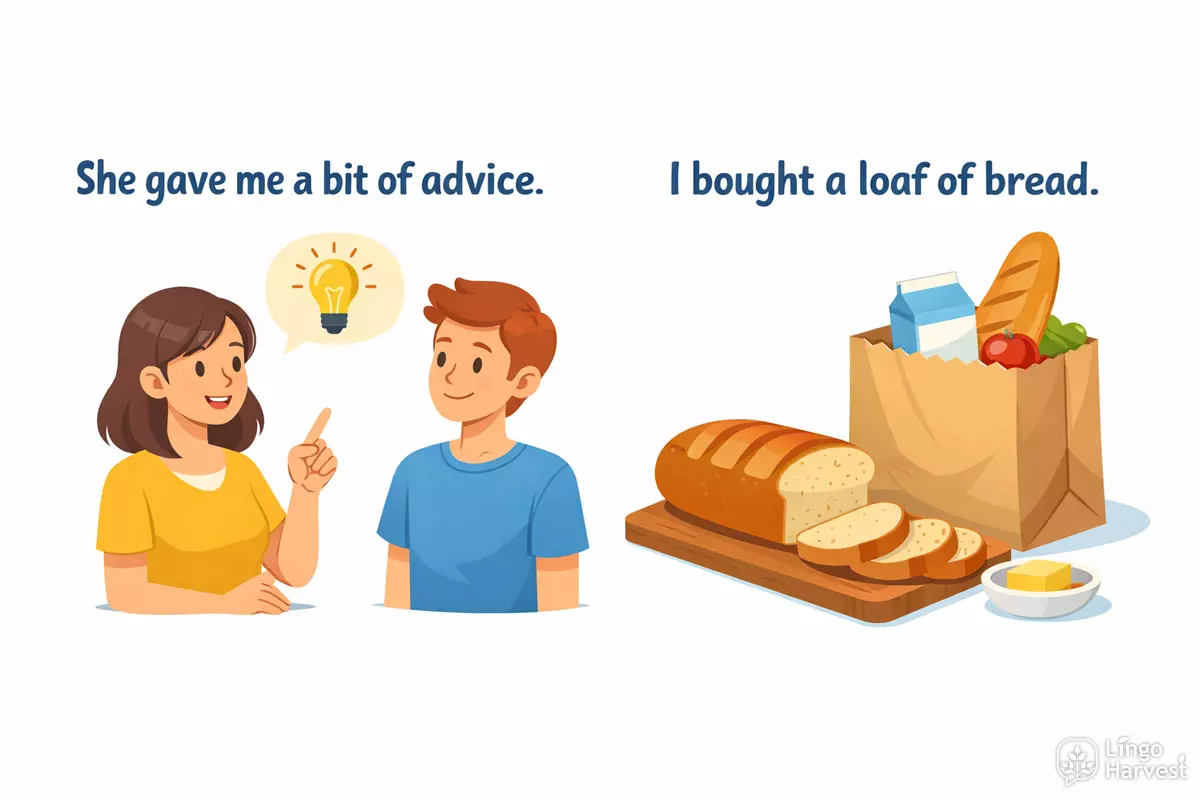
- a bit of advice → She gave me a bit of advice.
- a loaf of bread → I bought a loaf of bread.
- a bar of chocolate → He ate a bar of chocolate.
- a glass of water → She drank a glass of water.
- a cup of tea → I made a cup of tea.
- a drop of rain → A drop of rain fell on my hand.
- a bottle of milk → He opened a bottle of milk.
- a sheet of paper → Write your name on a sheet of paper.
- a grain of rice → There was a grain of rice on the table.
- a spoonful of sugar → She added a spoonful of sugar.
- a handful of nuts → He grabbed a handful of nuts.
- a lump of coal → The fire burned a lump of coal.
- a segment of orange → She peeled a segment of orange.
- a bowl of soup → He finished a bowl of soup.
- a tube of toothpaste → I need a new tube of toothpaste.
- a packet of crisps → They shared a packet of crisps.
Why use partitive nouns?
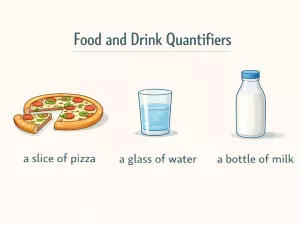
Using partitive constructions brings clarity and specificity. They help avoid confusion, especially in contexts where the quantity or type of portion matters. For example, saying "a cup of coffee" is more helpful than just "coffee" when ordering a drink.
Partitive nouns and countability
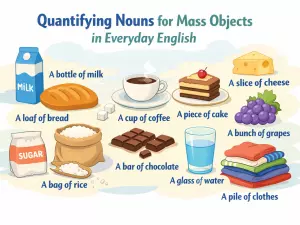
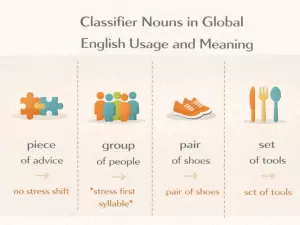
Partitives are especially important with uncountable nouns, as they allow us to refer to a defined quantity. With countable items, they can also indicate a portion of a larger group (like "a pair of shoes" or "a bunch of grapes").
Common partitives like piece, bit, slice, and item
Many English nouns represent things that cannot be counted directly, like bread, advice, or information. To refer to a single unit or a specific amount of these, speakers use partitive expressions. Words such as "piece," "bit," "slice," and "item" help specify portions or types of uncountable nouns and make meaning clearer in everyday conversation.
Usage and Nuances
Different partitives suit different contexts. For example, "a piece of advice" is idiomatic, while "a slice of advice" is not. Choosing the right word often depends on the physical nature or the convention associated with the noun.
- Piece: Used for both tangible and intangible things (e.g., a piece of cake, a piece of news).
- Bit: Suggests a small amount or fragment (e.g., a bit of luck, a bit of cheese).
- Slice: Refers to a thin, flat portion, usually of food (e.g., a slice of bread, a slice of pizza).
- Item: Used for countable objects or list entries (e.g., an item of clothing, an item on the agenda).
Expanded Examples of Common Partitive Constructions
These combinations show how different partitive nouns pair with various uncountables:
- a piece of furniture → We bought a piece of furniture for the living room.
- a bit of information → She shared a bit of information with us.
- a slice of ham → He put a slice of ham on the sandwich.
- an item of news → I heard an item of news this morning.
- a piece of evidence → The police found a piece of evidence.
- a bit of advice → She gave me a bit of advice.
- a slice of cake → He ate a slice of cake.
- an item of clothing → She bought an item of clothing online.
- a piece of music → I listened to a piece of music.
- a bit of time → I need a bit of time to finish.
- a slice of lemon → Add a slice of lemon to the tea.
- an item of expenditure → Travel was the biggest item of expenditure.
- a piece of land → They own a piece of land near the river.
- a bit of paper → Write it on a bit of paper.
- a slice of cheese → She cut a slice of cheese.
- an item on the list → Check the last item on the list.
Comparison of Partitive Usage
| Partitive | Typical Nouns Used With | Example Phrase | Notes |
|---|---|---|---|
| piece | cake, news, advice, furniture, evidence | a piece of cake | Flexible—used for physical and abstract nouns |
| bit | information, luck, advice, paper, time | a bit of information | Implies a small amount; often informal |
| slice | bread, pizza, ham, cheese, lemon | a slice of bread | Describes a thin, flat portion, mostly food |
| item | clothing, news, agenda, list, expenditure | an item of clothing | Used for countable objects or entries |
Choosing the Right Partitive
Selecting the correct expression depends on the noun and what you want to convey. For example, "a piece of cake" refers to an actual portion of cake, while "a bit of cake" might suggest just a taste. Similarly, "item" is rarely used with food, but is common with things on lists or in inventories. Understanding these subtle distinctions helps learners sound more natural and precise. These common structures are essential for clear, idiomatic English, especially when discussing quantities of uncountable things.
Using partitives with uncountable nouns
Partitive expressions help us talk about quantities of things that can't be counted individually, like water, information, or bread. Instead of trying to count the uncountable, English speakers use phrases such as “a piece of,” “a bit of,” or “a slice of” to refer to a specific amount or portion.
Why use partitives?
Uncountable nouns refer to substances, concepts, or categories that don't have a natural plural form. To describe a certain quantity, we rely on partitive structures. For example, you wouldn’t say “two breads,” but “two loaves of bread.” This approach allows for clarity and specificity when discussing portions, servings, or types.
Common partitive structures
The following are widely used partitive phrases for uncountable nouns. These help express small amounts, portions, or single units of substances and abstract ideas:
- a piece of advice → She gave me a piece of advice.
- a bit of luck → We need a bit of luck today.
- a slice of cake → He ate a slice of cake.
- a glass of water → She drank a glass of water.
- a loaf of bread → I bought a loaf of bread.
- a drop of oil → Add a drop of oil to the pan.
- a sheet of paper → Write it on a sheet of paper.
- a bar of chocolate → He ate a bar of chocolate.
- a grain of rice → A grain of rice fell on the floor.
- a cup of tea → I made a cup of tea.
- a bottle of milk → He opened a bottle of milk.
- a lump of sugar → She added a lump of sugar.
- a spoonful of honey → Take a spoonful of honey.
- a dash of pepper → Add a dash of pepper.
- a jug of juice → We served a jug of juice.
- a pinch of salt → Add a pinch of salt.
- a bowl of soup → She had a bowl of soup.
- a bag of flour → They bought a bag of flour.
Choosing the right partitive
Some partitives are general (“a piece of”), while others are specific to certain nouns (“a slice of bread,” “a glass of juice”). Using the correct combination helps your English sound natural. For example, “a piece of cake” ✅, but “a slice of information” ❌.
| Partitive | Typical Uncountable Nouns |
|---|---|
| a piece of | advice, furniture, information, paper, news |
| a slice of | bread, cheese, cake, pizza, ham |
| a glass of | water, milk, juice, wine |
| a bit of | luck, help, time, trouble, sugar |
| a drop of | water, oil, blood, rain |
| a loaf of | bread |
| a bar of | chocolate, soap, gold |
| a grain of | rice, sand, salt |
| a cup of | tea, coffee, soup |
| a bowl of | soup, rice, cereal |
Using these expressions, you can talk about amounts and portions naturally. Remember, the noun after the partitive stays singular: “a piece of information,” not “an information.” This approach helps you avoid awkward or incorrect phrasing when discussing things that can’t be counted directly.
Choosing correct partitives for food and materials
Selecting the right partitive noun for foods and materials depends on the type of substance and the way it is typically divided, served, or measured. English uses specific partitives to express portions of uncountable items, and using the wrong one can sound unnatural or even change the meaning.
Common partitives for food items
For many foods, the partitive reflects the typical shape or serving size. Here are some widely used combinations:
- a slice of bread, cake, cheese, pizza, ham, bacon, lemon, melon
- a piece of chocolate, cake, meat, fruit, advice, furniture, information, paper
- a loaf of bread, banana bread, rye bread, sourdough
- a bar of chocolate, soap, gold, butter
- a glass of water, juice, milk, wine, lemonade
- a cup of tea, coffee, soup, cocoa, yogurt
- a bottle of wine, water, oil, juice, vinegar
- a bowl of soup, rice, cereal, salad, noodles
- a spoonful of sugar, honey, medicine, jam, syrup
- a drop of water, oil, blood, rain, paint
- a lump of sugar, coal, clay, dough, butter
- a grain of rice, sand, salt, wheat, sugar
Typical partitives for materials
When talking about substances or materials, English speakers often use partitives to indicate a quantity or a specific portion:
- a sheet of paper, glass, metal
- a block of ice, wood, cheese
- a roll of tape, film, fabric
- a strip of cloth, paper, bacon
- a tube of toothpaste, cream, glue
| Item | Natural Partitive(s) |
|---|---|
| Bread | a slice of, a loaf of |
| Chocolate | a piece of, a bar of |
| Water | a glass of, a bottle of, a drop of |
| Paper | a sheet of, a piece of |
| Rice | a bowl of, a grain of |
| Soap | a bar of |
| Sugar | a lump of, a spoonful of |
| Soup | a bowl of, a cup of |
| Cheese | a slice of, a block of |
| Wine | a glass of, a bottle of |
Tips for choosing the right partitive
- Think about the form the item usually takes (solid, liquid, powder, etc.).
- Consider how it is commonly served or packaged.
- Some items allow for more than one partitive, each with a slightly different meaning (for example, “a piece of cake” vs. “a slice of cake”).
- If unsure, “piece of” is often a safe default for solids, while “glass of” or “cup of” works well for liquids.
- Understanding these patterns helps you sound more natural and precise when talking about quantities of foods and materials in English.
Differences between partitives and measurement nouns
Understanding how partitive nouns differ from measurement terms helps clarify how we break down uncountable nouns in English. While both types of expressions allow us to refer to “pieces” or “quantities” of something that can’t be counted directly, they each have distinct roles in sentences. Partitive nouns, such as “slice,” “piece,” or “bit,” usually refer to a portion that is separated from a whole, often without a precise measurement. They are commonly used when the exact amount is either unknown or irrelevant. For example, “a piece of cake” or “a bit of advice” focuses on a part of the whole rather than a specific quantity. In contrast, measurement nouns give us a clear, often standard, unit of measurement. They quantify the noun in an objective way, such as “a cup of water,” “three liters of milk,” or “two meters of fabric.” These terms are essential when precision is needed, especially in recipes, shopping, or scientific contexts.
Summary Comparison
| Partitive Nouns | Measurement Nouns |
|---|---|
| Imprecise amount e.g. a piece, a bit, a slice |
Exact, standard quantity e.g. a liter, a cup, a gram |
| Focus on a portion or segment | Focus on measurable units |
| Often used in informal, everyday speech | Common in cooking, science, commerce |
| “a piece of cake”, “a chunk of wood” | “a kilogram of apples”, “two meters of cloth” |
Notice how both types help us talk about uncountable nouns, but their choice depends on whether we care about a general portion or a precise measurement. Using the right form makes your English more natural and accurate in everyday and formal situations alike.
Common learner errors with partitive structures
Many English learners struggle with partitive structures, especially when combining them with uncountable nouns or choosing the right partitive for specific contexts. These mistakes often come from direct translation, misunderstanding of countable/uncountable distinctions, or incomplete knowledge of idiomatic usage.
Mixing up partitives and uncountable nouns
One frequent issue is treating uncountable nouns as countable by omitting the necessary partitive phrase. For example, saying "a bread" or "two informations" instead of the correct "a piece of bread" or "two pieces of information." This happens because some languages allow direct counting of such nouns, but English does not.
Overusing generic partitives
Learners often rely too much on "piece of" for everything, even when other, more natural partitives exist. For instance, "a piece of cheese" is correct, but "a slice of cheese" is usually more specific for thin, flat portions. Choosing the most suitable partitive makes speech more natural and precise.
Incorrect combinations of partitives and nouns

Some combinations are not used in English, even if they make sense logically. For example, "a slice of advice" is incorrect; only "a piece of advice" is idiomatic. Below are common mismatches and their correct forms:
| ❌ Incorrect | ✅ Correct | Example sentence |
|---|---|---|
| a slice of information | a piece of information | I found a piece of information online. |
| a bit of bread (large quantity) | a loaf of bread | She bought a loaf of bread for the family. |
| a piece of milk | a glass of milk / a carton of milk | He drank a glass of milk before bed. |
| a slice of water | a drop of water / a glass of water | Can I have a glass of water, please? |
| a bit of furniture (one item) | a piece of furniture | They moved a piece of furniture into the room. |
| a piece of meat (thin cut) | a slice of meat / a cut of meat | He put a slice of meat on the sandwich. |
| a piece of paper (small torn part) | a scrap of paper | He wrote the number on a scrap of paper. |
| a piece of cake (thin, flat part) | a slice of cake | She ate a slice of cake after dinner. |
| a bit of bread (thin, flat part) | a slice of bread | He toasted a slice of bread. |
| a glass of cheese | a slice of cheese / a piece of cheese | Could you cut a slice of cheese for me? |
Confusing quantity and partitive meaning
Another source of confusion is using the wrong partitive to express quantity or type. For instance, "a bit of" usually means a small amount, while "a piece of" indicates a portion, and "a slice of" refers to something cut thin and flat. Using the wrong one can change the meaning or sound odd.
Summary table: Typical partitive and noun combinations
| Partitive + Noun | Correct Usage Example |
|---|---|
| a piece of advice | She gave me a piece of advice. |
| a slice of bread | Can I have a slice of bread? |
| a bit of luck | With a bit of luck, we’ll arrive on time. |
| a loaf of bread | I bought a loaf of bread. |
| a piece of furniture | That’s a beautiful piece of furniture. |
| a drop of water | There isn’t a drop of water left. |
| a glass of milk | He drank a glass of milk. |
| a slice of cake | I’d like a slice of cake. |
| a chunk of cheese | We ate a chunk of cheese. |
| a scrap of paper | Write it on a scrap of paper. |
Tips for avoiding mistakes
- Pay attention to which nouns are uncountable in English.
- Learn common partitive-noun pairings and avoid direct translation from your first language.
- Notice how native speakers use partitives in context; not every combination is possible.
- Choose specific partitives ("slice," "glass," "loaf") instead of overusing "piece of."
- Practice with real examples to build natural usage habits.
Practice: complete sentences using correct partitive forms
Understanding how to use expressions like “a piece of,” “a slice of,” and “a bit of” can help you sound more natural in English. Below you’ll find exercises and examples to help you practice choosing the most appropriate partitive phrase for different contexts. These types of phrases are often used with uncountable nouns to refer to a specific amount or portion.
Fill in the blanks with the correct partitive noun
Select the best option (a piece of, a slice of, a bit of, etc.) to complete each sentence:
- Would you like _________ cake?
- She added _________ sugar to her tea.
- Could I have _________ advice about my homework?
- He bought _________ bread at the bakery.
- The teacher gave us _________ information about the test.
- I’d love _________ cheese with my crackers.
- Can I have _________ water, please?
- There is _________ hope that he will recover soon.
- She took _________ paper and started writing.
- He ate _________ pizza for lunch.
Show answers
- a slice of
- a bit of
- a piece of
- a loaf of
- a piece of
- a slice of
- a glass of
- a bit of
- a sheet of
- a slice of
Choose the best partitive: Multiple choice
Pick the most natural partitive phrase for each noun:
- _________ chocolate (a bar of / a slice of / a grain of)
- _________ sand (a grain of / a piece of / a drop of)
- _________ pizza (a slice of / a cup of / a loaf of)
- _________ rice (a bowl of / a loaf of / a pinch of)
- _________ information (a piece of / a slice of / a bar of)
- _________ water (a glass of / a slice of / a bar of)
- _________ bread (a loaf of / a drop of / a grain of)
- _________ cheese (a slice of / a cup of / a bottle of)
- _________ paper (a sheet of / a glass of / a spoonful of)
- _________ salt (a pinch of / a loaf of / a bar of)
Show answers
- a bar of
- a grain of
- a slice of
- a bowl of
- a piece of
- a glass of
- a loaf of
- a slice of
- a sheet of
- a pinch of
Practicing these forms will help you use English more precisely when talking about quantities or portions of uncountable nouns. Try making your own sentences using these patterns to reinforce your understanding.