Classifier Nouns in Global English Usage and Meaning

 This article explains what classifier nouns are in English, how they differ from partitives, and lists common examples for people, objects, and ideas. It also covers their use internationally, mistakes learners make, and includes practice exercises.
- What classifier nouns are in English
- How classifiers differ from partitives
- Common classifier nouns for people, objects, and ideas
- Classifier nouns in international communication
- Using classifiers with numbers and quantities
- Typical learner mistakes with classifier choices
- Practice: match classifiers with suitable nouns
Across various cultures, the way we use language to categorize and count objects highlights intriguing patterns in communication. Examining the different forms of count nouns used in English around the world provides valuable insight into how meanings can shift depending on regional and cultural contexts. These variations not only reflect linguistic diversity but also reveal how people interpret and interact with their environments, ultimately shaping the way language evolves to suit different communities and their unique perspectives.
What classifier nouns are in English
In English, classifier nouns (sometimes called measure words or unit nouns) are used to specify a particular quantity or type of something, especially when referring to countable items or groups. While English does not have a dedicated classifier system like Mandarin or Thai, it still relies on certain nouns to clarify meaning when the main noun is uncountable, abstract, or when precision is needed.
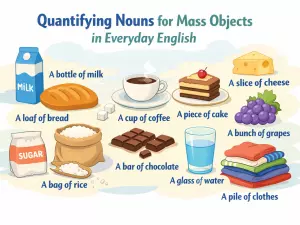
Consider how we often say "a piece of information" or "a loaf of bread" rather than simply "an information" or "a bread." These inserted words—piece, loaf, slice, bunch—act as classifiers, helping listeners understand what quantity or form is being referenced. They are essential for talking about portions, containers, or collections, especially for substances and mass nouns.
Common Types of Classifier Nouns in English
- Portion words: piece, slice, chunk, bit, drop, dash
- Container words: cup, glass, bottle, can, jar, bowl
- Collective words: group, bunch, flock, herd, pack, set
- Unit words: sheet, bar, pair, grain, stick, box
- Measurement words: liter, ounce, pound, meter, inch
How Classifier Nouns Work in English
These nouns typically appear between a determiner (like "a" or "two") and the main noun. The structure is often: Number/Determiner + Classifier Noun + of + Main Noun. For example: "three slices of cake", "a group of friends", or "two cups of coffee". This grammatical pattern clarifies both the amount and the form of the noun being discussed.
Examples of Classifier Noun Usage

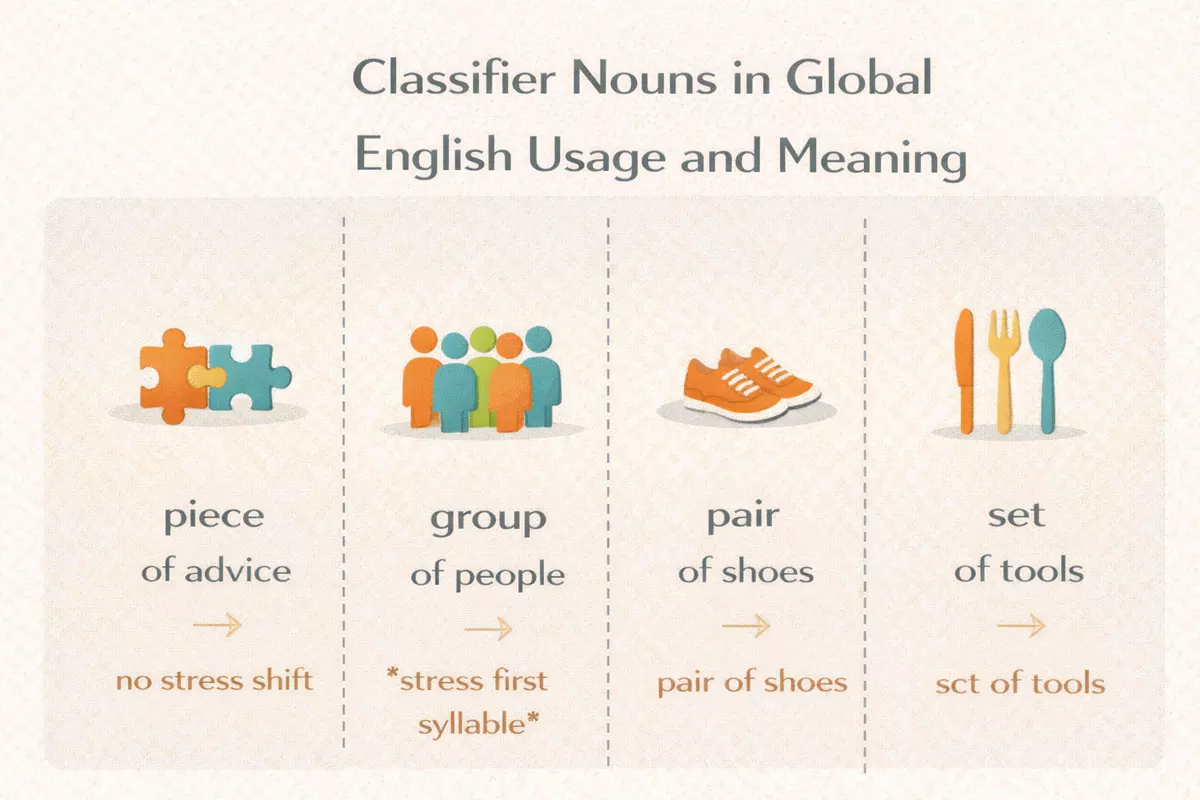
- a piece of advice → She gave me a piece of advice before the interview.
- two loaves of bread → He bought two loaves of bread from the bakery.
- three glasses of water → Please bring three glasses of water to the table.
- a handful of coins → She found a handful of coins in her pocket.
- a sheet of paper → Write your name on a sheet of paper.
- ten grains of rice → Only ten grains of rice were left on the plate.
- a flock of birds → A flock of birds flew over the lake.
- a bar of chocolate → He ate a bar of chocolate after lunch.
- several packs of cards → They opened several packs of cards.
- a set of tools → This set of tools is useful for repairs.
- a bunch of grapes → She washed a bunch of grapes.
- a pair of shoes → I need a new pair of shoes.
- a drop of rain → Not a drop of rain fell all day.
- a box of matches → He keeps a box of matches in the drawer.
- a stick of gum → She offered him a stick of gum.
- a bowl of soup → A bowl of soup warmed him up.
- a dash of salt → Add a dash of salt to the sauce.
- a group of students → A group of students gathered outside the hall.
Comparison with Classifiers in Other Languages
| English Example | Classifier Use in Other Languages |
|---|---|
| a piece of cake | Mandarin: 一块蛋糕 (yī kuài dàngāo), where 块 (kuài) is a required classifier |
| a pair of pants | Japanese: 一本のズボン (ippon no zubon), with 本 (hon) as the classifier for long objects |
| a herd of cattle | French: un troupeau de vaches, using troupeau as a collective noun |
| a glass of water | Russian: стакан воды (stakan vody), where стакан (stakan, glass) specifies the container |
While measure and collective nouns in English are not as grammatically obligatory as in some Asian languages, they serve a similar function: organizing and specifying how we refer to quantities, containers, and groupings in everyday conversation. These classifier nouns provide clarity and nuance, making communication more precise.
How classifiers differ from partitives
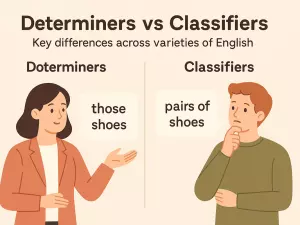
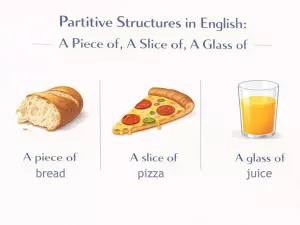
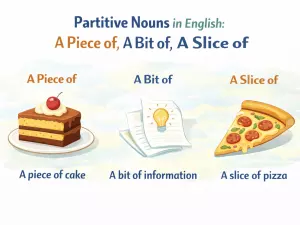
Classifiers and partitives are both tools for expressing quantity and specifying nouns, but they function in notably different ways. Classifiers are most familiar in languages like Chinese, but English employs them too, especially in phrases like “a slice of bread” or “a grain of sand.” Partitives, meanwhile, focus on indicating a portion or part of a mass or set, as in “a piece of cake” or “some of the students.”
Core Functions and Usage
The main distinction lies in what each construction highlights. Classifiers categorize or count nouns that cannot be directly quantified, while partitives divide a whole into measurable parts. For example, “a herd of cattle” uses a classifier for counting, whereas “a piece of cake” signals a portion of a whole.
Structural Differences
Classifiers are usually paired with countable or uncountable nouns that require further specification. Partitives, on the other hand, emphasize the extraction of a part from a mass or group. This difference influences both grammar and meaning in global English usage.
| Feature | Classifier Example | Partitive Example |
|---|---|---|
| Purpose | Categorizes/counts items not easily counted (e.g., “a loaf of bread”) | Indicates a portion or part of a whole (e.g., “a piece of bread”) |
| Typical Nouns | Uncountable or collective nouns | Mass nouns or sets/groups |
| Focus | Type or unit | Amount or portion |
| Examples | a flock of sheep, a bar of chocolate, a sheet of paper | a slice of bread, a bit of advice, some of the team |
Illustrative Examples in English
To clarify, here are several phrases that demonstrate how the two forms operate differently in practice:
- a cup of tea (classifier: cup as the container)
- a bowl of rice (classifier)
- a group of islands (classifier for collective noun)
- a piece of cheese (partitive: portion of cheese)
- a portion of fries (partitive)
- some of the water (partitive, referring to part of a mass)
- a strand of hair (classifier for individual unit)
- a handful of sand (classifier for amount that fits in a hand)
- a chunk of ice (partitive, part of a larger block)
- a pile of books (classifier for an arrangement)
- a segment of orange (partitive, one section from the whole)
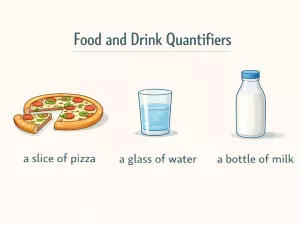
- a bottle of milk (classifier as container)
- a touch of salt (partitive, small amount)
- a cluster of stars (classifier for a group)
- a dash of pepper (partitive, small portion)
Summary
In summary, classifiers and partitives may appear similar but serve distinct grammatical and semantic roles. Classifiers help categorize or count things that are otherwise uncountable, while partitives carve out a portion from a larger whole. Recognizing the distinction can clarify meaning, especially in global varieties of English where these forms are used in rich and varied ways.
Common classifier nouns for people, objects, and ideas
Understanding how classifier nouns function can clarify the ways English speakers group and specify entities. Classifiers help us organize the world by signaling category, quantity, or type—especially when discussing people, tangible items, and even abstract ideas. These words often appear before the main noun, providing context or detail that might not otherwise be clear.
Classifiers for People
When referring to individuals or groups, English uses certain nouns to clarify roles, units, or relationships. Here are some frequently used options:
- Group — a group of students, a group of tourists
- Team — a team of doctors, a team of researchers
- Panel — a panel of judges, a panel of experts
- Crowd — a crowd of fans, a crowd of protesters
- Family — a family of four, a family of musicians
- Class — a class of graduates, a class of children
- Pair — a pair of twins, a pair of dancers
- Band — a band of musicians, a band of thieves
Classifiers for Objects
Physical items are often grouped or counted using specific classifier nouns, making communication more precise. Some common choices include:
- Piece — a piece of cake, a piece of furniture
- Set — a set of tools, a set of dishes
- Pair — a pair of shoes, a pair of gloves
- Pack — a pack of cards, a pack of batteries
- Stack — a stack of books, a stack of papers
- Bottle — a bottle of water, a bottle of wine
- Slice — a slice of bread, a slice of cheese
- Roll — a roll of tape, a roll of film
- Box — a box of chocolates, a box of tissues
- Sheet — a sheet of paper, a sheet of metal
Classifiers for Abstract Ideas
Even intangible concepts, such as feelings or information, can be grouped or quantified with suitable classifiers. Consider these examples:
- Piece — a piece of advice, a piece of information
- Bit — a bit of luck, a bit of knowledge
- Kind — a kind of belief, a kind of theory
- Form — a form of energy, a form of communication
- Level — a level of understanding, a level of risk
- Sense — a sense of humor, a sense of urgency
- Degree — a degree of certainty, a degree of freedom
Classifier Nouns: Functions and Patterns
To illustrate how classifier nouns operate across these categories, compare their use in context:
| Classifier | Typical Use (People/Objects/Ideas) | Example Phrase |
|---|---|---|
| Pair | People, Objects | a pair of friends, a pair of shoes |
| Piece | Objects, Ideas | a piece of cake, a piece of advice |
| Group | People, Objects | a group of students, a group of islands |
| Set | Objects | a set of keys, a set of dishes |
| Bit | Ideas | a bit of information, a bit of hope |
These classifier nouns add clarity and nuance, letting speakers specify quantity, type, or relation. Their flexibility also allows for creative and idiomatic uses, especially in global contexts where English is adapted and localized.
Classifier nouns in international communication
When English is used as a bridge language across cultures, classifier nouns can serve as helpful tools to clarify meaning, especially when speakers have different mother tongues. These nouns—often called measure words, counters, or quantifiers—help specify what kind or how much of something is being discussed. In cross-cultural exchanges, they can reduce ambiguity, particularly in technical, academic, or business contexts where precision is valued.
Why classifier nouns matter globally
In many languages, such as Mandarin, Thai, and Japanese, classifiers are a core part of grammar. English typically relies less on them, but in global settings, their use can help non-native speakers understand quantities and categories more easily. For instance, specifying "a piece of advice" or "a loaf of bread" makes the message more precise than simply saying "advice" or "bread." This attention to detail can minimize misunderstandings and support clearer communication.
Common classifier nouns used in international English

- a piece of information → She shared a piece of information about the schedule.
- a sheet of paper → He wrote the address on a sheet of paper.
- a bar of chocolate → She bought a bar of chocolate at the store.
- a slice of cake → He ate a slice of cake after dinner.
- a grain of rice → Not a single grain of rice was wasted.
- a glass of water → Please pour me a glass of water.
- a set of instructions → Follow the set of instructions carefully.
- a drop of oil → Add a drop of oil to the pan.
- a bunch of grapes → She washed a bunch of grapes.
- a pile of books → A pile of books was stacked on the desk.
- a cup of tea → He relaxed with a cup of tea.
- a bottle of shampoo → She opened a new bottle of shampoo.
- a strand of hair → A strand of hair fell across his face.
- a blade of grass → Each blade of grass was covered in dew.
- a piece of luggage → One piece of luggage went missing.
- a pair of shoes → She bought a new pair of shoes.
- a row of chairs → A row of chairs lined the wall.
- a block of ice → The block of ice melted slowly.
- a tube of toothpaste → He squeezed the tube of toothpaste.
- a dash of salt → Add a dash of salt to finish the dish.
Challenges in cross-cultural communication
Some speakers from classifier-heavy languages may overuse or invent classifiers in English, leading to phrases like "a piece of equipment" where native speakers might simply say "equipment." Conversely, native English speakers may omit classifiers that are expected by others, which can cause confusion. Being aware of these tendencies helps foster smoother interactions.
Comparing classifier noun usage across languages
| English Example | Equivalent in Other Languages | Typical Use Context |
|---|---|---|
| a piece of advice | Mandarin: 一条建议 (yī tiáo jiànyì) | Professional, academic |
| a glass of water | French: un verre d’eau | Hospitality, everyday |
| a pair of shoes | Japanese: 一足の靴 (issoku no kutsu) | Retail, travel |
| a sheet of paper | Spanish: una hoja de papel | Education, office |
| a bunch of grapes | German: eine Traube Trauben | Food, agriculture |
Guidelines for global English usage
- Use classifier nouns when they clarify quantity or type, especially with uncountable nouns.
- Be mindful of listeners’ language backgrounds; more explicit classifiers may help.
- Adapt your usage for context—formal writing often prefers precision, while informal speech may omit classifiers.
- When in doubt, follow established English collocations (e.g., "a piece of furniture," not "a furniture").
By understanding and thoughtfully applying classifier nouns, communicators can bridge linguistic gaps and ensure their messages are as clear as possible in diverse international environments.
Using classifiers with numbers and quantities
Classifiers, sometimes known as measure words or counting nouns, play a crucial role when expressing amounts or counts of objects, especially in contexts influenced by Asian and other world Englishes. In standard English, words like "piece," "sheet," or "slice" often bridge the gap between numbers and nouns that are otherwise uncountable or ambiguous. These lexical items help specify what is being counted, clarify meaning, and avoid confusion in communication.
Patterns in Combining Numerals and Classifiers
When quantifying objects, speakers commonly insert a classifier between the numeral and the noun to create a clear, idiomatic phrase. For example, instead of saying "three breads," one says "three loaves of bread." The classifier "loaf" indicates the typical unit for bread. This system is especially prominent in English varieties in East and Southeast Asia, reflecting influence from local languages.
- a piece of advice → "She gave me three pieces of advice."
- a sheet of paper → "Please hand out ten sheets of paper."
- a slice of pizza → "He ate two slices of pizza."
- a cup of tea → "I'll have two cups of tea."
- a grain of rice → "There are millions of grains of rice in the bag."
- a bar of chocolate → "She bought five bars of chocolate."
- a bottle of water → "We need six bottles of water for the trip."
- a strand of hair → "He found one strand of hair on his shirt."
- a pair of shoes → "I own four pairs of shoes."
- a bunch of grapes → "She brought three bunches of grapes."
- a set of keys → "He lost two sets of keys."
- a roll of tape → "There are five rolls of tape in the drawer."
- a stick of gum → "He chewed one stick of gum."
- a packet of sugar → "Add three packets of sugar to the tea."
- a glass of milk → "She drank two glasses of milk."
- a box of chocolates → "He received one box of chocolates."
- a drop of rain → "Not a single drop of rain fell."
- a tube of toothpaste → "Buy two tubes of toothpaste."
- a handful of nuts → "Take one handful of nuts."
- a fleet of ships → "The navy deployed five fleets of ships."
Global Englishes: Regional Preferences
In many varieties of English worldwide, the use of classifiers with numbers is more widespread or flexible than in traditional British or American usage. For instance, "three pieces of chicken" is common in Singaporean and Malaysian English, whereas "three chickens" would imply three whole birds in British English. The choice of classifier can signal both regional identity and communicative precision.
Comparison of Common Classifiers in Different Contexts
Below is a structured overview of several widely used classifiers, showing their typical pairing with nouns and example phrases:
| Classifier | Example Nouns & Usage |
|---|---|
| piece | advice, paper, cake — two pieces of cake |
| sheet | paper, metal, ice — five sheets of metal |
| slice | bread, pizza, cheese — three slices of cheese |
| strand | hair, thread, spaghetti — a strand of spaghetti |
| drop | water, oil, blood — a drop of oil |
| glass | milk, juice, wine — two glasses of wine |
| packet | sugar, chips, seeds — four packets of seeds |
| bar | chocolate, soap, gold — a bar of soap |
Summary
The use of classifier nouns with numbers and quantities enhances clarity and naturalness in English communication, especially in contexts where the boundaries between countable and uncountable nouns are blurred. Understanding regional patterns and the most common classifiers can help learners and speakers of global Englishes navigate these subtle distinctions.
Typical learner mistakes with classifier choices
Choosing the right classifier noun can be challenging for English learners, especially since classifier use varies across global varieties of English and may not directly translate from a learner’s first language. Many common errors stem from literal translations, overgeneralization, or confusion between similar quantifying expressions.
Overusing General Classifiers
Learners often rely too heavily on broad classifiers like "piece," "bit," or "type," even when more precise options exist. This can make speech sound unnatural or vague. For example, saying "a piece of information" is correct, but "a piece of advice" is preferable to "an advice," and "a piece of furniture" is used instead of "a furniture."
Confusing Countable and Uncountable Nouns
Mistakes frequently occur when learners use classifiers with nouns that are already countable or uncountable in English. For instance, saying "two breads" instead of "two loaves of bread" or "two pieces of bread" is a common pitfall.
Direct Translation from Other Languages
In some languages, classifiers are obligatory with almost every noun. Directly transferring this habit to English can result in unnatural constructions. For example, saying "a cup tea" instead of "a cup of tea," or "a slice pizza" instead of "a slice of pizza."
Mixing Up Specific Classifiers
Certain items require specific classifiers, and mixing them up often leads to confusion. For example, "a bar of soap" versus "a piece of soap," or "a sheet of paper" versus "a piece of paper." Using the wrong classifier can make the meaning unclear or awkward.
| Classifier | Correct Usage Example | Common Mistake |
|---|---|---|
| slice | a slice of bread | a bread |
| loaf | a loaf of bread | a bread |
| piece | a piece of advice | an advice |
| sheet | a sheet of paper | a paper |
| bar | a bar of chocolate | a chocolate |
| glass | a glass of water | a water |
| bottle | a bottle of milk | a milk |
| pair | a pair of scissors | a scissor |
| sheet | a sheet of ice | an ice |
| drop | a drop of rain | a rain |
Omitting the Classifier Altogether
Another frequent error is dropping the classifier, especially with uncountable nouns. For example, saying "I bought chocolate" when the intended meaning is "I bought a bar of chocolate," or "Give me paper" instead of "Give me a piece of paper."
Choosing Inappropriate Classifiers for Context
Context matters: some classifiers are suitable only for certain types of nouns or for specific cultural or regional varieties of English. For example, "a head of lettuce" is correct in American English, but learners might incorrectly say "a lettuce" or "a piece of lettuce."
- Using "a bread" instead of "a slice of bread" or "a loaf of bread"
- Using "an information" instead of "a piece of information"
- Saying "a water" instead of "a glass of water" or "a bottle of water"
- Using "a luggage" instead of "a piece of luggage"
- Saying "a news" instead of "a piece of news"
- Using "a furniture" instead of "a piece of furniture"
- Saying "a chalk" instead of "a stick of chalk"
- Mixing up "a pair of trousers" with "a trouser"
- Using "a equipment" instead of "a piece of equipment"
- Saying "a paper" when meaning "a sheet of paper"
Understanding these common missteps helps learners communicate more naturally and accurately, especially as English continues to evolve and absorb influences from around the world.
Practice: match classifiers with suitable nouns
Understanding which classifiers fit with which nouns is crucial for accurate and natural communication in English, especially when discussing quantities, measures, or specific types of objects. Below, you can test your knowledge by pairing various classifiers with appropriate nouns, reflecting how speakers across different varieties of English use them.
Choose the right classifier for each noun
Read each noun below and select the most suitable classifier or quantifying phrase from the list provided. Some nouns may accept more than one option, but try to select the most typical or natural pairing.
- ______ of bread
- slice
- piece
- grain
- ______ of water
- glass
- drop
- splash
- ______ of furniture
- piece
- item
- unit
- ______ of advice
- piece
- item
- word
- ______ of paper
- sheet
- page
- piece
- ______ of news
- piece
- thing
- report
- ______ of chocolate
- bar
- block
- plate
- ______ of milk
- carton
- glass
- jug
- ______ of hair
- strand
- thread
- line
- ______ of clothing
- item
- piece
- object
Show answers
- slice of bread
- glass of water
- piece of furniture
- piece of advice
- sheet of paper
- piece of news
- bar of chocolate
- carton of milk
- strand of hair
- item of clothing
Common classifier-noun pairings: a quick reference
For easier review, here is a table summarizing several widely used classifiers and the types of nouns they typically accompany. This can help you recognize patterns and apply them to new vocabulary.
| Classifier | Typical Nouns |
|---|---|
| piece | advice, furniture, information, cake, news |
| slice | bread, cake, cheese, pizza |
| cup | tea, coffee, sugar, rice (cooked) |
| bottle | water, wine, milk, juice |
| sheet | paper, glass, metal |
| bar | chocolate, soap, gold |
| strand | hair, thread, wire |
| set | tools, furniture, dishes, instructions |
| item | news, clothing, equipment |
| drop | water, oil, blood |
Reflection
Noticing which classifiers are used with which nouns can boost your fluency and comprehension. These patterns often reflect both meaning and cultural habits in English usage. If you encounter a new noun, try to observe or look up which quantifier or classifier is most natural.